


Mars Bible — People
Swati Mohan
A guidance engineer, she gave the Perseverance rover eyes so it could choose on its own where to land, then called its descent live, all the way to “Touchdown confirmed.”
guidance, navigation and control engineer, Jet Propulsion Laboratory
- Education
- Cornell (2004), Ph.D. in aeronautics and astronautics, MIT (2010)
- Institution
- Jet Propulsion Laboratory
- Roles
- Mars 2020 GNC operations lead, commentator for the Perseverance landing
- Specialty
- Guidance, navigation and control
- Link to Mars
- Integrated the Terrain Relative Navigation that made the Jezero landing possible
6 chapters and 4 appendices: about 3,000 words, or about 15 minutes of reading. Every fact comes from verified sources, listed at the end of each chapter.
Part One
Becoming an engineer
1980 – 2013
Chapter 1 · 1980s – 2004 The bridge of the Enterprise
On February 18, 2021, millions of people heard her voice announce that Perseverance had landed on Mars. For Swati Mohan, the adventure began in front of a science-fiction series watched with her family.
A TV series and an unexplored region of the galaxy
Swati Mohan was born in India and came to the United States at about one year old. She grew up in the Washington area, in Northern Virginia. As a child she watched Star Trek: The Next Generation with her family. One episode stayed with her: the one where the starship Enterprise enters an unexplored part of the galaxy. Those far-off galaxies, with different rules, sparked her interest in space.
At first she thought of becoming a pediatrician. A great physics teacher in high school steered her toward aerospace engineering. While still in high school she applied for a NASA internship near her home: three weeks at the Goddard center. Her NASA internships, which began in high school, deepened her passion.
Cornell
She chose Cornell University for its connections to space research: the Arecibo Observatory and the work of Steve Squyres, whose biography is part of this collection. During her studies she also interned at the Kennedy center and at the Jet Propulsion Laboratory. In the lab of Mark Campbell, who worked on very small satellites called CubeSats, she was given the attitude control system, the one that points the satellite in space. “That one assignment helped me find my niche,” she would say: she has never left the field. Mark Campbell remembers a student who always had an amazing passion for space. She earned her degree in mechanical and aerospace engineering in 2004, a semester early.
Sources: NASA Science, “Swati Mohan” page (Star Trek: The Next Generation with her family, the episode of the unexplored region, internships at Goddard, Kennedy and JPL, starting in high school); Cornell Chronicle, E. Philipson, “After landing Mars rover, Mohan ’04 reflects on time at Cornell,” March 25, 2021 (choosing Cornell, Arecibo and Steve Squyres, Mark Campbell and CubeSats, attitude control, “That one assignment helped me find my niche,” her passion according to Campbell, 2004 degree a semester early); Shaastra, S. Desikan, “Swati Mohan has Mars on her mind,” April 2024 (the Washington area and Northern Virginia, the three-week Goddard internship); A. Dandekar, podcast, episode 201, introduction (the physics teacher). Her birth in India, her arrival at about one year old and her plan to become a pediatrician are reported by the Wikipedia article, citing the Indian press and CNN; we did not consult those articles.
Chapter 2 · 2004 – 2013 Saturn, the space station and the Moon
Before Mars, Swati Mohan learned to guide spacecraft around Saturn, aboard the International Space Station and around the Moon.
Cassini
After Cornell she worked for a year at JPL as a systems engineer on the Cassini mission, as the spacecraft was taking its first images of Saturn.
SPHERES
She then joined the Space Systems Laboratory at the Massachusetts Institute of Technology, where Mark Campbell had earned his doctorate. Her research centered on SPHERES, a testbed of three small satellites aboard the International Space Station; they launched about a month after she arrived at MIT. Her Ph.D. dealt with the autonomous assembly of space telescopes: how robots can, on their own, build an instrument in orbit. She also helped with the first trial of the Zero Robotics program. At MIT she earned a master’s degree and then, in 2010, a Ph.D. in aeronautics and astronautics.
GRAIL
In 2010 she returned to JPL, in the guidance, navigation and control section. She worked on GRAIL, two small spacecraft that mapped the Moon’s gravity field.
Sources: Cornell Chronicle, March 25, 2021 (a year at JPL, Cassini and its first images of Saturn, MIT’s Space Systems Laboratory, SPHERES and its three satellites launched a month after her arrival); NASA Science, “Swati Mohan” page (autonomous assembly of space telescopes, SPHERES on the space station); A. Dandekar, podcast, episode 201, introduction (Cassini in 2004, MIT master’s and Ph.D., Zero Robotics, return to JPL in 2010 in the GNC section, GRAIL); Shaastra, April 2024 (GRAIL and the Moon’s gravity field). The year of the Ph.D., 2010, is that of the MIT thesis cited by Wikipedia.
Part Two
Perseverance
2013 – 2024
Chapter 3 · 2013 – 2020 Giving Perseverance eyes
In 2013 Swati Mohan joined a newly born Mars mission. For eight years she worked so that the rover could, for the first time, look at the ground on the way down and choose for itself where to land.
Planning in 2013 for 2021
She joined the Mars 2020 team when it was formed, in 2013, as its guidance, navigation and control systems engineer. Choosing the launch and landing dates, she recalls, takes into account a crazy number of factors: the dust season on Mars, the solar cycle, the angle of the Sun at the proposed landing time. Decisions made in 2012 or 2013 governed what would happen in 2020 and 2021. Earth and Mars come into alignment a little more than every two years, and the window for the shortest trip lasts three weeks.
Landing on Mars is hard, she explains. The terrain can be extreme. The planet is smaller than Earth and has less gravity, but it has an atmosphere about a hundred times thinner: just thick enough that you have to account for it, unlike the Moon. And that atmosphere changes with the seasons. Gravity, terrain, lighting, dust, atmosphere: all those smarts have to be built into the vehicle so it can manage on its own during the descent.
Landing with eyes open
The site chosen for Perseverance was Jezero Crater, an ancient lakebed where rivers flowed into a delta. It had been considered for earlier missions, including Curiosity, but deemed too hazardous. Landing engineers, she says, look for “parking lots”: flat, boring places. Jezero is strewn with cliffs, slopes and rock fields.
Curiosity’s system found its way by radar: like someone closing their eyes and putting their hands out toward the ground, it knew how far away it was, but not where. Terrain Relative Navigation makes it possible to land “with our eyes open.” A downward-looking camera photographs the ground during the descent and compares the images with a map made in advance from orbital imagery; the vehicle then knows where it is. A second onboard map records the hazards: cliffs, slopes, regions it could not escape. Knowing its position and the fuel it has left, the vehicle picks the safest spot it can reach. The heart of the system is the Lander Vision System, nicknamed “Elvis.” Swati Mohan was there from the beginning to “surgically insert” it into the landing system inherited from Curiosity.
According to her, without this technology the probability of landing safely at Jezero would have been about 80 to 85%; with it, it rose to 99%.
“The whole enchilada”
For three or four weeks, the standalone test of the vision system kept failing on the testbed: one or two lines of data, then nothing. Each piece worked separately; the whole did not. She had debugged everything she could think of. She then decided on a “total Hail Mary”: run the whole entry, descent and landing sequence, with no other changes. That was no small thing: setting up those seven minutes of landing took about five hours on the testbed. There were three of them in the room; none believed it would work. The system had to succeed within ten seconds, with one line of data per second. Suddenly the lines started scrolling. “It worked?” She looked at her colleague Aaron Stehura; they started jumping up and down. It was, she says, the first day she felt they had a mission. Once the whole system was proven, the team could isolate what had been going wrong.
She speaks of a “trifecta of testing”: hardware, put through vacuum, vibration and temperature; simulation, imagining a too-sunny, very dark or windy day; and real flights. A copy of the flight system flew one last time in 2019, mounted on a helicopter over Death Valley, capping more than six years of field tests.
A launch in the middle of a pandemic
The launch took place on July 30, 2020, in the middle of the COVID-19 pandemic. In the control room, people had to step out to eat their peanuts, then come back, because of the masks. About ten minutes before the engines were to ignite, a small earthquake shook JPL’s mission control. “Really?” she thought: a pandemic and an earthquake on the same day. Then, after launch, the vehicle’s signal came in, but the team could not talk to it. A piece of hardware had failed during launch; the vehicle had put itself into safe mode and swapped to the backup, exactly as it was supposed to. By the end of the first shift the team had a plan, and within a few hours everything was back on track. She remembers it all the more because her birthday is August 1: she did not have to spend it in mission control.
Sources: NASA/JPL, “On a Mission” podcast, season 4, episode 9, “Before You Can Drive, First You Have to Fly,” 2022 (choosing the dates, dust, the solar cycle, 2012-2013, the three-week window, the atmosphere a hundred times thinner, Jezero deemed too hazardous for Curiosity, the “parking lots,” closed eyes and outstretched hands, “land with our eyes open,” the two maps, “Elvis,” “surgically insert,” the test failing for three or four weeks, “a total Hail Mary,” “the whole enchilada,” five hours, ten seconds, Aaron Stehura, “the first day that I finally felt like we had a mission,” the peanuts, the earthquake, safe mode, July 30 and August 1); Cornell Chronicle, March 25, 2021 (joining in 2013); NASA Science, “Swati Mohan” page (eight years as Mars 2020 GNC systems engineer, then GNC operations lead); NASA, “The Perseverance of Testing,” February 8, 2021 (the trifecta of testing, the Death Valley helicopter in 2019, more than six years of testing); NASA, “Impact Story: Terrain Relative Navigation,” September 30, 2022 (80 to 85% and 99%).
Chapter 4 · February 18, 2021 “Touchdown confirmed”
On landing day Swati Mohan was the voice of the mission. In real time, she translated for the public what the team was saying in its jargon.
The commentator
During the landing, one person in the control room calls out each step, much as an Olympic commentator describes a skater’s routine. For Perseverance, that was her. She knew intimately everything that could go wrong and what it took for everything to go right. The most nerve-wracking part, she says, was knowing what to do if things did not go as planned. She had a huge flowchart: if we see this data, say this; if we see that data, stop talking and let someone with a much, much higher pay grade take over. She wore two masks, an N95 and a cloth mask over it.
In her ears she heard the whole entry, descent and landing team, voices she had worked with for years, calling out the events one after another in their technical language of acronyms and shorthand. Her job was to translate that into words the public could understand. The team had rehearsed these exact scenarios two or three times.
Seven minutes
“Perseverance now has radar lock on the ground. Current velocity is about 100 meters per second, 6.6 kilometers above the surface of Mars.” Her greatest relief came with the call that the parachute had deployed and the vehicle was decelerating: it is one of the single points of failure; if it does not open at the right time, the spacecraft crashes thirty seconds later.
Then came the call that worried her: “TRN Safety Bravo.” The navigation system had chosen its target, and the telemetry gave its hazard level. In all the simulations it had almost always picked the safest bin; that day it picked the second. “Uh oh,” she thought: where exactly are we going? “We have completed our Terrain Relative Navigation,” she announced, “current speed is about 30 meters per second, altitude of about 300 meters off the surface of Mars.” Then: “Sky crane maneuver has started. About 20 meters off the surface.”
“Touchdown confirmed! Perseverance is safely on the surface of Mars, ready to begin seeking the signs of past life.”
The first image
Parts of it felt like just another simulation. What made it real was the first image sent by Perseverance. In simulations, the image that came back showed the testbed engineers with two thumbs up. That day, the image showed Mars, and a rover safely on the surface, not upside down or anything strange.
The entry system had overshot a little, toward the southeast of the landing ellipse, a rock field. But the vehicle landed in the flat area, with the rocks around it. Mars Reconnaissance Orbiter data showed it had touched down within 5 meters of its target, well inside JPL’s 60-meter goal. Terrain Relative Navigation reduced the position error from about 3.2 kilometers to 40 meters or better.
She did not watch the full landing footage until six months later; until then, she says, it was still too traumatic an event. She was surprised by how it was perceived: on screen she is seen simply stating the events, but that was not her experience at all. Behind every call she heard a whole team.
Sources: NASA/JPL, “On a Mission” podcast, “Before You Can Drive, First You Have to Fly,” 2022 (the Olympic commentator, the flowchart, “someone with a much, much higher pay grade,” the team in her ears, translating the jargon, the rehearsals, the two masks, radar lock at 6.6 km, the parachute and the thirty seconds, “TRN Safety Bravo,” “Uh oh,” 30 m/s at 300 m, “Touchdown confirmed!,” the first image and the thumbs up, the overshoot to the southeast, the footage six months later); NASA/JPL, “Season 4 Preview: Mars Rovers” (“Sky crane maneuver has started. About 20 meters off the surface”); Cornell Chronicle, March 25, 2021 (within 5 m, 60 m goal, from Mars Reconnaissance Orbiter); NASA, “Impact Story: Terrain Relative Navigation,” September 30, 2022 (from 3.2 km to 40 m).
Chapter 5 · 2021 – 2024 After Mars, what comes next
The landing made her a public figure. But Swati Mohan remains first of all a guidance engineer, already looking toward the next landings.
A voice heard everywhere
In March 2021, a few weeks after the landing, she became supervisor of JPL’s guidance, navigation and control systems engineering group. That same year, for the centennial of the birth of Gene Roddenberry, the creator of Star Trek, she took part in a virtual panel on diversity and inspiration hosted by his son Rod and introduced by NASA Administrator Bill Nelson, alongside actor George Takei and astronaut Jonny Kim. To students she repeats the same thing: just keep trying. “Find your passion and don’t give up,” she also says; and, in her view, the path to success starts with being honest with yourself.
The next parking spot
Perseverance was the first leg of Mars Sample Return. The next mission, she explains, will not only have to land safely but land exactly where the samples are: it will be the first pinpoint landing on Mars. Perseverance targeted a big parking lot riddled with hazards and found a spot on its own; the next lander will have to go back to the same parking lot but will be allowed only one spot. Then a rocket will have to be launched from the surface of another planet, something never done before, to put the samples into orbit, where a third mission will collect them and bring them home. And the dust storm season will have to be avoided: if you cannot see the ground, navigating by images is useless.
Psyche
She then became guidance, navigation and control lead, and later one of the chief engineers, of the Psyche mission to the asteroid of the same name. Planned for 2022, the launch fell behind; she was put in charge of getting the schedule back on track, a leadership challenge, she says. Psyche lifted off on October 13, 2023. In April 2024 she was chief engineer of the Mars Launch System. Perseverance remains, she says, the most technically challenging mission she has worked on, and the first she followed from start to finish.
Sources: NASA Science, “Swati Mohan” page (GNC group supervisor since around March 2021, “Find your passion and don’t give up,” “the path to success starts with being honest to yourself”); NASA, “55 Years Ago: Star Trek Final Episode Airs, Relationship with NASA Endures” (the 2021 panel, Rod Roddenberry, Bill Nelson, George Takei, Jonny Kim); Cornell Chronicle, March 25, 2021 (“just keep trying”); NASA/JPL, podcast “Before You Can Drive, First You Have to Fly,” 2022 (sample return, pinpoint landing, the parking lots, launching from Mars, dust); A. Dandekar, podcast, episode 201, introduction (GNC lead and chief engineer of Psyche, launch on October 13, 2023); Shaastra, April 2024 (Psyche’s delay, the schedule, the leadership challenge, Mars Launch System chief engineer, the most challenging mission and the first followed from start to finish).
Epilogue
Swati Mohan and Mars
Chapter 6 · The lesson What Swati Mohan leaves to Mars
Thanks to the work of Swati Mohan and her team, a spacecraft for the first time looked at the Martian ground on the way down and chose on its own where to land. Her path carries three lessons for those who will go to Mars.
Land where it is interesting
The richest places for science are often the most dangerous. By giving spacecraft eyes, image-based navigation makes it possible to aim for a crater like Jezero rather than a featureless plain. Future crewed ships will have to land near useful resources and sites, not only where it is easy.
Test the whole
Every piece worked; the whole did not. It took daring the full test to understand. The systems that will keep a Martian base alive will have to be proven the same way, together, before departure.
Translate
On landing day her role was to make a team’s language understandable to the public. A Martian adventure exists only if it is shared; those who live it will need to know how to tell it.
This lesson is a reflection by the author of this book, based on the facts and words reported in the preceding chapters, where their sources are given.
Appendices
Further reading
Appendix Understanding Swati Mohan’s work
A few ideas, explained simply, to follow this book.
Guidance, navigation and control
Three questions a spacecraft must answer constantly: where am I (navigation), where should I go (guidance), and how do I use my engines or wheels to get there (control). They go by the abbreviation GNC.
Attitude control
A satellite’s orientation in space: where its antennas, cameras and solar panels point. Controlling it means turning the satellite and holding it in the right direction.
Entry, descent and landing
The few minutes between arriving in the Martian atmosphere and touching the ground: heat shield, parachute, retrorockets, then, for Curiosity and Perseverance, the sky crane that lowers the rover on cables. They are often called the “seven minutes of terror.”
Terrain Relative Navigation
A method in which the spacecraft photographs the ground during its descent and compares the images with an onboard map to know where it is, then chooses the safest landing spot within reach.
The landing ellipse
The oval-shaped zone in which a spacecraft is very likely to land, given the uncertainties of its trajectory.
These explanations are general notions. Terrain Relative Navigation follows Swati Mohan’s explanations in the 2022 podcast “Before You Can Drive, First You Have to Fly.”
Appendix Timeline
The dates of Swati Mohan’s career, in order, as far as the sources allow them to be established.
Childhood. Arrives in the United States at about one; Star Trek: The Next Generation with her family.
High school. Three-week internship at NASA’s Goddard center.
2004. Cornell degree; a year at JPL on Cassini.
Then. MIT: SPHERES, master’s degree.
2010. MIT Ph.D.; back at JPL; GRAIL.
2013. Joins the Mars 2020 team.
2019. Last test flight of the vision system over Death Valley.
July 30, 2020. Perseverance launches.
February 18, 2021. Landing at Jezero; she commentates the descent.
March 2021. Supervisor of JPL’s GNC group.
2021. Gene Roddenberry centennial panel.
October 13, 2023. Psyche launches.
April 2024. Chief engineer of the Mars Launch System.
Sources: those of the chapters.
Appendix The people
The people who appear in this book, with the role the sources give them.
Mark Campbell. Cornell professor who gave her the attitude control of a CubeSat.
Aaron Stehura. JPL engineer, on the testbed the day the vision system finally worked.
Steve Squyres. Cornell researcher whose Mars work weighed in her choice of university; he has his own biography in this collection.
Rod Roddenberry. Son of the creator of Star Trek, host of the 2021 panel.
Sources: those of the chapters in which each appears.
Appendix Sources and method
This book contains no invented dialogue and no thought attributed to anyone without a text to support it. The words and thoughts reported are those Swati Mohan herself recounted. This appendix shows where the facts come from and what the sources do not allow us to establish.
A living person
Swati Mohan is alive at the time of writing. In keeping with this collection’s rule, we keep to her public life and to what bears on her career. The sources consulted do not give her date of birth, only her birthday, August 1, which she mentions herself.
The main sources
The core of the book is the “Before You Can Drive, First You Have to Fly” episode of JPL’s “On a Mission” podcast (2022), in which she recounts the preparation and the landing day; to it we added her NASA Science page, a March 2021 Cornell Chronicle article, an interview published by IIT Madras’s Shaastra magazine in April 2024, the introduction to a podcast by Abhay Dandekar and several NASA pages.
What remains uncertain
Her birth in India, her arrival in the United States at about one, the age at which she discovered Star Trek and her plan to become a pediatrician are reported only by the Wikipedia article, citing the press; her NASA page does not mention them. The exact dates of her master’s degree and of her missions before Mars 2020 are not all established.
Length
This book runs to about three thousand one hundred words. The goal set for this collection was one hundred thousand. We did not reach it, and we prefer to say so. As it stands, the text contains only facts we were able to tie to a source.
The portrait
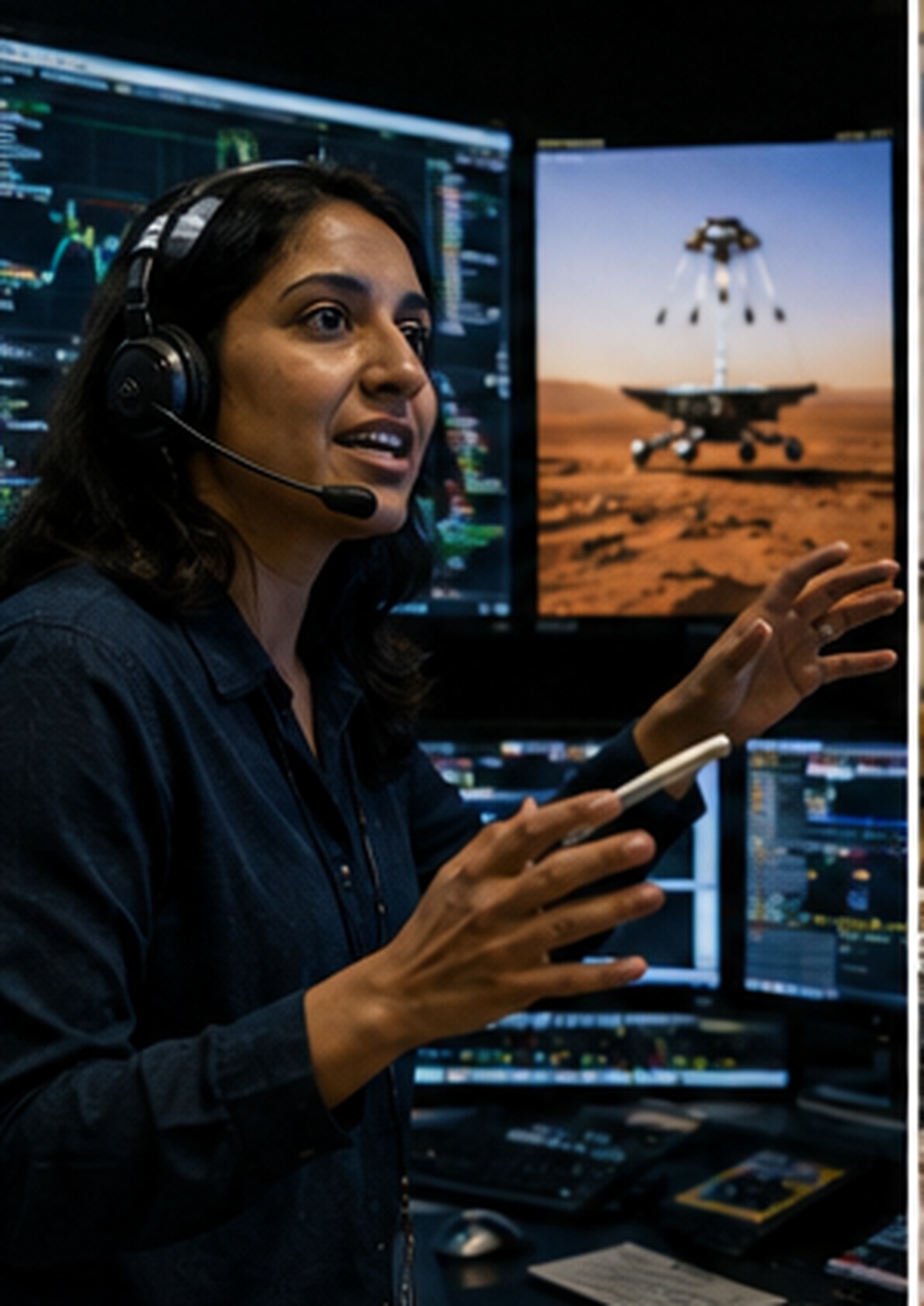
The portrait at the top of this book is an illustration whose exact provenance we were unable to verify.
Online sources
- NASA/JPL, On a Mission, “Before You Can Drive, First You Have to Fly” (2022)
- NASA Science, “Swati Mohan”
- Cornell Chronicle, “After landing Mars rover, Mohan ’04 reflects on time at Cornell” (2021)
- Shaastra, “Swati Mohan has Mars on her mind” (2024)
- NASA, “The Perseverance of Testing” (2021)
- NASA, “Impact Story: Terrain Relative Navigation” (2022)
- NASA, “55 Years Ago: Star Trek Final Episode Airs, Relationship with NASA Endures”
Facts checked against these sources on October 10, 2026.
Go further
Mars Library
This book extends the page with a complete settlement architecture. The dossier above remains deliberately self-contained: Arcadia is optional further reading, not a prerequisite for understanding it.
 Arcadia — Master Plan of the First Martian City