


Mars Bible — People
Ashwin Vasavada
The Stockton boy who gazed at the Viking pictures began his career with three lost missions. Since 2015 he has led Curiosity’s science, layer by layer, in Gale Crater.
Curiosity project scientist, Jet Propulsion Laboratory
- Education
- UCLA (1992), Ph.D. in planetary science, Caltech (1998)
- Institution
- Jet Propulsion Laboratory
- Roles
- Deputy project scientist (2004-2014), then Curiosity project scientist (since 2015)
- Specialty
- Mars climate and surface, giant-planet atmospheres, the Moon
- Link to Mars
- Leads the science of the Curiosity rover in Gale Crater
6 chapters and 4 appendices: about 3,900 words, or about 15 minutes of reading. Every fact comes from verified sources, listed at the end of each chapter.
Part One
Toward Mars, regardless
1970 – 2004
Chapter 1 · 1970s – 1992 A picture book of Viking
Ashwin Vasavada now leads the science of Curiosity, the biggest rover NASA has ever landed on Mars. It all began with a children’s book, open to a photograph taken at ground level on Mars.
Seeing Mars at eye level
He was eight or nine. In a book he found photographs of the surface of Mars taken by the Viking landers, launched in 1975. They showed the Martian ground roughly from eye level. “I could just stare at that for hours,” he recalls. That, he says, was the moment that made him want to explore other planets from their surfaces: to walk out in the landscape in his mind, see what was around the next bend, climb the next mountain, kick over a rock, dig a hole.
He belonged to the space shuttle generation, but he did not dream of being an astronaut. In his mind, the Moon was a world humans explored; the planets were the realm of robotic probes. He grew up during what he calls the golden age of planetary exploration, in the late 1970s and early 1980s: the Mars landings, the Voyager probes.
Stockton
He grew up in Northern California, in Stockton, not far from Sacramento. Without wanting to knock his hometown, he says, there was little guidance there toward his dream. A few great high school teachers helped him prepare, but he arrived at college knowing nothing about the path to becoming a planetary explorer, or which schools were good for it.
Another passion competed with space: music. For years he played drums and percussion, including in a symphony orchestra. He hesitated between two paths, music and aerospace engineering. His parents, he thinks, weighed in on the choice. His father is from India, a culture that puts great emphasis on science; he suspects they pictured him as a doctor. Planetary science was a bit of a stretch, he admits, but it certainly appealed to his father more than music.
Five majors at UCLA
He chose the University of California, Los Angeles, because it excelled in both the sciences and the arts. There he changed majors five times. He started in aerospace engineering, “because it had the word ‘space’ in it,” he jokes. He soon realized there was a cultural, perhaps psychological, difference between engineers and scientists: what interested him was not working out solutions to technical problems but understanding nature. He switched to physics, then discovered Earth science, which he loved. Replace Earth with another planet and you get planetary science: you study atmospheres, oceans, geology, physics, everything you would study on Earth, but elsewhere. It took him until his fourth year to find it.
His best memories of UCLA are those of a classic college life: studying on weeknights and, on Saturdays, playing in the university marching band at the Rose Bowl. He kept performing with music majors while studying science. In 1992 he earned his bachelor’s degree in geophysics and space physics.
Sources: NASA/JPL, “On a Mission” podcast, season 4, episode 5, “A Ton of Curiosity,” 2022 (the book and the Viking images, “I could just stare at that for hours,” the shuttle generation, the Moon and the planets, Stockton, the teachers, drums and the symphony, the marching band, music or engineering, his father from India, the five majors, “because it had the word ‘space’ in it,” engineers and scientists, the fourth year); UCLA, Department of Earth, Planetary, and Space Sciences, interview with Ashwin Vasavada, May 26, 2013 (choosing UCLA for sciences and arts, the Rose Bowl marching band on Saturdays, the golden age of the 1970s and 1980s, Voyager, not an astronaut); JPL, “Ashwin R. Vasavada” page (B.S. in geophysics and space physics, UCLA, 1992). The sources consulted give neither his date of birth nor his parents’ occupations; we keep to what he says about them in relation to his career.
Chapter 2 · 1992 – 2004 Three lost missions
Ashwin Vasavada entered planetary science in an era, he says, known more for failure than success. Three of the Mars missions he worked on, or meant to work on, were lost.
Mars Observer, on the highway
Accepted into the California Institute of Technology for graduate school, which he counts among the more unexpected things in his life, he drove down from Stockton, where he had spent the summer, for his first day at Caltech. That was the day the Mars Observer spacecraft was lost, three days before going into orbit around Mars. He heard it on the radio on the way to Los Angeles. It was the mission he had intended to work on for his thesis.
He had to pivot. He became a student of the outer planets and worked on the Galileo mission to Jupiter, then on the Cassini mission to Saturn. His research dealt with the atmospheric dynamics of Jupiter and Saturn, their vertical structure, their lightning and their auroras. He would spend, as he sums it up, five years in a laboratory. In 1998 he earned his Ph.D. in planetary science at Caltech.
Mars Polar Lander
His first real job as a scientist was a postdoc at UCLA, on the Mars Polar Lander mission. For about a year he prepared for the landing. On September 23, 1999, the sister spacecraft, Mars Climate Orbiter, was lost on arrival at Mars. On December 3, 1999, Mars Polar Lander fell silent in turn, just before entering the Martian atmosphere.
He drew a lesson he would not forget: exploring Mars, and above all landing on it, is a real challenge. Three missions he was to study or had prepared for were lost. When Curiosity was being built, he says, he approached the project with a very sober mindset.
Congress, then back to UCLA
From 2001 to 2002 he spent a year in the U.S. Congress as a Science and Technology Policy Fellow of the American Association for the Advancement of Science. From 2002 to 2004 he was a W. W. Rubey Faculty Fellow at UCLA. He then turned to the Moon and Mercury, to the stability and distribution of volatiles near their poles, and to the thermal properties of the surfaces of the Moon and Mars. In 2004 he became a co-investigator on the Diviner radiometer of the Lunar Reconnaissance Orbiter.
Sources: NASA/JPL, “On a Mission” podcast, “A Ton of Curiosity,” 2022 (“an era of planetary exploration that was known more for failure than success,” unexpected Caltech, the drive from Stockton, Mars Observer three days from orbit insertion, the radio, the switch to the outer planets, Galileo and Cassini, the UCLA postdoc, Mars Polar Lander for about a year, Mars Climate Orbiter, “a very sober mindset”); UCLA, interview of May 26, 2013 (five years in a laboratory); JPL, “Ashwin R. Vasavada” page (1998 Ph.D., AAAS fellowship in Congress from 2001 to 2002, Rubey fellowship at UCLA from 2002 to 2004, Diviner since 2004, research interests); NASA NSSDCA, “Mars Climate Orbiter” and “Mars Polar Lander” entries, cited in this collection’s biography of Donna Shirley (1999 dates). The podcast attributes the loss of Mars Observer to an explosion during a fuel transfer; we give that explanation as it states it. The podcast does not give the date of the loss.
Part Two
Curiosity
2004 – 2026
Chapter 3 · 2004 – 2012 Eight years for a “MegaRover”
In 2004 Ashwin Vasavada became deputy project scientist of a Mars mission still in preparation, then nicknamed the “MegaRover.” He would devote eight years to it before launch, without knowing whether the effort would pay off.
A one-ton beast
The future Mars Science Laboratory did not yet have a name. Later, a twelve-year-old girl from Kansas, Clara Ma, would win the contest that named it Curiosity. For now it was the “MegaRover”: it had to be big to carry all its tools. Ashwin Vasavada describes it as a beast, big and lumbering, weighing a ton and barely fitting in a garage, with wide wheels like a Hummer’s and a short body like a Mini Cooper’s. It carries ten science instruments and a robotic arm holding a drill.
The goal, he explains, is to figure out whether Mars ever had the conditions that could have supported life, by acting as a virtual field geologist. “There’s no yardstick for habitability,” he says: no single experiment measures it. You have to gather clues about water and its nature, since water can be too salty or too acidic for life, and that water is gone; you infer it from chemistry, mineralogy and the shape of the rocks. The heart of the mission is therefore to drill into rocks, scoop soil and deliver those samples to laboratories built inside the rover.
Learning to read rocks
To prepare the team, he took the scientists to places on Earth that resemble Mars: New Mexico, the Mojave Desert, Death Valley, where there are fine stromatolites, structures that life can imprint in layers of rock, and a basin near Pyramid Lake, north of Los Angeles, where streams and lakes left deposits very similar to those studied at Gale Crater. The point was for everyone to learn how to look at a rock and understand the story it tells.
He himself loves long hikes through the desert, seeing what lies around the next bend. “Every landscape is beautiful and has a story,” he says. What draws him to science is understanding how nature, physics and chemistry have conspired to create what you see.
Two years late
Building the rover proved much harder than expected, especially its mechanisms. In 2008 the team delayed the launch by two years: the rover was too complex for the schedule, and launch windows to Mars open only about every two years. On July 23, 2010, in a JPL clean room, the rover made its first test drive, watched by the team from a viewing gallery; Ashwin Vasavada narrated the video NASA released.
The launch
On November 26, 2011, an Atlas V rocket carried Curiosity from Cape Canaveral. For him that moment, even more than the landing, remains the most memorable; his family and close friends watched it with him. He had worked eight years on the mission. He knew, after the failures of 1999, that nothing guaranteed it would pay off.
On August 6, 2012, Universal Time, Curiosity landed in Gale Crater thanks to the sky crane. In mission control the call came: “Touchdown confirmed. We’re safe on Mars.” The landing damaged only one of the two wind sensors, hit by pebbles kicked up by the retrorockets.
Sources: JPL, “Ashwin R. Vasavada” page (deputy project scientist from 2004 to 2014); NASA/JPL, “On a Mission” podcast, “A Ton of Curiosity,” 2022 (the “MegaRover,” Clara Ma, the one-ton beast, the Hummer and the Mini Cooper, ten instruments, the goal, “There’s no yardstick for habitability,” water too salty or too acidic, the laboratories, the field trips, “every landscape is beautiful and has a story,” the mechanisms, the November 26, 2011 launch, eight years, the wind sensor, “Touchdown confirmed”); UCLA, interview of May 26, 2013 (the 2008 delay, launch windows, the launch as the most memorable moment, family and friends); NASA, “First Test Drive for Next Mars Rover” (July 23, 2010 test, narrated by Vasavada); NASA, “Here’s How Curiosity’s Sky Crane Changed the Way NASA Explores Mars,” August 7, 2024, cited in this collection’s biography of Adam Steltzner (landing on August 5, 2012 Pacific time, August 6 Universal Time).
Chapter 4 · 2012 – 2014 Driving the wrong way
Curiosity came for a mountain. But the mission’s first great discovery was made on the plain, because the team chose to turn its back on its goal.
Mount Sharp
In the middle of Gale Crater, 154 kilometers across, rises Mount Sharp, about 5.5 kilometers high. It is not the central peak that sometimes forms when a crater is made, Ashwin Vasavada explains: the mountain is built of horizontal layers of sediment, brought in by wind or water. Seen from orbit, two layers were intriguing: one enriched in clays, which suggest a lot of water, and just above it another enriched in sulfates, salts, a sign of a drier climate. But you cannot land on the mountain; you have to land on the plain and plan at least a year of driving to reach it.
The Yellowknife Bay gamble
A Mars rover drives very slowly; on a very good day it covers the length of a football field. Mount Sharp, a few miles away, could have been reached within a few months. But after landing, the team spotted nearby an area that might have been an ancient lake. “We drove in the wrong direction, on purpose,” he says with a laugh. It was a scientific risk, and an investment of time for the whole mission. Everyone would have said the big results would come from Mount Sharp and that the crater floor was a crapshoot. The gamble paid off in the very first year.
The mission’s first two drill holes revealed one of the best examples, in the entire mission, of a place where life could have survived, even prospered. Plenty of water had lasted a long time; life needs time to evolve. The key elements, carbon, hydrogen, oxygen, nitrogen, phosphorus and sulfur, were present at the same time as the water. And the minerals in the rocks could provide the chemical energy that microbes living underground on Earth feed on.
The sol 200 anomaly
It was while studying Yellowknife Bay that the rover “lost its mind.” Several software bugs made it hang; it stopped responding and did not go to sleep to recharge its battery, which was draining. Ashwin Vasavada felt completely helpless. All he could do, he says, was go home and let the JPL engineers work, diagnosing the fault from the scant data received from Mars. Every hour counted. In the end they had to command the rover to swap to its backup computer. The hours of waiting were very tense; the swap worked. “That’s the closest we ever came to the mission ending,” he says.
Shark teeth
In 2013, on the way to Mount Sharp, the team noticed that the wheels, made of thin aluminum, were wearing out much faster than predicted: scratches, punctures, tears between the ribs. In the worst case they would be shredded before the rover had climbed very far. Ashwin Vasavada calls it “our little mini-Apollo 13 moment,” one that took both scientists and engineers to solve. They found hard, pointed rocks, never seen at earlier landing sites, that did not budge under the rover’s weight: real shark teeth. They also found that the software turned all the wheels at the same rate; when one had to climb an obstacle, the other five pushed it even harder into the point. JPL engineers invented “traction control,” which helps the wheels climb over obstacles more gracefully, and the team now surveys the wheels every kilometer. The finding also exonerated the wheel designers: the rover’s weight alone would not have punctured them.
The lake of Mount Sharp
In 2013 NASA awarded him its Exceptional Achievement Medal. On December 8, 2014, the team presented a new interpretation: Mount Sharp may have been built largely by sediments laid down in a large lake over tens of millions of years. “If our hypothesis for Mount Sharp holds up, it challenges the notion that warm and wet conditions were transient, local, or only underground on Mars,” he said. A more radical explanation would be that the ancient, thicker atmosphere raised temperatures above freezing globally; but no one yet knew how.
Sources: NASA/JPL, “On a Mission” podcast, “A Ton of Curiosity,” 2022 (154 km, 5.5 km, the layered mountain, clays and sulfates, landing on the plain, a football field, “We drove in the wrong direction, on purpose,” “a crapshoot,” the first two drill holes, time, elements and energy, the sol 200 anomaly, “That’s the closest we ever came to the mission ending,” the wheels, “our little mini-Apollo 13 moment,” shark teeth, traction control, surveys every kilometer); NASA, “NASA’s Curiosity Mars Rover Gets a Major Software Upgrade,” April 13, 2023 (wheels damaged since 2013); NASA, “NASA’s Curiosity Rover Finds Clues to How Water Helped Shape Martian Landscape,” December 8, 2014 (Vasavada’s quote, as deputy project scientist); this collection’s biography of John Grotzinger (the lake and the tens of millions of years, from the same release); JPL, “Ashwin R. Vasavada” page (2013 medal).
Chapter 5 · 2015 – 2026 The project scientist
In January 2015 Ashwin Vasavada took charge of Curiosity’s science. For more than ten years he has led the rover, layer by layer, through the history of the Martian climate.
Succeeding John Grotzinger
On January 5, 2015, JPL announced that John Grotzinger was stepping down as project scientist; Ashwin Vasavada, deputy since 2004, succeeded him. “John Grotzinger put his heart and soul into Curiosity for seven years,” he said. The project scientist coordinates nearly five hundred researchers; with them, he decides where the rover goes next.
The broken drill
In December 2016, after sampling fifteen rocks since 2013, the drill’s feed mechanism, the motor that pushes the bit into the rock, stopped working reliably. Yet the whole mission is built around drilling. Usually a problem is resolved within twenty-four hours, and you count to ten before getting nervous. This time the days went by with no improvement. For the first time he lay awake at home, night after night, thinking this could be the end of the scientific exploration of Gale Crater.
The engineers spent about a year and a half inventing another way to drill without that motor: the bit stays extended and the robotic arm itself pushes it in, a little like a person drilling into a wall at home. They tested it in the summer and fall of 2017 on JPL’s test rover; it was not at all clear the arm could take those stresses. On the science side, the way samples were analyzed had to be reinvented. On May 20, 2018, Curiosity drilled the rock “Duluth”: its first sample since October 2016. Since then, he says, the rover has drilled more holes with this method than with the old one.
In July 2018, as a dust storm enveloped the planet, he explained that the team was “working double-duty”: the recommissioned drill was acquiring a fresh sample while the instruments studied how the storm evolved.
The methane mystery
The rover’s SAM laboratory detects small amounts of methane in the atmosphere that vary with the seasons, and sometimes much stronger whiffs whose origin is not understood. On Earth this gas is mostly produced by microbes, but it can also come from reactions between water and rock. In June 2019, after the largest detection of the mission, he summed it up: “The methane mystery continues.” Curiosity does not have the instruments to say whether its source is biological or geological.
A layered mountain
In April 2019 Curiosity took its first sample in the “clay-bearing unit.” “Each layer of this mountain is a puzzle piece,” he said; each holds clues to a different era of Martian history. In October 2019, salt-enriched rocks at Sutton Island showed that the drying of Mars was not linear: rather a “messy” passage, with dry periods followed by wetter ones.
In the 2022 podcast he says what strikes him most about Mars: how not strange it is. You expect a science-fiction setting; you find a landscape like parts of Earth. The difference is that for three billion years only the wind has shaped Mars. It has carved rocks so delicate that a push would topple them, “little fairy castles” that would not survive the first earthquake or flood on Earth.
The rover also helps prepare for humans. Its RAD instrument measures the radiation reaching the surface of Mars, harsher than on Earth for lack of a thick atmosphere, a magnetic field and an ozone layer. When the rover passes at the foot of tall hills or canyon walls that hide part of the sky, the team measures how well those rocks shield from radiation, as a habitat built against a cliff would.
Extra innings
In 2022 he spoke of “extra innings”: Curiosity was built for two years, tested for six, and was in its tenth year. The nuclear generator should provide enough power for about five more years; the real risk now is a catastrophic failure, because parts are wearing out. “Every day is a gift.” That same year the Royal Astronomical Society made him an Honorary Fellow, the Open University awarded him an honorary doctorate and JPL gave him its Magellan Award. In 2023 NASA awarded him its Outstanding Public Leadership Medal.
The discoveries kept coming. In February 2023, ripples left by waves in a shallow lake, where a dry climate was expected: “the best evidence of water and waves that we’ve seen in the entire mission.” In August 2023, cracks in ancient mud, a sign of wet-dry cycles that may have promoted the emergence of life: “the mission has found evidence of conditions that may have promoted the origin of life, too.” In July 2024, a field of stones of pure sulfur, never seen before on Mars: “Finding a field of stones made of pure sulfur is like finding an oasis in the desert.” In 2025, the criss-crossing ridges of the “boxwork,” like a spiderweb, seen nowhere else on the mountain. In April 2026, organic molecules never before observed on Mars, which, he said, once again increase the prospect that Mars offered a home for life in the ancient past.
In October 2026 Curiosity, in the second year of its fifth extended mission, is driving toward a layer of “yardangs,” landforms carved by the wind. “The yardang layer looks out of place,” he says; no one knows what formed it, perhaps ash from ancient volcanoes. The team hopes to reach its base in 2027.
Sources: JPL, “New Project Scientist for Mars Rover,” January 5, 2015, cited in this collection’s biography of John Grotzinger (“John Grotzinger put his heart and soul into Curiosity for seven years,” nearly 500 scientists); UCLA, interview of May 26, 2013 (deciding where the rover goes next); NASA, “Mars Rover Step Toward Possible Resumption of Drilling” (fifteen drillings from 2013 to 2016, December 2016 fault), “Testing New Techniques for Mars Rover Rock-Drilling” (2017 tests) and “Going Forward” (Duluth, May 20, 2018); NASA/JPL, “On a Mission” podcast, “A Ton of Curiosity,” 2022 (the drill, the sleepless nights, a year and a half, more holes than before, methane, Mars so not strange, the “fairy castles,” RAD and the canyon walls, “extra innings,” two years and six years, five years of power, “every day is a gift”); NASA, “‘Storm Chasers’ on Mars Searching for Dusty Secrets,” July 19, 2018; “Curiosity’s Mars Methane Mystery Continues,” June 23, 2019; “Curiosity Tastes First Sample in ‘Clay-Bearing Unit’,” April 11, 2019; “NASA’s Curiosity Rover Finds an Ancient Oasis on Mars,” October 7, 2019; “NASA’s Curiosity Finds Surprise Clues to Mars’ Watery Past,” February 8, 2023; “Cracks in Ancient Martian Mud Surprise NASA’s Curiosity Rover Team,” August 9, 2023; “NASA’s Curiosity Rover Discovers a Surprise in a Martian Rock,” July 18, 2024; “NASA’s Curiosity Mars Rover Starts Unpacking Boxwork Formations,” June 23, 2025; “NASA’s Curiosity Finds Organic Molecules Never Seen Before on Mars,” April 21, 2026; “NASA’s Curiosity Rover Catches Stunning Martian Dawn,” October 6, 2026; JPL, “Ashwin R. Vasavada” page (honors).
Epilogue
Ashwin Vasavada and Mars
Chapter 6 · The lesson What Ashwin Vasavada leaves to Mars
The child who gazed at the Viking pictures ended up guiding, for more than ten years, the most complex rover ever sent to Mars. His path carries three lessons.
Failure is part of the road
Mars Observer, Mars Climate Orbiter, Mars Polar Lander: his career began with three losses. He kept from them a sobriety that stayed with him through the eight years of building Curiosity. The first Martian crews will also set out knowing that nothing is guaranteed.
Dare the detour
Driving the wrong way, on purpose, to Yellowknife Bay gave the mission its finest discovery. On Mars the best answers are not always where the maps point; you have to look at what is under your wheels.
Fix it with what you have
Torn wheels, a stuck drill, a failing computer: each time, scientists and engineers invented a solution using only the hardware on Mars. Future inhabitants of Mars, far from any spare part, will have to live by the same ingenuity. And the radiation measurements Curiosity took at the foot of Mount Sharp’s cliffs already help them choose where to shelter.
This lesson is a reflection by the author of this book, based on the facts and words reported in the preceding chapters, where their sources are given.
Appendices
Further reading
Appendix Understanding Ashwin Vasavada’s work
A few ideas, explained simply, to follow this book.
The project scientist
The person in charge of a mission’s science. He coordinates the teams of the different instruments, weighs their requests and proposes, with them, where the rover should go and what it should study.
Habitability
The ability of an environment to support life: water neither too salty nor too acidic, present long enough, the necessary chemical elements and a source of energy.
Clays and sulfates
Two families of minerals. Clays form when water alters rocks over a long time; sulfates are salts deposited when salty water evaporates. Going from clays to sulfates means going from a wet Mars to a drier one.
The sol
A Martian day, a little longer than an Earth day. A mission’s days are counted in sols from landing.
Methane
A gas made of carbon and hydrogen. On Earth it is mostly produced by microbes, but it can also arise from reactions between water and rock.
The nuclear generator
Curiosity draws its power from the heat given off by the natural decay of a small amount of plutonium-238. That heat keeps the rover warm and charges its batteries; it slowly declines over the years.
These explanations are general notions. Habitability, methane and the generator follow the 2022 podcast “A Ton of Curiosity.”
Appendix Timeline
The dates of Ashwin Vasavada’s career, in order, as far as the sources allow them to be established.
Childhood. The Viking images, at eight or nine; grows up in Stockton, California.
1992. B.S. in geophysics and space physics, UCLA.
First day at Caltech. The day Mars Observer is lost.
1998. Ph.D. in planetary science, Caltech.
1999. UCLA postdoc for Mars Polar Lander; loss of Mars Climate Orbiter (September 23) and Mars Polar Lander (December 3).
2001 – 2002. AAAS fellow in the U.S. Congress.
2002 – 2004. Rubey Faculty Fellow at UCLA.
2004. Deputy project scientist of Mars Science Laboratory; Diviner co-investigator.
2008. Launch delayed by two years.
July 23, 2010. The rover’s first test drive.
November 26, 2011. Curiosity launches.
August 6, 2012. Landing in Gale Crater (Universal Time).
2013. Yellowknife Bay; the sol 200 anomaly; damaged wheels; NASA medal.
January 5, 2015. Curiosity project scientist.
December 2016. The drill’s feed mechanism fails.
May 20, 2018. First drilling with the new method.
2022. Honorary Fellow of the Royal Astronomical Society; honorary doctorate from the Open University; JPL Magellan Award.
2023. NASA Outstanding Public Leadership Medal.
July 2024. The field of pure sulfur.
April 2026. New organic molecules.
October 2026. On the way to Mount Sharp’s yardangs.
Sources: those of the chapters.
Appendix The people
The people who appear in this book, with the role the sources give them.
John Grotzinger. Curiosity’s project scientist until 2015, whom Ashwin Vasavada succeeded. He has his own biography in this collection.
Clara Ma. A twelve-year-old girl from Kansas who gave Curiosity its name.
Sources: those of the chapters in which each appears; “A Ton of Curiosity” podcast, 2022 (Clara Ma).
Appendix Sources and method
This book contains no invented dialogue and no thought attributed to anyone without a text to support it. The words reported are those Ashwin Vasavada spoke in interviews or releases. This appendix shows where the facts come from and what the sources do not allow us to establish.
A living person
Ashwin Vasavada is alive at the time of writing. In keeping with this collection’s rule, we keep to his public life and to what bears on his career. The sources consulted do not give his date of birth.
The main sources
The core of the book is the “A Ton of Curiosity” episode of JPL’s “On a Mission” podcast (2022), in which he tells his story and Curiosity’s; to it we added his JPL profile page, an interview published by UCLA in May 2013 and some twenty NASA releases and pages from 2010 to 2026.
What does not agree
The podcast places the drill failure in 2015; NASA’s pages date it to December 2016, which we follow. The podcast gives Mount Sharp a height of 18,000 feet, about 5.5 km; NASA releases say about 5 km. The podcast dates neither the loss of Mars Observer nor his first day at Caltech.
Length
This book runs to about four thousand words. The goal set for this collection was one hundred thousand. We did not reach it, and we prefer to say so. As it stands, the text contains only facts we were able to tie to a source.
The portrait
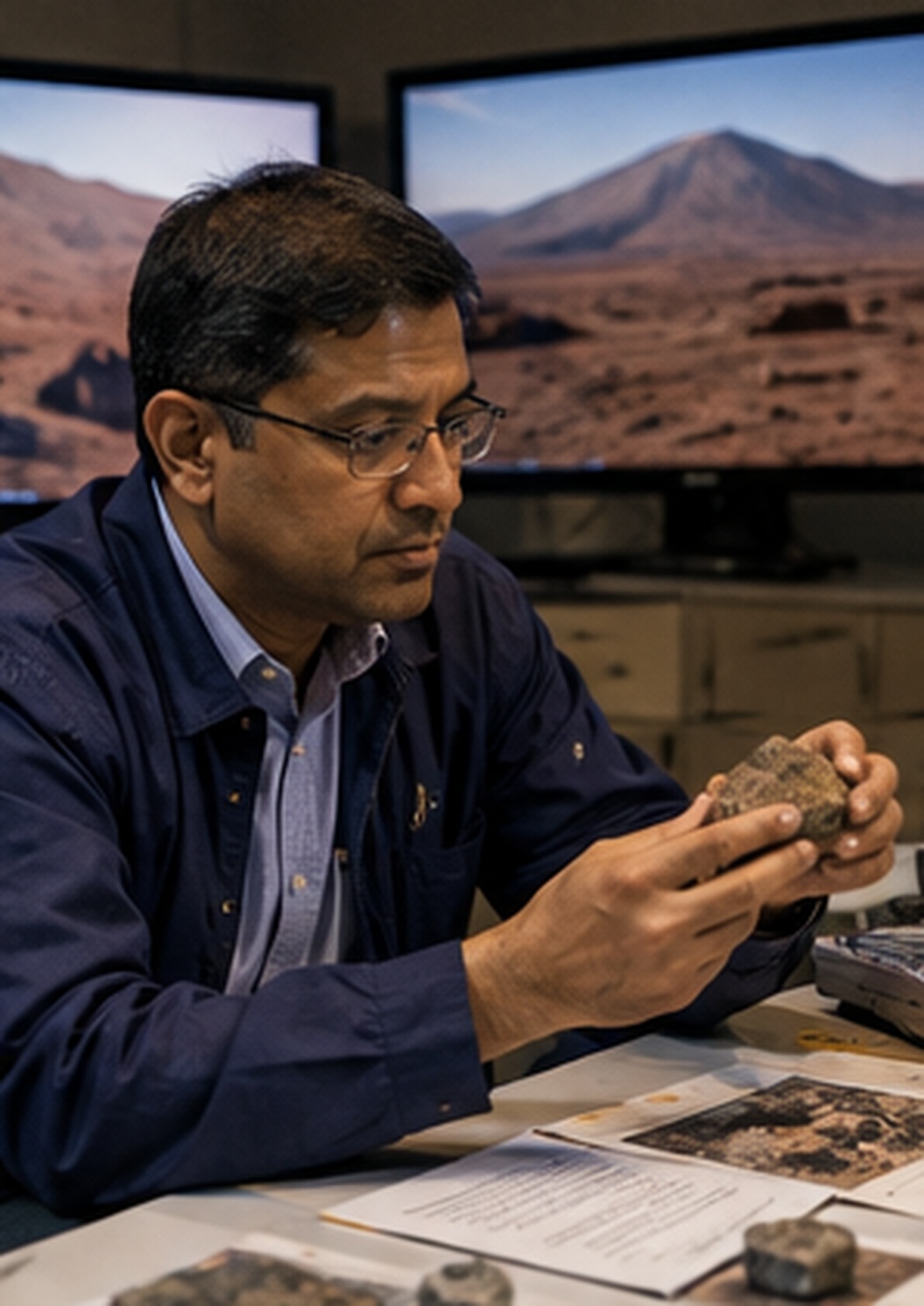
The portrait at the top of this book is an illustration whose exact provenance we were unable to verify.
Online sources
- NASA/JPL, On a Mission, “A Ton of Curiosity” (2022)
- JPL, “Ashwin R. Vasavada”
- UCLA, interview with Ashwin Vasavada (2013)
- NASA, “First Test Drive for Next Mars Rover” (2010)
- NASA, “NASA’s Curiosity Rover Finds Clues to How Water Helped Shape Martian Landscape” (2014)
- NASA, “Going Forward” (2018)
- NASA, “Curiosity’s Mars Methane Mystery Continues” (2019)
- NASA, “NASA’s Curiosity Rover Discovers a Surprise in a Martian Rock” (2024)
- NASA, “NASA’s Curiosity Finds Organic Molecules Never Seen Before on Mars” (2026)
- NASA, “NASA’s Curiosity Rover Catches Stunning Martian Dawn” (2026)
Facts checked against these sources on October 10, 2026.
Go further
Mars Library
This book extends the page with a complete settlement architecture. The dossier above remains deliberately self-contained: Arcadia is optional further reading, not a prerequisite for understanding it.
 Arcadia — Master Plan of the First Martian City