


MARS BIBLE — HISTORY
SpaceX: from Falcon 1 to Starship
How a Mars ambition became a strategy centered on launch cost, reuse, cadence and interplanetary transport — and what still separates Starship from a self-sustaining city.
BEFORE MARS — HOW THE ORGANIZATION WAS BORN
Before Mars: how SpaceX came into being
SpaceX was founded in 2002 in a context very different from the public agencies born during the Cold War. The company began from an entrepreneurial argument: if access to orbit remained rare, expensive and dependent on largely expendable hardware, many scientific and exploration projects would remain structurally unaffordable. Elon Musk’s Mars ambitions mattered in that genesis, but the organization was fundamentally built around an industrial decision — manufacture its own launch vehicles and attempt to change the economics of space transportation.
The first years were not a triumphal march. Falcon 1 failed several times before reaching orbit in 2008. That period helped form an internal culture of integrated teams, rapid design cycles and direct control over much of the technical chain. The relationship with NASA then became decisive: cargo contracts for the International Space Station gave SpaceX a market, operational discipline and certification requirements that changed the company’s scale.
Falcon 9, Dragon and then first-stage recovery gradually transformed SpaceX from a fragile newcomer into a major space operator. Starlink added a global network business that generated unprecedented launch cadence. Starship is the attempt to push that logic much further: very high capacity, broad reusability and interplanetary ambition.
Mars has therefore belonged to SpaceX’s story since the beginning, but it does not summarize the company. To understand its Martian role, one must first understand how an organization founded in 2002 built engines, launch vehicles, capsules, launch infrastructure, flight software, operations and cadence. Mars then becomes the far end of an industrial history rather than its only starting point.
Founding sources: SpaceX — Mission · SpaceX — Mars
SpaceX was founded in 2002 with an ambition that seemed disproportionate to a new company: build its own launch vehicles, lower the cost of reaching orbit and ultimately support human activity beyond Earth. Falcon 1 was deliberately smaller than the later Falcon 9 and Starship systems. It became an industrial school in which engines, tanks, avionics, structures, launch operations and supply chains all had to work together. The challenge was not merely producing thrust; it was building an organization capable of flying an integrated orbital system.
The first three Falcon 1 flights failed. Their importance is technical as much as dramatic: each demonstrated that launch reliability is a system property. A problem in propulsion, staging or flight dynamics can defeat every subsystem that worked correctly. The fourth flight reached orbit in September 2008. NASA has described Falcon 1 as the first privately developed liquid-fueled launch vehicle to reach orbit. That did not yet prove commercial cadence or human transport, but it closed a foundational question: SpaceX could design, manufacture and operate an orbital rocket.
This period also explains why Musk’s Mars argument became inseparable from launch economics. A settlement cannot be built by a single heroic flight. It needs repeated logistics, replacement equipment, learning cycles and eventually a fleet. If transportation remains rare and extraordinarily expensive, every surface architecture stays brittle. After Falcon 1, SpaceX therefore pursued not only greater performance but much greater repetition.
The SpaceX story becomes more useful once it is no longer told as an inevitable march toward success. Before Falcon 9, Dragon and Starship there was Falcon 1: a small launcher that had to prove a private company could design a rocket, manufacture it, move it to a remote launch site, prepare it, launch it and reach orbit. The first three attempts failed. The fourth reached orbit in 2008 and became the first privately developed liquid-fuel launch vehicle to do so. NASA records that milestone in the history of commercial spaceflight. [M3] The flight did not yet prove a routine transportation system; it proved that a new organization could cross a barrier long associated with national programs.
The technical tension of this period is not a secret engine trick or a personality trait. It lies in the number of functions that must all work on the same day: propulsion, structures, avionics, flight software, ground operations, telemetry, procedures and industrial quality. A rocket can be excellent in principle and still fail because one local chain is insufficiently controlled. That lesson scales directly to Mars. A settlement may fail not because its overall concept is foolish, but because a connector, sensor, valve, procedure or software interface breaks at the wrong time.
Chronology also protects the historical account from retrospective mythology. Tesla’s regulatory filings summarize Musk’s pre-SpaceX path through Zip2 and the payment system that became PayPal and confirm his University of Pennsylvania degrees. [M1] Wharton shows that by the early 2000s space was already one of the major fields to which he intended to devote his efforts. [M2] These sources do not prove that the future was predetermined. They show continuity of intention across very different ventures.

Looking for Elon Musk?
Looking for Elon Musk? Read his full biography →

Mars Oasis and the creation of SpaceX. Before SpaceX, Elon Musk explored a small Mars greenhouse concept often described as Mars Oasis. The effort confronted launch costs and helped redirect attention toward the transportation system itself. The historical importance is the shift from buying an expedition to building a launch company intended to change access-to-space economics.
Falcon and reuse. SpaceX’s Falcon program progressively demonstrated orbital launch, recovery and reuse of first stages. Reuse does not make spaceflight free; vehicles still require operations, inspection and finite-life management. It does, however, change the economic model for repeated launch, which is critical to any plan that requires enormous cargo flow.
Starlink and the Mars narrative. Starlink is a large communications business and technology program. It can plausibly contribute revenue, manufacturing scale, software and network operations experience. It is more rigorous to describe these links than to assert a simple one-to-one claim that every Starlink dollar “funds Mars.” Corporate cash flow, capital expenditure and program priorities change over time.
From Mars Oasis to a launch company
Accounts of SpaceX’s origins often return to Musk’s early interest in a small Mars greenhouse demonstration, commonly described as Mars Oasis. The proposed publicity mission did not become a flight program, but it helped expose the cost and availability of launch services and contributed to the decision to build rockets rather than buy a one-off ride. [S33][S34] That transition is historically important because the Mars ambition became attached to an industrial strategy: lower the cost of access to orbit first, then enlarge what becomes possible beyond Earth.
Mars Oasis: from symbolic experiment to company formation
The SpaceX story begins before SpaceX. In the early 2000s Elon Musk considered a project generally known as Mars Oasis: sending a small greenhouse or biological experiment to Mars in order to revive public interest in exploration. It was not yet a settlement architecture. It acted as a trigger. When Musk examined the cost of access to space and the possibility of buying a launch vehicle, the launch price itself became the problem to attack. [S33]
That transition explains much of what followed. Instead of beginning with the detailed design of a Martian city, the strategy moved down the causal chain: why is Mars access rare? Because launches are rare and expensive. Why are launches rare and expensive? Because hardware is largely consumed and the industry has historically operated at low cadence. SpaceX was therefore built around an Earth-based problem whose horizon was Mars.
The earliest Mars episode in Musk’s public narrative matters because it redirected attention from payload inspiration toward access to space.
Mars Oasis began as an attempt to create a visible Mars project, but the price of launch became the obstacle that redirected the effort. The historical significance is not that the greenhouse concept itself solved a Martian requirement. It is that the project reframed the problem: if access to space remained too expensive, changing the payload would not be enough. SpaceX was built around attacking the transportation system and later the economics of reuse. That shift helps explain why Mars remained an organizing objective even when the company’s near-term revenue and operations were necessarily terrestrial and Earth-orbit focused.
Mars Oasis was conceived as a small demonstration intended to renew public interest in Mars rather than as a complete settlement architecture.
Attempts to source launch capability exposed how large a fraction of the concept’s cost would be consumed before the payload could even begin its mission.
The resulting frustration encouraged a focus on launch economics and on whether vehicles could be built differently rather than simply purchased at prevailing prices.
SpaceX therefore emerged from an ambition that was Martian in direction but initially orbital in the engineering problems it had to solve. For Mars, consequences propagate.
The distinction is important because a company must survive near-term markets before it can finance long-horizon interplanetary systems.
Mars became an organizing objective, while commercial and government missions supplied the operational path that could keep development alive.
Mars Oasis matters because it marks a change in the type of problem Musk was trying to solve. The initial concept was a demonstrator: place a small greenhouse on Mars and use a visible biological experiment to renew public interest. Investigating launch options led to a different conclusion: access to space was itself the dominant constraint. Instead of simply seeking more money for the payload, Musk founded a company intended to alter the economics of launch.
That is why SpaceX did not begin with a Mars ship. Falcon 1, Falcon 9 and Dragon built propulsion, structures, avionics, operations and institutional credibility. First-stage recovery and reuse then turned launch cadence into a practical industrial capability rather than a PowerPoint assumption.
Reuse is the economic thesis behind the Mars vision. A Mars settlement would require logistics at a scale far beyond occasional science missions. It is therefore not enough for a rocket to be capable of sending one payload toward Mars. Vehicles, engines, tankers and ground systems must be produced, launched and reused at a cadence compatible with mass transport.
Reuse, Falcon and the economics of cadence
Falcon development and booster recovery shifted SpaceX’s public argument from the performance of a single launch toward the economics of repeated launch. Reuse does not by itself make a Mars settlement feasible, but it changes a central variable: how much hardware and propellant can be placed into the transportation chain for a given budget and industrial base. Starlink later added a very large operational spacecraft program and revenue stream; commentary has often linked its business scale to SpaceX’s broader Mars ambitions, but any direct financial claim should be tied to dated company statements or reporting rather than treated as an automatic one-to-one funding mechanism. [S35][S36]
Falcon 9 first-stage reuse became one of SpaceX’s defining achievements. Its importance is often reduced to the phrase “reuse is cheaper,” but the deeper issue is operational. Reuse only creates an advantage if recovery, inspection, refurbishment and reflight can be made sufficiently fast and predictable. Returning hardware allows more data to be gathered from flown structures and can reduce the need to build a completely new first stage for every mission.
That lesson is directly relevant to Mars. An architecture requiring thousands of tonnes of cargo cannot operate as a sequence of handcrafted expendable artifacts. Transportation has to become a fleet. The same logic applies on Mars: surface vehicles, power units, excavation machines and ISRU systems become far more valuable when they can be maintained and returned to service. Reuse introduces the logic of durable assets into spaceflight.
It does not eliminate wear. Engines, structures, thermal protection and mechanisms accumulate cycles. SpaceX has demonstrated large-scale reflight of Falcon 9 first stages; Starship is attempting to extend the concept to rapid reuse of both stages. As of 2026, full rapid reuse at the scale required by the Mars vision remains under development.
Recovered Falcon 9 first stages have become familiar images. Their historical meaning is not confined to a cost calculation per launch. Reuse changes the relationship with time: an organization that recovers, inspects, refurbishes and reflights hardware can shorten the learning loop. Every return produces data on actual wear; every reflight converts a lifetime assumption into accumulated experience. NASA’s commercial programs had to absorb that growing maturity while preserving their own certification requirements. [M4][M6]
For Mars, tempo is decisive. An architecture based on rare, one-off vehicles is difficult to reconcile with hundreds of cargo flights, orbital refueling campaigns and recurring departure windows. Starship instead assumes high industrial cadence. SpaceX presents it as a reusable system intended to move large masses to orbit, the Moon and Mars. [M8] Yet “reusable” must never be confused with “maintenance-free”: as cadence rises, inspection, spares, logistics and metrology become industries of their own.
The analytical value of this chapter is to separate three claims that public debate often merges: recovery of a vehicle, demonstrated reflight, and the economics of a reusable system at a given cadence. Falcon has accumulated substantial experience on the first two. Starship seeks a larger scale. Mars settlement requires another step: proving that an entire fleet can operate with reliability, cadence and economics compatible with interplanetary missions.
Starlink: a financial connection to Mars, but not a simplistic origin story
Musk has repeatedly connected Starlink revenue to financing the long-term Mars ambition. That supports a careful statement: Starlink became a major commercial engine that Musk explicitly expects to help finance interplanetary goals. It does not support the stronger claim that every technical decision in the constellation was designed for Mars.
There is also an industrial effect. Building and operating a huge constellation forces high-rate satellite production, frequent launch, software operations and global network management. Those capabilities are not a Mars settlement, but they train an organization to think in terms of fleets and continuous operations rather than unique spacecraft.
ITS, BFR and Starship: the architecture keeps changing
Names, scale and engineering choices evolved. That evolution is normal in development, but a reference page must date every statement. A 2016 architecture should not silently be described as the 2026 program.
A self-sustaining city is an industrial system
Transportation is only one layer. A durable settlement must maintain energy, air, water, food, medicine, manufacturing, spare parts, communications, governance and training across long resupply gaps. The central question becomes which functions stop depending on Earth, in what order, and with what reliability.
5 — Mars and Beyond in 2026
SpaceX currently describes a self-sustaining Martian city as a long-term objective requiring very large population and cargo flows, and frames Starship as the transportation system intended to support missions beyond Earth. These are stated corporate objectives. They remain distinct from demonstrated settlement capability and should be labeled accordingly.
Starship and Super Heavy are the core of SpaceX’s current Mars concept. The aim is not merely to build a larger rocket. The system attempts to combine high payload capacity, reuse of both stages, orbital refueling, methane-oxygen propulsion and a family of vehicles able to serve Earth orbit, the Moon and Mars. That common industrial base is central to Musk’s strategy: a vehicle that flies frequently for near-Earth missions can accumulate far more operational experience before a Mars campaign begins.
As of August 17, 2026, documentary caution is essential. SpaceX conducted Starship’s thirteenth flight test on July 24, 2026. Its official “Mission: Mars” page now states that cargo flights to the Martian surface are planned no earlier than 2028. That is a company target, not a guaranteed mission date. Between an Earth flight test and a Mars cargo landing stand major demonstrations: repeated orbital operations, propellant transfer, long-duration thermal management, interplanetary navigation, Mars entry, landing accuracy and autonomous surface operation after touchdown.
Methane and oxygen have an obvious Mars logic because SpaceX ultimately envisions producing return propellant from local resources. But that links the vehicle to an entire surface industry: water extraction, electrical power, electrolysis, carbon-dioxide capture, Sabatier chemistry, liquefaction, cryogenic storage, quality control and maintenance. The spacecraft is therefore not independent of the settlement; it would become one of its largest industrial customers.
SpaceX describes a long-term self-sustaining city requiring more than one million people and millions of tonnes of cargo. Those numbers are vision targets, not demonstrated performance. They nevertheless reveal the scale of Musk’s project: not simply a scientific expedition, but an attempt to turn interplanetary transport into a recurring logistics chain.
Status dated August 17, 2026. Sources: SpaceX “Mission: Mars” and “Starship’s Thirteenth Flight Test”; NASA Human Landing System.
In 2026 SpaceX’s official “Mission: Mars” page lists cargo Starship flights to the Martian surface as a target no earlier than 2028. [M7] That wording should be read literally. It is a company target, not a certified future event. A rigorous historical account protects the distinction: the existence of a published target is a fact; the future completion of the mission is not yet one.
NASA’s Human Landing System partnership makes the story more concrete. The agency is funding and evaluating a Starship-derived lunar lander and continues test campaigns connected with that architecture. [M9][M10] Lunar operations can demonstrate useful building blocks — propulsion, rendezvous, propellant transfer, autonomy and crewed systems — but Mars adds atmospheric entry, dust, long logistics cycles, radiation, local production and the absence of rapid rescue.
That is where industrial history becomes more interesting than advocacy for or against Musk. The useful question is not whether a Martian city “will happen” or “will never happen.” It is how an extraordinarily distant objective is converted into a sequence of testable subproblems. Each successful demonstration removes one unknown; each failure exposes a dependency; each delay forces a distinction between desire and industrial schedule. Mars remains not the conclusion of the story, but its most demanding test.
Even if Starship met all of its transportation goals, a durable settlement would require another industrial revolution: power generation, water extraction and purification, atmosphere control, maintenance, local parts, medicine, fire and depressurization safety, inventory management and the training of new generations of technicians. None of these systems can simply be assumed behind the launch vehicle.
SpaceX’s Mars transport concept has changed names, dimensions and operating assumptions. The 2016 Interplanetary Transport System presentation emphasized very large reusable vehicles, orbital refueling and repeated trips. [S11] The design later passed through the BFR label and evolved into Starship and Super Heavy. That evolution is not evidence of failure; it is evidence that an architecture remains under development. It also means historical pages must date diagrams and claims carefully, because a statement about one generation of the vehicle may not describe another.
From ITS to BFR to Starship: a changing architecture
In 2016 Musk presented the Interplanetary Transport System as an extremely large architecture. The concept later evolved through BFR and into Starship. Dimensions, engines, materials, recovery methods and operational priorities changed. From the outside such changes can look like indecision; from an industrial perspective they show that a conference concept must survive manufacturing, testing, regulation and failure before it becomes a vehicle. [S11] [S12]
That evolution matters historically because it prevents us from freezing 'Musk's plan' in one old rendering. The broad thesis — high mass, reuse, orbital refueling and a Mars destination — has remained relatively stable. The detailed architecture has not. Every diagram and schedule therefore has to be dated rather than blended into a single timeless master plan.
The changing names and designs show an architecture being revised by development rather than a single plan unfolding exactly as announced.
The changing names and configurations from ITS to BFR to Starship are historical evidence of development rather than a reason to rewrite the past as if the current vehicle had always been inevitable. Tank arrangement, materials, propulsion, staging, recovery methods and mission sequencing have evolved as hardware and tests produced information. In 2026 SpaceX publicly describes cargo Mars flights no earlier than 2028; that statement is an announced objective, not a demonstrated Mars transport capability. A careful history therefore records both the ambition and the evidence actually available at each stage.
The 2016 Interplanetary Transport System presentation emphasized very large vehicles, orbital refueling and a long-term settlement objective.
BFR represented a subsequent attempt to consolidate missions and vehicle concepts around a different scale and operating model.
Starship evolved again in materials, geometry, engines and test philosophy as full-scale prototypes began to fly.
Changing architecture is not automatically evidence of failure; experimental engineering often replaces assumptions with data as soon as hardware exists. For Mars, consequences propagate.
At the same time, public timelines should be treated as goals rather than guarantees because launch licensing, safety, production and technical maturity all affect schedule.
The historian’s task is to record which elements were demonstrated in each period and which remained declared future capability.
The Interplanetary Transport System presented in 2016 was not the Starship flying today. Dimensions, materials and names changed through BFR and into Starship/Super Heavy. That evolution is not a contradiction; it is a signature of an engineering program being forced to meet manufacturing, test and mission constraints.
The continuity is the search for a fully reusable heavy system using liquid methane and oxygen, combined with orbital refueling. NASA describes Starship as an architecture intended to evolve toward reusable travel to the Moon, Mars and other destinations. [S70]
Transport is not a colony
Even a highly capable transport system leaves the hardest settlement problem intact: how to keep people alive and productive across long resupply gaps. Energy, ECLSS, water, food, medicine, maintenance, manufacturing, communications, governance and education all need their own resilient architectures. The Mars story therefore ends not with a rocket, but with a systems problem.
Mars Oasis reframed the problem as cost
The Mars Oasis episode matters because it led to a different question: if launch prices make the objective unrealistic, should one buy launches or rebuild the launch business? SpaceX consequently made Mars a problem of cost, cadence and reuse as well as raw performance.
Reuse changes the economic model
A reusable vehicle aims to convert hardware from consumable inventory into capital used again. It does not eliminate inspection, refurbishment or finite life, but it changes the economics of repeated launch. For Mars, a transfer opportunity roughly every 26 months makes campaign cadence strategically important.
Starlink: separate revenue, capability and narrative
It is too strong to write that Starlink automatically “funds Mars.” More defensible connections include potential revenue, mass production, global network operations, terminals and software. A future transfer of those advantages into a Mars program remains a corporate strategy, not a guaranteed accounting identity.
The company’s current Mars material presents a self-sustaining city as the long-term goal and Starship as the transport system intended to make large cargo movement possible. [S13] The unresolved work begins after landing: reliable power through failures and dust, closed-loop life support, water and oxygen production, radiation management, medical autonomy, maintenance, spare parts, food, construction, governance and an economy capable of replacing critical imports. A credible history therefore ends not with “Starship solves Mars,” but with a sharper statement: Starship attempts to solve the transportation bottleneck on which many other settlement systems depend.
The real gap is between reaching Mars and sustaining civilization
Starship dominates the visuals because rockets are visible and dramatic. A settlement is less photogenic and much harder. Water, oxygen, food, power, thermal control, medicine, spare parts, mining, manufacturing, communications, governance and knowledge preservation have to function together through long periods without resupply.
No transport vehicle, however capable, has demonstrated that system. The rigorous historical conclusion is therefore not “Starship makes colonization solved.” It is that Starship is an attempt to change the scale and cost of transportation, potentially removing one of the largest constraints, while the settlement itself remains a much broader civilization-engineering problem.
Falcon and reuse: reducing cost is not enough if cadence remains low
Recovery and reuse of Falcon 9 first stages became one of SpaceX's most visible industrial demonstrations. The Mars-related logic is larger than the price of one launch. A settlement would require enormous mass across repeated transfer windows. Even a somewhat cheaper expendable launcher would remain inadequate if it flew only a handful of times per year. Reuse therefore aims to turn the launcher into hardware that can be operated repeatedly.
The thesis must still be separated from the result. Reusing an Earth booster does not demonstrate that a complete Earth-Mars-Earth transport system will be economical. Vehicles, orbital refueling, heat shields, Martian operations and life support create new problems. But Falcon gave SpaceX an operating culture of recovery, inspection and reflights that made 'reuse' an industrial practice rather than only a presentation slide.
Starlink: what is the real connection with Mars?
Musk and other SpaceX executives have publicly connected the potential revenue of a large satellite network with broader space-development and Mars ambitions. Contemporary reporting and statements cited in this dossier document that connection. It would still be excessive to write that Starlink was created only to finance Mars. The network addresses an Earth market and has its own commercial, technical and strategic logic. [S35] [S36]
The structural connection may be even more important than the slogan. Starlink forces SpaceX to manufacture satellites at scale, launch frequently, automate a huge constellation and create a revenue stream separate from launch contracts. Those capabilities can support the industrial ecosystem behind a far more ambitious vehicle. They do not prove that a Mars settlement can automatically be financed by satellite revenue.
The lunar detour: contradiction or full-scale learning?
NASA's selection of a Starship-derived human landing system for Artemis creates an unusual development path: a vehicle publicly associated with Mars must first demonstrate critical capabilities in the lunar program, including large-scale operations and propellant-transfer concepts. NASA describes Starship HLS as one of the selected systems for moving astronauts between lunar orbit and the surface. [S70]
The Moon is not a rehearsal of Mars in any simple sense. Atmosphere, gravity, communications and logistics differ profoundly. Yet industrial learning can accumulate: building vehicles, conducting cryogenic operations, integrating crewed missions and working to NASA requirements all matter to a company that continues to identify Mars as a long-term objective.

2026: Mars remains an objective, but schedules are not laws of nature
SpaceX and Musk continue to describe multiplanetary life and Mars as major goals, while operational priorities can change. In February 2026 Reuters reported increased near-term emphasis on a self-growing lunar city while Mars remained a longer-term ambition. NASA Kennedy's current Starship/Super Heavy environmental page likewise describes Moon and Mars among the system's goals. [S71] [S72]
That tension is the most accurate way to narrate a history that is still unfolding. A multi-decade vision can coexist with slipping dates, intermediate priorities and incomplete demonstrations. For the historian and engineer alike, an announced date is not a future fact; it is evidence of intent at a particular moment.
Why even a successful Starship would not by itself colonize Mars
A highly capable reusable interplanetary transport does not create a city. A settlement must produce power through dust and seasons, obtain water, make oxygen, manage ECLSS losses, maintain suits, construct pressure volumes, treat medical emergencies, store spares, manufacture locally and organize decision making in a place where some failures cannot wait for an answer from Earth.
That is the real scale change between SpaceX and colonization. A company can radically reduce one constraint — transportation — without removing all the others. Starship could therefore be historically transformative even if the first settlement looks nothing like today's concept art. Like von Braun's Mars Project, the architecture is both a concrete development program and a tool that forces a generation to make previously abstract problems calculable.
The vision has to be measured against an industrial sequence, not a poster
The most useful way to judge the SpaceX Mars program is therefore chronological. Falcon 1 had to reach orbit. Falcon 9 had to become reliable. Dragon had to support orbital operations. First-stage recovery had to move from experiment to routine. Raptor had to mature, Starship hardware had to be manufactured at scale, and large vehicles had to be tested repeatedly. Each step can be evaluated independently of the most ambitious settlement timetable.
This prevents two opposite errors. One is to treat every announced date as a guaranteed milestone. The other is to dismiss the entire Mars objective whenever a date slips. A long-term industrial program can make substantial progress while its final schedule remains uncertain. The historical task is to record what was actually demonstrated, what was under active development and what remained a declared objective at each stage.
Falcon and reuse: from demonstration to routine operations
Recovering a booster changes economics only if recovery can become repeatable, inspectable and compatible with a high flight rate.
Reusable recovery mattered historically only when it moved from a spectacular event to repeated operations. Landing one booster demonstrates a possibility; building a fleet that can be inspected, refurbished and flown again changes cadence and cost structure. This distinction is central to the Mars argument because a settlement cannot be supplied by a single showcase launch. It requires a transportation system that behaves like an industrial service, with production, ground operations, failure investigation and schedule recovery. Reuse is therefore relevant to Mars through operational repetition rather than through the visual drama of the landing itself.
Falcon 9 development proceeded through failures and redesigns before booster landing became routine enough to shape normal mission planning.
Each recovery generated operational data about entry, guidance, engine relight, landing and post-flight inspection that cannot be obtained from presentation slides.
Reuse also forced ground operations, refurbishment and fleet management to become part of launch-system engineering rather than afterthoughts.
The experience does not directly solve Mars entry because atmospheric conditions and vehicle scales differ, but it builds an organization accustomed to recovering large hardware. For Mars, consequences propagate.
Lower marginal launch cost can make testing more frequent, and frequent testing is one path to discovering design weaknesses earlier.
The historical significance is therefore institutional as well as technical: SpaceX learned to treat launch vehicles as a fleet rather than isolated national monuments.
Starlink and the industrial scale behind a Mars ambition
The link between Starlink and Mars is real but more complicated than the slogan that one simply pays for the other.
Starlink requires satellite mass production, frequent launches, global operations and continuous software-driven network management.
Those activities expand manufacturing scale and flight cadence inside the same company that is developing Starship.
Recurring communications revenue can strengthen the financial capacity to invest in long-term vehicle development, although the exact allocation of future cash flow is a corporate decision.
Starlink was not a Mars settlement system and should not be retroactively described as if every design choice was made for the red planet. For Mars, consequences propagate.
Its relevant historical contribution is the industrial ecosystem: factories, launch frequency, operations, electronics production and capital generation.
A future Mars campaign requiring hundreds or thousands of cargo launches would depend on precisely this sort of repetitive industrial competence.
Why successful transport would still leave most of colonization unsolved
A reusable interplanetary ship is a necessary enabling system in the SpaceX vision, not a complete settlement.
Even a fully reusable interplanetary transport would solve only one layer of settlement. Surface power, water extraction, oxygen, habitats, medical care, food, maintenance, local manufacturing and governance have their own maturity paths. The relationship is asymmetric: better transport can lower the cost of bringing solutions, but it does not turn an immature surface system into a reliable one. This is why the history of the SpaceX Mars vision has to be read beside the history of life support, surface operations and industry rather than as a substitute for them.
Crews would still require closed or partially closed air and water loops, food reserves and eventually substantial local food production.
Power systems must operate through night, dust and equipment failure while preserving critical loads such as thermal control and life support.
Radiation protection, medical autonomy, spare parts and maintenance become more demanding when evacuation to Earth is measured in months.
Local resource use must move from experimental production to industrial throughput if a settlement is expected to make propellant, oxygen, water and construction materials. For Mars, consequences propagate.
Governance, labor, safety standards and economic exchange would emerge as practical constraints long before a settlement could honestly be called self-sustaining.
The gap between landing and civilization is therefore the central historical test of the Mars narrative: transport must connect to an entire surface economy.
What would count as historical success for the SpaceX Mars vision?
The answer cannot be reduced to whether a particular launch date is met. SpaceX has already changed launch operations through high flight rates, booster recovery and a development culture built around repeated hardware testing. Those achievements are historically measurable even if a self-sustaining Mars settlement remains distant. A useful account therefore separates milestones that exist in flight records from capabilities that remain objectives: orbital-class reuse is demonstrated; rapid fully reusable operation of the complete Starship system at the scale required for a Mars campaign remains a development goal; long-duration human interplanetary transport and large-scale Mars surface industry remain future problems.
A second measure is whether the company can turn a vehicle program into a transportation system. Mars architecture requires more than launch. It requires reliable orbital refueling, storage and transfer of cryogenic propellants, deep-space communications, crew systems, abort philosophy, Mars entry and landing, surface unloading and a return strategy. Each element changes the number of vehicles and launches required. The historical test is therefore integration: can individual technologies become a repeatable chain whose weakest link does not make the entire campaign impractical? This is the same systems problem that appeared in von Braun’s fleet studies, now expressed with different hardware and industrial assumptions.
The third measure is what happens after the first successful landing. A settlement becomes historically different from an expedition only when it can preserve people, knowledge and productive capacity despite missed launches and equipment failures. That implies stocks, maintenance skills, local resource processing, medical capability, power redundancy and eventually manufacturing. SpaceX’s public vision often emphasizes transport because transport is the system the company directly develops. A full history of Mars must keep the larger boundary visible: the transport company can enable colonization without being able to supply every institution and technology that a colony would require.
For that reason, the SpaceX chapter should remain open-ended. It is too early to write the company as the inevitable victor of Mars history, just as it would be wrong to dismiss the program because schedules change. The historically defensible position is to record demonstrated achievements, document current declared objectives and identify the engineering gap between them. That method allows the reader to follow an unfolding program without turning either enthusiasm or skepticism into a substitute for evidence.
This evidence-based approach also protects the history from becoming obsolete every time a schedule moves. Vehicles can change, presentations can be revised and intermediate programs can take priority without erasing the larger strategic objective. What matters is whether each development reduces a concrete barrier and whether the resulting system remains economically and operationally coherent at the scale a Mars campaign would require.
The industrial question becomes even sharper when a Mars campaign is considered over several launch windows instead of as one spectacular expedition. A settlement-oriented transport system would have to produce vehicles, engines, heat-shield components, tank hardware and ground equipment continuously. It would also need enough launch-site capacity to recover from weather, technical holds and failed vehicles without losing an entire interplanetary opportunity. The mathematics of cadence therefore connects directly to factory design and maintenance culture. This is one of the strongest historical differences between the SpaceX vision and many earlier Mars proposals: the company talks about a transportation fleet and repeated operations rather than a single national expedition assembled for one date.
Yet repetition creates its own proof burden. A system that flies once is not automatically a system that can fly hundreds of times at acceptable cost and risk. Engines must accumulate reliable operating history, thermal protection must survive realistic cycles, orbital propellant transfer must work at useful scale and turnaround must be fast enough that the fleet does not grow without limit. Mars entry then adds a different atmosphere and no terrestrial recovery infrastructure. The historical value of the next years will therefore lie in operational data: how many vehicles are produced, how often they fly, what must be replaced, how long inspections take and which failure modes dominate. Those measurements will say more about the feasibility of a large Mars campaign than any single artist’s rendering.
The settlement question ultimately widens beyond SpaceX itself. Even if transport becomes routine, a viable community needs organizations responsible for health, food, construction, scientific work, resource extraction, education and public safety. The first outpost may operate like an expedition; a town requires institutions and division of labor. This does not weaken the importance of transportation. It puts transportation in the correct historical position: as the enabling infrastructure that can make a much larger social project physically reachable. Whether that larger project emerges is one of the central unanswered questions of the twenty-first-century Mars story.
A final historical distinction is between a company’s strategic narrative and the wider ecosystem required to make that narrative durable. SpaceX can design transport and communications systems, but a Mars settlement would also depend on scientific institutions, regulators, medical organizations, energy systems, suppliers and eventually actors that do not yet exist. If the transport barrier falls, the center of difficulty may simply move downstream into surface industry and social organization. That possibility is not a reason to dismiss the vision; it is one of the reasons to study it seriously. The history of aviation, railways and ocean transport repeatedly shows that cheaper movement changes which settlements and industries are possible, while never determining by itself what those communities become. Mars would be an extreme version of the same principle.
For the same reason, the future historical record will depend less on presentation graphics than on operational statistics. How many vehicles can be built per year? How many flights can each complete before major refurbishment? How reliable are engines after repeated cycles? How quickly can launch sites recover from an anomaly? Can propellant be transferred in orbit at mission scale? Can a large vehicle enter and land on Mars without prepared infrastructure? These questions turn ambition into a measurable program. A historian writing decades from now will judge the period by the answers that flight data produced, not by whether a particular target date printed on a slide was met exactly.
That is the standard this history will keep applying as the program evolves: demonstrated hardware, measured operations and dated primary statements are recorded separately from forecasts. The distinction preserves both the scale of the ambition and the credibility of the record.
The question of financing deserves the same systems treatment as propulsion. A settlement-oriented program consumes capital long before a mature Martian economy could return anything to Earth. SpaceX therefore has to sustain development through terrestrial and near-Earth markets while preserving a long-term objective that those markets do not themselves require. Government launch contracts, commercial customers and Starlink belong to this enabling environment. Their historical significance lies in whether they support enough recurring activity to maintain factories, launch sites, engineering teams and test programs at the scale needed for Starship. This is a different funding model from Apollo, but it is still a funding model; Mars does not make economics disappear.
The human factor is equally important. A transport architecture optimized around payload mass can be evaluated with engineering equations, while a settlement has to preserve people through isolation, conflict, fatigue, illness and changing responsibilities. As population grows, the social system becomes more complex rather than less. Specialized roles emerge, training must be transferred to new generations and decisions can no longer depend on a handful of founders. The history of SpaceX may therefore become only the opening chapter of a much larger institutional history if humans actually establish a durable presence. The company can lower the distance barrier, but the society that follows would have to solve problems no rocket manufacturer can solve alone.
Starship's scale also changes the relationship between payload design and transport. Traditional planetary missions are optimized intensely because every kilogram is expensive and the launch vehicle is largely fixed. A much larger reusable transport system could allow more redundancy, larger equipment and less aggressive miniaturization, but only if the launch and refueling cadence is actually achieved at acceptable cost. In that sense the vehicle is not merely another rocket; it is an attempt to alter the economic boundary conditions under which every other Mars subsystem is designed. Whether that transformation occurs will be measured by operational cost and reliability rather than payload-volume diagrams alone.
Surface unloading is a useful example of the hidden work behind a colony image. Landing a tall vehicle with heavy cargo does not automatically place excavators, reactors or habitat modules where they are needed. Equipment must be lowered safely, moved across unprepared terrain and commissioned by crews or robots. If a critical machine is damaged during unloading, local repair may be limited. This creates requirements for cranes, ramps, autonomous vehicles, packaging and redundancy that rarely appear in broad strategy presentations. A settlement architecture becomes credible when these ordinary logistics tasks are treated as seriously as the interplanetary flight.
The same is true of population growth. Transport capacity can increase the number of arrivals, but every additional person increases food demand, medical exposure, living volume, waste processing and power requirements. Economies of scale may reduce some costs while introducing new failure modes and social complexity. A city cannot be created simply by repeating a crewed mission many times. At some point infrastructure must shift from expeditionary hardware toward maintainable buildings, workshops, inventories and institutions designed for permanence. The historical significance of the SpaceX vision will therefore depend partly on whether it stimulates that second generation of systems beyond the vehicle itself.
This is also why the chapter remains deliberately unfinished. SpaceX is producing history in real time, so the evidence hierarchy must be renewed after every major test and program change. A claim that is only an objective today may become demonstrated capability tomorrow, while another may be abandoned. Recording those transitions accurately is more valuable than forcing the story toward a predetermined ending.
Starship's scale also changes the relationship between payload design and transport.
Transport economics, cadence and the difference between a rocket and a settlement
The most consequential feature of the SpaceX Mars vision is not a particular silhouette of Starship but the attempt to change the economic frequency of spaceflight. Traditional exploration architectures assume that each large interplanetary mission is a rare national project. SpaceX argues implicitly for an industrial model in which launch, recovery, refurbishment and refueling can be repeated often enough that transport becomes infrastructure. If that premise works, design choices across the Mars system change: equipment can be less aggressively miniaturized, more redundancy can be carried, replacement hardware can arrive more often and large surface machines become less implausible. If it does not work, the settlement architecture inherits the same scarcity that constrained earlier concepts.
This is why cadence deserves as much attention as payload capacity. A single successful heavy flight demonstrates important technology but does not create a logistics network. A settlement needs repeated deliveries over many launch windows, predictable enough that planners can coordinate power systems, habitats, spare parts and population growth. Reliability therefore has two scales: vehicle reliability on one mission and service reliability across a campaign. A transport system can have impressive peak performance yet remain unsuitable for settlement if operational interruptions are too long or too unpredictable.
Orbital refueling adds another systems layer. It can decouple the size of an interplanetary departure from the propellant carried at launch, but only by replacing one enormous launch requirement with a sequence of rendezvous, transfers and storage operations. Every transfer creates schedule, boil-off, contamination and coordination questions. The engineering significance is not that refueling is inherently good or bad; it is that it changes where complexity lives. The old architecture concentrates mass in a giant launch campaign, while the new one seeks to create a reusable orbital logistics chain.
Starlink belongs in the historical narrative carefully rather than as proof that a Mars settlement has been financed. The constellation demonstrates SpaceX's ability to manufacture and operate large numbers of spacecraft and provides a recurring commercial revenue stream, but the causal relationship between that revenue and a future Martian city is not a simple accounting identity. The more defensible historical point is organizational: operating a global network at scale builds production, software, launch and operations experience that resembles the industrial habits required for other high-cadence space systems.
The final distinction remains the most important. A vehicle can make Mars reachable without making Mars habitable. After landing, a settlement still requires unloading, power distribution, water processing, atmosphere control, food, medical capability, maintenance, construction, communications and eventually local industry. The historical value of the SpaceX program will therefore be judged on two different questions: whether it transforms interplanetary transport, and whether that transformation enables a broader ecosystem of surface systems to become reliable and economically supportable. The first is a launch problem. The second is the beginning of a civilization problem.
The historical test will therefore be operational rather than rhetorical: whether a launch system can achieve sustained flight cadence, orbital refilling, reliable deep-space operations and cargo delivery at a scale that changes the economics of Mars rather than merely the imagery surrounding it.
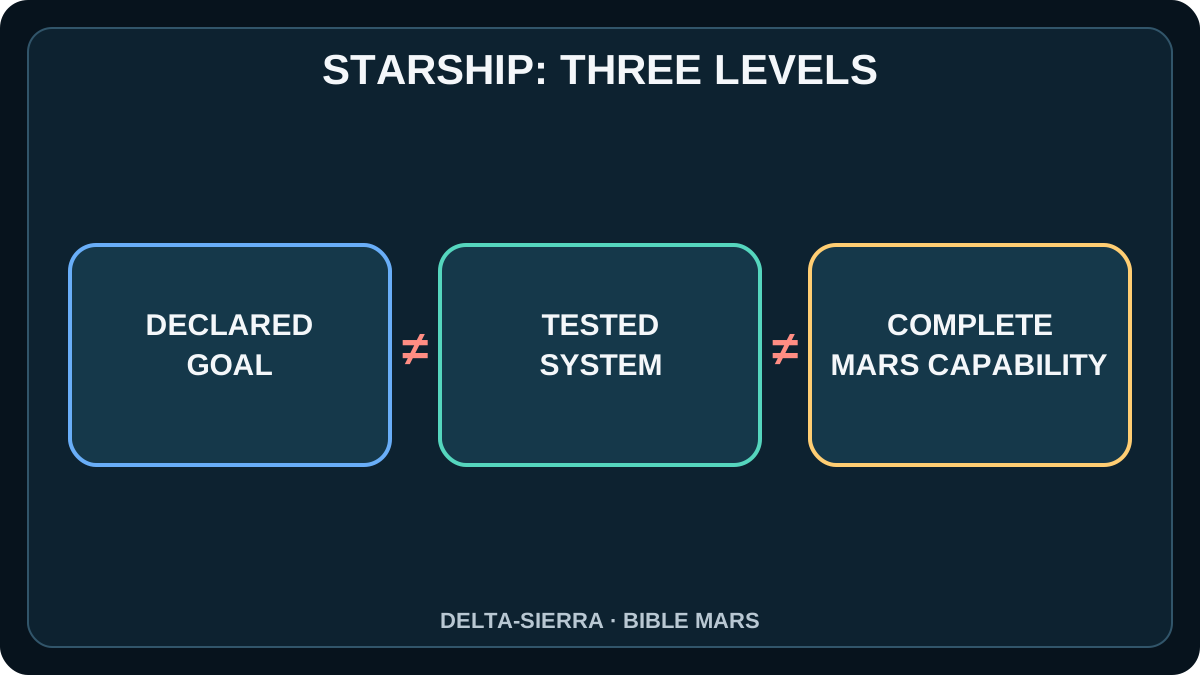
In 2026 the history has to separate three stories: the Mars objective, the Starship test program and demonstrated operational capability
SpaceX's Mars story is easy to compress into a misleading line because three levels overlap. The first is declared intent: SpaceX presents Starship as a transportation system intended for crew and cargo to Earth orbit, the Moon, Mars and beyond. The second is the actual development program: hardware is being matured through flights, redesigns, licensing, mishap investigations and operational learning. The third is a complete Mars transportation capability, which would require much more than a launch vehicle — orbital refilling, long-duration transit, Mars entry, landing, surface operations, life support, logistics and some architecture for ascent or return. Treating these levels as interchangeable turns an objective into an accomplished capability.
FAA records provide an institutional chronology independent of promotional language. The 2025 environmental process at Boca Chica evaluated an increase to as many as 25 Starship/Super Heavy orbital launches per year at that site, including associated landings, subject to licensing and safety requirements. In 2026 the FAA was still evaluating additional reentry trajectories and contingency landing areas. Those records show a test and operations infrastructure being expanded; they do not demonstrate a Mars campaign.
SpaceX's own Mars page illustrates the other side of the distinction. It describes a fully reusable system, more than 100 tonnes to orbit in a fully reusable configuration, and a Mars atmospheric-entry concept. Those are design claims and objectives from the developer, valuable as primary evidence of what the company intends. Historical method requires pairing them with what independent regulators and flight records show has actually been licensed and demonstrated.
Why cadence matters more than one spectacular flight
A settlement architecture built around large reusable vehicles depends on cadence, not merely peak payload. A single successful heavy flight can demonstrate propulsion, guidance and recovery steps. A Mars campaign requires repeated launch, turnaround, refilling, payload integration and mission operations without an unacceptable growth in failure probability or maintenance burden. The historical question therefore shifts from “can the vehicle fly?” to “can the transportation system repeat the operation at the required rate?”
This is also why regulatory documents matter to the story. Launch-site throughput, landing options, flight corridors and contingency regions are not peripheral bureaucracy; they are part of the real infrastructure that converts a prototype into an operating transportation system. The history of aviation followed a similar transformation from individual records to repeatable networks. Starship's ultimate place in Mars history will depend on whether its striking test campaign becomes a reliable logistics chain.
The Mars objective can still be historically significant even before a Mars mission exists. It has influenced vehicle sizing, public narrative, capital allocation and the choice to pursue rapid reusability at unprecedented scale. But a rigorous history should preserve the difference between influence and accomplishment. That distinction allows future readers to see exactly which parts of the vision were demonstrated, which changed, and which remained aspirations.
The decisive historical transition would be repetition, not size alone
Starship is often described through dimensions, thrust and intended payload. For Mars, the deeper discontinuity would be repetition: launch, recover, inspect, refuel and launch again at a rate high enough to turn interplanetary transportation into logistics. A very powerful but rare rocket remains an expedition tool. A frequent reusable system could change cargo count, redundancy and the way infrastructure is pre-positioned.
That is why the history should track turnaround, recovery procedures, licensing changes, vehicle losses and hardware modifications rather than flight records alone. A prototype becomes a transportation network when repetition becomes predictable. Until that condition is demonstrated at the required scale, it remains part of the program objective.
This distinction also protects the history from becoming obsolete every time a schedule changes. Dates announced for Mars may move; the engineering milestones remain more durable: orbital refilling, thermal protection reuse, payload deployment, long-duration operation, landing repeatability and campaign cadence. A history organized around demonstrated capability can survive changing forecasts.
The SpaceX/Mars story requires special discipline because the destination narrative and vehicle-development program evolve in parallel. A stated cadence, commercial price or Mars date is a company objective; it becomes demonstrated capability only through tests, repeated operations and mastery of the relevant phases. Claims therefore need dates and status labels.
For a settlement, the decisive metric will be cumulative transport reliability rather than one spectacular flight: mass actually delivered, sustained cadence, loss tolerance, return capability, surface infrastructure and replacement cost. The transition from prototype to repetitive logistics is what would make Starship historically transformative for Mars.
SpaceX currently presents Mars cargo flights as starting no earlier than 2028 and frames Starship around permanent-presence ambitions. These are recorded here as company-stated objectives, not as demonstrated Mars operational capability.
A test program should be told through what it learns, not only through success and failure labels
Developing a large reusable vehicle necessarily produces incomplete flights, configuration changes and investigations. The historically important fact is not only that a prototype was lost or one milestone achieved; it is what the program changed afterward. Flight data, regulatory constraints and infrastructure modifications reveal how an organization converts a test into knowledge.
This is directly relevant to Mars because an interplanetary campaign cannot depend on a system that is unable to learn quickly from anomalies. But the opposite shortcut must also be avoided: high terrestrial test cadence does not automatically demonstrate Mars mission cadence. Orbital refilling, transit, Mars entry and operation far from terrestrial maintenance remain additional domains.
Regulation is part of the operational history
The FAA record is useful because it captures the difference between company intent and authorized operations. Environmental review, flight-safety analysis, hazard areas, landing options and mishap investigations create an institutional record of what the system was actually being prepared to do at a given date. That record is less dramatic than a launch video but often more precise historically.
The Mars story should preserve superseded designs instead of pretending the vehicle was always inevitable
ITS, BFR and later Starship configurations changed dimensions, materials, propulsion details and mission presentation. Those changes are part of the engineering history. A design that disappears is not wasted archival space; it shows which assumptions were abandoned and which objectives survived.
Preserving the design lineage also prevents retrospective inevitability. SpaceX did not begin with a fully formed final Starship and march through a predetermined plan. The architecture evolved under test results, manufacturing experience, funding, regulation and mission opportunities. That makes the story more interesting — and more accurate — than a straight line from Mars Oasis to a future city.
Reusability changes the unit of analysis from vehicle performance to fleet economics
If a launch system is expendable, much of the economic analysis can be attached to one mission. A reusable architecture shifts attention toward turnaround, refurbishment, propellant logistics, pad throughput, vehicle lifetime and the number of flights required to move one Mars payload. A Starship-class Mars proposal is therefore inseparable from a fleet model.
Orbital refilling makes this especially clear. A Mars-bound vehicle may represent only one visible spacecraft while its departure depends on multiple tanker operations, storage duration, rendezvous and transfer performance. The mission architecture is the collection of those flights. Until those functions are demonstrated at the necessary scale, a payload number for one vehicle does not by itself describe delivered Mars capability.
Cadence is an engineering parameter because Mars windows are unforgiving
Earth–Mars opportunities recur on a roughly 26-month rhythm. A campaign that misses a launch period cannot simply move every shipment a few weeks later. That couples factory output, launch-site throughput, orbital operations and surface inventory to celestial mechanics. High launch cadence near Earth has strategic value because it can concentrate a large logistics pulse into a finite departure season.
The historical record should therefore distinguish three cadences: vehicle production, terrestrial launch operations and successful interplanetary dispatch. They are related but not identical. A bottleneck in any one can dominate the number of useful Mars departures.
The most valuable historical archive may be configuration history
For a rapidly changing program, a table of dimensions or engine counts frozen on one date quickly becomes misleading. A better historical method records configuration with date, test flight and source. That allows later readers to see which changes preceded a new capability and which were only proposed.
This discipline is particularly important for Starship because vehicle generations, ground systems and regulatory approvals can change faster than long-form articles are rewritten. A Mars reference should preserve dated claims instead of silently updating the past to resemble the present.
What SpaceX says today — and what still has to be demonstrated
SpaceX’s Mars page in 2026 presents Starship as a system intended to carry people and cargo to Mars, describes a self-sustaining city as the long-term objective, and frames the eventual challenge in terms of enormous cargo mass and population scale. [S13] Those statements are essential for understanding the company’s vision, but they remain declared objectives. Mars flights, interplanetary cadence, large-scale refueling, long-duration survival and autonomous industry are capabilities that still have to be demonstrated.
The lunar program is also a real operational test bed
NASA is developing a Starship Human Landing System with SpaceX for Artemis. [S70] A lunar lander does not prove a Mars settlement, but the program forces work on rendezvous, propellant transfer, crew operations and reliability that matter to deep-space systems.
Public priorities also evolve. In 2026 Musk stated that SpaceX would prioritize a faster path toward a self-growing lunar city while retaining Mars as a longer-term objective. [S72] The distinction is important: a long-term destination can remain part of the vision while the sequence of intermediate objectives changes.
Mars as an organizing objective rather than a single mission
SpaceX differs from many earlier Mars studies because Mars is presented not as one flagship expedition but as the reason to build a transportation capability that can fly repeatedly. The company’s public architecture links launch cost, reuse, orbital refueling, high flight rate and large payload capacity. In that logic, the rocket is only the first layer: a settlement would still need power, habitats, life support, surface mobility, communications, maintenance, food production and eventually industry.
Organisation deep dive
This sequence complements the historical narrative with the technical capabilities that determine the credibility of a Mars transportation architecture.
GO FURTHER
Mars Library
This book extends the page with a complete settlement architecture. The dossier above remains deliberately self-contained: Arcadia is optional further reading, not a prerequisite for understanding it.

Raptor and methalox: why engine choice matters for Mars
Starship uses engines burning liquid methane and liquid oxygen. For Mars this matters because methane is not only a terrestrial launch propellant: it can be connected to architectures that study local propellant production from Martian resources. That does not mean an operational Mars propellant plant exists today. It means propulsion and ISRU can be designed as parts of the same logistics chain rather than as unrelated technologies.
Orbital refueling: the bridge between an Earth launcher and interplanetary transport
A very large vehicle can reach Earth orbit without carrying all the propellant needed for an interplanetary mission. Starship therefore relies on propellant transfer in orbit. This turns one mission into a campaign of flights involving launchers, rendezvous, cryogenic storage, transfer, thermal control and inventory verification. For Mars this is structurally important because part of the challenge moves from one enormous vehicle into a repeatable orbital infrastructure.
Reentry, thermal protection and reuse: return in order to fly again
Full reuse is more than landing a stage. Structure, engines, thermal protection, actuators and avionics must survive with degradation compatible with another flight. Starship adds the challenge of returning the upper vehicle through a high-energy atmospheric entry. For a Mars transport architecture, reuse has economic value only if inspection, maintenance and turnaround themselves become industrial processes rather than heroic one-off operations.
Industrial cadence: when vehicle count becomes an architecture variable
A Mars settlement would require masses far beyond those of a conventional science mission. SpaceX addresses this by emphasizing production and operational cadence: many vehicles, many engines and repeated launches. The important point is not any single future production number but the philosophy. If total transported mass rises by orders of magnitude, the economics can no longer resemble a hand-built prototype program. Manufacturing, quality control, spares and ground facilities become part of the Mars architecture.
Ground infrastructure: the invisible half of Starship
A rocket never exists by itself. It depends on launch pads, tanks, loading systems, electrical power, safety systems, communications, test areas and trained teams able to repeat operations. Starship development therefore illustrates an often-overlooked truth about Mars exploration: before infrastructure can be built on Mars, Earth must already possess infrastructure capable of producing and launching the means to build it. Space industrialization begins long before interplanetary departure.
From Mars ambition to evidence: what should be watched next
A serious SpaceX dossier must separate goals from demonstrations. The most useful indicators of progress toward Mars are long-duration tests, engine reliability, reentry and recovery, propellant transfer, actual launch cadence, large-mass delivery to orbit and demonstrations of systems needed for deep-space missions. Announced dates can move; demonstrated capabilities remain measurable building blocks.
Operations at scale: why repetition changes engineering
When a system flies rarely, engineers can devote extraordinary attention to every operation. High cadence changes the problem. Procedures must be standardized, anomalies classified quickly, maintenance data fed back into manufacturing and ground crews protected from fatigue. This matters to Mars because a transport architecture serving a settlement cannot depend permanently on exceptional improvisation. Repetition must become a source of learning rather than a source of accumulated risk.
Interfaces with NASA and the wider space ecosystem
SpaceX is a private company, but much of its operational maturity developed inside a broader ecosystem of public requirements, customer missions, range safety, certification and international supply chains. Dragon and Falcon operations with NASA illustrate how an ambitious private development program can be forced to demonstrate repeatable performance under external mission requirements. For Mars, this history matters because a future interplanetary system will also have to interact with scientific payloads, communications networks, planetary-protection rules and partners outside the company.
NASA’s Commercial Orbital Transportation Services effort and later station resupply contracts changed the scale of SpaceX. The company now had measurable operational goals: reach orbit, maneuver, approach the International Space Station, deliver cargo, return to Earth and repeat the process. In May 2012 Dragon became the first commercial spacecraft to reach the ISS and return cargo to Earth. The milestone matters for Mars because it forced SpaceX beyond spectacular prototypes into recurring operations.
Falcon 9 evolved into a platform. Flight rate increased, procedures became more standardized and data from operations fed back into design. Dragon added another layer: redundant avionics, rendezvous, a pressurized environment and recovery. Crew Dragon later restored a regular US capability to carry astronauts to the ISS. None of these capabilities is equivalent to a Mars mission, but together they develop an operational culture in certification, mission assurance, integration with a public agency, abort systems and repeated flight.
The distinction remains essential: Falcon 9 success does not prove Starship, and Dragon success does not prove a long-duration interplanetary habitat. Radiation, consumables, medical autonomy, maintenance and Mars entry are different problems. The value of Falcon and Dragon lies in showing how a company can move from a few tests to a transportation service.
A launch company can survive on spectacular tests. An institutional customer demands something else: documentation, reviews, repeatability, safety, supply-chain control and the ability to explain anomalies. NASA’s COTS program was not an applause line for private rockets. It progressively purchased and demonstrated cargo transportation capability to the International Space Station through technical and contractual milestones. NASA’s COTS history and the COTS 2/3 mission document that transformation. [M3]
Dragon’s 2012 ISS mission changes the nature of the story. A private system no longer merely inserts an object into orbit; it approaches crewed infrastructure, performs rendezvous operations and delivers cargo. Crew Dragon then adds the hardest requirement: carrying people. NASA records Demo-2 in May 2020 as the return of crewed orbital launch from U.S. soil aboard a SpaceX system, followed by certification of Falcon 9, Dragon and associated ground systems for regular crew missions. [M5][M6]
For the Mars history of SpaceX, this episode matters more than many Mars speeches. It shows how aspiration becomes institutionally verified capability. A Martian settlement will need inventors, but it will also need thousands of dull and accurate procedures, configuration reviews, qualification plans, cross-checks and a culture in which anomalies are surfaced rather than hidden. The paradox is that the most adventurous projects become possible through extremely disciplined work.
Maintenance, inspection and the learning loop
The economic promise of reuse depends less on a spectacular landing than on what happens afterwards. A recovered vehicle must be inspected, flight data compared with models, life-limited components tracked and anomalies fed back into design. As cadence increases, this learning loop must become standardized and data-driven. A Mars architecture would add another constraint: some maintenance would eventually have to be performed far from the terrestrial factory, with limited spares and communication delays that prevent immediate expert intervention.
Digital engineering as a cadence multiplier
High-cadence programs generate enormous volumes of telemetry, test reports and hardware configurations. Performance then depends on linking serial numbers, software versions, manufacturing changes and flight behavior. This traceability can look administrative, yet it is a safety technology: it reveals whether an anomaly is unique or affects an entire vehicle family. A repeatable Mars fleet would require exactly this discipline to avoid carrying the same hidden defect across several missions.
Propellant logistics as an industrial system
Orbital propellant transfer is often described as one maneuver, but an operational system would require production, launch scheduling, tank conditioning, rendezvous, transfer verification and contingency rules. The architecture therefore has to be evaluated as logistics, not merely as a plumbing experiment. For Mars, the value lies in decoupling how much propellant a single launch can carry from how much an interplanetary vehicle can ultimately depart with.
Why Mars arrival is a different problem from Earth return
A vehicle designed to survive Earth reentry still faces a distinct Martian entry problem because atmospheric density, gravity, arrival velocity and available landing infrastructure differ. A Mars transport system must therefore connect interplanetary navigation, thermal protection, aerodynamic control and powered descent into one sequence. Success in one atmospheric environment is evidence of relevant capability, but not a substitute for Mars-specific validation.
Surface turnaround and the question of local infrastructure
If a transport vehicle is expected to leave Mars again, the surface becomes part of the transportation system. Propellant production, power, storage, loading, inspection and launch-site operations must exist before the return vehicle can be treated as reusable in practice. This reverses the usual mental model: the spacecraft does not simply deliver a base; the base may have to become part of the spacecraft's propulsion and maintenance architecture.
Human factors and operational discipline at interplanetary scale
An interplanetary transport system is also a human organization. Crews, controllers, launch teams and maintenance personnel must make decisions under fatigue, uncertainty and schedule pressure. High automation does not eliminate human factors; it changes where errors can occur. Procedures must therefore be designed for clear handovers, unambiguous states and recovery from incorrect assumptions. For Mars, this becomes even more important because the crew and the Earth team cannot share a real-time conversation during critical events. Training, simulation and decision authority become parts of the vehicle architecture just as surely as engines and tanks. A company pursuing repeated Mars flights would eventually need to demonstrate not only hardware performance but a mature operational culture capable of handling routine missions, rare emergencies and lessons that propagate across a fleet.