DELTA-SIERRAMARSEXPLORE · UNDERSTAND · SETTLE
Support my work

MARS BIBLE — ORGANISATIONS

China’s space program: history, capabilities, technology and its place in Mars exploration

Tianwen-1, Zhurong, Tianwen-3 and China’s institutional architecture: reconstructing a fragmented public picture without confusing official facts with foreign assessments.

BEFORE MARS — HOW THE ORGANIZATION WAS BORN

Before Mars: how Chinese space program / CNSA came into being

CreatedCNSA: 1993; Chinese space industry: 1956
Age
OriginsNational program developed since 1956 and now distributed across multiple institutions
TypeCivil administration, state industrial ecosystem and distinct programs

China’s space program is older than CNSA. Official Chinese documents date the start of the national space industry to 1956. China then developed its own launch vehicles and placed Dongfanghong-1 in orbit on April 24, 1970, becoming the fifth country able to launch its own satellite. That chronology matters: the Chinese space system was first built as a network of institutes, factories and state organizations before the civilian administration now known publicly as CNSA appeared.

The China National Space Administration was created in 1993 as part of a restructuring of the sector. It performs policy, coordination and international-representation functions, but it is not an exact counterpart to NASA. Much design and manufacturing is carried out by state industrial groups, while human spaceflight is managed through a separate structure. This architecture helps explain why public information is often distributed across administrations, academies, companies and mission announcements.

That fragmentation is not merely an inconvenience for foreign observers; it is a feature of the system. Reconstructing a program such as Tianwen requires cross-checking CNSA, scientific institutions, the companies that build launchers and spacecraft, scientific publications and sometimes foreign assessments. Transparency is therefore organized differently from that of major Western agencies.

Mars arrived late in this institutional history, but Tianwen-1 demonstrated that many required building blocks had already accumulated: heavy launch, interplanetary navigation, deep-space communications, atmospheric entry, autonomous landing, rover operations and science. Understanding the program’s origins makes Tianwen look less like a sudden miracle and more like the result of decades of industrial and institutional construction.

Founding sources: CNSA — China’s Space Program: 2021 Perspective · CNSA — historical review

Direct answer: why China’s space program matters to the story of Mars

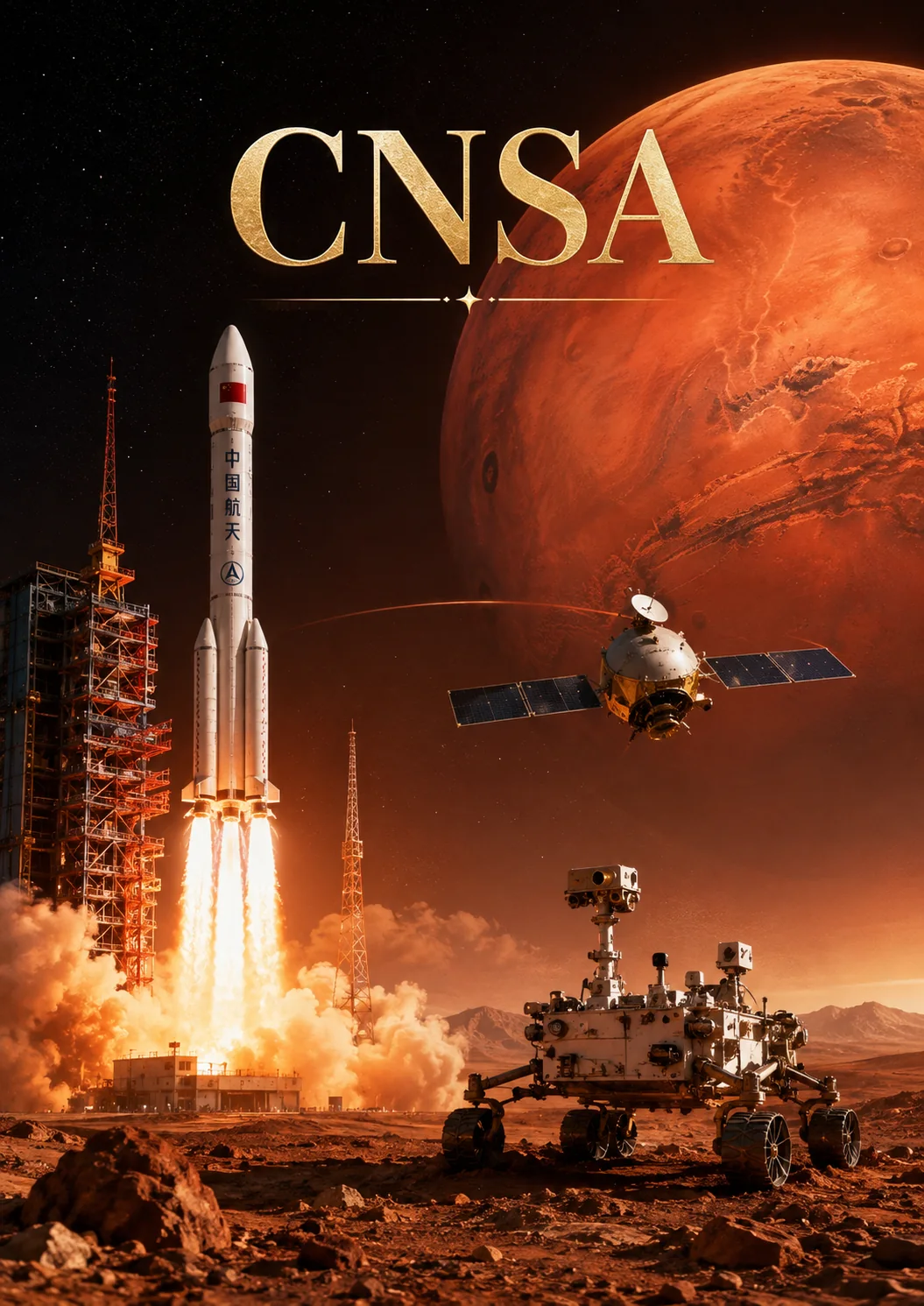
China’s space program deserves its own dossier because Tianwen-1 orbited Mars and deployed the Zhurong rover in 2021. [1] The goal is not to rank organizations but to understand one as a system: history, decision centers, infrastructure, technologies, successes, failures and the capabilities it contributes — directly or indirectly — to Mars exploration.

Tianwen-1, Zhurong, Tianwen-3 and China’s institutional architecture: reconstructing a fragmented public picture without confusing official facts with foreign assessments. This dossier separates demonstrated achievements, formally committed programs and prospective concepts. Institutional sources are preferred; where an outside assessment is used, its origin is labelled explicitly.

China methodology: do not mix five levels of evidence

China's space program is described by Chinese official sources, scientific publications, industrial communications and foreign assessments. They answer different questions. This dossier labels five levels: OBSERVED for events or hardware actually verified; CHINESE OFFICIAL for CNSA/government statements; NATIONAL PLAN for approved roadmaps; EXTERNAL ASSESSMENT for DoD/ODNI or other outside analysis; and NOT ESTABLISHED where public evidence is insufficient.

An important correction: the idea of a single “ten-year Party plan targeting Mars” does not exactly match the currently accessible official documents. China’s 2024 national space-science program runs through 2050 in three phases, while CNSA separately describes four approved planetary missions to be completed over roughly 10–15 years. The sources used here do not establish an official public date for a Chinese crewed landing on Mars.

Essential timeline

  • 2000s2000s deep-space capability buildup
  • 20202020 Tianwen-1 launch
  • 20212021 Mars orbit/landing/Zhurong
  • 20242024 approval detail for planetary exploration roadmap
  • 20242024 national space-science plan through 2050
  • 20262026 Tianwen-3 architecture publicly detailed
  • aroundaround 2028 Tianwen-3 planned launch
  • aroundaround 2031 planned sample return

Understand the organisation before looking at its rockets

A space organisation is never just a logo, a launch vehicle or a spectacular mission. To understand China’s space program, one must separate political goal-setting, program management, engineering centers, industrial manufacturing, science teams and mission operations. This matters especially for Mars because a successful interplanetary mission requires many chains to remain coherent for years, across institutions that do not always share the same incentives or vocabulary. In this case, one useful anchor is that Tianwen-1 orbited Mars and deployed the Zhurong rover in 2021. [1] Another is that China approved four planetary exploration missions including Tianwen-3 for Mars sample return. [2] These are verifiable facts; by themselves they do not guarantee success of any future program.

The theme institutional architecture is therefore best understood as a chain of functions rather than a keyword. A useful way to make this topic reproducible is to treat it as an input-output balance. What resources enter the subsystem? How much power does it consume? What data does it produce? What heat must be rejected? What degraded mode remains after a fault? This turns technical vocabulary into a chain of verifiable decisions. This helps non-specialists see why an apparently secondary property can become mission-critical millions of kilometres from Earth.

For Mars the useful question is: what dependency does this subsystem create? Even if China’s space program masters one capability, it must still interface with transportation, power, communications, navigation and science operations. Real maturity lives at that boundary between local expertise and global architecture.

Institutional schedules must also be separated from physical constraints. Announcements can move; planetary geometry, mass, power and the speed of light do not negotiate. The dossier therefore gives priority to material evidence — tests, integrated hardware, launches and returned data — where available.

Why Mars exposes the true maturity of a space program

Mars is an unforgiving maturity test. Communications are delayed, launch windows are infrequent, mass and energy margins are tight, atmospheric entry is difficult and onboard autonomy matters more than in near-Earth operations. Looking at China’s space program through Mars therefore reveals not only what it announces but which capabilities it can actually integrate, test and operate. In this case, one useful anchor is that China approved four planetary exploration missions including Tianwen-3 for Mars sample return. [2] Another is that in April 2026 CNSA described Tianwen-3 launching around 2028 and returning samples around 2031. [3] These are verifiable facts; by themselves they do not guarantee success of any future program.

The theme Long March 5 is therefore best understood as a chain of functions rather than a keyword. Margin is a central engineering concept. A system is not designed only for a nominal point: it must absorb manufacturing dispersion, ageing, environmental uncertainty and imperfect models. Too little margin increases risk; excessive margin adds mass and cost. Engineering is the art of placing margin where it actually protects the mission. This helps non-specialists see why an apparently secondary property can become mission-critical millions of kilometres from Earth.

For Mars the useful question is: what dependency does this subsystem create? Even if China’s space program masters one capability, it must still interface with transportation, power, communications, navigation and science operations. Real maturity lives at that boundary between local expertise and global architecture.

Institutional schedules must also be separated from physical constraints. Announcements can move; planetary geometry, mass, power and the speed of light do not negotiate. The dossier therefore gives priority to material evidence — tests, integrated hardware, launches and returned data — where available.

The technical chain from Earth to the Martian system

For the public a mission may seem to start at launch. For engineers it starts far earlier with requirements, interfaces, verification, margins, software, navigation, thermal control and communications. The theme of autonomous navigation illustrates this systems view. Each subsystem has its own physics, yet a mission can still fail at the interfaces. Integration is therefore a capability in its own right. In this case, one useful anchor is that in April 2026 CNSA described Tianwen-3 launching around 2028 and returning samples around 2031. [3] Another is that the 2024-2050 national space-science plan has three phases: through 2027, 2028-2035 and 2036-2050. [4] These are verifiable facts; by themselves they do not guarantee success of any future program.

The theme autonomous navigation is therefore best understood as a chain of functions rather than a keyword. Redundancy is not automatically equivalent to safety. Two identical units may share the same software, power source or manufacturing defect. Serious analysis therefore searches for common-cause failures. On Mars this matters because a backup that fails for the same reason as the primary is not a real backup. This helps non-specialists see why an apparently secondary property can become mission-critical millions of kilometres from Earth.

For Mars the useful question is: what dependency does this subsystem create? Even if China’s space program masters one capability, it must still interface with transportation, power, communications, navigation and science operations. Real maturity lives at that boundary between local expertise and global architecture.

Institutional schedules must also be separated from physical constraints. Announcements can move; planetary geometry, mass, power and the speed of light do not negotiate. The dossier therefore gives priority to material evidence — tests, integrated hardware, launches and returned data — where available.

Why failures often teach more than success releases

Space history is full of failures, anomalies and redesigns. They do not automatically diminish an organisation; they reveal whether it can learn. A failure becomes useful when its cause is understood, procedures change and the next design absorbs the lesson. On Mars, where another attempt may wait for a new planetary window, institutional learning is an engineering asset. In this case, one useful anchor is that the 2024-2050 national space-science plan has three phases: through 2027, 2028-2035 and 2036-2050. [4] Another is that the official documents reviewed here do not set a public date for a Chinese crewed Mars landing. [5] These are verifiable facts; by themselves they do not guarantee success of any future program.

The theme entry-descent-landing is therefore best understood as a chain of functions rather than a keyword. Availability depends on both reliability and repairability. A component may fail rarely yet immobilize a system for weeks; another may fail more often but be replaced in hours. For a future Mars base, diagnosis, repair and local manufacturing can therefore matter as much as initial performance. This helps non-specialists see why an apparently secondary property can become mission-critical millions of kilometres from Earth.

For Mars the useful question is: what dependency does this subsystem create? Even if China’s space program masters one capability, it must still interface with transportation, power, communications, navigation and science operations. Real maturity lives at that boundary between local expertise and global architecture.

Institutional schedules must also be separated from physical constraints. Announcements can move; planetary geometry, mass, power and the speed of light do not negotiate. The dossier therefore gives priority to material evidence — tests, integrated hardware, launches and returned data — where available.

Communications: commanding a machine that is no longer “live”

At interplanetary distance the word remote control changes meaning. Light-time delay cannot be negotiated away. Spacecraft must protect themselves, wait, diagnose some conditions and execute sequences without asking Earth for permission every second. The theme of Zhurong therefore combines ground antennas, radio power, coding, onboard storage, mission planning and autonomous software. In this case, one useful anchor is that the official documents reviewed here do not set a public date for a Chinese crewed Mars landing. [5] Another is that U.S. DoD/ODNI reports separately assess civil-military links and Chinese space capabilities from a security perspective; those are external assessments, not CNSA documents. [6] These are verifiable facts; by themselves they do not guarantee success of any future program.

The theme Zhurong is therefore best understood as a chain of functions rather than a keyword. Software must be treated like physical hardware because it commands valves, engines, batteries and critical sequences. Robust architectures isolate functions, monitor inconsistent states, preserve safe modes and retain enough observability to understand automated decisions. Useful autonomy is not the absence of humans; it is the ability to remain understandable when humans cannot intervene immediately. This helps non-specialists see why an apparently secondary property can become mission-critical millions of kilometres from Earth.

For Mars the useful question is: what dependency does this subsystem create? Even if China’s space program masters one capability, it must still interface with transportation, power, communications, navigation and science operations. Real maturity lives at that boundary between local expertise and global architecture.

Institutional schedules must also be separated from physical constraints. Announcements can move; planetary geometry, mass, power and the speed of light do not negotiate. The dossier therefore gives priority to material evidence — tests, integrated hardware, launches and returned data — where available.

Why mass governs almost everything

Every kilogram sent to Mars propagates through the design: structure, propulsion, thermal needs, power, atmospheric entry and surface logistics. Mass discipline is not simply about making hardware light; it is about knowing where an extra kilogram buys robustness or science. The architectures of China’s space program can therefore be read as repeated trades among mass, energy, risk, cost and schedule. In this case, one useful anchor is that U.S. DoD/ODNI reports separately assess civil-military links and Chinese space capabilities from a security perspective; those are external assessments, not CNSA documents. [6] Another is that Tianwen-1 orbited Mars and deployed the Zhurong rover in 2021. [7] These are verifiable facts; by themselves they do not guarantee success of any future program.

The theme subsurface radar is therefore best understood as a chain of functions rather than a keyword. A useful way to make this topic reproducible is to treat it as an input-output balance. What resources enter the subsystem? How much power does it consume? What data does it produce? What heat must be rejected? What degraded mode remains after a fault? This turns technical vocabulary into a chain of verifiable decisions. This helps non-specialists see why an apparently secondary property can become mission-critical millions of kilometres from Earth.

For Mars the useful question is: what dependency does this subsystem create? Even if China’s space program masters one capability, it must still interface with transportation, power, communications, navigation and science operations. Real maturity lives at that boundary between local expertise and global architecture.

Institutional schedules must also be separated from physical constraints. Announcements can move; planetary geometry, mass, power and the speed of light do not negotiate. The dossier therefore gives priority to material evidence — tests, integrated hardware, launches and returned data — where available.

Science and engineering must learn each other’s language

A science instrument may demand stability, temperature control or viewing geometry that complicates the spacecraft. A systems team may simplify the vehicle so aggressively that scientific value is lost. Strong missions make these communities converge early. The theme of sample return shows how a scientific question becomes a requirement, an instrument, an interface, an operations sequence and finally interpretable data. In this case, one useful anchor is that Tianwen-1 orbited Mars and deployed the Zhurong rover in 2021. [7] Another is that China approved four planetary exploration missions including Tianwen-3 for Mars sample return. [1] These are verifiable facts; by themselves they do not guarantee success of any future program.

The theme sample return is therefore best understood as a chain of functions rather than a keyword. Margin is a central engineering concept. A system is not designed only for a nominal point: it must absorb manufacturing dispersion, ageing, environmental uncertainty and imperfect models. Too little margin increases risk; excessive margin adds mass and cost. Engineering is the art of placing margin where it actually protects the mission. This helps non-specialists see why an apparently secondary property can become mission-critical millions of kilometres from Earth.

For Mars the useful question is: what dependency does this subsystem create? Even if China’s space program masters one capability, it must still interface with transportation, power, communications, navigation and science operations. Real maturity lives at that boundary between local expertise and global architecture.

Institutional schedules must also be separated from physical constraints. Announcements can move; planetary geometry, mass, power and the speed of light do not negotiate. The dossier therefore gives priority to material evidence — tests, integrated hardware, launches and returned data — where available.

From one-off missions to infrastructure

A program becomes more powerful when it stops rebuilding every capability from zero. Reusable software, standards, test facilities, ground networks, teams and interfaces lower the cognitive cost of the next mission. This is why the history of China’s space program is more interesting than a list of launches: the key question is which capabilities persist across generations. In this case, one useful anchor is that China approved four planetary exploration missions including Tianwen-3 for Mars sample return. [1] Another is that in April 2026 CNSA described Tianwen-3 launching around 2028 and returning samples around 2031. [2] These are verifiable facts; by themselves they do not guarantee success of any future program.

The theme ascent-orbiter-reentry chain is therefore best understood as a chain of functions rather than a keyword. Redundancy is not automatically equivalent to safety. Two identical units may share the same software, power source or manufacturing defect. Serious analysis therefore searches for common-cause failures. On Mars this matters because a backup that fails for the same reason as the primary is not a real backup. This helps non-specialists see why an apparently secondary property can become mission-critical millions of kilometres from Earth.

For Mars the useful question is: what dependency does this subsystem create? Even if China’s space program masters one capability, it must still interface with transportation, power, communications, navigation and science operations. Real maturity lives at that boundary between local expertise and global architecture.

Institutional schedules must also be separated from physical constraints. Announcements can move; planetary geometry, mass, power and the speed of light do not negotiate. The dossier therefore gives priority to material evidence — tests, integrated hardware, launches and returned data — where available.

Partners: autonomy does not mean isolation

Even major space powers depend on partners for instruments, ground stations, launch services, laboratories, components or science expertise. Cooperation can accelerate a mission but also creates dependencies. A Mars architecture therefore needs to decide what may be shared, what should be redundant and which strategic capabilities an actor wants to control directly. In this case, one useful anchor is that in April 2026 CNSA described Tianwen-3 launching around 2028 and returning samples around 2031. [2] Another is that the 2024-2050 national space-science plan has three phases: through 2027, 2028-2035 and 2036-2050. [3] These are verifiable facts; by themselves they do not guarantee success of any future program.

The theme 2024-2050 space science is therefore best understood as a chain of functions rather than a keyword. Availability depends on both reliability and repairability. A component may fail rarely yet immobilize a system for weeks; another may fail more often but be replaced in hours. For a future Mars base, diagnosis, repair and local manufacturing can therefore matter as much as initial performance. This helps non-specialists see why an apparently secondary property can become mission-critical millions of kilometres from Earth.

For Mars the useful question is: what dependency does this subsystem create? Even if China’s space program masters one capability, it must still interface with transportation, power, communications, navigation and science operations. Real maturity lives at that boundary between local expertise and global architecture.

Institutional schedules must also be separated from physical constraints. Announcements can move; planetary geometry, mass, power and the speed of light do not negotiate. The dossier therefore gives priority to material evidence — tests, integrated hardware, launches and returned data — where available.

Technical data explained in plain language

A technical number matters only if its consequence is understood. Thrust tells us how much mass can be accelerated; electrical power determines what computers and instruments can do; data rate constrains how many images and spectra can be returned; navigation accuracy shapes the arrival corridor. This dossier keeps sourced numbers but always links them to mission consequences. In this case, one useful anchor is that the 2024-2050 national space-science plan has three phases: through 2027, 2028-2035 and 2036-2050. [3] Another is that the official documents reviewed here do not set a public date for a Chinese crewed Mars landing. [4] These are verifiable facts; by themselves they do not guarantee success of any future program.

The theme OSINT and civil-military assessment is therefore best understood as a chain of functions rather than a keyword. Software must be treated like physical hardware because it commands valves, engines, batteries and critical sequences. Robust architectures isolate functions, monitor inconsistent states, preserve safe modes and retain enough observability to understand automated decisions. Useful autonomy is not the absence of humans; it is the ability to remain understandable when humans cannot intervene immediately. This helps non-specialists see why an apparently secondary property can become mission-critical millions of kilometres from Earth.

For Mars the useful question is: what dependency does this subsystem create? Even if China’s space program masters one capability, it must still interface with transportation, power, communications, navigation and science operations. Real maturity lives at that boundary between local expertise and global architecture.

Institutional schedules must also be separated from physical constraints. Announcements can move; planetary geometry, mass, power and the speed of light do not negotiate. The dossier therefore gives priority to material evidence — tests, integrated hardware, launches and returned data — where available.

Maturity: demonstrated, qualified, planned or merely studied

Space programs use words that may sound similar but are not equivalent. A studied technology is not built hardware; a ground prototype is not flight-qualified equipment; an approved mission is not a launched mission. For China’s space program, this dossier separates achievements, committed programs, announced schedules and prospective concepts so that ambition is not silently converted into fact. In this case, one useful anchor is that the official documents reviewed here do not set a public date for a Chinese crewed Mars landing. [4] Another is that U.S. DoD/ODNI reports separately assess civil-military links and Chinese space capabilities from a security perspective; those are external assessments, not CNSA documents. [5] These are verifiable facts; by themselves they do not guarantee success of any future program.

The theme institutional architecture is therefore best understood as a chain of functions rather than a keyword. A useful way to make this topic reproducible is to treat it as an input-output balance. What resources enter the subsystem? How much power does it consume? What data does it produce? What heat must be rejected? What degraded mode remains after a fault? This turns technical vocabulary into a chain of verifiable decisions. This helps non-specialists see why an apparently secondary property can become mission-critical millions of kilometres from Earth.

For Mars the useful question is: what dependency does this subsystem create? Even if China’s space program masters one capability, it must still interface with transportation, power, communications, navigation and science operations. Real maturity lives at that boundary between local expertise and global architecture.

Institutional schedules must also be separated from physical constraints. Announcements can move; planetary geometry, mass, power and the speed of light do not negotiate. The dossier therefore gives priority to material evidence — tests, integrated hardware, launches and returned data — where available.

What this organisation contributes specifically to Mars

The Mars relevance of China’s space program is better measured through transferable capabilities — Long March 5, deep-space navigation, autonomy, sample return, surface operations, instrumentation or transportation — than by counting how often the word Mars appears in public messaging. An organisation can matter greatly to Mars without currently running a human settlement program. In this case, one useful anchor is that U.S. DoD/ODNI reports separately assess civil-military links and Chinese space capabilities from a security perspective; those are external assessments, not CNSA documents. [5] Another is that Tianwen-1 orbited Mars and deployed the Zhurong rover in 2021. [6] These are verifiable facts; by themselves they do not guarantee success of any future program.

The theme Long March 5 is therefore best understood as a chain of functions rather than a keyword. Margin is a central engineering concept. A system is not designed only for a nominal point: it must absorb manufacturing dispersion, ageing, environmental uncertainty and imperfect models. Too little margin increases risk; excessive margin adds mass and cost. Engineering is the art of placing margin where it actually protects the mission. This helps non-specialists see why an apparently secondary property can become mission-critical millions of kilometres from Earth.

For Mars the useful question is: what dependency does this subsystem create? Even if China’s space program masters one capability, it must still interface with transportation, power, communications, navigation and science operations. Real maturity lives at that boundary between local expertise and global architecture.

Institutional schedules must also be separated from physical constraints. Announcements can move; planetary geometry, mass, power and the speed of light do not negotiate. The dossier therefore gives priority to material evidence — tests, integrated hardware, launches and returned data — where available.

The people behind the systems

Vehicles are visible; organizations are less so. Behind every mission stand design teams, quality engineers, operators, scientists and specialists in software, propulsion, materials and communications. Much of their job is to make the extraordinary repeatable: turn intuition into requirements, a one-time sequence into procedure and an anomaly into a design rule. In this case, one useful anchor is that Tianwen-1 orbited Mars and deployed the Zhurong rover in 2021. [6] Another is that China approved four planetary exploration missions including Tianwen-3 for Mars sample return. [7] These are verifiable facts; by themselves they do not guarantee success of any future program.

The theme autonomous navigation is therefore best understood as a chain of functions rather than a keyword. Redundancy is not automatically equivalent to safety. Two identical units may share the same software, power source or manufacturing defect. Serious analysis therefore searches for common-cause failures. On Mars this matters because a backup that fails for the same reason as the primary is not a real backup. This helps non-specialists see why an apparently secondary property can become mission-critical millions of kilometres from Earth.

For Mars the useful question is: what dependency does this subsystem create? Even if China’s space program masters one capability, it must still interface with transportation, power, communications, navigation and science operations. Real maturity lives at that boundary between local expertise and global architecture.

Institutional schedules must also be separated from physical constraints. Announcements can move; planetary geometry, mass, power and the speed of light do not negotiate. The dossier therefore gives priority to material evidence — tests, integrated hardware, launches and returned data — where available.

What to watch over the next decade

To follow China’s space program, it is more useful to watch funded missions, hardware entering integration, system tests, launch contracts, planetary windows and qualification of critical elements than to count distant announcements. Dates may move; physical hardware and verification campaigns usually provide a stronger signal of real progress. In this case, one useful anchor is that China approved four planetary exploration missions including Tianwen-3 for Mars sample return. [7] Another is that in April 2026 CNSA described Tianwen-3 launching around 2028 and returning samples around 2031. [1] These are verifiable facts; by themselves they do not guarantee success of any future program.

The theme entry-descent-landing is therefore best understood as a chain of functions rather than a keyword. Availability depends on both reliability and repairability. A component may fail rarely yet immobilize a system for weeks; another may fail more often but be replaced in hours. For a future Mars base, diagnosis, repair and local manufacturing can therefore matter as much as initial performance. This helps non-specialists see why an apparently secondary property can become mission-critical millions of kilometres from Earth.

For Mars the useful question is: what dependency does this subsystem create? Even if China’s space program masters one capability, it must still interface with transportation, power, communications, navigation and science operations. Real maturity lives at that boundary between local expertise and global architecture.

Institutional schedules must also be separated from physical constraints. Announcements can move; planetary geometry, mass, power and the speed of light do not negotiate. The dossier therefore gives priority to material evidence — tests, integrated hardware, launches and returned data — where available.

Mars as a system of systems

A Mars settlement would not be one large science mission. It would be a network of transportation, energy, habitats, health, communications, local production, mobility and maintenance. The theme of Zhurong is therefore one node in a larger architecture. Studying China’s space program helps reveal which nodes are already mature, which are developing and which still depend on other actors. In this case, one useful anchor is that in April 2026 CNSA described Tianwen-3 launching around 2028 and returning samples around 2031. [1] Another is that the 2024-2050 national space-science plan has three phases: through 2027, 2028-2035 and 2036-2050. [2] These are verifiable facts; by themselves they do not guarantee success of any future program.

The theme Zhurong is therefore best understood as a chain of functions rather than a keyword. Software must be treated like physical hardware because it commands valves, engines, batteries and critical sequences. Robust architectures isolate functions, monitor inconsistent states, preserve safe modes and retain enough observability to understand automated decisions. Useful autonomy is not the absence of humans; it is the ability to remain understandable when humans cannot intervene immediately. This helps non-specialists see why an apparently secondary property can become mission-critical millions of kilometres from Earth.

For Mars the useful question is: what dependency does this subsystem create? Even if China’s space program masters one capability, it must still interface with transportation, power, communications, navigation and science operations. Real maturity lives at that boundary between local expertise and global architecture.

Institutional schedules must also be separated from physical constraints. Announcements can move; planetary geometry, mass, power and the speed of light do not negotiate. The dossier therefore gives priority to material evidence — tests, integrated hardware, launches and returned data — where available.

What a non-specialist should retain

One does not need to be an engineer to read a space architecture. Three questions go a long way: what must work, how long must it work without rescue, and what happens when one element fails? Applied to China’s space program, these questions separate institutional messaging from operational reality without falling into cynicism. Space exploration is difficult precisely because thousands of constraints must become one coherent system. In this case, one useful anchor is that the 2024-2050 national space-science plan has three phases: through 2027, 2028-2035 and 2036-2050. [2] Another is that the official documents reviewed here do not set a public date for a Chinese crewed Mars landing. [3] These are verifiable facts; by themselves they do not guarantee success of any future program.

The theme subsurface radar is therefore best understood as a chain of functions rather than a keyword. A useful way to make this topic reproducible is to treat it as an input-output balance. What resources enter the subsystem? How much power does it consume? What data does it produce? What heat must be rejected? What degraded mode remains after a fault? This turns technical vocabulary into a chain of verifiable decisions. This helps non-specialists see why an apparently secondary property can become mission-critical millions of kilometres from Earth.

For Mars the useful question is: what dependency does this subsystem create? Even if China’s space program masters one capability, it must still interface with transportation, power, communications, navigation and science operations. Real maturity lives at that boundary between local expertise and global architecture.

Institutional schedules must also be separated from physical constraints. Announcements can move; planetary geometry, mass, power and the speed of light do not negotiate. The dossier therefore gives priority to material evidence — tests, integrated hardware, launches and returned data — where available.

Technical appendix 1 — reading subsurface radar as an architecture of capabilities

This appendix returns to subsurface radar to avoid a common mistake: confusing the existence of a piece of hardware with a durable capability. A capability requires hardware, software, procedures, trained operators, logistics, test facilities and a decision chain. For China’s space program, the fact that in April 2026 CNSA described Tianwen-3 launching around 2028 and returning samples around 2031 provides a documented starting point. [1]

Margin is a central engineering concept. A system is not designed only for a nominal point: it must absorb manufacturing dispersion, ageing, environmental uncertainty and imperfect models. Too little margin increases risk; excessive margin adds mass and cost. Engineering is the art of placing margin where it actually protects the mission.

From a Mars perspective the next question is repeatability. A single success proves that one sequence can work; it does not yet prove that it can be repeated at high cadence, repaired locally or integrated into permanent human presence. Moving from missions to infrastructure means turning tacit team knowledge into standards, interfaces, documentation and industrial means.

Robustness can be tested mentally with three scenarios: loss of a resource, delayed communication and an unavailable component. If the architecture still provides a minimum function under all three, it begins to look operational. If not, it remains dependent on a fragile nominal case. This is not a score assigned to China’s space program; it is a teaching tool for reading public programs without over-interpreting them.

Technical appendix 2 — reading sample return as an architecture of capabilities

This appendix returns to sample return to avoid a common mistake: confusing the existence of a piece of hardware with a durable capability. A capability requires hardware, software, procedures, trained operators, logistics, test facilities and a decision chain. For China’s space program, the fact that the 2024-2050 national space-science plan has three phases: through 2027, 2028-2035 and 2036-2050 provides a documented starting point. [2]

Redundancy is not automatically equivalent to safety. Two identical units may share the same software, power source or manufacturing defect. Serious analysis therefore searches for common-cause failures. On Mars this matters because a backup that fails for the same reason as the primary is not a real backup.

From a Mars perspective the next question is repeatability. A single success proves that one sequence can work; it does not yet prove that it can be repeated at high cadence, repaired locally or integrated into permanent human presence. Moving from missions to infrastructure means turning tacit team knowledge into standards, interfaces, documentation and industrial means.

Robustness can be tested mentally with three scenarios: loss of a resource, delayed communication and an unavailable component. If the architecture still provides a minimum function under all three, it begins to look operational. If not, it remains dependent on a fragile nominal case. This is not a score assigned to China’s space program; it is a teaching tool for reading public programs without over-interpreting them.

Technical appendix 3 — reading ascent-orbiter-reentry chain as an architecture of capabilities

This appendix returns to ascent-orbiter-reentry chain to avoid a common mistake: confusing the existence of a piece of hardware with a durable capability. A capability requires hardware, software, procedures, trained operators, logistics, test facilities and a decision chain. For China’s space program, the fact that the official documents reviewed here do not set a public date for a Chinese crewed Mars landing provides a documented starting point. [3]

Availability depends on both reliability and repairability. A component may fail rarely yet immobilize a system for weeks; another may fail more often but be replaced in hours. For a future Mars base, diagnosis, repair and local manufacturing can therefore matter as much as initial performance.

From a Mars perspective the next question is repeatability. A single success proves that one sequence can work; it does not yet prove that it can be repeated at high cadence, repaired locally or integrated into permanent human presence. Moving from missions to infrastructure means turning tacit team knowledge into standards, interfaces, documentation and industrial means.

Robustness can be tested mentally with three scenarios: loss of a resource, delayed communication and an unavailable component. If the architecture still provides a minimum function under all three, it begins to look operational. If not, it remains dependent on a fragile nominal case. This is not a score assigned to China’s space program; it is a teaching tool for reading public programs without over-interpreting them.

Technical appendix 4 — reading 2024-2050 space science as an architecture of capabilities

This appendix returns to 2024-2050 space science to avoid a common mistake: confusing the existence of a piece of hardware with a durable capability. A capability requires hardware, software, procedures, trained operators, logistics, test facilities and a decision chain. For China’s space program, the fact that U.S. DoD/ODNI reports separately assess civil-military links and Chinese space capabilities from a security perspective; those are external assessments, not CNSA documents provides a documented starting point. [4]

Software must be treated like physical hardware because it commands valves, engines, batteries and critical sequences. Robust architectures isolate functions, monitor inconsistent states, preserve safe modes and retain enough observability to understand automated decisions. Useful autonomy is not the absence of humans; it is the ability to remain understandable when humans cannot intervene immediately.

From a Mars perspective the next question is repeatability. A single success proves that one sequence can work; it does not yet prove that it can be repeated at high cadence, repaired locally or integrated into permanent human presence. Moving from missions to infrastructure means turning tacit team knowledge into standards, interfaces, documentation and industrial means.

Robustness can be tested mentally with three scenarios: loss of a resource, delayed communication and an unavailable component. If the architecture still provides a minimum function under all three, it begins to look operational. If not, it remains dependent on a fragile nominal case. This is not a score assigned to China’s space program; it is a teaching tool for reading public programs without over-interpreting them.

Technical appendix 5 — reading OSINT and civil-military assessment as an architecture of capabilities

This appendix returns to OSINT and civil-military assessment to avoid a common mistake: confusing the existence of a piece of hardware with a durable capability. A capability requires hardware, software, procedures, trained operators, logistics, test facilities and a decision chain. For China’s space program, the fact that Tianwen-1 orbited Mars and deployed the Zhurong rover in 2021 provides a documented starting point. [5]

A useful way to make this topic reproducible is to treat it as an input-output balance. What resources enter the subsystem? How much power does it consume? What data does it produce? What heat must be rejected? What degraded mode remains after a fault? This turns technical vocabulary into a chain of verifiable decisions.

From a Mars perspective the next question is repeatability. A single success proves that one sequence can work; it does not yet prove that it can be repeated at high cadence, repaired locally or integrated into permanent human presence. Moving from missions to infrastructure means turning tacit team knowledge into standards, interfaces, documentation and industrial means.

Robustness can be tested mentally with three scenarios: loss of a resource, delayed communication and an unavailable component. If the architecture still provides a minimum function under all three, it begins to look operational. If not, it remains dependent on a fragile nominal case. This is not a score assigned to China’s space program; it is a teaching tool for reading public programs without over-interpreting them.

Technical appendix 6 — reading institutional architecture as an architecture of capabilities

This appendix returns to institutional architecture to avoid a common mistake: confusing the existence of a piece of hardware with a durable capability. A capability requires hardware, software, procedures, trained operators, logistics, test facilities and a decision chain. For China’s space program, the fact that China approved four planetary exploration missions including Tianwen-3 for Mars sample return provides a documented starting point. [6]

Margin is a central engineering concept. A system is not designed only for a nominal point: it must absorb manufacturing dispersion, ageing, environmental uncertainty and imperfect models. Too little margin increases risk; excessive margin adds mass and cost. Engineering is the art of placing margin where it actually protects the mission.

From a Mars perspective the next question is repeatability. A single success proves that one sequence can work; it does not yet prove that it can be repeated at high cadence, repaired locally or integrated into permanent human presence. Moving from missions to infrastructure means turning tacit team knowledge into standards, interfaces, documentation and industrial means.

Robustness can be tested mentally with three scenarios: loss of a resource, delayed communication and an unavailable component. If the architecture still provides a minimum function under all three, it begins to look operational. If not, it remains dependent on a fragile nominal case. This is not a score assigned to China’s space program; it is a teaching tool for reading public programs without over-interpreting them.

Technical appendix 7 — reading Long March 5 as an architecture of capabilities

This appendix returns to Long March 5 to avoid a common mistake: confusing the existence of a piece of hardware with a durable capability. A capability requires hardware, software, procedures, trained operators, logistics, test facilities and a decision chain. For China’s space program, the fact that in April 2026 CNSA described Tianwen-3 launching around 2028 and returning samples around 2031 provides a documented starting point. [7]

Redundancy is not automatically equivalent to safety. Two identical units may share the same software, power source or manufacturing defect. Serious analysis therefore searches for common-cause failures. On Mars this matters because a backup that fails for the same reason as the primary is not a real backup.

From a Mars perspective the next question is repeatability. A single success proves that one sequence can work; it does not yet prove that it can be repeated at high cadence, repaired locally or integrated into permanent human presence. Moving from missions to infrastructure means turning tacit team knowledge into standards, interfaces, documentation and industrial means.

Robustness can be tested mentally with three scenarios: loss of a resource, delayed communication and an unavailable component. If the architecture still provides a minimum function under all three, it begins to look operational. If not, it remains dependent on a fragile nominal case. This is not a score assigned to China’s space program; it is a teaching tool for reading public programs without over-interpreting them.

Technical appendix 8 — reading autonomous navigation as an architecture of capabilities

This appendix returns to autonomous navigation to avoid a common mistake: confusing the existence of a piece of hardware with a durable capability. A capability requires hardware, software, procedures, trained operators, logistics, test facilities and a decision chain. For China’s space program, the fact that the 2024-2050 national space-science plan has three phases: through 2027, 2028-2035 and 2036-2050 provides a documented starting point. [1]

Availability depends on both reliability and repairability. A component may fail rarely yet immobilize a system for weeks; another may fail more often but be replaced in hours. For a future Mars base, diagnosis, repair and local manufacturing can therefore matter as much as initial performance.

From a Mars perspective the next question is repeatability. A single success proves that one sequence can work; it does not yet prove that it can be repeated at high cadence, repaired locally or integrated into permanent human presence. Moving from missions to infrastructure means turning tacit team knowledge into standards, interfaces, documentation and industrial means.

Robustness can be tested mentally with three scenarios: loss of a resource, delayed communication and an unavailable component. If the architecture still provides a minimum function under all three, it begins to look operational. If not, it remains dependent on a fragile nominal case. This is not a score assigned to China’s space program; it is a teaching tool for reading public programs without over-interpreting them.

Technical appendix 9 — reading entry-descent-landing as an architecture of capabilities

This appendix returns to entry-descent-landing to avoid a common mistake: confusing the existence of a piece of hardware with a durable capability. A capability requires hardware, software, procedures, trained operators, logistics, test facilities and a decision chain. For China’s space program, the fact that the official documents reviewed here do not set a public date for a Chinese crewed Mars landing provides a documented starting point. [2]

Software must be treated like physical hardware because it commands valves, engines, batteries and critical sequences. Robust architectures isolate functions, monitor inconsistent states, preserve safe modes and retain enough observability to understand automated decisions. Useful autonomy is not the absence of humans; it is the ability to remain understandable when humans cannot intervene immediately.

From a Mars perspective the next question is repeatability. A single success proves that one sequence can work; it does not yet prove that it can be repeated at high cadence, repaired locally or integrated into permanent human presence. Moving from missions to infrastructure means turning tacit team knowledge into standards, interfaces, documentation and industrial means.

Robustness can be tested mentally with three scenarios: loss of a resource, delayed communication and an unavailable component. If the architecture still provides a minimum function under all three, it begins to look operational. If not, it remains dependent on a fragile nominal case. This is not a score assigned to China’s space program; it is a teaching tool for reading public programs without over-interpreting them.

Technical appendix 10 — reading Zhurong as an architecture of capabilities

This appendix returns to Zhurong to avoid a common mistake: confusing the existence of a piece of hardware with a durable capability. A capability requires hardware, software, procedures, trained operators, logistics, test facilities and a decision chain. For China’s space program, the fact that U.S. DoD/ODNI reports separately assess civil-military links and Chinese space capabilities from a security perspective; those are external assessments, not CNSA documents provides a documented starting point. [3]

A useful way to make this topic reproducible is to treat it as an input-output balance. What resources enter the subsystem? How much power does it consume? What data does it produce? What heat must be rejected? What degraded mode remains after a fault? This turns technical vocabulary into a chain of verifiable decisions.

From a Mars perspective the next question is repeatability. A single success proves that one sequence can work; it does not yet prove that it can be repeated at high cadence, repaired locally or integrated into permanent human presence. Moving from missions to infrastructure means turning tacit team knowledge into standards, interfaces, documentation and industrial means.

Robustness can be tested mentally with three scenarios: loss of a resource, delayed communication and an unavailable component. If the architecture still provides a minimum function under all three, it begins to look operational. If not, it remains dependent on a fragile nominal case. This is not a score assigned to China’s space program; it is a teaching tool for reading public programs without over-interpreting them.

Technical appendix 11 — reading subsurface radar as an architecture of capabilities

This appendix returns to subsurface radar to avoid a common mistake: confusing the existence of a piece of hardware with a durable capability. A capability requires hardware, software, procedures, trained operators, logistics, test facilities and a decision chain. For China’s space program, the fact that Tianwen-1 orbited Mars and deployed the Zhurong rover in 2021 provides a documented starting point. [4]

Margin is a central engineering concept. A system is not designed only for a nominal point: it must absorb manufacturing dispersion, ageing, environmental uncertainty and imperfect models. Too little margin increases risk; excessive margin adds mass and cost. Engineering is the art of placing margin where it actually protects the mission.

From a Mars perspective the next question is repeatability. A single success proves that one sequence can work; it does not yet prove that it can be repeated at high cadence, repaired locally or integrated into permanent human presence. Moving from missions to infrastructure means turning tacit team knowledge into standards, interfaces, documentation and industrial means.

Robustness can be tested mentally with three scenarios: loss of a resource, delayed communication and an unavailable component. If the architecture still provides a minimum function under all three, it begins to look operational. If not, it remains dependent on a fragile nominal case. This is not a score assigned to China’s space program; it is a teaching tool for reading public programs without over-interpreting them.

Technical appendix 12 — reading sample return as an architecture of capabilities

This appendix returns to sample return to avoid a common mistake: confusing the existence of a piece of hardware with a durable capability. A capability requires hardware, software, procedures, trained operators, logistics, test facilities and a decision chain. For China’s space program, the fact that China approved four planetary exploration missions including Tianwen-3 for Mars sample return provides a documented starting point. [5]

Redundancy is not automatically equivalent to safety. Two identical units may share the same software, power source or manufacturing defect. Serious analysis therefore searches for common-cause failures. On Mars this matters because a backup that fails for the same reason as the primary is not a real backup.

From a Mars perspective the next question is repeatability. A single success proves that one sequence can work; it does not yet prove that it can be repeated at high cadence, repaired locally or integrated into permanent human presence. Moving from missions to infrastructure means turning tacit team knowledge into standards, interfaces, documentation and industrial means.

Robustness can be tested mentally with three scenarios: loss of a resource, delayed communication and an unavailable component. If the architecture still provides a minimum function under all three, it begins to look operational. If not, it remains dependent on a fragile nominal case. This is not a score assigned to China’s space program; it is a teaching tool for reading public programs without over-interpreting them.

Technical appendix 13 — reading ascent-orbiter-reentry chain as an architecture of capabilities

This appendix returns to ascent-orbiter-reentry chain to avoid a common mistake: confusing the existence of a piece of hardware with a durable capability. A capability requires hardware, software, procedures, trained operators, logistics, test facilities and a decision chain. For China’s space program, the fact that in April 2026 CNSA described Tianwen-3 launching around 2028 and returning samples around 2031 provides a documented starting point. [6]

Availability depends on both reliability and repairability. A component may fail rarely yet immobilize a system for weeks; another may fail more often but be replaced in hours. For a future Mars base, diagnosis, repair and local manufacturing can therefore matter as much as initial performance.

From a Mars perspective the next question is repeatability. A single success proves that one sequence can work; it does not yet prove that it can be repeated at high cadence, repaired locally or integrated into permanent human presence. Moving from missions to infrastructure means turning tacit team knowledge into standards, interfaces, documentation and industrial means.

Robustness can be tested mentally with three scenarios: loss of a resource, delayed communication and an unavailable component. If the architecture still provides a minimum function under all three, it begins to look operational. If not, it remains dependent on a fragile nominal case. This is not a score assigned to China’s space program; it is a teaching tool for reading public programs without over-interpreting them.

Technical appendix 14 — reading 2024-2050 space science as an architecture of capabilities

This appendix returns to 2024-2050 space science to avoid a common mistake: confusing the existence of a piece of hardware with a durable capability. A capability requires hardware, software, procedures, trained operators, logistics, test facilities and a decision chain. For China’s space program, the fact that the 2024-2050 national space-science plan has three phases: through 2027, 2028-2035 and 2036-2050 provides a documented starting point. [7]

Software must be treated like physical hardware because it commands valves, engines, batteries and critical sequences. Robust architectures isolate functions, monitor inconsistent states, preserve safe modes and retain enough observability to understand automated decisions. Useful autonomy is not the absence of humans; it is the ability to remain understandable when humans cannot intervene immediately.

From a Mars perspective the next question is repeatability. A single success proves that one sequence can work; it does not yet prove that it can be repeated at high cadence, repaired locally or integrated into permanent human presence. Moving from missions to infrastructure means turning tacit team knowledge into standards, interfaces, documentation and industrial means.

Robustness can be tested mentally with three scenarios: loss of a resource, delayed communication and an unavailable component. If the architecture still provides a minimum function under all three, it begins to look operational. If not, it remains dependent on a fragile nominal case. This is not a score assigned to China’s space program; it is a teaching tool for reading public programs without over-interpreting them.

Technical appendix 15 — reading OSINT and civil-military assessment as an architecture of capabilities

This appendix returns to OSINT and civil-military assessment to avoid a common mistake: confusing the existence of a piece of hardware with a durable capability. A capability requires hardware, software, procedures, trained operators, logistics, test facilities and a decision chain. For China’s space program, the fact that the official documents reviewed here do not set a public date for a Chinese crewed Mars landing provides a documented starting point. [1]

A useful way to make this topic reproducible is to treat it as an input-output balance. What resources enter the subsystem? How much power does it consume? What data does it produce? What heat must be rejected? What degraded mode remains after a fault? This turns technical vocabulary into a chain of verifiable decisions.

From a Mars perspective the next question is repeatability. A single success proves that one sequence can work; it does not yet prove that it can be repeated at high cadence, repaired locally or integrated into permanent human presence. Moving from missions to infrastructure means turning tacit team knowledge into standards, interfaces, documentation and industrial means.

Robustness can be tested mentally with three scenarios: loss of a resource, delayed communication and an unavailable component. If the architecture still provides a minimum function under all three, it begins to look operational. If not, it remains dependent on a fragile nominal case. This is not a score assigned to China’s space program; it is a teaching tool for reading public programs without over-interpreting them.

Technical appendix 16 — reading institutional architecture as an architecture of capabilities

This appendix returns to institutional architecture to avoid a common mistake: confusing the existence of a piece of hardware with a durable capability. A capability requires hardware, software, procedures, trained operators, logistics, test facilities and a decision chain. For China’s space program, the fact that U.S. DoD/ODNI reports separately assess civil-military links and Chinese space capabilities from a security perspective; those are external assessments, not CNSA documents provides a documented starting point. [2]

Margin is a central engineering concept. A system is not designed only for a nominal point: it must absorb manufacturing dispersion, ageing, environmental uncertainty and imperfect models. Too little margin increases risk; excessive margin adds mass and cost. Engineering is the art of placing margin where it actually protects the mission.

From a Mars perspective the next question is repeatability. A single success proves that one sequence can work; it does not yet prove that it can be repeated at high cadence, repaired locally or integrated into permanent human presence. Moving from missions to infrastructure means turning tacit team knowledge into standards, interfaces, documentation and industrial means.

Robustness can be tested mentally with three scenarios: loss of a resource, delayed communication and an unavailable component. If the architecture still provides a minimum function under all three, it begins to look operational. If not, it remains dependent on a fragile nominal case. This is not a score assigned to China’s space program; it is a teaching tool for reading public programs without over-interpreting them.

Technical appendix 17 — reading Long March 5 as an architecture of capabilities

This appendix returns to Long March 5 to avoid a common mistake: confusing the existence of a piece of hardware with a durable capability. A capability requires hardware, software, procedures, trained operators, logistics, test facilities and a decision chain. For China’s space program, the fact that Tianwen-1 orbited Mars and deployed the Zhurong rover in 2021 provides a documented starting point. [3]

Redundancy is not automatically equivalent to safety. Two identical units may share the same software, power source or manufacturing defect. Serious analysis therefore searches for common-cause failures. On Mars this matters because a backup that fails for the same reason as the primary is not a real backup.

From a Mars perspective the next question is repeatability. A single success proves that one sequence can work; it does not yet prove that it can be repeated at high cadence, repaired locally or integrated into permanent human presence. Moving from missions to infrastructure means turning tacit team knowledge into standards, interfaces, documentation and industrial means.

Robustness can be tested mentally with three scenarios: loss of a resource, delayed communication and an unavailable component. If the architecture still provides a minimum function under all three, it begins to look operational. If not, it remains dependent on a fragile nominal case. This is not a score assigned to China’s space program; it is a teaching tool for reading public programs without over-interpreting them.

Technical appendix 18 — reading autonomous navigation as an architecture of capabilities

This appendix returns to autonomous navigation to avoid a common mistake: confusing the existence of a piece of hardware with a durable capability. A capability requires hardware, software, procedures, trained operators, logistics, test facilities and a decision chain. For China’s space program, the fact that China approved four planetary exploration missions including Tianwen-3 for Mars sample return provides a documented starting point. [4]

Availability depends on both reliability and repairability. A component may fail rarely yet immobilize a system for weeks; another may fail more often but be replaced in hours. For a future Mars base, diagnosis, repair and local manufacturing can therefore matter as much as initial performance.

From a Mars perspective the next question is repeatability. A single success proves that one sequence can work; it does not yet prove that it can be repeated at high cadence, repaired locally or integrated into permanent human presence. Moving from missions to infrastructure means turning tacit team knowledge into standards, interfaces, documentation and industrial means.

Robustness can be tested mentally with three scenarios: loss of a resource, delayed communication and an unavailable component. If the architecture still provides a minimum function under all three, it begins to look operational. If not, it remains dependent on a fragile nominal case. This is not a score assigned to China’s space program; it is a teaching tool for reading public programs without over-interpreting them.

Technical appendix 19 — reading entry-descent-landing as an architecture of capabilities

This appendix returns to entry-descent-landing to avoid a common mistake: confusing the existence of a piece of hardware with a durable capability. A capability requires hardware, software, procedures, trained operators, logistics, test facilities and a decision chain. For China’s space program, the fact that in April 2026 CNSA described Tianwen-3 launching around 2028 and returning samples around 2031 provides a documented starting point. [5]

Software must be treated like physical hardware because it commands valves, engines, batteries and critical sequences. Robust architectures isolate functions, monitor inconsistent states, preserve safe modes and retain enough observability to understand automated decisions. Useful autonomy is not the absence of humans; it is the ability to remain understandable when humans cannot intervene immediately.

From a Mars perspective the next question is repeatability. A single success proves that one sequence can work; it does not yet prove that it can be repeated at high cadence, repaired locally or integrated into permanent human presence. Moving from missions to infrastructure means turning tacit team knowledge into standards, interfaces, documentation and industrial means.

Robustness can be tested mentally with three scenarios: loss of a resource, delayed communication and an unavailable component. If the architecture still provides a minimum function under all three, it begins to look operational. If not, it remains dependent on a fragile nominal case. This is not a score assigned to China’s space program; it is a teaching tool for reading public programs without over-interpreting them.

Technical appendix 20 — reading Zhurong as an architecture of capabilities

This appendix returns to Zhurong to avoid a common mistake: confusing the existence of a piece of hardware with a durable capability. A capability requires hardware, software, procedures, trained operators, logistics, test facilities and a decision chain. For China’s space program, the fact that the 2024-2050 national space-science plan has three phases: through 2027, 2028-2035 and 2036-2050 provides a documented starting point. [6]

A useful way to make this topic reproducible is to treat it as an input-output balance. What resources enter the subsystem? How much power does it consume? What data does it produce? What heat must be rejected? What degraded mode remains after a fault? This turns technical vocabulary into a chain of verifiable decisions.

From a Mars perspective the next question is repeatability. A single success proves that one sequence can work; it does not yet prove that it can be repeated at high cadence, repaired locally or integrated into permanent human presence. Moving from missions to infrastructure means turning tacit team knowledge into standards, interfaces, documentation and industrial means.

Robustness can be tested mentally with three scenarios: loss of a resource, delayed communication and an unavailable component. If the architecture still provides a minimum function under all three, it begins to look operational. If not, it remains dependent on a fragile nominal case. This is not a score assigned to China’s space program; it is a teaching tool for reading public programs without over-interpreting them.

Technical appendix 21 — reading subsurface radar as an architecture of capabilities

This appendix returns to subsurface radar to avoid a common mistake: confusing the existence of a piece of hardware with a durable capability. A capability requires hardware, software, procedures, trained operators, logistics, test facilities and a decision chain. For China’s space program, the fact that the official documents reviewed here do not set a public date for a Chinese crewed Mars landing provides a documented starting point. [7]

Margin is a central engineering concept. A system is not designed only for a nominal point: it must absorb manufacturing dispersion, ageing, environmental uncertainty and imperfect models. Too little margin increases risk; excessive margin adds mass and cost. Engineering is the art of placing margin where it actually protects the mission.

From a Mars perspective the next question is repeatability. A single success proves that one sequence can work; it does not yet prove that it can be repeated at high cadence, repaired locally or integrated into permanent human presence. Moving from missions to infrastructure means turning tacit team knowledge into standards, interfaces, documentation and industrial means.

Robustness can be tested mentally with three scenarios: loss of a resource, delayed communication and an unavailable component. If the architecture still provides a minimum function under all three, it begins to look operational. If not, it remains dependent on a fragile nominal case. This is not a score assigned to China’s space program; it is a teaching tool for reading public programs without over-interpreting them.

Technical appendix 22 — reading sample return as an architecture of capabilities

This appendix returns to sample return to avoid a common mistake: confusing the existence of a piece of hardware with a durable capability. A capability requires hardware, software, procedures, trained operators, logistics, test facilities and a decision chain. For China’s space program, the fact that U.S. DoD/ODNI reports separately assess civil-military links and Chinese space capabilities from a security perspective; those are external assessments, not CNSA documents provides a documented starting point. [1]

Redundancy is not automatically equivalent to safety. Two identical units may share the same software, power source or manufacturing defect. Serious analysis therefore searches for common-cause failures. On Mars this matters because a backup that fails for the same reason as the primary is not a real backup.

From a Mars perspective the next question is repeatability. A single success proves that one sequence can work; it does not yet prove that it can be repeated at high cadence, repaired locally or integrated into permanent human presence. Moving from missions to infrastructure means turning tacit team knowledge into standards, interfaces, documentation and industrial means.

Robustness can be tested mentally with three scenarios: loss of a resource, delayed communication and an unavailable component. If the architecture still provides a minimum function under all three, it begins to look operational. If not, it remains dependent on a fragile nominal case. This is not a score assigned to China’s space program; it is a teaching tool for reading public programs without over-interpreting them.

Technical appendix 23 — reading ascent-orbiter-reentry chain as an architecture of capabilities

This appendix returns to ascent-orbiter-reentry chain to avoid a common mistake: confusing the existence of a piece of hardware with a durable capability. A capability requires hardware, software, procedures, trained operators, logistics, test facilities and a decision chain. For China’s space program, the fact that Tianwen-1 orbited Mars and deployed the Zhurong rover in 2021 provides a documented starting point. [2]

Availability depends on both reliability and repairability. A component may fail rarely yet immobilize a system for weeks; another may fail more often but be replaced in hours. For a future Mars base, diagnosis, repair and local manufacturing can therefore matter as much as initial performance.

From a Mars perspective the next question is repeatability. A single success proves that one sequence can work; it does not yet prove that it can be repeated at high cadence, repaired locally or integrated into permanent human presence. Moving from missions to infrastructure means turning tacit team knowledge into standards, interfaces, documentation and industrial means.

Robustness can be tested mentally with three scenarios: loss of a resource, delayed communication and an unavailable component. If the architecture still provides a minimum function under all three, it begins to look operational. If not, it remains dependent on a fragile nominal case. This is not a score assigned to China’s space program; it is a teaching tool for reading public programs without over-interpreting them.

Technical appendix 24 — reading 2024-2050 space science as an architecture of capabilities

This appendix returns to 2024-2050 space science to avoid a common mistake: confusing the existence of a piece of hardware with a durable capability. A capability requires hardware, software, procedures, trained operators, logistics, test facilities and a decision chain. For China’s space program, the fact that China approved four planetary exploration missions including Tianwen-3 for Mars sample return provides a documented starting point. [3]

Software must be treated like physical hardware because it commands valves, engines, batteries and critical sequences. Robust architectures isolate functions, monitor inconsistent states, preserve safe modes and retain enough observability to understand automated decisions. Useful autonomy is not the absence of humans; it is the ability to remain understandable when humans cannot intervene immediately.

From a Mars perspective the next question is repeatability. A single success proves that one sequence can work; it does not yet prove that it can be repeated at high cadence, repaired locally or integrated into permanent human presence. Moving from missions to infrastructure means turning tacit team knowledge into standards, interfaces, documentation and industrial means.

Robustness can be tested mentally with three scenarios: loss of a resource, delayed communication and an unavailable component. If the architecture still provides a minimum function under all three, it begins to look operational. If not, it remains dependent on a fragile nominal case. This is not a score assigned to China’s space program; it is a teaching tool for reading public programs without over-interpreting them.

Technical appendix 25 — reading OSINT and civil-military assessment as an architecture of capabilities

This appendix returns to OSINT and civil-military assessment to avoid a common mistake: confusing the existence of a piece of hardware with a durable capability. A capability requires hardware, software, procedures, trained operators, logistics, test facilities and a decision chain. For China’s space program, the fact that in April 2026 CNSA described Tianwen-3 launching around 2028 and returning samples around 2031 provides a documented starting point. [4]

A useful way to make this topic reproducible is to treat it as an input-output balance. What resources enter the subsystem? How much power does it consume? What data does it produce? What heat must be rejected? What degraded mode remains after a fault? This turns technical vocabulary into a chain of verifiable decisions.

From a Mars perspective the next question is repeatability. A single success proves that one sequence can work; it does not yet prove that it can be repeated at high cadence, repaired locally or integrated into permanent human presence. Moving from missions to infrastructure means turning tacit team knowledge into standards, interfaces, documentation and industrial means.

Robustness can be tested mentally with three scenarios: loss of a resource, delayed communication and an unavailable component. If the architecture still provides a minimum function under all three, it begins to look operational. If not, it remains dependent on a fragile nominal case. This is not a score assigned to China’s space program; it is a teaching tool for reading public programs without over-interpreting them.

Technical appendix 26 — reading institutional architecture as an architecture of capabilities

This appendix returns to institutional architecture to avoid a common mistake: confusing the existence of a piece of hardware with a durable capability. A capability requires hardware, software, procedures, trained operators, logistics, test facilities and a decision chain. For China’s space program, the fact that the 2024-2050 national space-science plan has three phases: through 2027, 2028-2035 and 2036-2050 provides a documented starting point. [5]

Margin is a central engineering concept. A system is not designed only for a nominal point: it must absorb manufacturing dispersion, ageing, environmental uncertainty and imperfect models. Too little margin increases risk; excessive margin adds mass and cost. Engineering is the art of placing margin where it actually protects the mission.

From a Mars perspective the next question is repeatability. A single success proves that one sequence can work; it does not yet prove that it can be repeated at high cadence, repaired locally or integrated into permanent human presence. Moving from missions to infrastructure means turning tacit team knowledge into standards, interfaces, documentation and industrial means.

Robustness can be tested mentally with three scenarios: loss of a resource, delayed communication and an unavailable component. If the architecture still provides a minimum function under all three, it begins to look operational. If not, it remains dependent on a fragile nominal case. This is not a score assigned to China’s space program; it is a teaching tool for reading public programs without over-interpreting them.

Technical appendix 27 — reading Long March 5 as an architecture of capabilities

This appendix returns to Long March 5 to avoid a common mistake: confusing the existence of a piece of hardware with a durable capability. A capability requires hardware, software, procedures, trained operators, logistics, test facilities and a decision chain. For China’s space program, the fact that the official documents reviewed here do not set a public date for a Chinese crewed Mars landing provides a documented starting point. [6]

Redundancy is not automatically equivalent to safety. Two identical units may share the same software, power source or manufacturing defect. Serious analysis therefore searches for common-cause failures. On Mars this matters because a backup that fails for the same reason as the primary is not a real backup.

From a Mars perspective the next question is repeatability. A single success proves that one sequence can work; it does not yet prove that it can be repeated at high cadence, repaired locally or integrated into permanent human presence. Moving from missions to infrastructure means turning tacit team knowledge into standards, interfaces, documentation and industrial means.

Robustness can be tested mentally with three scenarios: loss of a resource, delayed communication and an unavailable component. If the architecture still provides a minimum function under all three, it begins to look operational. If not, it remains dependent on a fragile nominal case. This is not a score assigned to China’s space program; it is a teaching tool for reading public programs without over-interpreting them.

Technical appendix 28 — reading autonomous navigation as an architecture of capabilities

This appendix returns to autonomous navigation to avoid a common mistake: confusing the existence of a piece of hardware with a durable capability. A capability requires hardware, software, procedures, trained operators, logistics, test facilities and a decision chain. For China’s space program, the fact that U.S. DoD/ODNI reports separately assess civil-military links and Chinese space capabilities from a security perspective; those are external assessments, not CNSA documents provides a documented starting point. [7]

Availability depends on both reliability and repairability. A component may fail rarely yet immobilize a system for weeks; another may fail more often but be replaced in hours. For a future Mars base, diagnosis, repair and local manufacturing can therefore matter as much as initial performance.

From a Mars perspective the next question is repeatability. A single success proves that one sequence can work; it does not yet prove that it can be repeated at high cadence, repaired locally or integrated into permanent human presence. Moving from missions to infrastructure means turning tacit team knowledge into standards, interfaces, documentation and industrial means.

Robustness can be tested mentally with three scenarios: loss of a resource, delayed communication and an unavailable component. If the architecture still provides a minimum function under all three, it begins to look operational. If not, it remains dependent on a fragile nominal case. This is not a score assigned to China’s space program; it is a teaching tool for reading public programs without over-interpreting them.

Technical appendix 29 — reading entry-descent-landing as an architecture of capabilities

This appendix returns to entry-descent-landing to avoid a common mistake: confusing the existence of a piece of hardware with a durable capability. A capability requires hardware, software, procedures, trained operators, logistics, test facilities and a decision chain. For China’s space program, the fact that Tianwen-1 orbited Mars and deployed the Zhurong rover in 2021 provides a documented starting point. [1]

Software must be treated like physical hardware because it commands valves, engines, batteries and critical sequences. Robust architectures isolate functions, monitor inconsistent states, preserve safe modes and retain enough observability to understand automated decisions. Useful autonomy is not the absence of humans; it is the ability to remain understandable when humans cannot intervene immediately.

From a Mars perspective the next question is repeatability. A single success proves that one sequence can work; it does not yet prove that it can be repeated at high cadence, repaired locally or integrated into permanent human presence. Moving from missions to infrastructure means turning tacit team knowledge into standards, interfaces, documentation and industrial means.

Robustness can be tested mentally with three scenarios: loss of a resource, delayed communication and an unavailable component. If the architecture still provides a minimum function under all three, it begins to look operational. If not, it remains dependent on a fragile nominal case. This is not a score assigned to China’s space program; it is a teaching tool for reading public programs without over-interpreting them.

Technical appendix 30 — reading Zhurong as an architecture of capabilities

This appendix returns to Zhurong to avoid a common mistake: confusing the existence of a piece of hardware with a durable capability. A capability requires hardware, software, procedures, trained operators, logistics, test facilities and a decision chain. For China’s space program, the fact that China approved four planetary exploration missions including Tianwen-3 for Mars sample return provides a documented starting point. [2]

A useful way to make this topic reproducible is to treat it as an input-output balance. What resources enter the subsystem? How much power does it consume? What data does it produce? What heat must be rejected? What degraded mode remains after a fault? This turns technical vocabulary into a chain of verifiable decisions.

From a Mars perspective the next question is repeatability. A single success proves that one sequence can work; it does not yet prove that it can be repeated at high cadence, repaired locally or integrated into permanent human presence. Moving from missions to infrastructure means turning tacit team knowledge into standards, interfaces, documentation and industrial means.

Robustness can be tested mentally with three scenarios: loss of a resource, delayed communication and an unavailable component. If the architecture still provides a minimum function under all three, it begins to look operational. If not, it remains dependent on a fragile nominal case. This is not a score assigned to China’s space program; it is a teaching tool for reading public programs without over-interpreting them.

Technical appendix 31 — reading subsurface radar as an architecture of capabilities

This appendix returns to subsurface radar to avoid a common mistake: confusing the existence of a piece of hardware with a durable capability. A capability requires hardware, software, procedures, trained operators, logistics, test facilities and a decision chain. For China’s space program, the fact that in April 2026 CNSA described Tianwen-3 launching around 2028 and returning samples around 2031 provides a documented starting point. [3]

Margin is a central engineering concept. A system is not designed only for a nominal point: it must absorb manufacturing dispersion, ageing, environmental uncertainty and imperfect models. Too little margin increases risk; excessive margin adds mass and cost. Engineering is the art of placing margin where it actually protects the mission.

From a Mars perspective the next question is repeatability. A single success proves that one sequence can work; it does not yet prove that it can be repeated at high cadence, repaired locally or integrated into permanent human presence. Moving from missions to infrastructure means turning tacit team knowledge into standards, interfaces, documentation and industrial means.

Robustness can be tested mentally with three scenarios: loss of a resource, delayed communication and an unavailable component. If the architecture still provides a minimum function under all three, it begins to look operational. If not, it remains dependent on a fragile nominal case. This is not a score assigned to China’s space program; it is a teaching tool for reading public programs without over-interpreting them.

Technical appendix 32 — reading sample return as an architecture of capabilities

This appendix returns to sample return to avoid a common mistake: confusing the existence of a piece of hardware with a durable capability. A capability requires hardware, software, procedures, trained operators, logistics, test facilities and a decision chain. For China’s space program, the fact that the 2024-2050 national space-science plan has three phases: through 2027, 2028-2035 and 2036-2050 provides a documented starting point. [4]

Redundancy is not automatically equivalent to safety. Two identical units may share the same software, power source or manufacturing defect. Serious analysis therefore searches for common-cause failures. On Mars this matters because a backup that fails for the same reason as the primary is not a real backup.

From a Mars perspective the next question is repeatability. A single success proves that one sequence can work; it does not yet prove that it can be repeated at high cadence, repaired locally or integrated into permanent human presence. Moving from missions to infrastructure means turning tacit team knowledge into standards, interfaces, documentation and industrial means.

Robustness can be tested mentally with three scenarios: loss of a resource, delayed communication and an unavailable component. If the architecture still provides a minimum function under all three, it begins to look operational. If not, it remains dependent on a fragile nominal case. This is not a score assigned to China’s space program; it is a teaching tool for reading public programs without over-interpreting them.

Technical appendix 33 — reading ascent-orbiter-reentry chain as an architecture of capabilities

This appendix returns to ascent-orbiter-reentry chain to avoid a common mistake: confusing the existence of a piece of hardware with a durable capability. A capability requires hardware, software, procedures, trained operators, logistics, test facilities and a decision chain. For China’s space program, the fact that the official documents reviewed here do not set a public date for a Chinese crewed Mars landing provides a documented starting point. [5]

Availability depends on both reliability and repairability. A component may fail rarely yet immobilize a system for weeks; another may fail more often but be replaced in hours. For a future Mars base, diagnosis, repair and local manufacturing can therefore matter as much as initial performance.

From a Mars perspective the next question is repeatability. A single success proves that one sequence can work; it does not yet prove that it can be repeated at high cadence, repaired locally or integrated into permanent human presence. Moving from missions to infrastructure means turning tacit team knowledge into standards, interfaces, documentation and industrial means.

Robustness can be tested mentally with three scenarios: loss of a resource, delayed communication and an unavailable component. If the architecture still provides a minimum function under all three, it begins to look operational. If not, it remains dependent on a fragile nominal case. This is not a score assigned to China’s space program; it is a teaching tool for reading public programs without over-interpreting them.

Technical appendix 34 — reading 2024-2050 space science as an architecture of capabilities

This appendix returns to 2024-2050 space science to avoid a common mistake: confusing the existence of a piece of hardware with a durable capability. A capability requires hardware, software, procedures, trained operators, logistics, test facilities and a decision chain. For China’s space program, the fact that U.S. DoD/ODNI reports separately assess civil-military links and Chinese space capabilities from a security perspective; those are external assessments, not CNSA documents provides a documented starting point. [6]

Software must be treated like physical hardware because it commands valves, engines, batteries and critical sequences. Robust architectures isolate functions, monitor inconsistent states, preserve safe modes and retain enough observability to understand automated decisions. Useful autonomy is not the absence of humans; it is the ability to remain understandable when humans cannot intervene immediately.

From a Mars perspective the next question is repeatability. A single success proves that one sequence can work; it does not yet prove that it can be repeated at high cadence, repaired locally or integrated into permanent human presence. Moving from missions to infrastructure means turning tacit team knowledge into standards, interfaces, documentation and industrial means.

Robustness can be tested mentally with three scenarios: loss of a resource, delayed communication and an unavailable component. If the architecture still provides a minimum function under all three, it begins to look operational. If not, it remains dependent on a fragile nominal case. This is not a score assigned to China’s space program; it is a teaching tool for reading public programs without over-interpreting them.

Technical appendix 35 — reading OSINT and civil-military assessment as an architecture of capabilities

This appendix returns to OSINT and civil-military assessment to avoid a common mistake: confusing the existence of a piece of hardware with a durable capability. A capability requires hardware, software, procedures, trained operators, logistics, test facilities and a decision chain. For China’s space program, the fact that Tianwen-1 orbited Mars and deployed the Zhurong rover in 2021 provides a documented starting point. [7]

A useful way to make this topic reproducible is to treat it as an input-output balance. What resources enter the subsystem? How much power does it consume? What data does it produce? What heat must be rejected? What degraded mode remains after a fault? This turns technical vocabulary into a chain of verifiable decisions.

From a Mars perspective the next question is repeatability. A single success proves that one sequence can work; it does not yet prove that it can be repeated at high cadence, repaired locally or integrated into permanent human presence. Moving from missions to infrastructure means turning tacit team knowledge into standards, interfaces, documentation and industrial means.

Robustness can be tested mentally with three scenarios: loss of a resource, delayed communication and an unavailable component. If the architecture still provides a minimum function under all three, it begins to look operational. If not, it remains dependent on a fragile nominal case. This is not a score assigned to China’s space program; it is a teaching tool for reading public programs without over-interpreting them.

Technical appendix 36 — reading institutional architecture as an architecture of capabilities

This appendix returns to institutional architecture to avoid a common mistake: confusing the existence of a piece of hardware with a durable capability. A capability requires hardware, software, procedures, trained operators, logistics, test facilities and a decision chain. For China’s space program, the fact that China approved four planetary exploration missions including Tianwen-3 for Mars sample return provides a documented starting point. [1]

Margin is a central engineering concept. A system is not designed only for a nominal point: it must absorb manufacturing dispersion, ageing, environmental uncertainty and imperfect models. Too little margin increases risk; excessive margin adds mass and cost. Engineering is the art of placing margin where it actually protects the mission.

From a Mars perspective the next question is repeatability. A single success proves that one sequence can work; it does not yet prove that it can be repeated at high cadence, repaired locally or integrated into permanent human presence. Moving from missions to infrastructure means turning tacit team knowledge into standards, interfaces, documentation and industrial means.

Robustness can be tested mentally with three scenarios: loss of a resource, delayed communication and an unavailable component. If the architecture still provides a minimum function under all three, it begins to look operational. If not, it remains dependent on a fragile nominal case. This is not a score assigned to China’s space program; it is a teaching tool for reading public programs without over-interpreting them.

Technical appendix 37 — reading Long March 5 as an architecture of capabilities

This appendix returns to Long March 5 to avoid a common mistake: confusing the existence of a piece of hardware with a durable capability. A capability requires hardware, software, procedures, trained operators, logistics, test facilities and a decision chain. For China’s space program, the fact that in April 2026 CNSA described Tianwen-3 launching around 2028 and returning samples around 2031 provides a documented starting point. [2]

Redundancy is not automatically equivalent to safety. Two identical units may share the same software, power source or manufacturing defect. Serious analysis therefore searches for common-cause failures. On Mars this matters because a backup that fails for the same reason as the primary is not a real backup.

From a Mars perspective the next question is repeatability. A single success proves that one sequence can work; it does not yet prove that it can be repeated at high cadence, repaired locally or integrated into permanent human presence. Moving from missions to infrastructure means turning tacit team knowledge into standards, interfaces, documentation and industrial means.

Robustness can be tested mentally with three scenarios: loss of a resource, delayed communication and an unavailable component. If the architecture still provides a minimum function under all three, it begins to look operational. If not, it remains dependent on a fragile nominal case. This is not a score assigned to China’s space program; it is a teaching tool for reading public programs without over-interpreting them.

Technical appendix 38 — reading autonomous navigation as an architecture of capabilities

This appendix returns to autonomous navigation to avoid a common mistake: confusing the existence of a piece of hardware with a durable capability. A capability requires hardware, software, procedures, trained operators, logistics, test facilities and a decision chain. For China’s space program, the fact that the 2024-2050 national space-science plan has three phases: through 2027, 2028-2035 and 2036-2050 provides a documented starting point. [3]

Availability depends on both reliability and repairability. A component may fail rarely yet immobilize a system for weeks; another may fail more often but be replaced in hours. For a future Mars base, diagnosis, repair and local manufacturing can therefore matter as much as initial performance.

From a Mars perspective the next question is repeatability. A single success proves that one sequence can work; it does not yet prove that it can be repeated at high cadence, repaired locally or integrated into permanent human presence. Moving from missions to infrastructure means turning tacit team knowledge into standards, interfaces, documentation and industrial means.

Robustness can be tested mentally with three scenarios: loss of a resource, delayed communication and an unavailable component. If the architecture still provides a minimum function under all three, it begins to look operational. If not, it remains dependent on a fragile nominal case. This is not a score assigned to China’s space program; it is a teaching tool for reading public programs without over-interpreting them.

Technical appendix 39 — reading entry-descent-landing as an architecture of capabilities

This appendix returns to entry-descent-landing to avoid a common mistake: confusing the existence of a piece of hardware with a durable capability. A capability requires hardware, software, procedures, trained operators, logistics, test facilities and a decision chain. For China’s space program, the fact that the official documents reviewed here do not set a public date for a Chinese crewed Mars landing provides a documented starting point. [4]

Software must be treated like physical hardware because it commands valves, engines, batteries and critical sequences. Robust architectures isolate functions, monitor inconsistent states, preserve safe modes and retain enough observability to understand automated decisions. Useful autonomy is not the absence of humans; it is the ability to remain understandable when humans cannot intervene immediately.

From a Mars perspective the next question is repeatability. A single success proves that one sequence can work; it does not yet prove that it can be repeated at high cadence, repaired locally or integrated into permanent human presence. Moving from missions to infrastructure means turning tacit team knowledge into standards, interfaces, documentation and industrial means.

Robustness can be tested mentally with three scenarios: loss of a resource, delayed communication and an unavailable component. If the architecture still provides a minimum function under all three, it begins to look operational. If not, it remains dependent on a fragile nominal case. This is not a score assigned to China’s space program; it is a teaching tool for reading public programs without over-interpreting them.

Technical appendix 40 — reading Zhurong as an architecture of capabilities

This appendix returns to Zhurong to avoid a common mistake: confusing the existence of a piece of hardware with a durable capability. A capability requires hardware, software, procedures, trained operators, logistics, test facilities and a decision chain. For China’s space program, the fact that U.S. DoD/ODNI reports separately assess civil-military links and Chinese space capabilities from a security perspective; those are external assessments, not CNSA documents provides a documented starting point. [5]

A useful way to make this topic reproducible is to treat it as an input-output balance. What resources enter the subsystem? How much power does it consume? What data does it produce? What heat must be rejected? What degraded mode remains after a fault? This turns technical vocabulary into a chain of verifiable decisions.

From a Mars perspective the next question is repeatability. A single success proves that one sequence can work; it does not yet prove that it can be repeated at high cadence, repaired locally or integrated into permanent human presence. Moving from missions to infrastructure means turning tacit team knowledge into standards, interfaces, documentation and industrial means.

Robustness can be tested mentally with three scenarios: loss of a resource, delayed communication and an unavailable component. If the architecture still provides a minimum function under all three, it begins to look operational. If not, it remains dependent on a fragile nominal case. This is not a score assigned to China’s space program; it is a teaching tool for reading public programs without over-interpreting them.

Technical appendix 41 — reading subsurface radar as an architecture of capabilities

This appendix returns to subsurface radar to avoid a common mistake: confusing the existence of a piece of hardware with a durable capability. A capability requires hardware, software, procedures, trained operators, logistics, test facilities and a decision chain. For China’s space program, the fact that Tianwen-1 orbited Mars and deployed the Zhurong rover in 2021 provides a documented starting point. [6]

Margin is a central engineering concept. A system is not designed only for a nominal point: it must absorb manufacturing dispersion, ageing, environmental uncertainty and imperfect models. Too little margin increases risk; excessive margin adds mass and cost. Engineering is the art of placing margin where it actually protects the mission.

From a Mars perspective the next question is repeatability. A single success proves that one sequence can work; it does not yet prove that it can be repeated at high cadence, repaired locally or integrated into permanent human presence. Moving from missions to infrastructure means turning tacit team knowledge into standards, interfaces, documentation and industrial means.

Robustness can be tested mentally with three scenarios: loss of a resource, delayed communication and an unavailable component. If the architecture still provides a minimum function under all three, it begins to look operational. If not, it remains dependent on a fragile nominal case. This is not a score assigned to China’s space program; it is a teaching tool for reading public programs without over-interpreting them.

Tianwen-1: why the 2020–2021 mission changes the scale of China’s program

Tianwen-1 was more than China’s first independent Mars mission. Its architecture combined an orbiter, lander and rover in one launch, requiring interplanetary cruise, Mars orbit operations, landing-site reconnaissance, autonomous atmospheric entry, descent, landing and surface science to work as one campaign. CNSA described a roughly five-ton spacecraft launched by Long March 5 and a roughly 240 kg rover with six wheels and four solar panels. [8] The engineering significance is concentration: China could not learn the orbiting, landing and rover lessons in three separate generations before attempting the next step.

Tianwen-1 was more than China’s first independent the Mars system mission. Its architecture combined an orbiter, lander and rover in one launch, requiring interplanetary cruise, the Mars system orbit operations, landing-site reconnaissance, autonomous atmospheric entry, descent, landing and surface science to work as one campaign. CNSA described a roughly five-ton spacecraft launched by Long March 5 and a roughly 240 kg rover with six wheels and four solar panels. [8] The engineering significance is concentration: China could not learn the orbiting, landing and rover lessons in three separate generations before attempting the next step.

Zhurong: a compact rover that reveals China’s science choices

Zhurong carried six instruments: terrain and multispectral cameras, a subsurface radar, surface-composition detector, magnetic-field detector and meteorology monitor. [10] The combination matters because Mars science is strongest when context is linked across scales. Images locate a target, radar investigates below the visible surface, composition measurements characterize materials, and meteorology helps interpret the environment in which the rover is operating. The rover was therefore both an engineering demonstrator and a mobile geophysical package.

Zhurong carried six instruments: terrain and multispectral cameras, a subsurface radar, surface-composition detector, magnetic-field detector and meteorology monitor. [10] The combination matters because the Mars system science is strongest when context is linked across scales. Images locate a target, radar investigates below the visible surface, composition measurements characterize materials, and meteorology helps interpret the environment in which the rover is operating. The rover was therefore both an engineering demonstrator and a mobile geophysical package.

Zhurong EDL: nine minutes of onboard autonomy as a capability demonstration

CNSA’s published sequence describes atmospheric entry at roughly 125 km altitude, aerodynamic braking, parachute deployment, heat-shield release, retrorockets, a hover near 100 m to inspect the landing area, and final descent. Because Earth was hundreds of millions of kilometres away, the entire critical sequence had to run autonomously from onboard sensors and preset logic. [9] Human Mars landing would operate at a very different mass scale, but the underlying principle is identical: final decisions cannot wait for Earth.

CNSA’s published sequence describes atmospheric entry at roughly 125 km altitude, aerodynamic braking, parachute deployment, heat-shield release, retrorockets, a hover near 100 m to inspect the landing area, and final descent. Because Earth was hundreds of millions of kilometres away, the entire critical sequence had to run autonomously from onboard sensors and preset logic. [9] Human the Mars system landing would operate at a very different mass scale, but the underlying principle is identical: final decisions cannot wait for Earth.

Tianwen-3: sample return is a chain of missions inside one mission

In April 2026 CNSA described Tianwen-3 as five elements — lander, ascender, service capsule, orbiter and reentry module — launched around 2028 on two Long March 5 rockets, with samples returning around 2031. [1] Technically, the important point is the sequence of interfaces: land, acquire and contain material, launch a small vehicle from Mars, rendezvous in Mars orbit, transfer the sample, depart Mars, navigate back to Earth and hit a reentry corridor. Each interface is effectively a mission within the mission.

In April 2026 CNSA described Tianwen-3 as five elements — lander, ascender, service capsule, orbiter and reentry module — launched around 2028 on two Long March 5 rockets, with samples returning around 2031. [1] Technically, the important point is the sequence of interfaces: land, acquire and contain material, launch a small vehicle from the Mars system, rendezvous in the Mars system orbit, transfer the sample, depart the Mars system, navigate back to Earth and hit a reentry corridor. Each interface is effectively a mission within the mission.

The real public roadmap: 2024–2050 plus a 10–15 year planetary sequence

China’s national space-science program published in October 2024 runs through 2050, with phases through 2027, 2028–2035 and 2036–2050. [3] Separately, CNSA said in 2024 that four state-approved planetary missions were to be completed over roughly ten to fifteen years: Tianwen-1 already achieved, Tianwen-2 for small bodies, Tianwen-3 for Mars and Tianwen-4 for the Jovian system. [2] This corrects a common simplification: there is a 10–15 year planetary mission sequence, but the public documents reviewed here do not establish a “ten-year Mars colonization plan.”

China’s national space-science program published in October 2024 runs through 2050, with phases through 2027, 2028–2035 and 2036–2050. [3] Separately, CNSA said in 2024 that four state-approved planetary missions were to be completed over roughly ten to fifteen years: Tianwen-1 already achieved, Tianwen-2 for small bodies, Tianwen-3 for the Mars system and Tianwen-4 for the Jovian system. [2] This corrects a common simplification: there is a 10–15 year planetary mission sequence, but the public documents reviewed here do not establish a “ten-year the Mars system colonization plan.”

What U.S. government assessments add — and why they stay in a separate column

Public DoD and ODNI reports are useful for mapping parts of the wider Chinese space ecosystem that civil mission pages do not emphasize: SASTIND, state-owned industry, commercial growth, civil-military relationships and counterspace capabilities. [5][6] But these reports answer U.S. national-security questions. They must not be treated as if they were CNSA engineering documentation for Tianwen. Good OSINT places the two columns side by side and labels them clearly.

Public DoD and ODNI reports are useful for mapping parts of the wider Chinese space ecosystem that civil mission pages do not emphasize: SASTIND, state-owned industry, commercial growth, civil-military relationships and counterspace capabilities. [5][6] But these reports answer U.S. national-security questions. They must not be treated as if they were CNSA engineering documentation for Tianwen. Good OSINT places the two columns side by side and labels them clearly.

What is not publicly known: uncertainty is information

The public sources reviewed for this dossier do not provide an official date for a Chinese crewed Mars landing. That absence proves neither that internal studies do not exist nor that a secret timetable does exist. It means the public evidence is insufficient. This distinction matters because space programs attract rumor whenever documentation is incomplete. Delta-Sierra therefore keeps a blank space blank until an attributable document, budget, hardware item, test or official statement can fill it.

The public sources reviewed for this dossier do not provide an official date for a Chinese crewed the Mars system landing. That absence proves neither that internal studies do not exist nor that a secret timetable does exist. It means the public evidence is insufficient. This distinction matters because space programs attract rumor whenever documentation is incomplete. Delta-Sierra therefore keeps a blank space blank until an attributable document, budget, hardware item, test or official statement can fill it.

Primary and institutional sources

  1. CNSA — Tianwen-3 preview 2026
  2. CNSA — Deep-space missions 2024
  3. China State Council — Space science 2024–2050
  4. CNSA — China’s Space Program: A 2021 Perspective
  5. U.S. DoD — 2024 China Military Power Report
  6. ODNI — 2026 Annual Threat Assessment
  7. ODNI — 2025 Annual Threat Assessment
  8. CNSA — Tianwen-1 high-resolution Mars images and rover technical description
  9. CNSA — Tianwen-1 historic Mars landing / EDL sequence
  10. CNSA — Zhurong instruments and Tianwen-1 science goals

External links open in a new tab. For schedules that may change, the most recent official source takes precedence.

Mars Global Surveyor, Odyssey, Mars Express and Mars Reconnaissance Orbiter gradually changed what a human mission study could assume about the planet. Global topography, mineralogy, atmospheric monitoring, high-resolution imaging and relay services turned site selection from a coarse map exercise into a data-rich operational problem. This robotic infrastructure does not make a crewed mission inevitable, but it reduces uncertainties that earlier reference studies had to carry as broad margins.

The Design Reference Mission tradition should therefore be read as a sequence of controlled baselines, not as a hidden approved program. Each iteration fixes enough assumptions to expose propulsion, entry mass, surface duration, power and ISRU trades. Mars Direct challenged some of those assumptions by attacking mass and logistics from another direction. The historical value lies in the argument between architectures and in what each one reveals about the bottleneck of its period.

NASA’s human-Mars studies are better understood as successive architecture families than as one mission repeatedly cancelled. The Space Exploration Initiative, later Design Reference Missions, technology studies, and the present Moon-to-Mars architecture were created under different political constraints, launch assumptions, propulsion options, surface-duration choices, and views of in-situ resource utilization. What persists is a set of hard questions: how much mass must reach Mars, how crews survive transit, how large payloads land, what power supports the surface stay, what must be pre-positioned, and how the crew returns. The answers have changed because the available evidence and technology have changed.

The current NASA trade space makes that evolution explicit. NASA states that the Mars architecture remains relatively open and lists alternatives for transportation, entry/descent/landing, surface systems, power, crew systems, mobility, and ascent. Even the return chain can take several forms: the ascent vehicle may be integrated with or separate from the lander, and propellant may be carried from Earth or produced from local resources. This is not indecision in the ordinary sense. It is systems engineering before commitment: keeping alternatives alive until risk, performance, cost, and interfaces justify narrowing the architecture.

The Moon-to-Mars approach also changes the historical relationship between lunar and Martian exploration. NASA now describes an evolvable architecture in which some capabilities are developed and exercised closer to Earth before more demanding missions. The historical mistake would be to assume that every lunar system automatically becomes a Mars system. Lunar operations can retire risks in power, logistics, autonomy, maintenance, surface mobility, and crew operations, while Mars still requires its own evidence for atmospheric entry, long communication delay, different gravity, resource processing, and multi-year mission duration. The architecture therefore uses the Moon as a test environment without pretending that the destinations are interchangeable.

NASA’s robotic record is the other half of the human program. Mariner, Viking, Pathfinder, the orbiters, Spirit and Opportunity, Curiosity, Perseverance, and other missions progressively reduced uncertainty in terrain, atmosphere, geology, landing, communications, and surface operations. Human architecture studies become more credible when they absorb that evidence rather than treating Mars as an abstract destination. The half-century from Viking to current rover operations is especially important: it shows that Mars mission design has accumulated operational evidence for decades even though the specifically human layers—medical autonomy, large-mass EDL, long-duration surface habitation, and return—remain unflown.

Reference missions are comparison tools, not promises

NASA reference missions are most useful when read as disciplined comparison frameworks. They make assumptions explicit enough that engineers can compare crew size, surface duration, propulsion, landing sequence, power, logistics and return strategy. When a later study changes one of those assumptions, the difference can be traced rather than hidden inside a new mission name. That is why multiple generations of Mars reference architectures can coexist without one being a failed promise: they record how the design problem changes as technology, policy and risk posture change.

The 2026 Mars Architecture Trade Space makes that logic unusually explicit. NASA describes the space of options as still relatively open and lists alternatives across transportation, entry and landing, crew systems, surface power, ISRU and ascent. The public site is not itself a mission manifest. For a historical account, its importance is that NASA now presents Mars planning as an evolving system-of-systems problem whose elements are narrowed through trades rather than as a single vehicle concept waiting for approval.

Sources and bibliography

  1. S03 NASA Science — First Close Up Image of Mars by Mariner 4.
  2. S04 NASA Science — Mariner 9.
  3. S05 NASA Science — Viking Project.
  4. S24 NASA NTRS — Wernher von Braun, Manned Mars Landing.
  5. S25 NASA Science — Mariner 4.
  6. S26 NASA Science — Mars Mariner Missions.
  7. S27 NASA Science — Viking Project and Astrobiology.
  8. S28 NASA Science — Mars Pathfinder.
  9. S29 NASA History — Space Exploration Initiative.
  10. S30 NASA Ames — Robert Zubrin, Mars Direct: Humans to the Red Planet within a Decade.
  11. S31 NASA NTRS — Human Exploration of Mars: The Reference Mission (1997).
  12. S32 NASA — Moon to Mars Architecture — Mars Architecture Studies.
  13. S39 NASA History — Space Task Group Report and post-Apollo Mars planning (1969)
  14. S60 NASA/NSSDC — Chronology of Mars Exploration
  15. S61 NASA Science — Mars Exploration, 60 years of Mars exploration
  16. S62 NASA Science — Mariner Missions to Mars
  17. S63 NASA Science — Viking: 50 Years on Mars
  18. S64 NASA History — 25 years ago: Mars Global Surveyor launches to the Red Planet
  19. S65 NASA Science — How We Land on Mars

NASA — Moon to Mars Architecture

NASA — Mars Architecture Trade Space