


Mars Bible — People
Jennifer Trosper
From an Ohio farm, she drove all five of NASA’s Mars rovers: Pathfinder flight director, Spirit mission manager, Curiosity operations lead, then Perseverance project manager.
engineer, Jet Propulsion Laboratory
- Education
- Massachusetts Institute of Technology (aerospace engineering)
- Institution
- Jet Propulsion Laboratory
- Roles
- Pathfinder flight director, Spirit mission manager, Perseverance project manager
- Specialty
- Mars rover operations
- Link to Mars
- Worked on all five of NASA’s Mars rovers
6 chapters and 4 appendices: about 2,300 words, or about 10 minutes of reading. Every fact comes from verified sources, listed at the end of each chapter.
Part One
Toward Mars
1970 – 1997
Chapter 1 · 1970s – 1990s From an Ohio farm to JPL
Jennifer Trosper has worked on all five of NASA’s Mars rovers. Yet her road to Mars began among the soybean, corn and wheat fields of Ohio.
A farm childhood
She grew up on a farm in Ohio. She played sports and the piano, and for a time dreamed of being a concert pianist. But she also loved science and math, and was intrigued by the stories her father told about developing rockets for the Army Corps of Engineers in the 1950s. One of her summer jobs was weeding a 50-acre bean field. She drew from it a method she still applies: when you don’t know where to start, go to the biggest patch of weeds and start pulling.
MIT, then California
After high school she studied aerospace engineering at the Massachusetts Institute of Technology, then accepted an offer to work at the Jet Propulsion Laboratory. “I was very content here,” she says. “I was living in Southern California doing my dream job. I couldn’t even imagine that I was an engineer at the Jet Propulsion Laboratory doing space exploration. It seemed unreal.” She played a lot of grass volleyball.
A year in Crimea
In the early 1990s she took a leave of absence from JPL, with no guarantee of a job when she returned, to teach English in Ukraine, in Sevastopol, Crimea, with three other women. She describes a hard, isolated year in a closed military city just emerging from the Soviet Union, but also the generosity of her students. Her parents, who had paid for her MIT degree, were at first stunned.
Sources: NASA/JPL, “On a Mission” podcast, season 4, episode 1, “Driven to Mars,” December 20, 2021 (the Ohio farm, sports and piano, her father and the 1950s rockets, MIT, aerospace engineering, JPL, quotation, volleyball, the leave without guarantee, Ukraine and Sevastopol, the three other women, her parents, the 50-acre bean field and the method). In the same podcast she also spoke about her faith and family life; here we keep to what bears on her career.
Chapter 2 · 1993 – 1997 A picture of Mars on the steering wheel
At the end of her year in Ukraine, Jennifer Trosper sent a postcard to one of her JPL mentors. The day she got home to the family farm, the phone rang: there was a new Mars mission.
“A new mission called Mars Pathfinder”
She wrote to Joe Savino, then chief engineer of the electronics division: she had finished her year and wanted to come back. The very day she got home to Ohio, he called: “Jennifer, we have this new mission that we’re trying to recruit people for. It’s called Mars Pathfinder.” It was NASA’s first “Faster, Better, Cheaper” mission. “We were intentionally trying to do things as simply as possible,” she recalls: a small team, limited documentation, informal decisions, but intense design reviews. She was in charge of testing command sequencing.
July 4, 1997
Pathfinder landed on July 4, 1997, live on CNN. She was the mission’s flight director. That evening, driving home, she held the first printed image on her steering wheel: the little Sojourner rover on the lander’s deck, and the Martian landscape. “As I was on the freeway, I had that image on my steering wheel and kept looking at it. I probably should have been looking more closely at the road.” That was when, she says, it began to sink in that they were really on Mars. The next day Sojourner was to roll down its ramp: it weighed eleven kilograms and would travel the Martian surface for eighty-three days. “We were a little bit cowboyish. We just didn’t know what we didn’t know.”
Two inches from fame
Thanks to television, she became suddenly famous: many letters arrived, some from prisoners, others from people ready to go to Mars without coming back. Parade magazine ran a reader’s question about “that girl that was leading the operations on landing day,” two inches from an item about actress Sandra Bullock. She calls it her “two inches from fame.”
Sources: NASA/JPL, “On a Mission” podcast, season 4, episode 1, December 20, 2021 (the postcard to Joe Savino, the call, quotations, “Faster, Better, Cheaper,” sequencing, CNN, the image on the steering wheel, the letters, Parade and Sandra Bullock, “two inches from fame”); NASA/JPL, “NASA Marks 25 Years Since Pathfinder Touched Down on Mars,” July 27, 2022 (flight director, quotations, Sojourner, 11 kg, 83 days).
Part Two
Driving the rovers
1999 – 2025
Chapter 3 · 1999 – 2004 Spirit’s sol 18
After the loss of two Mars missions in 1999, NASA decided to build two bigger rovers, Spirit and Opportunity. Jennifer Trosper became Spirit’s mission manager. Eighteen days after landing, she thought she had lost it.
Two rovers for safety
Mars Climate Orbiter and Mars Polar Lander had been lost one after the other. From that came the idea of putting a bigger rover inside a Pathfinder-style landing system, with airbags and petals, grown a little. “Because we’d had problems before and we wanted to make sure this one worked, we made two of them.” Getting Spirit off its lander took a week of interactive commanding: standing the rover up, deploying the ramps; the team even had to lift one petal and roll back the airbags a little for fear a wheel would get caught. Each command took fifteen minutes to reach Mars; the answer came half an hour later.
“Lights on, nobody’s home”
Spirit landed on January 4, 2004. On the eighteenth Martian day she was the tactical mission manager. A sequence had just been hand-edited; the transmission ended abruptly. She wondered whether it was her fault, then whether the Deep Space Network had had a problem. It was the rover. The next day it sent a signal but no data: “lights on, nobody’s home.” It took about a week to understand: a half-received packet carried a time stamp a year in the future. The rover was stuck in a continuous reset cycle because of its flash file system. A hardware command took the flash offline; the team reformatted it, and fixed the problem on Opportunity, due to land a week later. She did not go home for four or five days and slept on a cot in her office.
After going through a few of those, she says, you become much more conservative: you know things can go very bad, very quickly. She compares Spirit, which landed at a harder site, to a kid who grew up through hard Ohio winters.
Sources: NASA/JPL, “On a Mission” podcast, season 4, episode 1, December 20, 2021 (the two lost missions, the idea of the rover inside the enlarged lander, quotation, the week of commanding, the petal and airbags, fifteen minutes, Spirit mission manager, landing on January 4, 2004, sol 18, “lights on, nobody’s home,” the packet dated a year ahead, flash file system, reformatting, Opportunity, the cot, caution, the Ohio comparison).
Chapter 4 · 2005 – 2016 Curiosity, a beast to care for
After the twin rovers, Jennifer Trosper went to NASA Headquarters in Washington to run a study on what it would take to send humans back to the Moon and to Mars. Five years later she was back at JPL for Curiosity.
A thousand cuts
She joined Curiosity about a year before launch. “Curiosity is a beast. And the beast needed a lot of care and feeding.” She led operations as mission manager: making the plans, solving anomalies, keeping the mission moving, training the teams; learning to operate the robotic arm can take six months to a year. With a vehicle that complex, the Martian environment, the orbiters and a big team, it is “almost death by a thousand cuts.” One day an object that had fallen from the rover lay on the ground; the team spent two days trying to find out what it was, and never did. “I’m a problem solver and I’m a team player.”
At the foot of Mount Sharp
In September 2014, as Curiosity deputy project manager, she announced that the rover had reached the base of Mount Sharp. The wheel issue had helped take the rover south sooner, she said, but was not a factor in the decision to start climbing at Pahrump Hills. “We have been driving hard for many months to reach the entry point to Mount Sharp.” From then on, the priority shifted from driving to investigating each layer of the mountain. Small, sharp, pointy rocks had started putting holes in the wheels early in the mission, and the autonomous navigation did not avoid them.
Sources: NASA/JPL, “On a Mission” podcast, season 4, episode 1, December 20, 2021 (the Headquarters study on returning to the Moon and Mars, the return five years later, a year before launch, quotations, mission manager, the duties, “death by a thousand cuts,” the mystery object); NASA, “NASA’s Mars Curiosity Rover Arrives at Martian Mountain,” September 11, 2014 (deputy project manager, quotations); NASA, “NASA’s Self-Driving Perseverance Mars Rover ‘Takes the Wheel,’” July 1, 2021 (the wheel-wear issue).
Chapter 5 · 2016 – 2025 Five times faster
Perseverance was required to collect five times as many samples as Curiosity and drive five times as far. Jennifer Trosper was tasked with making it faster and more independent, and then with leading the whole project.
Ten change requests
The team systematically examined what had slowed Curiosity down and came up with about ten changes: a much more capable autonomous navigation, better data compression on the link with the orbiters, also installed on the orbiters. Perseverance would send back more than a hundred thousand images. “We’re going to be able to get to places the scientists want to go much more quickly. Now we are able to drive through these more complex terrains instead of going around them.”
The COVID-19 pandemic forced the team to finish development, testing and then operations largely while teleworking. “It was almost to the point where you wondered, ‘Is this really doable?’” On February 16, 2021, as deputy project manager, she warned: “No Mars landing is guaranteed, but we have been preparing a decade.”
Project manager
On June 7, 2021, she became Perseverance’s project manager, succeeding Matt Wallace. In August, the first coring attempt came up empty: the rock had not reacted as expected. “I have been on every Mars rover mission since the beginning, and this planet is always teaching us what we don’t know about it.” In September, the rover collected its first core. “We did what we came to do.” In December 2021, NASA invited students who had overcome serious obstacles to talk with the team: “Mars always surprises you, but you work through it and get to the other side.”
The operations center
In 2022, NASA described her as having been Perseverance’s project manager “until recently.” In December 2025 she was leading JPL’s new Rover Operations Center, for the Moon and Mars, and bringing generative AI into it after a “three-week challenge.”
Sources: NASA/JPL, “On a Mission” podcast, season 4, episode 1, December 20, 2021 (five times the samples and distance, about ten change requests, autonomous navigation, compression, a hundred thousand images); NASA, “NASA’s Self-Driving Perseverance Mars Rover ‘Takes the Wheel,’” July 1, 2021 (quotation); NASA, “Team Behind NASA’s Newest Mars Rover to Honor Persevering Students,” December 9, 2021 (telework, quotations); NASA, “NASA’s Next Mars Rover Is Ready for the Most Precise Landing Yet,” February 16, 2021 (quotation); NASA, “NASA’s Perseverance Rover Begins Its First Science Campaign on Mars,” June 9, 2021 (June 7, Matt Wallace); NASA, “NASA’s Perseverance Team Assessing First Mars Sampling Attempt,” August 6, 2021 (quotation); NASA, “NASA’s Perseverance Rover Successfully Cores Its First Rock,” September 2, 2021 (quotation); NASA/JPL, “NASA Marks 25 Years Since Pathfinder Touched Down on Mars,” July 27, 2022 (“until recently”); NASA, “NASA JPL Unveils Rover Operations Center for Moon, Mars Missions,” December 10, 2025 (center lead, AI, “three-week challenge”).
Epilogue
Jennifer Trosper and Mars
Chapter 6 · The lesson What Jennifer Trosper leaves to Mars
Jennifer Trosper has driven all five of NASA’s Mars rovers. She watched each one gain independence, like a child growing up. Her path carries three lessons.
Ever more autonomous machines
From Sojourner’s step-by-step commanding to Perseverance’s self-driving, rovers have learned to decide for themselves. Her ideal, she says, would be to push a “do mission” button. Future Martian bases will depend on machines able to work without waiting for Earth.
Pull the biggest weeds first
Faced with an overly complex system, what matters is to start somewhere and not get stuck. Human crews, far from any help, will need that discipline.
Continuity of teams
Having worked on all five rovers means carrying a memory that documents do not always pass on. She sees the young engineers who start from a much higher level of knowledge as the natural continuation of that story.
This lesson is a reflection by the author of this book, based on the facts and words reported in the preceding chapters, where their sources are given; the “do mission” button and the growing-child comparison come from the December 20, 2021 podcast.
Appendices
Further reading
Appendix Understanding Jennifer Trosper’s work
A few ideas, explained simply, to follow this book.
Flight director and mission manager
The people who run day-to-day operations: they make the plans, approve the commands sent to the spacecraft and respond to problems.
The project manager
The person in overall charge of a mission: budget, schedule, teams, major technical decisions.
The UHF link
An antenna on the rover that talks to spacecraft orbiting Mars, which then relay the data to Earth. It can send far more data than a direct link, using less energy.
Autonomous navigation
The rover is given an end point and constraints, builds its own map of the terrain and chooses its route.
Flash memory
Electronic memory that keeps its data without power. On Spirit, a problem managing that memory caused the computer to reset over and over.
These explanations are general notions. The UHF link, autonomous navigation and the memory fault follow Jennifer Trosper’s explanations in the December 20, 2021 podcast.
Appendix Timeline
The dates of Jennifer Trosper’s career, in order, as far as the sources allow them to be established.
Before the 1990s. Aerospace engineering studies at MIT; joins JPL.
Early 1990s. A year teaching English in Sevastopol, Crimea.
1990s. Returns to JPL for Mars Pathfinder.
July 4, 1997. Pathfinder lands; she is flight director.
January 4, 2004. Spirit, of which she is mission manager, lands; the sol 18 fault.
After Spirit. Study at NASA Headquarters on returning to the Moon and Mars.
Around 2011. Back at JPL for Curiosity, about a year before launch.
September 11, 2014. As deputy project manager, she announces Curiosity’s arrival at Mount Sharp.
February 18, 2021. Perseverance lands.
June 7, 2021. Perseverance project manager.
September 2021. Perseverance’s first rock sample.
December 2025. Leads JPL’s Rover Operations Center.
Sources: those of the chapters. The date of around 2011 is inferred from her arrival “about a year before launch” of Curiosity, which launched in November 2011 (see John Grotzinger’s biography).
Appendix The people
The people who appear in this book, with the role the sources give them.
Joe Savino. Chief engineer of JPL’s electronics division, who called her back for Mars Pathfinder.
Matt Wallace. Her predecessor as Perseverance project manager, who became JPL’s deputy director for planetary science.
Rob Manning. Engineer on Pathfinder and on all the Mars rovers. He has his own biography in this collection.
Sources: those of the chapters in which each appears; NASA, “Screening Soon: ‘The Pathfinders’ Trains Lens on Mars,” November 7, 2019 (Rob Manning and Jennifer Trosper, Pathfinder team members).
Appendix Sources and method
This book contains no invented dialogue and no thought attributed to anyone without a text to support it. The dialogues reported are given as Jennifer Trosper herself told them. This appendix shows where the facts come from and what the sources do not allow us to establish.
A living person
Jennifer Trosper is alive at the time of writing. In the podcast where she tells her story, she also speaks at length about her faith, her family and the health of one of her children. In keeping with this collection’s rule for living people, we have kept only what bears on her career. The sources give neither her date of birth nor the year of her degree.
The main sources
The core of the book is the “Driven to Mars” episode of JPL’s “On a Mission” podcast, from December 20, 2021, in which she recounts twenty-five years of work on the rovers; to it we added a dozen NASA and JPL releases from 2014 to 2025.
What does not agree
The sources do not allow us to date precisely her arrival at JPL, her year in Ukraine or her time at NASA Headquarters. The July 2022 release says she was Perseverance’s project manager “until recently,” without saying when she left that post.
Length
This book runs to about two thousand three hundred words. The goal set for this collection was one hundred thousand. We did not reach it, and we prefer to say so. As it stands, the text contains only facts we were able to tie to a source.
The portrait
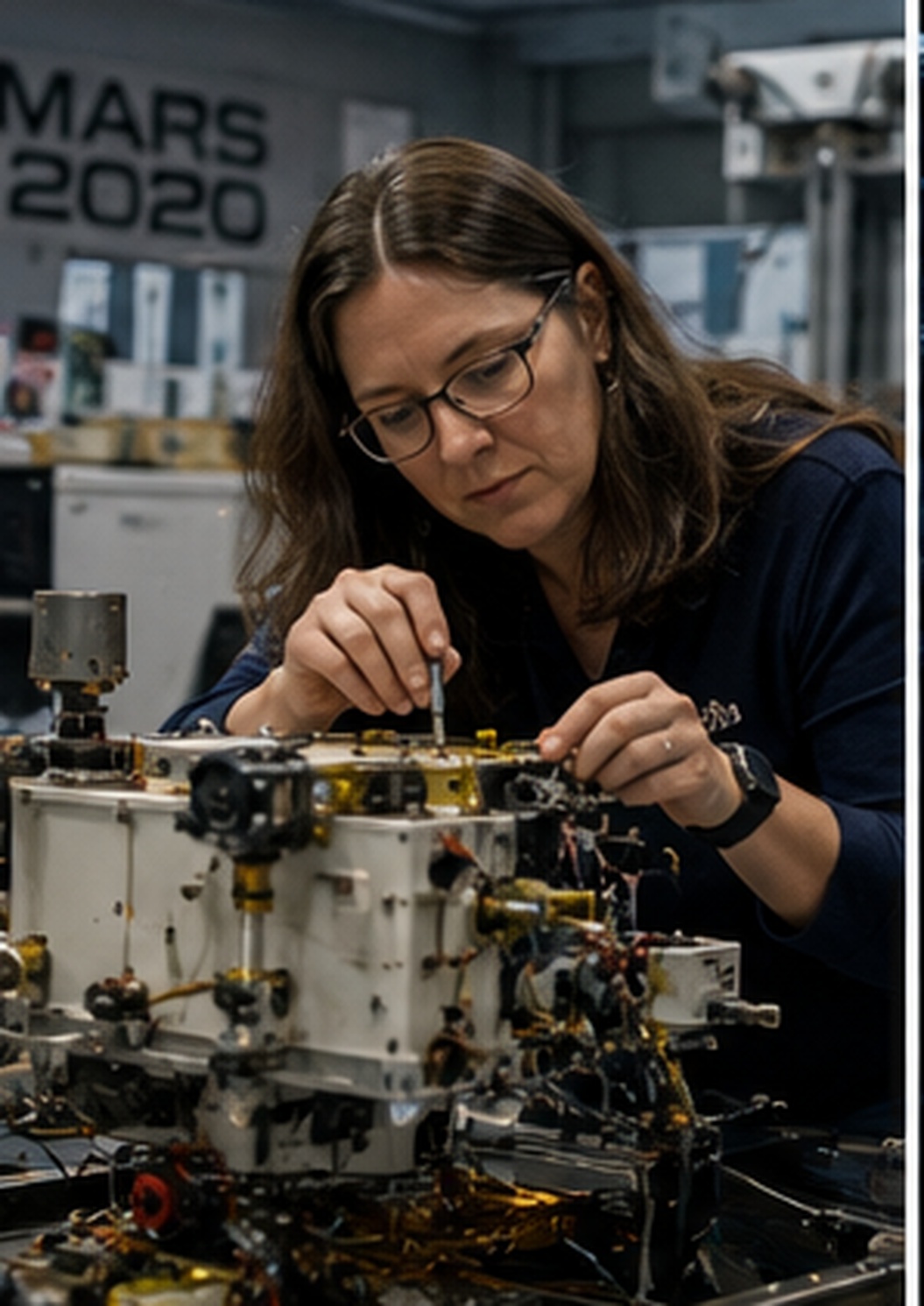
The portrait at the top of this book is an image whose exact provenance we were unable to verify.
Online sources
- NASA/JPL, On a Mission, “Driven to Mars” (2021)
- NASA/JPL, “NASA Marks 25 Years Since Pathfinder Touched Down on Mars” (2022)
- NASA, “NASA’s Mars Curiosity Rover Arrives at Martian Mountain” (2014)
- NASA, “NASA’s Perseverance Rover Begins Its First Science Campaign on Mars” (2021)
- NASA, “NASA’s Self-Driving Perseverance Mars Rover ‘Takes the Wheel’” (2021)
- NASA, “Team Behind NASA’s Newest Mars Rover to Honor Persevering Students” (2021)
- NASA, “NASA JPL Unveils Rover Operations Center for Moon, Mars Missions” (2025)
Facts checked against these sources on October 10, 2026.
Go further
Mars Library
This book extends the page with a complete settlement architecture. The dossier above remains deliberately self-contained: Arcadia is optional further reading, not a prerequisite for understanding it.
 Arcadia — Master Plan of the First Martian City