


Mars Bible — People
Adam Steltzner
The rock bass player who wanted to know why Orion had moved became the engineer of the sky crane: he led Curiosity’s landing and its “seven minutes of terror,” then Perseverance’s engineering.
engineer, Jet Propulsion Laboratory
- Education
- College of Marin; UC Davis (B.S., 1990); Caltech (M.S., 1991); University of Wisconsin (Ph.D.)
- Institution
- Jet Propulsion Laboratory
- Roles
- Curiosity entry, descent and landing lead; Mars 2020 chief engineer
- Invention
- The sky crane, conceived with his team from 2003
- Link to Mars
- Curiosity’s landing, August 2012
5 chapters and 4 appendices: about 1,800 words, or about 10 minutes of reading. Every fact comes from verified sources, listed at the end of each chapter.
Part One
From rock to engineering
1970 – 2003
Chapter 1 · 1970s – 1984 A bass player looks at Orion
At twenty, Adam Steltzner was playing bass in rock bands around the San Francisco Bay Area. Nothing suggested he would one day land a rover on Mars. A constellation would change his course.
A student who skipped class
He grew up in Marin County, north of San Francisco. In high school he refused to attend most classes except drama; he did just enough to graduate and never picked up his diploma. His father told him he would never be more than a ditch digger. After a short stint at Berklee College of Music in Boston, he came back to the Bay Area and played bass in local bands. He wanted to be a rock star.
Why stars move
In 1984, driving home after a gig with a new wave band, he crossed the Golden Gate Bridge and noticed that Orion was no longer in the same place in the sky. He wanted to understand why stars move. He enrolled at the College of Marin, a community college, to take an astronomy course. But first he had to take a non-math physics course taught by Stephen Prata. “He conveyed an excitement of learning,” he remembers. “I was hooked from there.”
In physics and engineering he found tangible rules: “Here was bedrock.” He threw himself into study with an intensity he compares to a monk’s. He remains an advocate of community colleges: “It’s not about prestige, it’s not about your SAT scores.”
Sources: J. Ouellette, “The Brilliance Behind the Plan to Land Curiosity on Mars,” Smithsonian Magazine, December 2013 (Marin County, high school and drama, the uncollected diploma, the father and the ditch digger, Berklee, bass, rock star, Orion from the Golden Gate Bridge, quotation, the monk); California Community Colleges, “Adam Steltzner” page (1984, new wave band, Orion, College of Marin, Stephen Prata’s course, quotations).
Chapter 2 · 1985 – 2003 Late studies and a job won by phone
The musician became an engineer. He got into JPL through persistence and found a culture that suited him: the only thing revered there is the truth.
Davis, Caltech, Wisconsin
After three semesters at the College of Marin, he transferred to the University of California, Davis, where he earned a bachelor’s degree in mechanical engineering in 1990. He went on to the California Institute of Technology, earning a master’s in applied mechanics in 1991. He landed his first JPL job by cold-calling scientists until one agreed to hire him in the spacecraft structures and dynamics group. He then worked toward a Ph.D. at the University of Wisconsin–Madison while working remotely for JPL during the academic year; according to Wikipedia, his 1999 thesis dealt with input force estimation and inverse structural filters.
A culture of truth
JPL, he says, “reveres the truth. There are no sacred cows, there is no dogmatism.” He likes to be on “the steep end of the learning curve,” tackling problems with little precedent. He worked on Galileo, Cassini, Mars Pathfinder, then on the Spirit and Opportunity rovers, where he was in charge of the parachutes. The first tests went badly: one parachute shredded to pieces as it opened, then another failed to inflate fully. The team solved those problems, and both rovers landed flawlessly in 2004.
Sources: California Community Colleges, “Adam Steltzner” page (three semesters at the College of Marin, Davis degree); web search summarizing UC Davis (B.S. in mechanical engineering, 1990); J. Ouellette, Smithsonian Magazine, December 2013 (Caltech in 1991, applied mechanics, the phone calls, structures and dynamics group, Wisconsin Ph.D. while working remotely, quotations); English Wikipedia, “Adam Steltzner” (1999 thesis, Galileo, Cassini, Pathfinder, MER; tertiary source); NASA, “Houston We Have a Podcast,” “Concepts Near Science Fiction,” June 5, 2020 (MER parachute lead, the shredded parachute, “squidding,” the successful landings).
Part Two
Landing and sampling
2003 – 2025
Chapter 3 · 2003 – 2012 Seven minutes of terror
Curiosity was too heavy to bounce on airbags. In 2003, Adam Steltzner and his team shut themselves away for three days to find another way to land it. They came up with the sky crane.
Three days of brainstorming
He led the mechanical engineering team, then the whole entry, descent and landing team of Mars Science Laboratory, some fifty people for about a decade. During three days of brainstorming in 2003, the team rejected a three-legged lander, too unstable for Curiosity’s weight. It settled on a strange idea: stay attached, come out together, do all the flying together, then lower the rover on cables from a powered stage hovering above the ground.
“The result of reasoned, engineering thought”
On June 22, 2012, JPL released a video: “Curiosity’s Seven Minutes of Terror.” In it, Steltzner acknowledges that the system looks strange, but says it is “the result of reasoned, engineering thought.” The descent from the top of the atmosphere to the ground takes about seven minutes; since signals take about fourteen minutes to reach Earth, by the time controllers learn the spacecraft has hit the atmosphere, it has already been on the ground, or destroyed, for seven minutes. The heat shield reaches some 1,600 degrees and glows. About twenty meters above the ground, the rover is lowered on a 21-foot tether and set down on its wheels.
The night of August 5
In the preceding days, a radar anomaly worried the whole team. On landing night, August 5, 2012, in California, August 6 in Universal Time, he watched the monitor: nine years of work were at stake. “In the back of my mind I was waiting for something to go wrong. I was rationally confident and emotionally terrified.” When the sky crane sequence began, he thought: “I am like, really? Nine years and it’s just going to happen.” Al Chen announced: “Touchdown confirmed.” Curiosity was on Mars.
Sources: J. Ouellette, Smithsonian Magazine, December 2013 (EDL mechanical team lead, the three days in 2003, the three-legged lander, “You stay attached, come out together and do all your flying…,” nine years, quotations, “Touchdown confirmed”); English Wikipedia, “Adam Steltzner” (team of about fifty for a decade, radar anomaly for almost 72 hours, landing on August 6, 2012, UTC; tertiary source); NASA/JPL, “Curiosity’s Seven Minutes of Terror,” video of June 22, 2012 (quotation, seven minutes, fourteen minutes, 1,600 degrees, 20 meters, 21-foot tether); NASA, “Here’s How Curiosity’s Sky Crane Changed the Way NASA Explores Mars,” August 7, 2024 (landing on August 5, 2012).
Chapter 4 · 2013 – 2025 A Swiss watch on Mars
After Curiosity, Adam Steltzner became chief engineer of Mars 2020. The new rover had to do something no robot had ever done: fill and seal sample tubes meant to return to Earth.
Three robots in place of two astronauts
“While you cannot help but marvel at what was achieved back in the days of Apollo, they did have one thing going for them we don’t: boots on the ground,” he said in 2020. “For us to collect the first samples of Mars for return to Earth, in place of two astronauts we have three robots that have to work with the precision of a Swiss watch.” The Sample Caching System has to drill into Martian rock on its own, pull out intact cores, then seal them hermetically in tubes almost entirely free of Earth-originating organic material. “In terms of technology, it is the most complicated, most sophisticated mechanism that we have ever built, tested and readied for spaceflight.”
He describes the choreography: the drill docks its filled bit with a carousel, which rotates it down inside the rover; a small arm pulls out the tube, images it, gauges the sample’s volume with a ramrod, images it again, picks up a seal, images it once more, seals the tube and returns it to storage.
An engineer on stage
From his rock years he kept a stage presence that has made him one of the space program’s most visible faces. In 2016 he published a book about his path, The Right Kind of Crazy. According to an event notice, he was elected that same year to the U.S. National Academy of Engineering. Several profiles later present him as chief engineer of the Mars Sample Return program at JPL.
Sources: NASA/JPL, “The Extraordinary Sample-Gathering System of NASA’s Perseverance Mars Rover,” June 2, 2020 (Mars 2020 chief engineer, quotations, the sampling sequence); California Community Colleges, “Adam Steltzner” page (Mars 2020 chief engineer); web search summarizing several profiles (stage presence, The Right Kind of Crazy, National Academy of Engineering election in 2016 according to an event notice, Mars Sample Return chief engineer). The 2016 date of the book comes from the same search, which cites a Gizmodo interview from that year. We have not read the book.
Epilogue
Adam Steltzner and Mars
Chapter 5 · The lesson What Adam Steltzner leaves to Mars
Adam Steltzner came to engineering by an unexpected detour, and solved one of the hardest problems in Mars exploration. His path carries three lessons.
It is never too late
A bass player who never collected his diploma, intrigued by Orion, can become the engineer who lands a rover on Mars. Future Martian crews will need talent from everywhere.
Dare the strange idea
The sky crane looked strange; it was the result of reasoning. The solutions that will land humans on Mars may look just as strange at first glance.
Truth above all
A culture with no sacred cows, where parachute failures are admitted in order to fix them: that is what made the successful landings possible. It will be essential when human lives are at stake.
This lesson is a reflection by the author of this book, based on the facts and words reported in the preceding chapters, where their sources are given.
Appendices
Further reading
Appendix Understanding Adam Steltzner’s work
A few ideas, explained simply, to follow this book.
Entry, descent and landing
The few minutes in which a spacecraft goes from more than 13,000 miles per hour to a stop on the ground of Mars.
Communication delay
Radio waves take several minutes to travel between Mars and Earth, about fourteen at the time of Curiosity’s landing. So the spacecraft has to do everything on its own.
The sky crane
A powered stage that hovers above the ground, lowers the rover on cables, cuts them, then flies off to crash at a distance.
“Squidding”
A parachute inflation failure in which the canopy stays partly closed and looks like a squid.
The Sample Caching System
The set of drill, carousel and small arm that lets Perseverance collect rock cores, seal them and store them.
These explanations are general notions. The fourteen-minute delay comes from JPL’s video of June 22, 2012; the entry speed (about 13,000 miles per hour) from the California Community Colleges page; “squidding” from NASA’s 2020 podcast.
Appendix Timeline
The dates of Adam Steltzner’s career, in order, as far as the sources allow them to be established.
1984. He notices Orion has moved and enrolls at the College of Marin.
1990. B.S. in mechanical engineering, University of California, Davis.
1991. Master’s degree at the California Institute of Technology.
1999. Ph.D. from the University of Wisconsin–Madison (according to Wikipedia).
2000s. In charge of the parachutes for the Spirit and Opportunity rovers, which landed in 2004.
2003. Three days of brainstorming that gave birth to the sky crane.
June 22, 2012. “Curiosity’s Seven Minutes of Terror” video.
August 5, 2012. Curiosity lands (August 6 in Universal Time).
2016. The Right Kind of Crazy; elected to the National Academy of Engineering (according to an event notice).
June 2, 2020. Presents, as chief engineer, Perseverance’s sampling system.
Sources: those of the chapters.
Appendix The people
The people who appear in this book, with the role the sources give them.
Stephen Prata. College of Marin physics teacher whose course turned him toward science.
Al Chen. JPL engineer who announced Curiosity’s landing.
Gentry Lee. JPL engineer, who said Adam Steltzner reminded him of Elvis Presley.
Rob Manning. Chief engineer of Mars Science Laboratory. He has his own biography in this collection.
Sources: those of the chapters in which each appears; Smithsonian Magazine, December 2013 (Gentry Lee and Elvis Presley). Rob Manning’s role comes from his own biography.
Appendix Sources and method
This book contains no invented dialogue and no thought attributed to anyone without a text to support it. This appendix shows where the facts come from and what the sources do not allow us to establish.
A living person
Adam Steltzner is alive at the time of writing. We have kept to his public life and to what he himself has told about his youth. We have not repeated the press’s details about his family’s wealth.
The main sources
We found no published oral history interview. The book rests on the profile published by Smithsonian Magazine in December 2013, his alumni page at the California Community Colleges, JPL’s 2012 video and a 2020 release, a NASA podcast, and English Wikipedia, a tertiary source flagged each time it is used. He wrote a book about his path, The Right Kind of Crazy, which we have not used.
What does not agree
His Caltech master’s degree is in “applied mechanics” according to Smithsonian Magazine, and in “applied mathematics” according to the California Community Colleges; his doctorate is in “engineering mechanics” according to the former, “engineering physics” according to the latter. Curiosity’s landing is dated August 5, 2012, California time, or August 6 in Universal Time.
Length
This book runs to about one thousand eight hundred words. The goal set for this collection was one hundred thousand. We did not reach it, and we prefer to say so. As it stands, the text contains only facts we were able to tie to a source.
The portrait
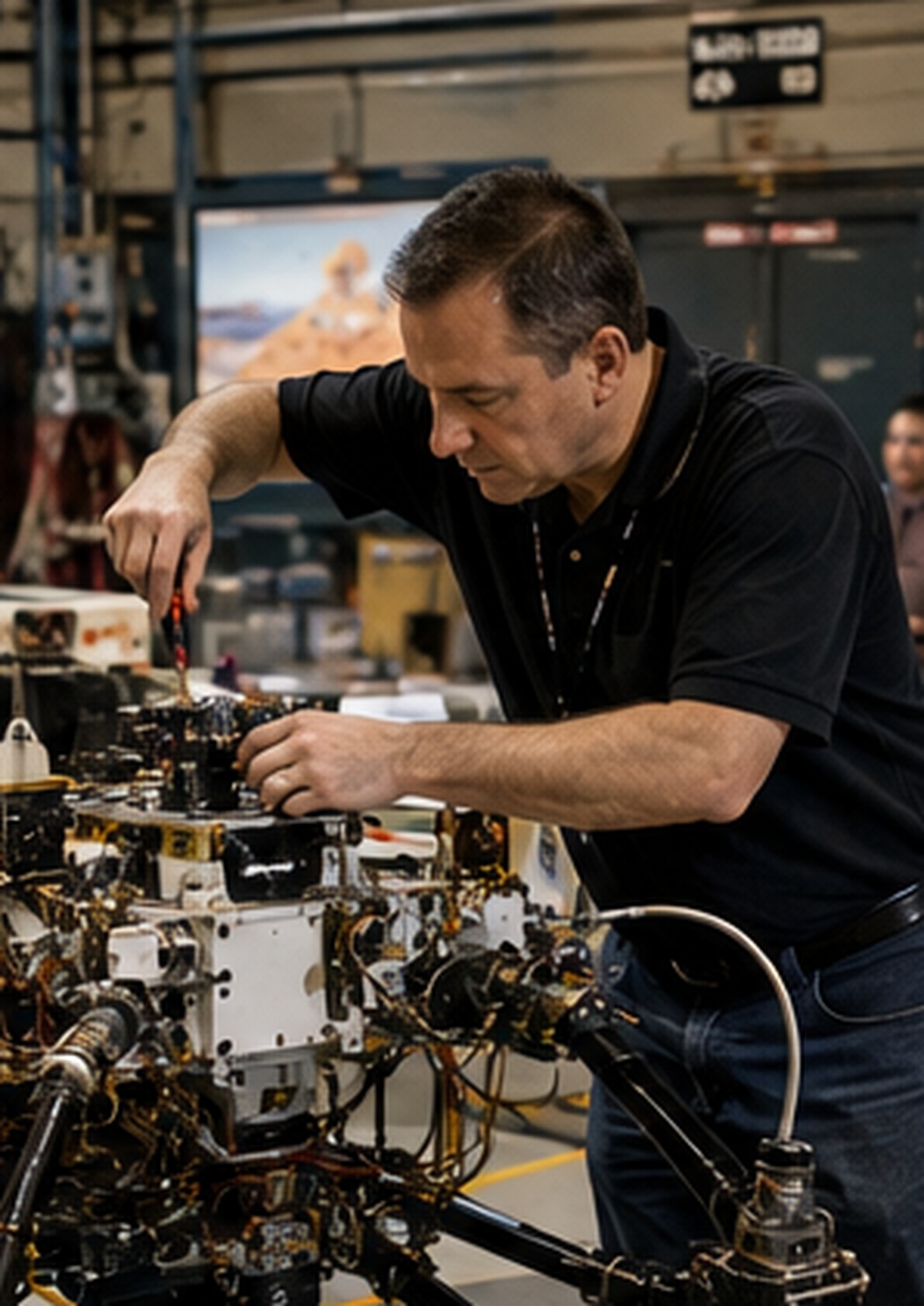
The portrait at the top of this book is an image whose exact provenance we were unable to verify.
Online sources
- J. Ouellette, Smithsonian Magazine, “The Brilliance Behind the Plan to Land Curiosity on Mars” (2013)
- California Community Colleges — Adam Steltzner
- NASA/JPL, “Curiosity’s Seven Minutes of Terror” (2012)
- NASA/JPL, “The Extraordinary Sample-Gathering System of NASA’s Perseverance Mars Rover” (2020)
- NASA, Houston We Have a Podcast, “Concepts Near Science Fiction” (2020)
- Wikipedia — Adam Steltzner (tertiary source)
Facts checked against these sources on October 10, 2026.
Go further
Mars Library
This book extends the page with a complete settlement architecture. The dossier above remains deliberately self-contained: Arcadia is optional further reading, not a prerequisite for understanding it.
 Arcadia — Master Plan of the First Martian City