


Mars Bible — People
Nathalie Cabrol
She discovered Gusev crater on a mosaic at Meudon in 1985 and championed it until the Spirit rover arrived. Then she dived into the highest lakes in the world to understand Martian life.
planetary geologist and astrobiologist, SETI Institute
- Education
- Ph.D. in planetary geology, University Paris 1 Sorbonne (1991)
- Institutions
- NASA Ames, SETI Institute
- Roles
- Spokesperson for the selection of Gusev for Spirit, director of the Carl Sagan Center (since 2015)
- Specialty
- Martian lakes, terrestrial analogs, the search for life
- Link to Mars
- Member of the Mars Exploration Rover science team from 2002 to 2019
6 chapters and 4 appendices: about 4,900 words, or about 20 minutes of reading. Every fact comes from verified sources, listed at the end of each chapter.
Part One
From Paris to Gusev
1963 – 2005
Chapter 1 · 1960s – 1985 Nose in the dirt or eyes on the sky
Nathalie Cabrol was born in France in the mid-1960s, at a time when the first Mariner probes were barely starting to visit the solar system. Planetary geology, the field she would work in, did not yet exist in France.
Her grandfather’s binoculars
Her first astronomer’s instrument was a pair of binoculars. Her grandfather, a soldier, had picked them up in Germany after the liberation of France, and he gave them to her when she was little. With them she first truly saw the Moon and the stars. “Later,” she says with a laugh, “my toys became more elaborate and complex.”
Her mother would tell her she never talked about anything else. What drew her then was astronomy: most of what was known about the solar system still came from telescopes on the ground. Very early, her questions were not only about the beauty of the sky but about why: why all of this exists. Around her, people mostly took her for a dreamer. Her mother was the only one to support her without reservation; her father thought it was a phase. At five, she always drew the same landscape: a dark sky, Saturn in the background, two moons, and a hill topped with domes.
An X-ray room and a computer the size of a room
Her mother was an X-ray technician; her father managed computer accounts for an accounting firm. When she was six or seven, he took her to work to see a computer that filled a whole room. Until she started university, she often did her homework in her mother’s X-ray lab. When her mother had a moment, she showed her the X-rays and taught her how to read them. “She trained my eyes,” says Nathalie Cabrol, who would spend part of her research life analyzing images of planets on computers.
Her grandmother kept saying that the child either had her nose in the dirt or was looking up at the sky, but never looked ahead of her when she walked. She was indeed as interested in crystals and minerals as in the stars.
Two baccalaureates
A straight-A student, including in math, she got lost when the high school curriculum switched to “modern math.” Math and physics, exactly the subjects she would need to become an astronomer, became her weak points. She describes very hard teenage years. The mistake she says she made then, and sees many young people make, was to judge her future by her circumstances of the moment.
She first earned a baccalaureate in literature and philosophy. Since she was a year ahead, her mother asked the principal whether she could repeat the final year of high school in the science track. It had never been done at the school; the principal agreed. Nathalie Cabrol still jokes about the outcome: she passed the literature baccalaureate thanks to math, and failed the science one because of philosophy.
A year of prep school
At seventeen, she decided to stop going back and forth and entered a French preparatory class, the demanding schools that train an elite for the most selective institutions. She did not want to teach at an elite school or go into politics: she came for a work method. The year was as brutal as advertised. Thirty-six students started; three weeks later, seventeen were left. On the first day, the French teacher gave them a dictation; a week later, handing back the papers, she taught them that in prep school grades could be negative.
There she met a professor of physical geography. He talked about climate, hydrology and geology, and she discovered a world that fascinated her. She became the best student in his class; every three weeks or so, he had her teach the class to her classmates. He trained her in hydrology, climatology and the evolution of landscapes. At the end of the year she obtained her equivalence certificate and went straight into the second year at Nanterre University, in physical geography and environment.
Nanterre
At Nanterre she studied natural hazards, remote sensing, climatology and hydrology. Her lab worked with the French Ministry of the Environment on avalanches and floods; the work was hands-on, in the field, and she liked it. She still carried her astronomy magazines everywhere, but she was starting to accept that the sky would remain an amateur’s pastime. At the end of May 1985, she was one week away from signing with her advisor for a master’s thesis in environmental science.
Sources: NASA Ames, “Interview with Nathalie Cabrol,” interview of August 3, 2021 (born in France close to the mid-1960s, the Mariners, astronomy, her mother and father, the drawing of Saturn, the X-ray lab and the computer, her grandmother, modern math, the two baccalaureates, prep school and its numbers, the dictation, the physical geography professor, Nanterre, May 1985); NASA Ames, “Exploring Earth’s alien spaces,” September 21, 2013, after Alexandra Witze, Science News (her grandfather’s binoculars, “Later, my toys became more elaborate and complex”). Wikipedia, citing a NASA profile, gives her date of birth as August 30, 1963, near Paris; we were unable to consult that profile. In the 2021 interview she also speaks about her family life and her personality; here we keep to what bears on her vocation.
Chapter 2 · 1985 – 1994 Meudon, Gusev and Ma’adim Vallis
A hallway conversation at the end of May 1985 turned Nathalie Cabrol away from the study of avalanches. It led her to the Meudon Observatory, in front of a map of Mars where a great channel ran into a crater.
“He called it planetary geology”
Her future master’s advisor ran into her in a hallway at Nanterre. He knew, like everyone, that she talked of nothing but astronomy. He told her he had a colleague, André Cailleux, who was doing something new; he did not know exactly what, he thought it was called planetary geology. He offered to put them in touch. Absorbed in her thesis project, she answered distractedly: sure, thanks. The next day he told her that Cailleux had agreed to see her at the Paris Observatory in Meudon. Already emeritus at the Sorbonne, André Cailleux still spent time there each week.
A Thursday at Meudon
That Thursday, she met André Cailleux and Audouin Dollfus, the astronomer who directed the lab. The observatory stands on a hill, and the lab was surrounded by the domes of the telescopes. In Dollfus’s office, the first thing she saw was a photograph of Saturn, with Janus, the little moon he had discovered, and its co-orbital companion, Epimetheus. The hill, the domes, Saturn and two moons: the landscape she had drawn at five.
Cailleux explained that the lab worked on images from the Viking probes, and on everything related to water on Mars, from permafrost to ancient water. He showed her mosaics. One caught her eye: a great channel ending in an impact crater. The atlas read Ma’adim Vallis and Gusev crater. Without her quite knowing why, Cailleux understood that she wanted to work on those images. She would leave Meudon nine years later with a master’s degree and a Ph.D. in planetary geology.
The death of André Cailleux
The master’s thesis was a childhood dream come true. She worked by day and observed by night at Meudon’s Grande Lunette. But in December, six months after her defense, André Cailleux died. In 1986 planetary geology was barely emerging in France, and a war of succession broke out. She was pressed to change advisors; she refused. She kept two, since the country had no planetary geologist as such: Audouin Dollfus, at the observatory, and Alain Godard, a geomorphologist at the Sorbonne. That is why she moved from Nanterre to the Sorbonne. She says this loyalty cost her more trouble than she would have liked, but that it worked out in the end.
A thesis on the water of Mars
She defended her thesis in December 1991 at the University of Paris 1 Panthéon-Sorbonne. She was the first woman in France to earn a Ph.D. in planetary geology. Her work dealt with the evolution of water on Mars and, increasingly, with the lakes that may have formed in impact craters. She carried it out with Edmond Grin, her husband, with whom she drew up maps of the Gusev–Ma’adim Vallis system.
In 1993, with Edmond Grin, Audouin Dollfus and G. Dawidowicz, she presented at the Lunar and Planetary Science Conference in Houston a study of an ancient inner lake in Ma’adim Vallis. Using a new topographic map of the Aeolis region, the team showed that the impact that dug Gusev came after the first incision of the valley, and reconstructed the order of three major events: the incision of Ma’adim, the Gusev impact, then the interactions with the flows from Apollinaris Patera.
No place to be found
In 1992 she was looking for a position at Meudon. The observatory’s astronomers now knew her work and better understood what planetary geology was. But new positions were rare, you needed the backing of a powerful lab director, and Dollfus was nearing retirement. He helped her as much as he could; it remained an uphill battle.
Chris McKay
In 1992, while on a postdoc at Meudon, she met Chris McKay, a researcher at NASA’s Ames Research Center, at a conference in Val Cenis. They talked about her work on Martian water, with no immediate follow-up. McKay came to the observatory twice a year. In 1993 she saw him in the cafeteria, looking bothered. He explained that he was preparing the concept for an astrobiology mission to Mars: he had the technology, but no landing-site study that would make it a good mission to search for life. She invited him to the lab that same afternoon and showed him Gusev and Ma’adim Vallis.
Before leaving, McKay invited her to spend a week at Ames presenting her work. In early November 1993, she presented her research to the scientists of the Space Science division, then went home to France. She did not know it was a job interview. Meanwhile, she had been selected for a new postdoc funded by the French Ministry of Research, but the government had changed and the money was frozen.
One piece of luggage
In the spring of 1994, McKay came back. The ministry’s money had finally been released; Dollfus was retiring and the lab was to close in October. She had nowhere to go. McKay offered her the chance to do that postdoc at Ames, with him as her technical monitor. She did not hesitate. She closed the Meudon lab and boarded a plane with Edmond Grin. They took only one piece of luggage: they were leaving, they thought, for only nine months. They landed in San Francisco on Halloween night 1994. Her first day at Ames was November 7.
That same year, at the Houston conference, she co-authored with Ragnild Landheim, Ronald Greeley and Jack Farmer a paper making the Ma’adim Vallis–Gusev system a high-priority site for exobiology. By the site-selection criteria, the search for extinct or living life should target places where water flowed and ponded. Ma’adim and Gusev seemed to have seen long-term flooding, different periods and rates of sedimentation, and probably episodic lakes.
Sources: NASA Ames, “Interview with Nathalie Cabrol,” August 3, 2021 (the Nanterre hallway, André Cailleux, the Thursday at Meudon, Dollfus, Janus and Epimetheus, the Viking mosaics, Ma’adim Vallis and Gusev, the Grande Lunette, Cailleux’s death in December, 1986, Alain Godard, the December 1991 thesis, the Meudon position, Val Cenis in 1992, the cafeteria in 1993, the November 1993 visit to Ames, the frozen funds, the lab closing, Halloween 1994, November 7); SETI Institute, profile “Nathalie Cabrol” (Ph.D. in planetary geology, University Paris 1 Sorbonne, 1991; first woman in France to earn this Ph.D.); N. A. Cabrol, E. A. Grin, A. Dollfus, G. Dawidowicz, “An ancient inner lake in Ma’adim Vallis,” Lunar and Planetary Science Conference XXIV, 1993; N. Cabrol, R. Landheim, R. Greeley, J. Farmer, “Fluvial processes in Ma’adim Vallis and the potential of Gusev crater as a high priority site,” LPSC XXV, 1994 (abstracts consulted on NASA’s NTRS server). The interview does not give the year of the master’s defense; Cailleux’s death in December and the mention of 1986 that follows place it in December 1986.
Chapter 3 · 1994 – 2005 The Gusev lake and the Spirit rover
At Ames, Nathalie Cabrol kept championing the crater she had discovered on a Meudon mosaic. Ten years after she arrived in California, a NASA rover landed in it.
From postdoc to the SETI Institute
The planned nine months became a life. In 1998 she joined the SETI Institute, in Mountain View, as an astrobiologist; she worked for NASA’s Ames Research Center as a contractor. She says it plainly: the downside of that status is having to compete for everything, all the time. The upside, she adds, is that it keeps you on your toes.
Rovers in the desert
In 1997 she was science lead for the field experiment of NASA’s Nomad rover, a robot sent into Chile’s Atacama Desert. From February 22 to 27, 1999, she took part with NASA’s Johnson Space Center in the first astronaut-rover interaction field test, at Silver Lake in California’s Mojave Desert. A test subject in an experimental spacesuit explored planetary-like terrain alongside a robotic rover; the aim was to learn where human and machine complement each other, and what future suits and rovers would need.
Two billion years of history
In 1998, for the Mars Surveyor 2001 landing site workshop, she signed with Edmond Grin, Ragnild Landheim, Ronald Greeley, R. Kuzmin and Chris McKay a paper titled “Gusev Crater Paleolake: Two-Billion Years of Martian Geologic, (and Biologic?) History.” The argument was simple. Ancient Martian lakes recorded in their sediments the planet’s climatic, chemical and possibly biological history. Among them, lakes inside impact craters were probably the most promising: the impact may have supplied heat and, in contact with water or ice, created deep hydrothermal systems favorable to life; later these lakes may have become cold oases protected by ice.
Also in 1998, with Edmond Grin, she published a study of the Ma’adim Vallis delta in the Elysium basin as a site for exobiology exploration. In 2001 she co-authored with Robert Haberle, Edmond Grin and other researchers a study of the possibility that liquid water exists today at the surface of Mars. In 2002, with Edmond Grin and D. Fike, she described in Gusev a groove whose shape and setting suggest a lateral channel cut by meltwater flowing along the shore of an ice-covered lake.
Gusev’s spokesperson
When NASA was choosing where to land the two rovers of the Mars Exploration Rover mission, Nathalie Cabrol was the spokesperson for Gusev’s candidacy. The crater was selected for the Spirit rover. She was a member of the mission’s science team from 2002 to 2019.
Spirit landed in Gusev on January 4, 2004. The first images showed not the hoped-for lake sediments but a flat plain, undulating at the scale of meters with ridges covered in blocks, some of them rounded-looking. In the distance, toward Ma’adim Vallis, stood flat-topped mesas. East of the landing site, a set of north-south hills rose to about 150 meters. Around the site, named Columbia Memorial Station, lay many small depressions; one of them, nicknamed “Sleepy Hollow,” about thirty meters across, may be a small eroded secondary crater.
By March 2004, Nathalie Cabrol was presenting these preliminary observations, and the hypotheses they suggested, notably intense wind action, with D. Des Marais, J. Farmer, L. Crumpler, Edmond Grin, John Grotzinger and other team members. With Ronald Greeley she then studied the soils Spirit crossed, from the landing site to Bonneville crater, then up into the Columbia Hills to the east, as far as sol 363.
The team’s awards
With the Spirit teams she received several NASA Group Achievement Awards, in 2004, 2005, 2008 and 2014, and the AIAA Haley Space Flight Award given in 2012 to the rover development and operations team. In 2005 the Ames center gave her, personally, its Honor Award for excellence as a contractor employee.
Sources: SETI Institute, profile “Nathalie Cabrol” (joined the SETI Institute in 1998, Nomad in 1997, spokesperson for the selection of Gusev, MER science team from 2002 to 2019, awards); NASA Ames, “Interview with Nathalie Cabrol,” August 3, 2021 (contractor status); J. J. Kosmo, A. Ross, N. A. Cabrol, “First Astronaut-Rover Interaction Field Test,” 2000; N. A. Cabrol, E. A. Grin, R. Landheim, R. Greeley, R. Kuzmin, C. P. McKay, “Gusev Crater Paleolake: Two-Billion Years of Martian Geologic, (and Biologic?) History,” Mars Surveyor 2001 Landing Site Workshop, 1998; E. A. Grin, N. A. Cabrol, “Ma’adim Vallis Estuarine Delta in Elysium Basin…,” 1998; R. M. Haberle et al., “On the possibility of liquid water on present-day Mars,” Journal of Geophysical Research, 2001; E. A. Grin, D. Fike, N. A. Cabrol, “New Evidence Supporting an Ice-covered Lake in Gusev Crater,” LPSC XXXIII, 2002; N. A. Cabrol et al., “Spirit at Gusev Crater: Preliminary Observations, Potential Processes and Hypotheses,” LPSC XXXV, 2004; N. A. Cabrol, R. Greeley, “Characterization of Non-Organized Soils at Gusev Crater with the Spirit Rover Data,” LPSC XXXVI, 2005 (abstracts consulted on NASA’s NTRS server); NASA Ames, “Ames Honor Awards” page (2005). Spirit’s landing date is the one given in this collection’s biography of Steve Squyres. The source does not give D. Fike’s first name.
Part Two
Andean lakes and life
2002 – 2025
Chapter 4 · 2002 – 2015 Diving at the top of volcanoes
To understand the lakes Mars has lost, Nathalie Cabrol went looking on Earth for the ones that most resemble them. She found them at the top of the Andes, at nearly six thousand meters.
The highest lake in the world
Licancabur is a volcano 6,017 meters high, on the border between Chile and Bolivia. Its summit crater holds one of the highest and least explored lakes on the planet. Oxygen is scarce, atmospheric pressure low, ultraviolet radiation intense; the lake is frozen much of the year, and yet the bottom water stays above freezing all year round. To Nathalie Cabrol, these conditions make it a unique analog of Martian lakes of 3.5 billion years ago, considered high-priority sites in the search for life on Mars.
The first expedition
From October 16 to November 9, 2002, she led the first multidisciplinary Ames expedition to Licancabur, with Edmond Grin, Chris McKay, I. Friedmann and a team of researchers. The goal was to understand what strategies life uses to defend itself against killer-level ultraviolet radiation and the extreme conditions of that altitude. At the foot of the volcano, at 4,300 meters, the lagunas Blanca and Verde, geothermally heated and fed by springs at various temperatures, were studied with the same methods, to compare survival strategies at different elevations.
During the successful ascent, the team measured the summit lake’s surface water at +6 °C, in a crater where the air was at −9 °C and an almost constant wind brought the wind chill down to −25 °C. That warmth suggested a source of heat beneath the lake.
Records she did not seek
Nathalie Cabrol climbed Licancabur many times and dived into its lake, free diving and with scuba gear. She holds the women’s world record for diving at altitude, in both disciplines, at the Licancabur summit lake, at 5,940 meters. Her measurements at the summit also earned a Guinness World Records mention for the highest ultraviolet radiation ever measured on Earth; a recognition, the SETI Institute notes, that was not requested. In 2009 a species of zooplankton discovered in that lake was named after her: Scutiglypha cabrolae.
She explains what drives her to those summits: the higher the lakes, the more they resemble alien environments. “Lakes are my little time machines,” she says, “to travel to the past of other planets or to look toward the future.” Leading large multidisciplinary teams in these extreme places also changed her: she, who describes herself as introverted, had to become a team leader in the field.
The Atacama Desert
At the same time, from 2003 to 2006, she took part in the “Life in the Atacama” project of NASA’s ASTEP program, which sent rovers to look for life in the Chilean desert; from 2011 to 2015 came “Subsurface Life in the Atacama,” devoted to life below the surface. In 2013, for a rover-mounted drilling project in the Atacama, she was the team’s science principal investigator.
The Planetary Lake Lander
From 2011 to 2015 she led the Planetary Lake Lander, a NASA-funded project. A solar-powered floating robot was installed on Laguna Negra, a lake in the Chilean Andes at 2,700 meters, in a basin where glaciers are melting rapidly. It carried weather sensors, cameras and a probe that a winch lowered and raised through the water column to measure temperature, dissolved oxygen, turbidity and other parameters. The robot had to decide for itself what to measure: when it detected a storm, it probed the depths more often and sent its data by satellite and e-mail to the team. The technology was designed to one day explore the methane seas of Titan, Saturn’s great moon.
“We’ve made a substantial leap toward robotic awareness,” she said in 2013. Her lakes are also climate sentinels: their levels, chemistry and biodiversity change with snow and rainfall. “What we are trying to develop to explore Mars and Titan helps us understand our own Earth.”
Books and honors
In 2010 she published with Edmond Grin a scientific book, Lakes on Mars, with Elsevier. Wings WorldQuest, an organization that honors women explorers, named her a laureate of its “Women of Discovery” award in the Air and Space category, then, in 2007, a Carey Fellow. In 2012 she received an award from the International Women Leadership Association. In March 2015 she gave a TED talk, explaining that life elsewhere is more likely to be microbial than “little green men,” and that the lakes of the Andes can indicate where to look for it on Mars.
Sources: N. A. Cabrol et al., “The Licancabur Project: Exploring the Limits of Life in the Highest Lake on Earth as an Analog to Martian Paleolakes” and “First Results of the Expedition to the Highest Lake on Earth…,” LPSC XXXIV, 2003 (abstracts consulted on NASA’s NTRS server; altitude, conditions, dates and goals of the 2002 expedition, lagunas, temperatures); NASA Ames, “Lincancabur, Chile,” 2010 and 2012; SETI Institute, profile “Nathalie Cabrol” (5,940 m record, Guinness mention, Scutiglypha cabrolae in 2009, Atacama and Lake Lander projects, honors); NASA, page on the 2013 Atacama drilling project; L. Pedersen et al., “Planetary Lake Lander – A Robotic Sentinel to Monitor a Remote Lake,” 2012; NASA Ames, “Exploring Earth’s alien spaces,” September 21, 2013, after Science News (Laguna Negra, Titan, quotes); NASA Ames, “Interview with Nathalie Cabrol,” August 3, 2021 (introverted team leader); TED, “How Mars might hold the secret to the origin of life,” March 2015 (talk description). The SETI Institute dates the “Women of Discovery” award to 2005, Wikipedia to 2007; we do not decide between them. The volcano is 6,017 m high according to the 2003 abstract; the lake, in the crater, is given at 5,940 m by the SETI Institute; NASA wrote “20,000 feet” in 2010, about 6,100 m.
Chapter 5 · 2015 – 2025 Leading the Carl Sagan Center
In 2015 the field geologist became a research director. She now steers the strategy of an entire institute, without ever stopping her search for traces of life.
Director of the Carl Sagan Center
In August 2015 the SETI Institute named her director of its Carl Sagan Center. There she leads the institute’s scientific vision, directs its astrobiology projects and develops exploration strategies for Mars, Titan and the icy moons of the outer solar system. A later institute profile says she oversees more than one hundred twenty researchers across seven divisions. The same year, the California Academy of Sciences elected her a Fellow.
The fingerprints of life
In October 2014 the team she leads was selected by the NASA Astrobiology Institute; from January 2015 she was its principal investigator. The project, titled “Changing Planetary Environments and the Fingerprints of Life,” ran until 2022. It aimed to develop strategies for detecting traces of life, in connection with the Mars 2020 mission.
Its culmination was published in March 2023 in Nature Astronomy, led by Kim Warren-Rhodes of the SETI Institute. The team mapped the sparse microbial life of the Salar de Pajonales, an ancient salt lake at 3,541 meters, on the edge of Chile’s Atacama Desert and Altiplano. It gathered more than 7,765 images and 1,154 samples of rocks, crystals and salt domes, then trained a machine-learning program to recognize where life concentrates. The result: life there is not randomly distributed but strongly tied to available water, and the model finds traces of life up to 87.5% of the time, against 10% at most for a random search, while shrinking the search area by up to 97%. Nathalie Cabrol pointed out that the study links data at very different resolutions, from orbit to the ground, to microbial habitats.
Telling the story
Since her teens she has loved to write; she was already translating articles from English into French. For years she refused to write her autobiography. She took it up during the pandemic, at night. Voyage aux frontières de la vie came out from Le Seuil in September 2021. Then came À l’aube de nouveaux horizons (Le Seuil, 2023), translated into English as The Secret Life of the Universe (Scribner, 2024) and published, according to the SETI Institute, in nine countries and seven languages, followed by L’Énigme cosmique de la vie (Le Seuil, 2024) and Inséparables. Les destins croisés de la Terre et de la Vie (Julliard, 2025). With Edmond Grin she had also published La Recherche de la vie dans l’Univers in 2000 and, in 2018, the scientific book From Habitability to Life on Mars (Elsevier). The SETI Institute credits her with more than six hundred thirty scientific publications and papers, and more than a thousand public lectures.
Earth first
In 2021 she spoke of having become a U.S. citizen: the United States, she says, gave her the chance to make her dream come true by welcoming her without knowing who she was, only because she could contribute something. That same year she had just finished the SETI Institute’s strategic research vision, and she had put the preservation of the environment at its center. She wants to open the Carl Sagan Center to environmental sciences and put the science and technology designed to explore planets to work for Earth, here and now. Her research goal does not change: to explore this planet and others to understand how life and its environment evolve together.
In 2023 the SETI Institute named her a Fellow.
Sources: SETI Institute, profile “Nathalie Cabrol” (August 2015 appointment, the center’s missions, California Academy of Sciences, NAI project from 2015 to 2022, books, number of publications and lectures, Fellow in 2023); Wikipedia, article “Nathalie Cabrol” (selection in October 2014, principal investigator from January 2015, link with Mars 2020, La Recherche de la vie dans l’Univers, From Habitability to Life on Mars); SETI Institute, “Can Artificial Intelligence Help Find Life on Mars or Icy Worlds?,” March 6, 2023 (study by K. Warren-Rhodes et al., Nature Astronomy, figures, N. A. Cabrol’s statement); NASA Ames, “Interview with Nathalie Cabrol,” August 3, 2021 (writing, translation, autobiography, release on September 23, 2021, U.S. citizenship, strategic vision). An older profile cited by Wikipedia gave more than four hundred publications. The SETI Institute profile says she has written seven books; the seven titles cited here are Lakes on Mars (previous chapter) and the six above.
Epilogue
Nathalie Cabrol and Mars
Chapter 6 · The lesson What Nathalie Cabrol leaves to Mars
A mosaic from the Viking probes seen at Meudon in 1985 led a NASA rover into Gusev crater nineteen years later. Nathalie Cabrol’s path carries three lessons for those who will go to Mars.
Look for water to look for life
All her work rests on one idea: where water flowed and ponded, life may have arisen, and the sediments may have kept its trace. The ancient lakes of Mars are archives. Future explorers, robots or humans, will look for those archives first.
Earth as a test bench
Before going to Mars, one can go to Licancabur, the Atacama or Laguna Negra: places where cold, altitude, dryness and ultraviolet light bring Earth closer to Mars. There one learns how life defends itself, where it hides, and how autonomous machines can search for it on their own. The first Martian bases will owe everything to these training grounds on Earth.
Create the path that does not exist
Her profession did not exist in France when she was fifteen. She drew from this the lesson she repeats to young people: give tomorrow a chance and, if what you want to do does not exist yet, create it. Those who will one day live on Mars will almost all work in jobs that do not exist yet.
This lesson is a reflection by the author of this book, based on the facts and words reported in the preceding chapters, where their sources are given; the advice to young people comes from the August 3, 2021 interview.
Appendices
Further reading
Appendix Understanding Nathalie Cabrol’s work
A few ideas, explained simply, to follow this book.
Planetary geology
The study of the rocks, landforms and history of other planets, from images taken by probes and, increasingly, from measurements made on site by robots.
Astrobiology
The science that studies the origin of life, its limits on Earth and the possibility that it exists elsewhere in the Universe.
A paleolake
An ancient lake, now gone, recognized by the sediments it deposited and the landforms it left behind.
A terrestrial analog
A place on Earth where some conditions resemble those of another planet: instruments and methods are tested there before being sent into space.
Ultraviolet radiation
An invisible part of sunlight that damages living cells. The higher you go, the less of it the atmosphere filters; at the surface of Mars, almost nothing stops it.
A biosignature
A trace that indicates the presence, now or in the past, of living things: a shape, a molecule, a particular arrangement of minerals.
Machine learning
A computing method in which a program is shown many examples so that it learns to recognize patterns, then to predict them in data it has never seen.
These explanations are general notions. The use of machine learning to predict biosignatures follows the SETI Institute release of March 6, 2023.
Appendix Timeline
The dates of Nathalie Cabrol’s life, in order, as far as the sources allow them to be established.
Mid-1960s. Born in France (August 30, 1963, according to Wikipedia).
Late May 1985. Meets André Cailleux and Audouin Dollfus at the Meudon Observatory; discovers Gusev and Ma’adim Vallis.
December 1986. Death of André Cailleux.
December 1991. Ph.D. in planetary geology, University Paris 1 Sorbonne.
1992. Meets Chris McKay in Val Cenis.
November 1993. First visit to NASA’s Ames Research Center.
October 31, 1994. Arrives in San Francisco; first day at Ames on November 7.
1997. Science lead of the Nomad rover experiment.
1998. Joins the SETI Institute; paper on the Gusev paleolake.
February 1999. First astronaut-rover test at Silver Lake.
2002. Joins the Mars Exploration Rover science team; first Licancabur expedition (October 16 – November 9).
2003 – 2006. “Life in the Atacama” project.
January 4, 2004. Spirit lands in Gusev crater.
2009. Scutiglypha cabrolae named after her.
2010. Lakes on Mars, with Edmond Grin.
2011 – 2015. Planetary Lake Lander; “Subsurface Life in the Atacama.”
March 2015. TED talk.
August 2015. Director of the SETI Institute’s Carl Sagan Center.
2015 – 2022. NASA Astrobiology Institute team.
September 2021. Voyage aux frontières de la vie.
March 2023. Study on predicting biosignatures in Nature Astronomy.
2023 – 2025. À l’aube de nouveaux horizons, The Secret Life of the Universe, L’Énigme cosmique de la vie, Inséparables.
Sources: those of the chapters.
Appendix The people
The people who appear in this book, with the role the sources give them.
André Cailleux. Geologist, emeritus professor at the Sorbonne, Nathalie Cabrol’s first research advisor at Meudon. Died in December 1986.
Audouin Dollfus. Astronomer, director of the Meudon lab, discoverer of Janus; co-advisor of her thesis.
Alain Godard. Geomorphologist at the Sorbonne; co-advisor of her thesis.
Edmond Grin. Her husband, co-author of most of her work on Gusev, Ma’adim Vallis and Licancabur.
Chris McKay. Researcher at NASA’s Ames Research Center, who brought her to California in 1994.
Ronald Greeley. Planetary scientist, co-author of her work on Gusev and on the soils studied by Spirit.
Kim Warren-Rhodes. SETI Institute researcher, lead author of the 2023 study on predicting biosignatures.
Steve Squyres and John Grotzinger. Members of Spirit’s science team; each has his own biography in this collection.
Sources: those of the chapters in which each appears.
Appendix Sources and method
This book contains no invented dialogue and no thought attributed to anyone without a text to support it. The words reported are those Nathalie Cabrol herself told. This appendix shows where the facts come from and what the sources do not allow us to establish.
A living person
Nathalie Cabrol is alive at the time of writing. In the 2021 interview at the heart of this book, she also speaks about her family, her character and her private life. In keeping with this collection’s rule for living people, we have kept only what bears on her vocation and career. Her autobiography, Voyage aux frontières de la vie (2021), could not be consulted.
The main sources
The interview given to NASA’s Ames Research Center on August 3, 2021; the SETI Institute’s biographical profile; about ten abstracts of scientific papers from 1993 to 2012, consulted on NASA’s NTRS server; NASA pages from 2010 to 2013; the SETI Institute release of March 6, 2023. The Wikipedia article served only as support, and each borrowing is flagged.
What does not agree
The SETI Institute dates the “Women of Discovery” award to 2005, Wikipedia to 2007. Wikipedia has her study of Gusev begin in 1986; in the 2021 interview, she dates her first sight of the crater to late May 1985. Licancabur’s altitude varies between texts: 6,017 m for the volcano in the 2003 abstract, 5,940 m for the lake according to the SETI Institute, “20,000 feet,” about 6,100 m, on a 2010 NASA page. Her number of publications is more than four hundred according to Wikipedia, more than six hundred thirty according to the SETI Institute’s recent profile.
Length
This book runs to about four thousand nine hundred words. The goal set for this collection was one hundred thousand. We did not reach it, and we prefer to say so. As it stands, the text contains only facts we were able to tie to a source; Nathalie Cabrol’s autobiography and books would allow it to be expanded.
The portrait
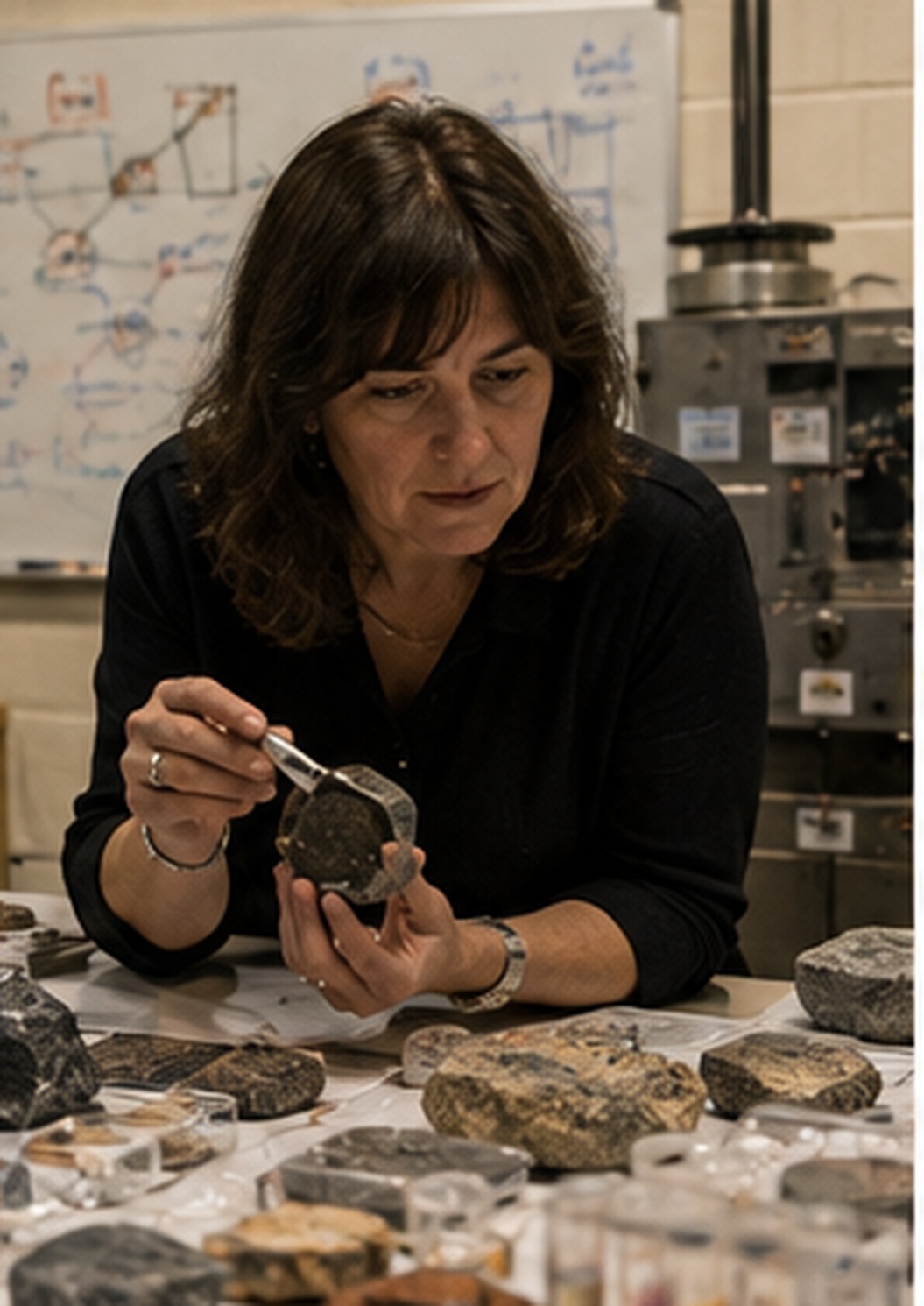
The portrait at the top of this book is an illustration whose exact provenance we were unable to verify.
Online sources
- NASA Ames, “Interview with Nathalie Cabrol” (2021)
- SETI Institute, profile “Nathalie Cabrol”
- NASA Ames, “Exploring Earth’s alien spaces” (2013)
- NASA Ames, “Lincancabur, Chile” (2010, 2012)
- Cabrol et al., “Fluvial processes in Ma’adim Vallis and the potential of Gusev crater as a high priority site” (1994)
- Cabrol et al., “Gusev Crater Paleolake” (1998)
- Cabrol et al., “First Results of the Expedition to the Highest Lake on Earth” (2003)
- Cabrol et al., “Spirit at Gusev Crater: Preliminary Observations” (2004)
- Pedersen et al., “Planetary Lake Lander” (2012)
- SETI Institute, “Can Artificial Intelligence Help Find Life on Mars or Icy Worlds?” (2023)
Facts checked against these sources on October 10, 2026.
Go further
Mars Library
This book extends the page with a complete settlement architecture. The dossier above remains deliberately self-contained: Arcadia is optional further reading, not a prerequisite for understanding it.
 Arcadia — Master Plan of the First Martian City