


Mars Bible — Organisations
The Mars Society
Founded in 1998 in Boulder around Robert Zubrin, the Mars Society campaigns for human settlement of Mars and, in the Canadian Arctic and the Utah desert, has crews live as if on the Red Planet.
founding convention of August 1998
- Founded
- August 1998, Boulder (Colorado)
- President
- Robert Zubrin
- Stations
- FMARS (Devon Island, 2000), MDRS (Utah, 2002)
- MDRS crews
- More than 300 (2026)
- Approach advocated
- Mars Direct, “living off the land”
5 chapters and 3 appendices: about 2,000 words, or about 10 minutes of reading. Every fact comes from verified sources, listed at the end of each chapter.
Part One
Founding and building
1998 – 2002
Chapter 1 · 1998 Boulder, August 1998
The Mars Society is neither an agency nor a company: it is an association of enthusiasts, born of a convention held in Colorado.
Seven hundred people
In August 1998, about seven hundred people gathered at the University of Colorado in Boulder for the founding convention of a new organization, the Mars Society. It was founded by engineer Robert Zubrin and others; he became its president. Eight years earlier, Zubrin and David Baker had presented the Mars Direct plan, which proposes making the return propellant on Mars.
A declaration
The participants ratified a founding declaration. It opens with a simple idea: the time has come for humanity to journey to Mars. It asserts that we are better prepared today to send humans there than we were to go to the Moon at the start of the space age. It then lists the reasons to go: finding out whether life arose there, better understanding the Earth by comparison, taking up a challenge that draws young people to science, building a new world, carrying life beyond the Earth.
Three goals
According to its own presentation, the Mars Society pursues three goals: public outreach to build deep interest in Mars; international support for government-funded Mars research and exploration; and encouragement of commercial ventures that will contribute to human exploration and settlement. It advocates Mars Direct or a similar plan, based on “living off the land”: a cargo mission leaves first and sets up a propellant factory using Martian water ice and atmosphere; the crew follows. It states that NASA and SpaceX have adopted this approach; that is the organization’s own claim.
At the founding convention, the society chose its first project: to build, on Devon Island in the Canadian Arctic, a research station simulating a Martian base. The idea had been proposed in April 1998 by planetary scientist Pascal Lee.
Sources: Mars Society, “Founding Declaration” (ratification by seven hundred participants in August 1998 at the University of Colorado in Boulder; content summarized, the text being protected); Mars Society, “About” page (founded in 1998 by Robert Zubrin and others, three goals, Mars Direct, “living-off-the-land,” cargo mission and propellant factory, claim about NASA and SpaceX); D. S. F. Portree, Humans to Mars, NASA SP-2001-4521 (Mars Direct presented on April 20, 1990); English Wikipedia, “Flashline Mars Arctic Research Station” (Pascal Lee’s proposal of April 1998, choice at the founding convention; tertiary source).
Chapter 2 · 2000 – 2002 Two Martian bases on Earth
To learn how to live on Mars, the Mars Society built its own “analog stations”: one in the Canadian High Arctic, the other in the Utah desert.
On Devon Island
The Flashline Mars Arctic Research Station, FMARS, stands on Devon Island, in the Canadian territory of Nunavut, a polar desert. It was built on the rim of Haughton impact crater, twenty-three kilometers wide. Designed by architect Kurt Micheels and engineer Wayne Cassalls, with Robert Zubrin and many members of the society, it was completed in the summer of 2000. The project cost $1.3 million, raised through sponsorships: an internet company, Flashline.com, contributed $175,000 and earned the right to name the station. The nearest town, Resolute Bay, is an hour away by plane.
Crews there carry out geological, microbiological and climatological exploration in a cold, isolated environment, under constraints similar to those of a crew on Mars. In 2001, biologist Shannon Rupert became the station’s mission support science officer.
In the Utah desert
The second station, the Mars Desert Research Station, MDRS, opened in 2002 in rural southeastern Utah, near Hanksville. It includes a two-level habitat with an airlock, a greenhouse, observatories, an engineering module and a science building. Small crews follow one another there, usually for two weeks. Whenever they go outside, members wear a suit that simulates a spacesuit. From 2002, Shannon Rupert set up a remote science team to support the crews; it would grow to more than forty scientists from around the world.
MDRS would become, according to the Mars Society, the largest and longest-running Mars analog facility in the world.
Sources: Mars Society, FMARS website (Devon Island, Nunavut, crew goals); Mars Society, “Mars160 FMARS Final Mission Report,” August 16, 2017 (rim of Haughton crater, Resolute Bay an hour away by plane); English Wikipedia, “Flashline Mars Arctic Research Station” (polar desert, 23 km crater, completion in summer 2000, Micheels and Cassalls, $1.3 million, Flashline.com and $175,000; tertiary source) and “Mars Desert Research Station” (Hanksville, buildings, suits; tertiary source); Mars Society, “Mars Society Promotes Dr. Shannon Rupert…,” February 17, 2023 (FMARS role in 2001, remote science team created in 2002 and its more than forty scientists, MDRS largest and longest-running); Mars Society, “Harper’s Magazine Feature ‘Redshift’…,” April 15, 2026 (opened in 2002 in rural southeastern Utah, simulations usually two weeks long).
Part Two
Simulating Mars
2016 – 2026
Chapter 3 · 2016 – 2017 Mars 160
In 2016, the Mars Society attempted its most ambitious simulation: eighty days in the desert, then eighty days in the Arctic, with a single crew.
A crew of seven
On April 6, 2016, the society announced the Mars 160 program: two eighty-day missions with the same international crew of seven. The first, Mars Desert 80, began on September 24, 2016 at MDRS, during the society’s nineteenth international convention. The second was to follow at FMARS in the summer of 2017. The announcement presented a crew bringing together a French engineer, Alexandre Mangeot, commander; a Japanese executive officer, Yusuke Murakami; American biologist Shannon Rupert, the program’s principal investigator; a Russian journalist, Anastasiya Stepanova; a Canadian engineer, Claude-Michel Laroche; an Australian geologist, Jonathan Clarke; and a British physician, Susan Jewell. Robert Zubrin managed the program.
Desert versus Arctic
The goal was to carry out geological, paleontological and microbiological field exploration under constraints similar to those of Mars, and to test engineering, telemedicine, spacesuit and traverse techniques. Above all, it was a comparison: could a far cheaper desert simulation replace an Arctic one? The crew members were drawn mostly from MDRS veterans, through the selection set up for a longer project, a one-year Arctic mission still awaiting funding.
Thirty days on Devon Island
On July 17, 2017, six crew members arrived at FMARS: Alexandre Mangeot, in command, Yusuke Murakami, Jonathan Clarke, Anastasiya Stepanova, Anushree Srivastava and American Paul Knightly. All had taken part in the desert phase. Shannon Rupert remained principal investigator, with Paul Sokoloff of the Canadian Museum of Nature, but neither lived at the station.
The Arctic part did not go as planned. According to the final report, published on August 16, 2017, weather and ground conditions delayed the expedition by more than three weeks, and the crew spent only thirty days in the Arctic. For lack of time, no engineering project was carried out. The generator ran only about nine hours a day; the satellite link was slow and unreliable; toward the end, food had to be saved. The crew nonetheless brought back dozens of patterned-ground samples, panoramas of the terrain taken on a regular grid, studies of lichens and rock-dwelling organisms, and observations on group dynamics.
Sources: Mars Society, “Mars Society to Launch Mars 160 Twin Desert-Arctic Analog Missions,” April 6, 2016 (two 80-day missions, seven people, MD80 on September 24, 2016 during the 19th convention, MA80 in summer 2017, crew, Rupert principal investigator, Zubrin program manager, objectives, desert-Arctic comparison, selection set up for MA365); M. Wall, “2nd Half of 160-Day Mars Mission Simulation Begins in Canadian Arctic,” Space.com, July 19, 2017 (arrival on July 17, six members, composition, seven people in the desert phase, Rupert and Sokoloff principal investigators off site); Mars Society, “Mars160 FMARS Final Mission Report,” August 16, 2017 (delay of more than three weeks, thirty days, six members, no engineering project, generator, satellite link, food, results).
Chapter 4 · 2023 – 2026 More than three hundred crews
A quarter of a century after its founding, the Mars Society remains a small association. But its stations have hosted hundreds of crews, and its model is spreading.
An organization taking shape
On February 17, 2023, the society appointed Shannon Rupert, long the director of MDRS, to a new position of Senior Director of Analog Research: she was to oversee a new remote science team and get the research done at the station published, including that of Mars 160. On-site management passed to a team of station managers led by Executive Director James Burk. On September 10, 2024, Ben Stanley, until then assistant director of MDRS alongside its director, Sergii Iakymov, became Analog Research Program Director; among his tasks was launching a journal devoted to space analog research.
Paying to simulate Mars
In April 2026, journalist Elena Saavedra Buckley described in Harper’s Magazine her stay at MDRS with Crew 315. The station, she writes, has hosted more than three hundred crews; most participants pay between $2,000 and $3,500 to take part. She applied through a simple online form, with no experience in aviation, medicine or extreme environments. Her crew wrote daily reports, watered the greenhouse plants and carried out modest research. Her first mission had been cancelled when its commander stopped responding.
The model spreads
In August 2025, India completed its first crewed Mars simulation, HOPE, in the Tso Kar valley in Ladakh, at 4,530 meters: two analog astronauts lived there for ten days in isolation. The project is led by the company Protoplanet, with the Indian Space Research Organisation, ISRO. The Mars Society joined it as a senior partner, with advisory expertise and financial support, and will take part in selecting future crews. On Devon Island, FMARS Crew 19 completed its simulation in July 2026.
Rovers and conventions
The society runs an annual university rover competition, the University Rover Challenge, and supports a European competition, the European Rover Challenge. It runs an online encyclopedia, Marspedia, virtual reality simulations, local chapters in the United States and elsewhere, and an annual international convention: the 2026 convention is scheduled for October 22–24 at the University of Southern California in Los Angeles.
Sources: Mars Society, “Mars Society Promotes Dr. Shannon Rupert to New Position of Senior Director, Analog Research,” February 17, 2023; Mars Society, “Mars Society Appoints Ben Stanley as New Analog Research Program Director,” September 10, 2024; Mars Society, “Harper’s Magazine Feature ‘Redshift’: Rehearsing for Humanity’s Future on Mars,” April 15, 2026 (article by E. Saavedra Buckley, Crew 315, more than 300 crews, $2,000 to $3,500, application, cancelled mission, 2026 convention); Mars Society, “India’s First Crewed Mars Analog Launches with Protoplanet, ISRO & the Mars Society,” September 16, 2025 (HOPE, Tso Kar, 4,530 m, ten days, two astronauts, partners); Mars Society, FMARS website (Crew 19, July 2026); Mars Society, “About” page (University Rover Challenge, European Rover Challenge, Marspedia, MarsVR, chapters, annual convention).
Epilogue
The Mars Society and Mars
Chapter 5 · The lesson What the Mars Society brings to Mars
An association with no rocket and no agency budget has had hundreds of crews live as if on Mars. Three lessons emerge.
Training before leaving
Going outside in a suit, managing power, water and food, handling the tensions of a small group: all of this can be learned on Earth. The Mars Society’s stations have made that learning a practice open to hundreds of volunteers.
Reality corrects the plan
Mars 160 was to last twice eighty days; the Arctic decided otherwise. Delays, a limited generator, slow links: these are exactly the constraints a Mars crew will face, without being able to wait for better weather.
The role of citizens
The Mars Society shows that one can contribute to exploration without being an agency: by campaigning, building stations, training students. A future Martian society will need such goodwill as much as engineers.
This lesson is a reflection by the author of this book, based on the facts reported in the previous chapters, where their sources are given.
Appendices
Further reading
Appendix Understanding the Mars Society
A few ideas, explained simply, to follow this book.
The analog station
A place on Earth chosen because it resembles Mars in some respects (cold, dryness, rocks, isolation), where a Mars mission is simulated to test equipment, methods and crew behavior.
The sol
The Martian day, slightly longer than an Earth day. Station crews often count their days in “sols,” as astronauts on Mars would.
The extravehicular activity
Any outing outside the habitat. In simulation, crew members wear a suit imitating a spacesuit and go through an airlock, as they would on Mars.
Living off the land
The idea of using the resources of Mars (water from ice, carbon dioxide from the air) to produce propellant, oxygen and water on site, instead of bringing everything from Earth.
These explanations are general notions. Counting in sols follows the FMARS mission reports; “living off the land” follows the Mars Society’s “About” page.
Appendix Timeline
The Mars Society, in dates.
April 20, 1990. Robert Zubrin and David Baker present Mars Direct to NASA.
April 1998. Pascal Lee proposes a research station on Devon Island.
August 1998. Founding convention of the Mars Society in Boulder.
Summer 2000. The FMARS station on Devon Island is completed.
2002. MDRS opens in Utah.
September 24, 2016. Mars Desert 80, first part of Mars 160, begins.
Summer 2017. Arctic part of Mars 160 at FMARS, thirty days.
February 17, 2023. Shannon Rupert becomes Senior Director of Analog Research.
September 10, 2024. Ben Stanley becomes Analog Research Program Director.
August 2025. India’s first crewed Mars simulation, HOPE, with the Mars Society.
April 2026. Harper’s Magazine report: more than three hundred crews at MDRS.
July 2026. FMARS Crew 19.
October 22–24, 2026. International convention in Los Angeles (scheduled).
Sources: those of the chapters.
Appendix Sources and method
This book tells the story of the Mars Society from its own publications, supplemented by a few outside sources. This appendix shows where the facts come from and their limits.
The main sources
Most of it comes from the Mars Society’s pages and announcements: its founding declaration, its presentation page, its announcements from 2016 to 2026 and the Mars 160 final report published on the FMARS website. These are the organization’s own sources: reliable for dates and internal facts, less so for its judgments of its own importance, which we flag as such. A few details on the construction of the stations come from English Wikipedia, a tertiary source, flagged each time.
The former “Mars Society” page of this site redirected to Robert Zubrin’s biography. That book tells his life; this one tells the story of the association. The dossier on MDRS also remains online.
What remains uncertain
The Mars Society presents itself as the world’s largest and most influential space advocacy organization, and states that NASA and SpaceX have adopted its approach; we have no independent source to verify this. Its membership numbers are not published on the pages consulted. The Mars 160 final report mentions six crew members in the Arctic, whereas the 2016 announcement planned seven: a Space.com article of July 19, 2017 explains the gap, the desert phase having indeed had seven people and the Arctic phase six. It also shows that the crew’s composition changed after the announcement: two of the six members who reached the Arctic were not on it. We have not found the exact list of the seven members of the desert phase.
Length
This book runs to about two thousand one hundred words. The goal set for this collection was one hundred thousand. We did not reach it, and we prefer to say so: we wrote only what our sources allowed us to state.
The illustration
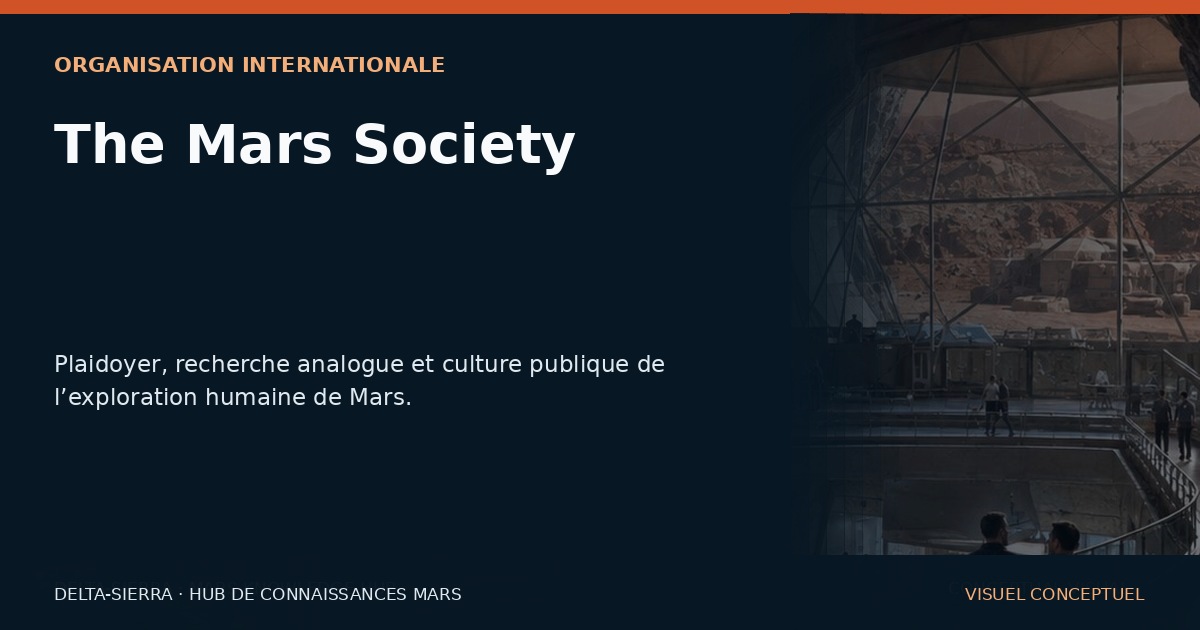
The image at the top of this book is an illustration whose exact provenance we were unable to verify.
Online sources
- Mars Society, Founding Declaration
- Mars Society, About
- Mars Society, Mars 160 (2016)
- Mars Society, Mars160 FMARS Final Mission Report (2017)
- Mars Society, Shannon Rupert (2023)
- Mars Society, Ben Stanley (2024)
- Mars Society, HOPE (2025)
- Mars Society, Harper’s, “Redshift” (2026)
- Mars Society, FMARS
- Wikipedia, Flashline Mars Arctic Research Station
- Wikipedia, Mars Desert Research Station
- D. S. F. Portree, Humans to Mars, NASA SP-2001-4521
- Space.com, start of the Mars 160 Arctic phase (2017)
Facts checked against these sources on October 11, 2026.
Go further
Mars Library
This book extends the page with a complete settlement architecture. The dossier above remains deliberately self-contained: Arcadia is optional further reading, not a prerequisite for understanding it.
 Arcadia — Master Plan of the First Martian City