

This portal distinguishes observed facts, demonstrated technologies, active development and forward-looking settlement scenarios. The linked monographs provide the evidence and assumptions behind each layer.
A realistic starting point
What does “colonizing Mars” actually mean?
The phrase Mars colonization is often used as if it described one event: a rocket lands, a flag is planted and a new world begins. In engineering terms, however, a landing is only the opening operation. A permanent settlement must keep people alive through equipment failures, launch delays, dust, radiation, medical emergencies and long periods in which immediate help from Earth is impossible. A true colony—or, more neutrally, a permanent human settlement—must eventually reproduce not only oxygen and water, but also maintenance capacity, knowledge, institutions and social continuity.
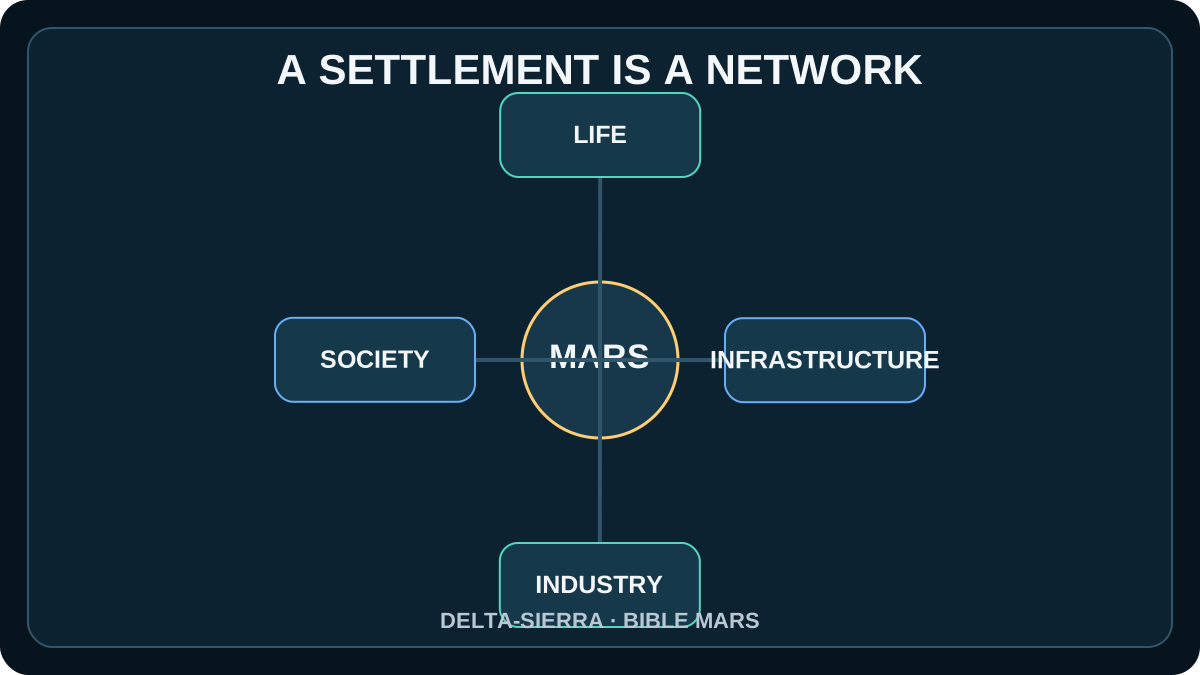
This hub therefore treats Mars as an interconnected system. Transport determines how much mass can be landed. Landing location determines access to water ice, sunlight and scientifically sensitive terrain. Power availability determines whether oxygen can be produced, ice can be mined, workshops can operate and crops can be illuminated. Habitat design affects radiation exposure, privacy, mental health and repair access. Crew selection affects whether the group can solve failures without real-time support. Governance determines who can ration scarce resources, investigate accidents and settle disputes. Industry determines whether the base remains a dependent expedition or develops into a durable city.
Three levels of evidence, kept separate
Many weak articles mix measured facts, laboratory demonstrations and speculative urban design in the same paragraph. That makes futuristic claims look more certain than they are. Every guide in this mini-site uses three explicit levels.
Measured or operational knowledge
Examples include Mars’s thin carbon-dioxide atmosphere, the presence of accessible subsurface ice in some mid-latitude regions, the communication delay and radiation measurements returned by robotic missions.
Technology proven at limited scale
MOXIE produced oxygen from Martian atmospheric carbon dioxide. Water recycling, crop growth and closed-loop life-support research operate on Earth or in orbit. None has yet sustained a settlement on Mars.
Reasoned choices for a future society
Settlement size, constitutional arrangements, district planning and the path toward autonomy are not scientific facts. They are design problems that must be argued transparently.
Why Mars remains the central destination
Mars is not a second Earth. Its surface pressure is below one percent of Earth’s sea-level pressure, its atmosphere is dominated by carbon dioxide, average temperatures are far below freezing and the planet lacks Earth’s global magnetic shielding. Yet Mars offers a combination unmatched by the Moon or free space: a near-Earth day of about 24 hours and 39 minutes, gravity of roughly 38 percent of Earth’s, abundant mineral resources, water ice and a surface large enough for geographically separated settlements.
That combination does not make Mars easy; it makes Mars conceivably inhabitable through technology. The distinction matters. Early residents would live inside pressurized, shielded environments. They would not breathe the outside air, farm untreated soil or walk freely without pressure suits. The first decades would resemble the operation of a remote industrial research station far more than the construction of a terrestrial suburb.
From von Braun’s expedition fleets to modern settlement architectures
Serious Mars planning has a long history. Wernher von Braun’s post-war Mars Project imagined a large expedition assembled through enormous launch campaigns. His proposals were technically sophisticated for their time but depended on a scale of orbital assembly and national mobilization that never materialized. The historical lesson is not that early planners were naïve; it is that a Mars plan is inseparable from the transport economy and political system capable of sustaining it.
Modern strategies divide more sharply. NASA’s Moon to Mars framework emphasizes progressive capability development, science, crew safety and systems tested through lunar operations. SpaceX emphasizes reusable heavy transport, high launch cadence and the long-term objective of a self-growing Martian base. These visions are not interchangeable. One is an agency architecture for exploration; the other is a corporate transport-and-settlement ambition. A credible public guide must describe both without treating either schedule as a certainty.
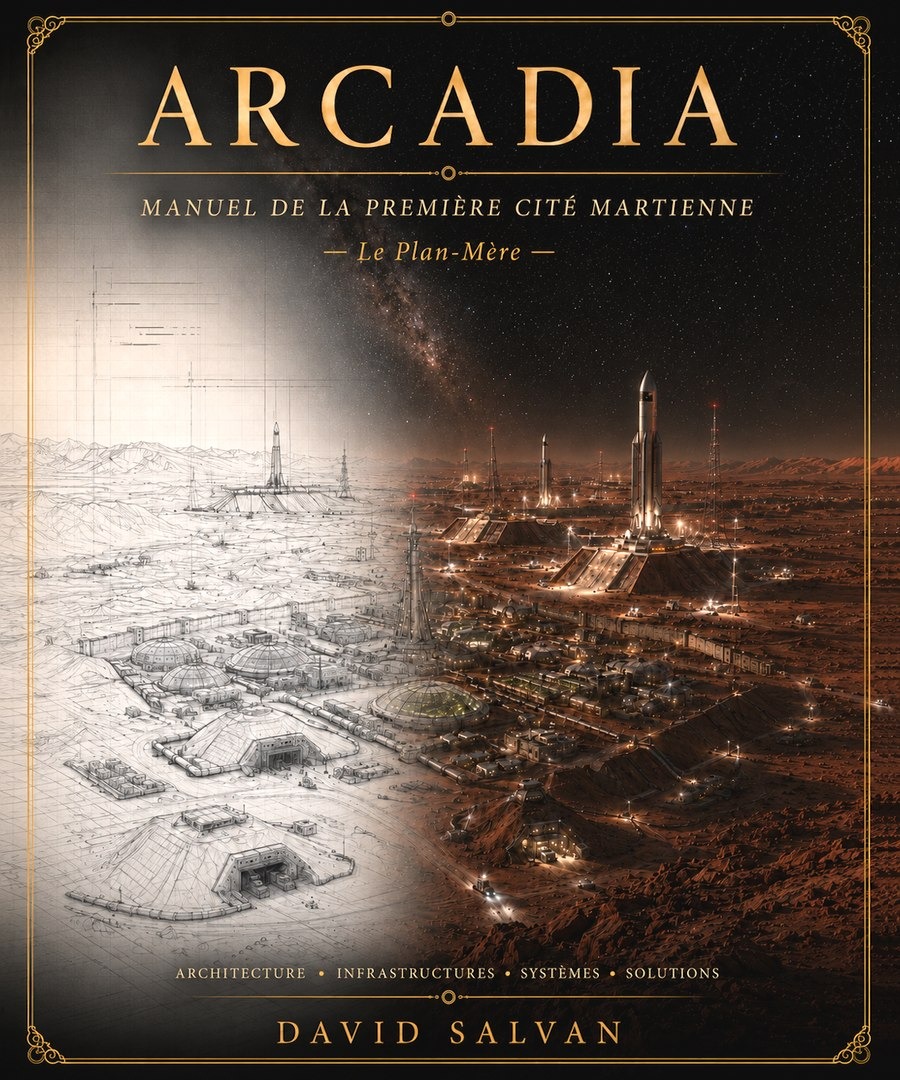
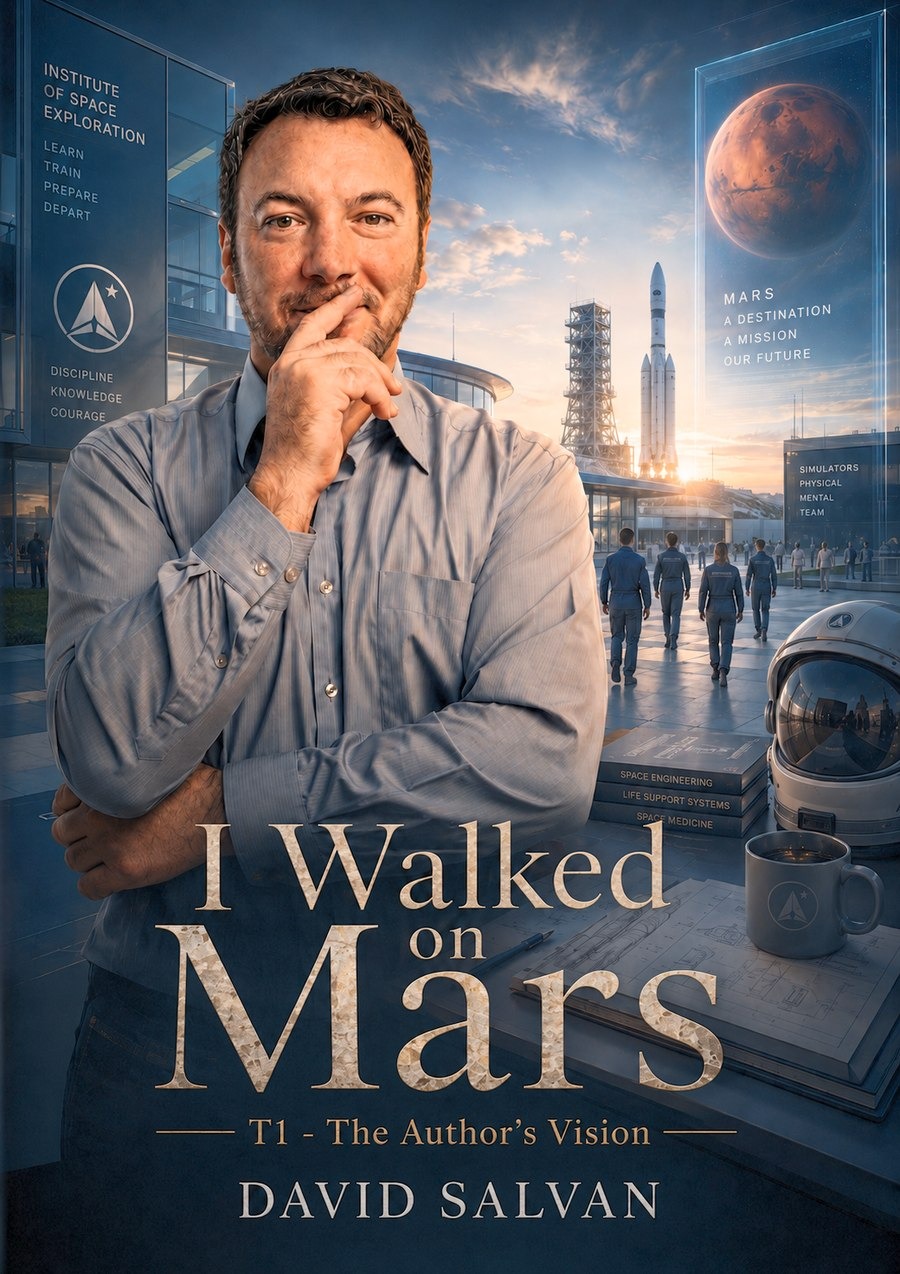
David Salvan’s Mars books enter at a different level: what happens after the transport architecture begins to work? I Walked on Mars explores selection, departure, arrival and political transformation through narrative. Arcadia — Manual of the First Martian City concentrates on the physical and organizational systems that turn repeated missions into a settlement.
Choose your reading level
The hub now offers a public introduction, a readable engineering overview and a continuously updated mission centre. These pages connect to the thematic dossiers of the Mars Bible without turning the public site into a reproduction of Arcadia.
Start here — Mars colonization explained
A clearly identified public introduction to rockets, payload, travel time, landing, water, oxygen, power, habitats, food, health and the progression from base to settlement.
Engineering overview — systems and trade-offs
A technical but readable map of propulsion, EDL, surface power, ISRU, life support, habitats, maintenance, communications, health, verification and technology maturity.
Live missions — official broadcasts and space news
Automatic NASA and SpaceX live-status detection, privacy-enhanced video playback and a continuously refreshed stream of official space, Mars and engineering updates.
The major questions that determine success
Any serious Mars project starts with the “why” before the “how”. If the settlement has no clear scientific, civilizational or industrial purpose, the engineering becomes spectacle. The first guide in this hub therefore asks the prior question: why go to Mars at all?
The thematic dossiers in this hub are designed to answer distinct search intentions while forming one coherent model. They are not fragments of the novels and do not publish the books’ narrative content. Each article provides an original, public explanation of the real-world problem, then points readers toward the books for the broader fictional and technical exploration.
1. Why go to Mars?
The scientific, strategic, industrial and civilizational case for building a permanent human settlement beyond Earth.
2. How could humans colonize Mars?
A realistic sequence from robotic preparation and cargo deployment to a permanent settlement.
3. Water, oxygen, food and energy
Why the colony’s resource loops matter more than any single spectacular technology.
4. Surface, buried or underground habitats?
Radiation shielding, pressure vessels, dust control, repair access and human interior life.
5. Who should be selected?
Technical skills, medical limits, psychological resilience, team compatibility and legitimacy.
6. How would a Mars colony govern itself?
Authority during emergencies, Earth–Mars delay, due process, resource law and gradual autonomy.
7. How does a base become a city?
Growth phases, local manufacturing, education, districts, civic identity and interdependence.
8. How do people reach and land on Mars?
Transfer windows, months in transit, heavy-payload descent and precision surface logistics.
9. Where should the colony be built?
Water ice, latitude, altitude, terrain, science and long-term growth.
10. What would Mars do to the human body?
Radiation, partial gravity, dust, isolation and autonomous medicine.
11. What would daily life be like?
The Martian sol, work, exercise, meals, privacy, communication and culture.
12. When could a colony exist, and what would it cost?
Capability gates, public claims, launch economics and honest uncertainty.
13. Does Mars need to be terraformed?
Why local habitats are a different and much nearer-term engineering problem.
The failure modes most popular explanations omit
A settlement can fail even when every major machine works. It can fail because maintenance hours exceed available labor, because spare parts were optimized for mass rather than repairability, because crop calories depend on one lighting system, because dust enters seals, because a medical case requires equipment that was never landed, or because command authority becomes illegitimate during a long emergency. The decisive design principle is therefore not maximum efficiency. It is graceful degradation: when one subsystem fails, the settlement must become less comfortable or less productive without becoming immediately uninhabitable.
This has consequences for every layer. Power generation needs physically independent backups. Habitats need isolatable pressure zones. Water storage must be distributed. Critical software must remain operable offline. Skills must overlap between crew members. Governance must specify emergency powers and their expiration. Archives and training systems must survive the loss of a single server or expert.
What would count as success?
The first successful mission would return its crew alive. The first successful base would survive between launch windows without emergency rescue. The first successful settlement would maintain its essential systems despite the loss of a major shipment. The first successful city would educate new specialists, manufacture a meaningful share of its replacement parts, debate its own priorities and possess institutions that outlive the founding mission.
That final threshold is why Mars colonization cannot be reduced to rockets. Rockets open the route. A city begins only when people can build a future at the destination.
Mars in ten minutes: the physical world every settlement architecture must obey
Before imagining domes, farms or cities, a settlement design has to accept the basic physics of Mars. A Martian solar day, or sol, lasts about twenty-four hours and forty minutes. That is close enough to Earth’s day to make the rhythm feel familiar, but different enough to affect clocks, software, work shifts and communication schedules. A Martian year is almost two Earth years long, so seasons are prolonged. Because Mars follows a more eccentric orbit than Earth, the seasons are not symmetric between hemispheres. Time therefore becomes an engineering input from the first day: when is solar power strongest, when are EVAs safest, when are thermal loads highest and when is Earth visible to a particular antenna?
Surface gravity is about 38 percent of Earth’s. A person or object has the same mass but a lower weight. If an object exerts 100 newtons of weight on Earth, a simple first estimate on Mars is 100 × 0.38 ≈ 38 newtons. That makes some lifting easier, but inertia does not disappear. A heavy vehicle still resists acceleration and can still crush equipment during a collision. For human health, the more difficult question is not how light a person feels on day one but what months, years, pregnancy and childhood at roughly 0.38 g would do to bones, muscles, circulation and development.
The atmosphere is the larger break with Earth. It is thin and dominated by carbon dioxide. Humans cannot breathe it, and it does not transport heat like dense terrestrial air. Yet it is not negligible. It produces drag during entry, moves dust, influences thermal design and provides carbon dioxide that can feed some industrial processes. Mars therefore often presents a resource and a hazard in the same phenomenon. The atmosphere is too thin to support human life or make heavy landing easy, but present enough that engineers must design around it.
Distance changes everything else. Earth and Mars move independently around the Sun, so the distance and radio delay vary. Favorable launch opportunities recur on a cycle of roughly twenty-six months. Communication cannot resemble a normal telephone call; a question may take several minutes to arrive and the reply several more to return. A settlement must therefore make local decisions. That communication delay changes medicine, maintenance, robotic operations, emergency response and even the culture of authority.
From the first cargo landing to a city: colonization is a sequence of proofs
The word colonization can make the process sound like one dramatic departure followed by settlement. A credible architecture is more like a sequence of evidence. Before a crew depends on a site, reconnaissance must reduce terrain uncertainty, communications must be available, power must work, shelter must be ready and vital systems must survive without immediate help from Earth. The first meaningful milestone is not simply “people landed.” It is “a surface system operated long enough that sending people no longer meant gambling on every subsystem at once.”
A practical sequence can be imagined. Robotic missions map and certify candidate zones. Uncrewed cargo delivers power, communications, spares and construction equipment. Local water or oxygen production is demonstrated before crew survival depends on it. The first crew arrives as operators of an infrastructure that is already alive. Later crews increase maintenance capability and local production. The base is then tested by a delayed or lost shipment. Only after it can absorb missing deliveries and replace more failures locally does the architecture begin to resemble permanent settlement.
This suggests a better measure than population alone: dependence on Earth. A base with one hundred people may remain extremely fragile if one filter, medical item, electronic board or pump must arrive in the next launch window. A smaller outpost may be more resilient if it can maintain power, water, air and essential machinery locally. Autonomy is not a binary status. It is a vector of dependencies that can shrink function by function.
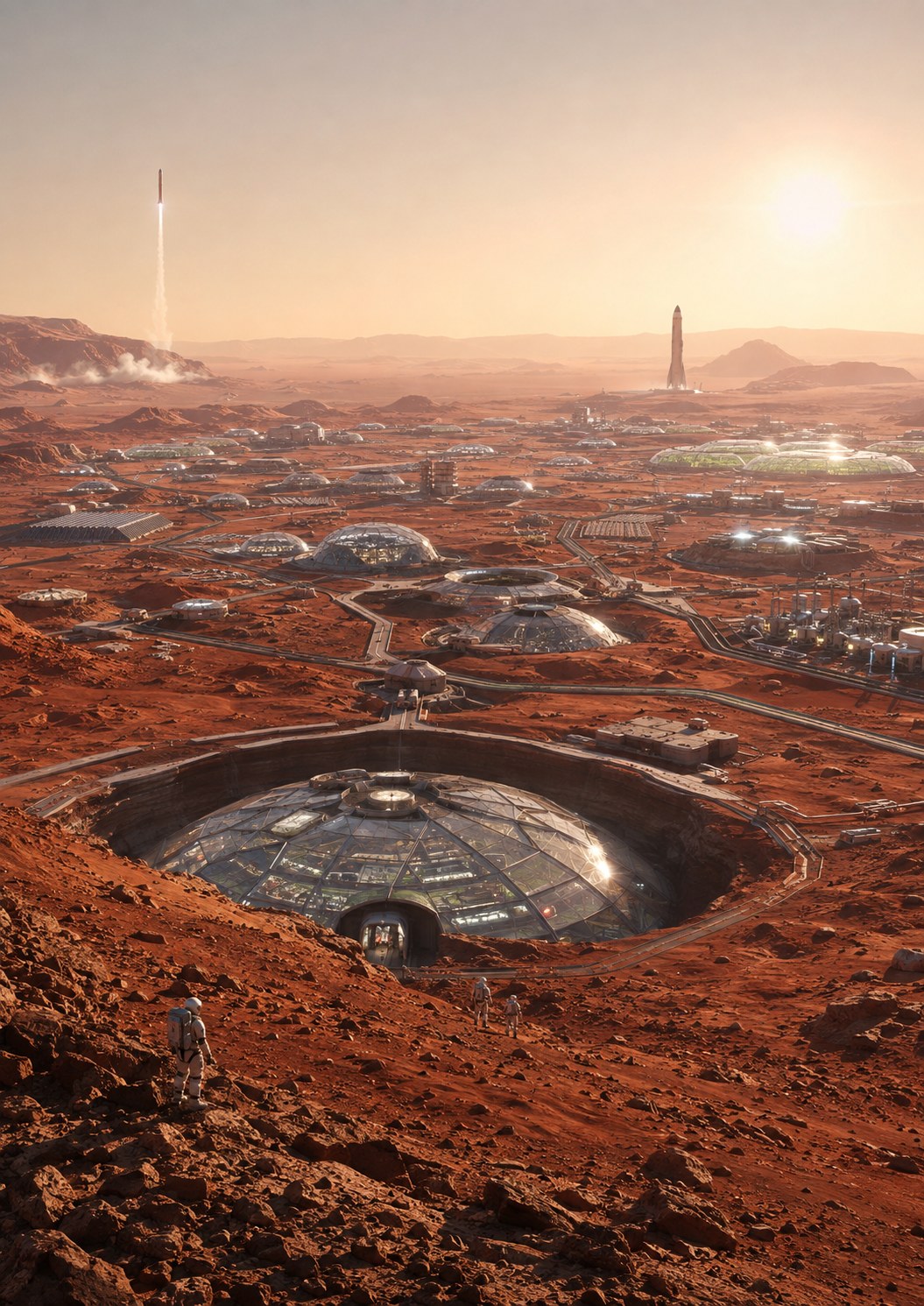
This perspective also changes how to read spectacular concept art. A glowing habitat does not explain how power is distributed, how a pressure leak is isolated, how spare parts are catalogued, how a failed harvest is covered or who repairs a motor controller when the manufacturer is months away. A serious Mars reference has to make those invisible infrastructures visible, because they are what separate an attractive image from a durable system.
Twelve systems that must work as one
A Martian settlement is not the sum of independent chapters. Transportation determines how much hardware can arrive. Habitat volume creates power and thermal demands. Water affects hygiene, agriculture, electrolysis and propellant options. Food production creates lighting, nutrient, air-circulation and waste-processing loads. Maintenance depends on tools, diagnostics, spares and training. Communications influence how much decision-making must occur locally. Each choice propagates across the architecture.
Consider a simple example. Adding crop lighting may require 20 kW for 12 hours per sol. The energy demand is E = P × t = 20 kW × 12 h = 240 kWh. That energy must be generated, transmitted and often stored. A decision that looked agricultural immediately becomes an electrical and thermal decision. The same coupling appears everywhere: more shielding adds mass, more redundancy adds spares, and more local production adds equipment that itself requires maintenance.
Redundancy also needs more thought than simply installing two identical units. Two pumps can share the same manufacturing defect, power supply, software or contamination source. A robust design therefore asks what can make redundant units fail together. Sometimes the answer is technological diversity, sometimes physical separation, sometimes inventory, and sometimes the ability to operate temporarily in a degraded mode.
This is why the Delta-Sierra corpus treats air, water, power, EDL, habitats, industry, health, logistics, communications, mobility, governance and transport as separate books while linking them constantly. The reader should be able to enter through a simple question such as “how do people breathe?” and discover the interfaces that question creates without having the same chapter copied onto every page.
Four people, twenty, one hundred, one thousand: scale changes the problem
An outpost of four people still resembles an expedition. Equipment can be counted unit by unit and each person may understand several systems. At twenty people, work begins to specialize. Medicine, agriculture, maintenance and external operations cannot all depend on the same individuals. At one hundred people, the settlement needs structured shifts, training, planned maintenance and fire protection. At one thousand, the architecture becomes industrial: machine shops, standardized parts, quality systems, power networks, roads, inventories and a real local economy begin to matter.
Not every need scales linearly. Some systems benefit from economies of scale: a laboratory or clinic can serve many people without being multiplied exactly with population. Other needs are close to proportional, such as metabolic oxygen or basic food energy. Still others appear only after thresholds are crossed: schools, maternity care, formal dispute resolution, metallurgy, a meshed electrical grid or large waste-processing systems. This nonlinearity makes it dangerous to design a city by simply multiplying an outpost by a hundred.
Scale also changes the tension between standardization and diversity. Using one pump model simplifies training and spares, but a common defect can affect the entire settlement. Multiple technologies complicate inventory but can protect against common-cause failure. On Earth, industries make this trade-off for cost and reliability. On Mars, it becomes a survival decision because replacement lead times are enormous.
Population eventually changes governance as well. Four astronauts can operate under a mission chain of command. One thousand permanent residents cannot indefinitely live as a spacecraft crew. Technical emergency authority, healthcare, resource allocation, justice and collective decision-making begin to require distinct institutions. Society itself becomes part of the life-support architecture.
Three architecture families—and what each one is really trying to optimize
No single Mars architecture is dictated by physics. Different plans optimize different things. One family emphasizes risk reduction through extensive pre-deployment, validation and reserves. Another reduces imported mass by using local resources earlier. A third assumes reusable transportation and high launch cadence can lower the cost of sending large amounts of hardware. Each approach may be rational under its own assumptions.
Every approach moves risk. Pre-deployment reduces uncertainty at crew arrival but increases cargo campaigns and preparation time. Early ISRU can reduce imported water, oxygen or propellant but makes the mission depend on industrial equipment operating reliably on Mars. High-cadence reusable transport can make heavy equipment and comfortable reserves more plausible, but the surface architecture becomes vulnerable if that cadence is not achieved.
The useful question is therefore not “which architecture is best?” without qualification. Best for minimizing crew risk? Best for reducing launches? Best for early arrival? Best for ten-year autonomy? An architecture can dominate one metric and perform poorly on another.
For the same reason, every number needs a boundary. Saying a settlement requires a certain mass is almost meaningless without population, duration, recycling assumptions, reserves, local production, redundancy and failure cases. Making those boundaries visible is what allows competing architectures to be compared honestly.
The real test: survive the event that was not supposed to happen
A base that works only when every shipment arrives on schedule is not autonomous. A base that survives only while every machine remains nominal is not resilient. The real test begins with a lost cargo vehicle, a failed converter, a poor harvest, a communications outage or a longer-than-planned dust event.
Resilience must therefore be expressed in time and function. How long can the settlement operate without new water-processing membranes? How many days of critical medicines exist? Which loads remain powered after an electrical emergency? Can a pressure refuge hold everyone? Can a failed machine be repaired, substituted or bypassed? Those questions are more revealing than a single headline percentage of “self-sufficiency.”
Information is part of resilience. The crew needs configuration records, compatible-part lists, failure history and accurate inventory. A warehouse full of components can be useless if no one knows which hardware revision they fit. As the settlement grows, quality control and configuration management become as important as the physical stock.
This marks the transition from exploration to habitation. An expedition can finish and come home. A settlement must absorb mistakes and continue. The central question becomes not only whether humans can reach Mars, but how many independent and combined failures the system can tolerate before ordinary life becomes impossible.
Reference dossier · systems view · updated 18 August 2026
A Mars settlement is a system of systems
The shortest useful definition of Mars colonization is not “people living on Mars.” It is a settlement able to keep people alive, productive and socially organized while Earth is too far away to intervene in real time. That changes the engineering question completely. A habitat may be excellent and the settlement may still fail because the power system cannot restart after a fault. A water plant may work and the settlement may still fail because its filters cannot be manufactured or replaced. A rover fleet may be reliable and the settlement may still fail because a dust event, software update or common electrical bus disables several vehicles at once. The correct unit of analysis is therefore the whole chain of dependencies, not the most impressive individual machine.
NASA’s current Moon to Mars architecture uses this same systems language. The agency’s 2026 architecture material describes a set of sub-architectures that must work together: autonomous systems and robotics, communications and positioning/navigation/timing, data systems, habitation, human systems, in-situ resource utilization, infrastructure support, logistics, mobility, power, transportation and utilization. Delta-Sierra extends the thought experiment one step further: an initial exploration campaign can accept substantial dependence on Earth, while a settlement must progressively shorten those dependency chains and increase the time it can function through a missed launch, a damaged plant or a period of degraded communications.
Why the same base cannot simply be multiplied by 250
It is tempting to imagine that a settlement of 1,000 people is merely 250 copies of a four-person outpost. Real infrastructure does not scale that way. Some functions become more efficient with size: one laboratory, one communications relay or one machine shop can serve many people. Other functions become harder: fire zoning, medical triage, traffic, food safety, waste handling, governance, spare-part diversity and cyber-security all gain new failure modes as the population grows. At small scale, expertise is concentrated in individuals; at larger scale, the organization must preserve knowledge when a particular person is unavailable. At small scale, a single pressure vessel may be acceptable; at larger scale, compartmentation becomes a basic survival principle.
| Scale | Primary engineering question | Typical hidden weakness | Evidence of progress |
|---|---|---|---|
| 4 people | Can a crew survive and return? | One specialist or one critical unit becomes a single point of failure. | Safe operations, emergency refuge, repair procedures and return capability. |
| 20 people | Can several crews share infrastructure without common-cause failure? | Shared power, air, water and software can make “redundant” modules fail together. | Independent loops, distributed stores, cross-trained crews and real maintenance capacity. |
| 100 people | Can the settlement reproduce everyday technical capability? | Thousands of different components and consumables exceed ad-hoc inventory management. | Machine shop, metrology, quality system, planned local production and traceable configuration control. |
| 1,000 people | Can a community endure industrial, medical and institutional disruption? | Failure becomes social as well as technical: queues, conflicting priorities, public-health events and governance errors. | Multiple districts, diversified utilities, hospitals, schools, emergency governance and multi-window resilience. |
Four clocks govern every serious Mars plan
A Mars settlement has at least four clocks running at once. The first is the orbital clock. Efficient Earth-to-Mars launch opportunities occur roughly every 26 months because the planets must reach a favorable relative geometry. A missed shipment is therefore not equivalent to a terrestrial delivery arriving a week late. The second is the communications clock. Depending on orbital geometry, a one-way radio message takes minutes rather than fractions of a second, and around solar conjunction communications can be degraded or deliberately restricted. The third is the maintenance clock: how long a function can operate before filters, seals, bearings, catalysts, batteries, sensors or lubricants need attention. The fourth is the biological clock: people need oxygen, water, food, sleep, medical care and psychological recovery every day, regardless of launch schedules.
A robust architecture makes those clocks explicit. If a carbon-dioxide scrubber has a replaceable element every 180 days, the logistics model must say how many elements exist, how many parallel scrubbers can carry the load, whether the part can be refurbished, what happens if two fail in the same week, and whether an equivalent can be manufactured locally. If a food reserve covers 400 days but the next launch opportunity plus flight time could exceed that period, the reserve is not a comfortable margin; it is a countdown. If a water system recovers 98% of collected water, the important question is not merely the impressive percentage. The settlement must ask what the remaining losses are, where they occur, whether they accumulate, and which replacement sources can close the balance.
Simple scale check: oxygen metabolism
NASA reference NASA’s human-spaceflight reference material gives a representative daily oxygen consumption of about 0.82 kg per crewmember for a standard day with exercise. This is a metabolic planning value, not the complete oxygen budget of a settlement.
Four people: 0.82 kg/person/day × 4 = 3.28 kg/day.
Twenty people: 0.82 × 20 = 16.4 kg/day.
One hundred people: 0.82 × 100 = 82 kg/day.
One thousand people: 0.82 × 1,000 = 820 kg/day.
The multiplication is simple; the engineering is not. A settlement also needs oxygen for leakage replacement, suit operations, medical use, fire-response strategy and sometimes industrial or propellant production. The calculation is useful because it turns “we will make oxygen on Mars” into a throughput, storage and maintenance problem.
Redundancy only counts when failures are truly independent
Two identical pumps on the same electrical bus are redundant against one pump motor failing. They are not redundant against a bus failure, a software command that shuts both pumps down, contaminated feedwater, a fire in the room, or a maintenance error repeated on both machines. This distinction between component redundancy and failure independence becomes decisive on Mars because resupply and outside expertise are delayed. A credible settlement design therefore asks not just “how many units?” but “what can disable them together?”
Common-cause failures can be physical, digital, organizational or environmental. Dust may enter multiple cooling loops. One corrupted software update may affect every controller of the same type. A single technician may apply the wrong procedure to several units. Spare parts from one manufacturing batch may share the same defect. A pressure corridor may connect otherwise separate habitats. A cyber-security incident may isolate systems that are mechanically healthy. The solution is not endless duplication. It is diversity, separation, buffering and graceful degradation: different technologies where justified, different physical zones, stores that buy time, and operating modes that preserve the most important functions when full performance is impossible.
| Question | Weak answer | Stronger answer |
|---|---|---|
| What powers the backup? | The same bus as the primary. | Separate distribution path or protected cross-tie with black-start capability. |
| Where is it located? | Next to the primary unit. | Different fire/pressure zone when the consequence justifies separation. |
| Who can repair it? | The same single specialist. | Cross-trained crew, procedure, tools and remote documentation. |
| Which software controls it? | The same image and update path. | Validated fallback, staged updates and recovery path independent of the failed controller. |
| How long can the settlement wait? | “Until repaired.” | Named buffer: hours of battery, days of stored water, kilograms of oxygen, thermal coast time. |
From exploration campaign to settlement: five proof gates
A settlement should not grow because a calendar says “phase two.” It should grow because the preceding infrastructure has crossed measurable gates. A useful sequence is: land it, operate it, stress it, repair it, then duplicate it. Landing demonstrates delivery. Operating for months demonstrates nominal performance. Stressing the system reveals hidden dependencies. Repair demonstrates maintainability. Duplication demonstrates that expansion is not a one-off prototype exercise.
Gate 1 — cargo and power: heavy cargo reaches the target zone repeatedly and a power system operates through expected environmental cycles. Gate 2 — life support: atmosphere, water and thermal loops operate for long periods with actual maintenance interventions recorded. Gate 3 — local resources: water, oxygen or construction feedstocks are produced at useful rates, with purity, energy cost, wear and rejects measured. Gate 4 — missed logistics: the site survives a deliberately modeled lost shipment without crossing life-safety limits. Gate 5 — institutional resilience: the community can handle a medical emergency, loss of a key specialist, cyber incident or internal conflict without losing control of life-critical systems.
This framework deliberately avoids claiming that any organization has selected the same sequence. NASA’s 2026 Mars trade-space pages still describe major choices as open, while progressively narrowing some decisions such as initial surface power. A reference site should make that uncertainty visible: the honest question is not “which famous plan will win?” but “which capabilities must be demonstrated whatever plan is chosen?”
Water recycling shows why percentages can mislead
In 2023 NASA reported that the International Space Station’s Environmental Control and Life Support System had demonstrated roughly 98% water recovery in the U.S. segment, a milestone relevant to long-duration exploration. That figure is impressive, but a settlement designer must immediately ask the Delta-Sierra question: where are the remaining two percent? If a closed system processes 1,000 kg of water and 2% is not recovered within the defined boundary, that is 20 kg that must be replaced or recovered elsewhere. Over repeated cycles, the cumulative make-up requirement can dominate logistics unless another source closes the balance.
The percentage also does not say that every drop in an entire settlement is recovered. Water can leave the defined recovery loop through EVA operations, cleaning, industrial processes, biological incorporation, leaks, maintenance, discarded brines and contaminated streams. A city-scale system therefore needs several water qualities and loops: potable water, hygiene water, technical water, greenhouse nutrient solution, fire reserve and industrial process streams. The engineering goal is not a magical “100% recycle” slogan. It is to know the mass balance, losses, contamination pathways, energy demand and emergency stores for each loop.
Calculation: why a small loss becomes a supply chain
Pedagogical scenario Suppose a 100-person settlement circulates an average of 25 kg of water per person per day through all defined recoverable uses. The gross circulation is 2,500 kg/day. If the total recovery across that boundary is 98%, unrecovered water equals 2% × 2,500 = 50 kg/day. Over 100 days that is 5,000 kg, or five metric tonnes.
This does not predict the water requirement of a real Mars city; the assumed 25 kg/person/day boundary is deliberately stated. It demonstrates why recovery percentage, boundary definition and local make-up water must be discussed together.
MOXIE proved a principle, not a settlement plant
NASA’s MOXIE experiment aboard Perseverance produced oxygen from Martian atmospheric carbon dioxide. By the end of its mission NASA reported 122 grams of oxygen produced in total and a best hourly rate of 12 grams, with purity of at least 98% at peak performance. This is an important demonstration because the feedstock is available in the atmosphere and the electrochemical process worked on Mars. But a human settlement requires a different category of system: continuous throughput, compressors, filters, thermal management, power conditioning, storage, distribution, maintenance access, replacement parts and redundancy.
Compare only the scales, without pretending that MOXIE was designed as life support. At 12 g/hour, 24 hours of operation would equal 288 g/day. The representative 0.82 kg/day metabolic oxygen value above is 820 g/day per person. Even one person’s metabolic demand is therefore several times that continuousized demonstration rate, and propellant oxygen can require vastly greater production. The lesson is positive rather than dismissive: a demonstrated chemical pathway creates a starting point, while settlement engineering begins when the production train, its energy system and its maintenance burden are scaled together.
Distance turns knowledge into infrastructure
On the International Space Station, crews can speak with mission control almost continuously and specialists on Earth can help diagnose a problem. Mars changes that operating model. NASA and JPL materials describe one-way communications delays that vary with planetary geometry and can approach about 22 minutes. A question, an Earth-side analysis and an answer can therefore consume tens of minutes even when the radio link is available. Solar conjunction adds periods in which operations are deliberately constrained because radio signals pass near the Sun.
The consequence is not merely “astronauts need autonomy.” Knowledge must be engineered into the settlement. Procedures have to work offline. Drawings, software repositories, diagnostic histories and training material must be locally available. Crew members need overlapping skills. Test equipment and metrology become strategic assets because Earth cannot physically inspect a valve or circuit board. Digital systems must tolerate delay and disruption. The city needs local time synchronization, positioning references, cyber-security and a way to recover essential control even if a central network fails.
The best Mars proposal is the one that exposes its assumptions
Readers should distrust any architecture that presents a precise population, date, cost or cargo count without showing the assumptions that produce it. Mars planning is full of coupled variables: payload delivered per landing, launch cadence, transfer time, crew size, reserve policy, power technology, habitat pressure, food strategy, water recovery, local resource yield, maintenance rate and acceptable risk. Changing one can alter several others.
Delta-Sierra therefore treats an assumption ledger as part of the architecture. Each major number should be marked as measured, demonstrated, sourced, calculated, approximate or scenario-specific. A calculation should expose units. A scenario should say what would falsify it. A reader should be able to move from a headline claim to the source, then to the arithmetic, then to the engineering consequence. That is more useful than pretending that a single future city design is already known.
Primary sources used in this reference module
- NASA — Moon to Mars Architecture: Components (current architecture and sub-architectures).
- NASA — Mars Architecture Trade Space (open choices for transportation, EDL, crew and surface systems).
- NASA — ISS water recovery milestone (98% recovery demonstration).
- NASA — MOXIE completes Mars mission (oxygen production results).
- NASA — carbon-dioxide technical brief (representative crew metabolic O₂/CO₂ loads).
- NASA NTRS — Communication Delays, Disruptions, and Blackouts for Crewed Mars Missions.
- NASA Science — Mars mission timeline (approximately 26-month efficient launch cadence).
Decision framework · from mission success to settlement resilience
Ten questions that expose a weak Mars architecture
Many Mars concepts look convincing in an illustration because the image hides the interfaces. A useful reference site should do the opposite: ask the questions that force hidden dependencies into view. The following test can be applied to almost any proposal, whether it comes from a government study, a company presentation, a scientific paper or a Delta-Sierra scenario.
- What must already be working before people arrive? If the answer is “the crew will set it up,” the design is transferring commissioning risk to the moment when failure is most dangerous.
- What is the longest life-critical repair? A spare part is useless if reaching the failed unit requires an impossible EVA, depressurizing the only workshop or dismantling another life-support train.
- What is the first common-cause failure? Power bus, coolant, software, dust, fire zone, network, technician, spare batch or shared intake can defeat nominal redundancy.
- What resource balance is still open? Oxygen can be closed while nitrogen, food, lubricants, medicines, electronics or specialty chemicals remain completely imported.
- Which single specialist cannot become sick? If one person holds unique knowledge, the architecture contains a human single point of failure.
- What happens during a lost launch window? The answer should name reserves, rationing rules, degraded production and which expansion activities stop first.
- What happens when communications are unavailable? Local procedures, authority and data must be sufficient to operate safely without waiting for Earth.
- How is a repaired system requalified? “It works again” is not enough. Pressure, purity, electrical insulation, software state or structural integrity may need measurement before return to service.
- Which number has the largest uncertainty? A design dominated by an uncertain landing payload, resource concentration or maintenance interval needs sensitivity analysis, not more decimal places.
- Which capability becomes easier after every mission? A settlement campaign should accumulate infrastructure, knowledge and repair capacity rather than repeatedly recreating an isolated expedition.
Autonomy is not a percentage: it is a map of dependencies
Statements such as “80% self-sufficient” are almost meaningless unless the denominator is defined. Does the percentage refer to mass, energy, food calories, number of spare parts, monetary value or operational hours? A settlement could produce 95% of its annual mass locally while remaining dependent on a few grams of a semiconductor, catalyst, pharmaceutical ingredient or sensor that cannot be replaced. Conversely, a settlement might import a large mass of food for years yet still be resilient if essential life-support hardware, power, water and repair functions have strong local alternatives.
A better method is a dependency map. For every critical function, list the imported items, local feedstocks, stored reserves, repair tools, skills, software and external services required. Then assign a time-to-consequence. Loss of network entertainment is inconvenient; loss of carbon-dioxide removal can become life-threatening much faster. Loss of a machine tool may not matter today but can become critical when the next pump shaft fails. This time structure helps prioritize what must be duplicated, locally manufactured or stockpiled first.
| Function | Earth dependency | Local substitute | Time to serious consequence | First resilience action |
|---|---|---|---|---|
| Atmosphere control | Special sorbents, sensors, valves | Partial refurbishment; local machining for some hardware | Minutes to days depending on failure | Parallel trains, stored O₂, independent CO₂ removal path |
| Water | Filters, membranes, catalysts, analytical consumables | Ice extraction, distillation, some regenerated media | Days | Separated potable reserve and multiple treatment paths |
| Food | Bulk food, seed stock, nutrients, vitamins | Controlled-environment agriculture | Weeks to months | Long-duration reserve, diversified crops, protected seed bank |
| Power | Electronics, control hardware, specialized reactor/solar components | Some wiring, structures, thermal hardware | Seconds to days | Black start, independent storage, load shedding and spatial separation |
| Medical | Drugs, sterile supplies, diagnostic parts | Limited local compounding and fabrication | Case-dependent | Inventory by clinical risk, telemedicine plus local authority |
A city requires boring infrastructure before iconic architecture
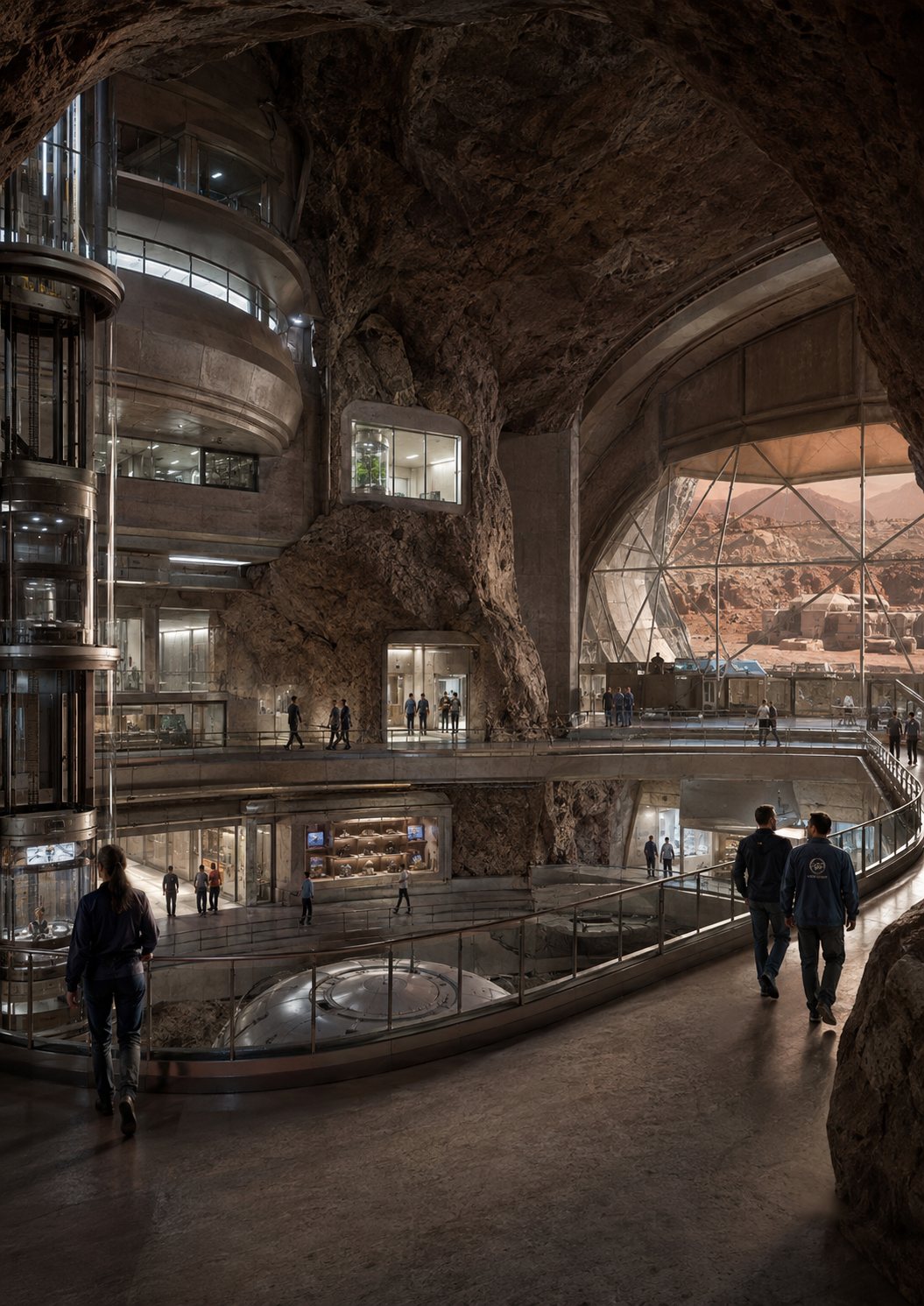
The most valuable early Martian structures may be visually unimpressive: cable trenches, utility galleries, isolated battery rooms, clean workshops, waste tanks, spare-part stores, fire barriers, inspection corridors, data cabinets, pressure bulkheads and medical isolation spaces. A city becomes durable when these hidden systems are accessible, documented and replaceable. Monumental domes can wait; the first civic luxury is the ability to maintain the systems without destroying the rest of the settlement.
This is one reason underground or regolith-protected construction appears so often in settlement studies and prospective designs. Shielding mass is abundant on Mars, but burying everything blindly creates a maintenance problem. A durable city needs access routes and inspectable interfaces. The same logic applies to pipes and cables. A perfectly optimized compact layout can be operationally worse than a slightly heavier design that allows a technician in gloves to isolate a valve, remove a pump or trace a leak without dismantling half the wall.
Planetary protection is part of settlement engineering
Mars is not simply empty real estate. It is a scientific target where terrestrial contamination can complicate the search for indigenous life, and material returned from Mars must be handled within planetary-protection frameworks. Human missions make contamination control harder because people carry vast microbial communities and generate waste, leaks, dust transfer and large surface disturbances. A settlement architecture therefore needs zones, clean/dirty boundaries, sample-handling rules and an explicit distinction between industrial areas and locations of high astrobiological interest.
This does not automatically make settlement impossible. It means site selection and operations must treat scientific preservation as a design constraint rather than an afterthought. A long-lived settlement could even improve planetary science by supporting laboratories, drilling and field campaigns impossible for small robotic missions, provided that contamination histories and exclusion zones are documented. The tension is real: the more capable humans become on Mars, the more carefully they must preserve the evidence they went there to study.
What “success” should mean at each scale
Success changes as the project grows. For a robotic precursor, success may mean proving a landing zone, locating accessible ice or operating a power system through a full seasonal cycle. For a first crew, success may mean completing the mission without consuming emergency reserves and demonstrating maintainable life support. For a recurring base, success may mean surviving a delayed shipment and restoring a failed system with local labor. For a settlement, success includes continuity of institutions, education, medical care and production. For a city, success eventually includes demographic continuity and the ability to choose its future without every decision being constrained by the next cargo manifest.
This staged definition prevents a common rhetorical error: using the success of one level as proof that the next is solved. Landing a rover does not demonstrate heavy human EDL. Producing grams of oxygen does not demonstrate a propellant plant. Recycling water on the ISS does not demonstrate a Martian city, but it provides valuable hardware experience and measured performance. A reference site should celebrate what has been demonstrated while keeping the scale gap visible.
Systems thinking · four clocks that govern settlement design
A settlement lives on four clocks at the same time
Many Mars explanations use one timeline: launch, cruise, landing, surface stay, return. A settlement has at least four clocks running simultaneously. The orbital clock determines when transport is favorable. The consumables clock measures how long air, water, food, medical supplies and stored energy last after a failure. The maintenance clock measures how quickly filters clog, seals age, batteries lose capacity, lubricants degrade and spare inventories are consumed. The human clock measures fatigue, training, skill retention, conflict, radiation exposure, health and demographic continuity. A design can look excellent on one clock and fail on another.
The orbital clock is unusually unforgiving. Efficient Mars launch opportunities recur roughly every 26 months. The consumables clock can be minutes for pressure loss, hours for some power failures, days for certain water or medical contingencies and months for food stocks. The maintenance clock may be thousands of operating hours for a machine but only hundreds for a dusty seal or consumable filter. The human clock extends from seconds in an emergency to years of skill development and decades of population continuity.
Why buffer capacity is often more valuable than nominal efficiency
A system with 99% efficiency but almost no buffer can be more fragile than a less efficient system with days of stored reserve. Buffers create decision time. A pressure-safe haven gives people minutes or hours to isolate a damaged habitat. Water tanks give operators time to diagnose a processor. Batteries bridge the gap between a grid fault and reactor restart. Food stores protect agriculture from a bad harvest. Spare parts protect maintenance from the orbital clock.
Buffers also have cost: mass, volume, inspection, contamination control and ageing. Engineering therefore asks not “how much reserve feels safe?” but “how long does diagnosis and recovery realistically take, and what events must be survived during that time?” A buffer should be tied to a failure scenario and a recovery plan.
The most dangerous dependency may be knowledge
A settlement can possess the correct spare part and still be unable to use it if nobody knows how to diagnose the failure, install the part, align the mechanism and verify the repair. Technical knowledge is therefore inventory. It must be duplicated across people, stored locally, searchable during communication outages and updated as the actual installation diverges from its original drawings.
This is one reason a Mars settlement should maintain a digital configuration record: which serial number is installed where, which software version is running, which valve was replaced, which cable was rerouted, which sensor has a known bias and which temporary repair has become permanent. Without configuration control, diagrams become historical fiction. The longer the settlement operates, the more valuable accurate local records become.
What the homepage should let a reader conclude
After reading this portal, a newcomer should be able to reject two opposite simplifications. First, Mars colonization is not “just build a bigger rocket”: transport is necessary but surface survival, maintenance, local industry and institutions determine permanence. Second, Mars colonization is not “impossible because Mars is hostile”: hostility can be decomposed into pressures, temperatures, radiation, dust, mass flows, communication delays and failure modes that can be measured, modeled and tested. The open question is not whether Mars is easy. It is whether humanity can build a sufficiently reliable chain of systems at a cost and risk society is willing to accept.
Reader tool · one scoreboard for every architecture
How to compare two Mars-settlement proposals without being fooled by presentation
Any serious architecture can be reduced to the same set of questions. This is useful because proposals often emphasize different strengths: one shows transport capacity, another local resources, another habitats or economic growth. A common scoreboard forces them onto comparable ground.
| Question | What must be named | Warning sign |
|---|---|---|
| What keeps people alive? | Air, water, food, temperature, pressure, medical response and emergency refuge. | “Life support” is one unexplained box. |
| What powers it? | Average and peak power, storage, black start, distribution and heat rejection. | Only generator nameplate power is quoted. |
| What arrives from Earth? | Mass, cadence, unique spares, food, medicines, electronics and specialist knowledge. | “Self-sufficient” appears without an import ledger. |
| What is produced locally? | Resource, process, rate, purity, energy, maintenance and storage. | A resource map is treated as an operating mine. |
| What happens after a failure? | Detection, isolation, remaining capacity, repair time, spare and return-to-service test. | Redundancy is claimed without common-cause analysis. |
| What is still unproven? | Technology maturity, missing measurements, biological uncertainty and scale gap. | Concept art is described as demonstrated capability. |
The scoreboard is deliberately independent of any company or national program. A NASA study, a SpaceX proposal, an academic architecture and a Delta-Sierra scenario should all be asked the same questions. That is how this website separates enthusiasm from evidence without becoming hostile to ambition.
Three labels that protect the reader
Measured means a quantity was observed or tested under stated conditions. Demonstrated means a capability worked in a relevant test, but not necessarily at settlement scale. Scenario means a coherent assumption used to calculate consequences, not a prediction. These labels are intentionally simple. If a reader knows which of the three applies, a large fraction of misleading Mars rhetoric disappears.
The purpose of the Bible Mars is therefore not to tell the reader what to believe about colonization. It is to give enough definitions, numbers, sources and failure logic that the reader can inspect the claim and decide how much confidence it deserves.
Failure triage · minutes, hours, days and months
Not every failure has the same clock
A useful way to read any settlement architecture is to classify failures by time to consequence. A major pressure loss may threaten life in minutes. Loss of active carbon-dioxide removal can become serious over hours depending on volume, crew and backup. A water-processor failure may be tolerable for days if tanks are full. A bad harvest can be survivable for months if food reserve is deep. A missing specialist component can become critical only when the installed unit reaches its next maintenance interval. The slower failures are not less important; they offer more options for detection and recovery.
| Time scale | Examples | Architecture response |
|---|---|---|
| Seconds to minutes | Fire, major leak, toxic release, electrical arc. | Automatic detection, isolation, local protective equipment and rehearsed crew action. |
| Hours | Loss of primary life support, thermal loop or essential power. | Buffers, safe haven, emergency generation and rapid fault localization. |
| Days | Water treatment, medical equipment, surface mobility or communications degradation. | Stored reserve, alternative process, repair and prioritization of use. |
| Months | Crop failure, spare-part depletion, declining battery capacity. | Inventory policy, local production, preventive maintenance and resupply planning. |
| Years | Skill loss, infrastructure ageing, demographic imbalance. | Education, documentation, renewal plans and institutional continuity. |
This classification also helps explain why a city needs both automation and human judgment. Machines must react faster than a delayed Earth link to immediate hazards; people must handle ambiguous combinations, long recovery campaigns and trade-offs between competing needs. The deeper meaning of “autonomy” is therefore not replacing humans with software. It is placing the right decision at the level that can act before the relevant clock runs out.
Claim discipline · what the site will not pretend to know
A reference page is strongest when it marks the boundary of knowledge
There is no approved engineering blueprint for a self-sufficient city on Mars. There are robotic missions, life-support demonstrations, launch systems, habitat studies, analog campaigns, resource maps, propulsion tests and increasingly detailed human-exploration trade studies. They are evidence, but they are not interchangeable. A rover landing proves that a particular robotic EDL architecture can work at its mass and conditions; it does not prove a hundred-tonne crew lander. ISS water recovery proves a process can reach a high recovery fraction in microgravity; it does not prove that the same hardware will operate for decades in Martian gravity and dust. MOXIE proved a chemical process on Mars; it did not prove settlement-scale oxygen production.
The same discipline applies to companies. A published target date is a declared objective, not a demonstrated schedule. A prototype test is not an operational transport system. A rendered city is not a funded construction program. Conversely, uncertainty should not be misrepresented as impossibility. Heavy Mars EDL is not yet demonstrated at human-settlement scale, but that statement is different from saying physics forbids it.
Delta-Sierra therefore uses a simple rule: state what happened, state what it proves, then state what remains to be demonstrated. That sequence lets the reader remain enthusiastic without confusing aspiration with evidence.
Final reader check
One final question: what happens when Earth cannot answer?
If an architecture can explain what the crew does during the first minute, first hour, first day and first month without timely Earth intervention, it has begun to address settlement rather than expedition. If the answer to every anomaly is “mission control will decide,” the design still carries a hidden terrestrial subsystem. Mars colonization becomes technically meaningful when enough authority, knowledge, tools, reserves and repair capability are already on Mars to keep the local system inside safe limits while Earth remains a partner rather than an immediate operator.
Delta-Sierra calculators and data
The quantitative tools are meant to be audited rather than trusted as black boxes: inputs, equations and outputs remain visible so orders of magnitude can be challenged.
Stay connected to real missions
Explore the books behind the broader Mars project
The portal is a map of the Mars library rather than a condensed copy of every book. It helps a reader choose between architecture, life support, industry, health, history, and training, while the long-form works remain separate narrative companions.
I Walked on Mars — Book 1
Explore Book 1I Walked on Mars — Complete Series
Explore the seriesFrequently asked questions
Has anyone colonized Mars?
No. As of 4 August 2026, all activity on Mars has been robotic. Human settlement remains a future engineering and political project.
Why go to Mars at all?
Because Mars brings together four rare advantages: major scientific value, resources usable on site, a plausible path toward long-term human settlement and a powerful test of whether civilization can expand beyond a single planet.
Could humans breathe the Martian atmosphere?
No. Mars’s atmosphere is extremely thin and dominated by carbon dioxide. Habitats and suits would require controlled pressure and an artificial breathing mixture.
Would a first Mars base be self-sufficient?
Almost certainly not. Early bases would depend heavily on Earth. The realistic goal is progressive resilience: local water and oxygen first, then repair, construction materials, food production and increasingly complex manufacturing.
Is this mini-site a free version of the books?
No. These are independent explanatory articles. They establish the scientific and engineering context while the books develop the narrative, technical detail and long-term societal vision in a different form.