


Mars Bible — People
Donna Shirley
The Oklahoma girl who was told that girls can’t be engineers, became JPL’s only woman engineer, got the first Mars rover, Sojourner, flying, then ran NASA’s entire Mars exploration program.
born 1941
- Born
- 1941, Pauls Valley, Oklahoma
- Role
- Aerospace engineer at JPL (1966-1998); manager of the Mars Exploration Program (1994-1998)
- Education
- University of Oklahoma (professional writing; aerospace and mechanical engineering, 1965); University of Southern California master’s degree (1968)
- Missions
- Mariner 10 (mission analyst); study that led to Cassini; Mars Pathfinder and Sojourner
- Link with Mars
- Original leader of the Sojourner rover team (1997); manager of NASA’s Mars program
17 chapters and 4 appendices: about 10,000 words, or about 45 minutes of reading. Every fact comes from verified sources, listed at the end of each chapter.
Part One
Oklahoma
1941 – 1966
Chapter 1 · 1941 – 1958 A Little Girl and Airplanes
Donna Shirley was born in 1941 in Pauls Valley, Oklahoma. She grew up a few miles away, in Wynnewood, a small town of 2,500 people that lived from farming and a small refinery. She would later say that she wanted to fly before she even knew what the word “engineer” meant.
A Family of Doctors and Ministers
Her parents were Edward and Ada Brooks Shirley. The family, of Chickasaw descent, owned large tracts of land around Wynnewood. Her grandfather, Dr. Charles Brooks, the town’s Methodist minister, served on the commission that set Oklahoma’s school standards when the state was created in 1907. Donna Shirley would recall that all four of her grandparents had gone to college, which was rare in their day, and that in her family it was simply expected that you would get an education.
During the war her father joined the Navy. Her mother took the children to Seal Beach, California, in the hope of seeing him on leave. After the war he set up a medical practice in San Jose, then the family returned to Wynnewood because the grandmother was ill. Dr. Shirley became one of the town’s two doctors. His daughter watched him leave at two in the morning to deliver babies out on the farms. When he suggested that she become a doctor too, she remembered his sleepless nights and chose something else.
“That’s What I Want to Be”
It would be airplanes. At six she already had a plan with a friend: the friend would be a nurse, she would be a bush pilot, and together they would fly into the outback and rescue people. She built model airplanes and hung them from her bedroom ceiling. When she was ten, her mother took her to an uncle’s graduation from medical school. On the program the little girl read “aeronautical engineering” and asked what it was. People who build airplanes, her mother answered. Her mind was made up: she would be an aeronautical engineer.
At ten she joined the school band, which was short of an oboe player; since you cannot play the oboe while marching, she later switched to cymbals and snare drum. Her mother started a Girl Scout troop for her two daughters. In high school Donna was the only girl who did not take home economics: she took mechanical drawing instead.
Mars in a Book
At about twelve she discovered science fiction. She read Arthur C. Clarke’s The Sands of Mars, Ray Bradbury’s The Martian Chronicles, Robert Heinlein’s Martian novels. Clarke’s book marked her most: it told of a colony on Mars, made up mostly of scientists and engineers busy exploring the planet. She would say that as a little girl she wanted to go and live there herself.
Alone at the Controls
For her fifteenth birthday her father gave her flying lessons. She took them in Pauls Valley, the “big town” nearby, with its 5,000 people and its little airfield. At sixteen, the minimum age, she flew solo for the first time. The school’s planes were small wood-and-fabric machines, with no radio and almost no instruments; on some, someone had to swing the propeller by hand to start the engine. She would compare these flights to those of the early barnstormers.
In high school she was class vice president and band vice president. Her graduating class had forty-nine students; she was valedictorian. Her best teacher was her English teacher, who gave her a love of literature and writing. She later said this mattered a great deal, because many engineers cannot communicate.
Sources: B. Moore, “Shirley, Donna L.,” Encyclopedia of Oklahoma History and Culture (birth, parents, Chickasaw descent, grandfather Brooks and the 1907 commission, Clarke at twelve, solo flight at sixteen, high school offices); Academy of Achievement interview, May 23, 1998 (Wynnewood, her father the doctor, the plan at six, the uncle and the program, science fiction reading, planes without radio, the English teacher); oral history interview with J. Nykolaiszyn, Oklahoma State University, March 14, 2011 (Seal Beach, San Jose, return to Wynnewood, oboe, Girl Scouts, mechanical drawing, class of forty-nine); “The Tech Club” interview, WAMC (the colony in Clarke’s novel). These interviews, under copyright, are summarized.
Chapter 2 · 1958 – 1962 “Girls Can’t Be Engineers”
In 1958 Donna Shirley entered the University of Oklahoma, in Norman. It was the year the United States put its first satellite, Explorer 1, into orbit, a few months after the Soviet Sputnik. There was not yet any training in space: she enrolled to learn how to build airplanes.
The Advisor
The family had visited MIT and Georgia Tech, but the country girl found those schools too urban; she chose to stay close to home. On enrollment day she walked into her academic advisor’s office and announced that she had come to sign up for aeronautical engineering. The man asked her what she was doing there, then gave her a sentence she would repeat all her life: “Girls can’t be engineers.” She replied that she could. He let her put together her own schedule.
She took a very heavy load: sixteen hours of classes, plus three hours of flying, which meant driving back and forth to the airfield. Because she did well on the multiple-choice entrance tests, she was placed in advanced chemistry and mathematics classes. Yet her small high school had had no chemistry lab and no physics course; its chemistry textbook dated from 1929. Eight weeks in, her parents received a warning: their daughter was in danger of failing. She turned down the tutor they offered, went home for Christmas and spent the holidays studying. She finished the semester with a B average.
Mathematics would never be her strong point. She said so plainly to the young people who interviewed her: she did not enjoy it, but it had to be done to become an engineer, and she worked at it until she got there.
The Only Girl in the Class
In the whole College of Engineering there were then only five or six women students. She was almost always the only woman in her classes. A sorority member, Gene Nora Stumbough, learned that she was a pilot and insisted that she be pledged; they would remain friends. Donna Shirley flew with the university club, in small Aeronca Champs, and took part in contests of landing accuracy and navigation. She piled up ratings: private pilot, commercial pilot, seaplane, multi-engine, flight instructor. She also soloed in a glider. She learned to fly seaplanes one summer on Lake Carl Blackwell, near Stillwater, in a little Piper Cub on floats.
She tried instructing: a first student never managed to learn to land; a second, more gifted, made a difficult first solo flight with a wind that had shifted. She concluded that this job was not for her.
A Detour Through Writing
In her junior year she got engaged. Worn out by the workload, she decided to change majors to get a degree quickly: it would be professional writing. She took as many as twenty-two hours of classes a semester. But she soon understood that the life her fiancé wanted was not hers, and they split up. In 1961 she was crowned Miss Wynnewood and competed for Miss Oklahoma. She received her writing degree in 1962, according to the Oklahoma encyclopedia; in 1963, according to the JPL release issued when she retired.
Sources: Academy of Achievement interview, May 23, 1998 (entry in 1958 and Explorer 1, the advisor, nineteen hours, advanced classes, B average, flying club, glider, mathematics); oral history interview, Oklahoma State University, March 14, 2011 (MIT and Georgia Tech, 1929 textbook, warning at eight weeks, five or six women, G. N. Stumbough, Lake Carl Blackwell, students, engagement, twenty-two hours); B. Moore, Encyclopedia of Oklahoma History and Culture (pilot ratings, Miss Wynnewood 1961, writing degree in 1962); JPL release of August 20, 1998 (degree in 1963); “The Tech Club” interview, WAMC (mathematics). The advisor’s sentence is reported by Donna Shirley herself in several interviews.
Chapter 3 · 1962 – 1966 Spec Writer, Then Aerodynamicist
Writing degree in hand, Donna Shirley looked for work. She received only one offer: a job as a specification writer at McDonnell Aircraft, in St. Louis, Missouri.
The Only Woman Among 330 Engineers
A specification is the document that describes exactly what a part or a system must do and how it will be checked that it does it. Writing such texts is a real profession, but not the one she wanted. She would recall that at McDonnell she was the only woman among 330 engineers. She liked neither the St. Louis climate, freezing in winter and stifling in summer, nor the loneliness of the first months. After a year she understood what she really wanted: to be an engineer.
So she went back to the University of Oklahoma and finished, in one year, the engineering degree she had abandoned. In 1965 she earned her bachelor’s degree in aerospace and mechanical engineering. She would later enroll at the University of Southern California, where in 1968 she earned a master’s degree in aerospace engineering.
The Vice President’s Letter
Back at McDonnell, she asked to move to the engineering department. Her boss refused: she was his best spec writer, and he would not let her go. Chance helped her. A memo from the company’s vice president happened to be circulating: he had learned that employees were being denied transfers, and this was to stop. She took the memo to her boss, who let her go.
A Hat for Entering the Atmosphere of Mars
In her new department she worked on vehicles for entering the atmosphere of Mars. The problem is a delicate one. To land on Mars, you first use its atmosphere to slow down. The front of the vehicle must therefore be broad and flat enough to brake hard, but not too much, or it becomes unstable and starts to wobble or tumble. The shape chosen is a “blunt sphere-cone,” a very open cone with a rounded tip, which she compared to a Chinese peasant hat. A heat shield protects it from the heat of entry. She studied which shapes of this kind were possible and how the whole descent would unfold.
She did not yet know it, but this work would follow her all her life. She would point out that the Viking landers, in 1976, and then Mars Pathfinder in 1997 used this kind of shield.
An Ad in the Paper
One day she read in the paper an ad from the Jet Propulsion Laboratory in Pasadena, California: the laboratory was looking for aerodynamicists to work on Martian entry vehicles. She wrote at once. She was invited to interview, the tickets were booked, when an airline strike broke out; JPL telegraphed that she could not come. She went to the airport anyway, got on a plane on standby, checked into the hotel already reserved for her and called the man who was to interview her to tell him she was there. The interview took place.
Other employers made her more generous offers; JPL’s was the lowest. She accepted it, and drove across the desert in the middle of August in a small sports car with no air conditioning. She would stay at JPL for thirty-two years.
Sources: oral history interview, Oklahoma State University, March 14, 2011 (single offer, St. Louis, return to the university, the boss’s refusal and the vice president’s memo, entry vehicles, JPL ad, strike, lowest offer, August drive); Academy of Achievement interview, May 23, 1998 (the hat shape, braking with the atmosphere, Viking and Pathfinder); “The Tech Club” interview, WAMC (330 engineers); JPL release of August 20, 1998 (1968 master’s degree); B. Moore, Encyclopedia of Oklahoma History and Culture, and English-language Wikipedia, “Donna Shirley” (1965 bachelor’s degree). Her account of her time at McDonnell is not the same everywhere: in 1998 she said she moved from spec writing to aerodynamics, without mentioning her return to the university in between.
Part Two
The Laboratory
1966 – 1991
Chapter 4 · 1966 – 1970 JPL’s Only Woman Engineer
In 1966 Donna Shirley joined the Engineering Mechanics Division of the Jet Propulsion Laboratory, the NASA center run by the California Institute of Technology (Caltech) that designs the probes sent to the planets. She was the only woman there with an engineering degree, among some two thousand engineers.
The First Voyager
She had written to JPL for a specific project. Her former employer, McDonnell, intended to bid to build a Mars lander as part of a large program then called Voyager, which JPL was to manage. By joining the laboratory, she made sure she would work on that project whoever won. This first Voyager, which has nothing to do with the later probes of the same name that went to Jupiter and Saturn, was planned between 1966 and 1968 as a precursor to sending humans to Mars.
She studied how blunt the entry bodies could be and ran wind tunnel tests at the Langley research center in Virginia. The work thrilled her. Then Congress canceled the program. Someone in her group had to be laid off; she was the most junior, so she was the one who left. This happens all the time, she would say. It would not be the last time a project slipped away from her like this.
A Question of Honesty
She found a job at a small aerodynamics company in Pasadena, about ten people. She had been attracted by the promise of studying how dolphins swim, a real problem in fluid dynamics. But she fell out with the owner: she refused to alter her results to make them look better. He demoted her to proposal writer. Going through the files, she discovered that the company made a habit of cheating the government, notably on travel expenses. She walked into the owner’s office and quit.
Back at the Laboratory
Out of work, she called her friends at JPL. A group supervisor in charge of advanced studies agreed to hire her: her background did not quite fit, he told her, but she was smart enough to learn. She studied trajectories that would go from one planet to another, passing through the atmosphere of Venus on the way to Mars. The subject bored her. Her officemate, for his part, was bored with an automated drug identification machine, and loved what she was doing. They asked their supervisor to swap jobs; he agreed.
For a while, then, she visited police and hospital laboratories across the United States, to see how drugs were detected in blood and urine. Her conclusion was clear: no machine could do the job at a price those laboratories could afford. The lesson holds for the rest of this book: a good technical idea is worth nothing if no one has the means to use it.
Sources: JPL release of August 20, 1998 (joined in 1966, Engineering Mechanics Division); oral history interview (JPL, a division of Caltech, the only NASA center run under contract); B. Moore, Encyclopedia of Oklahoma History and Culture, and “The Tech Club” interview, WAMC (only woman with an engineering degree among about two thousand); oral history interview, Oklahoma State University, March 14, 2011 (the Voyager project, Langley wind tunnels, cancellation, layoff, the small company, refusal to falsify, resignation, return to JPL, the job swap, the drug identification machine); English-language Wikipedia, “Voyager program (Mars)” (program planned between 1966 and 1968, precursor to crewed flights; tertiary source). The last sentence is the author’s reflection.
Chapter 5 · 1970 – 1974 Mariner 10’s Interpreter
She was dating a man whose roommate was in charge of mission design for Mariner 10, a probe meant to fly past Venus and then Mercury. He needed a mission analyst. She objected that she knew nothing about mission analysis; he answered that she would learn. It was, she would say, the project she was proudest of before the Mars ones.
“Define Your Own Job”
On the first day, she walked into her boss’s office and asked what exactly a mission analyst did. She would often quote the answer: it was customary to define your own job. So she looked for what nobody was doing. She found it between two worlds that understood each other poorly.
On one side, the scientists: they are the mission’s customers, the ones who will use the data to understand the planets. On the other, the engineers: the ones who build the craft that will go and get that data. Donna Shirley would insist on this distinction all her life, because the public often confuses the two. Mariner 10 carried seven scientific experiments, each with its own demands. The scientists always wanted more than the engineers could deliver. Her role became that of an interpreter: if you want to take this picture, what must be done on the spacecraft, what trajectory must it follow, how must it be operated?
Equations That Aren’t Quite Equations
To help each team say what it really wanted, she used what are called “value functions,” small mathematical tools that she described as equations that were not really equations. As the name suggests, the idea is to assign a value to the desired observations, so they can be compared. For two years she thus arbitrated between the scientists’ wishes and the capabilities of engineering. The most tangible result of this work was a date: the optimal launch date, set for November 3, 1973. For a long time she kept, framed on her office wall, the letter announcing that the launch would take place that day.
The Bounce off Venus
Mariner 10 did leave on November 3, 1973. According to Donna Shirley, it was the first mission to use the gravity of one planet to reach another: by swinging past Venus, it was deflected toward Mercury without spending propellant. It was also the first craft to visit Mercury. It would pass close to that small planet three times. Donna Shirley kept the technique in mind: she would use it a few years later to design a mission to Saturn.
Operating a mission in flight is exhausting: long hours, constant pressure. When she was then offered the mission analysis job on another project, the future Voyager probes to Jupiter and Saturn, she turned it down. She wanted a break.
Sources: oral history interview, Oklahoma State University, March 14, 2011 (hiring, the boss’s answer, two years of arbitration, the November 3, 1973 date and the framed letter, three passes at Mercury, turning down Voyager, the strain of operations, gravity assist reused for Saturn); Academy of Achievement interview, May 23, 1998 (the project she was proudest of before Mars, scientists and engineers, seven experiments, value functions); JPL release of August 20, 1998 (mission analyst for Mariner Venus-Mercury); English-language Wikipedia, “Mariner 10” (launch on November 3, 1973, first flyby of Mercury and of multiple planets; tertiary source).
Chapter 6 · 1974 – 1984 Away from Space, Then Saturn
The 1970s were the years of the oil crises. JPL, which knew how to run large technical projects, was handed work that had nothing to do with space. Donna Shirley would spend several years on it before returning to what had brought her to California.
An “Anything but Space” Group
She had hoped to run an energy project; she was offered only a group supervisor job, that is, head of a small team, with people to manage. She accepted without enthusiasm. Her group, called “civil systems,” covered everything that was not space: energy, medicine, police work.
They had to work out what was affordable, and how many people would need a given technology. Someone declared that an economist had to be hired. She admitted she had no idea what an economist was. The first candidate she found gave such a weak seminar before Caltech’s economists, invited to give their opinion, that she went to apologize to them. She asked for their help; they selected candidates themselves. The group would end up with economists, a policy analyst and a lawyer: “the strangest group at JPL,” she would say.
The Geothermal Plan
NASA had been tasked with preparing a national plan for geothermal energy, the heat of the ground, and had handed it to JPL. The engineers immediately plunged into designing power plants. Donna Shirley and her group argued that the problem was not primarily technical: one had to know how utilities would react, how to carry energy produced far from cities, what building codes said. Solar energy and other sources followed. The group grew to forty people; she asked to split it, then handed it over.
Toward Saturn
She wanted to get back into space. JPL’s head of advanced projects gave her a small study, about $250,000, for a mission to Jupiter and Saturn. She designed it using what she had learned on Mariner 10: using Jupiter’s gravity to reach Saturn. In 1979, according to JPL, she led the study of a Saturn orbiter carrying a probe to be released. This work would lead to the Cassini mission, launched in October 1997 by NASA with the European and Italian space agencies, whose Huygens probe was to descend to the surface of Titan, Saturn’s largest moon. She would point out that Cassini would cost two billion dollars, a sum out of all proportion to her study’s budget.
A Station in Space
Promoted to deputy manager of a section, a unit of about a hundred people, she found herself handling raises, conflicts and parking spaces. This was not what she wanted. Around 1980 a friend was running a small study of a future space station, then just an idea; she joined him, then took over the group. She would work on it for about four years and would receive in 1985 a NASA group award for the Space Station Task Force. She also discovered the rivalries: human spaceflight belonged to the centers in Houston, Florida and Alabama, which hardly appreciated JPL coming to tell them how to do their job. An engineer from one of those centers told her that JPL people were “neither fish nor fowl.” Around 1984 she concluded that this would lead nowhere.
Sources: oral history interview, Oklahoma State University, March 14, 2011 (civil systems group, economists and Caltech, geothermal plan, forty people, Jupiter–Saturn study of about $250,000, Cassini at two billion, deputy section manager, space station around 1980, rivalries with the human spaceflight centers, 1984); JPL release of August 20, 1998 (1979 study of a Saturn orbiter and probe leading to Cassini, October 1997 launch with ESA and ASI, Huygens probe, space station work in the 1980s, 1985 Space Station Task Force award). The geothermal plan is known here only from her account; we have not consulted the document itself.
Chapter 7 · 1975 – 1985 A Mother, and Determined to Lead
Donna Shirley married at thirty-four. At thirty-five she had a daughter, Laura. She herself has described, in her interviews, what this birth changed in her career, and how her workplace first looked at her.
“Fulfilled as a Mother”
She stayed home for six weeks, then went back half-time, because she was nursing: she fed her daughter, dropped her at the sitter’s, worked four hours in the afternoon, came home to feed her again. At ten months she was ready to go back full-time. She had been a manager before her leave. Yet she was now given only small tasks with no responsibility.
She asked her boss what was going on. He did not know and went to find out from those who handed out the projects and the money. He came back with the answer: they all assumed that she was now fulfilled as a mother, and no longer wanted a responsible job. She went to explain to them that she liked being a mother, but that she wanted a real job. They were not enemies, she stresses, rather friends, men who had grown up in the Depression and the war, for whom a woman found fulfillment at home. It simply had not occurred to them that she might see things differently. Once enlightened, they gave her a job.
A Child Care Center at the Lab
During the first years, her former secretary, forced by an illness to leave a stressful job, looked after the child at home. When she recovered and went back to work, something else had to be found. JPL’s director, Bruce Murray, had created an advisory council for women at the laboratory. JPL and Caltech funded a child care center two blocks away. Laura went there at two and a half, among the first children. Donna Shirley even taught science to the little ones there, three days a week for two years. She would say that without this center she probably would not have had the same career.
Her marriage, on the other hand, did not survive. She explains it by the difference of generation and models: her husband, born during the Depression, expected of a wife what his own mother had done. They divorced.
The Choice to Lead
It was when her daughter was born, she relates, that she asked herself what she wanted to contribute. She observed that in engineering organizations, engineers are promoted to managers without being chosen for their skill at leading people. She thought she could do at least as well as some of her bosses. She decided to become a manager and drew up a plan: the jobs she was aiming for and the pace at which she meant to progress, until her daughter finished college. In 1998 she would say she had kept to it.
The setting had changed as well. When she arrived at JPL, she remembers, everyone smoked cigars in meetings, and the rooms were as smoke-filled as in the caricatures. In 1998 she would note that the climate had changed profoundly since then, with the women’s movement, even if aerospace still lagged behind.
Sources: Academy of Achievement interview, May 23, 1998 (married at thirty-four, birth at thirty-five, half-time, the “fulfilled as a mother” episode, the former secretary, Bruce Murray and the women’s council, the child care center, the science lessons, the divorce, the decision to become a manager and the plan, the cigars); oral history interview, Oklahoma State University, March 14, 2011 (the same episode, told with the same conclusion). These facts of her private life are those she has made public herself; we have included no others.
Chapter 8 · 1984 – 1991 Robots, and a Great Dream Canceled
In the mid-1980s her boss, an assistant laboratory director, asked her to take charge of the “automation and robotics” technology program. She objected that she knew nothing about it. He answered that those who did know about it only wanted to do research, not manage. She accepted, took classes in robotics, read everything she could, and ran the program for several years.
Vehicles for Other Worlds
A large part of the program concerned mobile vehicles meant for planetary surfaces. The JPL release issued when she retired would say that she played an instrumental role, in the 1980s and 1990s, in the development of automation, robotics and surface vehicles, with an emphasis on the Moon and Mars. A great Mars sample return mission was then being studied: a rover would collect rocks and deliver them to a rocket, which would bring them back to Earth. These samples were meant to help choose where to send astronauts later on.
Donna Shirley led a study of this rover. She would describe it as a vehicle the size of a pickup truck, able to travel a hundred kilometers. The whole mission, with the lander and the return vehicle, would cost several billion dollars: between five and ten billion according to her 1998 account, about six billion according to her 2011 account.
The Speech of July 20, 1989
On July 20, 1989, for the twentieth anniversary of the first step on the Moon, President George H. W. Bush announced an ambitious project, which would be called the Space Exploration Initiative: build a station, return to the Moon “to stay,” then send astronauts to Mars. In Houston, the human spaceflight specialists rejoiced. But the studies put the program at hundreds of billions of dollars; Donna Shirley would cite a figure of about four hundred billion.
Congress refused. By cutting the funds for the human program, she relates, it also cut, as a side effect, those of the robotic Mars program. The big rover had no more money. Once again, “the story of my life,” she would say, laughing: a project canceled, and no more budget.
“Yelled At by Experts”
Meanwhile she was given work for NASA as a whole. She got all the centers to work together on a Mars systems engineering handbook, which was not easy, because the centers do not like to cooperate. The JPL release would recall that she led NASA-wide teams on engineering and management methods. She was also asked for a plan for training project managers. Her recommendations displeased: she proposed, for instance, that project managers’ salaries should no longer depend on center directors, so that they would not be tempted to send work to their own center rather than to the most competent one. During one presentation, NASA’s leaders laid into her for nearly an hour. Afterward, the only other woman in the room asked her how she could stand being yelled at like that. She answered that she came from JPL, where people were used to merciless reviews.
Cassini, Again
With no money for rovers, she went to work on Cassini, the great mission to Saturn born in part from the study she had led in 1979. In 1990 and 1991 she was its project engineer. Her role was to make sure that the spacecraft, the instruments, the operations and the science all worked together. She stayed about fifteen months.
Sources: oral history interview, Oklahoma State University, March 14, 2011 (the assistant director’s offer, robotics classes, sample return, about six billion, about four hundred billion, cancellation, systems engineering handbook, training report and the stormy presentation); Academy of Achievement interview, May 23, 1998 (rover the size of a pickup truck, a hundred kilometers, five to ten billion, the 1989 speech, the congressional cut, Cassini and fifteen months); JPL release of August 20, 1998 (automation, robotics and surface vehicles for the Moon and Mars, NASA-wide teams, Cassini project engineer in 1990-1991); English-language Wikipedia, “Space Exploration Initiative” (speech of July 20, 1989; tertiary source). Her retort, as she told it in 2011, is given in substance; in her words, she had “been yelled at by experts.”
Part Three
Sojourner
1991 – 1997
Chapter 9 · 1991 – 1992 A Rover the Size of a Microwave Oven
The big rover had died with the budgets. But Donna Shirley’s robotics team had built, to try out its techniques, one-eighth-scale models. She drew a simple conclusion: this little vehicle was probably the biggest thing anyone would ever be able to send to Mars.
Charles Elachi’s Bet
After some fifteen months on Cassini, one of JPL’s top managers, Charles Elachi, who had seen the technology developed by Donna Shirley’s group, proposed sending small rovers to Mars. He wanted to show that one could build a very small vehicle, only seven kilograms, able to do real science. He gave the job to Lonnie Lane, an engineer known for pulling off things no one else dared to try. Within a few months, Lane had a demonstrator working, named Rocky IV, able to carry instruments and scratch at a rock. It cost two million dollars according to Donna Shirley’s 1998 account, two and a half million according to her 2011 account.
Two Offices That Don’t Talk
To go further, a flight project was needed. But at NASA, she explains, technology and science came under two different offices. The technologists developed new tools and asked the scientists to use them. The scientists answered that these tools had never flown, and that they could not take the risk of carrying them. So many inventions stayed on the shelf. This time, the technologists decided to pay themselves for flying a small rover, to prove that it worked. After that, no one would be able to say that small rovers do not work.
JPL advertised for someone to manage this project. Donna Shirley applied and got the job. Her task, she would say, was to go and persuade NASA headquarters in Washington to spend ten times more than it had ever spent on a technology experiment: twenty-five million dollars, when technology had never paid more than five million for a single experiment. At the start, she would sum up, nobody wanted this rover; nobody took it seriously, except her small team.
A Very Small Team
The rover team would number about thirty people at most. Donna Shirley kept the books herself, for lack of money to hire someone, and admits she was very bad at it: she spent hours making the numbers come out right. The project started in 1992.
Sources: Academy of Achievement interview, May 23, 1998 (one-eighth-scale models, fifteen months on Cassini, Charles Elachi, seven kilograms, Lonnie Lane, Rocky IV at two million, NASA’s two offices); oral history interview, Oklahoma State University, March 14, 2011 (rover the size of a microwave oven, in-house project at two and a half million, the job posting, ten times more, thirty people at most, the books, start in 1992); “The Tech Club” interview, WAMC (twenty-five million against five at most, nobody took it seriously); NASA NSSDCA, “Mars Pathfinder Rover” entry (Rocky IV among the rover’s alternate names). In the 1998 transcript, Elachi’s name is spelled “Alechi.”
Chapter 10 · 1992 – 1994 The Passenger Nobody Wanted
To get to Mars, the little rover needed a ride. There was one: Mars Pathfinder, a low-cost lander that JPL was preparing at the same time. But Pathfinder did not want it.
Pathfinder, a Scout Without a Destination
Pathfinder was born of a larger project called MESUR, for “Mars Environmental Survey.” Climate specialists dreamed of scattering some twenty small weather stations across the surface of Mars, to check on the ground what the Mars Observer orbiter, then in preparation, would see from above. The Martian climate, simpler than Earth’s, which is dominated by the water of its oceans, would help test the models used to forecast ours. Before landing twenty stations, it had to be proved that landing could be done cheaply. The last time, with Viking, the operation had cost, according to Donna Shirley, the equivalent of $3.6 billion in 1990s dollars.
The project manager, Tony Spear, had long been looking for ways to do very cheap missions. Pathfinder became one of the first missions of NASA’s new Discovery program, with a cap: $150 million in 1992 dollars to build the spacecraft and its instruments, or $171 million in real-year dollars. Then MESUR’s money disappeared. All that was left was Pathfinder, a pathfinder that no longer quite knew what it was finding the path for.
A Spectrometer in Search of Rocks
For the Pathfinder team, the rover was a burden: it would complicate a mission already short of money. But the scientists demanded that the mission, which would cost nearly $250 million with the rocket, also do science: a good camera, a weather station. And the composition of rocks should be measured, something Viking had never been able to do. Germany offered to donate an alpha proton X-ray spectrometer, the APXS, which measures the chemical elements in a rock. A free instrument cannot be turned down. But it had to be brought up against a rock.
An arm was considered; a study showed that if the craft landed somewhere with few rocks, the arm would reach none. Tony Spear had a small rover tethered by a cable to the lander studied; it would cost a lot and do little. He finally accepted the free-roaming rover, on condition that it carry the spectrometer. It would take years, Donna Shirley relates, to close this deal, which she likens to barter: the rover team paid for integrating the spectrometer, the Pathfinder team paid for integrating the rover into the lander, and the two sums roughly balanced.
A Woman’s Name
Donna Shirley wanted the rover to bear a woman’s name. She would recall telling her team, almost entirely male, that all spacecraft were named after men or ships, and that it was time for a change. In March 1994 the Planetary Society, a Pasadena organization, launched with JPL a contest open to young people under eighteen around the world: choose a heroine and write an essay about her accomplishments and how a rover bearing her name would carry them on on Mars. JPL credits the Planetary Society with the initiative; Donna Shirley would say the idea was hers.
Some 3,500 essays arrived, from Canada, India, Israel, Japan, Mexico, Poland, Russia. On July 14, 1995, thirty years to the day after Mariner 4 flew past Mars, NASA announced the winner: Valerie Ambroise, twelve, of Bridgeport, Connecticut, proposed Sojourner Truth, an African-American abolitionist and champion of women’s rights. The word “sojourner” means “traveler.” The rover would be called Sojourner.
Handing Over
In 1994 Donna Shirley handed management of the rover to Jacob Matijevic, a Ph.D. in mathematics, much better than she was, she says, at the bookkeeping. She had just been given something much bigger: NASA’s entire Mars program.
Sources: Academy of Achievement interview, May 23, 1998 (MESUR and the weather stations, Mars Observer, the Martian climate, Viking at $3.6 billion, Tony Spear, Discovery, $150 and $171 million, refusal of the rover, the scientists’ demands, German spectrometer, arm, tethered rover, the barter); “The Tech Club” interview, WAMC (a woman’s name, her idea); JPL, “NASA Names First Rover to Explore the Surface of Mars,” July 14, 1995 (Planetary Society contest launched in March 1994, 3,500 essays, countries, Valerie Ambroise, Sojourner Truth, meaning of the word, thirtieth anniversary of Mariner 4); oral history interview, Oklahoma State University, March 14, 2011 (handover to J. Matijevic in 1994); NASA NSSDCA, “Mars Pathfinder” entry (former name MESUR Pathfinder, Discovery program); English-language Wikipedia, “Sojourner (rover)” (APXS provided by the Max Planck Institute for Chemistry in Mainz; tertiary source). Donna Shirley presents Pathfinder as the first Discovery mission; NASA counts it as the second launched.
Chapter 11 · 1993 – 1996 Running the Mars Program
On August 21, 1993, three days before going into orbit around Mars, the Mars Observer probe stopped answering. It was never found. Investigators would conclude that the most likely cause was the rupture of a tank in its propulsion system. For NASA it was a shock: according to Donna Shirley, the agency had not lost a complete mission in twenty-seven years.
The Lessons of a Failure
She would draw several lessons from this loss. It had been believed that one could simply buy a satellite designed for Earth orbit and send it to Mars; but the conditions are very different. It had also been believed that the probe could be loaded with instruments; they turned out to be too big, and the budget overran. “You learn something from everything,” she would say.
Out of the ashes of Mars Observer came a new way of working. Instead of one enormous mission every twenty years, NASA would send more modest craft every time the planets were well placed, that is, every twenty-six months, and two at a time, so that losing one would not be a disaster. The first replacement for Mars Observer would be Mars Global Surveyor, an orbiter, which would leave at the same time as Pathfinder.
The First Woman at the Head of a Program
In August 1994 the Mars Exploration Program Office was created at JPL, to coordinate the planning and implementation of all NASA’s robotic exploration of Mars. Donna Shirley was named its manager. According to the Oklahoma encyclopedia, she thereby became the first woman to manage a NASA program; the Massachusetts Institute of Technology writes instead that she was the first woman to head up a NASA project.
In 1996 she described her own working day for a NASA educational website. She managed three flight projects and studies of future missions. She spent her days in meetings, wrote program plans, and served as the link between the projects and NASA’s managers in Washington. She tried to get all the projects to adopt the same processes, because that was cheaper and more efficient than everyone doing their own thing. Forty people worked directly for her office. She wrote two or three papers a year on the program and gave many talks.
The Meteorite
In 1996 a team led by David McKay, of the Johnson Space Center in Houston, announced that it had found in a meteorite from Mars chemical traces that might indicate past life. The controversy was enormous. Since that announcement, Donna Shirley wrote in 1996, she had been spending five to ten hours a week with journalists: television, radio, newspapers, magazines. The program’s direction changed, she would say in 1998: it was no longer only about studying the climate and resources of Mars, but about looking for life.
Two Departures
On November 7, 1996, Mars Global Surveyor left Cape Canaveral. On December 4, 1996, at 6:58 Universal Time, it was the turn of Mars Pathfinder, with Sojourner folded against one of its petals. Pathfinder had seven months of travel ahead of it; Global Surveyor, ten.
Sources: English-language Wikipedia, “Mars Observer” (loss of August 21, 1993, three days before orbit insertion, probable tank rupture; tertiary source); Academy of Achievement interview, May 23, 1998 (twenty-seven years without a loss, lessons of Mars Observer, a mission every twenty-six months and two at a time, Mars Global Surveyor as first replacement, the meteorite and D. McKay, the search for life); JPL release of August 20, 1998 (creation of the office in August 1994 and its role); B. Moore, Encyclopedia of Oklahoma History and Culture (first woman to manage a NASA program); Lemelson-MIT, “Inventor of the Week,” 2002 (first woman to head up a NASA project); “Meet: Donna Shirley,” NASA Quest, 1996 (her day, forty people, media since the meteorite); NASA NSSDCA, “Mars Global Surveyor” and “Mars Pathfinder” entries (launch dates and time). The two phrasings about the “first woman” do not say quite the same thing.
Chapter 12 · July 4 – 6, 1997 “Six Wheels on Soil”
On July 4, 1997, Independence Day, Mars Pathfinder entered the atmosphere of Mars directly, at about 7,300 meters per second, without first going into orbit. It was protected by a shield shaped like a blunt cone, of the family of those Donna Shirley had studied thirty years earlier.
The Descent
The shield slowed the craft to 400 meters per second in about 160 seconds. A 12.5-meter parachute opened. The shield was released; the lander slid down a twenty-meter bridle. At 1.6 kilometers above the ground, the radar locked onto the surface. About ten seconds before arrival, four airbags inflated in three tenths of a second and wrapped the lander in a ball 5.2 meters across. Rockets fired to brake, and the bridle was cut at 21.5 meters. At 16:56:55 Universal Time, the ball hit the ground at 18 meters per second, bounced about twelve meters high, bounced at least fifteen more times, rolled, and came to rest two and a half minutes later, about a kilometer from its first point of impact. The site lies in Ares Vallis, an ancient flood plain. The lander would be named the Carl Sagan Memorial Station.
In Front of the Cameras
That day Donna Shirley saw almost nothing. With her boss, Norm Haynes, she had taken charge of the media, so that journalists would not come and disturb the people flying the mission. She stood outside, facing CNN’s cameras in the bright July sun, her eyes on a small monitor she could barely make out. She glimpsed the team jumping for joy and concluded that the landing had succeeded. She would recall that she was crying, that she almost hugged the anchor, who gave her a worried look, and that she compared the moment to the day her daughter was born.
The team was filmed shouting and hugging each other. According to Donna Shirley, the public recognized itself in them: these people wore neither suits nor ties, and they showed their emotions. She saw in this the mark of Tony Spear, a very emotional and charismatic leader.
A Night of Waiting
The petals opened 87 minutes after landing. But the rover, which she called the littlest one of her children, could not get off: an airbag that had not retracted properly was blocking the ramp. A petal had to be lifted, the airbags pulled in further, the petal set down again. Then the link between the lander and the rover failed. The sun went down before the rover could move, and she spent the night wondering what would happen.
The next day, a young scientist, Justin Maki, had programmed the lander’s camera to follow the descent like a small, jerky movie. First picture: the ramp, empty. She thought the rover had not been able to stand up. Then, image after image, the ramp bent, the rover appeared, came down. It took six images for it to reach the ground. In mission control, Art Thompson announced: “Six wheels on soil.” It was, according to NASA, about 5:40 Universal Time on July 6, 1997. For the first time, a wheeled vehicle was rolling on Mars.
Sources: NASA NSSDCA, “Mars Pathfinder” entry (direct entry at about 7,300 m/s, descent sequence and figures, time of impact, bounces, petals opened at 87 minutes, rover on the ground at about 05:40 UT on July 6, Ares Vallis, Sagan Memorial Station); Academy of Achievement interview, May 23, 1998 (the shield inherited from her work, Norm Haynes and CNN, the small monitor, the team without suits, Tony Spear, the littlest child, airbags and ramp, the link, the night, J. Maki, the six images, A. Thompson); “The Tech Club” interview, WAMC (tears, the anchor, her daughter’s birth); oral history interview, Oklahoma State University, March 14, 2011 (entry technology from the 1960s). English-language Wikipedia, “Sojourner (rover),” presents it as the first wheeled vehicle to operate on an astronomical object other than the Earth or Moon. In the 1998 transcript, Justin Maki’s name is spelled “Mackie.”
Chapter 13 · July – September 1997 Eighty-Three Days on Mars
Sojourner weighed about ten kilograms: 10.6 kg according to JPL, 10.5 according to NASA’s catalog. It was 63 centimeters long, 48 wide and 28 high, moved on six wheels and spoke only to the lander, which relayed its messages to Earth. Signals took between ten and fifteen minutes to make the trip: it could not be driven in real time.
The Intelligence of a Bug
Donna Shirley liked to explain that the rover had about the intelligence of a bug. A bug that meets a rock does not think; it bumps into it until it finds a way around. Sojourner did the same, without even needing to touch it. At the front, small lasers projected stripes of light onto the ground, which cameras watched. If the stripes stayed straight and flat, the computer concluded that the way was clear. If they wrinkled, there was an obstacle: the rover turned until it no longer saw it, went around it and resumed its heading. If it tilted too far, it stopped.
The First Martian Traffic Accident
That is what happened near a large rock the team had named Yogi, like all the stones at the site, named after cartoon characters. While backing up to the rock to analyze it, the rover slipped a little in the dust; one wheel climbed onto the rock, the rover tilted and stopped on its own. At the same moment, communications with the lander broke up; there was no way to send it the order to move forward. Yet the team was about to take a large color panorama meant for the President of the United States. Donna Shirley protested that you could not send the President a picture of the rover with a wheel in the air. The matter settled itself: by the time the link problems were solved, the rover was back down, and the big panorama that everyone would see shows a rover sitting properly on its six wheels.
What the Rocks Say
The spectrometer first analyzed the rock named Barnacle Bill, then Yogi. Both turned out to be close to andesites, volcanic rocks whose formation requires, on Earth, interaction between crust and mantle, which surprised some researchers. Other rocks looked like conglomerates, rounded pebbles cemented together, which might have formed in the presence of running water.
In all, in 83 Martian days of activity, Sojourner traveled 104 meters without ever going more than twelve meters from the lander. It sent back 550 images and made sixteen analyses with the spectrometer. It had been designed for a week.
Dust and Cold
The mission also taught its limits. On the rover, a small solar cell stayed protected by a cover that was removed once a day, to compare its output with that of the exposed cells. Result: dust falling out of the atmosphere made the panels lose 0.2 percent of their power per day. In 1998 Donna Shirley estimated that no one yet knew how to make a solar-powered mission on Mars last much more than ninety days. The freezing nights drained the batteries.
That is in fact how it all ended. The lander’s rechargeable batteries wore out. On September 27, 1997, communications were lost, for unknown reasons. Without the lander, the rover could no longer speak to Earth. Donna Shirley would recall that it had been programmed, if it lost contact, to circle the lander trying to reach it. She pictured it calling for help, with no help able to come. “It was very sad,” she would say.
Sources: JPL release of August 20, 1998 (10.6 kg); NASA NSSDCA, “Mars Pathfinder” and “Mars Pathfinder Rover” entries (10.5 kg, dimensions, delay of ten to fifteen minutes, relay through the lander, loss of contact on September 27, 1997); Academy of Achievement interview, May 23, 1998 (bug intelligence, laser stripes, stop on tilting, the Yogi episode and the presidential panorama, reference cell and 0.2 percent per day, ninety days, batteries and cold); oral history interview, Oklahoma State University, March 14, 2011 (the lander’s batteries, rover programmed to circle, “very sad,” designed for a week); English-language Wikipedia, “Sojourner (rover)” (rock names, Barnacle Bill and Yogi, andesites, conglomerates, 83 sols, 104 m, twelve meters, 550 images, sixteen analyses; tertiary source). The same page gives elsewhere 92 sols of operation; we keep the 83 sols of activity.
Chapter 14 · 1997 The Whole World on a Website
Pathfinder was not only an engineering success. It was also, according to Donna Shirley, the first great world event experienced on the Internet.
Millions of Hits
Before the landing, the outreach manager warned that there would be a lot of visits to the mission website. The webmaster set up “mirror sites,” copies of the site hosted elsewhere, to share the load. Large computer companies offered to host them. By the day of the landing, the whole system could handle sixty million hits. It needed nearly that many: on July 8, according to Donna Shirley in 1998, the site recorded 47 million hits; in 2011 she would speak of “something like 45 million.”
She liked to quote a phrase she had read in the press: Roosevelt’s Pearl Harbor speech had been the defining moment for radio, the first step on the Moon the defining moment for television, and the Pathfinder landing the defining moment for the Internet. She acknowledged that the Nagano Olympics had since exceeded that figure, but over several weeks.
What Mars Costs
She also liked to recall the price. The spacecraft cost $171 million, the rover 25, the rocket 55: about $265 million in all, which NASA’s catalog confirms. That was, she pointed out, roughly the price of the movie Waterworld. The project scientist, Matthew Golombek, added that the mission had been cheaper than Titanic and had a happier ending.
The rover nobody had wanted at the start became the star of the mission. The press found it adorable, and its popularity shielded the project from criticism. By the end, she sums up, everybody wanted it.
Global Surveyor
While Sojourner rolled, the program’s other mission arrived. On September 12, 1997, Mars Global Surveyor went into orbit. But one of its solar panels had failed to latch properly when deployed, and it moved worryingly when the probe began braking by skimming the upper atmosphere. This maneuver, “aerobraking,” had to be slowed: the probe did not reach its working orbit until February 1999, instead of the four months planned. It would then observe Mars for years, until contact was lost on November 2, 2006.
Sources: Academy of Achievement interview, May 23, 1998 (mirror sites, sixty million, 47 million on July 8, the phrase about Roosevelt and the Moon, Nagano, $171, 25 and 55 million, Waterworld, M. Golombek’s remark, the rover’s popularity); oral history interview, Oklahoma State University, March 14, 2011 (about 45 million, the same phrase); “The Tech Club” interview, WAMC (“by the end, everybody wanted it”); NASA NSSDCA, “Mars Pathfinder” (about $265 million) and “Mars Global Surveyor” entries (orbit on September 12, 1997, solar panel, aerobraking, mapping orbit in February 1999, loss on November 2, 2006). In the 1998 transcript, Golombek’s name is spelled “Golenbach.”
Part Four
After Mars
1998 – 2011
Chapter 15 · 1998 – 1999 Leaving Before the Failure
After the landing, Donna Shirley became one of the faces of Pathfinder. She spent July 4 on CNN, appeared on television and radio programs around the world and received many invitations to give talks. She was nearing the end of the plan she had set herself when her daughter was born.
“Managing Martians”
A literary agent suggested she write a book. She reminded the agent that she had already written one, on managing creativity, which the agency had turned down. Only one publisher, Broadway Books, was interested in the project, but it wanted an autobiography, and it imposed a co-writer. The collaboration was not easy: Donna Shirley wanted a book about how to manage, and cared about accuracy; her co-writer preferred emotion. The book appeared in 1998 under the title Managing Martians. It tells her life from Oklahoma onward and the adventure of the Sojourner and Mars Global Surveyor teams. She also published on the Internet her other book, Managing Creativity, drawn from the course she taught at JPL with a partner: sixteen hours to help engineers dare to create.
The 1998 Missions
The Mars program was preparing two new missions for the next launch window: an orbiter, Mars Climate Orbiter, and a lander, Mars Polar Lander. To save mass, the lander would touch down using retro-rockets, like Viking, rather than airbags. Donna Shirley later gave, in 2011, her version of this period: according to her, her team kept telling NASA headquarters that there was not enough money for everything being asked of it, requirements piled up without extra budget, and the managers, who were scientists, did not want to hear about engineering problems. She says she left before the launches, sadly, so as not to be associated with what she foresaw.
On August 21, 1998, Donna Shirley retired from JPL, after thirty-two years. The laboratory’s release presented her as manager of the Mars Exploration Program and original leader of the team that built the Pathfinder rover.
The two missions left in late 1998 and early 1999. On September 23, 1999, Mars Climate Orbiter vanished while entering orbit: the review board would establish that some commands had been sent in English units instead of being converted to metric, so that the probe passed far too low. On December 3, 1999, Mars Polar Lander fell silent just before entering the atmosphere; it was never heard from again. According to Donna Shirley, NASA then put money back into the program, and the next orbiter, Mars Odyssey, succeeded.
Honors
Distinctions piled up: NASA’s Outstanding Leadership Medal, the Women in Technology International Hall of Fame in 1997, the Oklahoma Aviation and Space Hall of Fame in 1998, the Golden Plate of the American Academy of Achievement the same year, the Washington Award in 2000, the National Space Society’s Wernher von Braun Memorial Award in 2001. In 1998 the University of Oklahoma, the one where an advisor had told her that girls could not be engineers, gave her an honorary doctorate. An asteroid, discovered in 1990 at Palomar Observatory by E. Helin, bears her name: (5649) Donnashirley.
Sources: oral history interview, Oklahoma State University, March 14, 2011 (CNN, talks, the agent, Broadway Books, the co-writer, her version of the preparation of the 1998 missions, her departure before the launches, Mars Odyssey); Academy of Achievement interview, May 23, 1998 (sixteen-hour course, retro-rockets for the 1998 lander, honorary doctorate); JPL release of August 20, 1998 (retirement on August 21, thirty-two years, Managing Martians and its content, Managing Creativity on the Internet, NASA medal); NASA NSSDCA, “Mars Climate Orbiter” and “Mars Polar Lander” entries (launches of December 11, 1998 and January 3, 1999, loss of September 23, 1999 and the units error, last signal of December 3, 1999); Lemelson-MIT, 2002, and English-language Wikipedia, “Donna Shirley” (honors); B. Moore, Encyclopedia of Oklahoma History and Culture (von Braun award 2001); JPL Small-Body Database (5649 Donnashirley, discovered on November 18, 1990 by E. Helin at Palomar). The explanation of the 1999 failures by lack of money is Donna Shirley’s; it is hers alone.
Chapter 16 · 1998 – 2011 What Do You Do After Mars?
In Managing Martians, one chapter asks a question that Juliana Nykolaiszyn, interviewing her in 2011 for the Oklahoma State University library, put back to her: what do you do after you have been to Mars? Donna Shirley answered, laughing, that it had been a difficulty. Nothing, she said, had seemed to her as intriguing as landing on Mars for the first time.
Back to Oklahoma
When she left JPL, she was working on a doctorate in human and organizational development at the Fielding Institute in Santa Barbara. She also became the official spokesperson for the Mars Millennium Project, an international educational initiative backed in particular by the White House, NASA and the Department of Education. Students from kindergarten through high school imagined a colony of one hundred people on Mars in 2030: not only its buildings and machines, but also how to make art there under a different light, how to dance with three eighths of Earth’s gravity, how to govern themselves and put up with one another.
Her daughter had finished college; nothing kept her in Los Angeles anymore. The University of Oklahoma offered her a post as assistant dean of engineering, in charge of new programs. She sold her house and went back to the university where she had been told that girls could not be engineers. There she did strategic planning and taught her course on managing creativity. She stayed three years, from 2000 to 2003, according to Wikipedia and the Oklahoma State University biographical note; “four years,” she says in the 2011 interview. Then the budget was cut. That happens to me all the time, she jokes.
The Science Fiction Museum
She moved to Seattle, where her daughter was then living. She was asked to join the board of a museum being planned, devoted to science fiction, then to become its director. She accepted, for about ten months, long enough to launch it. This museum, attached to the Experience Music Project founded by Microsoft co-founder Paul Allen, would later become the Museum of Pop Culture. The loop is a strange and beautiful one: the little girl who read Clarke and Bradbury in Oklahoma ran, half a century later, a museum devoted to such stories.
In 2003 she was inducted into the Oklahoma Women’s Hall of Fame. Later settled in Tulsa, she sat on the advisory board of the University of Oklahoma’s College of Engineering, gave talks and encouraged young women who wanted to become engineers.
The First Role Model
In 2011 she noted that she had never had a female role model, apart from Wonder Woman and Mary Marvel, the comic book heroines of her childhood. She had been the only woman in her university classes, the only one in her graduate classes, the only woman engineer among two thousand at JPL. She had become, she said, a role model for others without having had one herself, and she liked that role. She noted that about one engineering student in five was now a woman, more at some schools, fewer in aerospace.
Her advice to girls fits in a few words, the ones she teaches in her course: find your passion, then figure out how to follow it.
Sources: oral history interview, Oklahoma State University, March 14, 2011 (the question from the book and her answer, leaving Los Angeles, assistant dean, planning and teaching, “four years,” budget cut, Seattle, the museum and its ten months, Tulsa, advisory board, lack of role models, Wonder Woman and Mary Marvel, one student in five, her advice to girls; biographical note: three years); JPL release of August 20, 1998, and Lemelson-MIT, 2002 (doctorate at the Fielding Institute, Mars Millennium Project and its sponsors, assistant dean for advanced program development); “The Tech Club” interview, WAMC (the colony of one hundred people in 2030, art, dance, living together); English-language Wikipedia, “Donna Shirley” (2000-2003, founding director of the Science Fiction Museum, Oklahoma Women’s Hall of Fame in 2003) and “Museum of Pop Culture” (founded by Paul Allen; tertiary source). The remark about the “loop” is the author’s.
Epilogue
Donna Shirley and Mars
Chapter 17 · The lesson What Donna Shirley Leaves to Mars
As a child, Donna Shirley wanted to go and live on Mars. She said herself that humanity did not yet have the will to send people there, and that the best she could do was to send a robot. That robot opened the way for the Martian rovers that followed it.
Start Small So You Can Keep Going
The big rover the size of a pickup truck died with the budgets; the little ten-kilogram rover flew. The lesson of Sojourner is that of a modest but real step: proving that something works is worth more than drawing a perfect thing that will never leave. Donna Shirley put it her own way: you learn from each mission and apply it to the next, instead of trying to do everything at once. That, according to her, is how risk is managed.
Get People Talking Who Don’t Talk
Throughout her career, from Mariner 10 to Pathfinder, she served as an interpreter: between scientists and engineers, between the technology office and the science office, between JPL and the other centers. A mission to Mars, with or without a crew, depends as much on this agreement among people who do not speak the same language as on the quality of the machines.
Do Not Flee the Earth
To those who saw Mars as a refuge, in case humanity ruined its planet, she answered that this was nonsense. Sending people to live on another planet takes a strong economy, and a strong economy requires a healthy world. We must take care of the Earth to have, one day, the means to go to Mars.
Prepare the Humans
Finally, she insisted on what we do not know. In 1998 it was known that humans could live a year in space; no one knew what three years would do. She judged it essential to train at length on an orbiting station before leaving, and saw in the Antarctic bases, as in submarines, models for future Martian habitats: places where a few people learn to live together, for a long time, far from everything.
This lesson is a reflection by the author of this book, based on the facts reported in the preceding chapters and on Donna Shirley’s remarks in the Academy of Achievement interview (1998) and “The Tech Club” interview (WAMC), where her ideas are set out.
Appendices
Going Further
Appendix Understanding Donna Shirley’s Work
A few notions, explained simply, to follow this book.
The Entry Body and the Heat Shield
A craft arriving at Mars travels very fast, several kilometers per second. It first uses the planet’s atmosphere to brake. Its front is a very open cone with a rounded tip: broad enough to brake, not so broad that it loses stability. A heat shield protects it from the heat produced by friction with the air.
The Mission Analyst
The person who translates the scientists’ wishes into constraints for the engineers: trajectory, timing of observations, how to operate the probe. On Mariner 10, Donna Shirley defined this role herself.
Gravity Assist
When it passes close to a planet, a probe is deflected and sped up or slowed down by the planet’s gravity, without burning propellant. Mariner 10 used Venus to reach Mercury; Donna Shirley’s study for Saturn used Jupiter.
The Launch Window
Earth and Mars are not always well placed relative to each other. The favorable moment to leave comes around about every twenty-six months. That is the rhythm the Mars Exploration Program adopted from 1994 on.
The Discovery Program and “Faster, Better, Cheaper”
In the 1990s NASA launched smaller missions, with capped costs, built in a few years. Mars Pathfinder was one of the first. The slogan of the time, “faster, better, cheaper,” summed up this ambition.
Airbags
For Pathfinder, instead of landing gently on engines, the lander wrapped itself in enormous airbags, fell, bounced and rolled to a stop. The method worked, but Donna Shirley pointed out that the airbags were heavier than expected.
The APXS Spectrometer
An instrument that bombards a rock with particles and measures what comes back. From this one deduces which chemical elements the rock contains. It must be placed right against the rock: that is why a rover was needed.
The Martian Sol
A “sol” is a Martian day: 24 hours and about 37 minutes. Mission durations on Mars are counted in sols.
These explanations are general notions of astronautics. The facts specific to Donna Shirley and her missions are sourced in the corresponding chapters; the length of the Martian day is the one she gives in 1998, and NASA’s slogan is cited by English-language Wikipedia, “Sojourner (rover).”
Appendix Chronology
The dates of Donna Shirley’s life, in order. Where the sources disagree, both versions are given.
1941. Born in Pauls Valley, Oklahoma; childhood in Wynnewood.
Around 1953. Reads Arthur C. Clarke’s The Sands of Mars.
Around 1956 – 1957. Flying lessons for her fifteenth birthday; first solo flight at sixteen.
1958. Enters the University of Oklahoma.
1961. Miss Wynnewood.
1962 (1963 according to JPL). Degree in professional writing.
Around 1963. Specification writer at McDonnell Aircraft, St. Louis.
1965. Degree in aerospace and mechanical engineering.
1966. Joins the Jet Propulsion Laboratory.
1968. Master’s degree in aerospace engineering, University of Southern California.
November 3, 1973. Launch of Mariner 10, for which she is mission analyst.
1979. Leads the study of a Saturn orbiter and probe that led to Cassini.
Around 1980 – 1984. Space station studies.
1980s. Manages the automation and robotics technology program.
July 20, 1989. President Bush’s speech on the Moon and Mars.
1990 – 1991. Cassini project engineer.
1992. Takes charge of the rover project that will become Sojourner.
August 21, 1993. Loss of Mars Observer.
March 1994. Launch of the contest to name the rover.
August 1994. Named manager of the Mars Exploration Program.
July 14, 1995. The rover is named Sojourner.
November 7, 1996. Launch of Mars Global Surveyor.
December 4, 1996. Launch of Mars Pathfinder.
July 4, 1997. Pathfinder lands in Ares Vallis.
July 6, 1997. Sojourner rolls onto Mars.
September 12, 1997. Mars Global Surveyor in orbit.
September 27, 1997. Last communication with Pathfinder.
1998. Managing Martians.
August 21, 1998. Retires from JPL.
2000 – 2003. Assistant dean of engineering at the University of Oklahoma (four years by her own account).
2001. National Space Society’s Wernher von Braun Memorial Award.
2003. Oklahoma Women’s Hall of Fame.
2000s. Founding director of the Science Fiction Museum in Seattle.
March 14, 2011. Oral history interview in Tulsa.
Appendix The People
The people met in this book, in alphabetical order.
Ambroise, Valerie. Schoolgirl from Bridgeport, Connecticut, who at twelve proposed the name Sojourner.
Brooks, Charles. Her grandfather, Methodist minister in Wynnewood.
Bush, George H. W. President of the United States; announced in 1989 a return to the Moon and flights to Mars.
Elachi, Charles. JPL manager; proposed sending small rovers to Mars.
Golombek, Matthew. Mars Pathfinder project scientist.
Haynes, Norm. Her boss; shared media relations with her during the landing.
Helin, E. Discovered at Palomar Observatory in 1990 the asteroid that bears Donna Shirley’s name.
Lane, Lonnie. JPL engineer; built the Rocky IV demonstrator.
Laura. Her daughter.
Maki, Justin. Young scientist; programmed the camera that filmed Sojourner’s descent.
Matijevic, Jacob. Succeeded her in 1994 as head of the rover project.
McKay, David. Johnson Space Center researcher; announced in 1996 possible traces of life in a Martian meteorite.
Murray, Bruce. JPL director; created an advisory council for women.
Nykolaiszyn, Juliana. Interviewed her in 2011 for Oklahoma State University.
Shirley, Edward and Ada Brooks. Her parents; her father was a doctor in Wynnewood.
Spear, Tony. Mars Pathfinder project manager.
Stumbough, Gene Nora. Pilot, university friend.
Thompson, Art. Announced in mission control that the rover had its six wheels on the ground.
Appendix Sources and Method
This book contains no imagined dialogue, nor any thought attributed to anyone without a text to support it. The scenes come from Donna Shirley’s own accounts. This appendix shows where the facts come from and where the sources disagree.
A Living Person
Donna Shirley is alive as this book is written. We have kept to her public life and to what she herself has told publicly. Of her private life we have kept only what sheds light on her career and what she chose to say, and we have left aside her health, her political commitments and her family’s life.
The Main Sources
Two long interviews form the backbone of the book. The first was recorded on May 23, 1998 in Jackson Hole by the American Academy of Achievement, a few weeks before her retirement; it is under copyright and we summarize it. The second is the oral history interview conducted by Juliana Nykolaiszyn on March 14, 2011 in Tulsa for the Oklahoma State University library, whose scholarly use is unrestricted. To these are added a radio interview from the series “The Tech Club” (WAMC), recorded while she was teaching at the University of Oklahoma, and the biography she wrote herself in 1996 for the NASA Quest educational website.
Career facts and dates come from the JPL release of August 20, 1998 announcing her retirement, from the entry in the Encyclopedia of Oklahoma History and Culture (Oklahoma Historical Society) and from the Lemelson-MIT program’s “Inventor of the Week” page (2002). Mission data come from NASA’s catalog (NSSDCA) and from JPL’s 1995 release on Sojourner’s name. The asteroid was checked in JPL’s Small-Body Database. We also used English-language Wikipedia, a tertiary source, flagged each time. Quotations are given in their original English; this English edition was translated from the French edition of the book. Her autobiography, Managing Martians (1998), is not freely accessible and was not consulted.
Interview transcripts sometimes mangle names. We have restored Charles Elachi (“Alechi”), Justin Maki (“Mackie”) and Matthew Golombek (“Golenbach”).
Where the Sources Disagree
Place of birth. Pauls Valley according to the Oklahoma encyclopedia, Wikipedia and her own 2011 account; Wynnewood according to the 1998 JPL release.
Birth name. Wikipedia gives her as “née Donna Lee Pivorotta”; the Oklahoma encyclopedia calls her the daughter of Edward and Ada Brooks Shirley, and she herself speaks of her father, a doctor in Wynnewood. No other source consulted explains this difference.
Pilot’s license. Wikipedia says she earned it at sixteen; in the 2011 interview she explains that she soloed at sixteen but earned her private pilot’s license at the university.
Degrees. Writing degree in 1962 according to the Oklahoma encyclopedia and the 2011 biographical note, in 1963 according to JPL and MIT; engineering degree in 1965 according to the encyclopedia and Wikipedia, in 1963 according to MIT.
The Rocky IV demonstrator. Two million dollars according to her 1998 account, two and a half million according to her 2011 account.
The big rover. Sample return mission estimated at five to ten billion dollars in 1998, at about six billion in 2011.
Sojourner’s name. JPL credits the contest to the Planetary Society; Donna Shirley says the idea of naming the rover after a heroine was hers.
The rover’s mass. 25 pounds (about 11.3 kg) in the 1995 announcement; 10.6 kg in 1998 according to JPL; 10.5 kg according to NASA’s catalog.
“First woman.” First woman to manage a NASA program according to the Oklahoma encyclopedia and the 2011 biographical note; first woman to head up a NASA project according to MIT.
Website hits. 47 million on July 8, 1997 according to her 1998 account, “something like 45 million” in 2011.
The University of Oklahoma. Three years (2000-2003) according to Wikipedia and the 2011 biographical note; four years according to her 2011 account.
The asteroid. The 2011 biographical note cites “Asteroid 5624 Shirley”; Wikipedia and the JPL database give (5649) Donnashirley. 5624 Shirley exists, but we could not verify to whom it is dedicated.
The 1999 failures. The explanation by lack of money is Donna Shirley’s; we have not consulted NASA’s review board reports, and we keep from them only the units error cited by NASA’s catalog.
Length
This book runs to about ten thousand four hundred words. The goal set for this collection was one hundred thousand. We have not reached it, and we prefer to say so. Her autobiography, JPL’s archives and the many press articles of 1997 are not freely accessible; as it stands, the text contains only facts we have been able to tie to a source.
The Portrait
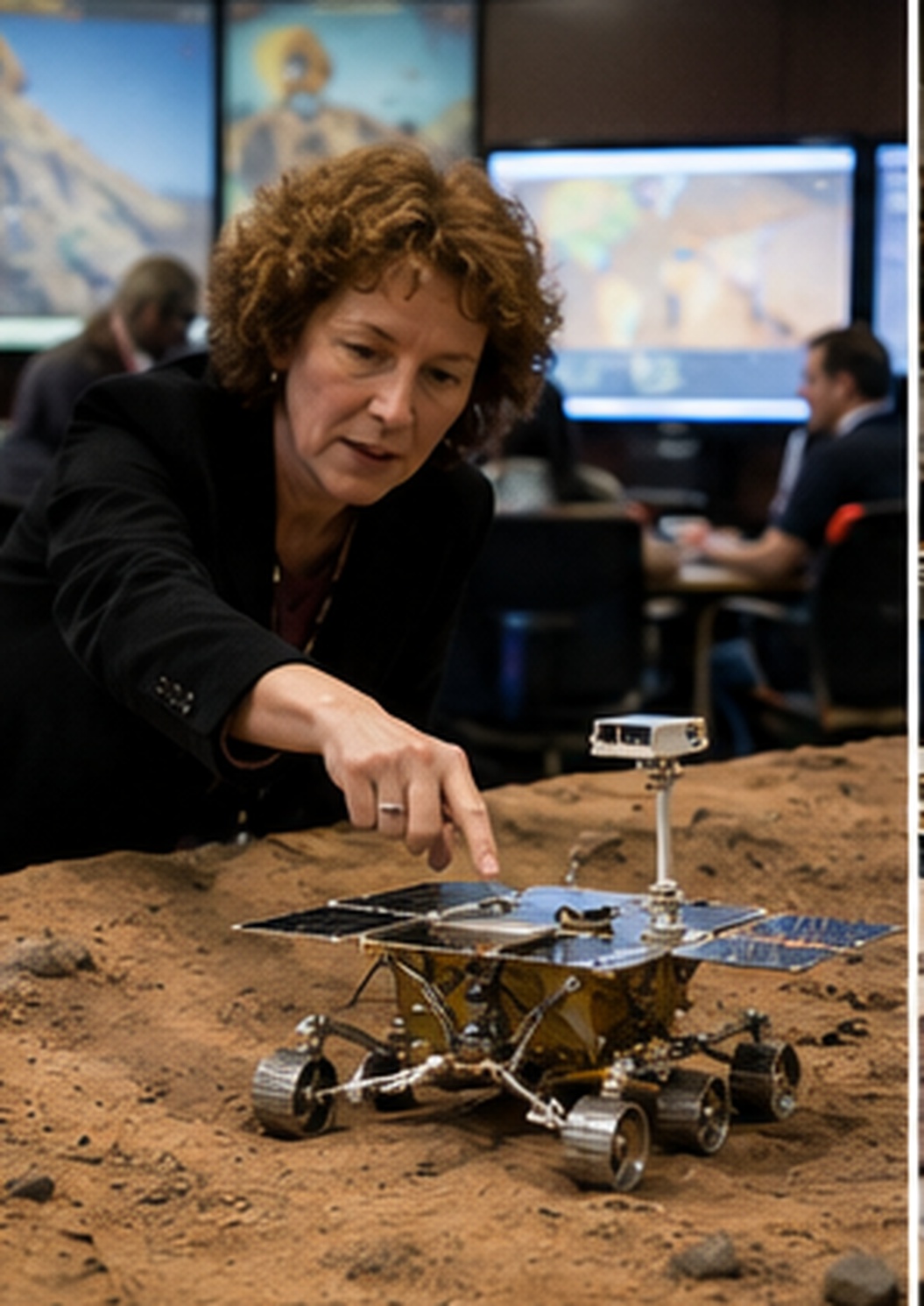
The image at the head of this book is an illustration, not an archival photograph.
Online sources
- Oral history interview with Donna Shirley, by J. Nykolaiszyn, March 14, 2011, Oklahoma State University Library
- Donna Shirley Interview, American Academy of Achievement, May 23, 1998 (archive)
- “The Tech Club: Donna Lee Shirley,” Women in Science, WAMC (archive)
- JPL, “Mars Exploration Program Manager Donna Shirley to Retire,” August 20, 1998
- NASA Quest, “Meet: Donna Shirley” (1996, archive)
- B. Moore, “Shirley, Donna L.,” Encyclopedia of Oklahoma History and Culture (archive)
- Lemelson-MIT, Inventor of the Week, “Mars Rover” (2002, archive)
- JPL, “NASA Names First Rover to Explore the Surface of Mars” (1995, archive)
- NASA NSSDCA — Mars Pathfinder
- Wikipedia (English) — Donna Shirley (tertiary source)
- Wikipedia (English) — Sojourner (rover) (tertiary source)
Facts checked against these sources on October 10, 2026.
Go further
Mars Library
This book extends the page with a complete settlement architecture. The dossier above remains deliberately self-contained: Arcadia is optional further reading, not a prerequisite for understanding it.
 Arcadia — Master Plan of the First Martian City