


Mars Bible — People
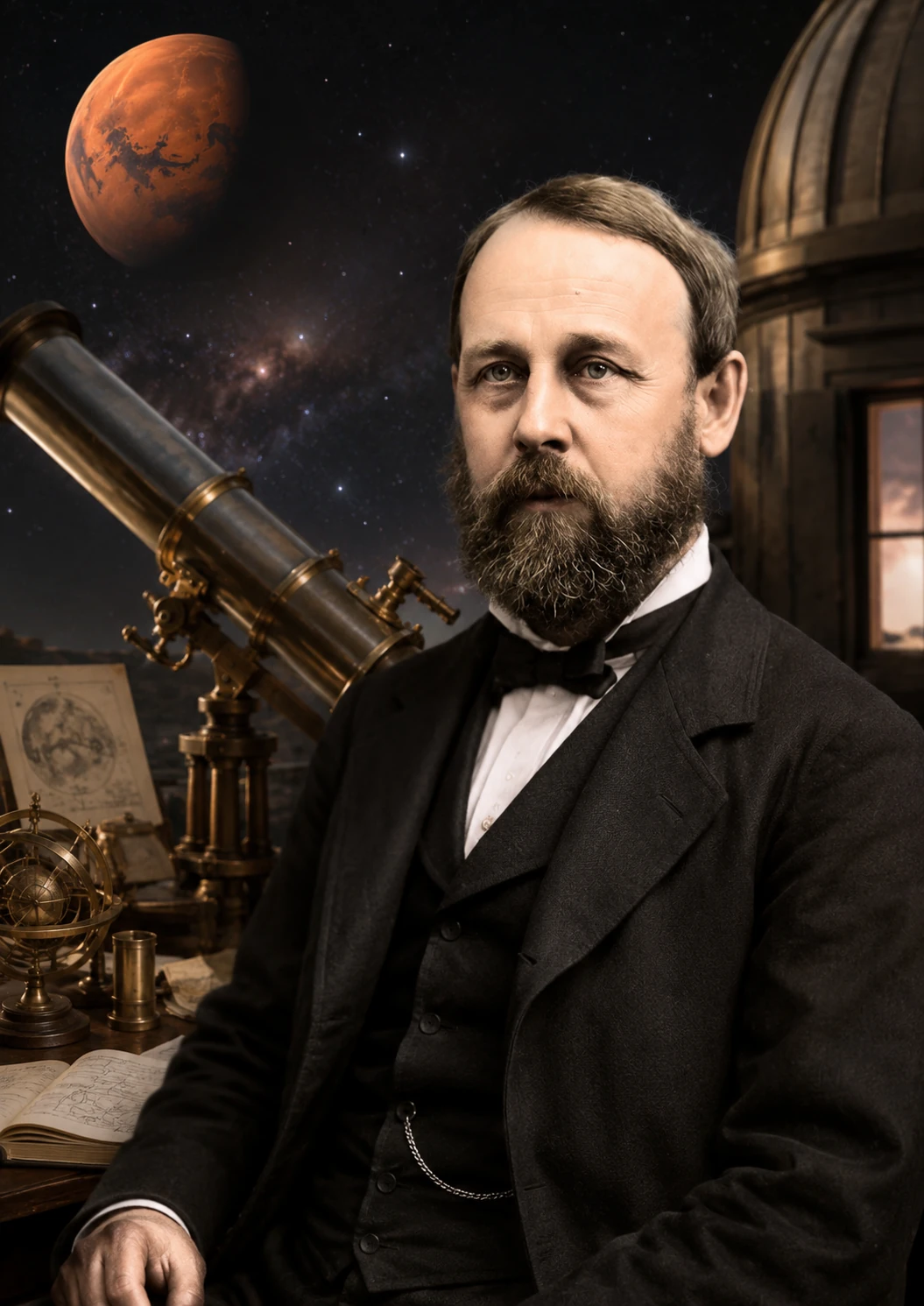
Asaph Hall
The Connecticut carpenter who became a U.S. Navy astronomer, searched in 1877 for what everyone believed did not exist, and discovered the two moons of Mars, Phobos and Deimos, encouraged by his wife, the mathematician Angeline Stickney.
1829 – 1907
- Born
- October 15, 1829, Goshen, Connecticut
- Died
- November 22, 1907, Annapolis, Maryland
- Role
- Astronomer, professor of mathematics in the U.S. Navy (1863-1891)
- Education
- Carpenter; New York Central College, University of Michigan, Harvard College Observatory
- Discoveries
- Deimos (August 11-12, 1877) and Phobos (August 17-18, 1877)
- Link with Mars
- Discovery of the two moons of Mars; first precise measurement of the planet’s mass
21 chapters and 4 appendices: about 13,000 words, or about 60 minutes of reading. Every fact comes from verified sources, listed at the end of each chapter.
Part One
The Carpenter
1829 – 1856
Chapter 1 · 1829 – 1842 The Clock Peddler
Asaph Hall was born on October 15, 1829, in Goshen, in the hills of northwestern Connecticut, in a house that has since disappeared. It stood on the road known locally as Goshen East Street, an almost treeless plain given over to grass, sloping gently up toward Ivy Mountain. It is a bleak country, especially in winter: nothing checks the wind. He was the eldest of six children, two boys and four girls.
Three Asaphs
He was the third to bear the name. His grandfather, the first Asaph Hall, had been one of the leading men of Goshen: an officer in the Revolutionary War, a companion of Ethan Allen at the capture of Fort Ticonderoga, elected twenty-four times to the state legislature, a member of the convention that ratified the Federal Constitution, and a justice of the peace. He had died around March 1800 after a fall from a sled, leaving about a thousand acres of land, several houses and sawmills.
His only son, the second Asaph, was born a few months after his death, on August 8, 1800. Brought up as a young gentleman, he was prepared for Yale but did not go. He went into business, lost much of his inheritance, then set up a clock factory at Hart Hollow, a hamlet of Goshen. He loaded his clocks onto wagons and drove south to sell them, as far as Georgia; at the end of the trip he sold the horses and wagon too, and came home for another load. He had married Hannah Palmer, born in Goshen in 1804.
Crossing the Pond
One of the earliest memories Asaph Hall would later share with his friend, the astronomer George William Hill, was of a swim. One summer day his father took him to North Pond, near their home. He placed the boy on his back and struck out to cross. The child, who had never been in the water, was terrified. “Don’t be frightened at the water, my son,” his father told him; “only hang fast to papa’s neck and you will be brought safely to land.” Which was accomplished.
The boy went to the district school and was early initiated into farm labor, beginning, no doubt, with driving cows to pasture. The house held more books than the neighbors’: his father was a man of intelligence. Asaph read the English historians Gibbon and Hume when very young. “What a fortunate circumstance it was for me,” he would say, “that these books were in my father’s library.”
September 6, 1842
This comfortable childhood ended abruptly when he was thirteen. On one of his selling trips to the South, his father fell ill. He died at Clinton, Georgia, on September 6, 1842, leaving his widow and six children land that was heavily mortgaged.
Sources: G. W. Hill, Biographical Memoir of Asaph Hall, 1829-1907, National Academy of Sciences, 1908 (birth, house, landscape, six children, grandfather, father, clocks, memory of the pond with the father’s words, school, reading of Gibbon and Hume, father’s death at Clinton on September 6, 1842); Angelo Hall, An Astronomer’s Wife, 1908, chapter VIII (family, Ticonderoga, clocks). Hill states that these memories were told to him by Hall himself or supplied by his family.
Chapter 2 · 1842 – 1854 The Carpenter Who Read Euclid
After the father’s death, the Hall family fought to save at least one farm. Hannah Hall began making cheese. In a letter written in 1906 to his son Angelo, Asaph Hall would recall: “She did a great deal of hard labor. One year we sold 10,000 pounds of cheese, all made by her.” His friend Hill found the figure incredible and suspected an extra zero; Angelo repeats it as it stands, adding the price: six cents a pound.
The Mail Bag
Asaph, the eldest, helped his mother with all his strength; his only brother, Lyman, was several years younger. To bring in a little money, he carried the mail bag on a route in Goshen. Nothing helped: they could barely pay the interest on the mortgages and their living expenses. After three years his mother gave up and retired to a small farm she owned in her own right.
At sixteen Asaph was apprenticed to two carpenters, Herrick and Dunbar, for three years. He received his board and five dollars a month. He gave his mother everything he could save. As a journeyman he earned twenty-two dollars a month; while still under age he gave her one hundred dollars. He built houses in Connecticut and as far away as Great Barrington, Massachusetts. A leading citizen of Goshen, Deacon Norton, inventor of the pineapple cheese, had him carve with chisel and mallet the wooden molds that gave the cheeses their shape. In winter, when building stopped, he went back to his mother’s to tend cattle and hunt gray squirrels.
The Roof Without Guesswork
The carpenters of his day cut the timbers of a roof by “cut and try”: cut, fit, and if the joist was spoiled by too many trials, take another. Young Hall was sure it could be done right the first time. Without textbook or teacher, he worked out the problem by the principles of projection. The timbers sawed to his directions fitted perfectly. His fellow carpenters marveled. To himself the episode meant he was more than a carpenter. For a while he thought of becoming an architect.
He read at every spare moment, by candlelight or on Sundays. Hill noted a trait that would stay with him all his life: as soon as a subject interested him, he first found out the names of all the leading authors who had written on it and the titles of their works, even when he had little hope of ever owning them. He would always despise school textbooks, “intellectual pap, suitable only for babes,” and always go to the masters. One winter he studied algebra and the first six books of Euclid at the Norfolk academy; according to his son, he found he was a better mathematician than his teacher.
Three Hundred Dollars
Once of age, he began saving the money that was to pay his way through college. At a dollar and a half a day, the savings grew at a snail’s pace. By the summer of 1854 he had about three hundred dollars. He was twenty-four. He then read in the New York Tribune a description of a small college in New York State where tuition was remarkably low and every student could pay his way by manual labor. He decided to go.
Sources: G. W. Hill, Biographical Memoir of Asaph Hall, 1908 (cheese and the 1906 letter, doubt about the figure, brother Lyman, mail route, apprenticeship at 16 for three years, houses as far as Great Barrington, Deacon Norton, search for authors and contempt for textbooks, Norfolk academy, wages of a dollar and a half, $300 in the summer of 1854, New York Tribune); Angelo Hall, An Astronomer’s Wife, 1908, chapter VIII (price of the cheese, Herrick and Dunbar, wages, $100 given to his mother, hunting, Norfolk teacher, roof by projection, plan to become an architect).
Chapter 3 · 1830 – 1852 Lady Angeline
To understand the discovery of the moons of Mars, one must know another person. Chloe Angeline Stickney was born on All Saints’ Day, November 1, 1830, in Rodman, Jefferson County, in northern New York State, not far from Lake Ontario. Her son Angelo, who wrote her life in 1908, recounts that she liked to tell her children she was born on the day of all the saints.
An Absent Father
Her father, Theophilus Stickney, was a carpenter, like Asaph Hall. He was a likable man who sang well. But he had lost his house and farm on a building job that was never paid for, and in a country where distilleries were everywhere, he became a drunkard. Before his daughter was three, he had left home to become a wanderer. He died on February 14, 1842, in a hospital in Rochester, among strangers. To her, he was only a name.
Her mother, Electa Cook, raised her daughters alone, under the protection of her own father, who lived half a mile up the road. Little Angeline went to the district school at three. At five she was spinning flax. At nine she had read a church history through. At eight she had broken her leg sliding downhill. Her stomach was weak; her health would remain frail all her life. But she loved the outdoors, the wild strawberries, the woodland flowers, the lake visible in the distance. And she was ambitious. She used to say, strangely for a little country girl: “You may hear of me through the papers yet.”
“Lady Angeline”
In 1843 her mother remarried a widower, Milton Woodward, a man of violent temper with ten children. For four years Angeline, then twelve, was her mother’s chief helper in that noisy household: she baked, mopped floors, waded through snow to milk the cows. Yet she went to school and did brilliantly, once spelling down the whole school. The envious Woodward children mocked the hardworking, ambitious girl by calling her “Lady Angeline.” Her son writes that she lived up to that title from then on.
The College at McGrawville
In April 1852 she entered New York Central College, at McGrawville, in Cortland County. It was a small, poor institution of about ninety students, founded by abolitionists such as Gerrit Smith and supported by the editor Horace Greeley. Anyone could study there: women as well as men, Black students as well as white. Angeline Stickney embraced all the causes of the place. She became a woman suffragist and adopted the “bloomer” costume, the full trousers worn by the women’s rights activists of the day. She received letters from Susan B. Anthony.
Money was short. She worked for her board, interrupted her studies for a year to teach, and came back in September 1853. She studied Greek, German, mathematical astronomy and calculus. Her marks, in the records her son kept, were all perfect, except one term of Greek at 98 percent. And she was already teaching mathematics to other students. Six weeks before the end, exhausted, she broke down; her sister Ruth came to take her home. Still, she returned to take her Bachelor of Arts degree in July 1855, with four classmates, all men.
Sources: Angelo Hall, An Astronomer’s Wife: the Biography of Angeline Hall, 1908, chapters I to VI (birth on November 1, 1830, Rodman, Theophilus Stickney, his ruin, drinking and death at Rochester on February 14, 1842, childhood, the sentence about the papers, her mother’s remarriage, the nickname “Lady Angeline,” New York Central College, bloomers, Susan B. Anthony, studies, marks, breakdown, degree of July 1855). The author is her son: a book of affection, but based on the letters and grade records he quotes.
Chapter 4 · 1854 – 1855 The Pupil and His Teacher
In 1854 Asaph Hall arrived at McGrawville with his three hundred dollars. According to his son’s account, when the stage rolled into town, the first person he saw was a young woman in a “bloomer” costume: Angeline Stickney. He was good-humored; no doubt he had a hearty laugh at the sight. He did not suspect that he would marry this student less than two years later.
A Puzzling College
The college disappointed him. His friend Hill, who tells the episode from Hall’s own account, describes a motley crowd drawn by the promise of almost free education, in which there were idealists of high character but also, in his view, adventurers who believed the sole use of education was to dispense with muscular exertion. There were no real masters on the teaching staff. Hall nevertheless decided to stay and make the most of what he found: the library, and above all leisure, far more than he had ever had. He kept the college buildings in repair with his carpenter’s skills, acquired some French and Latin, and discovered that the science he loved above all was mathematics. According to his son, he distinguished himself early by solving a problem that had baffled students and teachers alike.
The Plot
Angeline Stickney was two years ahead of him in the course of studies. She taught mathematics, and Asaph Hall found himself among her pupils in a geometry class. With other members of the class, he tried to disconcert her by asking questions she would not be able to answer. The plot failed: she answered everything. Hill reports the story cautiously (“it is asserted”); the couple’s son tells it more merrily. Years later, Hall would say she had been a “good, careful teacher.”
They were very different. She was a devout Baptist, a suffragist, an abolitionist. He belonged to no church, disbelieved in woman suffrage and played cards. Another student, a deeply religious man, also loved Angeline, but too bashfully. Asaph Hall went straight to the point.
What She Told Him Before Saying Yes
Before becoming engaged, Angeline told Asaph Hall the whole story of her father and his drinking. He was undeterred. Shortly before her graduation, while she was ill, she wrote him a letter her son preserved: she believed God had sent him to love her just at that time, so that she might not get discouraged, and she urged him not to study too hard and to get as much rest and sleep as he needed.
After her graduation in July 1855, he went with her to Rodman and spent a week or ten days with her family. He bought her an engagement ring. Despite her Puritan objection to adornment, she wore it faithfully for twenty years, until the day she badly burned her fingers and it had to be removed; it was her astronomer husband who filed the slender band of gold apart.
At the end of 1855, after a year and a half, Hall left McGrawville. He judged he had exhausted what the college could offer and saw no use in staying for a degree. Angeline, for her part, left in November for Wisconsin, where her eldest sister lived, hoping to find a school where they could teach together.
Sources: Angelo Hall, An Astronomer’s Wife, 1908, chapters VI, VIII and IX (arrival of the stage, problem solved, geometry class and plot, “good, careful teacher,” differences of conviction, the other suitor, her confession about her father, letter before graduation, stay in Rodman, ring, departure for Wisconsin in November 1855); G. W. Hill, Biographical Memoir, 1908 (judgment on the college, lack of masters, repairs to the buildings, French and Latin, mathematics, the plot reported as hearsay, departure at the end of 1855 after a year and a half).
Chapter 5 · 1856 A Monday Morning in Elkhorn
In January 1856, Asaph Hall wrote from Goshen to his fiancée in Wisconsin: “Sometimes when I feel how much better and holier you are than I am, I think that I ought to go through with much trial and affliction before I shall be fitted for your companion.” He promised her they would “find a good happy home somewhere.” In February he joined her.
“Rather Poor in Worldly Goods”
On February 28 he wrote to Angeline’s mother. He found her health much improved; they expected to be married that spring. “I fear,” he added, “that I shall fail to fulfil the old rule, which says that a man should build his house before he gets his wife, and shall commence a new life rather poor in worldly goods. But then we know how, and are not ashamed to work.”
Together they looked for a school in Wisconsin, without success. Hall, whom his friend Hill describes as a great hater of indecision, then proposed that they marry and leave. They were married at the home of Angeline’s pastor, Elder Bright, in Elkhorn, on a Monday morning, March 31, 1856, and set off that same afternoon. On April 2 she wrote to her sister from Ann Arbor, Michigan: “Mr. Hall came here for the purpose of pursuing his studies. We have just got nicely settled.”
Angeline was then so weak that, according to her son, it looked as if she could not live more than two or three years.
Brünnow
At the University of Michigan, Hall studied French under Fasquelle and astronomy under Franz Brünnow, a German astronomer. He would always be grateful to him: it was Brünnow who initiated him into the art of handling astronomical instruments. Hill writes that Hall got to the bottom of an instrument in one-third of the time needed by the ordinary man, and that Brünnow, struck by this, gave him extra attention; after three months Hall was well versed in the principles of observation. According to his son, Brünnow even arranged for him to attend the university for as long as he chose without paying tuition.
But two had to live. To get his degree he would have to stay two more years, and Hall could not see where the money would come from. In July 1856 the couple left Ann Arbor.
One image from those months remained in the family’s memory. The former carpenter, tall and strong, used to carry his frail wife on his back across the fields to hunt wild flowers.
Sources: Angelo Hall, An Astronomer’s Wife, 1908, chapters IX and X (letter from Goshen of January 17, 1856, letter to Mrs. Woodward of February 28, marriage at Elder Bright’s, letter of April 2, 1856, Angeline’s health, Brünnow’s offer, walks across the fields); G. W. Hill, Biographical Memoir, 1908 (search for a school, hatred of indecision, marriage at Elkhorn on March 31, 1856, Fasquelle and Brünnow, three months, departure in July for lack of money).
Part Two
The Apprenticeship
1856 – 1862
Chapter 6 · 1856 – 1857 Fifteen Miles for Laplace
On August 6, 1856, Asaph and Angeline Hall arrived at Shalersville, Ohio, where they had agreed to run the local institute’s school together. Their only pay would be what their pupils paid. They stayed until the end of April 1857.
A Country School
The school went well. The pupils, some of them schoolteachers themselves, were apt, and the townspeople liked the young couple. To persuade them to keep school for a last term, they presented them with a purse of sixty dollars. For his lessons Hall made a prism, a three-sided glass vessel filled with water. On Saturdays he gathered the boys for talks; one of these farm boys, his son relates, was inspired to step up higher and became a civil engineer.
Angeline wrote to her sister Ruth: “He is real good, and we are very happy. He is a real noble, true man besides being an extra scholar.” She had set about converting him; before leaving Ohio he joined the Campbellites, a Protestant church of the region, and was baptized. Her son notes that much later it was he who converted her, until the Unitarian church itself was too narrow for her.
The Mécanique Céleste
In the evenings Hall studied late. It was at Shalersville that an anecdote took place which he told his friend Hill himself. After battling for several evenings without success against an intricate problem in the motion of the heavenly bodies, he jumped up, vexed: “If I only could consult Laplace’s Mécanique Céleste my difficulties would vanish in a moment. I dare say they have the book in the Western Reserve College library at Hudson. Tomorrow is Saturday, when ‘school doesn’t keep,’ and I am going to see.”
Early the next morning he set off on foot for Hudson, at least fifteen miles away, about twenty-four kilometers. The librarian, seeing a man in linsey-woolsey with his shoes covered with dust, took him for a tramp and was about to turn him out without ceremony. Hall, in a few words, convinced him that his poverty was far less than skin deep. The book was brought out; he made all the extracts he wanted, then returned the way he had come. His own library at the time could be packed in a corner of his trunk.
“Let’s Go East”
He wanted to become an astronomer, and Shalersville would not get him there. Two doors were open. Brünnow invited him back to Ann Arbor; the director of the Harvard College Observatory, William Cranch Bond, encouraged him to come to Cambridge, near Boston. When they reached Cleveland they still had not decided. Lake Erie settled the matter. A heavy gale raised great waves; Angeline was frightened and shrank from going aboard the steamer for Detroit. “Let’s go East,” she said.
Sources: G. W. Hill, Biographical Memoir, 1908 (Shalersville from August 1856 to the end of April 1857, pay, $60 purse, the Hudson anecdote told by Hall himself with his words, library in a trunk, the gale and “Let us go East”); Angelo Hall, An Astronomer’s Wife, 1908, chapters IX, X and XI (arrival on August 6, 1856, pupils, prism, Saturday talks, letter to Ruth, Campbellites, invitations from Brünnow and Bond, “Let’s go East”). The conversion to kilometers is ours.
Chapter 7 · 1857 – 1859 Three Dollars a Week
In Cambridge, Asaph Hall met the director of the Harvard College Observatory, William Cranch Bond, the mathematician Benjamin Peirce and the dean of the faculty. All encouraged him. But none could guarantee him a salary. He could attend lectures and receive help without charge; to live, he would have to depend on stray scientific jobs.
The Apron of the Dam
Before settling in, he wanted a little money in his pocket. So he went back to carpentry, at Thomaston, Connecticut, at the highest wage of the day, a dollar and a half a day. A mill owner hired him to rebuild the decayed apron of his dam across the Naugatuck River. When the job was done, Hall stood on the upper edge to contemplate his work; the timber, wet from the spray of the fall, was slippery; he lost his footing, slid the width of the apron, and went splash into the pool below. The bystanders laughed. The mill owner said: “Don’t mind them: you have made the best apron on the Naugatuck.”
On May 19, 1857, he wrote his wife a letter weighing the choices. It would be much pleasanter for her, he wrote, were he to give up his studies and try to get them a home. But he had no tact for money-making, and with his hands alone they would be old before it was accomplished. “It seems to me that with two years’ more study I can attain a position in which I can command a decent salary.” He proposed that she stay with his family while he tried his luck alone. Angeline insisted on going with him.
“You Will Starve”
At the end of August 1857, the couple arrived in Cambridge with fifty dollars. On August 26 Hall entered the Lawrence Scientific School. George Phillips Bond, the director’s son, told him bluntly that he would starve if he followed astronomy. Hill, reporting the remark, observes that Bond himself was following astronomy without starving. The elder Bond offered him three dollars a week; Hall accepted. After six months his pay rose to four dollars.
He soon stopped attending Peirce’s lectures, which he found too theoretical. He wanted to read the great German treatises but had no time to learn the vocabulary. So Angeline, who knew German, became what Hill calls “a living dictionary”: every morning, while he kindled the fire, she taught him thirty or forty new words. After about two months he thought himself tolerably equipped. In 1858 he was reading Gauss’s Theoria Motus.
A Dollar a Culmination
To eke out their means, he took every job that came along. Early in 1858 he observed “moon culminations,” the passages of the Moon across the meridian that serve to determine longitudes, for the army engineers surveying in the West under Colonel Joseph E. Johnston. He received a dollar for each observation; in March he made twenty-three. Angeline woke him in the night to send him to the observatory “as faithfully as an alarm clock,” writes Hill. He also computed farmers’ almanacs.
The couple lived on almost nothing. Angeline turned their old clothes to mend them yet again. The Harvard librarian, John Langdon Sibley, seeing the young man’s shabby overcoat and thin face, exclaimed: “Young man, don’t live on bread and milk!” Two of Hall’s sisters, on a visit, found their brother so poor that they advised his wife to steer him toward a more profitable profession. The advice was not followed.
Sources: G. W. Hill, Biographical Memoir, 1908 (welcome at Harvard, Thomaston, the dam and the mill owner’s words, letter of May 19, $50, Lawrence Scientific School on August 26, Peirce, $3 a week, G. P. Bond’s remark and Hill’s comment, living dictionary, moon culminations, almanacs, sisters); Angelo Hall, An Astronomer’s Wife, 1908, chapter XI (meetings at Harvard, Thomaston wage, fuller text of the letter of May 19, 1857, $4 after six months, Gauss in 1858, clothes, Sibley’s remark). Sibley’s first name belongs to the general history of Harvard.
Chapter 8 · 1858 – 1862 The Cottage on the Hill
“Another new comet last night,” Angeline Hall wrote on May 4, 1858. “Mr. Hall has just finished computing the elements of one.” The “elements” of a comet are the handful of numbers that describe its orbit around the Sun; it takes hours of calculation to derive them from three or four positions measured in the sky. These were published in the Astronomical Journal. Its editor, Benjamin Apthorp Gould, became the young computer’s friend.
The Fight Is Won
In less than a year Hall had won respect at the observatory. His son writes that he solved problems George Bond himself was unable to solve. Early in 1859, after the death of William Cranch Bond, his pay was raised to four hundred dollars a year. “He had won the fight,” writes his son. On February 4 Angeline told her sister that her husband was “getting to be a grand scholar.”
Angeline’s letters mark these years. December 16, 1860: “Mr. Hall is up almost every night this winter observing zones,” that is, recording the positions of stars, one strip of sky after another. July 18, 1861: “Big Asaph” is computing orbits; this makes the sixth since March, she thinks, besides two almanacs and a long article for the Mathematical Monthly. “Big Asaph,” because there was now a little Asaph in the house.
The Bond Cottage
In the spring of 1859 the Halls moved into the little Bond cottage at the top of Observatory Hill. They would stay three years. Behind the house a vegetable garden helped out a small salary; they grew sweet corn. It was there that their first son, Asaph, was born on October 6, 1859. The hill was a place of work: Hall took part in observations of comets and minor planets, in the revision of the Harvard star zones, and in transits of clock stars at the meridian circle. In 1858 he had observed the great comet of Donati.
A Night in Boston
These were also the years before the Civil War. The couple went to Boston to hear the great abolitionist orators. One evening after Lincoln’s election, Wendell Phillips spoke in favor of disunion. The crowd grew excited and threatened to mob him. A bodyguard had to be formed to escort him home. Hall, a six-footer who believed in fair play, joined it. He would later tell of Phillips’s apparent unconcern and of his courteous bow of thanks on his doorstep.
Leaving
In the summer of 1862 Hall’s salary was raised again, but the war had driven up all prices. Congress had just authorized four new aids at the United States Naval Observatory in Washington. Hall, reluctantly, sat the examination. He passed. The Bonds, who did not want to lose him, offered him eight hundred dollars in gold if he would stay; the Washington post paid a thousand in paper money. He left. Thanks to his frugal wife, they had three hundred dollars in the bank.
Sources: Angelo Hall, An Astronomer’s Wife, 1908, chapters XI, XII and XIII (letter of May 4, 1858, B. A. Gould, problems solved, $400 salary after the elder Bond’s death, “he had won the fight,” letter of February 4, 1859, Bond cottage from spring 1859 to 1862, garden, birth of Asaph on October 6, 1859, Wendell Phillips, the Bonds’ offer, salaries, $300 in the bank); G. W. Hill, Biographical Memoir, 1908 (letters of December 16, 1860 and July 18, 1861, “Big Asaph,” raise of 1862, four posts, examination; in the bibliography, work at Harvard from 1857 to 1862 and Donati’s comet). The meaning of the “elements” of an orbit belongs to general astronomy.
Part Three
Washington
1862 – 1876
Chapter 9 · 1862 – 1863 Observing Mars, Serving Mars
On August 6, 1862, Asaph Hall arrived in Washington to stay. The city was at war. Three weeks later the second battle of Bull Run was fought a few dozen kilometers away. From the Naval Observatory he heard the roar of cannon and the rattle of musketry.
“Don’t Tell Little A That I Am Going to Be Shot”
Angeline had stayed in the North with their son. On September 4 she wrote, worried: if there was danger, she would rather share it. The little boy had cried the night before, his arms around her neck: he did not want papa to get shot. On September 6 Hall replied: “You must not give yourself any uneasiness about me. I shall keep along about my business. We are now observing the planet Mars in the morning, and I work every other night. Don’t tell little A that I am going to be shot. Don’t expect anything of that kind.”
“Observing Mars every other night, and serving Mars the rest of the time!” his son would write: the rest of the time, he was searching for wounded friends. His McGrawville roommate, Captain Oscar Fox, had a ball in his chest, lodged near the lungs. Angeline’s stepbrothers, Constant and Jasper Woodward, were wounded; Hall found them. Jasper, left in a damp stone church, took cold and died.
The House of the Wounded
After the battle of Antietam, Angeline joined her husband, afraid that Washington might be cut off from the North. The Halls shared a house in Georgetown with the family of another McGrawville friend, Colonel A. J. Warner, who was brought home shot through the hip. Little Asaph and the colonel’s boy caught diphtheria; Asaph survived thanks to his mother’s care, the other child died. Hall, exhausted by the climate and by his care of the wounded, came down with jaundice; he was confined indoors for six weeks and took two years to recover fully. He wrote to his friend Hill, jokingly, asking him to exchange places.
In January 1863 the household moved to a street in Washington. A third operation at last removed the colonel’s bullet. In March smallpox broke out in the house; Hall sent his wife and son to Cambridge. He stayed alone through the summer.
The Letter to Captain Gillis
In the spring of 1863 a professor of mathematics in the Navy, Hesse, resigned. Hall’s friends wanted him to have the place. He believed the office should seek the man, not the other way round: he would do nothing. Angeline disagreed. On April 17, 1863, from Cambridge, she wrote to the superintendent of the Observatory, Captain James Gillis:
“If the question is one of ability, I should be more than willing that he with all other competitors should have a thorough and impartial examination. I know I should be proud of the result. If on the other hand the question is who has the greatest number of influential friends to push him forward whether qualified or unqualified, I fear, alas! that he will fail. He stands alone on his merits. Mr. Hall writes me that he shall do nothing but wait. I could not bear not to have his name at least proposed.”
On May 3 Hall wrote to his wife: “Yesterday afternoon Capt. Gillis told me to tell you that the best answer he could make to your letter is that hereafter you might address me as Prof. A. Hall. You wrote to Capt. Gillis, did you? What did you write?” He was appointed professor of mathematics in the United States Navy, a post he would hold until retirement. That summer he wrote to her again: “It took me a long time to find out what a good wife I have got.”
Sources: Angelo Hall, An Astronomer’s Wife, 1908, chapter XIII (letters of September 4 and 6, 1862, Oscar Fox, Constant and Jasper Woodward, Antietam, Colonel Warner, diphtheria, jaundice, move of January 1863, smallpox, letter to Gillis of April 17, 1863, reply of May 3, sentence of summer 1863); G. W. Hill, Biographical Memoir, 1908 (arrival on August 6, Bull Run heard from the Observatory, letter of September 6, wounded nursed, joking request to Hill, smallpox and departure of the family in March 1863, Hesse’s resignation, Hall’s refusal to solicit, letter of May 3). Captain Gillis’s first name belongs to the general history of the Naval Observatory.
Chapter 10 · 1863 – 1872 The President at the Trap Door
One evening, President Abraham Lincoln and his Secretary of War, Edwin Stanton, came to the Naval Observatory. Asaph Hall showed them some objects with the equatorial telescope. A few nights later Hall was alone in the observing tower when he heard a knock at the trap door in the floor.
The Moon Upside Down
He leisurely completed his observation, then went to lift the door. Up through the floor the tall President raised his head. Lincoln had come unattended through the dark streets to ask why the Moon had appeared inverted in the telescope. The surveyors’ instruments he had once used showed objects in their true position. His curiosity satisfied, he stayed to talk about astronomy. The story is told both by Hill and by Hall’s son. The son notes a contrast: at the Harvard observatory, during a visit by the Prince of Wales, the young assistant had been made to feel less than nobody; in Washington, the war President who had signed his commission in the Navy talked with him face to face.
“Keep Cool”
On July 12, 1864, firing was heard north of the city: the Confederate army of General Jubal Early was threatening Washington. Hall went to work as usual but did not return. Angeline, who was expecting another child, took little Asaph and went in search of him. At the Observatory she found a note on his table: “I am going out to Fort Lincoln. Don’t know how long I shall stay. Am to be under Admiral Goldsborough. We all go. Keep cool and take good care of little A.”
With the other Observatory officials, Hall was put in command of workmen from the Navy Yard manning an entrenchment near Fort Lincoln. Many were foreigners; some did not know how to load a gun. Had the Confederates charged, his son notes, they might have been slaughtered. But within a day or two Union troops arrived and drove Early away. On September 28, 1864, the couple’s second son, Samuel, was born.
Captain Fox’s Needle
Captain Oscar Fox, the McGrawville friend wounded at Bull Run, later a government clerk, would for a time board with the Halls. An original document from these years has a place in the history of mathematics. On June 5, 1872, Hall published in the Messenger of Mathematics a short article “On an experimental determination of π.” In it he reported an experiment he had persuaded Fox to perform while recuperating from his wound: throwing a fine steel wire at random, hundreds of times, onto a wooden surface ruled with equidistant parallel lines, and counting how often the wire crossed a line. A simple calculation, known since the naturalist Buffon in the eighteenth century, yields from this an approximate value of π.
According to Wikipedia, this is one of the very first documented uses of random sampling in scientific inquiry: a method that would be named, during the Second World War, the Monte Carlo method, and is now used throughout scientific computing, including in preparing space missions.
Sources: G. W. Hill, Biographical Memoir, 1908 (visit of Lincoln and Stanton, Lincoln’s return alone, inverted Moon, July 12, 1864, the note, entrenchment near Fort Lincoln, arrival of the Sixth Corps); Angelo Hall, An Astronomer’s Wife, 1908, chapter XIII (the trap door, surveyors’ instruments, Prince of Wales, commission signed by Lincoln, Angeline expecting, full text of the note, risks of the entrenchment, Samuel’s birth on September 28, 1864, Fox as a boarder); English-language Wikipedia article “Asaph Hall” (article of June 5, 1872, Fox’s experiment, Monte Carlo method; tertiary source). The last remark on present-day uses of the Monte Carlo method belongs to general scientific culture.
Chapter 11 · 1863 – 1875 From Siberia to Vladivostok
After the war, Asaph Hall became one of the most solid astronomers at the Naval Observatory. The subjects he took up in these years already show what set him apart: he went for hard problems, he measured with extreme care, and he distrusted hasty conclusions.
Mars and the Distance of the Sun
His first important work was, as it happens, about Mars. In 1863 he used the positions of the planet measured during the opposition of 1862 at Washington, Uppsala in Sweden and Santiago in Chile to derive the “solar parallax,” that is, in essence, the distance from the Earth to the Sun. He found 8.84 seconds of arc. He also showed that it is better to measure the planet with two micrometer wires cutting off small, nearly equal segments of its disk than with a single wire laid against its edge. Hill, his friend, judged the result imprecise, for lack of a common method at the three observatories; but the point of method stood.
From 1864 to 1870 he compiled a catalogue of one hundred fifty-one stars in the Praesepe cluster, in the constellation Cancer. On May 2, 1868, he observed a rarity: the occultation of the star Aldebaran by the Moon in daylight, while the Moon itself was invisible, only eight degrees from the Sun. He showed that the comets of Faye and Winnecke gave no proof of a “resisting medium” in space, which the astronomer Encke believed established, recalling a rule of logic: that a cause accounts for the facts is not enough; one must also show that no other cause can do so.
The Expeditions
The Navy sent him to the ends of the earth. In 1869 he went to observe the total solar eclipse of August 7 at Plover Bay, on the eastern coast of Siberia, by the Bering Strait. Clouds and insufficient equipment spoiled the observation. He drew a lesson from it, which he wrote in his report: “I most sincerely regret that we had no means of taking photographs,” he wrote, hoping that their fortune “may be a warning to future expeditions.” The following year he observed the eclipse of December 22, 1870, at Syracuse, in Sicily.
In 1874 he led the American party sent to Vladivostok, on Russia’s Pacific coast, to observe the transit of Venus across the Sun on December 8, a rare event expected to yield the distance of the Sun. The journey took two months. On site, the winds were so violent that the roof of the telescope house had to be tied down to posts with ropes, which made the instrument nearly useless. Hall wrote, not without irony, that he had had “such an experience in building” at Vladivostok that he very much disliked undertaking anything more. On the day of the transit, haze spoiled the first measurements; only thirteen photographs, he thought, would admit of measurement.
The Gay Street Home
In November 1867 the family bought a house at 18 Gay Street, Georgetown. It would be their home for twenty-five years. Angelo was born there on September 16, 1868, Percival on September 16, 1872: four sons in all. Angeline taught them herself until they were of academic age, and all four would graduate from Harvard. A young man from Missouri, Henry Pritchett, son of an astronomer whom Hall had helped in his studies, also became a member of the family, a kind of fifth son; he would later become president of MIT.
Sources: G. W. Hill, Biographical Memoir, 1908 (solar parallax of 1863 and Hill’s judgment, two-wire method, Praesepe 1864-1870 and 151 stars, Aldebaran on May 2, 1868, resisting medium and the rule of logic, Plover Bay and quotation from the report, Syracuse, Vladivostok and quotations from the report); Lord Lindsay, RAS Gold Medal address, 1879 (parallax values, Aldebaran 8° from the Sun, comets of Faye and Winnecke); Angelo Hall, An Astronomer’s Wife, 1908, chapters XI, XIV and XV (Gay Street in November 1867, births of Angelo and Percival, teaching of the sons, Harvard, Henry S. Pritchett). The role of transits of Venus in measuring the distance of the Sun and H. S. Pritchett’s presidency of MIT (mentioned by Angelo Hall) belong to general history.
Chapter 12 · 1875 – 1876 The Largest Telescope in the World
In May 1875 Asaph Hall was put in charge of the Naval Observatory’s new refractor, built by Alvan Clark and Sons of Cambridgeport, Massachusetts. Its objective lens measured twenty-six inches, or sixty-six centimeters. It was then the largest refracting telescope in the world. Hall would keep it until his retirement.
George Anderson
To manage the dome and the clock that turned the instrument with the sky, he had an assistant, George Anderson. A Civil War veteran, Anderson had obtained on that score a position as a laborer at the Observatory. He was exceedingly efficient. Hill relates that Hall threw aside all ceremony with him: two brothers could not have been more intimate. Hall would call him to the eyepiece: “Well, George, what do you see?” George would describe. “Well, how is it situated?” George would describe again, in his homely way. “Well, I think we may enter on the observing book that we both saw it.”
The ritual was not a courtesy. Hall had, says Hill, “a wholesome dread of ‘subjectivities,’” objects an observer believes he sees because he expects to see them. He knew that the great William Herschel had announced four satellites of Uranus that turned out not to exist, and that at Pulkovo an imaginary companion of the star Procyon had long been observed. He was determined to escape such mistakes. Having a second eye confirm, even that of an untrained assistant, was a safeguard.
The White Spot on Saturn
On December 7, 1876, Hall noticed a brilliant white spot near Saturn’s equator. The very next day he wrote to astronomers around the country asking them to observe it too. The spot remained visible until January 2, 1877. Hall used it as a marker: following it for some sixty rotations, he measured the planet’s rotation period, about ten hours fourteen minutes. No one had checked it since William Herschel in 1794, and the textbooks had ended up repeating wrong values; one of them even gave, by a strange error, the rotation period of Jupiter.
At the end of 1876, Hall was forty-seven. He was a respected astronomer, a computer of the first rank, a scrupulous observer. He had at his command the most powerful instrument on Earth. And the following summer, Mars would pass close by.
Sources: G. W. Hill, Biographical Memoir, 1908 (charge of the Clark refractor in May 1875, George Anderson and the dialogue at the eyepiece, dread of “subjectivities,” Herschel’s satellites of Uranus, Procyon’s companion, Saturn’s spot from December 7, 1876 to January 2, 1877); Lord Lindsay, RAS Gold Medal address, 1879 (letters sent the next day, period of 10 h 14 min 23.8 s, textbook errors and the confusion with Jupiter); obituary of Hall, Monthly Notices of the Royal Astronomical Society, 1908 (Herschel in 1794, sixty rotations, 10 h 14 min 24 s); H. S. Pritchett, Science, December 13, 1907, and English-language Wikipedia article “Asaph Hall” (26 inches, largest refractor in the world).
Part Four
The Moons of Mars
1877 – 1879
Chapter 13 · Spring 1877 “Mars Has No Moon”
In 1877 the astronomy textbooks said it calmly: “Mars has no moon.” Distinguished observers had searched long without success, and when men have made a long search for a thing without success, Hill remarks, they feel warranted in saying it does not exist. In the spring, however, Asaph Hall began to think about it.
Two Moons in Books
The idea that Mars has two moons is older than their discovery. Early in the seventeenth century, when Galileo announced a discovery about Saturn in a Latin anagram, Johannes Kepler thought he read in it a greeting to the “furious twins, sons of Mars.” In 1726, in Gulliver’s Travels, Jonathan Swift credited the astronomers of the flying island of Laputa with discovering two satellites of Mars, at three and five diameters of the planet, circling it in ten and twenty-one and a half hours. Voltaire mentioned them too, in Micromégas, in 1752. According to Wikipedia, most astronomers think Swift was simply reasoning by analogy: Venus and Mercury have no moon, the Earth one, Jupiter four known at the time; Mars, between them, should have two, small and close, since no one saw them.
Those Who Had Searched
Astronomers, for their part, had searched in earnest. In 1830 the German Mädler had combed the surroundings of Mars with a telescope of three and a half inches and concluded that if a satellite existed it could not exceed some twenty miles in diameter. In 1864 the astronomer Heinrich d’Arrest searched in turn, with no better luck. He had computed that it was useless to look too far: more than seventy minutes of arc from the planet, a satellite would take longer to circle Mars than Mars takes to circle the Sun. And a note in an astronomy book published in Copenhagen in 1867, probably inspired by d’Arrest, made an apt remark: if no satellite of Mars had been found, it might be because it was very near the planet and extinguished in its glare.
The Decision
Hall wrote himself, in the introduction to his great memoir on the satellites of Mars, how the idea came to him: “In the spring of 1877, the approaching favorable opposition of the planet Mars attracted my attention, and the idea occurred to me of making a careful search with our large Clark refractor for a satellite of this planet.” But he had at once measured the difficulty: “An examination of the literature of the planet showed, however, such a mass of observations of various kinds, made by the most experienced and skillful astronomers that the chance of finding a satellite appeared to be very slight, so that I might have abandoned the search had it not been for the encouragement of my wife.”
The sentence, rare for a scientist of that time, has remained famous. The president of the Royal Astronomical Society in London would echo it in 1879 when presenting Hall with its Gold Medal: discouraged by the failures of distinguished observers, and by the low position of Mars in the sky, which seemed to promise better results to observatories in the southern hemisphere, Hall had thought a slight hope remained, recalling the power of his telescope, and “encouraged by his wife.”
Hall told no one at the Observatory. He had his reasons. If nothing was found, he thought, his energies would not have been wasted: negative knowledge is sometimes as valuable as positive. But he preferred to announce nothing before he was sure.
Sources: G. W. Hill, Biographical Memoir, 1908 (“Mars has no moon,” the reasoning on fruitless searches, value of negative knowledge); Angelo Hall, An Astronomer’s Wife, 1908, chapter XV (quotation from the introduction to Observations and Orbits of the Satellites of Mars, 1878); Lord Lindsay, RAS Gold Medal address, 1879 (Mädler in 1830, d’Arrest in 1864, note of 1867, discouragement, low declination, “encouraged by his wife”); Hall’s account quoted in the English-language Wikipedia article “Moons of Mars” (silence kept at the Observatory); same article (Kepler, Swift, Voltaire, reasoning by analogy; tertiary source).
Chapter 14 · August 10 – 18, 1877 Fog from the Potomac
At the beginning of August 1877, Mars rose in the Washington sky, red and blazing. The planet reached its stationary point on August 5; a month later it would be in opposition. Each night Angeline Hall sent her husband to the Observatory with a nourishing lunch, then awaited developments. Their son Angelo, nearly nine, would remember the excitement at home: there was “a great secret in the house” that drew the family together.
The First Nights
Hall began with faint objects at some distance from the planet. He soon found they were nothing but fixed stars. On August 10 he began to examine the region close to the planet, within the glare of light around it. To avoid being dazzled, he kept the planet’s disk just outside the field of view and swept all around it. The images were poor. He found nothing: it would be learned later that the satellites were at that moment too close to the planet to be seen.
The next night he tried again. He told what followed himself: “I repeated the examination in the early part of the night of 11th, and again found nothing, but trying again some hours later I found a faint object on the following side and a little north of the planet. I had barely time to secure an observation of its position when fog from the River stopped the work. This was at half past two o’clock on the night of the 11th.” The fog rose from the Potomac, close by. Then the sky clouded over for several days.
The Night of the Thunderstorm
“On 15 August the weather looking more promising, I slept at the Observatory.” At eleven o’clock the sky cleared off with a thunderstorm, and the search resumed. But the air was very unsteady; Mars was “so blazing and unsteady,” he writes, that nothing could be seen of the object, which was then, as is now known, too near the planet.
On August 16 the object was found again, still on the following side of the planet. The night’s measurements, spread over two hours, showed that it was moving with Mars. It was not a star. If it was a satellite, it was near its greatest distance from the planet. Around three in the morning, leaving the Observatory, Hall spoke of it for the first time to anyone: to his assistant, George Anderson, to whom he had shown the object. He told him he thought he had discovered a satellite of Mars, and asked him to keep quiet until the matter was beyond doubt. “He said nothing,” Hall recounts, “but the thing was too good to keep and I let it out myself.” On the 17th, between one and two in the afternoon, while he was reducing his observations, the astronomer Simon Newcomb came into his room to eat his lunch. Hall showed him the measures proving that the faint object was moving with the planet.
The Second Moon
On the night of August 17, while waiting and watching for the outer moon, Hall discovered a second, much closer to the planet, only about thirty seconds of arc from its center. In the observing book he wrote at the end: “Daylight. Both the above objects faint, but distinctly seen by George Anderson and myself.” True to his rule, he had a second eye confirm.
The observations of the 17th and 18th removed the last doubts. Mars had two moons. The discovery was publicly announced by the superintendent of the Observatory, Admiral John Rodgers.
A Question of Hours
The sources do not give exactly the same time for the first observation. Hall writes “half past two”; the Royal Astronomical Society’s address gives 14:30; Admiral Rodgers’s table, 14:40; Hill, 14:42. These times are counted in the manner of the astronomers of the day, whose day began at noon: “August 11 at 14:40” corresponds to August 12 at about 2:40 in the morning, Washington time. In universal time, according to Wikipedia, the outer moon was discovered on August 12 at about 7:48, the inner moon on August 18 at about 9:14. Wikipedia also states that Hall had already glimpsed a satellite on August 10; Hill and the 1879 address say on the contrary that he found nothing that night.
Sources: Hall’s account quoted in the English-language Wikipedia article “Moons of Mars” (nights of the 11th, 15th, 16th and 17th, fog, thunderstorm, George Anderson, Newcomb); G. W. Hill, Biographical Memoir, 1908 (stationary point on August 5, opposition a month later, observing-book notes, “Planet blazing,” the August 17 entry with George Anderson, announcement by Rodgers); Lord Lindsay, RAS Gold Medal address, 1879 (fixed stars, search on August 10, disk kept outside the field, 14:30, motion on the 16th, distance of about 31″ on the 17th); letter of Admiral Rodgers, August 21, 1877, MNRAS 37 (table of measurements, two hours of observation on the 16th); Angelo Hall, An Astronomer’s Wife, 1908, chapter XV (lunch, “great secret”). The convention of the astronomical day beginning at noon is explained by Wikipedia.
Chapter 15 · August 1877 “That’s a Moon Hoax”
On Saturday, August 18, 1877, the Naval Observatory telegraphed the news to the opticians Alvan Clark and Sons in Cambridgeport, near Boston. They had in their shop another twenty-six-inch telescope, ordered by a private patron, Leander McCormick: if the Washington sky clouded over, they could confirm. Professor Edward Pickering and his assistants at the Harvard observatory, and the Clarks themselves, saw the two objects. On August 19 the Smithsonian Institution sent the American and European observatories a terse dispatch: “Two satellites of Mars discovered by Hall, at Washington.”
The Admiral’s Letter
On August 21 Admiral Rodgers wrote officially to the Secretary of the Navy, Richard W. Thompson. His letter, published by the Royal Astronomical Society in London, clearly credits both discoveries to Professor Asaph Hall, lists his measurements night by night, and gives the first orbital elements computed by Simon Newcomb: about thirty hours for the outer moon, seven hours thirty-eight minutes for the inner one. It also corrects an error in the first dispatch, which had placed the inner moon too far from the planet.
The Satellite Craze
The news created a great sensation. Hill, who was in New York when it appeared, walked into his bookseller’s shop. The bookseller thrust the morning paper under his eye, pointing to an editorial: “What do you think of that?” Hill read the heading and the first line and replied: “That’s a moon hoax.” Information from Washington the next day disposed of that view.
A craze for discovering satellites took hold of many people. A man in Pennsylvania, the owner of a small telescope, wrote to Hall: “I have discovered a satellite, and it goes round the primary in five seconds.” And, Hill adds, it was surprising how many relatively small telescopes revealed the satellites once people knew where to look, “so much easier is it to discover what has already been discovered.”
Each Man’s Share
There was envy too. Hall’s colleague and neighbor, the astronomer John R. Eastman, would write in 1908 that at the time of the discovery “an effort was made to divert the honor” from Hall, but failed. He does not say by whom. Above all he reports that he had discussed Hall’s plan with him on their walks to the Observatory, and that the discovery was the result of a carefully devised plan, not an accident, as a Boston newspaper had written at Hall’s death. That same year an astronomer at Amherst College, David Todd, claimed in a popular magazine to have been the first to see the inner moon; Eastman replied that near the limit of vision no astronomer can tell a satellite from a small star without extended observation or careful measures.
Hill makes a simple remark: after the discovery, no astronomer came forward to say that he too had intended to search. Hall seems to have been the only one in 1877 to have had the idea and carried it through. Had it not been for Hall, Hill writes, the great opportunity of 1877 would have passed without the discovery of these bodies.
Hall himself played it down. He would tell Hill that George Phillips Bond, at Harvard, “should have discovered these satellites in 1862”: his telescope was powerful enough. Hill would reply, bantering, that Bond had very kindly left the nuggets for him to pick up.
Sources: letter from Admiral J. Rodgers to Secretary of the Navy R. W. Thompson, August 21, 1877, Monthly Notices of the Royal Astronomical Society, 37 (telegram of August 18 to the Clarks and McCormick’s telescope, confirmation by Pickering and the Clarks, dispatch of August 19, Newcomb’s elements, the dispatch’s error); G. W. Hill, Biographical Memoir, 1908 (bookseller and “moon hoax,” satellite craze, the Pennsylvania man, small telescopes, absence of claims, Hill’s judgment, Hall’s modesty and the nuggets); J. R. Eastman, letter to Science, April 1908 (effort to divert the honor, walks, Boston Evening Transcript article of November 26, 1907, D. Todd’s claim in the Cosmopolitan). The first names of Leander McCormick and David Todd belong to general history.
Chapter 16 · 1877 – 1879 The Moon Faster Than Its Planet
The inner moon at first baffled its discoverer. “Still for several days the inner moon was a puzzle,” Hall wrote. “It would appear on different sides of the planet on the same night, and at first I thought that there were two or three inner moons, since it seemed to me at that time very improbable that a satellite should revolve round its primary in less time than that in which the primary rotates.”
A Unique Case
To settle the point, Hall watched it through the nights of August 20 and 21. He was then sure: there was only one inner moon, and it went around Mars in less than one-third of the time Mars takes to rotate. It was, he observed, a case unique in our solar system. Seen from the Martian surface, this moon rises in the west and sets in the east.
Measuring in the Glare
Measuring these moons was a feat. They were very faint objects, always immersed in the glare surrounding the planet. Hall bisected the disk of Mars with one micrometer wire, as nearly as the eye could judge, and laid the other on the satellite. Since planet and satellite could rarely be seen in the field together, he had to slide the eyepiece to and fro until both bisections appeared satisfactory. In 1879 he would find an easier device: a piece of colored glass covering half the field, behind which he placed the planet.
By the end of the opposition he had made fifty-two observations of the outer moon on thirty-one nights, and thirty-six of the inner moon on twenty-five nights. Only three were not his. Several observatories had also measured the satellites; Hall chose to compute the orbits from his own measurements alone, so as not to mix the personal errors peculiar to each observer.
No Trimming
One detail of his memoir struck the president of the Royal Astronomical Society. For the night of August 17, a measurement of the outer moon departed from the computation more than the others. Hall checked his comparisons and reductions and found no error. He could have discarded it; he kept it. “The method of rejecting observations after the comparison by means of criterions which are based on the residuals and the probable errors seems to me to rest on a false logic and to lead to the dangerous practice of trimming observations for the purpose of procuring an apparently accurate result, which, in fact, may be wide of the truth.”
The Weight of Mars
The most important fruit of the discovery, for the astronomers of the day, lay elsewhere. Knowing a satellite’s distance and period makes it possible to compute the mass of the planet it circles. Until then the mass of Mars had been estimated by indirect means, and the values varied widely. Hall obtained very close values from each of the two moons: the mass of Mars is about one three-millionth of the Sun’s. For Lord Lindsay, it was the best determination in existence.
Fear and Terror
Names were needed. Of all the suggestions he received, Hall chose those of a science master at Eton College in England, Henry Madan. He had taken them from Book XV of Homer’s Iliad, in which the war god Ares, whom the Romans called Mars, summons Phobos and Deimos, Fear and Terror. Deimos would be the outer moon; Phobos, the inner.
Honors followed. In 1878 the Paris Academy of Sciences awarded him the Lalande Prize. In January 1879 the Royal Astronomical Society elected him an associate and, in February, its president, Lord Lindsay, presented him with the Gold Medal “for his discovery and observations of the satellites of Mars, and his determinations of their orbits.” He closed by asking the United States Minister to transmit the medal, assuring Hall of the deep interest with which England watched the progress of “our beloved science in the hands of our cousins in the Far West.”
Sources: Lord Lindsay, Gold Medal address, Monthly Notices of the Royal Astronomical Society, 39, February 1879 (Hall’s quotation on the inner moon, nights of August 20 and 21, unique case, method of measurement, number of observations, choice of his own measurements, quotation on rejecting observations, mass of Mars and Lindsay’s judgment, names proposed by Madan, wording of the medal, conclusion); G. W. Hill, Biographical Memoir, 1908 (sliding the eyepiece, colored glass of 1879); obituary, MNRAS 68, 1908 (Lalande Prize 1878, election as associate on January 10, 1879); English-language Wikipedia article “Moons of Mars” (Book XV of the Iliad, Madan at Eton, rising in the west; tertiary source). The mass quoted (1/3,093,500 of the Sun’s) is Hall’s value as reported by Lindsay.
Part Five
After the Discovery
1878 – 1907
Chapter 17 · 1878 – 1891 The Planet That Did Not Exist
On July 29, 1878, a total eclipse of the Sun crossed the American West. Asaph Hall awaited it at La Junta, Colorado, a station on the Santa Fe railroad. Angeline and their youngest son, Percival, went with him. He had not come for the solar corona. He had come to look for a planet.
Vulcan
For years the great French astronomer Le Verrier, who had found Neptune by calculation, had attributed irregularities in Mercury’s motion to an unknown planet even closer to the Sun, which had been named Vulcan. A total eclipse, which puts out the Sun’s glare for a few minutes, was the ideal chance to see it. Hall had prepared carefully. Before the eclipse he studied the configuration of the stars on the Observatory’s chart, and during totality he kept a copy a few feet in front of him. As soon as darkness fell he swept the sky above the Sun and near the ecliptic, out to about ten degrees. “In this part of the sky,” he wrote, “I saw nothing but the stars laid down on the chart.”
That same day, other astronomers announced that they had discovered intra-Mercurial planets. Hill, reporting Hall’s account, merely notes that under the circumstances his remarks have an interest. Vulcan does not exist. Mercury’s anomalies would be explained in 1915 by Einstein’s general relativity.
Hall had proposed another lead in 1894: by diminishing the exponent of the law of gravitation by a very small fraction, the unexplained advance of Mercury’s perihelion could be accounted for. The idea, though not the right explanation, was nevertheless adopted by Simon Newcomb in forming his tables of the inner planets.
The Sky of the High Plains
At La Junta, Hall was struck by something else: the clearness of the night sky. He could see distinctly with the naked eye a star of the Little Bear that he had never been able to see from Washington. The Milky Way appeared with wonderful distinctness. He wrote that he could not but think that those elevated plains offered advantages for astronomical observation that had not yet been used, and that the question would not be settled until an experienced astronomer with a good telescope had observed there for several years. Sixteen years later, Percival Lowell would set up his observatory on an Arizona plateau.
Other Planets’ Moons
In charge of the great telescope, Hall became, in Hill’s phrase, the man who should have the care of all the satellites of the solar system except those of the Earth and Jupiter. He studied Hyperion, a moon of Saturn, and found in 1884 that its oval orbit was turning backward by about twenty degrees a year. He computed the orbits of Oberon and Titania around Uranus, that of Neptune’s moon, and that of Iapetus, which Hill counts among the most admirable pieces of astronomical literature. He measured hundreds of double stars and the distances of a few nearby stars, and showed that Otto Struve’s theory announcing the imminent collapse of Saturn’s rings onto the planet was without warrant. In 1882 he led the observation of a second transit of Venus in Texas.
He also returned to his moons of Mars at each favorable opposition. In 1879 the two satellites were remarkably near the positions predicted by his calculations.
Sources: G. W. Hill, Biographical Memoir, 1908 (eclipse of July 29, 1878 at La Junta, search for Vulcan and quotations from the report, other astronomers’ announcements, the Colorado sky and the quotation on the elevated plains, Hyperion, Oberon and Titania, Neptune, Iapetus, double stars, parallaxes, Struve’s theory, transit of Venus of 1882 in Texas, satellites of Mars in 1879, the 1894 memoir on Mercury adopted by Newcomb); Angelo Hall, An Astronomer’s Wife, 1908, chapter XV (Angeline and Percival in Colorado); English-language Wikipedia article “Asaph Hall” (Hyperion, 20° a year in 1884). Le Verrier, Neptune, general relativity (1915) and Lowell’s Flagstaff observatory (1894) belong to general history; on Lowell, see his biography on this site.
Chapter 18 · 1878 – 1892 Gay Street
The house at 18 Gay Street, Georgetown, had been enlarged in 1876 with a third story and three bay windows. In the sitting room, over the fireplace, hung an engraving of Lincoln. In one corner stood the round mahogany table where the professor played whist with his boys. In the garden grew a cherry tree, a crab-apple that blossomed prodigiously, and roses: Angeline had dedicated a rose bush to each of her sons, one to her husband, and one to his mother.
The Division of Labor
Angelo Hall, who tells this life, does not hide that his parents quarreled. Hall was opposed to woman suffrage; he discouraged his wife from writing verse, not from an aversion to poetry, but because poetry inferior to the best, he said, is of little value. She had tried to help him with his computations; he computed much faster than she did, and she demanded, not without reason, a man’s wages. The most serious quarrel broke out when some Boston ladies proposed that she inaugurate the “bloomer” costume in their city: he opposed it, fearing it would ruin their prospects, and she called him a coward. Shortly afterward, coming home one night, he found her watching a blazing lamp on the point of exploding and dropped his observing cap over it. “You are brave!” she said. Their son concludes that the secret of the household was a division of labor: he to astronomy, she to the home. He wonders whether the world lost a reformer-poetess.
Angeline did not give up serving others. For years she distributed relief to poor Black families in Washington and visited a home for destitute colored women and children. She also did for another what she had done for her husband: when George William Hill, the family friend and one of the country’s greatest theoretical astronomers, lived in their house, she urged his appointment to the corps of professors of mathematics in the Navy. This time, without success.
Retirement
On October 15, 1891, his sixty-second birthday, Asaph Hall was retired, as Navy regulations required. He finished his work at the Observatory at the end of the summer of 1892, as the instruments were moving to the new site on the heights of Washington chosen by the board on which he had served.
July 3, 1892
On Christmas Day 1891, Angeline sat down at table with her husband and all four sons in the old Georgetown home. She had already been seriously ill in 1881. In 1892 she attended Class Day at Harvard for Percival, the youngest: all four sons were now graduates. She was planning another trip to the Adirondacks when, a few days after that graduation, she died of apoplexy on July 3, 1892, at the house of a friend in North Andover, Massachusetts. She was sixty-one.
Her son Angelo ended his biography with a sonnet. He imagines his mother young, studying by lamplight through the northern winter; and he concludes that, like Orion hunting down the stars, her husband “found and gave to her the moons of Mars.”
Sources: Angelo Hall, An Astronomer’s Wife, 1908, chapters XII, XIV, XV and epilogue (description of the house, enlargement of 1876, rose bushes, quarrels, bloomers, the lamp, division of labor, charity, efforts for G. W. Hill, Christmas 1891, illness of 1881, Percival’s graduation, death on July 3, 1892 at North Andover, the closing sonnet); G. W. Hill, Biographical Memoir, 1908 (retirement on October 15, 1891 at 62, end of work in the summer of 1892, new Observatory site). Hill’s text as digitized dates Mrs. Hall’s death to July 1893: we follow her son and Wikipedia (1892).
Chapter 19 · 1892 – 1907 Gunstock
After Angeline’s death, Asaph Hall stayed on in Georgetown for two more years. He often went to read in the Observatory library. In 1893 the superintendent lent him the great telescope to observe his moons of Mars one last time. But in the summer of 1894 he felt that the ties binding him to Washington were of the slightest. He wished to spend the rest of his days in the country. He thought of Goshen.
The Old Tavern
He bought a small house with a piece of land there, on the road between Litchfield and Norfolk, about two miles from where he was born. The house had been built shortly before the Revolutionary War; it had served as a tavern where the Albany stages stopped. It had to be renovated: the former carpenter spent the autumn and the following spring on the work. In taking up the flooring, coins of colonial Connecticut were found. The spot was very retired; the nearest railroad station was seven miles away; the screech of a locomotive was hardly ever heard. He dubbed the house “Gunstock,” after the nearby brook.
The Harvard Professor
In 1896 Harvard invited him to give instruction in celestial mechanics. He accepted, but stayed in Cambridge only during term time; all his vacations were spent at Gunstock. His lectures were addressed to undergraduates; he built them around Gauss’s Theoria Motus, the book he had been reading in 1858 in the little house on the hill. The man who had been an assistant at three dollars a week at the Harvard observatory became a professor there, and then a member of its governing board. After five years, at seventy-two, he retired for good. In the autumn of 1901 he married Mary B. Gauthier, who survived him.
The Sundial
At Gunstock the astronomer kept measuring. He planed off the top of a large rock near his door and bolted to it an iron sundial of his own design, cast at Torrington, not without trouble: the foundrymen had difficulty following his drawing exactly. Sunlight passed through a small conical hole and formed a tiny star on the dial; when it was bisected by the sharp line at the bottom of a groove cut on the meridian, it was true noon. Hall thought he got the time correct to within twenty seconds. The neighbors, having found out, came to the house to set their watches. To fix the position of his house, he even made a rough triangulation connecting it with the summit of Ivy Mountain.
The Refusal
One day a deputation of his fellow townsmen came to ask him to represent Goshen at the convention to revise the Connecticut constitution: he was by far the most notable man in the town. But Hall judged that the system of representation of the day disadvantaged the inhabitants of the populous towns. “Gentlemen,” he answered, “I think you do an injustice to your fellow-citizens who have the misfortune to live in the populous towns. If I go to the convention, I must vote for the reform of this abuse.” The deputation went off with downcast faces to find a candidate elsewhere, wondering how a man could be so quixotically altruistic.
“I Can’t Swing the Axe”
Around January 1907 he found himself unable to do the chores about the house. One day he said to his wife: “I can’t swing the axe; what do you suppose is the matter with me?” A medical examination showed heart trouble. He spent the early spring at Annapolis, Maryland, with his son Angelo, a professor at the Naval Academy, and the summer at Gunstock. At the beginning of November he was taken to Annapolis to spare him the Goshen winter. He died there three weeks later, on November 22, 1907. He was buried at Goshen, in the family cemetery, on November 25.
Sources: G. W. Hill, Biographical Memoir, 1908 (Observatory library, observations of 1893 lent by the superintendent, decision of summer 1894, Goshen house, former tavern, colonial coins, seclusion, the name Gunstock, Harvard from 1896 and conditions, Gauss, governing board, retirement at 72, marriage in autumn 1901 to Mary B. Gauthier, sundial and 20-second precision, neighbors, triangulation, deputation and reply, January 1907 and the axe, heart trouble, Annapolis, death on November 22, 1907); H. S. Pritchett, Science, December 13, 1907 (death at Angelo Hall’s home in Annapolis, burial at Goshen on November 25).
Epilogue
Hall and Mars
Chapter 20 · After 1907 Stickney Crater
In 1971 the American probe Mariner 9 went into orbit around Mars and photographed at close range, for the first time, the two little moons Asaph Hall had only ever seen as two points of light drowned in the planet’s glare. In 1973 a committee of the International Astronomical Union chaired by the astronomer Carl Sagan named their features. The largest crater on Phobos, nine kilometers across, was given the name Stickney, Angeline Hall’s maiden name.
Two Small Worlds
Phobos and Deimos look nothing like our Moon. They are small bodies of irregular shape. Phobos measures about twenty-two kilometers, Deimos about thirteen. Phobos orbits 9,377 kilometers from the center of Mars, in about seven hours forty minutes; Deimos at 23,460 kilometers, in a little over thirty hours. Hall’s figures of 1878 were not far off. Stickney crater takes up a large part of the surface of Phobos; according to a 2016 study cited by Wikipedia, the impact that dug it nearly shattered the little moon.
Another crater on Phobos bears the name Hall. On Deimos, two craters are named Swift and Voltaire, in memory of the writers who imagined two moons of Mars long before their discovery.
A Falling Moon
The peculiarity that so baffled Hall, a moon that circles its planet faster than the planet rotates, has a consequence. The tides Mars raises on Phobos slow it down: Phobos is drawing closer to Mars by about two centimeters a year. One day it will be broken up by these forces and end as a ring around Mars, or crash onto the planet. Deimos, by contrast, is slowly moving away.
Around 1958 this slow fall inspired the Soviet astrophysicist Iosif Shklovsky with an extraordinary hypothesis: to be braked so quickly by the very thin Martian atmosphere, Phobos would have to be hollow, and therefore artificial. Later measurements showed that the rate of approach had been overestimated; the images from the Viking probes in the 1970s showed a natural object. The density of Phobos, measured since, is that of a porous pile of rubble.
Where Do They Come From?
The origin of the moons of Mars is still not known with certainty. According to Wikipedia, two main hypotheses compete: asteroids captured by the planet, or debris torn from Mars by a great impact that gathered in orbit. Current data are compatible with both. Sample-return missions may settle the question.
Several attempts have failed. In 1988 the Soviet Union launched two Phobos probes; neither managed to land, but Phobos 2 photographed the moon. In 2011 the Russian Phobos-Grunt probe, which was to bring back samples, was stranded in Earth orbit after a failure and fell into the Pacific in January 2012. The Japanese space agency has prepared a new mission, MMX, which is to land on Phobos, collect at least ten grams and bring them back to Earth; according to Wikipedia, consulted in October 2026, its launch was planned for 2026 and its return for 2029.
Sources: English-language Wikipedia articles “Moons of Mars,” “Phobos (moon),” “Deimos (moon)” and “Stickney (crater),” consulted in October 2026 (sizes, distances and periods, Stickney crater named in 1973 from Mariner 9 images by a committee chaired by Carl Sagan, the 2016 study, Hall crater, Swift and Voltaire craters, approach of 2 cm a year, fate of Phobos, Deimos receding, Shklovsky’s hypothesis around 1958 and its refutation, Viking, density, hypotheses on origin, the 1988 Phobos missions, Phobos-Grunt, MMX; tertiary source). Mariner 9’s arrival in orbit in 1971 belongs to the general history of Mars exploration; see the history of NASA on this site. Hall’s periods of 1878 are given by the Royal Astronomical Society’s obituary (1908).
Chapter 21 · The lesson What Asaph Hall Leaves to Mars
In the very year when Schiaparelli in Milan was drawing canali that did not exist, Asaph Hall in Washington found, around the same planet, two things that really did. His story leaves those preparing the journey to Mars a few simple and lasting lessons.
Look Where No One Is Looking
Everyone “knew” that Mars had no moon. Hall reread what had been done, understood why nothing had been found, and searched where no one had looked properly: right next to the planet, in its glare. He accepted that he might find nothing, judging that well-established negative knowledge would also be worth something. That is an explorer’s attitude: one does not prepare a Mars mission by taking for granted what the textbooks say, but by checking why they say it.
Distrust Your Own Eyes
The second lesson lies in his dread of “subjectivities.” Hall knew that great observers had seen moons and companions that did not exist. He had George Anderson look before writing in the book. He refused to discard an awkward measurement to make a result look better. On a distant planet, where every piece of data arrives from a probe at the end of a long relay, the temptation to see what one hopes for is the same as at the eyepiece in 1877. So must be the discipline: a second check, and no trimmed observations.
Moons as Stepping Stones
The third lesson is more concrete. The two moons Hall found are not merely a curiosity. It was by measuring their motion that he weighed Mars, and every trajectory to Mars rests on that mass. Phobos and Deimos are studied today as possible way stations: tiny bodies on which one can land and from which one can leave with little energy, and from which the whole planet can be seen. The probes that failed to land on them, and those preparing to, carry on the work begun in the dome in Washington.
The People Behind the Discovery
The last lesson is a human one. Hall wrote that he might have given up without his wife. He entered in his observing book the name of his untrained assistant, George Anderson. He kept saying that Bond should have found these moons before him. A Mars expedition will be, even more than the discovery of 1877, the work of many hands. The name Stickney, on the largest crater of Phobos, is a reminder that no one gets there alone.
This lesson is a reflection by the author of this book, based on the facts reported in the preceding chapters, where their sources are given.
Appendices
Going Further
Appendix Understanding Asaph Hall’s Astronomy
A few notions, explained simply, to follow this book.
Opposition
The Earth goes around the Sun in 365 days, Mars in 687. About every twenty-six months the Earth catches up with Mars: the two planets line up with the Sun, on the same side. Mars is then opposite the Sun in our sky; it is said to be “in opposition.” That is when it is closest and best lit. The opposition of 1877 was one of the most favorable of the century.
The Refractor and Its Objective
An astronomical refractor is a long tube with a large lens at the front, the objective. The wider the objective, the more light the telescope gathers and the fainter the objects and finer the details it shows. Hall’s had an objective of sixty-six centimeters, the largest in the world in 1875.
The Micrometer
This is an instrument placed at the eyepiece, with very fine wires moved by a graduated screw. It measures very small angles. For each satellite, Hall measured two things: its distance from the center of the planet and its direction, the “position angle.”
Orbital Elements
To describe completely the path of one body around another, a few numbers suffice: the size of the orbit, how elongated it is, its tilt, its orientation, the period of revolution and the position of the body at a given date. These are the “elements.” Computing them from telescope measurements took, before computers, days of work by hand.
Weighing a Planet
At a given distance, a satellite circles its planet faster the heavier the planet is. This is Kepler’s third law, explained by Newton’s gravitation. Knowing a satellite’s distance and period therefore yields the planet’s mass. Before 1877 the mass of Mars could only be estimated from its faint effects on other planets.
Astronomical Time
Until 1925 astronomers began the day at noon rather than midnight, so that a night of observation was not split across two dates. The “August 11 at 14:40” of 1877 therefore corresponds, for us, to August 12 at about 2:40 in the morning.
A Moon Faster Than Its Planet
Most moons take longer to circle their planet than the planet takes to rotate. Phobos goes around Mars in about seven hours forty minutes, whereas a Martian day lasts twenty-four hours thirty-seven minutes. Seen from Mars, it therefore rises in the west and sets in the east, and crosses the sky twice a day.
The Monte Carlo Method
Instead of computing a result exactly, one recovers it by repeating a random experiment many times. By dropping a needle on a floor ruled with parallel lines and counting how often it crosses a line, one can estimate the number π. That was the experiment Hall had Captain Fox perform. Today computers make millions of such draws to simulate phenomena too complicated to calculate directly.
These explanations are notions of general astronomy and mathematics. The facts specific to Hall are sourced in the corresponding chapters.
Appendix Chronology
The dates of Asaph Hall’s life, in order. Where the sources contradict each other, both versions are given.
October 15, 1829. Born in Goshen, Connecticut.
November 1, 1830. Angeline Stickney born in Rodman, New York.
September 6, 1842. His father dies at Clinton, Georgia.
About 1846 – 1849. Apprentice carpenter, then journeyman.
1854. Enters New York Central College at McGrawville; Angeline Stickney is his geometry teacher.
July 1855. Angeline Stickney takes her Bachelor of Arts.
March 31, 1856. Married at Elkhorn, Wisconsin. Ann Arbor, studies under Brünnow.
August 1856 – April 1857. School at Shalersville, Ohio.
May 1857. Carpenter at Thomaston, Connecticut.
August 1857. Assistant at the Harvard College Observatory (1856 according to Wikipedia).
1858. Donati’s comet; first orbit computations published.
October 6, 1859. Birth of Asaph Hall Jr.
August 6, 1862. Aid at the Naval Observatory in Washington.
May 1863. Professor of mathematics in the Navy.
July 12, 1864. Defense of Washington near Fort Lincoln. September 28: birth of Samuel.
November 1867. House at 18 Gay Street, Georgetown.
September 16, 1868. Birth of Angelo.
August 7, 1869. Solar eclipse at Plover Bay, Siberia.
December 22, 1870. Eclipse at Syracuse, Sicily.
June 5, 1872. Article on the experimental determination of π. September 16: birth of Percival.
December 8, 1874. Transit of Venus observed at Vladivostok.
1875. Member of the National Academy of Sciences. May: in charge of the 26-inch Clark refractor.
December 7, 1876. White spot on Saturn; the planet’s rotation.
August 11, 1877 (August 12 in civil time). First observation of Deimos.
August 16, 1877. Deimos confirmed; Hall confides in George Anderson.
August 17, 1877. Discovery of Phobos.
August 18 – 21, 1877. Announcement; telegram to the Clarks; Smithsonian dispatch; Admiral Rodgers’s letter.
1878. Observations and Orbits of the Satellites of Mars; Lalande Prize. July 29: eclipse at La Junta, Colorado; search for Vulcan.
February 1879. Gold Medal of the Royal Astronomical Society.
1882. Transit of Venus observed in Texas.
1884. Motion of Hyperion’s orbit.
October 15, 1891. Retires from the Navy.
July 3, 1892. Death of Angeline Hall (July 1893 in the digitized text of Hill).
1893. Last observations of the satellites of Mars. Arago Medal.
1894. Settles at Goshen (“Gunstock”). Memoir on Mercury.
1896 – 1901. Teaches celestial mechanics at Harvard.
Autumn 1901. Marries Mary B. Gauthier.
November 22, 1907. Dies at Annapolis, Maryland. Buried at Goshen on November 25.
1971 – 1973. Mariner 9 photographs Phobos; its largest crater is named Stickney.
Appendix The People
The people met in this book, in alphabetical order.
Anderson, George. Civil War veteran, Hall’s assistant at the great telescope; witness of the 1877 discovery.
Bond, George Phillips. Harvard astronomer, son of the director; predicts that Hall will starve.
Bond, William Cranch. Director of the Harvard College Observatory; hires Hall at three dollars a week; died in 1859.
Brünnow, Franz. German astronomer at Ann Arbor; Hall’s first teacher in practical astronomy.
Clark, Alvan, and sons. Opticians; makers of the 26-inch telescope.
Eastman, John R. Naval Observatory astronomer, Hall’s neighbor and friend; defends in 1908 the methodical nature of the discovery.
Fox, Oscar. McGrawville classmate, captain wounded at Bull Run; performs the needle experiment.
Gauthier, Mary B. Hall’s second wife (1901).
Gillis, James. Superintendent of the Naval Observatory; makes Hall a professor in 1863.
Hall, Angeline (née Chloe Angeline Stickney). Mathematician, Hall’s wife (1856-1892); Stickney crater on Phobos bears her name.
Hall, Angelo. Third son; minister and professor at the Naval Academy; his mother’s biographer (1908).
Hall, Asaph (Jr.), Samuel and Percival. The other three sons; Asaph Jr. becomes an astronomer, Percival president of Gallaudet University.
Hall, Hannah (née Palmer). Asaph Hall’s mother.
Hill, George William. Theoretical astronomer, family friend; author of the 1908 biographical memoir.
Lincoln, Abraham. President of the United States; visits the Observatory alone.
Lindsay, Lord. President of the Royal Astronomical Society; presents the Gold Medal in 1879.
Madan, Henry. Science master at Eton; proposes the names Phobos and Deimos.
Newcomb, Simon. Naval Observatory astronomer; computes the first orbital elements.
Peirce, Benjamin. Harvard mathematician.
Pritchett, Henry S. Hall’s pupil, the family’s “fifth son”; author of an obituary in 1907.
Rodgers, John. Admiral, superintendent of the Naval Observatory in 1877; announces the discovery.
Sagan, Carl. Astronomer; chairs in 1973 the committee that names the craters of Phobos.
Todd, David. Amherst astronomer; claims in 1908 to have seen Phobos first.
Warner, A. J. McGrawville classmate, colonel wounded at Antietam; lodges with the Halls.
Appendix Sources and Method
This book contains no imagined dialogue and no thought attributed to anyone without a text to support it. Words quoted come from the sources, which had them from Hall himself, from his family or from his letters. This appendix indicates where the facts come from, what is solid, what is less so, and the points where the sources contradict one another.
The Two Main Sources
The first is the Biographical Memoir of Asaph Hall read before the National Academy of Sciences on April 28, 1908, by George William Hill, one of the great American theoretical astronomers and an intimate friend of Hall. Hill had access to the family’s papers and reports anecdotes Hall had told him. He is admiring, but he sometimes doubts (the cheese figure) or stays cautious (the geometry-class episode).
The second is An Astronomer’s Wife: the Biography of Angeline Hall, published in 1908 by Angelo Hall, the couple’s third son. It is a book of affection and sometimes of humor, but it quotes many family letters with their dates. We have used it for Angeline’s life and for daily life; its personal judgments are flagged as such.
Both books are in the public domain and freely available on archive.org.
The Other Sources
For the 1877 discovery: Admiral John Rodgers’s letter to the Secretary of the Navy of August 21, 1877, and Lord Lindsay’s address presenting Hall with the Royal Astronomical Society’s Gold Medal in February 1879, which summarizes and quotes his 1878 memoir. Hall’s own night-by-night account is quoted in the English-language Wikipedia article “Moons of Mars”; we could not consult the original text directly. For the end of his life and his colleagues’ judgments: Henry S. Pritchett’s notice in Science (December 13, 1907), the Royal Astronomical Society’s obituary (1908) and John R. Eastman’s letter to Science (April 1908). For what is known today about Phobos and Deimos, and for the 1872 needle experiment, the English-language Wikipedia articles, a tertiary source, flagged each time.
The Quotations
This book was written in French. In this English edition, all quotations are given in their original English wording, as printed in the sources named above.
Points Where the Sources Contradict One Another
The arrival at Harvard. End of August 1857 according to Hill, Angelo Hall and Pritchett; 1856 according to Wikipedia. The letters quoted by Angelo Hall confirm 1857.
The time of the first observation of Deimos. “Half past two” in Hall’s account; 14:30 according to Lord Lindsay; 14:40 in Admiral Rodgers’s table; 14:42 according to Hill. These times are counted from noon, according to the astronomical usage of the day.
The night of August 10, 1877. According to Hill and Lord Lindsay, Hall found nothing that night. According to Wikipedia, he had already glimpsed a satellite on August 10. We have followed the contemporary sources.
The cheese. Ten thousand pounds in one year, according to Hall’s 1906 letter and to Angelo Hall; Hill suspects an extra zero.
Angeline Hall’s death. July 3, 1892, according to her son and Wikipedia; the digitized text of Hill reads “July, 1893,” probably a printing or digitization error, since Hill also writes that Hall finished his work at the Observatory in the summer of 1892 and then lingered alone in Georgetown.
Saturn’s rotation. 10 h 14 min 23.8 s according to Lord Lindsay; 10 h 14 min 24 s according to the 1908 obituary. The difference is rounding.
The periods of the moons. Newcomb’s first elements, in August 1877, give about 30 h 14 min and 7 h 38 min; the orbits computed by Hall in 1878, 30 h 17 min 54 s and 7 h 39 min 14 s. Present-day values are 30.35 h and 7.66 h.
Chance or method. An article in the Boston Evening Transcript published at Hall’s death called the discovery accidental; Hill, Eastman, Pritchett, Lord Lindsay and Hall himself describe a deliberate search. In 1908 David Todd claimed to have been the first to see Phobos; Eastman disputes it. We have not consulted Todd’s article.
What This Book Does Not Say
There are other sources we could not read: Hall’s original memoir, Observations and Orbits of the Satellites of Mars (1878), known to us only through the extracts quoted; his observing books kept at the Naval Observatory; a booklet by his son Percival, Asaph Hall, Astronomer; and modern studies in the history of astronomy. We say nothing about Hall’s views on the question of the canals of Mars, for lack of a text.
The Length
This book runs to about thirteen thousand five hundred words. The goal set for this collection was one hundred thousand. We did not reach it, and we prefer to say so. The freely available sources on Hall are mainly two memoirs and a few notices; to go further without inventing, one would need to consult his papers and observing books. As it stands, the text contains only facts that we were able to tie to a source.
The Portrait
The image at the head of this book is an illustration, not an archival photograph.
Online sources
- G. W. Hill, Biographical Memoir of Asaph Hall, 1829-1907 (National Academy of Sciences, 1908)
- Angelo Hall, An Astronomer’s Wife: the Biography of Angeline Hall (1908)
- J. Rodgers, letter announcing the discovery of the satellites of Mars, August 21, 1877 (MNRAS 37)
- Lord Lindsay, address on presenting the Gold Medal to Asaph Hall (MNRAS 39, 1879)
- H. S. Pritchett, “Asaph Hall,” Science, December 13, 1907
- J. R. Eastman, “The Discovery of the Satellites of Mars,” Science, 1908
- Obituary of Asaph Hall, MNRAS 68 (1908)
- Wikipedia (English) — Asaph Hall (tertiary source)
- Wikipedia (English) — Moons of Mars (tertiary source)
- Wikipedia (English) — Stickney (crater) (tertiary source)
Facts checked against these sources on October 10, 2026.
Go further
Mars Library
This book extends the page with a complete settlement architecture. The dossier above remains deliberately self-contained: Arcadia is optional further reading, not a prerequisite for understanding it.
 Arcadia — Master Plan of the First Martian City