


Mars Bible — People
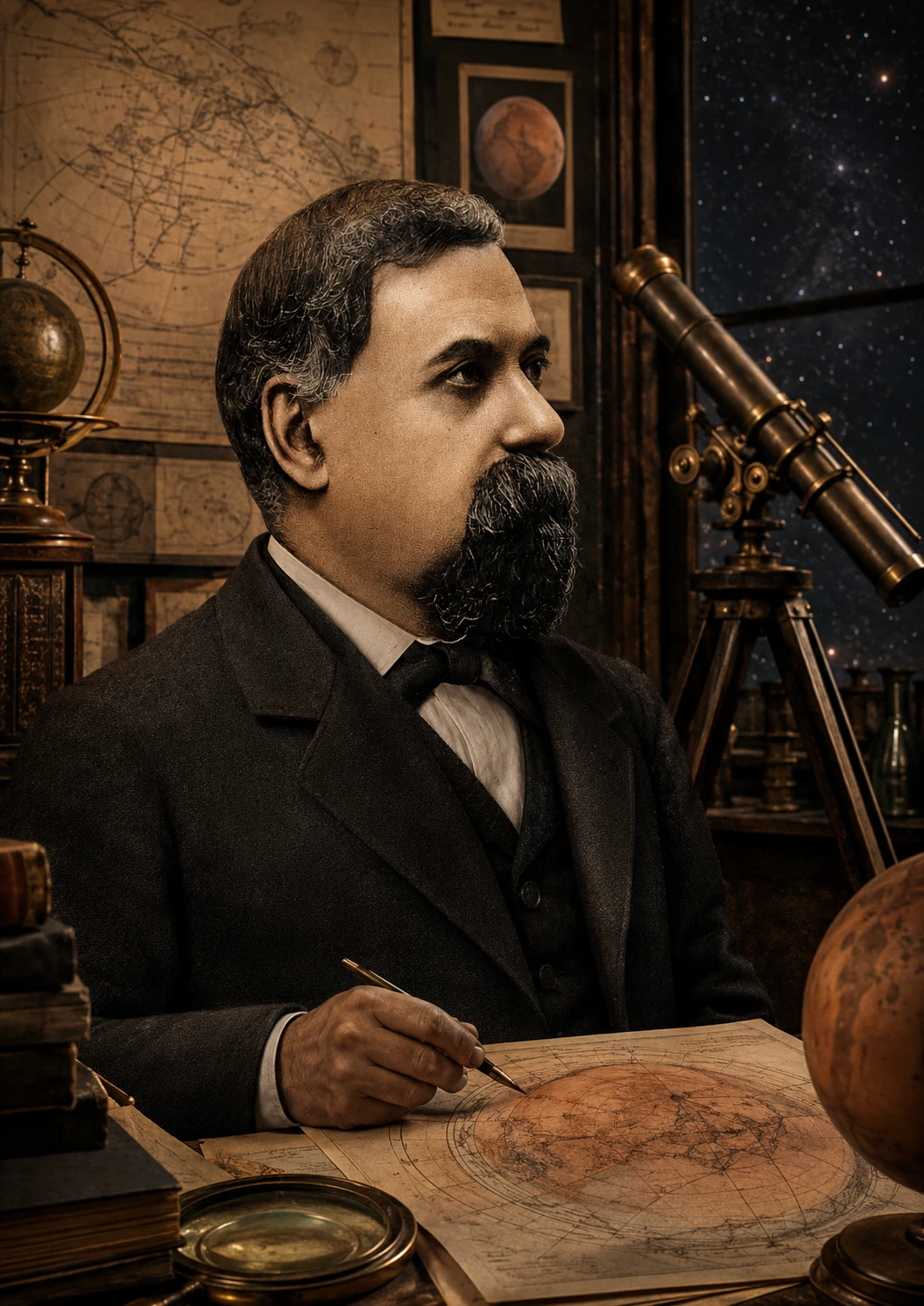
Giovanni Schiaparelli
The son of a Piedmontese brickmaker who became director of the Brera Observatory, explained shooting stars, reconstructed the astronomy of the Greeks, gave Mars its names and saw there canali that did not exist.
1835 – 1910
- Born
- March 14, 1835, Savigliano, Piedmont
- Died
- July 4, 1910, Milan
- Role
- Astronomer; director of the Brera Observatory (1862-1900); senator of the Kingdom of Italy (1889)
- Education
- University of Turin (engineer, 1854); Berlin and Pulkovo (1857-1860)
- Discoveries
- Link between shooting stars and comets (1866); asteroid Hesperia (1861)
- Link with Mars
- Map and nomenclature of Mars (1877); the canali and their geminations
24 chapters and 4 appendices: about 13,000 words, or about 55 minutes of reading. Every fact comes from verified sources, listed at the end of each chapter.
Part One
The Piedmontese
1835 – 1860
Chapter 1 · 1835 – 1850 The Brickmaker’s Son
The man who would give Mars the names of its seas and continents was born far from any observatory, in a small town in Piedmont, Savigliano, south of Turin, on March 14, 1835. His name was Giovanni Virginio Schiaparelli. He was the eldest of nine children. His father, Antonino, owned a brick kiln. His mother was named Caterina Schiaparelli: she bore the same family name as her husband. Both came from Occhieppo Inferiore, a village near Biella, at the foot of the Alps.
An Uncle, a Workman, a Priest
A brickmaker’s son was not destined for long studies. It was a maternal uncle, Luigi, who stepped in: after elementary school, he arranged for the boy to go on to secondary school. This Luigi would be the father of a famous Egyptologist, Ernesto Schiaparelli, Giovanni’s cousin. The family would produce other well-known names: one of Giovanni’s younger brothers, Celestino, would become a noted scholar of Arabic, and Celestino’s daughter, Elsa Schiaparelli, a great fashion designer.
His love of the sky came from elsewhere, and from two men whom nothing predisposed to train an astronomer. The first was one of his father’s workmen, a certain Giovanni Battista Miglietti, an amateur astronomer, who taught him the rudiments. The second was a priest, Don Paolo Dovo, parish priest of the church of Santa Maria della Pieve in Savigliano, also a lover of astronomy. His successor in Milan, Giovanni Celoria, would write that this “theologian,” from the top of his church’s bell tower, showed the young boy the constellations and the brightest stars and initiated him into the mysteries of the sky. The Italian biographical dictionary places this meeting instead during his university years, and specifies that Don Dovo introduced him to observing through a telescope.
Portrait of a Pupil
Celoria, who knew him all his life, takes care not to make him a child prodigy. “Without being a prodigy,” he writes, he was an exceptional schoolboy and then student, in Savigliano as in Turin, and left his teachers and classmates with a high opinion of him. Celoria adds a sentence that sums up, in his view, Schiaparelli’s whole life: he was an astronomer “because he wanted to be.”
One physical detail matters in this story. The young man was severely nearsighted. This myopia would get him declared unfit for military service. The man who would spend his life with his eye to the eyepiece did not have good eyes.
Sources: P. Del Santo, “Schiaparelli, Virginio Giovanni Battista,” Dizionario Biografico degli Italiani, vol. 91, 2018 (birth, parents, brick kiln, Occhieppo Inferiore, uncle Luigi, G. B. Miglietti, Don Paolo Dovo, myopia and exemption); English-language Wikipedia article “Giovanni Schiaparelli” (Celestino and Elsa, tertiary source); G. Celoria, “L’opera di Giovanni Schiaparelli,” Scientia, 1911 (the bell tower of Santa Maria della Pieve, “without being a prodigy,” “an astronomer because he wanted to be”).
Chapter 2 · 1850 – 1857 An Engineer Without a Job
In July 1850, at fifteen, Giovanni Schiaparelli finished secondary school and passed the entrance examination for the mathematics class of the Royal University of Turin. There he studied under distinguished professors: Giovanni Plana for analysis, Carlo Ignazio Giulio for mechanics, Luigi Federico Menabrea for the science of construction. On August 11, 1854, he obtained the title of hydraulic engineer and civil architect. The subject of his final thesis gave no hint of the sky: a design for a bazaar in the Byzantine Gothic style.
The Closed Door
Diploma in hand, he did not want to build. He wanted to observe. He applied to join the Turin observatory, directed by Plana, his former professor, as an assistant. He was turned down.
Two difficult years followed. He earned his living giving private mathematics lessons. Celoria explains that he chose private teaching to keep time free to study modern languages on his own and, above all, astronomy. In November 1856, he was appointed teacher of elementary mathematics in the public schools of Porta Nuova, in Turin. The address delivered in 1902 when he received the Bruce Medal, in the United States, mentions a post as a mathematics instructor held for two months that year.
A Comet of 1556
To force the door open, he did what a researcher does: he worked, and he sent out his work. He wrote a study of a comet observed in 1556, whose return was then expected. He computed its ephemerides, that is, its predicted positions in the sky, day after day, in case it came back. The comet never returned. But the study was convincing.
He sent it to his former professor Giulio, by then a senator. Giulio thought highly of it. He was thinking ahead: one day Plana would need a successor. Together with Menabrea and with a young scientist who would play a great role in this life, Quintino Sella, he persuaded the Minister of Public Instruction, Giovanni Lanza, to send the young man abroad to complete his training. Schiaparelli obtained a modest grant from the government of the Kingdom of Sardinia. Celoria calls it “his first success,” that of a self-taught man’s will that had finally overcome obstacles that seemed insurmountable.
Sources: Dizionario Biografico degli Italiani, 2018 (July 1850, professors, degree of August 11, 1854 and thesis subject, Plana’s refusal, private lessons, appointment of November 1856, comet of 1556, Giulio, Menabrea, Sella, Lanza, grant); G. Celoria, Scientia, 1911 (choice of private teaching, “first success”); R. Dolbeer, address on the presentation of the Bruce Medal, Publications of the Astronomical Society of the Pacific, 1902 (post of 1856). The Kingdom of Sardinia, whose capital was Turin, belongs to general history.
Chapter 3 · 1857 – 1860 Berlin and Pulkovo
In February 1857, Giovanni Schiaparelli arrived in Berlin. He was twenty-one. He would stay more than two years, with Johann Franz Encke, a pupil of the great Gauss and holder of the chair of astronomy. The young Piedmontese got on very well with him from the start.
Learning Everything
In Berlin he did not limit himself to astronomy. He also attended the lectures of the mathematician Karl Weierstrass and the physicist Johann Christian Poggendorff; the Bruce Medal address also names, among his Berlin teachers, a professor called Ohm. Celoria describes a student who followed “very varied” university courses, drawn at once to the mysteries of nature, to the most tangled historical and philological questions, and to art. This curiosity would never leave him: it would resurface forty years later, when he learned Hebrew to read the Bible in the original.
The “Great Observatory”
His grant was extended. In the summer of 1859, he left for what Celoria calls the “great observatory” of Pulkovo, near Saint Petersburg, in Russia. The Italian biographical dictionary dates this departure to July; Celoria, to June. There he worked under the director, Otto Wilhelm von Struve, and under Friedrich August Winnecke. In Berlin he had learned the theory. At Pulkovo he learned the trade: observing, measuring, calculating.
A Post in Milan
But the renewal of his grant remained uncertain. Schiaparelli asked Quintino Sella to find him a permanent post in Turin. Sella did better. Italy’s map was changing: in 1859, after the war against Austria, Lombardy and its capital, Milan, passed to the Kingdom of Sardinia. Sella put Schiaparelli’s name forward to Francesco Brioschi to replace, as second astronomer of the Brera Observatory in Milan, Paolo Frisiani, who was considered inactive and a fervent supporter of Austria.
The plan succeeded. On November 6, 1859, Schiaparelli was appointed. Yet he left Pulkovo only at the end of his year there. He took up his post at Brera at the end of June 1860. The tribute that Italian astronomers would offer him forty years later bears a precise date: June 30, 1860. Celoria writes that he returned to Italy in July. Then he adds a sober sentence: “He was never to leave it again.”
Sources: Dizionario Biografico degli Italiani, 2018 (Berlin in February 1857, Encke, Weierstrass, Poggendorff, Pulkovo in July 1859, Struve and Winnecke, Sella, Brioschi, Frisiani, appointment of November 6, 1859, start of service at the end of June 1860); G. Celoria, Scientia, 1911 (varied courses, Pulkovo in June 1859, return in July 1860); R. Dolbeer, Bruce Medal address, 1902 (Ohm; June 30, 1860). The title of the 1900 tribute (“30 giugno 1860 – 30 giugno 1900”) is cited in the bibliography of the Dizionario. The passage of Lombardy to the Kingdom of Sardinia in 1859 belongs to general history.
Part Two
Brera
1860 – 1877
Chapter 4 · 1860 The House of Brera
The observatory that Giovanni Schiaparelli entered in the summer of 1860 occupies the southeast corner of the Brera Palace, in the heart of Milan. He would spend forty years there. He himself wrote its history, in a few precise pages, around 1880, and it is through his eyes that we can discover the place.
A Jesuit Observatory
The Specola, as it is called, was born in 1760 on the initiative of two Jesuit fathers who taught at the college of Brera. The building dates from 1764; it was built under the direction, and partly at the expense, of another Jesuit, the scholar Roger Boscovich. When the Jesuit order was suppressed in 1773, the observatory became state property.
Since January 1, 1763, the weather has been recorded there without interruption. In 1775 the annual publication of the Astronomical Ephemerides began: a hundred volumes would appear in a century, until 1874. At the end of the eighteenth century, three astronomers, Reggio, Cesaris and Oriani, brought Brera its fame. Oriani computed the orbit of the planet Uranus, discovered by Herschel in 1781, and in 1801 presented Bonaparte with improved tables of the motion of Mars. The Brera astronomers also drew up the map of the State of Milan, completed in 1796.
The Old Director
In 1860 the director was Francesco Carlini, who had worked at the observatory since 1797 and directed it since 1832, known for his tables of the Sun and his work on refraction. Brera had trained generations of scientists, among them Giovanni Plana, the very man who had turned Schiaparelli away in Turin.
The instruments, however, had aged. The meridian circle in use since 1835, made at the Polytechnic Institute of Vienna, was in his eyes a “rather mediocre” piece of work. The English equatorial sector that arrived in 1775 had served, he writes, “until these last years” to observe the minor planets and comets. And the task was immense: astronomy, geodesy, meteorology, terrestrial magnetism. “A very vast field,” Schiaparelli concludes, “to cultivate which properly would require not one but four observatories.”
Sources: G. Schiaparelli, Notizie sull’osservatorio di Brera in Milano (around 1880, drawn from a publication of the Lombard Historical Society of 1880; Italian Wikisource): location, founding in 1760, building of 1764 and Boscovich, suppression of the Jesuits in 1773, weather records since 1763, Ephemerides 1775-1874, Reggio, Cesaris, Oriani, Uranus, tables of Mars presented to Bonaparte in 1801, map of 1796, Carlini, Plana among the pupils, meridian circle of 1835, sector of 1775, closing quotation. The first name “Roger” for Boscovich (Ruđer Bošković) belongs to general history.
Chapter 5 · 1861 A Planet for Italy
On April 29, 1861, less than a year after arriving at Brera, Giovanni Schiaparelli discovered a minor planet. It was the sixty-ninth known, one of those tiny bodies that circle the Sun between Mars and Jupiter. He gave it a name: Hesperia, in Italian Esperia. It is one of the ancient names of Italy, the Greeks’ “land of the evening.”
A Political Name
The choice was not innocent. The Kingdom of Italy had just been proclaimed, in March 1861. The Italian biographical dictionary specifies that the name was chosen in honor of the new unified state. The discovery was widely reported in the national press. It earned the young astronomer a certain popularity with the Italian public, and the title of knight of the Order of Saints Maurice and Lazarus.
In 1872, when the Royal Astronomical Society in London awarded him its Gold Medal, the English astronomer William Lassell, in his address, would recall that it was at Brera, on April 29, 1861, that Schiaparelli had found Hesperia.
Ordinary Work
Hesperia was a lucky find, but it was not what filled most of his days. In his first years at Brera, he worked mainly on comets and on positional astronomy, which measures the places of the stars with precision. From his arrival, he began observations of stars at the meridian circle which, continued over many years, would form a catalogue.
Celoria tallied up these first years, from 1860 to 1867, and marveled at them: “What scientist’s life offers a period equally rich?” It opened with Hesperia; it would close with the discovery that made Schiaparelli famous throughout learned Europe.
Sources: Dizionario Biografico degli Italiani, 2018 (discovery of April 29, 1861, planet no. 69, name in honor of the new state, press coverage, knight of Saints Maurice and Lazarus, comets and positional astronomy); W. Lassell, Gold Medal address, Monthly Notices of the Royal Astronomical Society, 1872; G. Celoria, Scientia, 1911 (star catalogue, review of 1860-1867). The proclamation of the Kingdom of Italy (March 17, 1861) and the meaning of the word Hesperia belong to general history.
Chapter 6 · 1862 – 1865 Director at Twenty-Seven
Francesco Carlini died in 1862. On September 8 of that year, Giovanni Schiaparelli was appointed in his place as director of the Brera Observatory. He was twenty-seven. He would hold the post for nearly forty years.
The Duties
The young director at once became the man to whom missions were entrusted. He joined the commission charged with reorganizing the Italian observatories. The following year, the Minister of Public Instruction gave him the task of reorganizing the observatory of Palermo, in Sicily. He was appointed professor of geodesy, the science of the shape and size of the Earth, at the Higher Technical Institute of Milan; he would leave this post in 1868.
Teaching did not attract him. The Italian biographical dictionary notes that he never showed any particular taste for it. He would return to it only in 1875 and 1876, for courses in descriptive astronomy and celestial mechanics at Pavia.
In 1864 he was part of the Italian delegation sent to Berlin for the first general conference on the measurement of the meridian arc in central Europe, a great international undertaking to measure the curvature of the Earth. The following year he was one of the founders of the Italian geodetic commission.
A Promised Telescope
He also obtained from the government the means to buy a modern instrument: an equatorial refractor by the optician Merz of Munich, eight inches in aperture, or twenty-two centimeters. Schiaparelli writes that the national government granted it in 1862; the biographical dictionary specifies that it arrived at Brera in 1865. Yet it would not be ready for use until February 1875. It was with this telescope that, two years later, he would discover the canali of Mars.
Maria
In 1865 Schiaparelli married a Milanese woman, Maria Comotti, the daughter of an engineer. They would have five children: Attilio, who would become a professor of letters; Emilio, a doctor of agricultural science; Ester, who would marry the engineer Francesco Borletti; Eva, who would marry Paolo Bassi; and Emma. The sources consulted say little more about his family life, except for a remark by Celoria about his last years: all his family, without distinction, “more than loved him, idolized him.”
Sources: Dizionario Biografico degli Italiani, 2018 (appointment of September 8, 1862, commission on the observatories, Palermo, geodesy until 1868, Pavia 1875-1876, Berlin conference 1864, Italian commission, arrival of the Merz refractor in 1865 and entry into service in February 1875, marriage of 1865 and children); G. Celoria, Scientia, 1911 (September 1862, eight-inch refractor obtained from the government, founding of the geodetic commission, family); G. Schiaparelli, Notizie sull’osservatorio di Brera (22 cm refractor granted in 1862).
Chapter 7 · 1866 – 1867 The Dust of Comets
Every year, around August 10, the summer sky fills with shooting stars. In 1866 Giovanni Schiaparelli observed them on the nights of August 9 to 11. A few weeks later, on August 25, he wrote a first letter to Father Angelo Secchi, the great Jesuit astronomer in Rome, to be published in the meteorological bulletin of the observatory of the Roman College. Four more followed, until February 2, 1867. These five letters would change the understanding of a phenomenon as old as the world.
What Was Known
Schiaparelli himself described, a few years later, what was known before him. A shooting star is a small flame that suddenly appears in the sky, runs in a straight line and goes out. On an ordinary night, one counts on average fifteen to twenty an hour. But on certain nights they fall like rain. It had been noticed that these showers return on fixed dates. As early as 1836, the Belgian scientist Quételet had announced, from the old catalogues, that the date of August 10 should be marked by an increase in shooting stars, which the observations of the following years had confirmed. The Chinese annals already recorded, in the year 830, an August shower in which “it was not possible to count all the stars.” In November another shower returned, more capricious: spectacular in 1799 and in 1833, then again on the night of November 14, 1866, when meteors appeared at the rate of two, three and four a second.
A Comet and a Swarm
It remained to understand where these grains came from. Schiaparelli computed the orbit followed through space by the August shooting stars, called the Perseids because they seem to spring from the constellation Perseus. And he compared it with the known orbits of comets. One of them matched: that of the great comet that appeared in 1862, which takes, according to the astronomer Oppolzer’s calculations, one hundred twenty-one to one hundred twenty-two years to go around the Sun.
The two orbits were identical. The Perseids follow the comet’s path. The Bruce Medal address of 1902 would state the conclusion in its simplest form: the orbit of the Perseids is the same as that of the comet of 1862.
From this Schiaparelli drew a theory. Comets, as they travel around the Sun, gradually come apart. They leave tiny particles along their path, which form streams. When the Earth crosses one of these streams, every year on the same date, the grains enter the atmosphere and burn up: that is the meteor shower. Shooting stars, he would write in a famous phrase, “are nothing other than the dust or flour of comets.”
The Other Cases
Further confirmations followed quickly. Schiaparelli lists them himself with care, giving each his due: after “the relation found by me” between the Perseids and the comet of 1862, the astronomer Peters noted the link between the November Leonids and the comet of 1866; Galle and Weiss connected a shower of April 20 with the first comet of 1861. The English-language Wikipedia credits Schiaparelli himself with the link between the Leonids and their comet; that is not what he writes.
Celoria would sum up the discovery in a sentence: for the first time, these letters demonstrated that there is an intimate and undeniable relation between shooting stars and comets, and that the former result from the disintegration of the latter.
Sources: Dizionario Biografico degli Italiani, 2018 (five letters to Secchi from August 25, 1866 to February 2, 1867, Bullettino meteorologico of the Roman College, quotation on the “flour of comets,” from Le stelle cadenti, 1873, p. 94); W. Lassell, RAS Gold Medal address, 1872 (observations of August 9-11, 1866, letters to Secchi, theory of streams); G. Schiaparelli, Le stelle cadenti, tre letture, 1873 (Italian Wikisource: ordinary frequency, Quételet 1836, Chinese annals of 830, showers of 1799, 1833 and November 14, 1866, comet of 1862 and Oppolzer’s calculation, Peters, Galle and Weiss); R. Dolbeer, Bruce Medal address, 1902; G. Celoria, Scientia, 1911; English-language Wikipedia article “Giovanni Schiaparelli” (tertiary source). Quotations from Italian sources are our translations.
Chapter 8 · 1868 – 1873 The Comet That Broke Apart
The theory of shooting stars made Schiaparelli, at thirty-three, one of the most noticed astronomers of his time. In 1868 the Italian Society of Sciences, known as “the Forty,” awarded him its gold medal. The same year, the Paris Academy of Sciences gave him the Lalande Prize. In 1872 the Royal Astronomical Society in London presented him with its Gold Medal.
The German Book
He did not rest on these laurels, writes Celoria. He continued to study the speed of meteors in the atmosphere, the shape of their “radiants,” the points in the sky from which they seem to spring, and the relations between comets, shooting stars and meteorites. He gathered his work in a book that he wrote in Italian and that appeared in 1871 in German, translated by G. von Boguslawski: Outline of an Astronomical Theory of Shooting Stars.
November 27, 1872
On the evening of November 27, 1872, an extraordinary meteor shower lit up the European sky. The meteors fell at two, three, four a second. In one place, Schiaparelli reports, four observers counted more than ten thousand in an hour, not counting those they could not follow. News of it came from Athens and Christiania, from Kraków and from North America.
This shower had a history, which Schiaparelli tells like an astronomical novel. It was linked to Biela’s comet, a small comet that returns about every six and a half years. In 1846, before the astronomers’ eyes, it had split in two: two comets traveled side by side, on almost identical orbits. At the next return, Father Secchi in Rome had found one of the two heads on August 25, 1852, then the other on September 16, much farther from the first than expected. The shower of 1872 strikingly confirmed what other astronomers, d’Arrest and Weiss, had noticed as early as 1867: the meteors followed the orbit of the broken comet.
Three Lectures
A few colleagues at the Lombard Institute, Milan’s academy of sciences and letters, asked him to explain these phenomena “in a generally intelligible way.” He gave three lectures, at three consecutive sessions. They appeared in 1873 under the title Le stelle cadenti, “Shooting Stars.” In them he speaks of a science that may rightly be called, he says, “the science of the infinite and of eternity.”
The book reveals a talent that would matter greatly in the history of Mars: Schiaparelli knew how to write for everyone. He quotes medieval chronicles alongside orbital calculations, and wants to be understood by all. Twenty years later, it was with this pen that he would explain to the Italian public what he had seen on Mars.
Sources: Dizionario Biografico degli Italiani, 2018 (medal of the Forty 1868, Lalande Prize 1868, RAS Gold Medal 1872); G. Celoria, Scientia, 1911 (work on speed and radiants, Entwurf einer astronomischen Theorie der Sternschnuppen, 1871, translated by G. von Boguslawski); G. Schiaparelli, Le stelle cadenti, 1873, preface and three lectures (shower of November 27, 1872, counts, places of observation, Biela’s comet, splitting of 1846, Secchi’s observations of 1852, d’Arrest and Weiss in 1867, three sessions of the Lombard Institute, “science of the infinite and of eternity”). The period of Biela’s comet belongs to general history.
Chapter 9 · 1873 – 1875 The Spheres of Eudoxus
There were in Schiaparelli’s mind, writes Celoria, two quite distinct and ever-living tendencies. One drew him toward the most complex astronomical and natural facts. The other drove him to seek, in antiquity, the most remote origins of astronomy. All his life he would pursue both side by side.
The Precursors of Copernicus
In 1873 he published a memoir on The Precursors of Copernicus in Antiquity. In it he tells by what difficult paths the Greeks approached the idea that the Earth goes around the Sun, and why this bold idea, once reached, survived them only as a faint echo. Twenty-five years later, in 1898, he returned to the subject in another memoir, Origin of the Heliocentric Planetary System among the Greeks, starting from Heraclides of Pontus and Aristarchus of Samos.
A Two-Thousand-Year-Old Puzzle
His great work as a historian appeared in 1874 (1875 according to Celoria): The Homocentric Spheres of Eudoxus, Callippus and Aristotle. Eudoxus of Cnidus, in the fourth century BCE, had imagined explaining the motion of the planets by a nesting of spheres all turning around the same center, the Earth. The system was known from brief summaries, but no one since antiquity had managed to understand it completely.
Schiaparelli, engineer and geometer, reconstructed it. He showed how the combination of these spheres could make a planet trace a figure-eight curve, which the ancients called the “hippopede,” the horse fetter, and so account for its stops and backward loops in the sky. The memoir was translated into German in 1877. The Italian biographical dictionary writes, in 2018, that it remains to this day the standard work on the subject.
Latin and Greek
This historical work rests on a knowledge of ancient languages that Celoria considers rare, and exceptional for an astronomer. Schiaparelli read Greek texts in the original, and handled Latin well enough to write verse in it. The Italian-language Wikipedia attributes a sentence to him: in his view, there is no truly cultivated person who does not know Latin and Greek.
Other studies would come later: on the astronomical and meteorological calendars of the ancients, the “parapegmata”; annotations to the astronomy of the Arab scholar al-Battani, published by Carlo Nallino; and an essay with a Latin title, Rubra Canicula, in which he asks whether it is true that Sirius, today a pure white, was red at the beginning of the Christian era.
Sources: G. Celoria, Scientia, 1911 (the two tendencies, I precursori di Copernico 1873, Origine del sistema planetario eliocentrico presso i Greci 1898, spheres of Eudoxus, ancient languages, parapegmata, al-Battani and Nallino, Rubra Canicula); Dizionario Biografico degli Italiani, 2018 (Le sfere omocentriche 1874, German translation 1877, standard work); G. Schiaparelli, Le sfere omocentriche (Italian Wikisource, chapter V on the hippopede); Italian-language Wikipedia (sentence on Latin and Greek, tertiary source). The date of Eudoxus belongs to general history.
Part Three
The Map of Mars
1877 – 1890
Chapter 10 · 1877 The Great Opposition
In February 1875 the twenty-two-centimeter Merz refractor was at last ready at Brera. Schiaparelli used it first to measure double stars, those pairs of stars that orbit one another. Then came the summer of 1877. Mars was approaching the Earth as it does only once every fifteen or seventeen years. On September 2, 1877, the distance between the two planets fell to nearly fifty-seven million kilometers. In September and October, Schiaparelli turned his telescope toward Mars. This would be, writes Celoria, the beginning of the widest fame he would know.
Why Mars Shows Itself So Rarely
Schiaparelli himself explained, in 1893, for the general public, why these occasions are rare. The Earth goes around the Sun in 365 days, Mars in 687. The two planets line up on the same side of the Sun only about every twenty-six months, or 780 days: this is called an opposition, because Mars is then opposite the Sun in our sky. But Mars’s orbit is noticeably more oval than the Earth’s. If the opposition falls where the two orbits are closest, Mars outshines every other planet except Venus: this is a “great opposition,” as in 1877, 1892 and 1909. Otherwise the distance is almost double, and the planet appears four times smaller in area.
Even in the best conditions, Mars remains tiny. At its closest, its disk does not exceed one seventy-fifth of the apparent diameter of the Moon. It must be magnified seventy-five times to look as large as the Moon to the naked eye. On the Moon, a good telescope distinguishes an object half a kilometer across. On Mars, writes Schiaparelli, one can hope to make out only a spot sixty to seventy kilometers wide, or a line thirty kilometers across. None of the Earth’s great rivers would be visible there; nor would Paris or London.
Those Who Had Seen Before Him
Schiaparelli knew his predecessors perfectly, and he did them justice. Galileo, with telescopes that magnified no more than thirty times, had been able to see nothing on Mars. The Dutchman Huygens was the first to see its markings with some certainty, between 1656 and 1659; the Great Syrtis can be recognized in his drawings. In Bologna, in 1666, Giovanni Domenico Cassini deduced from the shifting of the markings that the planet rotates in twenty-four hours forty minutes. In Verona, in 1719, Bianchini made the first fairly accurate drawings. Herschel and Schroeter, at the end of the eighteenth century, had deduced from the polar caps the tilt of its axis, and therefore its seasons. Finally the German Mädler, around 1830, drew up the first map of Mars, which for more than thirty years remained the only one.
An Engineer’s Method
What set Schiaparelli apart was his method. He did not want merely to draw what he saw: he wanted to measure it. He made dozens of micrometer measurements, with an instrument that measures very small angles at the eyepiece, to fix first the exact position of the planet’s axis of rotation and south pole, then that of reference points on the disk. On this network, like a surveyor in the field, he built his map. It would be, according to the Italian biographical dictionary, far richer in detail than any made until then.
His positions agreed with those of Mädler in 1830 and of the astronomer Kaiser in 1862. He drew from this a conclusion he considered solid: the markings of Mars are not passing clouds, as had been thought; the planet has a stable geography, like the Earth and the Moon.
Sources: Dizionario Biografico degli Italiani, 2018 (entry into service in February 1875, double stars, opposition of September-October 1877, micrometer measurements, axis, south pole, cartographic network, richness of the map); G. Celoria, Scientia, 1911 (September-October 1877, fame); G. Schiaparelli, Il pianeta Marte, Natura ed Arte, February 1893, chapter II (Italian Wikisource: periods, oppositions, 780 days, great oppositions of 1877, 1892 and 1909, distance on September 2, 1877, magnifications, limits of visibility, Galileo, Huygens, Cassini, Bianchini, Herschel and Schroeter, Mädler, agreement with Mädler and Kaiser, stability of the topography).
Chapter 11 · 1877 – 1878 Naming a World
A map without names is useless. To designate the forms he discovered, Schiaparelli invented a nomenclature drawn from ancient geography and mythology. It would soon be adopted throughout the world, and it has survived to our day.
A Poet’s Geography
The large dark markings became seas: the Tyrrhenian Sea, the Cimmerian Sea, the Sea of the Sirens, the Erythraean Sea, which is the ancient name of the Red Sea. The bright regions bear the names of legendary or ancient lands: Hesperia, Ausonia, Atlantis, Hellas, Argyre. A great dark gulf became the Great Syrtis, named after the sandbanks off Libya dreaded by ancient sailors. There one finds the Lake of the Sun, the Fountain of Youth, the rivers of milk, the Acheron, river of the underworld.
Celoria was struck by these names, which he considers drawn from “primitive oriental geography,” and by the mastery of classical literature they presuppose. When the International Astronomical Union fixed in 1958 the official list of Martian names seen through the telescope, it kept one hundred twenty-eight. According to Wikipedia, one hundred five come from Schiaparelli.
The Poem to Tito Vignoli
These names are not the idle game of a man of letters. They say something about what Mars meant to him. A document shows it. A few years later, sending his third memoir on Mars to his friend Professor Tito Vignoli, Schiaparelli wrote on the first page a dedication of fifty Latin lines, which Celoria published after his death.
Let us stop singing of Jason, Cadmus and Aeneas, the poem says in substance: “What use is it to fill poems with imaginary glories?” A truthful Muse sings to him the science of the stars. He invites his friend to roam with his eyes over new worlds, shores no mortal has seen, and those “double furrows” that an “unknown Daedalus” has traced on the glowing orb. Then follows a walk across his map: the Golden Chersonese near Thaumasia, Ausonia washed by the Tyrrhenian Sea, the Syrtes with their ill-omened name, the Ganges, Thule in the night of the pole, the Acheron rolling its black waves. Neither Ulysses, nor Alexander, nor Rome, he concludes, ever traveled or conquered a territory as vast as the one this little book displays.
The poem is signed with a pseudonym: Achilles Parius. It is an anagram of Schiaparellius, his name in Latin.
Celoria sees in it proof that Schiaparelli felt all the poetry of the mysteries of Mars. The scientist whom an American colleague, Edward Holden, called “very chary of hypotheses” allowed himself, in a dedication to a friend, to imagine an unknown architect tracing furrows on a distant planet.
Sources: Dizionario Biografico degli Italiani, 2018 (nomenclature drawn from ancient geography and mythology, internationally adopted); G. Celoria, Scientia, 1911 (names drawn from “primitive oriental geography,” Latin poem to Tito Vignoli with its Italian translation by A. Avancini, pseudonym Achilles Parius); E. Holden, quoted by R. Dolbeer, Bruce Medal address, 1902 (“very chary of hypotheses”); G. Schiaparelli, Il pianeta Marte, 1893, chapters II and IV, and Il pianeta Marte, 1909 (names of seas, gulfs, lakes and regions); English-language Wikipedia article “Giovanni Schiaparelli” (105 names out of 128 in 1958, tertiary source). The meaning of the ancient names (Erythraean Sea, Syrtes, Acheron) belongs to general culture. Quotations from the poem are our translations from the Italian version.
Chapter 12 · 1878 – 1879 The Canali
On May 5, 1878, Giovanni Schiaparelli presented his first map of Mars and its accompanying memoir to the Accademia dei Lincei in Rome. Everything in it was striking, writes Celoria: the method of observation, the precision of the measurements, the drawing traced “with the hand and mind of an artist,” the names taken from antiquity. And one strange thing: a complicated system of lines enveloping the whole planet.
The Network
On the bright regions of Mars, Schiaparelli had seen a dense network of fine dark lines, hundreds or thousands of kilometers long. He named them canali. The word was not new in astronomy: Father Secchi had used it before him, but for quite different, broad features.
The choice of word was no accident, explains the Italian biographical dictionary. These lines had the same color as the large dark markings, then taken for liquid expanses, seas and lakes. They crossed the bright regions, considered continents, in every direction. And they never stopped in the middle of a continent: they always began and ended in a sea, in another line, or at a crossing of several lines. Schiaparelli concluded that this was a true hydrographic network, through which the water of the polar caps, melting each season, flowed across the continents to the seas.
One Word, Two Meanings
In Italian, canale can mean a natural channel, like the English Channel or the Mozambique Channel, as well as a canal dug by human hands. In English the word would be translated as canals, which suggests an artificial work, rather than channels, which denotes a natural passage. Wikipedia sees in this translation the origin of many suppositions about intelligent life on Mars.
Schiaparelli himself stated and restated the sense he gave the word. In a letter quoted by Celoria, he writes that in the present state of our knowledge, “or rather of our ignorance,” of the nature of Mars, the words sea and continent are only convenient ways of designating the dark and bright spaces; that a dark line, in this system, will be called a strait or a canal; but that in using these words one must always remember that they are “simply conventional.”
Doubt and Adversaries
The first work on Mars aroused doubts and criticism. Celoria believes that, had Schiaparelli not already been a first-rank astronomer, “and a feared one,” his observations might have been stifled at birth by foreign astronomers and academicians. Schiaparelli saw his adversaries’ maneuvers, but he refused to engage in polemics. He kept observing.
At the next opposition, in 1879, he saw almost twice as many canals as in 1877. Doubt, he would write later in a sentence quoted by Celoria, is a praiseworthy thing, and sometimes the source of admirable discoveries in scientific research; but it cannot be admitted in the face of facts “seen, seen again and faithfully reproduced.”
Sources: G. Celoria, Scientia, 1911 (Lincei session of May 5, 1878, what was striking in the map, criticism, “first-rank and feared astronomer,” refusal of polemics, letter on conventional words, sentence on doubt); Dizionario Biografico degli Italiani, 2018 (network of lines, earlier use of the word by Secchi, reasons for the choice of word, hydrographic network, almost twice as many canals in 1879); G. Schiaparelli, Il pianeta Marte, 1893, chapter IV (comparison with the English Channel and the Mozambique Channel); English-language Wikipedia article “Giovanni Schiaparelli” (translation as canals, tertiary source). Quotations from Italian sources are our translations.
Chapter 13 · 1878 – 1886 Quintino Sella’s Gift
Right after his first memoir on Mars, Schiaparelli asked for a more powerful instrument for Brera. His twenty-two-centimeter refractor, in service for barely more than three years, was modest beside those of the great foreign observatories. On June 10, 1878, Quintino Sella, the man who had already sent him to Berlin and then brought him to Milan, obtained a considerable sum from Parliament: two hundred fifty thousand lire.
Merz and Repsold
The objective of the new telescope, forty-nine centimeters in aperture, or eighteen inches, was ordered from the Merz firm in Munich, which had made the first. The mounting was entrusted to the Repsold brothers of Hamburg. The instrument was completed and in service in 1885; Schiaparelli used it for Mars from the opposition of 1886.
In 1893 he described it proudly for the readers of a popular magazine. The moving part weighs several tons of metal, and yet the pressure of a finger is enough to move it and point it at a star with the precision of the most delicate microscope. In five minutes this mass can be turned toward any region of the sky. A clockwork mechanism turns it with the sky, so that the star remains motionless in the field for as long as one wishes. It is, he writes, the largest telescope in Italy, and the most powerful to have come out of the workshops of Germany.
Every time he looks at it, he adds, he thinks of “that man not easily forgotten,” Quintino Sella, to whom the Milan observatory owes its principal ornament. Sella died in 1884, before seeing the telescope in service.
The Race of Giants
Schiaparelli knew that others were going further. He cites eight or ten larger instruments, built or under construction. The greatest of all stands in California, on the summit of Mount Hamilton: the refractor of the Lick Observatory, built thanks to the bequest of a wealthy merchant, James Lick. Its objective of ninety-one and a half centimeters alone cost fifty thousand dollars. He also mentions the private observatory that an Italian astronomer, Vincenzo Cerulli, had just built at his own expense near Teramo, in the Abruzzi, with a forty-centimeter refractor. He praises this “example worthy of imitation.” The same Cerulli would later play a role in the story of the canals.
The North of Mars
The new telescope came at the right moment. During great oppositions, Schiaparelli explains, Mars shows the Earth mainly its southern hemisphere, which he had mapped in 1877-1879 with the small refractor. The northern hemisphere shows itself well only at less favorable oppositions, when the planet is farther away. One must then magnify five or six hundred times. With the great Brera objective he could push to six hundred fifty, and in 1888 and 1890 draw the map of the north of Mars.
Sources: Dizionario Biografico degli Italiani, 2018 (request for a more powerful instrument, 8-inch refractor in service for barely more than three years, vote of June 10, 1878, 250,000 lire, 18-inch Merz objective or about 49 cm, Repsold mounting, entry into service in 1885, Mars from 1886); G. Schiaparelli, Il pianeta Marte, 1893, chapter II (description of the telescope, decision “by the King and Parliament” in 1878, tribute to Sella, Lick refractor, James Lick’s bequest, cost of the objective, V. Cerulli’s observatory, southern and northern hemispheres, magnifications, maps of 1877-1879 and 1888-1890). The date of Quintino Sella’s death (March 14, 1884) belongs to general history.
Chapter 14 · 1882 – 1890 The Rails of Mars
In 1882 Schiaparelli observed a new and disconcerting phenomenon on Mars. A canal he knew as a single line suddenly appeared doubled: beside it, along its whole length, ran a second line, parallel to the first. He gave the phenomenon a name that would stick: gemination, the doubling into twins.
What He Saw
He described it very precisely in his article of 1893. The transformation is rapid: it takes a few days, perhaps a few hours, and he was never able to catch its course. The canal changes, along its whole length, into two uniform lines, almost always parallel, which run straight and equal with a tracing as geometrically exact as that of two railway rails. The comparison stops there, he specifies: the dimensions have nothing in common. The gap between the two lines ranges from more than six hundred kilometers to less than fifty. Each is between thirty and a hundred kilometers wide.
The phenomenon also affects the lakes: one of them can be seen changing into two broad dark bands separated by a yellow one. Geminations do not all occur at once. They appear mainly around the Martian equinoxes, before and after the great melting of the northern snows. They last a few months, fade and disappear. Some canals never double. In 1877 he had seen none; they were on the contrary very numerous in 1882 and 1888.
He drew an important conclusion: since the same gemination can change its appearance and even, slightly, its direction from one season to another, geminations cannot be stable formations, as the canals themselves are.
The Bridge of Achilles
Other changes intrigued him. Between the Niliacus Lake and the Acidalian Gulf stretches a bright band, about two hundred kilometers wide and nearly a thousand long, which he called the “Bridge of Achilles.” It looks like a dike. It is almost permanent; but in 1888 he saw it interrupted for a time.
Seven Memoirs
From 1877 to 1890, Schiaparelli observed Mars at seven oppositions. For each he wrote a long memoir, with detailed maps, under the title Astronomical and Physical Observations on the Topography of the Planet Mars. They appeared in the proceedings of the Accademia dei Lincei. The last, devoted to the opposition of 1890, would be read only in 1910, a few months before his death.
His discoveries set off, says the Italian biographical dictionary, a veritable “hunt” for canals, in which the best observers of Europe and the United States took part. In 1893 Schiaparelli noted that since 1882 eight or ten observers had seen and described geminations. He added that others still denied they were real and taxed those who claimed to have seen them “with illusion (or even imposture),” in the wording of the English translation published by Nature.
Celoria quotes one of his sentences on the subject: there are many questions more important than that of the double canals of Mars, but it is hard to find one more extraordinary, whose secret is further from our everyday experience and yet more profound.
Sources: Dizionario Biografico degli Italiani, 2018 (discovery of 1882, the name gemination, lakes, seasonal character, seven oppositions and seven memoirs, memoir of 1890 read in 1910, “hunt” for canals); G. Celoria, Scientia, 1911 (1882, title of the memoirs, sentence on the double canals); G. Schiaparelli, Il pianeta Marte, 1893, chapters III and IV (description, rails, dimensions, seasons, conclusion on instability, observers, interruption of the dike in 1888), and its English translation, “Schiaparelli on Mars,” Nature, November 22, 1894 (“with illusion (or even imposture)”); G. Schiaparelli, Il pianeta Marte, 1909 (absence in 1877, abundance in 1882 and 1888, dimensions of the Bridge of Achilles).
Chapter 15 · 1882 – 1890 The Eternal Day of Mercury
Mars was not the only planet Schiaparelli observed. From 1882 he undertook the study of Mercury, the closest to the Sun and the hardest to see: it stays almost always drowned in the Sun’s glare. Astronomers thought it rotated in a time close to twenty-four hours, like the Earth. He would reach an unexpected conclusion.
A Few Markings
According to the account given by the American astronomer Edward Holden in 1890, Schiaparelli made between one hundred fifty and two hundred observations of Mercury from 1881 to 1886. He managed, as he would write, to make out a few markings on it often enough. And he concluded that Mercury rotates in exactly the time it takes to go around the Sun, 87.97 days. It would therefore always show the same face to the Sun, as the Moon always shows the same face to the Earth.
Before the King
He presented this result on December 8, 1889, to the Accademia dei Lincei, at a session attended by the King and Queen of Italy. The following year, discussing earlier observations and combining them with his own, he argued that Venus too rotates in the time of its revolution, 224.70 days. But he remained cautious: the details on Venus’s disk are so elusive that he did not rule out a rotation of between six and nine months. He would confirm his conclusions in 1895 with new observations.
This work earned him a second Lalande Prize in 1890. Celoria notes that he did not hesitate to publish results contrary to ideas accepted by all astronomers, showing himself a severe and impartial critic of his own work. He also notes that in 1911 most observers agreed with him about Mercury, fewer about Venus.
What Radar Would Say
His values remained the most accepted for more than seventy years. Then, in the 1960s, the first radar observations measured the rotation of the two planets directly. Mercury rotates in 58.65 days, Venus in 243.69 days, and in the opposite direction to the other planets. Space probes would confirm these figures. On Mercury, Schiaparelli had been wrong. On Venus, his caution had led him to consider a period far closer to the truth than the twenty-four hours of his predecessors.
A feature on Mercury bears his name today: Schiaparelli Dorsum, a long ridge.
Sources: E. S. Holden, account of Schiaparelli’s work on Mercury, Publications of the Astronomical Society of the Pacific, 1890 (150 to 200 observations from 1881 to 1886, session of December 8, 1889 before the King and Queen); G. Celoria, Scientia, 1911 (start in 1882, publication of 1889, Venus in 1890 and 1895, critical attitude, state of opinion in 1911); G. Schiaparelli, Il pianeta Marte, 1893, chapter I (markings on Mercury); Dizionario Biografico degli Italiani, 2018 (periods of 87.97 and 224.70 days, six-to-nine-month hypothesis for Venus, second Lalande Prize in 1890, radar of the 1960s, 58.65 and 243.69 days, dorsum on Mercury). The retrograde rotation of Venus belongs to general astronomy.
Part Four
Life on Mars
1885 – 1910
Chapter 16 · 1885 – 1893 Senator of the Kingdom
On January 26, 1889, Giovanni Schiaparelli was appointed senator of the Kingdom of Italy. It was not an election. The Albertine Statute, the kingdom’s constitution, allowed the king to appoint to the Senate, for life, members of the Royal Academy of Sciences of at least seven years’ standing. Schiaparelli had been one since 1870.
The Honors
From June 1885 to May 1889 he also sat on the Higher Council of Public Instruction. Honors accumulated. The Leopoldina Academy in Germany had awarded him its Cothenius Medal in 1876. He had been a member of the Accademia dei Lincei since 1870, and of the Lombard Institute, of which he was vice-president in 1883 and then president in 1884 and 1885. The Paris Academy of Sciences made him a correspondent in 1896, then a foreign associate in 1902. In 1907 he would even enter the Accademia della Crusca, the venerable academy of the Italian language, a rare distinction for an astronomer. At his death Celoria counted forty-eight Italian and foreign academies that had welcomed him, and the insignia of twelve orders of chivalry.
The Man
Celoria, who worked beside him for decades, left the only living portrait of him found in the sources consulted. He describes him as short, rather stocky, slightly stooped with the years, so that some called him “the bent and frowning astronomer of Brera.” His strongly nearsighted eye gave him, in the street and in public, a manner always circumspect and seemingly distrustful.
At first meeting he was reserved, almost cold, and readily shut himself in an unencouraging silence. But if asked about a specific question, he would speak at length, naturally, and his words cast, writes Celoria, surprising flashes of light on the subject. In private he had simple manners and a character that was rigid, impetuous, quick-tempered by fits, “but good.” An enemy of idleness, of posing and of everything that had only the appearance of truth, he rarely spoke of himself.
He gave little time to receptions and conversation, but kept up a vast correspondence with regularity: more than four thousand letters exchanged, according to Celoria.
Bereavement
In June 1893 his wife Maria died. Schiaparelli remained a widower. The sources consulted say nothing more.
Sources: Dizionario Biografico degli Italiani, 2018 (appointment to the Senate on January 26, 1889 and the rule of the Albertine Statute, Higher Council 1885-1889, Cothenius 1876, list of academies with their dates, Crusca 1907, widowhood in June 1893); G. Celoria, Scientia, 1911 (physical and moral portrait, “the bent and frowning astronomer of Brera,” correspondence, forty-eight academies, twelve orders). The year of his entry into the Turin Academy of Sciences (1870) is given by the Dizionario. Quotations from Italian sources are our translations.
Chapter 17 · 1892 – 1894 “Let Us Therefore Hope and Study”
In 1892 Mars came back as close as it gets to the Earth: on August 6 the distance fell once more to nearly fifty-seven million kilometers, as in 1877. For months, and into the fine autumn evenings, a great red star shone above the southern horizon. The public was enthralled. In America, the giant refractor of the Lick Observatory was now available. In France, the astronomer and writer Camille Flammarion had just published a thick book on Mars and its conditions of habitability. On September 15, 1892, at Brera, Schiaparelli drew the planet with his great telescope.
An Article for Everyone
In February 1893 he published in a popular Milanese magazine, Natura ed Arte, a long article in four chapters, Il pianeta Marte, with his maps. In it he explains why Mars suddenly fascinated the world: people hoped, thanks to giant telescopes, to learn at last whether other heavenly bodies harbor living beings, even intelligent ones. He recalls the writers who had peopled the sky, from Cicero and Lucian to Cyrano de Bergerac, Fontenelle, Voltaire and Edgar Poe. He quotes Father Secchi at length, for whom life fills the universe. He pays tribute to Flammarion, “ardent apostle” of the plurality of inhabited worlds, whose eloquence he admires. Then he adds, with a frankness that sums him up: “as to results of observation, so far we have few hopes and no facts.”
He describes, as a witness, the melting of the southern polar cap in 1892. In July and August, even with ordinary telescopes, it could be seen shrinking from week to week: from more than two thousand kilometers across, it was reduced in two or three months to three hundred kilometers at most. He describes the snows splitting, large pieces breaking off and melting. He deduces that Mars has an atmosphere, seasons, and a climate that must resemble “the climate of a clear day upon a high mountain,” in the words of the English translation: very strong sunshine by day, great cold at night, little or no rain.
The Network and Intelligent Beings
On the canals he is clear. They are, he thinks, true channels, a hydrographic system through which the meltwater flows. He concludes: “It is not necessary to suppose them the work of intelligent beings.” Despite the almost geometrical appearance of the network, he inclines to see it as a product of the planet’s evolution, like the English Channel or the Mozambique Channel on Earth.
On the geminations he is more open. Some, he says, see in them the work of inhabitants of Mars. “I will take good care not to combat this supposition, which includes nothing impossible.” They could not be permanent works, since they change from one season to another; but one can imagine, for example, great works of cultivation and irrigation. At once he adds that intelligent beings are not needed to explain this geometry: the planets are spheres, the rainbow is a perfect arc, crystals are regular polyhedra, and no one traced them with compasses.
What, then, does he propose? He admits it: if asked whether he can imagine anything better than the explanations put forward, he will answer “candidly, no.” Any hypothesis appealing to life leaves too much freedom to be useful. One must trust in what Galileo called “the courtesy of nature,” which sometimes brings light from an unexpected quarter. And he ends: “Let us therefore hope and study.”
A Letter to Holden
On April 5, 1893, he wrote to Edward Holden, director of the Lick Observatory. In it he discusses and rejects a hypothesis of the Lick astronomer John Schaeberle. He explains that deep lakes, seen from above, look black as ink, which may explain the dark color of the “seas.” He thinks that the dark border of the northern cap is formed of meltwater. And he declares himself quite ready to modify his ideas. A note of June 7 reports the doubling of three canals: the Ganges, the Euphrates and the Hydaspes.
In November 1894 the British journal Nature published, under the title “Schiaparelli on Mars,” a translation of his texts by the American William Henry Pickering. The scientist of Brera was now read throughout the world.
Sources: G. Schiaparelli, Il pianeta Marte, Natura ed Arte, February 1893, chapters I to IV (Italian Wikisource: distance on August 6, 1892, public interest, Lick, Flammarion, writers, quotation from Secchi, “few hopes and no facts,” melting of 1892, climate, canals and evolution, “nothing impossible,” examples of natural geometry, “candidly, no,” “courtesy of nature,” drawing of September 15, 1892); “Schiaparelli on Mars,” Nature, November 22, 1894 (translation by W. H. Pickering; English wording of “the climate of a clear day upon a high mountain,” “It is not necessary to suppose them the work of intelligent beings,” “Let us therefore hope and study”); letter from G. Schiaparelli to E. S. Holden of April 5, 1893 and note of June 7, 1893, Publications of the Astronomical Society of the Pacific, 1893. Other quotations are our translations from the Italian.
Chapter 18 · 1895 “I Dismount from the Hippogriff”
In 1895 Giovanni Schiaparelli published in Natura ed Arte a second article, in three parts: La vita sul pianeta Marte, “Life on the Planet Mars.” He placed it under a Latin epigraph that warns the reader: Semel in anno licet insanire, “once a year it is permitted to play the fool.” The scientist who in 1893 had asked us to hope and study would, for once, let his imagination run. And he says so.
The Melting of 1894
The starting point is an observation. In 1894 other astronomers had followed the southern polar cap of Mars. On May 25, seen from Melbourne, it measured two thousand eight hundred kilometers. By mid-August it was only six hundred. After a pause, it disappeared around October 23. For the first time, a polar cap of Mars had been seen to melt entirely.
Schiaparelli drew from this a picture of water on Mars. The southern seas, he thinks, are probably salty, like ours. The northern snows, by contrast, fall on a dry continent; when they melt they give almost pure water, which spreads in a gigantic flood before running back toward the southern seas. Since it hardly ever rains on Mars, all life on the continents would depend on this water, and this water alone. And “if there exists on Mars a population of rational beings,” he concludes, the regulated distribution of these waters must be the chief problem of its engineers and statesmen.
A Novel, He Says
The third part opens with a warning. What he is about to say, he writes, will not have the value of a scientific result and will border in part on the novel. He adds, not without mischief, that this novel is no less probable than many others, bolder and less harmless, printed under the sacred name of science.
He then reasons as a hydraulic engineer, which he is by training. The dark lines are too wide to be drainage canals: they would empty the flood in a few hours. They would rather be broad, flat valleys, irrigated and covered with vegetation, at the bottom of which run real canals too narrow to be seen from Earth. The doubling would be explained by the order of irrigation. On each slope of the valley, parallel canals are set at different heights. When the flood is at its peak, the “Grand Prefect of Agriculture” orders the highest sluices opened: two parallel bands turn green, and the inhabitant of Earth sees a gemination. Then lower, closer bands are irrigated, and finally the valley floor: the double becomes single again.
He lets himself go to the end. Mars, he writes, must be “the paradise of hydraulic engineers.” He wonders whether the community of interests among the inhabitants of each valley would not make collective socialism more practical there than here, whether the planet should be a federation of valleys or the “universal monarchy” dreamed of by Dante. On a planet where the welfare of each depends on the welfare of all, wars would be unknown, and all the effort that “the mad inhabitants of another neighboring globe” spend on harming one another would be turned against the stinginess of Nature.
Then he stops, with an image borrowed from Ariosto’s poem, in which the hero rides the hippogriff, a winged horse: “I dismount from the hippogriff; you, if you like, may continue the flight.” He leaves the rest to the reader, borrowing a line from Dante: “I have set it before you; now feed yourself.”
What to Remember
One could read this text as an endorsement of Martian builders. It is more nuanced. In it Schiaparelli grants that, if one looks closely at the geminations and their regularity, the idea that a race of intelligent beings might have at least a secondary part in them “cannot be considered entirely absurd.” But he took care to frame it with an epigraph about the folly permitted once a year and a word about the novel. The Italian biographical dictionary concludes that he never ceased to believe in the real existence of the canals, and never gave up the idea that they might manifest vegetation, or even the work of intelligent beings.
Sources: G. Schiaparelli, La vita sul pianeta Marte, Natura ed Arte, 1895, parts I to III (Italian Wikisource: epigraph, melting of 1894 and figures, salt water and pure snow, absence of rain, “population of rational beings,” warning about the novel, irrigated valleys, “Grand Prefect of Agriculture,” order of irrigation, “paradise of hydraulic engineers,” socialism, federation or Dante’s monarchy, absence of wars, “mad inhabitants of another globe,” hippogriff, Dante’s line, “not entirely absurd”); Dizionario Biografico degli Italiani, 2018 (judgment on his convictions). The origin of the references (the hippogriff of Ariosto’s Orlando Furioso; the line from Dante’s Paradiso, canto X) belongs to general culture. Quotations are our translations from the Italian.
Chapter 19 · 1894 – 1907 The American Heir
On the other side of the Atlantic, a wealthy Bostonian had read Schiaparelli. Percival Lowell, diplomat and writer, decided in the winter of 1893-1894 to devote his fortune to the study of Mars. In the spring of 1894 he founded an observatory on a hill at Flagstaff, Arizona. To his friend George Agassiz he gave a reason: Schiaparelli’s eyesight was failing, and he could no longer continue his observations. Lowell would.
The Visit
During the winter of 1895-1896, Lowell traveled to Milan. He had just published a book, Mars, arguing that the canals were the work of a civilization. At Brera the two men compared their observations, to Lowell’s satisfaction. According to the account his brother would give, the old astronomer still seemed to him in the prime of life, but said he no longer expected to make discoveries, and explained that bad weather had let him see almost nothing at the previous opposition. Lowell’s brother would write that Schiaparelli’s mantle had, that day, fallen on Percival.
Two Temperaments
The contrast between the two men is striking. Lowell asserts; Schiaparelli doubts aloud. The first writes books to prove that Mars is inhabited; the second writes that he has “no facts.” Lowell’s severest critic, the astronomer William Wallace Campbell of the Lick Observatory, would begin his 1896 review of Lowell’s book with a tribute to Schiaparelli, whose work, he said, bears “the impress of a scientific spirit par excellence,” concerned with facts rather than a theory.
Schiaparelli, however, did not disown the American. In 1905, when the Flagstaff observatory managed to photograph canals, he wrote to Lowell in wonder: “I should never have believed it possible.” In December 1906 Lowell dedicated his new book, Mars and its Canals, to him. In his article of 1909, Schiaparelli recommends this book to his readers, and calls “fairly probable” the hypothesis, upheld “principally” by Lowell, that one sees on Mars the stages of a vegetation cycle.
A Reservation
But he kept his freedom of judgment. According to Wikipedia, Schiaparelli considered much of the detail in Lowell’s drawings imaginary. At Flagstaff, as early as 1894, Lowell said he saw in some regions almost all of Schiaparelli’s canals, and about as many others.
Their encounter left a lasting mark on history: the word came from Schiaparelli, the legend from Lowell. On Lowell, see his biography on this site.
Sources: A. Lawrence Lowell, Biography of Percival Lowell, 1935 (decision of the winter of 1893-1894, visit to Brera, Schiaparelli’s remarks, the “mantle,” letter of 1905, Flagstaff observations of 1894); G. R. Agassiz, notice on P. Lowell, 1917 (Schiaparelli’s eyesight); W. W. Campbell, review of Mars, Publications of the Astronomical Society of the Pacific, 1896; G. Schiaparelli, Il pianeta Marte, 1909 (Lowell’s hypothesis “fairly probable,” recommended reading); English-language Wikipedia article “Percival Lowell” (Schiaparelli’s judgment on Lowell’s drawings, tertiary source). These sources are detailed in the biography of Lowell on this site.
Chapter 20 · 1900 – 1908 Hebrew at Sixty-Five
On June 30, 1900, forty years to the day after entering Brera, Giovanni Schiaparelli left the directorship of the observatory. His colleagues did everything to keep him; he held firm. His eyesight, worn by years of observing at the telescope, was seriously impaired. He handed the directorship to Giovanni Celoria, his longtime collaborator.
Why He Left
Celoria gave two reasons for this departure. A little, he writes, Schiaparelli’s frail health. Much more, he believes, the wish to give himself at last to the intimate joys of the independent, solitary worker. The obituary published by the American astronomer Robert Aitken stresses rather his ill health and failing eyesight.
For his forty years of service, astronomers from all over Italy offered him a tribute that touched him deeply: a detailed chronicle of his scientific life and the complete bibliography of his writings up to June 30, 1900.
The Bruce Medal
Honors now came from America. In 1902 the Astronomical Society of the Pacific, in San Francisco, awarded him its Bruce Medal, one of the highest distinctions in astronomy. On March 29, 1902, the astronomer delivering the presentation address recalled his years of training, his discoveries, and the number of his double-star observations: nearly twelve thousand. He noted that his three gold medals and two Lalande Prizes had all rewarded work other than that on Mars. He also quoted the judgment of Edward Holden, former director of the Lick Observatory: Schiaparelli was “very chary of hypotheses.”
Reading the Bible in the Original
Retired, he did not rest. He launched into the great project of his old age: a history of ancient astronomy. To prepare for it, he made a thorough study of the language of the Hebrews and the script of the Assyrians and Babylonians. Within a few years, Celoria recounts, he could read the Bible in Hebrew.
In 1903 he published an astronomical interpretation of two passages of the Book of Job, then a book, Astronomy in the Old Testament, setting out what the Hebrews knew of the stars and how they used that knowledge for their calendar and religious practices. The book was translated into German and English. Schiaparelli himself drew a clear-eyed conclusion: this people did not have, like the Greeks, the glory of creating the principles of the sciences.
He then turned to the Babylonians. He wrote on their observations of Venus and of the oppositions of Mars, and in 1908 published in the review Scientia two memoirs on the beginnings and the progress of their astronomy. He also knew the recent work on Indian and Chinese astronomy. He was convinced, he wrote, that there was not one chapter of ancient astronomy that new discoveries had not radically changed. The same year he published a pamphlet on the orbits of comets, cosmic streams and meteorites; in 1909, a volume on double stars; in 1910, a paper on cometary orbits and meteorites.
Sources: Dizionario Biografico degli Italiani, 2018 (retirement in 1900, seriously impaired eyesight, succession of Celoria, Bruce Medal of 1902); G. Celoria, Scientia, 1911 (refusal of the pleas to stay, reasons for leaving, tribute of 1900, Hebrew, Assyrian and Babylonian, Job, L’astronomia nell’Antico Testamento and its translations, Babylonians, India and China, quotation on the chapters of ancient astronomy, pamphlet of 1908); R. G. Aitken, obituary, Publications of the Astronomical Society of the Pacific, 1910 (health, eyesight, work from 1903 to 1910); R. Dolbeer, address of March 29, 1902, same journal (double stars, medals, Holden’s quotation, date of June 30, 1900).
Chapter 21 · 1909 The Last Look
In the autumn of 1909, Mars came back as close as it gets to the Earth, forty-seven million kilometers. It appeared, writes Schiaparelli, more luminous and magnificent than at any time since 1877. He was seventy-four, and his eyesight was badly weakened. In December he published in Natura ed Arte a last article on the planet of his life.
A Mosaic of Gems
It is a serene text, almost a testament. In it he explains what a twenty-centimeter telescope can see on Mars: every island as large as Sicily, every lake as large as Ladoga. He recalls the difficulty of the draftsman, who sees the disk change from minute to minute with the planet’s rotation. He describes the colors of Mars, light red, orange, yellow, gray, brown, and sometimes black: the whole, he says, gives the idea of a magnificent mosaic of gems scattered on a gold background, which no painter has ever managed to represent even remotely.
He returns to 1877, to the network of fine lines, to the dark spots called “fountains,” sometimes lined up along a canal “like pearls strung on a thread,” to the geminations, and to those bright “bridges” that sometimes cut across the seas.
Neither True Nor False
On the question of Martians he is perfectly cautious. The name of canals and their apparent regularity, he writes, have led many men “of ardent imagination” to see in them the gigantic works of intelligent beings: a hypothesis that it has not yet been possible to prove either true or false. Skeptical minds, for their part, have settled the question by denying these formations any real existence, declaring them born of confused vision.
He, on the other hand, believes the canals are real. Their shape changes with the planet’s rotation exactly as perspective requires if they lie on its surface; this fact, verified “hundreds and thousands of times,” is enough in his view to rule out optical illusion. The Italian biographical dictionary would say in 2018 that he never ceased to believe in their existence, even when, at the turn of the century, strong evidence already indicated that they were purely illusory.
The Future
He ends with the future. The study of these riddles, he says, “has barely begun.” Everything will depend on the progress of photography of Mars, and on the day when plates sharp enough to take measurements from are obtained. He salutes Lowell, who inaugurated the spectroscopic study of the Martian atmosphere and, he writes, demonstrated that it contains water vapor and oxygen. At the same moment, however, other spectroscopic measurements were beginning to show that there is no water in the Martian atmosphere.
That same year, 1909, at Meudon near Paris, the astronomer Eugène Antoniadi observed Mars with an eighty-three-centimeter refractor and saw no canals. Schiaparelli, in his article, does not mention it.
Sources: G. Schiaparelli, Il pianeta Marte, Natura ed Arte, December 1909 (Italian Wikisource: distance of 47 million kilometers, brightness since 1877, limits of visibility, rotation, colors and “mosaic of gems,” fountains “like pearls,” geminations, bridges, “neither true nor false,” skeptics, argument from perspective, “barely begun,” photography, Lowell’s spectroscopy); Dizionario Biografico degli Italiani, 2018 (persistence of his conviction); for Antoniadi and the other spectroscopic measurements, see the sources of the biography of Percival Lowell on this site (English-language Wikipedia articles “Percival Lowell” and “Martian canals”). Quotations are our translations from the Italian.
Chapter 22 · 1910 Via Fatebenefratelli
On June 22, 1910, Giovanni Schiaparelli suffered a cerebral thrombosis. The right side of his body was paralyzed, and he lost almost all power of speech. He died twelve days later, on the morning of July 4, 1910, at home, at number 7 Via Fatebenefratelli, in Milan. He was seventy-five.
Unfinished Work
When illness struck, he was working on the new history of ancient astronomy he had long been meditating. He did not have time to write it. That same year, the last of his great memoirs on Mars, on the opposition of 1890, was read at the Accademia dei Lincei, a few months before his death.
Celoria drew up the list of his writings: two hundred fifty publications, not counting scattered pages and the more than four thousand letters of his scientific correspondence. He touched almost everything: positional astronomy, comets, meteors, double stars, the planets, geodesy, meteorology, terrestrial magnetism, mathematics, the history of science. In 1898 he even tried to relate the classification of living forms to that of pure geometrical forms; Celoria judges the essay bold, perhaps premature. Only one branch remained foreign to him, notes the biographical dictionary: astrophysics, then in its infancy, whose Italian pioneers were his friends Secchi and Tacchini.
A Funeral He Did Not Want
He had asked for a simple funeral. Against his last wishes, the city of Milan gave him a solemn funeral at its own expense. He was buried in the Monumental Cemetery of Milan, in the family tomb according to the Italian biographical dictionary; the Italian-language Wikipedia places him in the crypt of the Famedio, the pantheon of illustrious Milanese.
A Last Portrait
Celoria ends his tribute with an image. With age, he writes, Schiaparelli’s face had come to reflect more and more his high intelligence and habitual nobility of thought; his last portraits are more striking than those of his maturity. “I would like to be a painter,” he says, to hand down to posterity one of the noblest figures of an old man and a scientist that ever existed.
In Savigliano, his hometown, a museum has been devoted to him since 1913; a monument was inaugurated there on November 15, 1925.
Sources: Dizionario Biografico degli Italiani, 2018 (thrombosis of June 22, 1910, paralysis, speech, death on the morning of July 4 at Via Fatebenefratelli 7, memoir of 1890 read in 1910, solemn funeral against his wishes, family tomb at the Monumental, 250 publications, astrophysics, Secchi and Tacchini; in its bibliography, E. Bianchi’s address at the inauguration of the Savigliano monument on November 15, 1925); G. Celoria, Scientia, 1911 (unfinished history, list of writings, 4,000 letters, range of work, essay of 1898, final portrait); R. G. Aitken, obituary, 1910 (date and age); Italian-language Wikipedia (Famedio, Savigliano museum since 1913, tertiary source).
Epilogue
Schiaparelli and Mars
Chapter 23 · After 1910 What Remains
The Italian biographical dictionary writes in 2018 that of Schiaparelli’s “canals,” swept away by the merciless eye of space probes, nothing remains today but the memory. And it adds at once that Schiaparelli must nonetheless be counted among the greatest astronomers of the second half of the nineteenth century. Both sentences are true together.
The Canals
After his death, astronomers gradually reached a consensus against the canal hypothesis. According to Wikipedia, it was notably thanks to the observations of the Italian astronomer Vincenzo Cerulli, the very man whose private observatory Schiaparelli had praised in 1893, that the famous lines were concluded to be optical illusions: the eye, at the limit of what it can distinguish, joins scattered details into continuous lines.
On July 15, 1965, the American probe Mariner 4 flew past Mars and took the first close-up photographs of the planet. They showed craters, and no canals. Later probes confirmed it. The dark “seas” are not water. The changes of hue that Schiaparelli saw over the seasons are now explained by dust, which the winds shift and which orbiting probes have monitored for decades.
What Held Up
Much of his work, however, has endured. His theory of shooting stars, born of comet dust, is still the one taught. His work on the spheres of Eudoxus remains, according to the Italian biographical dictionary, the standard reference.
His names, above all, are still there. When people speak today of Hellas, Argyre, Elysium, the Great Syrtis, Utopia or Tharsis, they speak the language Schiaparelli gave Mars. On Mercury he was wrong; on Venus he was right to reject the twenty-four-hour rotation.
The Name on Mars
His own name is written in the sky: on an asteroid, no. 4062, on a crater of the Moon, on a crater of Mars, on a ridge of Mercury. Italy devoted a stamp to him in 2010, for the centenary of his death; Hungary had done so as early as 1974.
In 2016 the European Space Agency and the Russian space agency launched the ExoMars mission toward Mars. It carried a small module built in Italy, designed to test landing techniques. It was called Schiaparelli. On October 19, 2016, during the descent, contact was lost about a minute before reaching the ground; two days later, a NASA probe photographed what appears to be its impact site. The module that bore his name crashed on the planet he had mapped. The data transmitted during the descent were used to understand the causes of the failure.
Sources: Dizionario Biografico degli Italiani, 2018 (final judgment, spheres of Eudoxus, asteroid 4062, craters, dorsum, ExoMars module, stamps of 1974 and 2010); English-language Wikipedia articles “Giovanni Schiaparelli,” “Martian canals” and “Schiaparelli EDM” (Cerulli, optical illusion, Mariner 4, albedo linked to dust, launch in 2016, loss of contact on October 19, 2016, image of October 21, use of the data; tertiary source). The date of Mariner 4 and its images are reported in the biography of Percival Lowell on this site, with their sources. The Martian region names still in use (Hellas, Argyre, Elysium, Utopia, Tharsis) belong to the current nomenclature of the International Astronomical Union.
Chapter 24 · The lesson What Schiaparelli Leaves to Mars
Giovanni Schiaparelli never traveled farther than Pulkovo. He never saw a rocket. Yet every mission to Mars travels, in a sense, on his map. His story leaves those preparing the journey several lessons, and they are not all the ones one would expect.
Measure First
The first is a method. Before drawing Mars, Schiaparelli measured: the axis, the pole, reference points, then a network. His map was an engineer’s work before it was an artist’s. Every exploration begins this way: one does not choose a landing site, still less the site of a base, on an impression. One chooses it on measurements.
Naming
The second concerns words. By giving Mars names drawn from humanity’s oldest memory, Schiaparelli turned the planet into a place rather than a smudge. His names have outlived his errors. Those who one day walk near Hellas or Elysium will still be speaking his language. Words, however, carry weight: a single one, canali, misunderstood in translation, fed for half a century the dream of a Martian civilization. Whoever names a world must choose words with care, and say what they do not mean. He had done so; he was not always listened to.
Telling Fact from Fiction
The third is the most precious. Schiaparelli saw things that did not exist: his eye, at the limit of what it could distinguish, drew lines. But he always knew how to separate what he observed from what he imagined. In 1893 he wrote that he had “no facts” about life elsewhere. In 1895, when he dreamed of Martian engineers, he warned the reader that he was entering the realm of the novel, and he left it by dismounting from the hippogriff. His error about the canals was an error of instrument and eye; it was not an error of method. For a Martian expedition, which will constantly have to decide on incomplete data, this discipline is worth more than a good telescope: knowing how to say what one knows, what one believes, and what one dreams.
Staying Open
The last lesson fits in a sentence from his 1893 letter to Holden: he declared himself quite ready to modify his ideas. And in another, which closes his article of the same year: “Let us therefore hope and study.” The module that bore his name crashed on Mars in 2016; engineers studied the data from its fall to understand what had gone wrong. That is how, through error acknowledged and studied, one finally lands.
This lesson is a reflection by the author of this book, based on the facts reported in the preceding chapters, where their sources are given.
Appendices
Going Further
Appendix Understanding Schiaparelli’s Astronomy
A few notions, explained simply, to follow this book.
Opposition and Great Opposition
The Earth goes around the Sun in 365 days, Mars in 687. About every twenty-six months the Earth catches up with Mars: the two planets line up with the Sun, on the same side. Mars is then opposite the Sun in our sky; it is said to be “in opposition.” This is when it is closest and best lit. Because Mars’s orbit is noticeably oval, some oppositions bring it much closer than others. The most favorable, the “great oppositions,” come every fifteen or seventeen years: 1877, 1892, 1909.
The Refractor and Its Aperture
An astronomical refractor is a long tube fitted at the front with a large lens, the objective. The diameter of this objective, the “aperture,” matters more than the magnification: the larger it is, the brighter the image and the smaller the details one can make out. Schiaparelli discovered the canals with an objective of twenty-two centimeters, and continued with one of forty-nine centimeters.
The Micrometer
This is an instrument placed at the eyepiece, with very fine wires moved by a graduated screw. It measures very small angles: the separation between the two stars of a pair, or the position of a marking on a planet’s disk. It was with it that Schiaparelli made his twelve thousand or so double-star measurements and fixed the reference points of his map of Mars.
Double Stars
Many stars, seen closely through a telescope, turn out to be double: two stars orbiting one another. By measuring year after year their separation and direction, one can compute their orbit, and therefore their mass.
Shooting Stars and Comets
A comet is a small body of ice and dust that goes around the Sun on a very elongated orbit. As it approaches the Sun, it loses material, which spreads out along its path. When the Earth crosses this trail, the grains enter the atmosphere at high speed and burn up: these are shooting stars. Since the Earth passes the same place on the same date each year, the shower returns every year: the Perseids around August 10, the Leonids in mid-November. This is the link Schiaparelli established in 1866.
The Canali and the Illusion
In Italian, canale means a natural channel as well as a dug canal. Schiaparelli always said the word was conventional. The lines he saw do not exist: when the eye looks at details too small to be distinguished one by one, it tends to join them into continuous lines. Space probes showed, from 1965 on, a surface made of craters, volcanoes, canyons and dust.
Gemination
This is the name Schiaparelli gave in 1882 to the apparent doubling of a canal into two parallel lines. Like the canals themselves, the phenomenon has no real existence.
Synchronous Rotation
A body has synchronous rotation when it turns on itself in the same time it takes to go around another body: it therefore always shows it the same face. That is the case of the Moon with the Earth. Schiaparelli believed the same held for Mercury and Venus with the Sun. Radar showed in the 1960s that he was wrong.
Homocentric Spheres
For the Greek astronomers, the Earth was at the center of the world. Eudoxus of Cnidus imagined that each planet was carried by several nested spheres, all centered on the Earth, each turning about a different axis. The combination of these simple motions could reproduce, in part, the complicated motions of the planets in the sky. Schiaparelli was the first, in the nineteenth century, to reconstruct this system completely.
These explanations are notions of general astronomy. The facts specific to Schiaparelli are sourced in the corresponding chapters.
Appendix Chronology
The dates of Giovanni Schiaparelli’s life, in order. Where the sources contradict each other, both versions are given.
March 14, 1835. Born in Savigliano (Piedmont).
July 1850. Finishes secondary school; enters the University of Turin.
August 11, 1854. Degree as hydraulic engineer and civil architect.
November 1856. Teacher of elementary mathematics in Turin.
February 1857. Leaves for Berlin, to study with Encke.
June or July 1859. Pulkovo Observatory, near Saint Petersburg.
November 6, 1859. Appointed second astronomer at Brera.
End of June 1860 (June 30 according to the 1900 tribute; July according to Celoria). Takes up his post at Brera.
April 29, 1861. Discovers the asteroid Hesperia.
September 8, 1862. Director of the Brera Observatory.
1864. Geodetic conference in Berlin.
1865. Marries Maria Comotti.
August 1866 – February 1867. Five letters to Angelo Secchi: the Perseids follow the orbit of the comet of 1862.
1868. Gold medal of the Forty; Lalande Prize.
1871. Theory of shooting stars published in German.
1872. Gold Medal of the Royal Astronomical Society. November 27: meteor shower from Biela’s comet.
1873. Le stelle cadenti; The Precursors of Copernicus.
1874 (1875 according to Celoria). The Homocentric Spheres.
February 1875. The 22 cm Merz refractor enters service. Double-star measurements begin.
1876. Cothenius Medal.
September – October 1877. Great opposition of Mars; first map; the canali.
May 5, 1878. First memoir on Mars presented to the Lincei. June 10: grant of 250,000 lire for the great refractor.
1879. Almost twice as many canals observed.
1882. First observation of geminations. Study of Mercury begins.
1885. The great 49 cm Merz-Repsold refractor enters service (Mars from 1886).
January 26, 1889. Senator of the Kingdom. December 8: rotation of Mercury presented to the Lincei.
1890. Rotation of Venus; second Lalande Prize. Last of the seven oppositions studied.
1892. Great opposition; melting of the southern cap observed.
February 1893. Il pianeta Marte in Natura ed Arte. April 5: letter to E. Holden. June: death of his wife.
1895. La vita sul pianeta Marte.
Winter 1895 – 1896. Percival Lowell visits Brera.
June 30, 1900. Leaves the directorship of Brera; G. Celoria succeeds him.
1902. Bruce Medal (address of March 29).
1903. Astronomy in the Old Testament.
1908. Memoirs on Babylonian astronomy in Scientia.
December 1909. Last article on Mars.
June 22, 1910. Cerebral thrombosis.
July 4, 1910. Dies in Milan.
1960s. Radar measures the rotation of Mercury and Venus.
1965. Mariner 4 photographs Mars: no canals.
October 19, 2016. The European Schiaparelli module crashes on Mars.
Appendix The People
The people met in this book, in alphabetical order.
Aitken, Robert Grant. Astronomer at the Lick Observatory; author of an obituary of Schiaparelli in 1910.
Antoniadi, Eugène. Astronomer who in 1909 saw no canals with the great Meudon refractor.
Brioschi, Francesco. Mathematician; supports Schiaparelli’s appointment to Brera in 1859.
Campbell, William Wallace. Lick astronomer; critic of Lowell, admirer of Schiaparelli’s method.
Carlini, Francesco. Director of Brera until his death in 1862.
Celoria, Giovanni. Brera astronomer, Schiaparelli’s successor in 1900; author of a tribute published in 1911.
Cerulli, Vincenzo. Italian astronomer; private observatory near Teramo; his observations help establish the canals as an optical illusion.
Comotti, Maria. Schiaparelli’s wife (1865), died in June 1893.
Dovo, Paolo. Parish priest of Santa Maria della Pieve in Savigliano, amateur astronomer; introduces the young Schiaparelli to the sky.
Encke, Johann Franz. Astronomer, pupil of Gauss; Schiaparelli’s teacher in Berlin.
Flammarion, Camille. French astronomer and writer, apostle of the plurality of inhabited worlds.
Frisiani, Paolo. Second astronomer at Brera until 1860, replaced by Schiaparelli.
Giulio, Carlo Ignazio. Professor of mechanics in Turin, senator; obtains Schiaparelli’s grant.
Holden, Edward S. Director of the Lick Observatory; Schiaparelli’s correspondent.
Lanza, Giovanni. Minister of Public Instruction; grants the 1857 scholarship.
Lassell, William. English astronomer; delivers the Royal Astronomical Society Gold Medal address in 1872.
Lowell, Percival. Bostonian, founder of the Flagstaff observatory (1894); see his biography on this site.
Menabrea, Luigi Federico. Professor in Turin; supports Schiaparelli’s departure for Berlin.
Miglietti, Giovanni Battista. Workman of Schiaparelli’s father, amateur astronomer.
Peters. Astronomer; links the Leonids to the comet of 1866.
Pickering, William Henry. American astronomer; translates Schiaparelli for Nature in 1894.
Plana, Giovanni. Director of the Turin observatory; turns Schiaparelli down as an assistant.
Schiaparelli, Antonino and Caterina. His parents.
Schiaparelli, Ernesto. Egyptologist, his cousin, son of his uncle Luigi.
Schiaparelli, Elsa. Fashion designer, his niece, daughter of his brother Celestino, an Arabist.
Secchi, Angelo. Jesuit astronomer in Rome; recipient of the 1866-1867 letters on shooting stars.
Sella, Quintino. Statesman and scientist; architect of his career and of the great Brera refractor.
Struve, Otto Wilhelm von. Director of the Pulkovo Observatory.
Vignoli, Tito. Professor, Schiaparelli’s friend; recipient of the Latin poem on Mars.
Winnecke, Friedrich August. Astronomer at Pulkovo.
Appendix Sources and Method
This book contains no imagined dialogue and no thought attributed to anyone without a text to support it. This appendix indicates where the facts come from, what is solid, what is less so, and the points where the sources contradict one another.
The Main Sources
The biographical framework rests on Paolo Del Santo’s entry in the Dizionario Biografico degli Italiani (volume 91, 2018), published by the Treccani Institute of the Italian Encyclopedia. It is the most recent and most precise account, based on the archives of the Brera Observatory. It is under copyright: we have summarized it without copying it.
The portrait of the man comes mainly from the tribute published in 1911 in the review Scientia by Giovanni Celoria, his collaborator and successor at Brera, who knew him for decades. It is a text of admiration; we have flagged it each time we borrowed a judgment from it.
Above all, we read Schiaparelli himself. His most important writings for this story are in the public domain and available on the Italian Wikisource: Le stelle cadenti (1873), the account of the Brera Observatory (around 1880), and his three popular articles on Mars in the Milanese magazine Natura ed Arte: Il pianeta Marte (February 1893), La vita sul pianeta Marte (1895) and Il pianeta Marte (December 1909).
The Other Sources
English-language texts of the period: William Lassell’s address for the Royal Astronomical Society Gold Medal (1872), Edward Holden’s account of the work on Mercury (1890), Schiaparelli’s letter to Holden of April 5, 1893, the translation published by Nature in 1894, the Bruce Medal address (1902) and Robert Aitken’s obituary (1910), most of them in the Publications of the Astronomical Society of the Pacific. For Lowell’s visit and their relations, the biography of Percival Lowell by his brother (1935). For what happened after his death, the English- and Italian-language Wikipedia articles, a tertiary source, which we flag each time.
The Quotations
This book was written in French. In this English edition, quotations from English-language sources (Nature, the Bruce Medal address, Campbell, the Lowell biography) are given in their original wording. All other quotations, from Italian and Latin texts, are our own translations; they are not official English versions.
Points Where the Sources Contradict One Another
The arrival at Brera. End of June 1860 according to the Dizionario; June 30, 1860 according to the Bruce Medal address and the title of the 1900 tribute; July 1860 according to Celoria.
The date of the directorship. September 8, 1862, according to the Dizionario, Celoria and Wikipedia. The Bruce Medal address seems to start his directorship as early as 1860. We have followed the majority of sources.
The departure for Pulkovo. June 1859 according to Celoria; July 1859 according to the Dizionario.
The 22 cm Merz refractor. Granted by the government in 1862 according to Schiaparelli himself; arrived at Brera in 1865 according to the Dizionario; in service in February 1875. These dates are not mutually exclusive.
The spheres of Eudoxus. Published in 1874 according to the Dizionario, in 1875 according to Celoria.
Double stars. Nearly twelve thousand observations according to the Dizionario and the Bruce Medal address; eleven thousand measurements according to Celoria.
The Leonids. The English-language Wikipedia credits Schiaparelli with the link between the Leonids and their comet. Schiaparelli himself, in 1873, attributes that link to Peters and claims only that of the Perseids with the comet of 1862. We have followed Schiaparelli.
The first lessons in astronomy. For Celoria, Don Paolo Dovo showed the boy the sky from his church’s bell tower; for the Dizionario, the meeting dates from the university years. Both versions are given in the text.
The burial. Family tomb in the Monumental Cemetery according to the Dizionario; crypt of the Famedio of the same cemetery according to the Italian-language Wikipedia.
What This Book Does Not Say
The Italian-language Wikipedia reports that in October 1892 Schiaparelli was part of a commission of scientists in Milan charged with examining the séances of the medium Eusapia Palladino, and that he is said to have declared the phenomena genuine; it also mentions a private interest in spiritualism. The 2018 Dizionario says nothing of it, and in his 1893 article Schiaparelli himself sets aside the “so-called revelations of the spiritualists.” Lacking a first-hand source we could consult, we have not brought this episode into the narrative.
We do not claim to know what Schiaparelli really saw at the eyepiece. We report what he drew, wrote and believed, and what the probes showed.
The Length
This book runs to about thirteen thousand words. The goal set for this collection was one hundred thousand. We did not reach it, and we prefer to say so. To go further without repeating or inventing, one would need to consult the eleven volumes of his Works published by the Brera Observatory (1929-1943), his correspondence with Secchi edited in 1991, the archives of the Schiaparelli collection at Brera and Savigliano, and the modern Italian studies, which are not freely accessible. As it stands, the text contains only facts that we were able to tie to a source.
The Portrait
The image at the head of this book is an illustration, not an archival photograph.
Online sources
- P. Del Santo, “Schiaparelli, Virginio Giovanni Battista,” Dizionario Biografico degli Italiani, vol. 91 (2018; in Italian)
- G. Celoria, “L’opera di Giovanni Schiaparelli,” Scientia, 1911 (Wikisource, in Italian)
- G. Schiaparelli, La vita sul pianeta Marte: articles of 1893, 1895 and 1909 (Wikisource, in Italian)
- G. Schiaparelli, Le stelle cadenti, tre letture (1873; Wikisource, in Italian)
- G. Schiaparelli, Notizie sull’osservatorio di Brera in Milano (Wikisource, in Italian)
- A. Lawrence Lowell, Biography of Percival Lowell (1935; Project Gutenberg)
- Wikipedia (English) — Giovanni Schiaparelli (tertiary source)
- Wikipedia (Italian) — Giovanni Schiaparelli (tertiary source)
- Wikipedia (English) — Schiaparelli EDM (tertiary source)
Facts checked against these sources and the period articles cited in the appendix on October 10, 2026.
Go further
Mars Library
This book extends the page with a complete settlement architecture. The dossier above remains deliberately self-contained: Arcadia is optional further reading, not a prerequisite for understanding it.
 Arcadia — Master Plan of the First Martian City