


Mars Bible — People
Pascal Lee
Trained in Paris and hardened by a 402-day winter in Antarctica, Carl Sagan’s last teaching assistant turned a crater in the Canadian Arctic into a “Mars on Earth,” proposed a Mars that stayed cold, and discovered a giant volcano where he would like the first humans to land.
planetary scientist, SETI Institute and Mars Institute
- Education
- University of Paris-Sorbonne (geology and geophysics); Cornell (M.S., Ph.D. in 1997)
- Institutions
- SETI Institute, Mars Institute, NASA Ames Research Center
- Role
- Director of the Haughton-Mars Project on Devon Island since 1997
- Research
- Terrestrial analogs of Mars, the early climate of Mars, preparing human exploration
- Link to Mars
- The “Noctis Landing” site and the Noctis volcano
7 chapters and 4 appendices: about 2,800 words, or about 15 minutes of reading. Every fact comes from verified sources, listed at the end of each chapter.
Part One
Training
1980s – 1997
Chapter 1 · 1980s Four hundred and two days in Antarctica
Before working on Mars, Pascal Lee learned to live and work in extreme cold. His training began in Paris; his first great field site was Antarctica.
The Sorbonne
He studied physics at the University of Paris-Sorbonne, then earned an engineering degree in engineering geology and geophysics from Polytech-Sorbonne. Wikipedia dates that degree to 1987 and says that from 1982 to 1987 he was general secretary of the Cosmos Club de France.
Wintering at Dumont d’Urville
He then spent four hundred and two days at the French Antarctic base Dumont d’Urville, staying through the winter. In 1988 he was the station’s chief geophysicist; according to Wikipedia, that stay, from November 1987 to February 1989, was his national service. The United States would later award him its Antarctica Service Medal.
That stay made him a polar field scientist. He would return to Antarctica five times for summer campaigns, three of them with the American meteorite-search program ANSMET, and lead seventeen summer and five winter campaigns in the Arctic. In all, more than thirty polar expeditions to study Mars by comparison with Earth.
Sources: SETI Institute, “Pascal Lee” page (degree in geology and geophysics from the University of Paris-Sorbonne, 402-day winter-over at Dumont d’Urville, U.S. Antarctica Service Medal, more than 30 expeditions); National Space Society, “Pascal Lee Biography” (physics at Paris-Sorbonne, engineering degree from Polytech-Sorbonne, French base); English Wikipedia, “Pascal Lee” (1987, Cosmos Club de France, national service from November 1987 to February 1989; tertiary source); The Planetary Society, “Pascal Lee” profile (chief geophysicist at Dumont d’Urville in 1988, five Antarctic summer campaigns including three with ANSMET, 17 summer and 5 winter Arctic campaigns).
Chapter 2 · 1990s Carl Sagan’s last teaching assistant
From Antarctica, Pascal Lee moved on to Cornell University, in New York State, one of the great centers of American planetary science.
Cornell
There he earned a master’s degree and then, in 1997, a Ph.D. in astronomy and space sciences. His thesis dealt with the physical properties and processing of asteroid regoliths and interiors, that is, the layer of debris covering these small bodies and what lies beneath it. Wikipedia dates his master’s degree to 1993.
At Cornell he was the last teaching assistant of Carl Sagan, the astronomer who brought planetary science to the general public. According to Wikipedia, he returned to teach there for one semester as a visiting assistant professor in 2004.
Small bodies
From that training he kept a lasting interest in the small bodies of the solar system, in particular the two moons of Mars, Phobos and Deimos.
Sources: SETI Institute, “Pascal Lee” page (Cornell master’s and Ph.D., Ph.D. in 1997, thesis topic, Carl Sagan’s last teaching assistant); National Space Society, “Pascal Lee Biography” (“Carl Sagan’s last T.A.,” Phobos and Deimos); English Wikipedia, “Pascal Lee” (master’s in 1993, teaching semester in 2004; tertiary source).
Part Two
Mars on Earth
1997 – 2024
Chapter 3 · 1997 – 2005 Mars on Earth
In 1997, the year of his doctorate, Pascal Lee launched a project that would occupy his life: studying Mars in a crater in the Canadian Arctic, on Devon Island.
Haughton crater
Haughton crater is an impact structure about twenty kilometers across on Devon Island, in the Canadian High Arctic. Its ice-cemented impact breccias make it, according to NASA, an excellent Mars analog. There Pascal Lee launched the Haughton-Mars Project, a research project in planetary science and preparation for human exploration. He set up a research station that The Planetary Society describes as now the largest privately operated polar research station in the world. NASA, the Canadian Space Agency, the Mars Institute and the SETI Institute conduct research there. The place is nicknamed “Mars on Earth.”
Valleys like those on Mars
In 1999, with researchers from NASA Ames, the University of Arizona and the Geological Survey of Canada, including C. P. McKay and John W. Schutt, he described small valleys at Haughton that might serve as analogs for the small valleys of Mars. Those Martian valleys are often cited as evidence of a warm, wet early climate in which rain ran off the surface; but their shapes have unusual features, and climate models struggle to make early Mars warm enough for rain.
Other work followed: an airborne geomagnetic survey of the crater with Brian Glass of NASA Ames, in 2001 and 2002; and a study, with Charles Cockell and Gordon Osinski, of the crater as a habitat, where microorganisms live inside rocks shocked by the impact.
The Mars Institute
In 2002, according to Wikipedia, he co-founded the Mars Institute with Marc Boucher, a research organization whose board he chairs. From then on he worked for the SETI Institute, the Mars Institute and NASA’s Ames Research Center in California, where he is based.
Sources: NASA, “HMP 2014 Field Team leaves for Haughton Crater tests,” August 4, 2014 (20 km impact structure, ice-cemented breccias, excellent Mars analog); SETI Institute, “Pascal Lee” page (director of the NASA Haughton Mars Project, “Mars On Earth”); The Planetary Society, “Pascal Lee” profile (launched in 1997, the research station, “now the largest privately operated polar research station in the world,” co-founder and chair of the Mars Institute); NASA blog, “Haugton Mars Project – Sea-Ice Traverse Mission Completed,” May 24, 2010 (NASA, Canadian Space Agency, Mars Institute, SETI Institute); P. Lee et al., “Possible Analogs for Small Valleys on Mars at the Haughton Impact Crater Site,” 1999 (NTRS 20000092052); B. J. Glass and P. Lee, 2001 and 2002 (NTRS 20010045180 and 20020046532); C. S. Cockell, G. R. Osinski and P. Lee, “The impact crater as a habitat,” Astrobiology, 2003 (NTRS 20040087638); English Wikipedia, “Pascal Lee” (Mars Institute in 2002 with Marc Boucher; tertiary source); University of Maryland, March 26, 2024 (SETI Institute and Mars Institute, based at NASA Ames).
Chapter 4 · 2003 – 2005 Always cold, sometimes wet
For decades, early Mars was thought to have had a warm, wet climate, with rain and rivers. From what he saw in Earth’s polar regions, Pascal Lee proposed another idea.
A contrarian hypothesis
In 2003, with Christopher McKay of NASA Ames, he presented a synthesis with a question for a title: “Mars: Always Cold, Sometimes Wet?” Bringing together water-related landforms seen in two polar regions on Earth, Devon Island in the Arctic and the Dry Valleys of Antarctica, the two researchers questioned the need for long warm, wet periods in Mars’s past. Brief, local episodes of water activity, triggered by impacts, by stronger internal heat or by small orbital changes, under a global climate that stayed cold and at low pressure, might be enough to explain the traces of water seen at the surface. Such a Mars would also fit the difficulties climate models have in warming the planet.
The Planetary Society presents this “Cold Early Mars model” as an idea he was the first to propose, counter to conventional wisdom.
Measuring how craters wear down
In 2005, with M. Boucher, B. J. Glass, C. P. McKay, G. R. Osinski, J. W. Schutt and others, he compared the wearing down of Haughton crater, recently shown to be much older than thought, Eocene rather than Miocene, with that of Martian craters of the same size. Craters keep a record of climate: their state of erosion, infilling and mantling tells what they have undergone since they formed. The team derived upper limits for Mars’s erosion rates since the Late Noachian, far lower than those published before. Mars may never have been warm and wet for geologically long periods.
Sources: P. Lee and C. P. McKay, “Mars: Always Cold, Sometimes Wet?,” Lunar and Planetary Science XXXIV, 2003 (NTRS 20030111298: Devon Island and the Dry Valleys, transient episodes, cold low-pressure climate, models); The Planetary Society, “Pascal Lee” profile (“Cold Early Mars model,” “counter to conventional wisdom”); P. Lee et al., “Mars, Always Cold, Sometimes Wet: New Constraints on Mars Denudation Rates and Climate Evolution from Analog Studies at Haughton Crater,” 2005 (NTRS 20050170975: coauthors, Eocene age of Haughton, crater comparison, upper limits on denudation rates). Christopher McKay has his own biography in this collection.
Chapter 5 · 2003 – 2014 Driving toward Mars on the sea ice
At Haughton, the work is not only geology. In the cold and isolation, teams rehearse what future explorers of the Moon and Mars will do: drive, drill, treat injuries, communicate with a distant mission control.
Simulating an injury on the Moon
In 2006, with NASA and Canadian Space Agency teams, he took part in a simulation on Devon Island: how to extract an astronaut injured during a lunar moonwalk, stabilize them, bring them back to the habitat and send their medical data to several control centers. The scenarios drew on the Apollo moonwalks and on conversations with astronauts of that era. According to Wikipedia, in July 2008 he led NASA’s first simulated pressurized-rover traverse at Haughton, and in August 2008 he tested a crewed rover prototype in Arizona as scientist-pilot.
The Northwest Passage
To bring to Devon Island a vehicle simulating a future pressurized rover, the Mars Institute organized the Northwest Passage Drive Expedition, led by Pascal Lee. In April 2009, the first leg covered nearly 500 kilometers over sea ice, from Kugluktuk to Cambridge Bay, Nunavut: the longest distance ever driven on sea ice in a road vehicle, according to a project post published by NASA. During that drive, the crew collected samples inside the rover and on the undisturbed snow around it. The analyses would show 69 kinds of bacteria and 16 of fungi inside, but almost nothing outside: a useful result for the planetary protection of future human missions to Mars.
On May 5, 2010, the team set out again from Resolute Bay, on Cornwallis Island, aboard the Moon-1 Humvee Rover and two snowmobiles: Pascal Lee, Joe Amarualik, John W. Schutt, Jesse Weaver, and two documentary filmmakers from Jules Verne Adventures, Jean-Christophe Jeauffre and Mark Carroll. Snowstorms pinned the convoy down for several days; the ice was very rough. The vehicle had to be repaired on the sea ice, and Lee sent two men by snowmobile to fetch spare parts from the station. On the evening of May 16, after thirteen days and 150 kilometers, the rover reached solid ground at Domville Point, on Devon Island. “It’s both a great joy and a relief to get our Moon-1 onto solid ground on Devon Island,” said Lee. “This final sea-ice crossing was quite a challenge, but we had a fantastic team and vehicle, and we just kept working at it.” The expedition is the subject of an award-winning documentary, Passage to Mars.
Robots and drills
The station also hosts robots and drills. In 2010, for the project’s fourteenth season, NASA Ames’s K10 robots followed up on the geological traverses Lee had simulated in 2009 with Mark Helper and Essam Heggy, to study how robots might continue the work of astronauts. In 2014, with Brian Glass, he returned to Haughton to test a new drill designed to reach the Martian subsurface.
Sources: R. A. Scheuring et al., including P. Lee (Mars Institute), “Haughton-Mars Project (HMP)/NASA 2006 Lunar Medical Contingency Simulation: An Overview,” 2006 (NTRS 20060056230); English Wikipedia, “Pascal Lee” (July and August 2008; tertiary source); A. C. Schuerger and P. Lee, Astrobiology, 2015 (NTRS 20150020808: April 2009, Kugluktuk–Cambridge Bay, 496 km, samples, 69 bacteria and 16 fungi, planetary protection); NASA, Haughton-Mars Project blog posts, May 2010 (May 5 departure, crew, Moon-1 Humvee Rover, repairs and snowmobiles, May 16 arrival at Domville Point, 13 days, 150 km, quotation, 494 km in 2009 and the sea-ice record); SETI Institute, “Pascal Lee” page (the documentary Passage to Mars); NASA, “NASA Simulates Lunar and Planetary Exploration at Harsh Arctic Impact Crater Site,” August 3, 2010, and blog “HMP-2010,” July 20, 2010 (14th season, K10, Helper and Heggy); NASA, “HMP 2014 Field Team leaves for Haughton Crater tests,” August 4, 2014.
Chapter 6 · 2015 – 2024 Noctis, a place for the first humans
After years of preparing for human exploration, Pascal Lee ended up proposing a specific spot on Mars where the first crews could land. Nine years later, he discovered a volcano in that same Noctis region.
Noctis Landing
In 2015, with colleagues from the SETI Institute, the Mars Institute, NASA’s Ames and Johnson centers and Cornell, he proposed a landing site and exploration zone for human missions: “Noctis Landing,” at the crossroads of the great volcanic region of Tharsis and the Valles Marineris canyon system. The site, they argued, offers many targets for study, channels, gullies, craters, water-related deposits, and hydrogen detected from orbit suggests 4 to 10 percent water in the top third of a meter of soil.
A hidden volcano
On March 13, 2024, at the 55th Lunar and Planetary Science Conference, Pascal Lee and student Sourabh Shubham of the University of Maryland announced the discovery of a giant, deeply eroded volcano just south of the equator, in eastern Tharsis. They had spotted it while studying the geology of the area where they had already found the remains of a glacier. It rises more than 29,600 feet and spans more than 280 miles; spacecraft had photographed it as early as 1971 without anyone recognizing it. “It’s an ancient and long-lived volcano so deeply eroded that you could hike, drive or fly through it,” said Lee. Glacier ice is likely still preserved near the surface, in a relatively warm equatorial region.
A man of many hats
Pascal Lee is now a senior planetary scientist at the SETI Institute, a planetary scientist with the Mars Institute and at NASA Ames, a professor at Kepler Space University and chief scientist of Ceres Robotics, a company providing lunar delivery services to NASA. He sits on the U.S. National Academies committee on a science strategy for the human exploration of Mars. He advocates human bases at Clavius on the Moon and at Noctis on Mars.
He has received the Sagan Prize for the Popularization of Science, the National Space Society’s Space Pioneer Award and the Space Frontier Foundation’s Vision to Reality Award. In 2013 he published a children’s book, Mission: Mars. He is also a commercial helicopter pilot and flight instructor, and paints in oils on the theme of Mars exploration.
Sources: P. Lee et al., “Noctis Landing: A Proposed Landing Site/Exploration Zone for Human Missions to the Surface of Mars,” 2015 (NTRS 20150021128: institutions, Tharsis and Valles Marineris, regions of interest, 4 to 10 percent water in the top 0.3 m); University of Maryland, “UMD Geology Ph.D. Student Helps Discover Giant Volcano on Mars,” March 26, 2024 (March 13, 2024, 55th LPSC, Sourabh Shubham, equator, Tharsis, more than 29,600 feet and 280 miles, 1971, quotation, the ice, the glacier found earlier); Astronomy, “Scientists discover an ancient volcano near the martian equator,” March 2024, as summarized by a web search (location in Noctis Labyrinthus, provisional name); SETI Institute, “Pascal Lee” page (positions, Ceres Robotics, Academies committee, Clavius and Noctis, awards, Mission: Mars, helicopter, painting); National Space Society, “Pascal Lee Biography.”
Epilogue
Pascal Lee and Mars
Chapter 7 · The lesson What Pascal Lee leaves to Mars
Pascal Lee chose to prepare for Mars on Earth, where Earth resembles it most: in ice, cold and isolation. His career points to three lessons.
Train where it is hard
An Arctic crater is no substitute for Mars, but it forces you to face real problems: vehicles breaking down on the sea ice, storms, injured people to evacuate, distant communications. Future crews will need these full-scale rehearsals.
Do not hide behind certainties
By proposing a Mars that stayed cold, he challenged a widely held idea. Whether he is right or not, his approach is a reminder that Earth offers points of comparison able to question what we think we know about Mars.
Choose a place
A human mission begins with a concrete spot: a safe site, rich in water and in scientific questions. By proposing Noctis, then finding a volcano and ice there, he shows that choosing a base is already an explorer’s work.
This lesson is a reflection by the author of this book, based on the facts reported in the preceding chapters, where their sources are given.
Appendices
Further reading
Appendix Understanding Pascal Lee’s work
A few ideas, explained simply, to follow this book.
The terrestrial analog
A place on Earth that resembles, in some respects, a place on another planet. Researchers study comparable landforms there and test the equipment and methods of future missions.
The impact structure
The crater left by the fall of an asteroid or comet. On Earth, erosion erases most of them; those that remain help us understand the craters of Mars or the Moon.
Regolith
The layer of debris, dust and broken rock covering the surface of a body without a thick atmosphere, such as an asteroid or the Moon.
The Noachian
The oldest major period in the history of Mars, more than roughly 3.5 billion years ago, marked by many impacts and traces of water.
The pressurized rover
A closed vehicle in which astronauts could live and work without spacesuits during long drives, stepping out only for extravehicular activities.
Planetary protection
The set of rules meant to avoid contaminating other worlds with Earth microbes. Human missions make it harder, because humans carry a great many microorganisms.
These explanations are general notions. The use of Haughton crater as an analog and the question of contamination by a crewed rover follow the sources of the chapters “Mars on Earth” and “Driving toward Mars on the sea ice.”
Appendix Timeline
The dates of Pascal Lee’s career, in order, as far as the sources allow them to be established.
1982 – 1987. General secretary of the Cosmos Club de France (according to Wikipedia).
1987. Engineering degree in geology and geophysics, Paris (according to Wikipedia).
1988. Chief geophysicist at Dumont d’Urville base, Antarctica; 402-day winter-over.
1993. Master’s degree at Cornell (according to Wikipedia).
1997. Ph.D. at Cornell; launch of the Haughton-Mars Project.
1999. Study of Haughton’s small valleys as Martian analogs.
2002. Co-founds the Mars Institute (according to Wikipedia).
2003. “Mars: Always Cold, Sometimes Wet?,” with Christopher McKay.
2005. Mars erosion rates derived from Haughton crater.
2006. Lunar medical contingency simulation on Devon Island.
2008. First simulated pressurized-rover traverse at Haughton (according to Wikipedia).
April 2009. Nearly 500 km over sea ice, from Kugluktuk to Cambridge Bay.
May 5 – 16, 2010. Sea-ice crossing from Resolute Bay to Devon Island.
2013. Mission: Mars, a children’s book.
2014. Drilling tests at Haughton with Brian Glass.
2015. Proposal of the “Noctis Landing” human landing site; study of microbial dispersal around a crewed rover.
March 13, 2024. Announcement of the discovery of the Noctis volcano.
Sources: those of the chapters.
Appendix The people
The people who appear in this book, with the role the sources give them.
Carl Sagan. Cornell astronomer, whose last teaching assistant Pascal Lee was. He has his own biography in this collection.
Christopher McKay. NASA Ames planetary scientist, coauthor of the “always cold, sometimes wet” Mars hypothesis. He has his own biography in this collection.
Marc Boucher. Co-founder of the Mars Institute.
John W. Schutt. Haughton-Mars Project camp manager, member of the 2010 expedition.
Joe Amarualik and Jesse Weaver. Crew members of the 2010 Northwest Passage Drive Expedition.
Jean-Christophe Jeauffre and Mark Carroll. Jules Verne Adventures documentary makers who filmed the expedition.
Brian Glass. NASA Ames researcher, partner in the geomagnetic studies and drilling tests.
Charles Cockell and Gordon Osinski. Coauthors of the study of the crater as a habitat.
Sourabh Shubham. University of Maryland doctoral student, co-discoverer of the Noctis volcano.
Sources: those of the chapters in which each appears; John W. Schutt’s role as camp manager comes from the NASA blog “HMP-2010,” July 20, 2010.
Appendix Sources and method
This book contains no invented dialogue and no thought attributed to anyone without a text to support it. This appendix shows where the facts come from and what the sources do not allow us to establish.
A living person
Pascal Lee is alive at the time of writing. We have kept to his public life. Wikipedia gives a place and year of birth and details of his childhood that we could not verify in a primary source; we have not used them.
The main sources
We found no long published biographical interview. The book rests on his profiles from the SETI Institute, The Planetary Society and the National Space Society; on Haughton-Mars Project posts published by NASA in 2010 and 2014; on abstracts of his work held in NASA’s technical archives (NTRS), from 1999 to 2015; on the University of Maryland article of March 2024; and, for a few dates, on English Wikipedia, a tertiary source flagged each time it is used.
What does not agree
The distance driven over sea ice in April 2009 is 494 kilometers according to the 2010 project post and Wikipedia, and 496 kilometers according to the 2015 scientific paper; the latter names the vehicle “Okarian rover,” while the 2010 posts speak of the “Moon-1 Humvee Rover.” The May 2010 crossing lasted thirteen days according to NASA and twelve according to Wikipedia; the end-of-expedition release also carries an April 2010 date that is clearly wrong, since it announces an arrival on May 16. For the Noctis volcano, the University of Maryland gives more than 29,600 feet in height and more than 280 miles across; other articles give a base of about 250 kilometers. Finally, the SETI Institute speaks of more than thirty polar expeditions, while The Planetary Society lists five Antarctic summer campaigns and twenty-two Arctic campaigns.
Length
This book runs to about two thousand nine hundred words. The goal set for this collection was one hundred thousand. We did not reach it, and we prefer to say so. Lacking a biographical interview, his personal life and the details of his expeditions are known only from profiles and summaries. As it stands, the text contains only facts we were able to tie to a source.
The portrait
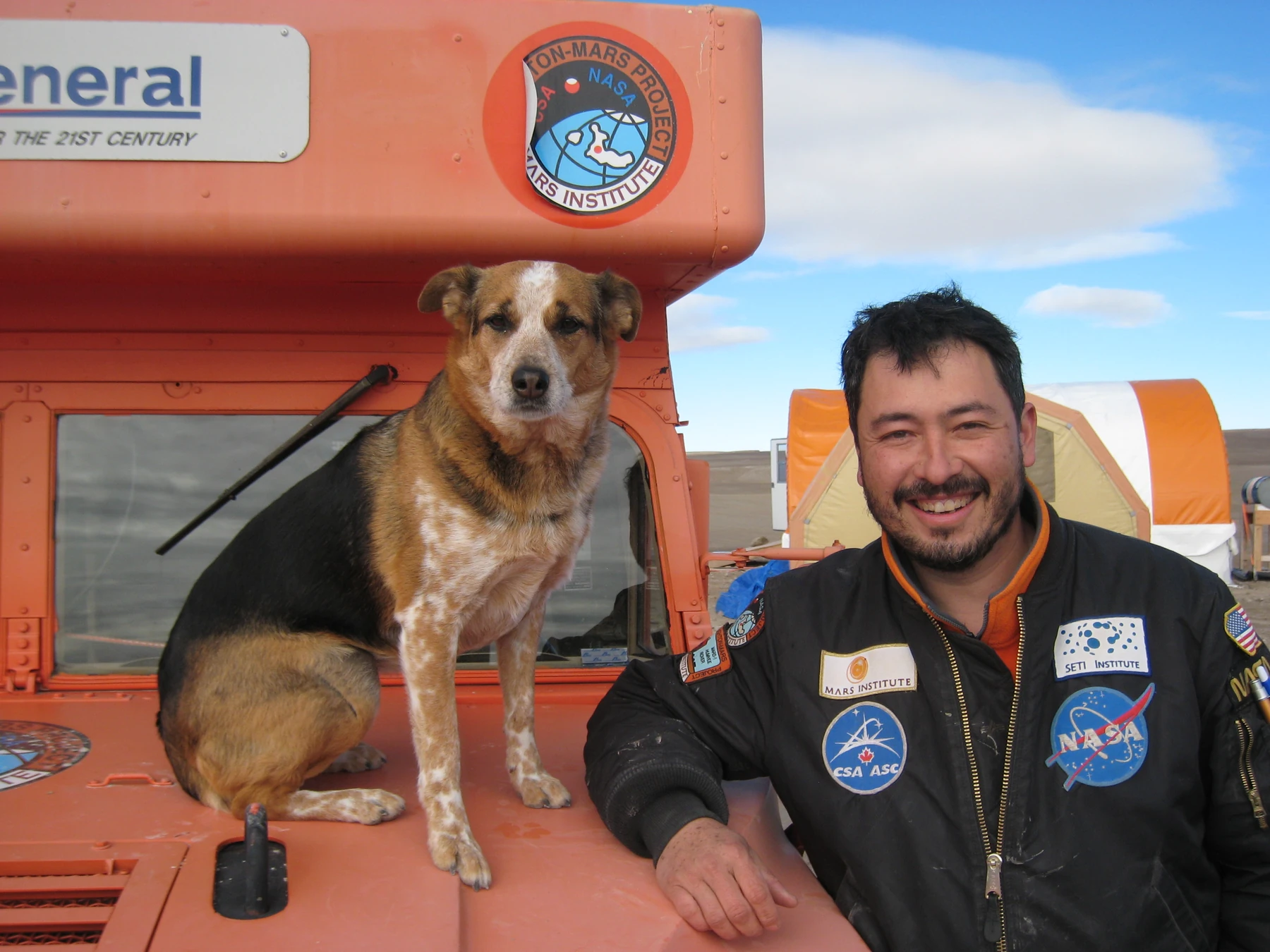
The portrait at the top of this book is an image whose exact provenance we were unable to verify.
Online sources
- SETI Institute — Pascal Lee
- The Planetary Society — Pascal Lee
- National Space Society — Pascal Lee Biography
- P. Lee and C. P. McKay, “Mars: Always Cold, Sometimes Wet?” (2003, NTRS)
- P. Lee et al., Mars denudation rates and Haughton crater (2005, NTRS)
- A. C. Schuerger and P. Lee, microbial dispersal around a crewed rover (2015, NTRS)
- P. Lee et al., “Noctis Landing” (2015, NTRS)
- NASA, “NASA Simulates Lunar and Planetary Exploration at Harsh Arctic Impact Crater Site” (2010)
- University of Maryland, “UMD Geology Ph.D. Student Helps Discover Giant Volcano on Mars” (2024)
Facts checked against these sources on October 10, 2026.
Go further
Mars Library
This book extends the page with a complete settlement architecture. The dossier above remains deliberately self-contained: Arcadia is optional further reading, not a prerequisite for understanding it.
 Arcadia — Master Plan of the First Martian City