


Mars Bible — People
Bruce Jakosky
The bored physics student who became the scientist who followed the water of Mars for forty years, then conceived and led MAVEN, the spacecraft that showed the planet had lost most of its atmosphere to space.
planetary scientist, University of Colorado
- Education
- UCLA (physics, then planetary science); Caltech (Ph.D., 1982)
- Institution
- Laboratory for Atmospheric and Space Physics (LASP), University of Colorado Boulder
- Role
- Principal investigator of the MAVEN mission, from its birth in 2003 to 2021
- Research
- Water and atmosphere of Mars, atmospheric loss to space, astrobiology and society
- Link to Mars
- The proof that Mars lost most of its atmosphere to space
7 chapters and 4 appendices: about 3,400 words, or about 15 minutes of reading. Every fact comes from verified sources, listed at the end of each chapter.
Part One
Following the water
1960 – 1995
Chapter 1 · 1960s – 1977 One class that changed everything
Bruce Jakosky was always interested in space. But what really set him on the path to Mars, he says, was a single class, taken almost by chance, because he was bored.
In front of the television
He remembers being six years old, sitting in front of the TV, watching the countdown of the first Mercury astronauts in the very early 1960s. Space drew him in. He did not yet make it his work.
Bored with physics
At the University of California, Los Angeles, UCLA, he studied physics. He got bored: the classes, he says, were only teaching tools and techniques. He looked around for something else and took a planetary science class from one of the professors, Hugh Kieffer. By the end of the semester, he had changed his major. He was now working for Kieffer on the Viking mission.
Mapping the heat of Mars
The Viking orbiters carried an infrared thermal mapper, a four-telescope radiometer that measured the temperature of the Martian surface. In 1977 the student appeared, under the University of California banner, among the coauthors of the paper led by Hugh Kieffer that presented the thermal and albedo mapping of Mars during the primary mission: polar temperatures, predawn temperatures, a map of thermal inertia, that is, how well the ground holds heat, clouds. It was his entry into Mars science.
Sources: NASA, “Gravity Assist” podcast, season 1, episode 6, “Mars with Bruce Jakosky and Michael Meyer,” December 20, 2017 (the quotation about being six, UCLA, physics, “all they were doing was teaching us tools and techniques,” Hugh Kieffer, the change of major, Viking); H. H. Kieffer et al., including B. M. Jakosky (University of California), “Thermal and Albedo Mapping of Mars During the Viking Primary Mission,” Journal of Geophysical Research, September 30, 1977 (NTRS 19780027509: the radiometer, the topics of the paper).
Chapter 2 · 1977 – 1995 Following the water of Mars
After Viking, Bruce Jakosky devoted some fifteen years to one question: where is the water of Mars, and how does it move between the atmosphere, the ground and the polar caps?
Water vapor seen by Viking
He did his doctorate at the California Institute of Technology, Caltech. In 1982, with C. B. Farmer of the Jet Propulsion Laboratory, he published the complete results of another Viking orbiter instrument, the atmospheric water detector, which mapped water in the Martian atmosphere for almost one and a half Martian years, from June 1976 to April 1979. The two researchers examined what might control that seasonal cycle: ice in the ground, water stuck to grains or chemically bound to minerals, water supplied by the north polar cap, transport by winds, air temperature. The same year, with F. P. Fanale, he studied the exchange of water and carbon dioxide between the ground and the atmosphere, and its effects on climate. He received his Caltech Ph.D. in 1982.
Boulder
He then joined the University of Colorado at Boulder and its Laboratory for Atmospheric and Space Physics, LASP, where he was a research associate from 1982 to 1988. In 1985 he wrote a major review of the seasonal cycle of water on Mars: ice in the caps, subsurface ice at high latitudes, water held in the soil, the stability of each reservoir and its exchanges with the atmosphere. He also measured, with the Solar Mesosphere Explorer satellite, water vapor in Earth’s stratosphere and mesosphere.
Water for future explorers
In 1990 he asked what Martian water would be available to future crewed missions. His conclusion was cautious: the only sure source, in useful quantities, lies in the polar ice deposits. In 1995, with Bradley Henderson and Michael Mellon, he explored the consequences of the tilt of Mars’s axis, which varies chaotically between about 0 and 60 degrees over periods longer than ten million years: at high tilt, tens of centimeters of water could leave the caps each year, and carbon dioxide stored in the polar deposits could be released, bringing occasional periods of a milder climate.
Sources: B. M. Jakosky and C. B. Farmer (Caltech and JPL), “The seasonal and global behavior of water vapor in the Mars atmosphere,” Journal of Geophysical Research, April 10, 1982 (NTRS 19820047714); F. P. Fanale and B. M. Jakosky, 1982 (NTRS 19820060023); University of Colorado, “Bruce Jakosky” page (Caltech Ph.D., 1982); English Wikipedia, “Bruce Jakosky” (LASP research associate 1982–1988, Solar Mesosphere Explorer; tertiary source); B. M. Jakosky, “The seasonal cycle of water on Mars,” Space Science Reviews, June 1985 (NTRS 19850067517); NTRS 19890016431 (Solar Mesosphere Explorer observations, 1988); B. M. Jakosky, “Water on Mars – Volatile history and resource availability,” 1990 (NTRS 19910025538); B. M. Jakosky, B. G. Henderson and M. T. Mellon, “Chaotic obliquity and the nature of the Martian climate,” Journal of Geophysical Research, January 25, 1995 (NTRS 19950050283).
Part Two
An escaping atmosphere
1990 – 2026
Chapter 3 · 1990 – 2003 An atmosphere slipping away
Mars once had liquid water on its surface; today it is cold and dry. Where did its atmosphere go? In the early 1990s, Bruce Jakosky began to think that space had taken much of it.
A mission idea as early as 1992
In 1992, with J. G. Luhmann, C. T. Russell, A. F. Nagy, C. A. Barth and others, he presented two ideas for Mars missions suited to NASA’s new Discovery program. The first would address the escape of the Martian atmosphere to space, a question essential, they wrote, to understanding the evolution of the atmosphere, climate change and the inventories of water and gases.
The solar wind as a sandblaster
In 1993 and 1994, with Robert Pepin, Robert Johnson and J. L. Fox, he modeled the loss of the Martian atmosphere over the past 3.8 billion years through two mechanisms: sputtering, in which ions picked up by the solar wind strike the upper atmosphere and knock atoms out, and photochemical escape. Because lighter atoms leave more easily, the loss changes the proportion of each element’s isotopes. Measuring those proportions therefore makes it possible to work back to what was lost. That is exactly the method MAVEN would apply twenty years later.
Missions and books
During those years he took part in many missions: Clementine, to the Moon, Mars Observer, Mars Global Surveyor, Mars Odyssey, whose THEMIS infrared camera he helped present in 1999, and later Mars Science Laboratory. In 1999 he published in Science an article titled “Mars: water, climate, and life.”
He was also interested in what the search for life elsewhere means for society. He published The Search for Life on Other Planets in 1998, then Science, Society, and the Search for Life in the Universe in 2006. In 1999, with Matt Golombek, he coauthored a piece on the role of planetary science, astrobiology and exploration in society. For more than ten years he led the University of Colorado team in the NASA Astrobiology Institute. In 2012 the American Geophysical Union elected him a fellow, an honor given each year to no more than 0.1 percent of its members; he was then LASP’s associate director for science and a professor of geological sciences.
Sources: J. G. Luhmann et al., including B. M. Jakosky, “Discovery concepts for Mars,” 1992 (NTRS 19920019792); B. M. Jakosky, R. O. Pepin, R. E. Johnson and J. L. Fox, “Mars atmospheric loss and isotopic fractionation by solar-wind-induced sputtering and photochemical escape,” 1993 and 1994 (NTRS 19940028702 and 19950058543); NTRS 20000012704 (THEMIS, 1999); B. M. Jakosky, “Mars: water, climate, and life,” Science, January 29, 1999 (NTRS 20040142079); M. Golombek and B. Jakosky, EOS, 1999 (NTRS 20060034503); English Wikipedia, “Bruce Jakosky” (Clementine, Mars Observer, Mars Global Surveyor, Mars Odyssey, MSL, the two books and their publishers, the Astrobiology Institute team; tertiary source); University of Colorado, Arts & Sciences Magazine, January 24, 2012 (AGU election, under 0.1 percent of members, positions). The sentence about MAVEN refers to the chapter “The argon isotopes.”
Chapter 4 · 2003 – 2014 MAVEN, eleven years to reach Mars
In 2003, an hour-long phone call turned an old idea into a project. Eleven years later, a spacecraft built to study the escape of the Martian atmosphere slipped into orbit around Mars.
A phone call
MAVEN’s development began in 2003 with an hour-long conversation between Bruce Jakosky and two University of California, Berkeley scientists, Janet Luhmann and Bob Lin. It ended with a decision: propose the mission to NASA. Jakosky assembled the team. In August 2006, NASA issued a call for proposals for its Mars Scout program, meant to send small, low-cost missions led by a principal investigator; twenty proposals came in.
$485 million
In September 2008, NASA selected MAVEN, for “Mars Atmosphere and Volatile EvolutioN,” judged to have the best science value and the lowest risk. The mission would cost $485 million. Jakosky, of LASP, was its principal investigator; NASA’s Goddard Space Flight Center would manage the project; Lockheed Martin would build the spacecraft based on Mars Reconnaissance Orbiter and Mars Odyssey. Measuring the present-day loss of the Martian atmosphere had been among the priorities of the 2003 decadal survey, Michael Meyer pointed out. According to Wikipedia, it was the largest research contract ever awarded to the University of Colorado.
A worrying comet
About a year and a half before launch, Comet Siding Spring was discovered. At first its orbit was so poorly known that it might hit Mars. Jakosky’s first reaction, he recalls, was: “Oh, my God, if it hits Mars and we’re in orbit around it, the debris sent up by that impact would destroy our spacecraft.” In the end it passed 140,000 kilometers from the planet.
“After 10 years of working on this”
On September 26, 2013, at Kennedy Space Center, he stood in front of the spacecraft’s outstretched solar panels: “After 10 years of working on this, I can’t tell you how excited I am to see this finished spacecraft ready to go.” Mars, he explained, is a system as complicated as Earth; no single spacecraft can study everything. “With MAVEN, we’re exploring the single biggest unexplored piece of Mars so far.” The spacecraft, an eight-foot cube, weighed about 5,400 pounds at launch.
MAVEN lifted off from Cape Canaveral on November 18, 2013, on an Atlas V rocket. After a 711-million-kilometer journey, it fired its engines for thirty-three minutes and entered orbit around Mars on September 21, 2014, at 10:24 p.m. EDT, that is, September 22 in Universal Time. “We’re the first mission devoted to observing the upper atmosphere of Mars and how it interacts with the sun and the solar wind,” Jakosky said.
Sources: NASA, “NASA Mars Mission Begins a New Chapter of Science With a New Leader,” September 9, 2021 (the 2003 conversation with “Janet Luhman” and Bob Lin, the decision, the team); NASA, “NASA Selects ‘MAVEN’ Mission to Study Mars Atmosphere,” September 2008 ($485 million, twenty proposals to the August 2006 call, Mars Scout, Goddard, Lockheed Martin, MRO and Odyssey, Michael Meyer and the 2003 decadal survey); English Wikipedia, “Bruce Jakosky” (selection in September 2008, largest research contract; tertiary source); NASA, “Gravity Assist” podcast, December 20, 2017 (Siding Spring, quotation, 140,000 km); NASA, “MAVEN Seeks to Solve Another Mars Riddle,” November 14, 2013 (September 26 at Kennedy, quotations, launch planned for November 18 on Atlas V, eight-foot cube and 5,400 pounds); NASA, “NASA’s MAVEN Spacecraft Makes Final Preparations For Mars,” September 8, 2014 (September 21, 2014, 711 million kilometers, 33 minutes, quotation); NASA, release 14-260, “NASA’s Newest Mars Mission Spacecraft Enters Orbit around Red Planet,” September 22, 2014 (orbit insertion at 10:24 p.m. EDT on September 21).
Chapter 5 · 2014 – 2019 The argon isotopes
In orbit, MAVEN studied what happens in a layer so thin that it would be called a vacuum in a laboratory on Earth. Yet that, says Bruce Jakosky, is where the climate at the surface is decided.
Diving into the atmosphere
Normally the spacecraft measured the atmosphere between about 150 and 6,200 kilometers in altitude. In February 2015, for its first “deep dip” campaign, the team lowered the orbit’s low point to about 125 kilometers to measure the entire upper atmosphere. “We wanted to go as deep as we can without putting the spacecraft or instruments at risk,” Jakosky explained. In June 2015, MAVEN observed a plume of escaping particles over the poles, a long-lived layer of metal ions, and auroras, which on Mars, lacking a global magnetic field, spread over the whole planet.
A few coins stolen every day
On November 5, 2015, the team announced that the solar wind strips about 100 grams of gas per second from the Martian atmosphere. “Like the theft of a few coins from a cash register every day, the loss becomes significant over time,” Jakosky said. During the solar storms of March 2015, the erosion sped up sharply; the young, more active Sun must therefore have stripped away far more. Almost three-quarters of the escaping ions leave through the planet’s “tail,” about a quarter through the polar plume.
What the argon says
On March 30, 2017, as lead author of a paper in Science, he announced a result obtained with the isotope method he had described as early as 1993. Argon is a noble gas: it does not react with rocks, and only sputtering by the solar wind can send it into space. And the lighter isotope escapes more easily than the heavier one. By comparing the ratio of the two isotopes measured in the upper atmosphere by MAVEN and at the surface by the Curiosity rover, the team calculated that about 65 percent of the argon Mars ever had has gone to space. “We’ve determined that most of the gas ever present in the Mars atmosphere has been lost to space,” he said. Most of the planet’s carbon dioxide was also lost by sputtering, and that is only a minimum.
Avoiding Phobos
Mars was getting crowded: five or six working spacecraft, plus the hulks of Mariner 9, the Vikings and the Russian Phobos mission. When orbits cross, the team speaks of “COLA” seasons, for collision avoidance. On March 2, 2017, NASA announced that MAVEN had even had to maneuver to steer clear of the moon Phobos. Jakosky praised the JPL navigation teams who watch for possible collisions every day of the year.
Terraforming Mars?
In July 2018 a dust storm engulfed the planet: “one of the things we’ve been waiting for” since arrival, he said, to see how it changes the escape of gases. On July 30, 2018, he published in Nature Astronomy a study of a science-fiction dream: warming Mars by releasing the carbon dioxide in its soil and caps. Carbon dioxide and water vapor are the only greenhouse gases abundant enough on Mars. Yet vaporizing the caps would only double the pressure, to 1.2 percent of Earth’s; heating the soil would give at most 4 percent of the pressure needed. “Terraforming Mars is not possible using present-day technology,” he concluded.
In February 2019, MAVEN tightened its orbit by aerobraking to better relay messages from future rovers. “It’s like using your cell phone,” he explained. “The closer you are to a cell tower, the stronger your signal.”
Sources: NASA, “Gravity Assist” podcast, December 20, 2017 (the thin layer “that we would call that a vacuum,” auroras over the whole planet, five or six spacecraft, the hulks, “COLA” seasons); NASA, “NASA’s MAVEN Spacecraft Completes First Deep Dip Campaign,” February 19, 2015 (150 and 6,200 km, 125 km, quotation); NASA, “MAVEN Results Find Mars Behaving Like a Rock Star,” June 20, 2015 (polar plume, metal ions, auroras); NASA, “NASA Mission Reveals Speed of Solar Wind Stripping Martian Atmosphere,” November 5, 2015 (100 grams per second, quotation, March 2015 storms, 75 and 25 percent); NASA, “NASA’s MAVEN Reveals Most of Mars’ Atmosphere Was Lost to Space,” March 30, 2017 (argon, isotopes, Curiosity, 65 percent, quotation, CO2); NASA, “NASA Orbiter Steers Clear of Mars Moon Phobos,” March 2, 2017; NASA, “‘Storm Chasers’ on Mars Searching for Dusty Secrets,” July 19, 2018 (quotation); NASA, “Mars Terraforming Not Possible Using Present-Day Technology,” July 30, 2018 (quotations, 1.2 percent, 4 percent); NASA, “NASA’s MAVEN Spacecraft Shrinking its Mars Orbit to Prepare for Mars 2020 Rover,” February 11, 2019 (quotation).
Chapter 6 · Since 2021 Passing the baton
Bruce Jakosky led MAVEN from its birth in 2003 through seven years of orbital operations. In 2021 he chose to step aside.
“Let somebody else take over”
On September 9, 2021, NASA announced that Shannon Curry of LASP was succeeding him as MAVEN’s principal investigator; Wikipedia dates the handover to August 31. “I wanted to let somebody else take over and bring new ideas and directions to this important mission,” he explained. Of his successor he said: “She knows how science and engineering work together.” In meetings, he had watched her collect the information needed to make thoughtful decisions.
He stayed at LASP half-time, as a scientist and member of the MAVEN team. “It’s been an incredible opportunity to be able to propose and implement a mission that addresses the science that you think is most important,” he said, “and that’s what we set out to do as a team.” He is now professor emeritus of Earth science at the University of Colorado.
The end of MAVEN
On December 6, 2025, MAVEN passed behind Mars and did not reappear. A fragment of data picked up by the Deep Space Network showed the spacecraft in safe mode, spinning unusually fast. On June 3, 2026, NASA announced the end of the mission: the batteries had drained and the spacecraft was unrecoverable. It had spent more than eleven years in orbit, a decade beyond its one-year primary mission. Its data, NASA stressed, will help define the radiation protection humans will need on Mars.
Sources: NASA, “NASA Mars Mission Begins a New Chapter of Science With a New Leader,” September 9, 2021 (Shannon Curry, seven years of operations, quotations, half-time at LASP); English Wikipedia, “Bruce Jakosky” (August 31, 2021; tertiary source); University of Colorado, “Bruce Jakosky” page (professor emeritus); NASA, “NASA Says Farewell to MAVEN Mars Mission, Hosts Media Call Today,” June 3, 2026 (last signal on December 6, safe mode and spin, batteries, more than 11 years, radiation protection). The year 2025 of the last signal is inferred from that release, which mentions a review board convened in February before the June 2026 announcement.
Epilogue
Bruce Jakosky and Mars
Chapter 7 · The lesson What Bruce Jakosky leaves to Mars
Bruce Jakosky spent his life asking where the water and atmosphere of Mars had gone. His answers bear directly on how humans will be able to live there.
Mars lost its sky
MAVEN showed that most of the Martian atmosphere went to space, stripped away by the Sun and the solar wind. The warm, wet planet of the early days became cold and dry, and that lost gas will not come back. Explorers will have to live with the Mars of today.
No terraforming within reach
Releasing the carbon dioxide in the soil and caps would not be enough to warm Mars with present-day technology. The first inhabitants will live in pressurized, radiation-shielded shelters, not in the open under a transformed sky.
Water, a precious resource
As early as 1990, he concluded that the only sure water, in useful quantities, lay in the polar ice. Knowing where the water is, in what form and how much, will remain one of the first questions for any human settlement.
This lesson is a reflection by the author of this book, based on the facts and results reported in the preceding chapters, where their sources are given.
Appendices
Further reading
Appendix Understanding Bruce Jakosky’s work
A few ideas, explained simply, to follow this book.
The solar wind
A continuous stream of charged particles, mainly protons and electrons, flowing from the Sun in every direction. Earth is shielded from it by its magnetic field; Mars, which no longer has a global magnetic field, takes it head-on.
Sputtering
Ions carried by the solar wind strike the upper atmosphere at high speed and knock atoms out into space, the way a sandblaster tears grains from a surface.
Isotopes
Atoms of the same element with different masses. The lighter ones escape to space more easily. Measuring the ratio of light to heavy isotopes makes it possible to estimate how much gas has been lost.
Volatiles
Substances that easily turn into gas, such as water or carbon dioxide. The “V” in MAVEN refers to their evolution.
Axial tilt
The angle between a planet’s rotation axis and the plane of its orbit. Earth’s is stabilized by the Moon; Mars’s varies greatly over millions of years, which changes the seasons and the climate.
The principal investigator
The scientist who proposes a mission to NASA, answers for it and leads its science team.
These explanations are general notions. The definitions of the solar wind, sputtering and isotopes follow the 2015 and 2017 NASA releases cited in the chapter “The argon isotopes.”
Appendix Timeline
The dates of Bruce Jakosky’s career, in order, as far as the sources allow them to be established.
Early 1960s. At six, he watches the countdown of the Mercury astronauts on television.
1970s. A UCLA student, he switches from physics to planetary science and works on Viking with Hugh Kieffer.
1977. Coauthor of Viking’s thermal mapping of Mars.
1982. Caltech Ph.D.; complete results of the water vapor measured by Viking; arrives at LASP in Boulder.
1985. Review of the seasonal cycle of water on Mars.
1990. Study of the water available for human exploration.
1992. Idea for a Discovery mission devoted to atmospheric escape.
1993 – 1994. Models of atmospheric loss by sputtering.
1995. Chaotic obliquity and the climate of Mars.
1998. The Search for Life on Other Planets.
1999. “Mars: water, climate, and life,” in Science; presentation of the THEMIS camera.
2003. MAVEN’s founding conversation with Janet Luhmann and Bob Lin.
2006. Science, Society, and the Search for Life in the Universe; Mars Scout call for proposals in August.
September 2008. MAVEN selected.
January 2012. Elected a fellow of the American Geophysical Union.
November 18, 2013. MAVEN launches.
September 21, 2014. Enters orbit around Mars, at 10:24 p.m. EDT (September 22 in Universal Time).
November 5, 2015. Rate of erosion by the solar wind.
March 30, 2017. About 65 percent of the argon lost to space.
December 20, 2017. “Gravity Assist” podcast with Jim Green.
July 30, 2018. Study showing terraforming Mars is not possible today.
2021. Shannon Curry succeeds him as principal investigator.
December 6, 2025. MAVEN’s last signal.
June 3, 2026. NASA announces the end of MAVEN.
Sources: those of the chapters.
Appendix The people
The people who appear in this book, with the role the sources give them.
Hugh Kieffer. UCLA professor whose planetary science class decided Bruce Jakosky’s calling, and lead author of Viking’s thermal mapping.
C. B. Farmer. JPL researcher, coauthor of the 1982 study of Martian water vapor.
Janet Luhmann and Bob Lin. University of California, Berkeley scientists with whom MAVEN was born in 2003.
Robert Pepin, Robert Johnson, J. L. Fox. Coauthors of the 1993 and 1994 atmospheric loss models.
Bradley Henderson and Michael Mellon. Coauthors of the 1995 study on chaotic obliquity.
Matt Golombek. JPL geologist, coauthor of a 1999 piece on science and society. He has his own biography in this collection.
Michael Meyer. NASA’s Mars chief scientist, with whom he appeared on the 2017 podcast. He has his own biography in this collection.
Jim Green. NASA’s director of planetary science, host of the “Gravity Assist” podcast. He has his own biography in this collection.
Shannon Curry. LASP researcher, who succeeded him as head of MAVEN in 2021.
Sources: those of the chapters in which each appears.
Appendix Sources and method
This book contains no invented dialogue and no thought attributed to anyone without a text to support it. This appendix shows where the facts come from and what the sources do not allow us to establish.
A living person
Bruce Jakosky is alive at the time of writing. We have kept to his public life. Wikipedia gives a date of birth that we could not verify in a primary source; we have not used it. The sources consulted give neither the date of his UCLA degree nor the exact subject of his thesis.
The main sources
We found no published oral history interview. The book rests on the December 20, 2017, episode of NASA’s “Gravity Assist” podcast, in which he tells how he started; on some twenty NASA releases from 2008 to 2026 that quote him; on abstracts of his papers held in NASA’s technical archives (NTRS), from 1977 to the 2010s; on his University of Colorado pages; and, for a few dates and titles, on English Wikipedia, a tertiary source flagged each time it is used.
What does not agree
The 2021 release says the team “proposed and won” MAVEN in 2007, whereas the final selection was announced in September 2008; it also spells Janet Luhmann’s name “Luhman,” while the scientific archives write “Luhmann.” Orbit insertion is dated September 21, 2014, by a 2014 release and September 22 by a 2013 release written before departure; the difference is a matter of time zones: NASA’s release of September 22, 2014 dates orbit insertion to 10:24 p.m. EDT on September 21, which is September 22 in Universal Time. Finally, the handover to Shannon Curry was announced by NASA in September 2021 and is dated August 31 by Wikipedia.
Length
This book runs to about three thousand five hundred words. The goal set for this collection was one hundred thousand. We did not reach it, and we prefer to say so. Lacking a long biographical interview, his personal life and much of his work are known only from summaries. As it stands, the text contains only facts we were able to tie to a source.
The portrait
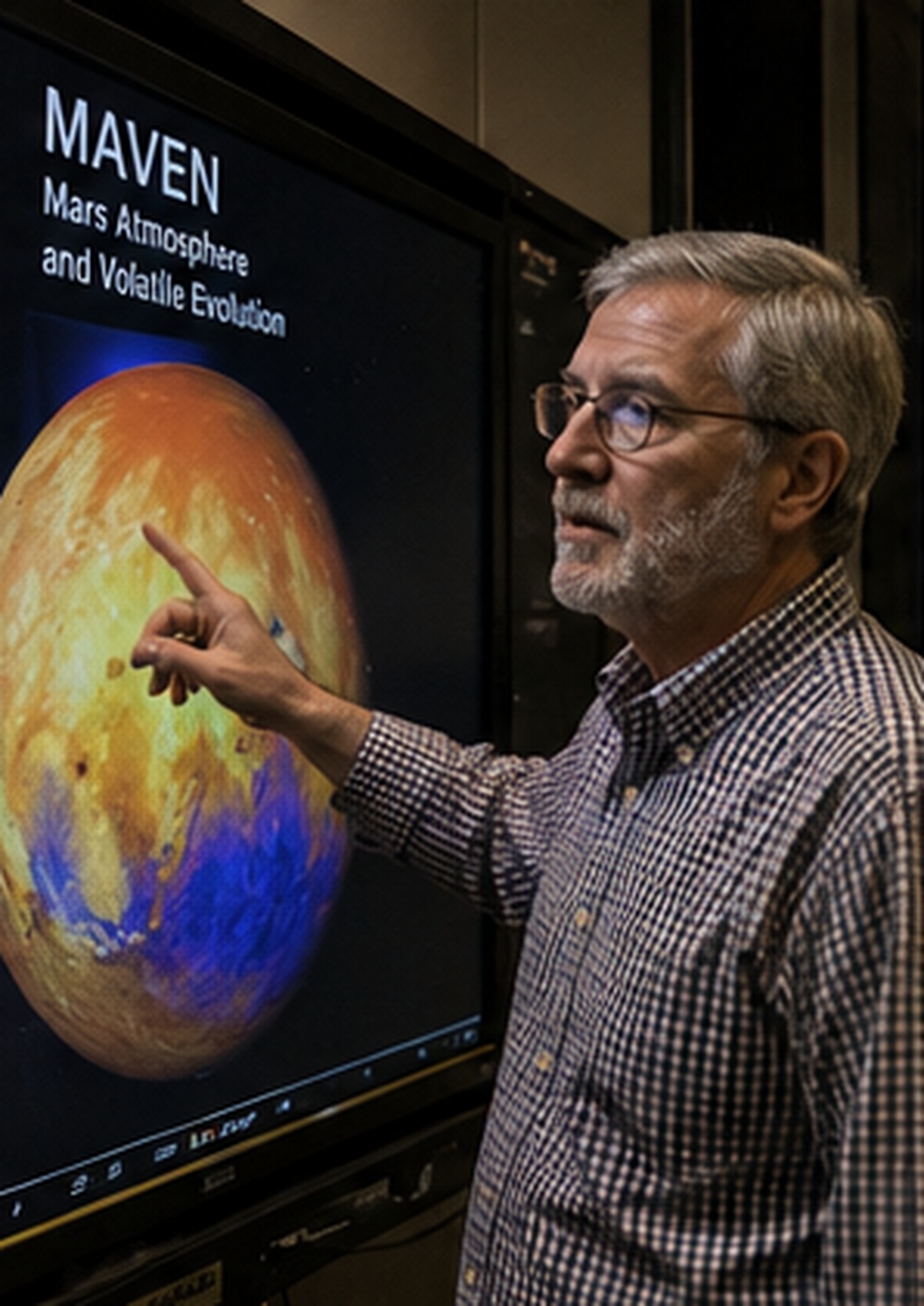
The portrait at the top of this book is an image whose exact provenance we were unable to verify.
Online sources
- NASA, Gravity Assist, “Mars with Bruce Jakosky and Michael Meyer” (2017)
- University of Colorado — Bruce Jakosky
- NASA, “NASA Selects ‘MAVEN’ Mission to Study Mars Atmosphere” (2008)
- NASA, “MAVEN Seeks to Solve Another Mars Riddle” (2013)
- NASA, “NASA Mission Reveals Speed of Solar Wind Stripping Martian Atmosphere” (2015)
- NASA, “NASA’s MAVEN Reveals Most of Mars’ Atmosphere Was Lost to Space” (2017)
- NASA, “Mars Terraforming Not Possible Using Present-Day Technology” (2018)
- NASA, “NASA Mars Mission Begins a New Chapter of Science With a New Leader” (2021)
- NASA, “NASA Says Farewell to MAVEN Mars Mission” (2026)
- B. M. Jakosky et al., atmospheric loss by sputtering (1993, NTRS)
- NASA, release 14-260 (September 22, 2014)
Facts checked against these sources on October 10, 2026.
Go further
Mars Library
This book extends the page with a complete settlement architecture. The dossier above remains deliberately self-contained: Arcadia is optional further reading, not a prerequisite for understanding it.
 Arcadia — Master Plan of the First Martian City