


Mars Bible — People
Steve Squyres
The student who spent four hours in a room of Viking photographs, the Voyager graduate student, then the researcher who endured ten years of rejection before sending two six-wheeled geologists to Mars, Spirit and Opportunity.
planetary scientist, Cornell
- Education
- Cornell University (B.A. in geology, Ph.D. in 1981)
- Role
- Principal investigator for the science payload of the Spirit and Opportunity rovers
- Missions
- Voyager, Magellan, NEAR, Mars Odyssey, Cassini, Mars Express, Mars Reconnaissance Orbiter
- Service
- Chair of the planetary science decadal survey (2011) and of the NASA Advisory Council
- Link to Mars
- The proof, at Meridiani Planum, that liquid water flowed on the surface of Mars
10 chapters and 4 appendices: about 7,000 words, or about 30 minutes of reading. Every fact comes from verified sources, listed at the end of each chapter.
Part One
The calling
1962 – 1981
Chapter 1 · 1960s – 1970s A scientist who wasn’t a good one yet
Steve Squyres does not remember deciding to become a scientist. “When I was six years old I wouldn’t have told you I want to grow up to be a scientist,” he says. “I would have told you I was a scientist, I just wasn’t a good one yet.”
Dad for physics, Mom for life
He grew up in the flatlands of New Jersey, in a family where science permeated everything. His father had earned a doctorate in chemical engineering at the Massachusetts Institute of Technology; his mother, a bachelor’s degree in zoology at Wellesley College. For every physical-science question, the boy went to his father; for every life-science question, to his mother.
Mountains and explorers
At eight, on a family trip to the Colorado Rockies, he fell in love with the mountains. Being outdoors in nature and doing science were, he says, his two loves from his earliest memories. Geology, a way of doing science in the mountains, seemed a natural choice.
A third passion had gripped him since the age of eight, ten, twelve: exploration. He read and reread books about early explorers of the Arctic, the Antarctic, the undersea world. And he grew up during Mercury, Gemini and Apollo. In 1962, at six, he stayed glued to the television for John Glenn’s entire orbital flight; he can still picture, he says, where he was sitting. For him, being a scientist and being an explorer were always intertwined.
The Juneau Icefield
By about eighteen, his mind was made up: it would be geology. In the summer between the end of high school and the start of college, he won a National Science Foundation fellowship to join a research expedition on the Juneau Icefield in southeast Alaska. A whole summer of fieldwork, mostly in northwestern British Columbia, climbing up and down mountains while doing research. “I just fell in love with it,” he says. He would remember those boots and that rock hammer when he came to look at Mars from orbit.
Sources: NASA, Science Mission Directorate Oral History Project, interview of Steven W. Squyres by Sandra Johnson, August 22, 2017 (the quotation about being six, his parents, New Jersey, Colorado at eight, books about explorers, John Glenn and “’62,” the Juneau Icefield, the NSF fellowship, British Columbia, “I just fell in love with it,” boots and a hammer).
Chapter 2 · 1970s Four hours in the Mars Room
At Cornell University, in Ithaca, New York, Steve Squyres studied geology. After two years, something was missing: the unknown. He would find it, almost by chance, in a room full of photographs of Mars.
One map too many
Geologists, he thought at the time, had already done a very good job on Earth over two centuries. There was much left to do, but not the unexplored that he was looking for. He turned toward the seafloor. Then came the first great map of the relief of the entire ocean floor, by Bruce Heezen and Marie Tharp, around 1977 as he recalls. It went up at once in every geology department in the world. He looked at it and said to himself: “Oh, crap. Now what?” It was all mapped out. That magnificent map was the last straw that drove him out of terrestrial geology.
The blue card
In his third year, in 1977, a gap opened in his schedule: he had just squeaked through a language test and no longer had to take the semester of Spanish he had planned on. One day he was showing his girlfriend around campus. For some reason he no longer remembers, they stopped into the Space Sciences Building. On the first floor, she spotted a small three-by-five card, blue, on a little bulletin board: a professor, Joe Veverka, a member of the science team of the Viking mission then flying at Mars, would be teaching a course on its results.
On the first day, Veverka announced that the course was for graduate students only. “Are there any undergraduates here?” One hand went up: his. “Come see me after class,” the professor said in a stern voice. Squyres was about to be thrown out when a geology graduate student who knew him well came over and vouched for his studious nature. Veverka relented.
The room of photographs
The whole grade rested on a single term paper of original research. Two or three weeks in, he needed a topic. Images from the Viking orbiters were coming down daily, printed on big rolls of photographic paper and shipped in cardboard boxes to the thirty or so members of the science team. At Cornell they were sliced up, put into plastic sleeves and binders, and kept in a room in the physics building known as the Mars Room.
Veverka gave him the key. Metal shelves, a linoleum floor, harsh fluorescent lights, boxes of photos. He meant to flip through a few binders for fifteen or twenty minutes. He stayed four hours. He walked out, he says, “knowing exactly what I wanted to do with the rest of my life.” He did not understand what he was seeing in those pictures, but that was the beauty of it: nobody did. Perhaps a hundred people on Earth had seen them. It was the blank canvas he had been looking for. The term paper he wrote became the first scientific paper he ever published.
Sources: NASA, oral history interview of August 22, 2017 (geology and the unexplored, the seafloor, the Heezen–Tharp map and “I want to say, ’77,” “Oh, crap. Now what?,” the third year, Spanish, the girlfriend, the Space Sciences Building, the blue card, Joe Veverka and Viking, 1977, the quotations, the graduate student, the term paper, the rolls and boxes, the thirty or so team members, the Mars Room, the key, the four hours, “nobody did,” about a hundred people, the first paper); NASA, “Gravity Assist” podcast, season 2, episode 4, “Exploring Mars with Steve Squyres,” July 3, 2018 (the same story, “blank canvass”).
Chapter 3 · 1978 – 1981 Voyager, or forty-eight hours without sleep
One day Steve Squyres found a note in his mailbox: “Professor Sagan would like to see you.” Nothing more. He had never met Carl Sagan. He never really figured out why the astronomer had noticed him.
“How’d you like to be my grad student?”
Sagan sat him down and asked, “Hey, how’d you like to be my grad student for Voyager?” Squyres’s heart started pounding. He had applied to five graduate schools strong in planetary science and had no intention of staying at Cornell. But Sagan was on the Voyager science team, and nobody at the other schools was. He walked out, went straight down the hall to Joe Veverka’s office and told him: Carl has asked me to be his grad student for Voyager, I want to do it, but I want you to be my advisor, because Carl is not going to be around much. Sagan was indeed making his television series Cosmos. Veverka agreed, and later joined the Voyager team as well.
Points of light become worlds
To him, Voyager is still the greatest planetary mission ever flown: the first good look at four giant planets and their moons. “You only get to do something for the first time once.” As a geologist, he was drawn to the big solid moons of Jupiter, Io, Europa, Ganymede and Callisto. In the forty-eight hours of the flyby, they went from little points of light barely resolved in a telescope to entire worlds that could be mapped. He did not sleep for those forty-eight hours. The Voyager 1 flyby of Jupiter was, he would say, the formative event of his career: after it, he was willing to put up with twenty years of airplanes, bad coffee and PowerPoint slides for another forty-eight hours like those.
“Steve, could you come help me out?”
In 1979 he had just turned twenty-three. Voyager was bearing down on Jupiter; he was at the Jet Propulsion Laboratory for maybe the second time in his life. Late one night, the only two people left in the imaging area were he and geologist Gene Shoemaker. A Deep Space Network station had failed to receive some images of the moons, which were still on the spacecraft’s tape recorder. But commands were about to go up to take new pictures that would overwrite them. One or the other: a scientific choice, and the engineers came to ask Shoemaker. He turned to the student: “Steve, could you come help me out with this?” He did not need to. It was the first time a real scientist treated him as a peer. Forty years later, doing the same for the students on his rovers would be, he says, his way of paying off that debt.
The envelope on the door
To keep researchers from stepping on each other’s toes, the head of the team’s geology group put an envelope on his door: everyone was to slip in a piece of paper with their name and the moon they most wanted to work on. Squyres waited. One evening, when nobody was around, he pulled out the slips and read them: “Io,” “Io,” “Europa,” “Europa”… then “Ganymede, Gene Shoemaker.” If he picked Ganymede, he could work with Gene. So he did. He spent a summer in Flagstaff, Arizona, writing papers with him. “A little bit underhanded,” he admits, “but it worked out well in the end.”
His thesis was on Ganymede and Callisto, Jupiter’s two big icy moons: the first bodies of ice and rock anyone had ever seen up close. He received his Ph.D. from Cornell in 1981.
Sources: NASA, oral history interview of August 22, 2017 (the note, the quotations, the five schools, Veverka as advisor, Cosmos, “Voyager is still the greatest planetary mission that’s ever flown,” the Galilean moons, the 48 hours, Gene Shoemaker, 1979, age 23, the tape recorder, the Deep Space Network, the debt, the envelope, Flagstaff, the thesis on Ganymede and Callisto, Ph.D. in 1981); NASA, “Gravity Assist” podcast, July 3, 2018 (the Voyager 1 flyby as formative event, “20 years of sitting on airplanes and drinking bad coffee”); NASA, “Steve Squyres” page (Cornell Ph.D., 1981).
Part Two
The long road
1981 – 2003
Chapter 4 · 1981 – 1986 At Ames, the shackles come off
During Voyager, a daring prediction struck Steve Squyres. It would decide the next step of his career and teach him a rule he would repeat all his life: when you surround yourself with really smart people, good things can happen to you.
The Io gamble
Some years earlier, three theoreticians, Stan Peale of the University of California, Santa Barbara, and Ray Reynolds and Pat Cassen of NASA’s Ames Research Center, had worked out how much heat tides generate by flexing a solid body. Applied to the Moon, the result was modest and the paper drew little attention. As Voyager approached Jupiter, one of them had the idea of rerunning the calculation for Jupiter’s moons. For Io, the result was astonishing: the moon should practically melt and be the most volcanically active body in the solar system. They checked and rechecked, then dashed off a paper to Science in a few days; it was published one week before the flyby. Voyager did indeed find erupting volcanoes on Io, six or seven plumes spewing sulfur compounds a couple of hundred kilometers into space. When the team learned of the paper, Squyres was blown away by the courage of a prediction that stood a very good chance of being proven wrong within a week.
He decided he wanted to work with those people. Joe Veverka called Reynolds or Cassen, and after his Ph.D., in 1981, Squyres went to NASA Ames in California: two years as a postdoc, then three years as a NASA civil servant.
Everything at once
In graduate school he had to focus on a single topic. At Ames, he says, the shackles were off. He worked on Mars, on the moons of Jupiter and Saturn, on comets, on studies of future missions, theoretical calculations, geologic mapping. He knew that those first years after the doctorate, before the committees and the paper reviews, were a time of exceptional freedom, and he made the most of it.
One of the team’s first projects was to apply the same tidal theory to Europa. The case was harder, but their paper, published in Nature in his first or second year at Ames, predicted an ocean of liquid water beneath the ice crust. He also wrote about the possible habitability of that ocean. Had he seen, in the early 1980s, how to send a submarine to Europa, he would not have done Mars rovers, he says: that was even more exciting. But it was too hard, too far off for his career.
In the mid-1980s he also studied Antarctic lakes, to prepare the tools that might one day be sent to ancient dry lakebeds on Mars. And around 1985 he was selected, by proposal, as a member of the gamma-ray spectrometer team on the Mars Observer spacecraft.
“You did what?”
He loved Ames. But living in Silicon Valley was hard on a government salary. He was married, and children were on the horizon. His vague plan was to stay ten years or so, then convince the University of Colorado to hire him, for the mountains. One day Cornell called about a faculty position. He said no: he had done his undergraduate and graduate studies there, and going back seemed the wrong career move. That evening he told his wife, who was born and raised in Ithaca, where her family lived. “You did what?” The next morning he called Cornell back.
After much wavering, he accepted. Ithaca was a small town, with terrific schools and a low crime rate, and you could buy a nice house in the countryside on five acres, which was impossible in Silicon Valley. They moved there in 1986 and raised their two daughters there. By leaving NASA he gave up his employee badge: to take part in missions from now on, he would have to win his place through peer-reviewed proposals.
Sources: NASA, oral history interview of August 22, 2017 (Peale, Reynolds and Cassen, tidal heating, “like, 5 degrees” for the Moon, Io, the paper sent to Science one week before the flyby, six or seven volcanoes, “gutsy,” the quotation about smart people, Veverka’s call, Ph.D. in 1981, two years as a postdoc and three as a civil servant, “the shackles were off,” the topics, the freedom, Silicon Valley, Colorado, the call from Cornell, “You did what?,” Ithaca, five acres, 1986, two daughters, Mars Observer around 1985, the end of the badge, the Antarctic lakes in the mid-1980s); NASA, oral history interview of September 14, 2017 (Europa, the Nature paper, the habitability of the ocean, the submarine).
Chapter 5 · 1987 – 2000 Ten years of rejection
Back at Cornell, Steve Squyres was frustrated. For ten years he had studied Mars through calculations and images taken from orbit. He knew that five minutes on the ground, with his boots and a rock hammer, would answer the questions. Since he could not go himself, he would send a robot.
Five minutes with a hammer
Theoretical calculations gave one answer, then another if you tweaked the parameters a little. Orbital images lent themselves to three interpretations. But a field geologist, up close to the rocks, sees things that settle the matter. That frustration, and his desire to know whether Mars had been habitable, led him in 1987, a year after arriving at Cornell, to set out on the quest to put serious geological instruments on the surface of Mars. It would take ten years and four proposals.
The sideways diagram
The first was for a camera on the Mars Pathfinder lander. To design it, he spent his first sabbatical at Ball Aerospace in Boulder, Colorado. His team came up with a true panoramic camera: a 3,000-pixel line detector rotated smoothly to build up a huge image in one sweeping motion. They called it Pancam. But NASA had provided a diagram of the available volume printed sideways, rotated 90 degrees. The team misread it and proposed a camera that was tall and thin when one that was short and fat was wanted. The proposal was rejected out of hand. Only the name would survive. The day Pathfinder landed on Mars, in 1997, Squyres was in a cabin in the Rocky Mountains, working on the proposal that would become Spirit and Opportunity.
A night in the Paris rain
The second proposal covered an entire science payload for the 1998 Mars lander, with many of the instruments that would fly later. Three competing teams. He firmly believed in his chances. The call from NASA Headquarters reached him in Paris: he had lost. He could not sleep and spent the whole night walking the streets of Paris in the rain. The winning mission became Mars Polar Lander, which crashed on Mars. That bitter loss may have been, he says, one of the best things that ever happened to him.
The third, a small rover proposed to the Discovery program, was turned down too. After that third failure he was ready to quit, very close to a career change. The fourth was selected: a payload for a rover due to launch in 2001. But the rover was removed from the mission, which became a lander only, then was canceled after the failure of both Mars missions launched in 1998.
A Darwinian selection
He keeps on his desk the stack of his rejected proposals. Today he can see their flaws. Competition, he sums up, is “incredibly valuable, incredibly necessary, incredibly unpleasant”: you usually lose, you compete against friends, but it forces you to get better. During those years, other proposals succeeded: he joined the radar team of Magellan, bound for Venus, whose image strips widened day after day until a whole planet came into view; the gamma-ray and X-ray spectrometer team of NEAR, bound for the asteroid Eros; and the imaging team of Cassini, bound for Saturn. The gamma-ray spectrometer of Mars Observer, an ill-fated mission that failed, would fly again on Mars Odyssey.
Sources: NASA, oral history interview of August 22, 2017 (the frustration, “if you could just give me five minutes with my boots and a rock hammer on the ground on Mars, I could answer the question,” 1987, ten years and four proposals, Ball Aerospace and Boulder, the 3,000-pixel panoramic camera, the diagram rotated 90 degrees, “short and fat” and “tall and thin,” Pancam, the cabin on the day Pathfinder landed, the 1998 proposal and the three competitors, Paris in the rain, Mars Polar Lander, “one of the best things that ever happened to me,” the Discovery proposal, the 2001 payload, “very close to a career change,” the quotation on competition, the stack of proposals, Magellan, NEAR, Cassini, “ill-fated” Mars Observer, Mars Odyssey).
Chapter 6 · 2000 – 2003 “Can you build two?”
Both Mars missions launched in 1998, Mars Climate Orbiter and Mars Polar Lander, had failed. NASA’s Mars program had to be rebuilt. Steve Squyres had instruments ready and no way to get them there.
The summer 2000 shootout
Ed Weiler, Associate Administrator for Space Science, wiped the slate clean: stop, figure out what went wrong, then do something different. Dozens of ideas were considered for 2003. After a chaotic winnowing, two were left: a rover landed on Mars with airbags, and a big orbiter loaded with instruments. In the summer of 2000, at NASA Headquarters, a two-day shootout pitted them against each other: each team had a day to present its science and engineering to a panel of about a dozen people. The panel recommended, Weiler decided, and NASA Administrator Dan Goldin would make the final call.
The rover reused two technologies proven by Mars Pathfinder: airbags for landing and the little Sojourner rover, about the size of a microwave oven. The team blended the two, scaled the rover up massively and put its science payload on board.
“Two what?”
Squyres already knew from Scott Hubbard that Weiler would recommend the rover. The day the decision went up to Goldin, he sat at his desk at Cornell waiting for the phone to ring. He expected one voice. It was the entire Mars office at Headquarters, half a dozen people on a speakerphone: “Steve, we have to ask you a question. Can you build two?” The next two words out of his mouth, he swears, were: “Two what?” — “Two payloads.” — “Why would you want two payloads?” — “For two rovers.” He just about fell off his chair.
Goldin’s idea was brilliant, he says. Landing on Mars is risky: with two vehicles, you improve your chances. And Mars was then so poorly known that you might pick the wrong site: with two rovers sent to two very different places, you double your chances of choosing well. Squyres knew where his instruments stood. He answered: “Sure I can build two. Just send money.” The most surprising phone call of his life, he says, and it was all Dan Goldin.
Thirty-four months
Between the formal start of the project and the rovers sitting on top of their rockets in Florida, there were about thirty-four months. A prudent schedule, he reckons, would have been forty-eight. The task turned out harder than expected, and the pressure was all the greater because the mission had been born of two failures.
Squyres was the principal investigator for the science payload. The project manager was engineer Pete Theisinger, to whom he gives enormous credit: Theisinger understood instinctively that the mission was “engineering in the cause of science.” Scientists, Squyres says, are seekers of truth; engineers have to make it work. He hammered into his scientists: “We don’t get any science if the engineering isn’t good.” The same electrical power is used to take pictures, to drive and to heat the actuators at night. Years later, in the meetings where scientists and engineers prepare the next day’s commands together, you would have to listen a long time to tell who was who.
Saying goodbye
Launch was nothing like the triumphant moment he had imagined. For lack of time, the team could only complete the tests on its “incompressible test list,” without which there would be no launch; many others had to be cut. Sending the rovers into space without feeling ready was frightening. And he discovered an emotion he had not expected: it was hard to say goodbye. You pour so much of yourself into these machines that watching them leave is like seeing your kid go off to college. Spirit lifted off from Cape Canaveral on June 10, 2003, and Opportunity on July 8, 2003, Universal Time.
Sources: NASA, oral history interview of August 22, 2017 (Polar Lander and Climate Orbiter, Ed Weiler, the dozens of possibilities, rover versus orbiter, the two-day shootout in summer 2000, the panel of about 12 people, Weiler and Goldin, Scott Hubbard, the phone, the quotations, the two reasons, “it was all Dan Goldin”); NASA, oral history interview of September 14, 2017 (34 and 48 months, Pete Theisinger, “engineering in the cause of science,” “seekers of truth,” the shared power, the joint meetings, the “incompressible test list,” “it was hard to say goodbye,” the kid going off to college); NASA, “Gravity Assist” podcast, July 3, 2018 (airbags and Sojourner, the microwave oven, selection in summer 2000, 34 months); NASA, “Steve Squyres” page (principal investigator for the science payload); NASA, NSSDCA catalog, MER-A and MER-B entries (launches of June 10 and July 8, 2003).
Part Three
On Mars
2004 – 2019
Chapter 7 · 2004 Six wheels in the dirt
For the public, the big moments of a Mars mission are launch, landing and the first pictures. For Steve Squyres, the most important one would come twelve days later, and go almost unnoticed.
“Oh my god, it all works!”
Spirit landed in Gusev crater on January 4, 2004, Universal Time. Landing was for him a necessary step, full of danger, but not the heart of the mission: a rover still perched on its lander cannot touch anything, and four of its six instruments do not work. When the first pictures came in and looked great, the planetary scientist should have been looking at the geology. All he could think was: “Oh my god, it all works!” It took him tens of minutes to pay any attention to the scene, so thrilled was he to see the cameras, the actuators and the software working.
Sol 12
The most important moment of the whole mission, for him, was Spirit’s twelfth Martian day, “sol 12”: the day the rover drove off its lander and put six wheels in the dirt on Mars. Sixteen years had passed since he first set out on that path. A geologist taken to a wonderful new place with his boots nailed to the ground is useless, he says. Now they could explore.
A “crazy-looking” site
Opportunity landed at Meridiani Planum three weeks later, on January 24, 2004, according to NASA, January 25 in Universal Time. The spacecraft came to rest in a small crater about twenty meters across. This time, with the hardware already proven on Spirit, Squyres got pulled into the geology much faster: the site was, he says, so crazy-looking. Right next to it, on the crater’s inner slope, the bedrock was exposed.
Very soon, strange little spheres turned up embedded in the rock “like blueberries in a muffin.” The team had no idea what they were. But it had the tools to find out. Squyres compares the rover to a Swiss Army knife: you give it as many blades as you can, without knowing what you will find; once on Mars, you have to use the tools you brought. The “blueberries” turned out to be hematite concretions, an iron oxide: nodules that grow layer upon layer, the way an oyster builds a pearl, in rock soaked with water.
“Liquid water once flowed through these rocks”
On March 2, 2004, the team announced that the area had been very wet. On the outcrop named “El Capitan,” Opportunity had found a lot of sulfur, probably in sulfate salts, chlorides and bromides, and a hydrated iron sulfate, jarosite. The rocks bore small cavities left by dissolved salt crystals, and cross-bedding hinting at the action of water. “Liquid water once flowed through these rocks,” Squyres said. “It changed their texture, and it changed their chemistry.” The team, he added, had been able to read the tell-tale clues the water left behind.
It is hard, he would say fourteen years later, to remember the Mars people thought they knew in 2003: a dry, dusty, desolate place where nobody had yet sampled bedrock. Suddenly the minerals and the chemistry told a story of water. You needed the right tools to read it; but “the story was there to be read.”
Sources: NASA, oral history interview of September 14, 2017 (launch, landing and first pictures, four of six instruments unusable on the lander, “Oh my god, it all works!,” the tens of minutes, sol 12, the six wheels, sixteen years, the nailed boots, Opportunity’s “so crazy-looking” site); NASA, NSSDCA catalog, MER-A and MER-B entries (landings on January 4, 2004, and January 25, 2004, Universal Time, 20 m crater); NASA, “NASA’s Record-Setting Opportunity Rover Mission on Mars Comes to End,” February 13, 2019 (landing on January 24, 2004, Spirit 20 days earlier, Gusev); NASA, “Gravity Assist” podcast, July 3, 2018 (the “blueberries” and the muffin, “We had no idea,” the Swiss Army knife, hematite concretions, the pearl, the Mars of 2003, unsampled bedrock, the quotation); NASA/JPL, “Opportunity Rover Finds Strong Evidence Meridiani Planum Was Wet,” March 2, 2004 (bedrock on the crater’s inner slope, El Capitan, sulfur and sulfates, chlorides and bromides, jarosite, cavities, cross-bedding, quotations).
Chapter 8 · 2004 – 2019 Ninety days that lasted fifteen years
The rovers were designed for ninety Martian days. “90 days was when the warranty expired,” says Steve Squyres: nobody expected the wheels to fall off when the Sun came up on the ninety-first. He hoped for six months, maybe nine, maybe even a year. Opportunity would roll on for nearly fifteen years.
Proof by transponder
Anyone who says they expected such longevity is lying, he insists, and he can prove it. Each rover carries an X-band radio transponder locked to a single frequency. The team had built four: two for flight, two spares, at a million dollars apiece. After launch, the Mars Reconnaissance Orbiter team, due to arrive twenty-six months later, asked for one of the spares. “Sure. We are going to be dead by the time you guys get to Mars.” As a result, for years Spirit and the orbiter talked to Earth on the same frequency, a real headache.
Three reasons
Why did they last so long? First, the hardware was good: “If you want to accuse us of over-engineering these things, I will plead guilty as charged.” Second, the weather was kind. The team had expected dust piling up on the solar arrays to kill the rovers, as it had piled up steadily on Pathfinder. But gusts of wind, which the team calls “cleaning events,” regularly swept the arrays clean, like a trip to the carwash. Third, the team found a trick. The arrays cannot tilt. Yet in winter the Sun is low in the northern sky. So the rovers were driven onto north-facing slopes, guided by color-coded maps of safe, well-tilted spots where the rover hops from one to the next like a frog from lily pad to lily pad: the “lily pad” maps. Spirit spent its first winter this way on the north flank of a hill, where it could keep working.
Names to remember by
At the first Thanksgiving on Mars, the team wanted four days off. Spirit was kept busy meanwhile taking a big 360-degree panorama. When the team came back, rocks were named “cranberry,” “drumstick,” “mashed potatoes.” It seemed like a joke, but it turned out to be valuable: two years later, a rock called “cranberry sauce” instantly brought back where they had been at Thanksgiving. Names linked by a theme and a moment serve as memory. On the Fourth of July, at the summit of Husband Hill, a rock was named “Cherry Bomb,” after a kind of firework.
Stay or go
Every day they had to choose: study carefully where they were, or head for a distant, more promising place. Without knowing when the rover would die, they always decided on inadequate information. Early on, the team drove away from possible discoveries because it thought the mission was about to end. If he had it to do over again, he would do it differently; but dwelling on that, he says, will make you crazy. He admits he “seriously underestimated Mars”: he thought one day they could say they had learned all there was to learn at those two places. It never happened, and it never will.
The end of Spirit
Spirit lost its right front wheel. The team dragged it through the soil. One day the trench it dug in a little valley, later called “Silica Valley,” turned up soil as white as snow: hydrated silica, opal, more than 90 percent pure. It must have formed near fumaroles or hot springs, places that on Earth teem with microbes. A habitable place, Squyres says. Then Spirit lost its right rear wheel, on flat ground, and could no longer reach a slope to survive the winter. It stopped communicating in 2010, and its mission was closed in May 2011. An honorable death, Squyres felt: they wore it out, then Mars reached out and killed it. The team held a kind of Irish wake, drank a few beers, told a few stories, and the next day went back to work operating Opportunity.
Like a ship sighting land
Opportunity, meanwhile, went from crater to crater. At the rim of Endurance, the first big crater, everyone just stopped and stared, as at the edge of the Grand Canyon. The same at Victoria. Then came Endeavour: a sixteen-kilometer drive and three years across flat plains, its rim visible on the horizon like land seen from a ship at sea. The rover arrived in 2011, and it was like a new mission. It found white veins of gypsum, laid down by water flowing through fractures, and clays, which form only in water with a neutral or slightly alkaline pH, more favorable to life.
In July 2014, Opportunity passed the distance covered by the Soviet lunar rover Lunokhod 2. Squyres hailed “the first golden age of planetary exploration” of the 1960s and ’70s: “It has been a real honor to follow in their historical wheel tracks.” In March 2015 the rover completed a marathon. “This mission isn’t about setting distance records, of course,” he said. “Still, running a marathon on Mars feels pretty cool.” In 2018 it was driving down a gully, perhaps carved by a flowing fluid, that the team had named Perseverance Valley “because it took so long to get there.”
Every two years, Squyres had to defend the mission before a senior review panel: operating Opportunity cost about twelve million dollars a year, money that could do a lot of good elsewhere. During the Mars Science Laboratory overruns, there was even talk at NASA Headquarters of shutting off one of the two rovers. It never happened.
In June 2018, a dust storm blanketed the whole planet. Opportunity sent its last message on June 10. After more than a thousand commands sent in vain, NASA declared the mission over on February 13, 2019. The rover had traveled more than forty-five kilometers and exceeded its planned lifetime sixty times over. It rests in Perseverance Valley.
Sources: NASA, “Gravity Assist” podcast, July 3, 2018 (the warranty, the three reasons, the “cleaning events,” north-facing slopes, Spirit’s first winter on a north flank, Thanksgiving and the names, “Cherry Bomb” and Husband Hill, Silica Valley and the right front wheel, more than 90 percent silica, opal, fumaroles and hot springs, the right rear wheel, the “honorable” death, the wake, Endurance, Victoria, Endeavour, 16 km and three years, the ship, gypsum, clays, Perseverance Valley); NASA, oral history interview of August 22, 2017 (six, nine months, a year, the transponder, $1 million, MRO and the 26 months, the quotation, “I seriously underestimated Mars,” “Do we stay or do we go?,” the early decisions, the “lily pad” maps, the review every two years, $12 million a year, the talk of shutting off a rover); NASA, “NASA Hosts News Conference About 10 Years of Roving on Mars,” January 21, 2014 (Spirit silent since 2010); NASA, “NASA’s Long-Lived Mars Opportunity Rover Sets Off-World Driving Record,” July 28, 2014 (Lunokhod 2, Endeavour reached in 2011, quotation); NASA, “NASA’s Opportunity Mars Rover Finishes Marathon…,” March 24, 2015 (quotation); NASA, “NASA’s Record-Setting Opportunity Rover Mission on Mars Comes to End,” February 13, 2019 (June 2018 storm, last contact on June 10, more than a thousand commands, more than 45 km, 60 times the planned lifetime, Perseverance Valley, end of Spirit in May 2011).
Part Four
In the service of exploration
2004 – 2019
Chapter 9 · 2004 – 2019 Telling, advising, diving
The rovers made Steve Squyres famous. He sees it as an opportunity but also a responsibility: NASA does not give a team a billion dollars so it can have fun; it does so because the discoveries matter to the people who pay for them.
Carl Sagan’s lesson
He says he learned many things from Carl Sagan, but this one goes near the top of the list: before almost anyone else, Sagan understood how important it was to tell the public what planetary missions do. Squyres thinks above all of children. He grew up watching Mercury, Gemini and Apollo. Somewhere, a kid is watching the team jump up and down as if it had won the Super Bowl and saying: “That’s really cool, but I bet I could do better.” Not all of them will work for NASA, but they will develop the technologies and medicines society needs.
He appeared on major science television programs, and even on the satirical show The Colbert Report. The producers warned him: “Don’t try to be funny. That’s not your job. Stephen is the funny one.” He could not stop laughing, and found backstage a Stephen Colbert very different from his on-air character, thoughtful and a big fan of the space program. He also teaches at Cornell, in lecture halls of two or three hundred students. In 2009 the American Astronomical Society awarded him the Carl Sagan Medal for Excellence in Public Communication in Planetary Science.
Interpreting scripture
He chaired the second planetary science decadal survey, carried out under the auspices of the National Academy of Sciences, whose report came out in 2011. The goal: to get hundreds or thousands of highly opinionated researchers to agree on priorities. The team studied about twenty-five mission concepts. The final document runs to 379 pages. Its two top priorities were the same as ten years earlier: a rover to collect Martian samples for eventual return to Earth, and a mission to the putative ocean of Europa. They would become Mars 2020 and Europa Clipper. At NASA Headquarters, some held up the report and said, “This is the bible for us.” He is amused to be “frequently called upon to interpret scripture.”
He testified several times before Congress. A staffer for a member of the appropriations committee once explained the “cockroach theory” to him: five or six thoughtful letters from constituents on a topic is a lot, because if you see a few cockroaches in your kitchen, you know there are a lot more back in the walls.
After Barack Obama’s election, the new NASA Administrator, Charles Bolden, asked him to chair the NASA Advisory Council, which advises the Administrator directly. He held the post for about five years and came to see the whole agency, from human spaceflight to aeronautics.
Under the sea as in space
He could never explore in person: too late for the Moon, too early for Mars. To scratch that itch, he joins expeditions as a helper, in the Arctic, the Antarctic, under the sea. In October 2011 he was a crew member of NEEMO 15, a NASA mission in the Aquarius undersea habitat off Key Largo, Florida, simulating the exploration of an asteroid, where the lack of gravity makes everything new, even hitting a rock with a hammer. Astronaut Mike Gernhardt called to invite him. “Hell yes,” he answered. But visibility was poor, the currents strong, and the approach of Hurricane Rina forced the crew out before the halfway point of the thirteen days planned.
He was called back for the next mission, NEEMO 16, with, among others, British astronaut Tim Peake and Japanese astronaut Kimiya Yui. This time everything went right: thirteen days under the sea. One night, lying on his back on the bottom at 70 feet, he could see the stars. Mounted on the front of small submarines “like a giant hood ornament,” the divers tested how to approach the surface of an asteroid.
In 2017, at sixty-one, he came back from a NASA-funded week in the lava caves of Craters of the Moon, in Idaho: young researchers were using sterile procedures to sample mineral deposits in which microbes are trapped like bugs in amber, to learn what to look for one day in Martian lava tubes. He carried samples and took notes: he was their field assistant.
Paying off debts
He says he has reached the stage of paying off debts. The senior scientists on Voyager had nothing left to gain; they were in it for the love of the game and to help ambitious youngsters. He wants to do the same. In September 2019, a few months after the end of Opportunity, he announced that he was leaving Cornell to become chief scientist of the space company Blue Origin. “With the Mars rover missions behind us, it’s time for me to find a new challenge,” he said.
Sources: NASA, oral history interview of August 22, 2017 (the billion dollars, Sagan, the kid and the quotation, technologies and medicines, “too late for the Moon, too early for Mars,” the expeditions, the Idaho caves, Craters of the Moon, sterile sampling, “like bugs in amber,” field assistant, age 61); NASA, oral history interview of September 14, 2017 (60 Minutes, Nova, The Colbert Report, the quotation, classes of 200 to 300 students, the 2009 Carl Sagan Medal, the decadal survey, about 25 studies, 379 pages, Mars 2020 and Europa Clipper, the quotations, Congress, the “cockroach theory,” the Advisory Council under Charlie Bolden and about five years, NEEMO 15 and Mike Gernhardt, “Hell yes,” the hurricane, NEEMO 16, Tim Peake and Kimiya Yui, 13 days, the stars at 70 feet, the hood ornament, the debts and the Voyager scientists); NASA, “NASA’s NEEMO Mission Ending Early Due To Hurricane Rina,” October 26, 2011 (Key Largo, start on October 20, Hurricane Rina, five days in the habitat); NASA, “NASA Announces 15th Undersea Exploration Mission Date And Crew,” September 19, 2011 (13-day mission, asteroid, Gernhardt as pilot); NASA, “NASA Names Six New Members to Advisory Council,” April 16, 2014 (Council chair); The Cornell Daily Sun, September 13, 2019, and GeekWire, September 2019 (Blue Origin, quotation).
Epilogue
Steve Squyres and Mars
Chapter 10 · The lesson What Steve Squyres leaves to Mars
Steve Squyres wanted to walk on Mars with his boots and a hammer. He sent two six-wheeled geologists instead. His career leaves three lessons for those who will go.
Habitable and accessible
Mars, he explains, combines two almost unique qualities: it is one of the few places in the solar system where habitable environments existed, and the only one where humans can go to those environments. The oceans of Europa or Enceladus are fascinating, but nobody will go down into them any time soon. It is that convergence of habitability and accessibility that makes Mars the human destination.
Move to understand
The most important moment of his mission was not the landing, but the day the rover left its platform. An explorer nailed in place is useless. The first crews will need to travel far and long, and to decide each day, on incomplete information, whether to stay or go.
Patience and the team
Ten years of rejection before selection, a project built in thirty-four months, a team in which scientists and engineers can no longer be told apart: the exploration of Mars will not happen without that tenacity and that mutual trust. Nor without passing it on: as the Voyager scientists did for him, the young will have to be treated as peers.
This lesson is a reflection by the author of this book, based on the facts and words of Steve Squyres reported in the preceding chapters; the argument about the habitability and accessibility of Mars comes from his oral history interview of August 22, 2017.
Appendices
Further reading
Appendix Understanding Steve Squyres’s work
A few ideas, explained simply, to follow this book.
The principal investigator
The scientist who proposes a mission or a set of instruments to NASA, answers for it, and leads the science team. For the Spirit and Opportunity rovers, Steve Squyres was the principal investigator for the science payload.
Proposals and peer review
To join a mission, a team writes a detailed proposal, which other scientists evaluate before NASA chooses. There are far more good ideas than seats on board.
The sol
The Martian day, which lasts a little over twenty-four hours. Missions count their days in sols from landing.
Tidal heating
A moon orbiting a big planet on a slightly elongated orbit is constantly stretched and relaxed. That flexing produces heat, which can melt rock, as on Io, or keep an ocean liquid under the ice, as perhaps on Europa.
Concretions and sulfates
A concretion is a small mineral ball that grows layer upon layer inside rock soaked with water. Sulfates are salts that are often deposited when water evaporates. Found together, they tell a story of water.
The decadal survey
Roughly every ten years, an American scientific community agrees, under the auspices of the National Academy of Sciences, on its priorities for the decade ahead. NASA uses it to choose its major missions.
These explanations are general notions. The descriptions of tidal heating, concretions and the decadal survey follow Steve Squyres’s own explanations in his 2017 interviews and the 2018 podcast; the principal investigator’s role follows NASA’s page about him.
Appendix Timeline
The dates of Steve Squyres’s life, in order, as far as the sources allow them to be established.
1962. At six, he watches John Glenn’s orbital flight on television.
Around age eighteen. Research expedition on the Juneau Icefield.
1977. In his third year at Cornell, Joe Veverka’s course on Viking; four hours in the Mars Room.
1979. Voyager flybys of Jupiter; he is twenty-three.
1981. Ph.D. at Cornell (Ganymede and Callisto); moves to NASA’s Ames Research Center.
Around 1985. Member of the Mars Observer gamma-ray spectrometer team.
1986. Professor at Cornell, in Ithaca.
1987. Begins his quest for a geology laboratory on the surface of Mars.
1997. On the day Pathfinder lands, he is writing the future rover proposal in a cabin.
Summer 2000. Mission selected; “Can you build two?”
June 10 and July 8, 2003. Launches of Spirit and Opportunity.
January 4, 2004. Spirit lands in Gusev crater (Universal Time).
January 24, 2004. Opportunity lands at Meridiani Planum (January 25 in Universal Time).
March 2, 2004. Announcement: liquid water flowed through the rocks of Meridiani.
2009. Carl Sagan Medal of the American Astronomical Society.
2010. Spirit stops communicating.
2011. Planetary science decadal survey report; Opportunity reaches Endeavour crater; Spirit’s mission ends in May.
October 20 – 26, 2011. NEEMO 15 mission, cut short by Hurricane Rina.
April 2014. Named as chair of the NASA Advisory Council, a post he holds for about five years.
July 28, 2014. Opportunity breaks Lunokhod 2’s distance record.
March 24, 2015. Opportunity completes a marathon.
August 22 and September 14, 2017. Oral history interviews with NASA.
June 10, 2018. Opportunity’s last message.
July 3, 2018. “Gravity Assist” podcast with Jim Green.
February 13, 2019. End of Opportunity’s mission.
September 2019. Leaves Cornell for Blue Origin, as chief scientist.
Sources: those of the chapters.
Appendix The people
The people who appear in this book, with the role the sources give them.
Joe Veverka. Cornell professor, member of the Viking and later Voyager teams, his teacher and then his thesis advisor.
Carl Sagan. Cornell astronomer, who invited him to be his graduate student for Voyager and taught him the importance of speaking to the public.
Gene Shoemaker. U.S. Geological Survey geologist in Flagstaff, the first to treat him as a peer.
Stan Peale, Ray Reynolds, Pat Cassen. Theoreticians who predicted Io’s volcanism; he joined the last two at Ames.
Bruce Heezen and Marie Tharp. Authors of the ocean-floor map that turned him away from terrestrial geology.
Ed Weiler. NASA Associate Administrator for Space Science after the 1998 failures.
Dan Goldin. NASA Administrator, who decided to send two rovers.
Scott Hubbard. One of the Mars managers at NASA Headquarters, at the heart of the 2000 selection.
Pete Theisinger. Engineer, rover project manager through landing.
Jim Green. NASA Chief Scientist, who interviewed him in 2018 on the “Gravity Assist” podcast. He has his own biography in this collection.
Charles Bolden. NASA Administrator, who made him chair of his advisory council.
Mike Gernhardt. Astronaut, who invited him onto the NEEMO 15 crew.
Tim Peake and Kimiya Yui. British and Japanese astronauts, his NEEMO 16 crewmates.
Stephen Colbert. Television host, who had him on his show.
Sources: those of the chapters in which each appears.
Appendix Sources and method
This book contains no invented dialogue and no thought attributed to anyone without a text to support it. The dialogues reported are given as Steve Squyres himself told them. This appendix shows where the facts come from and what the sources do not allow us to establish.
A living person
Steve Squyres is alive at the time of writing. We have kept to his public life and to what he chose to say about his family. The sources consulted give neither his exact date of birth, nor his wife’s name, nor his daughters’; we did not look for them.
The main sources
The backbone of the book is formed by his two oral history interviews with Sandra Johnson for NASA’s Science Mission Directorate, on August 22 and September 14, 2017, and by the episode of NASA’s “Gravity Assist” podcast recorded with Jim Green, released on July 3, 2018. To these we added his page on NASA’s website, NASA and JPL releases from 2004 to 2019, NASA’s catalog (NSSDCA) for launch and landing dates, and two press articles from September 2019 about his move to Blue Origin. He tells much of this story himself in his book Roving Mars, which we did not use.
What does not agree
Opportunity’s landing date is January 24, 2004, according to NASA releases, in U.S. time, and January 25, 2004, in Universal Time according to NASA’s catalog. We give both.
For NEEMO 15, Steve Squyres remembers an evacuation “six days” into a thirteen-day mission; NASA’s release of October 26, 2011, speaks of five days in the habitat. We wrote “before the halfway point of the thirteen days planned.”
Spirit’s end is dated 2010 (last communication) in a 2014 release, 2011 in the 2018 podcast, and May 2011 (end of mission) in the 2019 release: these dates refer to two different moments, which we distinguish.
Finally, he dates the Heezen–Tharp ocean-floor map from memory to “’77, something like that”; we have not checked that date and give it as his recollection.
Length
This book runs to about seven thousand words. The goal set for this collection was one hundred thousand. We did not reach it, and we prefer to say so. The public sources consulted are rich but limited; as it stands, the text contains only facts we were able to tie to a source.
The portrait
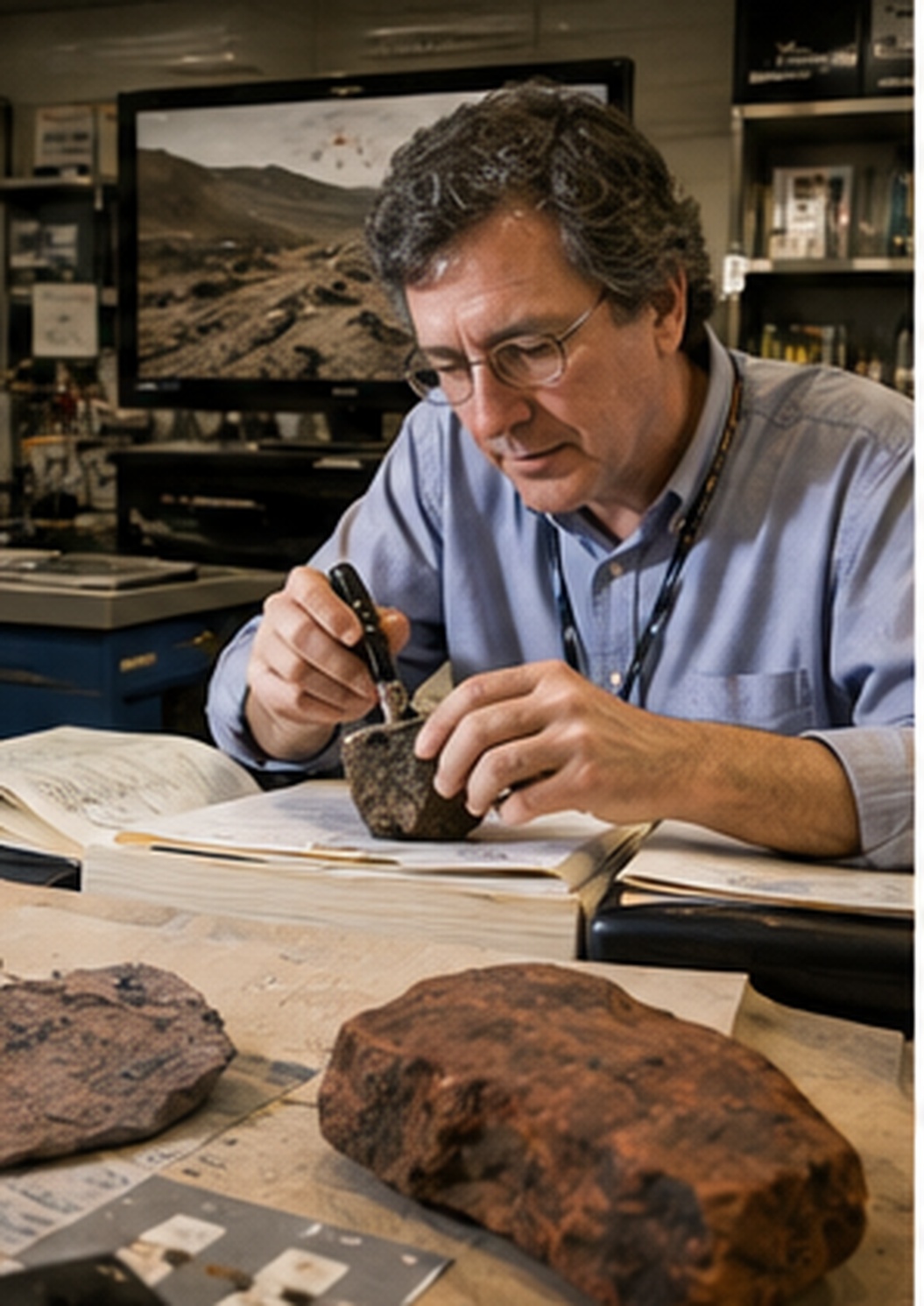
The portrait at the top of this book is an image whose exact provenance we were unable to verify.
Online sources
- NASA, Science Mission Directorate Oral History, Steven W. Squyres, August 22, 2017
- NASA, Science Mission Directorate Oral History, Steven W. Squyres, September 14, 2017
- NASA, Gravity Assist, “Exploring Mars with Steve Squyres” (2018)
- NASA — Steve Squyres
- NASA/JPL, “Opportunity Rover Finds Strong Evidence Meridiani Planum Was Wet” (2004)
- NASA, “NASA’s Long-Lived Mars Opportunity Rover Sets Off-World Driving Record” (2014)
- NASA, “NASA’s Opportunity Mars Rover Finishes Marathon…” (2015)
- NASA, “NASA’s Record-Setting Opportunity Rover Mission on Mars Comes to End” (2019)
- NASA, “NASA’s NEEMO Mission Ending Early Due To Hurricane Rina” (2011)
- NASA, NSSDCA — MER-B (Opportunity)
- The Cornell Daily Sun, September 13, 2019
Facts checked against these sources on October 10, 2026.
Go further
Mars Library
This book extends the page with a complete settlement architecture. The dossier above remains deliberately self-contained: Arcadia is optional further reading, not a prerequisite for understanding it.
 Arcadia — Master Plan of the First Martian City