


Mars Bible — People
Michael Meyer
The treasure-hunt diver turned oceanographer of cold deserts, then, at NASA Headquarters, the scientist who holds the thread of the Mars program: Odyssey, Curiosity, the methane puzzle, Mars 2020 and the preparation of sample return.
NASA scientist
- Education
- Rensselaer Polytechnic Institute (bachelor’s); Texas A&M (master’s and doctorate in oceanography)
- Role
- Senior scientist for astrobiology and lead scientist of NASA’s Mars Exploration Program
- Missions
- Program scientist for Mars Odyssey and Mars Science Laboratory (Curiosity)
- Research
- Microorganisms in extreme environments
- Link with Mars
- Science strategy of the Mars program; preparation of sample return
10 chapters and 4 appendices: about 3,800 words, or about 15 minutes of reading. Every fact comes from verified sources, listed at the end of each chapter.
Part One
From the Ocean to the Cold
Youth – 1980s
Chapter 1 · Youth From Sunken Treasure to Biology
Michael Meyer became the scientist in charge of NASA’s entire Mars program. But when asked in 2017 what launched him into science, he spoke neither of Mars nor of the stars. He spoke of the ocean.
The Bored Engineer
Because he was good at math, he relates in 2002, he was told he should be an engineer. So he went to Rensselaer Polytechnic Institute, in New York State, to study engineering. One year he realized it did not really interest him: it was not exciting enough. Biology was much more interesting. He switched. It was an exciting time: when he took cell biology, he says, the three textbooks published that year were already out of date. He earned his bachelor’s degree at Rensselaer.
A Diver by Accident
He had always loved the sea. He was a fan of Jacques Cousteau, had an aquarium, liked to sail. At the end of his freshman year in college he was hired as a deckhand on a treasure salvaging operation off the coast of Florida. After a couple of weeks, the head of the operation fired all the divers, who were not doing the job, and asked him if he wanted to dive. He did not know how to dive, but he was happy to.
It was, he says, his first foray into the subsurface. Despite all the TV shows and books, he discovered a world he knew nothing about: “My word, I don’t know anything about this world. This is fantastic.” That shock set him on a track: he could do this for the rest of his life. Above all, he realized that he could make a living by learning things, going on to graduate school. This is what he calls his “gravity assist.”
Sources: NASA Astrobiology, “Interview With Michael Meyer,” interview with Kathleen Connell (NASA Ames), February 13, 2002 (good at math, Rensselaer, engineering not exciting enough, biology, the three cell biology textbooks, the ocean, the deckhand job at the end of freshman year); NASA, Gravity Assist, season 1, episode 6, December 20, 2017 (Cousteau, the aquarium, sailing, the treasure salvaging operation, the divers fired, the first dive, “My word, I don’t know anything about this world,” making a living by learning); NASA Astrobiology, “Michael Meyer to Serve as NAI Director,” February 24, 2014 (bachelor’s degree from Rensselaer Polytechnic Institute). The sources consulted do not give his date of birth.
Chapter 2 · 1980s From the Ocean to Cold Deserts
After his bachelor’s degree, Michael Meyer chose oceanography, because he had always enjoyed the ocean. His studies would nonetheless take him far from the oceans, all the way to the mountains of Antarctica.
Texas A&M
He earned a master’s and then a doctorate in oceanography from Texas A&M University, in College Station. He would go to the Antarctic on a couple of cruises. His research focused on microorganisms living in extreme environments.
Algae Without a Sea
Going from oceanography to the mountains of Antarctica may seem like a big leap. He explains it simply: algae are aquatic organisms whether they live in marine or fresh water or on land, because they do not do anything unless they have water. That, he says, is how he got into “cold desert” research and into microorganisms in extreme environments.
A Trace in the Archives
NASA’s technical archives list, between 1986 and 1993, several papers co-authored by a researcher named Michael A. Meyer, of Florida State University, with the specialist of Antarctic microorganisms Imre Friedmann. They deal with soil temperatures and ultraviolet radiation in the ice-free valleys of Victoria Land, the effect of low temperature on algae living inside rocks, and the long-term productivity of these microbial communities in the Ross Desert. One of them, published in 1993, presents microclimate records from 1985 to 1988 and is co-authored by Christopher McKay. This work matches exactly what Michael Meyer says of his research; none of the sources consulted, however, explicitly states that it is him.
Sources: NASA Astrobiology, interview of February 13, 2002 (oceanography, the Antarctic cruises, algae and water, cold deserts, extreme environments); NASA Astrobiology, “Michael Meyer to Serve as NAI Director,” February 24, 2014 (master’s and doctorate in oceanography from Texas A&M, microorganisms in extreme environments); NASA Technical Reports Server: J. A. Nienow, M. A. Meyer and E. I. Friedmann (Florida State University), 1986; M. A. Meyer, G. J. Morris and E. I. Friedmann, 1988; E. I. Friedmann, L. Kappen, M. A. Meyer and J. A. Nienow, 1993; C. P. McKay, J. Nienow, M. A. Meyer and E. I. Friedmann, “Continuous Nanoclimate Data (1985-1988) from the Ross Desert (McMurdo Dry Valleys) Cryptoendolithic Microbial Ecosystem,” 1993. The dates of his degrees are not given in the sources consulted. Chris McKay has his own biography in this collection.
Part Two
Astrobiology
1990s – 2002
Chapter 3 · 1990s From Exobiology to Astrobiology
In the 1990s, the search for life elsewhere changed its name and its ambition at NASA. Michael Meyer found himself at the heart of that change.
Exobiology
NASA’s exobiology program had long existed, he explains in 2002. It studied the origin of life on Earth as a model for understanding the probabilities of life elsewhere. In June 1994 NASA’s archives list two papers co-authored by John Rummel, of NASA Headquarters, and a Michael A. Meyer, of an organization designated by the acronym LESC, in Washington: one on NASA’s plans for exobiology and solar system exploration, the other on the opportunities the small missions of the Discovery program offered exobiology. In 1996 the same two names signed recommendations for a consensus on planetary protection requirements for future Mars landers: how to avoid contaminating Mars with Earth microbes.
The Allan Hills Meteorite
For Michael Meyer, the Allan Hills Martian meteorite focused attention on the idea that there might be life outside Earth, possibly within our own solar system. The important thing, he says, is that it was not a crazy idea: it was, and it is, reasonable. On Earth, organisms are found living in environments no one suspected twenty years earlier. A whole third branch of life has been established, the archaea, which look somewhat like bacteria but are not, and often live in extreme environments. And members of the National Academy of Sciences consider it not unreasonable that there could still be life on Mars today.
A New Word
Astrobiology, defined as the study of the origin, evolution and distribution of life in the universe, seemed to him a natural extension of exobiology. The word, he says, made it understandable how the research fit into the grand scheme of exploring planets and looking for planets around other stars. It also captured the public’s interest. And it brings together diverse disciplines, because you cannot understand life, or the potential for life, without understanding the environment.
Sources: NASA Astrobiology, interview of February 13, 2002 (the exobiology program and the origin of life, the Allan Hills meteorite, “it wasn’t a crazy idea,” organisms of extreme environments, the archaea, the National Academy of Sciences, astrobiology as an extension, public interest, multidisciplinarity); NASA Technical Reports Server: J. D. Rummel (NASA Headquarters) and M. A. Meyer (LESC, Washington), “Future NASA plans for exobiology and solar system exploration,” and M. A. Meyer and J. D. Rummel, “Exobiology opportunities from Discovery-class missions,” June 1994; J. D. Rummel and M. A. Meyer, “A consensus approach to planetary protection requirements: recommendations for Mars lander missions,” 1996. As in the previous chapter, the identity of this Michael A. Meyer is not explicitly confirmed by the sources.
Chapter 4 · 2001 – 2002 At NASA Headquarters: Odyssey and the Method
In February 2002 Michael Meyer introduced himself this way: he was the Astrobiology discipline scientist at NASA Headquarters in Washington, and the program scientist for the Mars 2001 Odyssey mission, a Mars orbiter.
The Role of a Program Scientist
Part of his job, he explains, is to look at what is being done now and project what needs to be done in the future. NASA now has a robust Mars exploration program, with missions every twenty-six months, as the planets line up. What instruments, what knowledge should astrobiology have ready for those missions? The same question for Europa, the moon of Jupiter thought to have a liquid ocean under its frozen surface: what tools would be needed to understand whether life ever started there?
Looking for Environments, Not Beings
His approach to looking for life on Mars, past or present, is step-wise: ask very general questions, whose answers lead to the next question. This approach shifted the goal: instead of looking directly for life, one looks for environments that could have supported it. Then you are talking about geochemistry, hydrology, geologic history, past climate, atmospheric modeling: “where is the water?” The search for life thus brings in most of the planetary sciences.
He also sees two challenges for information technology: helping disciplines that speak different languages understand one another, and making robots autonomous enough to explore more on their own, with proper sensors.
Questions for Society
Whether we are alone in the universe affects how we view ourselves. There is also, he notes, the risk of transferring microbes to another planet and contaminating it, and the question of whether sample return is safe and what society thinks about it. But he does not think astrobiology will upend society overnight: perceptions change gradually.
A Prediction
Is there life elsewhere in the universe? “Most definitely,” he answers, simply because of the numbers: ten to the eleven stars in the galaxy, ten to the eleven galaxies in the universe. It is almost a faith statement, he admits. The real question is whether there is life close enough for us to notice it. And he makes a prediction: in the next twenty years, we will find out whether life is common or rare. Twenty years later, in 2022, the question remained open.
Source: NASA Astrobiology, “Interview With Michael Meyer,” interview with Kathleen Connell, February 13, 2002 (his titles, Mars 2001 Odyssey, projecting the future, missions every twenty-six months, Europa, the step-wise method, environments, “where is the water?,” information technology, contamination, sample return, society, “Most definitely,” ten to the eleven stars and galaxies, “a faith statement,” “in the next twenty years we’ll find out if life is common, or if life is rare”). The last sentence of the chapter is the author’s observation.
Part Three
The Mars Program
2011 – 2018
Chapter 5 · 2011 – 2012 Curiosity’s Program Scientist
In 2011 Michael Meyer is the lead scientist of the Mars Exploration Program at NASA Headquarters, while also being the agency’s senior scientist for astrobiology. He watches over the scientific coherence of the Mars missions.
From “Follow the Water” to “Seeking Signs of Life”
On January 13, 2011, the National Air and Space Museum in Washington hosted, with NASA, a public update on the Mars program. Its title sums up the turning point of those years: “From ‘Follow the Water’ to ‘Seeking Signs of Life.’” The past decade had been one of searching for water; it had been found. Michael Meyer moderated the last session, on the future: “Seeking Signs of Life: What Will the Future Bring?”
Curiosity’s Program Scientist
For the Mars Science Laboratory mission and its Curiosity rover, which carries ten science instruments, Michael Meyer is the program scientist for the entire mission: while other scientists work directly with the instruments, he makes sure, for NASA, that the mission meets its goals, characterizing the environment of Mars and determining whether the planet ever had the potential for life.
Bradbury Landing
Curiosity landed on August 6, 2012 in Gale Crater. On August 22, the day writer Ray Bradbury, who had died in June, would have turned ninety-two, NASA named the landing site “Bradbury Landing.” Michael Meyer explained the choice: “This was not a difficult choice for the science team. Many of us and millions of other readers were inspired in our lives by stories Ray Bradbury wrote to dream of the possibility of life on Mars.”
Sources: NASA Astrobiology, “Michael Meyer to Serve as NAI Director,” February 24, 2014 (senior scientist for astrobiology and lead scientist of the Mars Exploration Program); NASA Astrobiology, “‘Live’ From the Smithsonian, a NASA Mars Program Update,” January 10, 2011 (program of January 13, 2011, title, session III moderated by M. Meyer); NASA Astrobiology, “Curious About Life: Interview With Michael Meyer,” October 27, 2012 (program scientist for MSL, ten instruments, goals); English-language Wikipedia, “Bradbury Landing” and “The Martian Chronicles” (landing on August 6, 2012, naming on August 22, Bradbury’s death on June 5, 2012, M. Meyer’s words; tertiary source).
Chapter 6 · 2013 – 2017 The Methane Puzzle
Methane is a gas that, on Earth, living things largely produce. On Mars it became one of the great puzzles of the decade, and Michael Meyer was often the one asked to explain it.
No Methane
On September 19, 2013, NASA announced that Curiosity had found no methane. The rover had sampled the atmosphere six times, from October 2012 through June 2013, without detecting any; there could be no more than 1.3 parts per billion, about one-sixth of some earlier estimates. “This important result will help direct our efforts to examine the possibility of life on Mars,” said Michael Meyer. It reduces the probability of current methane-producing Martian microbes, he added, but addresses only one type of microbial metabolism: many terrestrial microbes do not generate methane.
Then a Spike
On December 16, 2014, NASA announced, on the contrary, that Curiosity had measured a tenfold spike in methane in the atmosphere around it. A few days earlier, on December 8, Michael Meyer had been among the participants in a NASA media teleconference on the rover’s observations.
In 2017 he told what came next to Jim Green. A big spike of methane appeared, then, almost as surprising, disappeared. You have to go through real “chemical gymnastics,” he said, to get methane to show up and disappear like that, and atmospheric modelers were in a tizzy. A low background level is understandable, since material from comets can bring a little. But then another spike came, and disappeared in turn, with no correlation to anything else. It is, he said, a real mystery.
Geology or Biology
The mystery matters, he explains, because methane can be a sign of active geological processes, where rock interacts with water; that would already be very interesting. And on Earth, most methane is a biological product, which on Mars would obviously be very exciting. Either way, the source must be found.
Sources: NASA, release 13-288, “NASA Curiosity Rover Detects No Methane on Mars,” September 19, 2013 (six analyses from October 2012 through June, 1.3 parts per billion, one-sixth, M. Meyer’s quotation); NASA, release of December 3, 2014 announcing the December 8 teleconference (M. Meyer among the participants); NASA, release 14-330, “NASA Rover Finds Active, Ancient Organic Chemistry on Mars,” December 16, 2014 (tenfold methane spike); NASA, Gravity Assist, season 1, episode 6, December 20, 2017 (the spike and its disappearance, “chemical gymnastics,” comets, the second spike, geology or biology).
Chapter 7 · 2014 – 2017 Spokesman for Martian Discoveries
As lead scientist of the Mars program, Michael Meyer often sat at the table of the press conferences where NASA announced its discoveries. These events mark out the decade.
A Busy Year
On January 21, 2014, he took part in the news conference on ten years of the Spirit and Opportunity rovers. On February 24, NASA announced that, from April 7, he would serve as interim director of the NASA Astrobiology Institute, a network of fifteen teams and 840 researchers across 180 institutions. But on April 24 the institute announced that he had declined the position: the requirements levied to resolve a conflict of interest were, he said, unacceptable, and he was disappointed not to be able to re-engage with that work. On July 31 he was again on the panel for the announcement of the instruments of the future Mars 2020 mission.
The Slope Streaks
On September 28, 2015, he was among the participants in the news conference at which NASA presented the dark streaks that appear each season on certain Martian slopes, then attributed to liquid water. In 2017 he explained the mystery. In the spring, when it starts warming up, they appear; through the summer, they get longer down a slope; in the fall, they start to disappear; in the winter, they are gone; the next year, they come back in the same place. It looks like water flowing down the slope. But it is hard to explain as water, with temperatures so low and so little water stable at the surface.
The problem, he explains, is that the streaks are too narrow for orbiting spectrometers to get good spectra: you see them darken and lighten without being able to say why. He hoped Curiosity, which had spotted candidates in the distance in Gale Crater, could watch them from the ground, in color and over the seasons.
The Lost Atmosphere
On November 5, 2015, he was also present when NASA announced, thanks to the MAVEN probe, how fast the solar wind is stripping away the atmosphere of Mars.
Sources: NASA, “NASA Hosts News Conference About 10 Years of Roving on Mars,” January 21, 2014; NASA Astrobiology, “Michael Meyer to Serve as NAI Director,” February 24, 2014 (start on April 7, fifteen teams, 840 researchers, 180 institutions) and “NAI Interim Director: Announcement,” April 24, 2014 (refusal and his statement); NASA, “NASA to Announce Mars 2020 Rover Instruments,” July 30, 2014 (conference of July 31); NASA, “NASA to Announce Mars Mystery Solved,” September 24, 2015 (participants of the September 28 conference); NASA, Gravity Assist, season 1, episode 6, December 20, 2017 (the seasonal cycle, the difficulty with water, the spectrometers, the Gale candidates); NASA, “NASA to Announce New Findings on Fate of Mars’ Atmosphere,” November 2, 2015 (participants of November 5). The 2017 reinterpretation of these streaks as dry flows is told in Jim Green’s biography in this collection.
Chapter 8 · 2014 – 2018 On the Shoulders of Curiosity
After Curiosity, NASA prepared a new mission, Mars 2020, which would become the Perseverance rover. For Michael Meyer, it directly extends what Curiosity learned.
An Architecture That Has Proven Itself
Mars 2020, he explained in 2017, stands on the shoulders of Curiosity in a couple of ways. First, it uses the whole architecture of the mission: the entry, descent and landing system and the rover body, which worked so well that they are being done again. Brand-new instruments are added, everything is updated, and the rover will cache samples: when it finds interesting rocks, there will be the opportunity to bring them back.
What Curiosity Learned
Second, what Curiosity has found informs the new mission. The rover showed that Mars was habitable during the period when Gale Crater formed, or soon after. The mineralogy and the rocks tell what the environment was like. The instruments of Mars 2020 were chosen accordingly, and the choice of its landing site draws on what was learned at Gale and from orbit. We are now, he said, much more sophisticated about where to go to get the right rocks: those that tell of the early history of Mars, during the period when life started on Earth and in the solar system.
Jezero
On November 19, 2018, NASA announced the site chosen for Mars 2020: Jezero Crater. The Perseverance rover would land there on February 18, 2021.
Sources: NASA, Gravity Assist, season 1, episode 6, December 20, 2017 (“standing on the shoulders of Curiosity,” the reused architecture, the new instruments, sample caching, Gale’s habitability, instruments and site chosen accordingly, the period when life started); NASA, “NASA Announces Landing Site for Mars 2020 Rover,” November 19, 2018; NASA NSSDCA, “Mars 2020” entry (landing on February 18, 2021).
Part Four
The Return
2022 – 2023
Chapter 9 · 2022 – 2023 Preparing the Return of the Samples
As early as 2002, Michael Meyer raised the question of the safety of a Mars sample return and of how society would view it. Twenty years later, he was one of the scientists preparing that return.
Sixteen Standard-Bearers
On June 14, 2022, NASA and the European Space Agency, partners in the Mars Sample Return Program, established a new group of researchers: the Mars Sample Return Campaign Science Group. Sixteen scientists from the United States, Europe, Canada and Japan were to help maximize the scientific potential of the rock and sediment samples that would be returned from Mars. “These 16 individuals will be the standard-bearers for Mars Sample Return science,” said Michael Meyer, still lead scientist of the Mars Exploration Program. They would build the roadmap, establish the processes for sample-related decision-making and design the procedures allowing the worldwide scientific community to become involved with these first samples from another world.
Receiving the Samples
In 2023 NASA and ESA issued a call for membership in a team to define the measurements to be made on the samples upon their arrival, in the future receiving facility. The call is signed by two names: Michael A. Meyer and Gerhard Kminek, “MSR Lead Scientists.”
As this book is written, in October 2026, the samples collected by Perseverance are still waiting for the mission that will bring them back to Earth.
Sources: NASA Astrobiology, interview of February 13, 2002 (sample return and society); NASA/JPL, “NASA, Partner Establish New Research Group for Mars Sample Return Program,” June 14, 2022 (the group, the sixteen researchers and their countries, the quotation “These 16 individuals will be the standard-bearers…”); NASA Astrobiology, call “Mars Sample Return (MSR) Sample Receiving Project Measurement Definition Team 1 (MDT-1),” 2023 (signature of M. A. Meyer and G. Kminek, “MSR Lead Scientists”). The last sentence is the author’s observation.
Epilogue
Michael Meyer and Mars
Chapter 10 · The lesson What Michael Meyer Leaves to Mars
Michael Meyer invented no famous instrument and never landed on Mars. His job was to hold the scientific thread of an entire program, mission after mission. His path sheds light on three lessons.
Search Step by Step
You do not find life by looking for it directly. You first ask general questions, where is the water, what was the climate, which environments could have been habitable, and each answer dictates the next question. That patience led from “follow the water” to “seeking signs of life,” then to sample return.
Do Not Conclude Too Fast
Methane that appears and disappears, streaks that flow without anyone knowing whether it is water: Mars resists simple explanations. Faced with these puzzles, he always distinguished what is known from what is not, and recalled that a negative result closes only one door among others.
Think Beyond Science
Finally, he pointed out early on that exploring for life elsewhere touches society: the risk of contaminating other worlds, the safety of returned samples, how humanity sees itself if it is not alone. The first humans to go to Mars will take these questions with them.
This lesson is a reflection by the author of this book, based on the facts and on Michael Meyer’s words reported in the preceding chapters, where their sources are given.
Appendices
Going Further
Appendix Understanding Michael Meyer’s Work
A few notions, explained simply, to follow this book.
The Program Scientist
At NASA Headquarters, the scientist responsible for making sure, on the agency’s behalf, that a mission or program meets its scientific goals. He does not run the instruments, but keeps the overall view.
Exobiology and Astrobiology
Exobiology mainly studied the origin of life on Earth to estimate its chances elsewhere. Astrobiology broadens the question: the origin, evolution and distribution of life in the universe, bringing many disciplines together.
Archaea
The third great branch of life, alongside bacteria and eukaryotes. They look like bacteria but differ profoundly, and often live in extreme environments.
Methane
A simple gas made of carbon and hydrogen. On Earth it is mostly produced by living things, but some reactions between water and rocks produce it too. Its presence on Mars could therefore signal active geology or, perhaps, life.
Planetary Protection
The set of rules meant to avoid contaminating other worlds with Earth microbes, and Earth with possible organisms from elsewhere.
Sample Return
A NASA and European Space Agency project to bring back to Earth the rocks collected by Perseverance, to study them with the best laboratory instruments.
These explanations are general notions. The facts specific to Michael Meyer are sourced in the corresponding chapters; the description of archaea and methane follows his own explanations of 2002 and 2017.
Appendix Chronology
The dates of Michael Meyer’s career, in order, as far as the sources allow them to be established.
1970s (date not specified). Engineering then biology studies at Rensselaer; deckhand then diver for a treasure salvaging operation in Florida.
Date not specified. Master’s and doctorate in oceanography, Texas A&M.
1986 – 1993. Papers by a Michael A. Meyer (Florida State University) on microorganisms of the Antarctic Dry Valleys.
June 1994. Papers by a Michael A. Meyer (Washington) with John Rummel on exobiology.
1996. Recommendations on planetary protection, with John Rummel.
February 2002. Astrobiology discipline scientist at NASA Headquarters; program scientist for Mars Odyssey.
January 13, 2011. Moderates a public session on seeking signs of life at the National Air and Space Museum.
2012. Program scientist for Mars Science Laboratory (Curiosity).
August 22, 2012. Naming of Bradbury Landing.
September 19, 2013. No methane detected by Curiosity.
January 21, 2014. News conference on ten years of the rovers.
February 24, 2014. Named interim director of the NASA Astrobiology Institute.
April 24, 2014. Declines the position.
July 31, 2014. Announcement of the Mars 2020 instruments.
December 16, 2014. Announcement of a methane spike measured by Curiosity.
September 28, 2015. News conference on the Martian slope streaks.
November 5, 2015. News conference on the loss of the Martian atmosphere (MAVEN).
December 20, 2017. Gravity Assist podcast with Jim Green.
November 19, 2018. Jezero Crater chosen for Mars 2020.
June 14, 2022. Creation of the Mars Sample Return Campaign Science Group.
2023. Lead scientist for Mars Sample Return, with Gerhard Kminek.
Appendix The People
The people met in this book, in alphabetical order.
Bradbury, Ray. Writer, author of The Martian Chronicles; Curiosity’s landing site bears his name.
Connell, Kathleen. Interviewed him in 2002 for NASA’s astrobiology program.
Cousteau, Jacques-Yves. Ocean explorer he admired in his youth.
Friedmann, Imre. Specialist of the microorganisms in Antarctic rocks.
Green, Jim. Director of NASA planetary science; interviewed him in 2017.
Jakosky, Bruce. Principal investigator of the MAVEN probe; shared the 2017 podcast episode with him.
Kminek, Gerhard. Co-lead scientist, on the European side, for Mars sample return.
McKay, Christopher. Ames planetary scientist; co-authored a 1993 paper on Antarctica.
Rummel, John. Of NASA Headquarters; co-authored the 1994 and 1996 papers.
Appendix Sources and Method
This book contains no imagined dialogue, nor any thought attributed to anyone without a text to support it. This appendix shows where the facts come from and what the sources do not allow us to establish.
A Living Person
Michael Meyer is alive as this book is written. We have kept to his public life. The sources consulted give neither his date of birth, nor the dates of his degrees, nor the year he arrived at NASA Headquarters; we have not invented them.
The Main Sources
Two interviews in the public domain form the basis of the book: the one given in 2002 to Kathleen Connell for NASA’s astrobiology program, and the episode of NASA’s Gravity Assist podcast recorded with Jim Green and Bruce Jakosky, published on December 20, 2017. To these are added announcements from NASA’s astrobiology program (2011, 2012, 2014, 2023) and a series of NASA releases from 2013 to 2022 that quote him or list him among the participants in news conferences. For the naming of Bradbury Landing, we used English-language Wikipedia, a tertiary source, which quotes his words. Quotations are given in their original English; this English edition was translated from the French edition of the book.
An Identity to Be Confirmed
NASA’s technical archives list papers by a Michael A. Meyer at Florida State University (1986-1993), on the microorganisms of the Antarctic Dry Valleys, then in Washington with John Rummel (1994 and 1996), on exobiology and planetary protection. This work matches what he tells of his path, and Michael A. Meyer is the full name under which he signs in 2023. But no source consulted explicitly states that it is the same person; we flag it each time.
Length
This book runs to about three thousand eight hundred words. The goal set for this collection was one hundred thousand. We have not reached it, and we prefer to say so. Public sources on Michael Meyer’s life are scarce. As it stands, the text contains only facts we have been able to tie to a source.
The Portrait
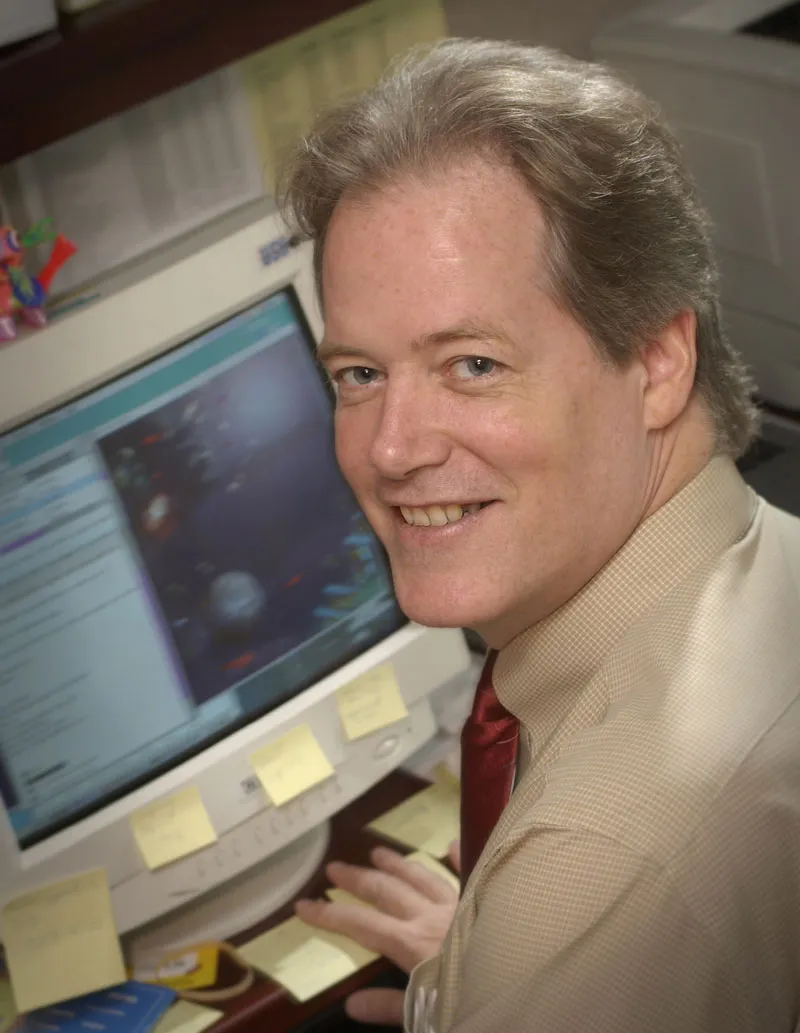
The portrait at the head of this book is a photograph whose exact provenance we could not verify.
Online sources
- NASA Astrobiology, “Interview With Michael Meyer” (2002)
- NASA, Gravity Assist, season 1, episode 6 (2017)
- NASA Astrobiology, “Michael Meyer to Serve as NAI Director” (2014)
- NASA Astrobiology, “NAI Interim Director: Announcement” (2014)
- NASA, “NASA Curiosity Rover Detects No Methane on Mars” (2013)
- NASA, “NASA, Partner Establish New Research Group for Mars Sample Return Program” (2022)
- Wikipedia (English) — Bradbury Landing (tertiary source)
Facts checked against these sources on October 10, 2026.
Go further
Mars Library
This book extends the page with a complete settlement architecture. The dossier above remains deliberately self-contained: Arcadia is optional further reading, not a prerequisite for understanding it.
 Arcadia — Master Plan of the First Martian City