


Mars Bible — People
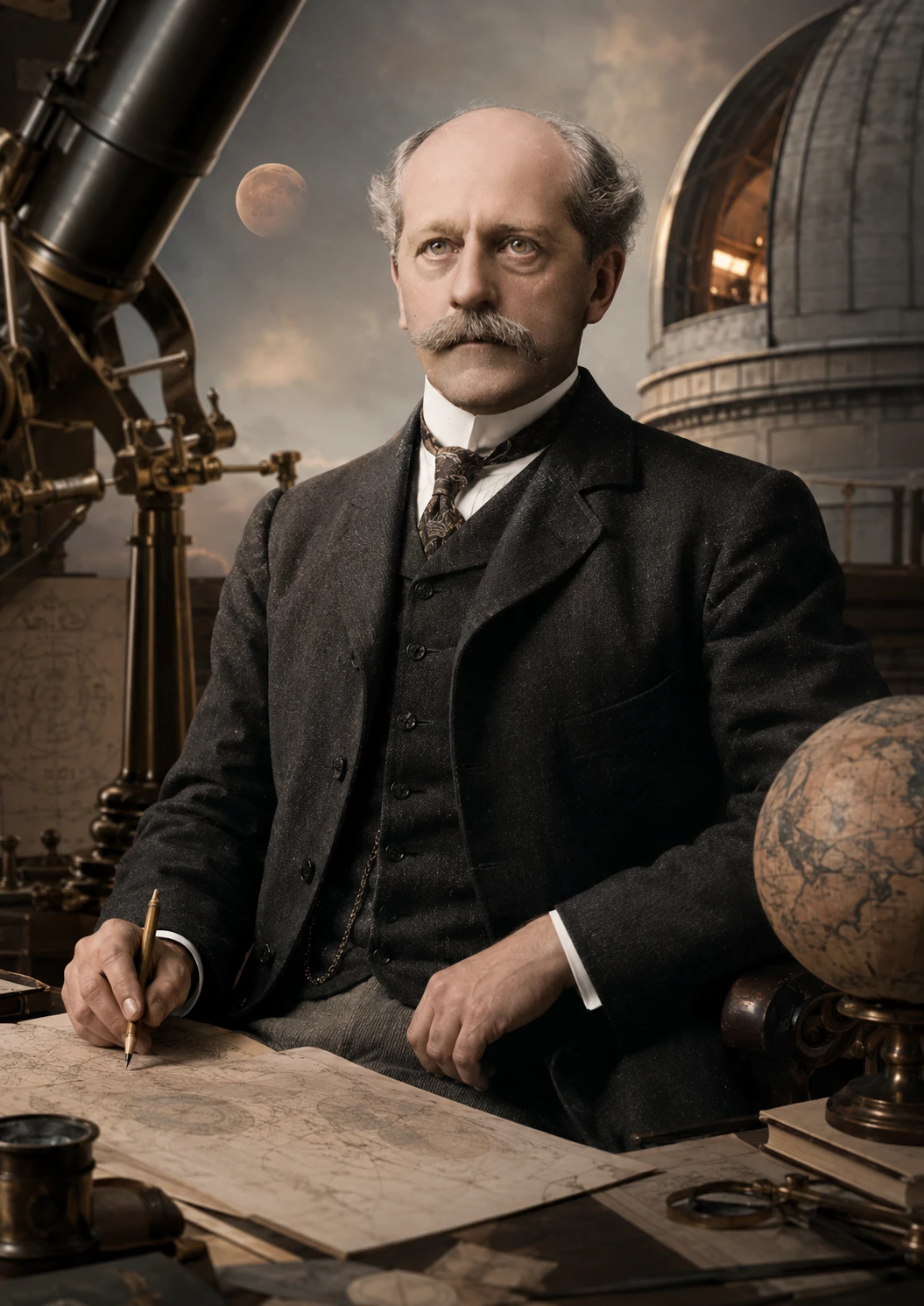
Percival Lowell
The wealthy Bostonian, diplomat in Korea and writer on Japan, who founded the Flagstaff observatory to study Mars, believed he saw there the canals of a dying civilization, and launched the search that led to Pluto.
1855 – 1916
- Born
- March 13, 1855, Boston, Massachusetts
- Died
- November 12, 1916, Flagstaff, Arizona
- Role
- Businessman, writer, astronomer; founder of Lowell Observatory (1894)
- Education
- Harvard University (1876), honors in mathematics
- Works
- Mars (1895), Mars and its Canals (1906), Mars as the Abode of Life (1908)
- Link with Mars
- Theory of Martian irrigation canals; twenty years of observations of the planet
25 chapters and 4 appendices: about 14,000 words, or about 65 minutes of reading. Every fact comes from verified sources, listed at the end of each chapter.
Part One
The Bostonian
1855 – 1883
Chapter 1 · 1855 – 1872 The Roof at Brookline
On the flat roof of a large house in Brookline, near Boston, a boy has set up his telescope. It is small: about two and a quarter inches across. He points it at Mars. Much later, having become famous the world over for what he said he saw on that planet, Percival Lowell would remember that first image: a white snow cap at the pole, crowning a globe spread with blue-green patches on an orange ground.
A Town’s Name
Percival Lowell is born in Boston on March 13, 1855, at 131 Tremont Street. He is the eldest child of Augustus Lowell and Katharine Bigelow Lawrence. Two industrial cities in Massachusetts, Lowell and Lawrence, bear the names of his ancestors. His maternal grandfather, Abbott Lawrence, had been the United States Minister to England.
The family includes other names that would be heard of. His brother Abbott Lawrence Lowell would become president of Harvard University and his biographer. His youngest sister, Amy Lowell, would be a well-known poet.
The father has a simple idea, which his children absorb listening to him each morning in the carriage that takes them into town. A self-respecting man, he makes them feel, must work at something worth while, and work very hard at it. The work need not pay: the family has enough to live on. But it must matter.
Paris and War
In the spring of 1864, the mother falls seriously ill. The doctors advise a complete change. The whole family sails for Europe on a paddle-wheel steamer, the Africa. They spend the summer in England, then the winter in Paris. Percival, nine years old, is sent to a French boarding school. There he learns the language “by the native method,” his brother would say. He would speak it all his life.
In 1866 the family is in Germany, at Schwalbach, when war breaks out between Prussia and Austria. The boy sees Prussian scouts gallop past, then Nassau infantrymen spring out and fire from behind a woodpile. He never forgets it.
By the end of the summer, the mother has recovered. They go home to Boston.
A Good Student
He enters George Noble’s school, where he is always near the top of his class, especially in the classics. One day, for fun, he writes some hundreds of Latin hexameters about the imaginary shipwreck of a toy boat he was sailing in a pool of melted snow.
In 1867 his father buys a property in Brookline. There the boy grows up, and there, on the roof, his astronomy begins. He reads many books about the sky. His brother writes that this interest, after lying half-dormant for many years, would blaze forth again to dominate his life.
His teachers, oddly enough, judge him somewhat weak in English composition and mathematics. He is tutored. In the fall of 1872 he enters Harvard with honors in mathematics.
Sources: A. Lawrence Lowell, Biography of Percival Lowell, New York, Macmillan, 1935, ch. I (birth, parents, grandfather, stay in Europe from 1864 to 1866, Paris boarding school, Schwalbach, Noble school, Latin verses, Brookline, the father’s views, telescope and memory of Mars, entry to Harvard); G. R. Agassiz, obituary notice, Proceedings of the American Academy of Arts and Sciences, 1917 (the cities of Lowell and Lawrence). The family tie with Amy Lowell comes from the English-language Wikipedia article (tertiary source).
Chapter 2 · 1872 – 1883 The Nebular Hypothesis
In 1876, at Harvard’s Commencement, a twenty-one-year-old student takes the floor. His subject is no occasional speech: he speaks on “the nebular hypothesis,” the idea that the Sun and planets were born from a single rotating cloud of matter. The student is Percival Lowell. Thirty years later, he would make this idea the framework of all his thinking about Mars.
Benjamin Peirce’s Student
At Harvard he studies mathematics every year. The great mathematician Benjamin Peirce considers him one of the most brilliant scholars he has ever had, and even hints that he could someday succeed him in his chair if he devoted himself to it. A family friend, George Agassiz, would report that Peirce ranked him among the two most brilliant mathematicians he had seen at Harvard.
But he does not shut himself up in figures. He also takes courses in the classics, physics and history. In his senior year he wins a prize for an essay on England’s rank among the European powers. He is elected to Phi Beta Kappa. And he spends his evenings at Boston dancing parties.
The Grand Tour
After graduating, he spends a year in Europe with a classmate, Harcourt Amory. It is the traditional grand tour of wealthy young men: London, the British Isles, the Continent. Alone, he goes down the Danube and tries, without success, to get to the front of the war then raging between Serbia and Turkey. With Amory he travels as far as Palestine and Syria.
Six Years in an Office
Back home in the summer of 1877, he has no impulse toward a profession. He enters the office of his paternal grandfather, John Amory Lowell, who manages trust funds. He learns business. For a time he is acting treasurer, that is, executive head, of a large cotton mill. He is also a young man of fashion.
He invests his money well. George Agassiz would note that, unlike most devotees of pure science, he had a marked gift for business. By the spring of 1883, his means allow him to do as he pleases.
What he pleases is to go to Japan, to learn its language and study its people.
Before leaving, he had written to his sister, seven years his junior, a letter setting out his outlook. Life, he told her, is but one long journey, misspent if one does not take interest in whatever one encounters. He advised her to be honest with herself, even if wrong, rather than force herself to agree with the multitude. And always to be able to give a reason for what she thinks.
Sources: A. Lawrence Lowell, Biography of Percival Lowell, 1935, ch. I and II (studies at Harvard, B. Peirce’s opinion, courses taken, Bowdoin Prize, Phi Beta Kappa, Commencement part on the nebular hypothesis, travels in Europe and the Near East, grandfather’s office, cotton mill, departure for Japan, letter to his sister); G. R. Agassiz, obituary notice, 1917 (Peirce’s opinion, gift for business).
Part Two
The Far East
1883 – 1893
Chapter 3 · 1883 Like a Native (of America)
Three weeks after landing in Japan in the spring of 1883, Percival Lowell writes home: “I am beginning to talk Japanese like a native (of America), and I take to ye manners and customs of ye country like a duck to the water.” He has rented a house in Tokyo and settled in as if born and bred there. A Boston friend living there, the physician William Sturgis Bigelow, would write to his father that he had never seen any man learn a language faster.
Impersonality
Everything fascinates him: the tea-houses, the gardens, the art, the customs. Within a fortnight he notes two things that would later become books.
The first he believes he reads in the language. On June 8 he writes to his mother that a key to the Japanese is perhaps “impersonalism”: their inflected speech, he says, has no distinction of persons, no sex, not even a plural. He takes care to add that it is not a lack of feeling: it is, in his view, a thing of the mind rather than the heart.
The second is a superstition: the “fox disease,” a form of mania that the people attribute to bewitchment by a fox.
The Ruined Castle
In July he crosses the mountains to the other side of the main island with a professor at the university, Terry. The journey is hard. He complains of the food in a land where there is “no milk, no butter, no cheese, no bread, almost no meat.” He visits an abandoned castle. Sitting at a window above the slime-covered moat, he notes that the last lord had left only eleven years before. The Middle Ages he had dreamed of as a child had still existed, on the other side of the world, while he dreamed of them.
An Unexpected Offer
He gets back to Tokyo on August 13. That very evening, he receives an offer: to accompany to the United States a Special Mission sent by the Kingdom of Korea, as its Foreign Secretary and Counsellor. Korea, long closed to the world, has just signed a treaty with the United States. It is its first embassy to a Western power.
He refuses for two days, hesitates on a third, then accepts. Bigelow explains to his father that what held him back was anxiety about what his father would say. “He distrusts himself too much,” he adds.
On September 2, 1883, Lowell lands in San Francisco with the Korean diplomats. In New York the Mission is received by President Chester Arthur.
Sources: A. Lawrence Lowell, Biography of Percival Lowell, 1935, ch. II and III (settling in Tokyo and letter on the language, letter of June 8, 1883, on impersonalism, “fox disease,” journey with Professor Terry, ruined castle, return on August 13, offer of the Korean Mission, W. S. Bigelow’s letter, arrival in San Francisco on September 2, reception by President Arthur). The treaty between Korea and the United States (1882) belongs to general history.
Chapter 4 · 1883 – 1886 Guest of the King of Korea
Just before Christmas 1883, Percival Lowell enters Söul, the walled capital of the Kingdom of Korea. He is the King’s guest. A group of buildings belonging to the Foreign Office has been prepared for him. He describes it to his mother: you enter a courtyard, then another, then a garden, “wall after wall,” until you lose yourself in “the delightful maze.” Floor, ceiling and walls are all paper; even what look like square stone slabs underfoot are oil paper so hard that they sound like flags under your footfalls.
A Free Foreigner
He is one of the first Westerners to enter the country with an official position and no official duties. Two officers look after him without following him everywhere. His brother thinks he was freer than anyone in the land. High officials go out only in palanquins; everyone else must stay indoors after nightfall on pain of flogging. Lowell, who finds being carried in the palanquin box intolerable, walks, at any hour, all over the city.
The King and the Crown Prince receive him in audience. He photographs them. On February 17, 1884, he writes to his sister that he has taken fifty-three negatives in and around Söul. According to the online encyclopedia Wikipedia, his portrait of King Gojong is the earliest surviving photograph of a Korean monarch.
In the spring he leaves, despite his hosts’ insistence. He would never see Korea again.
A Friend Executed
In December 1884, a few months after his departure, a coup d’état breaks out in Söul. The partisans of opening to the world, several of whom had been on the Mission to America, try to seize power. They fail. One of them, Hong Yöng Sik, who had been especially attentive to Lowell during his stay, refuses to flee with the others. Someone, he says, must remain to show the world that they are not rebels. Chinese soldiers find him in the palace and execute him. He was thirty years old.
Lowell would recount those days in 1886, in a long article in the Atlantic Monthly.
The First Book
He goes home to Boston by way of Asia, India and Europe. Along the way he keeps his mathematician’s reflexes: from the Red Sea, he shows how to compute the height of a cloud from the angle of its shadow on the desert. But at this point, his brother stresses, nothing suggests he is thinking of science. Literature is his aim.
To a writer friend, he sets out his view: it is not facts alone that please mankind, but the reflections drawn from them. “We know now what was long unknown,” he writes, “that true seeing is done with the mind from the comparatively meagre material supplied by the eye.” Ten years later, at the telescope, the sentence would carry quite another weight.
To his mother he confides: “I wish I could believe a little more in myself.”
His book on Korea appears early in 1886: Chosön, the Land of the Morning Calm. His brother considers it valuable because the life it describes has since vanished.
Sources: A. Lawrence Lowell, Biography of Percival Lowell, 1935, ch. III to VI (arrival in Söul, description of the lodging, freedom of movement, curfew, audiences, photographs, letter of February 17, 1884, departure, the coup of December 1884 and the death of Hong Yöng Sik according to Lowell’s article in the Atlantic Monthly of November 1886, journey home, the Red Sea cloud, letter to F. J. Stimson, letter to his mother of October 7, 1884, Chosön). The mention of the photograph of King Gojong comes from the English-language Wikipedia article (tertiary source).
Chapter 5 · 1886 – 1893 The Gods of Mount Ontake
On August 6, 1891, near the top of Ontake, an extinct volcano and one of Japan’s sacred peaks, Percival Lowell and his friend George Agassiz watch three young pilgrims begin a ceremony. One of them, seated before a shrine, chants and gestures. Another, seated opposite and motionless, begins to twitch, breaks into a paroxysm and goes rigid. The first leans forward and asks him the name of the god possessing him. The entranced man answers in a strange voice: “I am Hakkai.” Then the god is questioned like an oracle.
The Soul of the Far East
In the meantime, Lowell has become a well-known writer. In 1888 his most celebrated book on Asia appears: The Soul of the Far East. In it he develops the idea that had struck him in 1883: the “impersonality” of the peoples of the Far East, among whom the individual would count for less than in the West. He looks for it everywhere: in the family, the language, art, religion.
The book is admired. The writer Lafcadio Hearn, who would settle in Japan, called it, according to Wikipedia, a “colossal, splendid, godlike book.” The French psychologist Pierre Janet cited it. Read today, its argument seems made mostly of generalizations about whole peoples, as were written in that era; his own brother repeats without reservation the idea of an “arrested development” of the Japanese. This book notes it; it does not dwell on it, since it is not its subject.
In December 1888 Lowell sails again for Japan. He is there in February 1889 when the Emperor promulgates the Constitution, the very day a fanatic assassinates the minister Mori.
Occult Japan
The Ontake scene launches him into a two-year inquiry. In Tokyo he finds the cult’s headquarters, befriends its head, records every gesture of the possession rites, and witnesses walking over hot coals and climbing ladders made of sword blades. The resulting book, Occult Japan, appears in 1894. To write it he reads the newly published Psychology of William James.
A Telescope in the Luggage
Yet another passion returns. In July 1891, just before Ontake, he writes to his brother-in-law about a project for a work on the “philosophy of the cosmos.” In 1892 he takes to Japan a six-inch telescope, no small encumbrance unless really desired. He observes Saturn.
He leaves Japan in the fall of 1893. He would never return.
Why the change? His brother admits that he left no written explanation. To George Agassiz, Lowell said one thing: the Italian astronomer Giovanni Schiaparelli, who had discovered on Mars the fine lines he called canali, was losing his eyesight and could no longer pursue his observations. Lowell had decided to carry them on. Wikipedia adds another influence: reading La Planète Mars, the great book the French astronomer Camille Flammarion had just published in 1892.
He is thirty-eight. He has been a businessman, a diplomat, a writer, an ethnographer. He is about to become an astronomer.
Sources: A. Lawrence Lowell, Biography of Percival Lowell, 1935, ch. VI to VIII (The Soul of the Far East, second visit, Constitution and Mori’s assassination, journey with G. Agassiz, the scene of August 6, 1891, on Ontake, the inquiry and Occult Japan, W. James’s influence, the project of July 1891, six-inch telescope in 1892, departure in the fall of 1893, absence of a written explanation, remarks reported by G. Agassiz); G. R. Agassiz, obituary notice, 1917 (Pierre Janet, Schiaparelli’s eyesight). L. Hearn’s judgment and the reading of Flammarion come from the English-language Wikipedia article (tertiary source). The remark on the dated character of the book is the author’s.
Part Three
Flagstaff
1893 – 1897
Chapter 6 · 1893 – 1894 On the Eve of Discovery
On May 22, 1894, in Boston, before the city’s Scientific Society, Percival Lowell announces what his observatory, not yet finished, will be for. It will serve, he says according to a newspaper two days later, for “an investigation into the conditions of life in other worlds,” including their habitability by beings like or unlike man. This is not, he adds, a chimerical search: “there is strong reason to believe that we are on the eve of pretty definite discovery in the matter.” He has not yet looked at Mars even once with his new telescope.
Schiaparelli’s Canali
To understand what he is looking for, one must go back to 1877. That year Mars passes very close to the Earth. In Milan, Giovanni Schiaparelli draws on the planet’s disk a network of fine, straight lines, which he calls canali. In Italian the word can mean a natural channel as well as a dug canal. In English it was rendered as “canals,” which suggests workmen. Schiaparelli’s lines would be seen again by others, notably at Nice; some would appear “doubled,” as two parallel lines.
Lowell, in a text intended for his observatory’s Annals, pays tribute to his predecessor: his discoveries, he writes, were due solely to the genius of the man, “his insight, not his eyesight, for at the telescope eyes differ surprisingly little, brains surprisingly much.”
The Air
In 1892 the astronomer William Pickering, of Harvard College Observatory, had observed Mars from Harvard’s station at Arequipa, Peru, more than two thousand meters up. He had seen dark round spots where the lines crossed. For Lowell, the main lesson lies elsewhere: it is the importance of the atmosphere. Unsteady air blurs the images, like an elaborately decorated plate held up by a man with a palsied hand. One must go where the air is steadiest.
Lowell has an asset for this. A leading Boston ophthalmologist, Hasket Derby, said his eyesight was the keenest he had ever examined. And his mathematics have not rusted: in Boston he belongs to a club of mathematicians and physicists.
A Winter Decision
During the winter of 1893–1894, he decides to mount an expedition for the opposition of 1894, when Mars and the Earth are on the same side of the Sun, nearest each other. He joins forces with Pickering and a young astronomer, A. E. Douglass. He has two objects, he would write: the physical condition of the planets, primarily Mars; and the conditions of the best observation.
Time is short. The opposition is in the summer, and he has neither site nor building.
What the Lecture Reveals
The lecture of May 22 matters for judging what follows. Lowell would later maintain that his theory came to him toward the end of the first year of observation. The astronomer William Campbell, of Lick Observatory, recalled as early as 1896 those sentences spoken before any observation, and observed that Lowell’s results “agree perfectly with his pre-observational views.”
His brother, in his biography, assures us on the contrary that he did not set out with any preconceived idea that the planet was inhabited. Both texts exist. The reader may compare them.
Sources: W. W. Campbell, review of Mars, Publications of the Astronomical Society of the Pacific, 1896 (lecture of May 22, 1894, quoted from the Boston Commonwealth of May 24; judgment on the agreement with the earlier views); A. Lawrence Lowell, Biography of Percival Lowell, 1935, ch. IX and X (introduction to the Annals written by P. Lowell: Schiaparelli, Pickering, role of the atmosphere, decision in the winter of 1893–1894, two objects; eyesight examined by H. Derby; mathematics club; image of the plate; the biographer’s position on the absence of a preconceived idea). The translation of canali, the observations at Nice and the altitude of Arequipa come from the English-language Wikipedia article “Martian canals” (tertiary source). On Schiaparelli, see his biography on this site.
Chapter 7 · 1894 Six Weeks
On May 28, 1894, Percival Lowell steps off the train at Flagstaff, in the Territory of Arizona. That evening he writes to his mother: “Here on the day. Telescope ready for use tonight for its Arizonian virgin view.” The sky clouds over. An unprecedented rain falls for several days, through the dome that has not yet received its canvas, onto Lowell and Pickering, who had camped there to be ready for the early-rising Mars.
Testing the Air
Everything was done in three months. In March, Douglass had left Boston for Arizona with the six-inch telescope Lowell had brought back from Japan. His mission: to measure the steadiness of the air from place to place. His instructions, dated February 28, set him two nights of observation each at Tombstone, Tucson and Phoenix. Lowell, keeping in touch by letter and telegraph, adds other places, among them Flagstaff.
His reasoning is this. The steadiest air should lie in the two desert belts that encircle the Earth north and south of the equator. A high tableland is better than a mountain, where currents run up and down the slopes. The best spot might be abroad, but there is no time to search for it. The Arizona plateau will do.
On Douglass’s reports, Lowell chooses Flagstaff.
A Town of Eight Hundred
Flagstaff is then a town of eight hundred inhabitants on the Atlantic and Pacific Railroad, in the middle of a great pine-covered plateau, between six and seven thousand feet high, rising above the desert. To the north stand the San Francisco Peaks. The chosen site is the edge of a mesa west of the town, about a mile and a quarter away. The town deeds the land and builds a road up to it.
An eighteen-inch telescope has been rented from the maker John Brashear, the largest glass to be had at the time, and a twelve-inch borrowed from Harvard. Both are mounted together. Pickering has designed a temporary dome: its upper part, of arches covered with wire netting and canvas, is made in Massachusetts and shipped west; the lower part is built on the spot.
Ground is broken on April 23, 1894. Six weeks later, regular observation begins. Lowell liked a maxim: when you have made up your mind that a thing must be done, and done quickly, “do it yesterday.”
Mars Hill
At that season Mars rises around three in the morning. The hill is a mile and a half from the hotel, uphill. During the summer a cottage is built next to the dome for sleeping and meals. The place acquires a name: Mars Hill.
Lowell stays there almost all year, apart from two business trips east. He observes much of the night, writes articles and reports by day, makes drawings for the journals. He writes to his mother almost every day.
On September 2 he writes to her: “But the number of canals increases encouragingly—in the Lake of the Sun region we have seen nearly all Schiaparelli’s and about as many more.”
Sources: A. Lawrence Lowell, Biography of Percival Lowell, 1935, ch. IX (P. Lowell’s text intended for the Annals: Douglass’s mission, choice of Flagstaff, description of the town and site, gift of the land, the Brashear and Harvard telescopes, Pickering’s dome, ground broken on April 23, 1894, six weeks; the biographer’s account: instructions of February 28, reasoning on the desert belts, the maxim, letter of May 28, rain, cottage, Mars rising at three, letters of September 2). The observatory’s altitude is given by Lowell as 7,250 feet. W. W. Campbell dates the start of Lowell’s observations to May 31.
Chapter 8 · 1894 One Watcher, with the Dawn
In the early morning of June 8, 1894, Percival Lowell is at the eyepiece. Suddenly, in the midst of the polar cap of Mars, two points flash out like stars, dazzlingly bright upon the duller white of the snow, shine for a few moments, then slowly disappear. It is at once evident, he writes, what they were: not the fabled signal lights of Martian folk, but the glint of ice-slopes turned earthward for a moment by the planet’s rotation. The light had taken nine minutes to come. It found to note it, he writes, “but one watcher, alone on a hill-top with the dawn.”
The Melting Snows
For six months, from late May to late November, the team follows the changes in the southern hemisphere of Mars, then turned toward the Earth. It is spring, then summer, on the planet.
The white cap of the south pole melts. A dark, bluish band borders it and follows it as it shrinks. Lowell sees meltwater in it. Pickering, examining it through a polariscope, finds its light polarized, as is the light reflected from a smooth surface of water. By October 13 the cap has entirely disappeared: it is, says Lowell, the first time it has been seen to vanish wholly. Where there had been ice and a polar sea, there is now only “one ochre stretch of desert.”
At the same time, the great dark regions of the hemisphere, which were called “seas,” change tint. They fade in the Martian autumn. For Lowell, they are not seas: water cannot vanish like that, having nowhere to go. They are areas of vegetation, greening and fading with the seasons.
The Lines
And then there are the lines. When the dark tint has reached the edge of the so-called seas, fine straight lines run from there into the orange regions, toward the equator. Their number grows fast. They often cross more than two at a point, and a round spot then appears at the crossing. Some double into two parallel lines.
At Flagstaff in 1894, a hundred and eighty-three would be recorded. Some were seen only once; one, a hundred and twenty-seven times. In all, three thousand two hundred and forty records. Douglass, for his part, finds forty-four even in the dark regions.
Doubts from the Lick
That very summer, doubts are voiced. Lowell sends his mother a clipping from a San Francisco newspaper that mocks the director of Lick Observatory, Edward Holden, for saying that his canals were not confirmed by observations made on Mount Hamilton. Doubt always vexes him. His brother reports that it was sometimes attributed to defective vision.
The brother offers an answer: one who knows what he is looking for sees what another misses, as people in the habit of looking for four-leaved clovers keep finding them. He also acknowledges the other side of the argument: a belief that a thing exists may make one think one has seen it.
Visitors
Life on the hill is not austere. Travelers from the East climb up at night to look through the telescope before catching their train; what pleases them most, Lowell notes, are the out-of-focus views. At four in the morning, a Colorado man out for his health is there; they share coffee of Lowell’s brewing, standing by the platform. There are trips to the cave dwellings, the petrified forest, the Grand Canyon.
At the end of November he returns to Boston. He has a book to write.
Sources: A. Lawrence Lowell, Biography of Percival Lowell, 1935, ch. IX and X (quotations from Mars on June 8, 1894, melting of the cap, polarization observed by W. H. Pickering, complete disappearance, dark regions, lines and spots, 183 canals, 3,240 records, Douglass’s 44 canals; letters on E. Holden, the biographer’s analysis of perception, visitors, return at the end of November). Lowell’s observing period (May 31 – November 20, 1894) is given by W. W. Campbell, 1896.
Chapter 9 · 1895 The Book Mars
“Irrigation, and upon as vast a scale as possible, must be the all-engrossing Martian pursuit.” The sentence lies at the heart of a book Percival Lowell finishes in November 1895, a year after his first season at Flagstaff. It is simply called Mars. It would travel around the world, and a request would even come to translate it into Chinese.
A Chain of Reasoning
The book is not a novel. It is a demonstration, conducted step by step, which Lowell sums up himself in his conclusion.
First link: Mars can support life. Its gravity is a little over a third of the Earth’s. Its day is barely longer than ours, its year about twice as long. A slight change in its apparent diameter betrays an atmosphere, which Lowell estimates at a seventh of the density of ours. He calculates that it can retain oxygen, nitrogen and water vapor. The polar cap, he thinks, is made of water snow, not frozen carbonic acid, which would require an impossible cold.
Second link: Mars is short of water. Since the dark regions are vegetation, there are no seas. Almost all the planet’s water comes from the melting of the caps. This does not surprise Lowell: Mars, smaller than the Earth, would have aged faster, and its water would have gradually retreated underground. For a planet that has supported life, a dwindling water supply would be the beginning of the end.
Third link: if there are inhabitants, they must irrigate. And the telescope shows precisely a network of lines.
Fourth link: these lines cannot be natural. They are straight; plotted on a globe, they are arcs of great circles, the shortest route between two points. Their width is uniform. They form a system: three, four, five, up to seven meet at one point, which chance would make almost impossible. They are not cracks, rivers or meteorite furrows. What we see, he adds, taking up an idea of Pickering’s, is not the canal itself, too narrow, but the strip of vegetation it irrigates.
Last link: the “oases.” These are the round spots at the crossings, a hundred and twenty miles and more across. They darken shortly after the lines leading to them arrive. For Lowell, they are lands fertilized by the canals. It was, he would say, “the final rivet” of his theory.
The Conclusion
He concludes: “All this, of course, may be a set of coincidences, signifying nothing; but the probability points the other way.”
He anticipates resistance. Man, he writes, is instinctively shy of anything resembling himself; he prefers any hypothesis to the thought of a mind other than his own.
What His Brother Concedes
His brother, forty years later, concedes that the hypothesis runs against an old principle of science, “Occam’s razor”: nothing should be attributed to intelligent action unless it cannot be explained by natural forces. He adds that many skilled observers see these markings as irregular rather than as fine, uniform lines. And that on this point his brother’s hypothesis “may be said to rest.”
Sources: A. Lawrence Lowell, Biography of Percival Lowell, 1935, ch. X (analysis of and quotations from Mars: gravity, day, year, atmosphere, cap, vegetation, water shortage, irrigation, arguments about the lines, W. H. Pickering’s idea, oases, “final rivet” from the preface to the fourth edition, conclusion; the biographer’s judgment on Occam’s razor) and ch. XII (request for a Chinese translation); W. W. Campbell, review of Mars, 1896 (Lowell’s remark on man’s shyness toward his like). The diameter of the oases (120 to 150 miles) is Lowell’s.
Chapter 10 · 1896 The Burden of Proof
In 1896 the journal Science publishes a review of the book Mars by an astronomer at Lick Observatory, in California, William Wallace Campbell. He begins with a tribute to Schiaparelli, whose work bears, he says, “the impress of a scientific spirit par excellence,” because he was concerned with ascertaining facts rather than establishing a theory. Then he opens Lowell’s book. And he recalls what Lowell had said in Boston on May 22, 1894, before he had observed.
A Conclusion Known in Advance
Campbell quotes the lecture as a newspaper reported it. Lowell had announced there that the most self-evident explanation of the canals was probably the true one: the work of intelligent beings. “It will be seen,” Campbell writes, “that Mr. Lowell’s results agree perfectly with his pre-observational views.” He notes with irony that the book warns at length against the bias of observers with preconceived notions, and concludes: “So I suppose we shall have to forget his remarkable preliminary lecture.”
The World Does Not Shy Away
Lowell thought the world would refuse the idea of Martians. Campbell answers that he is wrong: he has taken the popular side of the most popular scientific question afloat. The world at large is anxious for the discovery of intelligent life on Mars, and every advocate gets an instant and large audience. Scientists, for their part, are ready to admit life wherever the environment is shown to be suitable. But in size, and probably in physical condition, Mars is closer to the lifeless Moon than to the Earth. Those who advocate the affirmative “must prepare the burden of proof.”
The Details
Campbell then points out specific weaknesses. The irregularities at the planet’s lit edge are attributed now to the atmosphere, now to the ground, as the argument requires. Heights there are given to the thousandth of a second of arc, when every practical astronomer knows the first decimal is uncertain. A geometrical statement about the appearance of great circles is incorrect. And drawings of Mars by different observers differ, even with the same telescope on the same night: those of the three Flagstaff observers are no exception.
He also grants what is due. Lowell deserves great credit for devoting his private means so generously to an observatory, for seeking the best atmosphere, and for understanding the need for continuous and systematic observation. The book is written in a lively style and faultlessly illustrated.
Two Faults
But, Campbell concludes, it has two serious faults. The theories it advances are mostly old ones, suggested by Schiaparelli, Pickering, Flammarion and others. And above all, so elaborate an argument for intelligent life, embracing a complete cycle of seasons, rests on observations covering only one fourth of a single Martian year.
The Lick’s director, Edward Holden, had already said he did not see the canals. The Lick and Flagstaff would long remain adversaries.
Sources: W. W. Campbell, “Mars, by Percival Lowell,” review published in Science and reprinted in the Publications of the Astronomical Society of the Pacific, vol. 8, 1896 (all the quotations and criticisms in this chapter); A. Lawrence Lowell, Biography of Percival Lowell, 1935, ch. IX and XI (E. Holden, rivalry with the Lick).
Chapter 11 · 1895 – 1897 The Twenty-Four-Inch
One evening in December 1895 or January 1896, in Paris, Percival Lowell dines with Camille Flammarion, the astronomer and novelist devoted to Mars, who follows his work at Flagstaff. He describes the evening to his father: there were fourteen of them, and all that could sat in chairs of the zodiac, under a ceiling painted as a pale blue sky dotted with fleecy clouds. “Flammarion,” he writes, “is nothing if not astronomical.”
A Tour of Observatories
The 1894 observatory had been only an expedition. In the spring of 1895, the borrowed telescopes are returned to their owners, the dome dismantled, the rest stored. But Lowell has already ordered from the makers Alvan Clark & Sons a twenty-four-inch lens.
His mother died in March 1895. The daily stream of his letters has ceased to flow.
On December 10, 1895, he sails for Europe with Alvan G. Clark, the last surviving brother of the telescope-making family. As they enter the Solent, the liner runs aground on a ledge near the Needles: the fault, he records, of a pilot aged seventy-three. Tugs land the passengers at Southampton. In Paris he meets the glassmaker Édouard Mantois, who cast the disk of his new lens. He talks about Mars to the Société astronomique de France.
From there he crosses to Algeria with a friend, Ralph Curtis, to test the air on the edge of the Sahara. He organizes a small caravan, the telescope on the back of a mule. The air is very clear, but the stars twinkle badly: it is unsteady. North Africa is ruled out.
At Schiaparelli’s
On the way back, he stops in Milan, at the Brera observatory, to see Schiaparelli. They compare observations, much to Lowell’s satisfaction. The veteran looks middle-aged, but says he no longer expects to make discoveries, and that at the last opposition the weather was so bad he saw almost nothing. His mantle, writes Lowell’s brother, had definitely fallen on Percival.
The Clarks’ Last Great Lens
Lowell is back in New York on March 28, 1896. In mid-July he reaches Flagstaff with Clark. The new telescope’s tube is such a tight fit in the dome that the lens must be hoisted in through the shutter opening: “quite a job,” he writes, “for so delicate and yet heavy a thing as a 24-inch lens.” The next morning at half past two, observing begins. It would be, according to Lowell, the last large glass to leave the Clark workshops.
The observatory is now permanent. Lowell has houses built on the hill. An astronomer, Thomas See, arrives to study double stars. It is found that Flagstaff’s daytime air also allows Mercury and Venus to be observed.
Winter in Mexico
In winter, the Flagstaff air is not as good. In December 1896, Lowell has the telescope taken down and carried to Mexico, to Tacubaya, near the capital, at 7,500 feet. The President and the National Observatory welcome it kindly. For the large lens, the results are disappointing. In the spring of 1897, everything goes back to Flagstaff.
Lowell himself returns to Boston. He is exhausted.
Sources: A. Lawrence Lowell, Biography of Percival Lowell, 1935, ch. IX to XI (dismantling of 1895, order for the lens, his mother’s death, voyage of December 10, 1895, and grounding, Mantois, dinner at Flammarion’s and letter to his father, lecture, Algeria with R. Curtis, visit to Schiaparelli, return of March 28, 1896, installation in July 1896, houses, T. J. J. See, daytime observations, Mexico, return of the telescope in May 1897); P. Lowell’s text intended for the Annals (the Clarks’ last large glass, Tacubaya at 7,500 feet). The exact date of the Flammarion dinner is not given: Lowell was in Paris for about three weeks from mid-December 1895.
Part Four
The Battle of the Canals
1897 – 1914
Chapter 12 · 1897 – 1900 Festina Lente
On January 22, 1898, from Bermuda, Percival Lowell sends his father a letter of a few lines. He encloses a copy of a request from China: someone wishes to translate his book Mars. And he adds two Latin mottoes: Festina lente, “make haste slowly,” is now, he says, nature’s motto for him; and he tries to make nulla vestigia retrorsum, no steps backward. The man who observed all night and wrote all day has been ill for months.
The Collapse
In the spring of 1897 he came back from Mexico nervously shattered. He had held out through days and nights without enough sleep, sustained by his quest. Exhaustion caught up with him. The doctors put him to bed for a month in his father’s house in Brookline, which he always thought a mistake. A slow recovery begins, with ups and downs, lasting about three years. Letters from this period are few and short. One, from January 1899, says it all: “Was much better; now can’t sleep well. So it wags.”
The Tripoli Eclipse
Early in 1900 he is well enough to organize with Professor Todd of Amherst an expedition to observe a total eclipse of the Sun at Tripoli, then a Turkish possession. He has regained his humor: he heads his travel journal as “the sequel to The Valet and the Valetudinarian,” a purely fanciful title summing up his years as an invalid.
On the way, he spends several weeks on the Riviera. There he meets the philosopher William James, also recovering from nervous exhaustion. They see each other all the time. Lowell walks alone, studying trees and insects. “I can converse with plants,” he notes, “because they don’t talk back.”
The eclipse takes place at the end of May under a clear sky. Everything goes well. He notes, amused, what some of the townspeople said: beforehand, that the Christians lied; afterward, that they had no business to know, being infidels.
In Paris, the Universal Exhibition is open. He finds his exhibit from Flagstaff relegated to a corner of the Palace of Optics, and four of his drawings of Mars hung without labels. “Felt badly for the poor orphans.”
Shortly before sailing home, he learns by telegram of his father’s death during an operation.
The Trees of Chocorua
He spends the end of the summer of 1900 at a rented farmhouse in Chocorua, New Hampshire. He lists the trees and shrubs of the woods and swamps in order of abundance. The taste would never leave him. From Flagstaff he would later send specimens to Harvard’s Arnold Arboretum; an oak found near his observatory might be a new species.
By the spring of 1901 he has recovered. Mars is approaching again.
Sources: A. Lawrence Lowell, Biography of Percival Lowell, 1935, ch. XII (collapse in the spring of 1897, month in bed, recovery of about three years, letters of January 22, 1898, and January 17, 1899, the request for a Chinese translation, Tripoli expedition with Professor Todd, title of the journal, the Riviera and W. James, remark about plants, eclipse, the townspeople’s comments, 1900 Exhibition, father’s death, Chocorua) and ch. XII (C. S. Sargent’s memoir: specimens sent to the Arnold Arboretum from 1910, the oak); ch. XIII (recovery in the spring of 1901). The biographer dates the eclipse four days after the arrival at Tripoli on May 24, 1900.
Chapter 13 · 1900 – 1903 A Machine, Then a Mind
In December 1900, Percival Lowell sends astronomers, through the usual telegraphic channels, an observation from the night before: a “projection” had been seen on the edge of Mars for seventy minutes. The press seizes on it. In America and Europe, it is proclaimed that the Martians are trying to signal to the Earth. A year later, before the American Philosophical Society, Lowell gives the explanation: it was the reflection of a cloud on the planet’s horizon.
The Newcomers
In the spring of 1901, recovered, he resumes observing. The oppositions of 1901, 1903 and 1905 are less favorable than that of 1894: Mars passes farther from the Earth. But they show the other hemisphere, the northern one, with its cap and its seasons.
Douglass leaves the observatory shortly after Lowell’s return. The biographer says only that “the services of Mr. Douglass came to an end.” Wikipedia reports that Douglass, based on his own experiments, came to explain the canal observations in essentially psychological terms.
Two young men arrive: Vesto Melvin Slipher in 1901, Carl O. Lampland in 1902. They would stay at Flagstaff all their lives, and each would do important work.
The Effaced Draftsman
Observing at all hours of the night is exacting work. “Patient plodding,” Lowell writes, “is the road to results in science, and the shortest road in the end.”
He sets out his method. Each drawing of the planet must be as nearly as possible an instantaneous picture: it covers only a few minutes of observation, and must be made as if the observer had never seen Mars before. “In other words,” he writes, “the man was sunk in the manner. Such mental effacement is as vital to good observation as mental assertion is afterward to pregnant reasoning. For a man should be a machine in collecting his data, a mind in coördinating them. To reverse the process, as is sometimes done, is not conducive to science.”
The sentence says exactly what he believes he is doing. Campbell, as we have seen, reproached him for precisely the reverse: having his theory before his data.
The Thread That Appears
He described what one experiences at the eyepiece. The observer, in steady air, first notes the white cap and the sharp outline of the dark areas. Then suddenly he becomes aware of a vision as of a thread stretched across the orange of the disk. The thread vanishes at once. The observer doubts his eyesight. No effort can bring it back; then it returns just as abruptly. After three or four showings, he is convinced the thing is real, without yet knowing where it lies. By persistent watching for the best instants, “backed by the knowledge of what he is to see,” he sees it more and more often. One thread, then another. And each always appears in place.
“Backed by the knowledge of what he is to see.” Lowell writes these words as a condition of success. We have seen that his brother also recognized its danger.
How Wide?
To learn how fine a line can be perceived, Lowell experiments with wires viewed at a distance. He concludes that at Flagstaff a Martian canal would be visible down to about a mile wide. The canals, he estimates, run from two or three miles up to fifteen or twenty. The number of oases recorded rises to one hundred and eighty-six.
Sources: A. Lawrence Lowell, Biography of Percival Lowell, 1935, ch. XIII (telegram of December 1900 and explanation before the American Philosophical Society, return in 1901, oppositions of 1901, 1903 and 1905, Douglass’s departure, arrival of V. M. Slipher and C. O. Lampland, Lowell’s remarks on patience and method, description of a canal’s appearance from Mars and its Canals, the wire experiment, widths, 186 oases). Douglass’s change of view comes from the English-language Wikipedia article “Martian canals” (tertiary source).
Chapter 14 · 1903 A Hundred and Forty-Three Nights
From April 6 to May 26, 1903, Percival Lowell draws the planet Mars every twenty-four hours, without missing one. The rest of the season does not equal this perfection, but no great gap occurs: a hundred and forty-three nights in all. He makes all the drawings himself. He does not want differences in judgment between observers to distort his measurement.
What He Measures
He wants to prove one thing: that the canals, that is, in his view, the strips of vegetation along waterways, spring to life one after another as the water travels from the poles toward the tropics.
No instrument can then measure the intensity of a line on Mars. It must be estimated by eye, drawing after drawing. A further difficulty: Mars takes about forty minutes longer than the Earth to turn. A given region therefore presents itself forty minutes later each night, then disappears for several weeks. Lowell manages, the changes being slow.
For a hundred and nine canals, he uses about a hundred drawings each. That makes, he writes, ten thousand nine hundred separate determinations. For each canal he plots the curve of its visibility through the season. He calls it the canal’s “cartouche.”
The Wave
Combining the cartouches by zones of latitude, he obtains what he was looking for. The awakening of the canals travels from north to south, from the Martian arctic down past the equator, in about eighty Martian days. From latitude 72 degrees north to the equator, 2,650 miles, he counts fifty-two days: fifty-one miles a day, or 2.1 miles an hour.
On Earth, he remarks, it is the reverse: vegetation wakes first near the equator and spring travels toward the pole, because what makes the sap run is the warmth of the Sun. On Mars, what is lacking is water, and it comes from the caps.
“No Escape”
He goes further. On a planet in equilibrium, gravity does not draw water from the pole toward the equator. Nothing makes it flow of itself in these canals, and it runs through them twice a year, one way and then the other, depending on which pole is melting. “No natural force propels it,” he writes, “and the inference is forthright and inevitable that it is artificially helped to its end. There seems to be no escape from this deduction.” The Martians, then, would not only have dug the canals: they would pump the water.
The doubters of his drawings irritate him more and more. He writes that the lines show a geodetic precision so striking that they look artificial even to those who have not seen them, to the point that such skeptics accuse the draftsman of having invented them. They are thus driven, he says, to deny the fact. “Now the fact can look after itself and will be recognized in time.”
Sources: A. Lawrence Lowell, Biography of Percival Lowell, 1935, ch. XIII (method and figures for 1903 from Mars and its Canals: April 6 – May 26, 143 nights, drawings by Lowell alone, rotation, “presentations,” 109 canals, 10,900 determinations, cartouches, the north-to-south wave, 52 days from 72° N to the equator, 2,650 miles, 51 miles a day, 2.1 miles an hour, comparison with the Earth, the pumping argument and quotation, answer to the skeptics and quotation).
Chapter 15 · 1905 – 1907 “I Should Never Have Believed It Possible”
In 1905, at Flagstaff, Carl Lampland develops photographic plates of Mars. Canals can be made out on them: thirty-eight in all, one of them double. When he hears of it, Giovanni Schiaparelli writes to Lowell in wonder: “I should never have believed it possible.” The Royal Photographic Society of Great Britain awards its medal to Lampland.
Eye Against Plate
For years Lowell had faced a simple objection: his canals could be seen only in his drawings. Photographing Mars seemed the answer. But Lowell explains why it is difficult. The photographic plate has one advantage over the eye: its action is cumulative; the longer it is exposed, the more it records, which is how it reveals stars no eye has ever seen. But for fineness of detail, the eye wins. The air quivers constantly; the eye, by its nimbleness, catches the good moments among the poor. The plate, too slow, records everything, the bad with the better, and blurs the image.
In 1901 the attempts fail. Lampland, a newcomer, takes up the problem in 1903. The plates improve without showing the canals. He adjusts the telescope, tries all kinds of plates, from the rapid to the well-defining. In 1905 the lines appear.
For Lowell’s brother, the question of the canals’ existence was thus settled “when it became possible to photograph them.” That would not be history’s verdict: four years later, other photographs of Mars, taken at the Pic du Midi observatory, would on the contrary help discredit the canals.
An Expedition to the Andes
Lowell wants clearer proof. In 1907 he sends one of his astronomers, Slipher, with Professor Todd of Amherst, to photograph Mars from the Andes, under more favorable air. The pictures appear in the Century magazine in December.
The same year, on May 15, he writes a long letter to the astronomer Simon Newcomb, then at the height of his great reputation, who holds that the continuity of the canals is an optical illusion. Lowell sets out every reason for believing that it is not.
The Romance of Fact
At the end of these three oppositions, Lowell writes a passage that says much about him. Some people, he says, think that the very strangeness of Martian life precludes its appeal to human interest. He calls this a near-sighted view. The less that life resembles ours, the more it piques inquiry. As children we conjured goblins and spirits from the void. As we grow older, we merely exchange “the romance of fiction for the more thrilling romance of fact.” We demand reality; but so long as it is real, the stranger it is, the better we are pleased.
Sources: A. Lawrence Lowell, Biography of Percival Lowell, 1935, ch. XIII (photographic attempts of 1901, 1903 and 1905, 38 canals including one double, Schiaparelli’s letter, Royal Photographic Society medal, Lowell’s remarks on the eye and the plate and on the romance of fact, the biographer’s judgment) and ch. XVI (letter to S. Newcomb of May 15, 1907, Andes expedition with Professor Todd, publication in the Century). The biographer names the astronomer sent to the Andes “Dr. Slipher,” without saying which of the two Slipher brothers. The 1909 Pic du Midi photographs are mentioned in the English-language Wikipedia article “Martian canals” (tertiary source).
Chapter 16 · 1906 – 1909 Like a Night at the Opera
In the fall of 1906, in Boston, Percival Lowell gives eight lectures at the Lowell Institute, a foundation created by one of his kinsmen. The title is “Mars as the Abode of Life.” The hall is full; every lecture has to be repeated. It is, says the preface of the book that would come out of them, the most thronged course ever given before the Institute. And it was his own brother, Abbott Lawrence, trustee of the foundation, who had proposed it to him. His secretary, Louise Leonard, remembered the nearby streets filled with motors and carriages “as if it were grand opera night.”
Three Books
In three years he publishes three books on the same subject. Mars and its Canals appears in December 1906, dedicated to Schiaparelli. It is not a sequel to the 1895 book, but an entirely new presentation, drawing on twelve years of observation. The 1906 lectures, first published as six papers in the Century Magazine, become Mars as the Abode of Life in 1908. And lectures given at the Massachusetts Institute of Technology, where he is a non-resident professor, become The Evolution of Worlds in 1909.
In the preface to Mars and its Canals, he says why he writes for everyone. To set forth science in a generally understandable form, he writes, is as obligatory as to present it in a more technical manner. If men are to benefit by it, it must be expressed to their comprehension. To do so should be feasible for anyone who masters his subject: it is both the best test of that mastery and the best training for it.
His brother acknowledges that these books for the public may have alienated scientists who were slow to admit his discoveries and wary of the style of a man of letters.
Planetology
Beyond Mars, Lowell has an overall idea. All planets, he thinks, are born of the same nebula and pass through the same stages, faster or slower according to their size. Life arises inevitably when conditions allow, then declines as the water retreats. Mars, being smaller, would be older than the Earth in this history: a world near its end. For the study of this history of the planets, he proposes a word: “planetology.” It must, he writes, bridge the gap between the nebular hypothesis and Darwin’s theory.
The Whole World
The press of the whole world, in America, England, France and Germany, discusses his ideas, above all the existence of Martians and their canals. The inventor of radio, Guglielmo Marconi, is reported to have said that we would be in wireless communication with them within a few years.
His days keep their furious pace. He lectures, writes for journals, manages his property and his father’s estate, keeps in touch by mail with his computers in Boston and his observers at Flagstaff, and stands his own observing watch: “Jupiter before dinner and Mars at 4 A.M.” To a correspondent asking for advice, he answers in December 1907 that “the best and final education must always be given by one’s self.”
In Europe he is honored more than in America. In 1904 the Société astronomique de France awarded him its Janssen medal. He lectures at the Sorbonne in French and in Berlin in German.
Sources: A. Lawrence Lowell, Biography of Percival Lowell, 1935, ch. XIII and XIV (Mars and its Canals, preface and dedication, reception by scientists, lectures of 1902 and 1906, Century papers, books of 1908 and 1909, planetology, Lowell’s general conclusions on evolution and life) and ch. XVI (press, Marconi, pace of life, December 1907 quotation, Janssen medal, lectures in Europe); L. Leonard, Percival Lowell: An Afterglow, 1921 (crowds at the lectures, lectures in Paris and Berlin in the local language); P. Lowell, Mars as the Abode of Life, 1908, preface and dedication (most thronged course, proposed by A. L. Lowell). The preface places the repeated lectures in the afternoons, Louise Leonard in the evenings.
Chapter 17 · 1908 A Piece of Detective Work
“Discovery of a truth in the heavens varies in nothing, except the subject, from discovery of a crime on earth.” So begins the most important chapter of Mars as the Abode of Life, published in December 1908. It is titled “Proofs of Life on Mars.” Percival Lowell presents his thesis there as a criminal investigation: first the circumstantial evidence must be marshaled, then a motive found. The culprit, here, is a civilization.
The Motive
An isolated fact proves nothing, Lowell writes. A theory is needed that is contradicted by no fact and assigns a reason to all of them. To gather facts without seeking the cause is, he says, to do no more than “the clerkage of science.”
The motive he proposes is thirst. On an aging planet, water withdraws. An intelligent species, he thinks, ends by prevailing over all others, as man has obliterated the bison and domesticated the dog. It becomes lord of the whole planet. Its actions are therefore planet-wide in their showing. And when water runs short, getting it becomes its foremost concern, whose trace would be the first visible from afar.
A United Planet
The network of canals covers Mars from pole to pole. Lowell sees in it the proof of a single purpose. Not only does one species possess the planet, he writes, but its subdivisions must labor harmoniously to a common aim. “Nations must have sunk their local patriotisms in a wider breadth of view and the planet be a unit to the general good.”
He imagines how the work may have begun: small at first, as water locally gave out, then reaching farther, as our large cities go far to tap a stream or a lake, until necessity lured them to the pole. He sees no difficulty in it. On Mars, gravity is only about thirty-eight percent of the Earth’s. Beings there could be bigger and stronger: “An elephant on Mars could jump like a gazelle.” Digging there would be, he calculates, seven times easier. And there are no mountains to obstruct the routes.
What we see of the canals, he repeats, is not the water but the cultivated strip it makes grow. The conduit itself is an invisible thread, probably covered to prevent evaporation.
The Cities
He goes further, warning that he now separates surmise from deduction. The oases fade at certain seasons, except for a small dark kernel. That core may be the evidence of a permanent population: cities. The largest, some seventy-five miles across, would have room to live and to feed themselves. Tokyo, he remarks, is ten miles by ten.
A Doomed Civilization
His conclusion mixes enthusiasm and sadness. It is moving, he writes, that an intelligence should make its existence known across space by the work of its mind, as men live after they are dead by what they have written. These beings, ahead of us on the path of evolution, oust us from any unique position in the solar system, as Copernicus ousted the Earth from the center of the world; and the world survived.
But their fate is sealed. The drying up will proceed until the surface can support no life at all. “Slowly but surely time will snuff it out.” Then the planet will roll a dead world through space.
This chapter holds the image that went around the world: that of a very old, wise and dying Mars. Lowell presents it as a deduction, and writes that he has been careful “to indulge in no speculation.”
Sources: P. Lowell, Mars as the Abode of Life, New York, Macmillan, December 1908, ch. VI “Proofs of Life on Mars” (all the quotations and arguments in this chapter: investigation and motive, theory, dominant species, unity of the planet, gradual growth of the network, 38 percent gravity, elephant, work seven times easier, absence of mountains, covered conduit, oases and kernels, 75 miles, Tokyo ten miles by ten, Copernicus, extinction). A public-domain work.
Chapter 18 · 1907 Absolutely Uninhabitable
In October 1907, at his house in Broadstone, Dorset, in England, an eighty-four-year-old man signs the preface of a small book. His name is Alfred Russel Wallace. Half a century earlier, at the same time as Charles Darwin, he had discovered the principle of natural selection. His book is a reply to Percival Lowell. It is called Is Mars Habitable? The answer lies in its last word, printed in capitals: UNINHABITABLE.
The Climate of the South of England
Wallace had concluded as early as 1902 that Mars could not support life. At first he meant to write only a review of Mars and its Canals. An article by Lowell made him do more. In July 1907, in a physics journal, the Philosophical Magazine, Lowell had claimed to demonstrate by calculation that Mars, despite its distance from the Sun and its very thin atmosphere, had a climate on average equal to that of the south of England.
Wallace, helped by a Birmingham physicist, John Poynting, answers that Lowell has neglected the effect of a dense atmosphere, which holds in heat. A thin atmosphere lets more sunlight through, but lets even more heat escape. The proof is before our eyes: on Earth, even at the equator, high mountains bear perpetual snow, though the air there is far denser than on Mars. And the airless Moon is frigid.
Three Proofs
Wallace sums up his argument in three points. Even with an atmosphere as dense as ours, Mars, so far from the Sun, would have a mean temperature well below freezing. Its thin atmosphere cools it further. Finally, according to another scientist, George Johnstone Stoney, water vapor cannot persist there, and Lowell has not attempted to refute this. Animal life, especially in its higher forms, therefore cannot exist there.
A Naturalist’s Common Sense
The old naturalist also asks common-sense questions. Lowell, he writes, never even discusses the totally inadequate water supply for irrigation on a planetary scale. In a desert such as Lowell himself describes, evaporation from canals thousands of miles long would use up ten times the probable supply. And why would the Martians not first have irrigated the land near the caps, where the water is, before digging canals across deserts toward distant regions? How would they even have known of the equatorial regions?
Wallace also proposes a natural explanation: the canals and oases would be cracks, born of the planet’s particular mode of formation. That explanation would not hold either.
His arguments about the cold and the lack of water, on the other hand, would prove right.
Sources: A. R. Wallace, Is Mars Habitable? A Critical Examination of Professor Percival Lowell’s Book “Mars and its Canals,” with an Alternative Explanation, London, Macmillan, 1907 (preface dated Broadstone, October 1907; conclusion of 1902; Lowell’s article of July 1907 in the Philosophical Magazine; help from J. H. Poynting; argument from altitudes and the Moon; three proofs; G. Johnstone Stoney; questions about water and evaporation; geological explanation; the book’s last word). Wallace’s age and his discovery of natural selection belong to general history. The judgment on the soundness of his arguments rests on the measurements of the Mariner 4 probe in 1965, reported later.
Chapter 19 · 1908 – 1910 “Seeing Good”
In October 1908, Constance Lowell is to meet her husband on the Flagstaff train at Boston’s South Station at two in the afternoon. Anxious to show her punctuality, she boards ten minutes early. Percival comes in, watch in hand, two minutes before the hour. “What time were you here?” She answers triumphantly: “Oh, I got here about ten minutes ago.” He replies: “I consider that just as unpunctual as to be late. Think how much could have been accomplished in ten minutes!” She said she never forgot it.
The Marriage
Percival Lowell married Constance Savage Keith on June 10, 1908. He is fifty-three. The couple leaves for Europe at the end of the month.
In London, Lowell meets a cousin, the meteorologist Abbott Lawrence Rotch, who had also founded an observatory at his own expense, near Boston. Lowell wants to see how measurable lines appear in a photograph taken from above. He goes up in a balloon with his cousin and photographs the paths of Hyde Park. His wife goes too. A newspaper, unable to resist, publishes an imaginary picture of an astronomer and a bride in a wedding dress honeymooning in the basket of a balloon.
At the Sorbonne, where he lectures in French, Constance hears a Frenchman behind her exclaim: “Why! He is even clever in French!”
Life on the Hill
She left an account of her years at Flagstaff. At dusk on the third day of the train journey, they arrive in snow so deep that it is almost level with the car’s step. The men from the observatory are on the platform. Their first words are: “Seeing Good.” Percival jumps into the snow and drives off at once to the telescope with Earl Slipher.
The house on Mars Hill is long and shingled. The sitting room is lined with half logs with their bark on. In the evening one hears insects working in the wood; pack rats come down from the attic. Servants brought from the East often leave after a few days, lured by nearby California. Constance ends up doing the cooking herself; the wives of the astronomers Slipher and Lampland teach her to make bread and soup. Percival would later call those weeks “happy peaceful days.”
She saw, she says, the observers’ frost-bitten ears and thumbs, their hunger, their fatigue, and never a complaint. Someone once asked her whether her husband was an atheist. She put the question to him. He answered that he believed in keeping the laws, and in the chaos that would follow if they were not kept. He liked to quote the Bible, the verses of Genesis about the lights in the firmament.
Visitors
In August 1910, some thirty astronomers of the International Union for Coöperation in Solar Research, on their way to Pasadena, stop for a whole day at the observatory. Among them is the Englishman Herbert Hall Turner. The only thing Constance can find in sufficient quantity to serve them is watermelon. It makes the visit a success.
One Christmas, the Lowells invite all the children of Flagstaff to the observatory. Percival, dressed as Santa Claus, speaks to them down the chimney, then comes down into the library to give a present to each.
His secretary, Louise Leonard, kept other memories of him. He said he liked people to come, “and he liked to have them go!” He smoked cigar after cigar after dinner. His motto was “not the possible but the impossible,” and everything he asked for had to be done “at once!” He grew gourds and pumpkins on the hill, and climbed the San Francisco Peaks to study the trees.
Sources: A. Lawrence Lowell, Biography of Percival Lowell, 1935, ch. XVI (marriage of June 10, 1908, travels, A. L. Rotch, the balloon and the Hyde Park photographs, the press drawing, the Sorbonne; Constance Lowell’s account: punctuality, arrival in the snow, “Seeing Good,” the house, servants, cooking, the observers, the question about atheism, the visit of August 1910, H. H. Turner, watermelons, Christmas); L. Leonard, Percival Lowell: An Afterglow, 1921 (hospitality, cigars, motto, “at once,” gourds, San Francisco Peaks). Constance Lowell’s account names “Mr. E. C. Slipher”; his first name, Earl, is the one in common use.
Chapter 20 · 1909 – 1914 The Great Telescopes
In 1909, when Mars again comes closest to the Earth, the astronomer Eugène Antoniadi observes it at the Meudon observatory, near Paris, with a great refractor of eighty-three centimeters, thirty-three inches, of aperture; Lowell’s has twenty-four inches. He sees no canals.
The Year 1909
According to Wikipedia, that same year the great sixty-inch telescope on Mount Wilson, in California, allowed closer observation of the structures Lowell interpreted as canals, and revealed irregular geological features. Photographs taken at the Pic du Midi observatory, in the Pyrenees, helped discredit the canals. Spectroscopy began to show that there was no water in the Martian atmosphere.
Something else had been known since 1903, established by two Englishmen, Joseph Evans and Edward Maunder. Through visual experiments with schoolboy volunteers, they had shown how canals could arise as an optical illusion: seen through a poor instrument, many small points seem to join up into lines.
Lowell does not change his mind. On September 9, 1909, at Flagstaff, two striking canals are observed where none had ever been seen before, and they are photographed. After consulting all the maps, Lowell concludes in an observatory bulletin that they are new not only to us but to Mars: something extra ordinem naturae, outside the order of nature.
The Spokes of Venus
Lowell does not observe only Mars. Since 1896 he has also drawn Venus, in broad daylight, stopping his telescope down to about three inches to calm the image. He sees spoke-like features radiating from a central spot. It is known today that Venus’s thick atmosphere shows no surface detail at all. According to two articles published in 2003, cited by Wikipedia, the telescope stopped down so far may have become an ophthalmoscope: Lowell would have seen the shadows of the blood vessels of his own retina.
The observatory also produces work that would endure. There the rotation of Venus and of Uranus is measured with the spectroscope; comets and spiral nebulae are studied. Vesto Slipher begins measurements of the velocities of nebulae that would count in the history of astronomy.
Outside the Guild
His brother writes that he always enjoyed more recognition in Europe than in America. A highly distinguished astronomer told him why: Percival “did not belong to the guild.” He liked to call himself an amateur, meaning one who works without pay, and to point out how many great men of science had been amateurs. The American profession, trained in the regular treadmill, was not readily hospitable to him. And it had been shocked by his audacity in proclaiming a discovery of intelligent handiwork on Mars.
His friend George Agassiz, who admired him, wrote after his death a fair sentence: his theory would doubtless have made much more headway in the scientific world “had it been less dogmatically presented.”
Sources: A. Lawrence Lowell, Biography of Percival Lowell, 1935, ch. XIV (canals of September 9, 1909, Bulletin no. 45) and ch. XIX (recognition in Europe, “guild,” amateur); G. R. Agassiz, obituary notice, 1917 (rotation of Venus and Uranus, comets and nebulae, judgment on the dogmatic presentation); R. G. Aitken, obituary notice, 1916 (spiral nebulae). E. Antoniadi’s observations at Meudon, the Mount Wilson telescope, the Pic du Midi photographs, spectroscopy, the experiment of J. E. Evans and E. W. Maunder, the observations of Venus and the ophthalmoscope hypothesis come from the English-language Wikipedia articles “Percival Lowell” and “Martian canals” (tertiary source). The comparison of apertures is the author’s; the mention of V. M. Slipher’s work on the velocities of nebulae belongs to the general history of astronomy.
Part Five
Planet X
1905 – 1916
Chapter 21 · 1905 – 1915 Planet X
On January 13, 1915, in Boston, Percival Lowell presents before the Academy the result of years of calculation: the probable orbit and position of an unknown planet beyond Neptune. He calls it Planet X. A month earlier he had written to his astronomer Carl Lampland, in jest, that it would be thoughtful of him to announce the actual discovery on the same day. Lampland finds nothing.
The Example of Neptune
The idea is not new, and Lowell knows it. In the nineteenth century, the planet Uranus did not follow exactly the course calculated for it. A young French mathematician, Urbain Le Verrier, deduced that an unknown planet was disturbing it, and calculated where it must be. On September 23, 1846, in Berlin, the astronomer Johann Galle found it the very night he received his letter, within a degree of the predicted place. It was Neptune.
Lowell told this story in one of his books, with his usual humor. He notes that several astronomers had recorded Uranus before its discovery, taking it for a fixed star: one of them, he writes, “discovered that he had himself not discovered it several times”; another “was spared a like mortification by being dead.”
The Calculations
By 1905 Lowell’s calculations encourage him enough for the observatory to begin searching for a planet beyond Neptune. He then imagines it like Neptune: large, bright, and therefore easy to find. The photographs of 1906 and a systematic search the following year yield nothing. He grows distrustful of his data.
In March 1908 he begins a correspondence with the U.S. Naval Observatory about the residuals of Uranus, those small differences between its observed and calculated positions that the known planets do not explain. In Boston he directs a team of computers, led by a mathematician, Elizabeth Williams. The calculations take years.
The result appears in 1915: Memoir on a Trans-Neptunian Planet. Lowell finds two possible solutions, on opposite sides of the sky. The one that best accounts for the residuals seems to him the less probable: it places the planet in a region already searched without success.
A Needle Among the Stars
The search is done by photography. Two plates of the same region of the sky are taken a few days apart, and one looks, among more than a hundred thousand stars, for a point that has moved. His brother compares the task to finding, among many thousand pins thrown on the floor, the one that has been slightly moved. Moving points are found. They are unknown asteroids. Planet X does not show itself.
According to Wikipedia, the observatory did in fact photograph the planet in March and April 1915, without recognizing it.
His brother puts it plainly: that X was not found was “the sharpest disappointment of his life.”
Sources: A. Lawrence Lowell, Biography of Percival Lowell, 1935, ch. XIX (search begun in 1905, failures of 1906–1907, correspondence of March 1908 with W. T. Garrigan, computers led by Elizabeth Williams, Lowell’s account of the discovery of Neptune and quotations, presentation to the Academy on January 13, letter to Lampland, disappointment) and ch. XX (photographic method, the image of the pins, asteroids, two solutions); G. R. Agassiz, obituary notice, 1917 (Memoir on a Trans-Neptunian Planet). The biographer writes only “the Academy”; Lowell was a fellow of the American Academy of Arts and Sciences, in Boston. The year 1915 for the presentation is inferred from the date of the memoir; the 1915 photographs of Pluto come from the English-language Wikipedia article (tertiary source).
Chapter 22 · 1916 “Not So Soon”
On the night of November 11, 1916, at Flagstaff, Percival Lowell is measuring with Earl Slipher the exact position of Jupiter’s innermost satellite. He expects from it a clue to the shape of the planet’s interior. He has spent the preceding nights at it. The next day, November 12, a stroke fells him. Before losing consciousness, his brother reports, he said that he had always known it would come thus, but not so soon.
The Last Tour
The last eighteen months of his life were divided, as always, between Flagstaff, where he was adding buildings, and Boston, with lectures. In May 1916, to an Italian editor asking for an article, he replies that he has no time, and adds: “Eventually I hope to publish a work on each planet—the whole connected together—but the end not yet.”
In the fall he makes a lecture tour in the northwestern United States and California: Washington State, Reed College, the universities of Idaho, Washington, Oregon and California. A month before his death he is still speaking at Berkeley and Stanford. His brother describes something of a triumphal procession, but too much for him: he returns to Flagstaff more exhausted than he knows.
His secretary, Louise Leonard, reports a sentence from this last tour: “That Mars is inhabited we have absolute proof.”
According to Wikipedia, the war then ravaging Europe saddened him deeply: he was a pacifist.
The Man
He was sixty-one. The notices written in the following weeks draw up an account. The astronomer Robert Aitken, of Lick Observatory, writes that no one since Simon Newcomb had done more to interest the public in astronomy. He adds that many astronomers had been unable to adopt his point of view, but that all appreciated the value of his work on the planets and the generosity with which he had supported his observatory.
George Agassiz notes that the observations of Mars accumulated under his direction exceeded those of all other observers combined. He counts more than 2,100 quarto pages and 2,500 octavo pages of scientific publications.
Mars Hill
He is buried on the hill, close to the dome where his work was done, in a mausoleum his widow has built.
By his will, apart from an income for his wife, he leaves his whole fortune to his observatory, in the care of a single trustee who appoints his own successor. Agassiz expects its income eventually to be at least twice that of the Harvard Observatory. According to Wikipedia, Constance Lowell would contest the will, and the proceedings would halt the observatory’s work for ten years. The biography written by Lowell’s brother says nothing of this, and indicates on the contrary that the searches continued.
Sources: A. Lawrence Lowell, Biography of Percival Lowell, 1935, ch. XIX (last months, letter of May 1916, lecture tour, exhaustion, measurements of Jupiter’s satellite V with E. C. Slipher through the night of November 11, the stroke of November 12, 1916, and his last words, mausoleum) and ch. XX (will, trustee); R. G. Aitken, obituary notice, PASP, 1916 (assessment, lectures at Berkeley and Stanford; Aitken dates the death to November 13); G. R. Agassiz, obituary notice, 1917 (mass of observations, publications, observatory’s income); L. Leonard, Percival Lowell: An Afterglow, 1921 (sentence from the last tour). Lowell’s pacifism and the contesting of the will come from the English-language Wikipedia article (tertiary source). The biographer speaks of “apoplexy.”
Epilogue
Lowell and Mars
Chapter 23 · 1930 The Planet He Never Saw
Early in 1930, at Flagstaff, a twenty-three-year-old man brought up on a farm, with a natural love of astronomy, is comparing photographs of the sky. His name is Clyde Tombaugh. On two plates taken January 23 and 29, he notices a point that has moved, but too little to be an asteroid. The object is much farther off. It is followed for seven weeks. Then, on March 13, 1930, Lowell Observatory announces to the world the discovery of a planet beyond Neptune. March 13 is Percival Lowell’s birthday.
The Comparator
After Lowell’s death the search had continued, almost without hope. The war had made it impossible to obtain glass for a new photographic lens. Only in 1929 is the instrument completed, in the observatory’s workshop. Section after section of the region where Lowell expected the planet is photographed, and the plates are compared with a “blink comparator,” which shows two plates of the same region alternately: whatever has moved seems to jump. Months of work yield nothing. Then Tombaugh finds it.
The planet follows closely the path Lowell had calculated. It lies, moreover, in the region of the solution he considered less probable.
The Name
The discoverers have the right to propose a name. “Pluto” is chosen. According to Constance Lowell, it was the English astronomer Herbert Hall Turner, one of the visitors of 1910, who had suggested it. The symbol chosen for the planet joins two letters, P and L: they are the first letters of Pluto, and Percival Lowell’s initials. “Henceforth,” his brother writes in 1935, “astronomers will be reminded of Percival Lowell, by the planet he found but never saw.”
An Agreement Too Good
In December 1930 the leading astronomer in the country, Henry Norris Russell, compares in the Scientific American the predicted orbit with the real one. Lowell had announced a period of 282 years; it is 249. He had announced the closest approach to the Sun around 1991; it would occur in 1989. The agreement is so good, Russell writes, that it is “quite incredible” that it should be due to accident.
But a doubt soon grows. In the largest telescopes Pluto shows no disk. It must therefore be very small, and probably too light to have disturbed Uranus. Lowell’s brother reports this doubt as early as 1935: if the planet has no significant mass, the whole basis of the calculation falls to the ground, and a body would have been found, by a marvelous coincidence, traveling in the right orbit but without producing the effects ascribed to it, “a phantom but not a force.”
What Is Known Today
The sequel proved the doubt right. According to Wikipedia, Pluto’s mass could only be measured in 1978, after the discovery of its satellite Charon: it is far too small to explain the discrepancies of Uranus and Neptune. Those discrepancies themselves came from an erroneous value for the mass of Neptune; when the Voyager 2 probe measured it in 1989, they disappeared. There was no Planet X. Pluto was found because it was sought in the right place, for the wrong reasons. In 2006 the International Astronomical Union classified it as a dwarf planet.
What remains is the observatory, the method, and the obstinacy of this man who had a point of light sought for more than ten years among a hundred thousand others.
Sources: A. Lawrence Lowell, Biography of Percival Lowell, 1935, ch. XX (continuation of the search, war and optical glass, the 1929 lens, the comparator, C. W. Tombaugh, plates of January 23 and 29, 1930, seven weeks, announcement of March 13, H. N. Russell’s judgment in the Scientific American of December 1930 and the table of elements, doubt about the mass, the solution judged less probable, name and symbol, closing sentence) and ch. XVI (Constance Lowell’s account of H. H. Turner). Tombaugh’s age belongs to general history (born February 1906). Pluto’s mass in 1978, Neptune’s mass corrected by Voyager 2 in 1989 and the 2006 classification come from the English-language Wikipedia article (tertiary source). The sentence about the “wrong reasons” is the author’s judgment.
Chapter 24 · 1965 The Verdict of Mariner 4
On July 15, 1965, the American probe Mariner 4 passes less than ten thousand kilometers from Mars and takes the first close-up photographs of another planet. They show craters, a desolate ground like that of the Moon. No canals. No oases. No vegetation. The surface pressure is a few millibars, less than a hundredth of the Earth’s. In daytime the temperature falls toward minus one hundred degrees Celsius. Half a century after Percival Lowell’s death, his Mars vanishes.
An Illusion
The following probes, Mariner 6 and 7 in 1969, then Mariner 9 in orbit in 1971 and 1972, confirm it: there are no canals. The lines Lowell drew are now regarded as an optical illusion. The eye, at the limit of what it can see, links blurred details into continuous lines. A psychologist, Matthew Sharps, has suggested that it resulted from a combination of individual differences, the tendency of perception to complete shapes, and the influence of the social setting.
Lowell’s first assistant, Douglass, had reached a psychological explanation on his own. And Schiaparelli, the man who had seen the first canali, considered much of the detail in Lowell’s drawings imaginary.
The dark “seas” that changed with the seasons were not vegetation: some of those changes are due to dust storms. The seasonal cap contains a great deal of frozen carbon dioxide, which Lowell thought impossible. Wallace had been right about the cold and about the water.
One line, perhaps, escapes the wreck. The great canyon of Mars, Valles Marineris, several thousand kilometers long, may have corresponded to one of the features the observers drew.
What Remains
A great deal remains. The idea of placing an observatory where the air is best, far from cities and at altitude, has become a principle. Lowell Observatory still exists. It was from there that Vesto Slipher measured the velocities of nebulae, and from there that Clyde Tombaugh found Pluto.
An image also remains. That of an aging, desiccated planet, where a civilization struggles to survive by bringing water from the poles. It nourished literature. In 1898, three years after Lowell’s book, the Englishman H. G. Wells published The War of the Worlds, in which Martians flee their dying planet to invade the Earth. Edgar Rice Burroughs, Robert Heinlein, Ray Bradbury and many others would take up the canals of Mars.
And a curiosity remains. Planetary scientists have called him the most influential popularizer of planetary science in America before Carl Sagan. Generations looked up at Mars because of him. Among the names given there, a crater on Mars bears his.
Sources: English-language Wikipedia articles “Percival Lowell” and “Martian canals” (tertiary source: results of Mariner 4, 6, 7 and 9, measured pressure and temperature, optical illusion, M. J. Sharps’s work, Douglass’s change of view, Schiaparelli’s judgment on Lowell’s drawings, role of dust storms, Valles Marineris, the principle of observatory sites, influence on science fiction, the judgment on the popularizer, the Lowell crater on Mars); D. S. F. Portree, Humans to Mars, NASA, 2001 (Mariner 4, 6 and 7 and their cratered images). The date and distance of Mariner 4’s flyby and the composition of the cap belong to the general history of Mars exploration; see also, on this site, the history of NASA.
Chapter 25 · The lesson What Lowell Leaves to Mars
Percival Lowell was wrong about the essential: there are no canals, no oases, no Martians. Yet those preparing the voyage to Mars today have reasons to remember him. His story is that of a brilliant, wealthy, hard-working mind that managed to see what it wanted to see. The lesson is all the more useful because it does not concern fools.
The Air and the Place
His first lesson is sound, and it has lasted. To see well, one must go where seeing is best. He tested the air of Arizona, then that of Algeria, Mexico and the Andes, and kept Flagstaff. He understood that a high desert plateau was better than a mountaintop. Find the best site, measure it, then settle there to last: that is what would be done for telescopes, and what will have to be done to choose the place for a Martian base.
Duration
His second lesson is constancy. He observed Mars for more than twenty years, opposition after opposition, night after night. He wanted continuous, systematic series, made by the same observer. Even Campbell, his critic, gave him credit for it. A planet is not understood in one season.
Proof
His third lesson is a warning. Lowell announced his conclusion before he had observed. He wrote that the observer succeeds when he knows in advance what he is to see. He built a chain of reasoning in which each link seemed solid, and drew from it a certainty, to the point of speaking of “absolute proof.” Campbell had answered him as early as 1896: whoever asserts something extraordinary must bear the burden of proof. And Wallace had shown that one can explain everything except what one does not want to look at: the missing water, the killing cold.
The search for life on Mars is carried out today by robots, instruments and samples, with protocols designed to distrust our own wishes. That is partly Lowell’s lesson.
The Public
His fourth lesson is a happier one. He believed that explaining science to the public was a duty, and the best test of mastering a subject. His books and lectures gave a very wide public the desire to look at Mars. No voyage to Mars will happen without that shared curiosity.
Patience
The last is perhaps the finest. He had a point of light sought for years among a hundred thousand others, without finding it. Others found it after him, with the instrument he had wanted, in the observatory he had founded. Great undertakings outlive those who begin them, provided they have been given the means to last.
Sources: the preceding chapters of this book and their sources (A. Lawrence Lowell, 1935; W. W. Campbell, 1896; A. R. Wallace, 1907; L. Leonard, 1921; R. G. Aitken, 1916; G. R. Agassiz, 1917; Wikipedia). The conclusions of this chapter are the author’s.
Appendices
Going Further
Appendix Understanding the Canal Affair
A few notions, explained simply, to follow this book.
Opposition
The Earth and Mars both orbit the Sun, the Earth faster. About every twenty-six months, the Earth catches up with Mars: the two planets are on the same side of the Sun, lined up with it. Mars is then said to be “in opposition,” because it stands opposite the Sun in our sky. This is when it is closest and best lit. Since the orbit of Mars is elongated, some oppositions are far more favorable than others: those of 1877, 1892 and 1894 were.
“Seeing”
Astronomers call the steadiness of the air “seeing.” The layers of warm and cold air moving above us constantly bend the light a little: that is what makes stars twinkle. In a telescope, a planet’s image trembles and blurs. The finest details appear only in brief moments of calm. That is why Lowell sought the best air, and why he preferred the eye, which catches those moments, to the photographic plate of his day, which was too slow.
The Telescope and Its Aperture
A refracting telescope gathers light with a large lens, the objective. Its diameter, the aperture, determines how much light is collected and how fine the details it can separate. At Flagstaff Lowell used an eighteen-inch, then a twenty-four-inch telescope. But the larger the aperture, the more the image suffers from the trembling of the air: hence his liking for modest instruments and reduced apertures.
Canali
The Italian word Schiaparelli used in 1877 can mean a natural channel as well as a canal dug by hand. In English it was rendered as “canals,” which suggested engineers. Lowell embraced the meaning of “canal” and saw in them the work of intelligent beings.
Great Circles
On a sphere, the shortest route between two points follows a “great circle,” a circle whose center is that of the sphere. Air routes follow them. Lowell maintained that the canals all followed great circles, and saw this as proof of intent.
The Light and Dark Regions
Through a telescope Mars shows large orange regions and darker ones, which in the nineteenth century were called “seas” and still bear Latin names of seas and gulfs. Lowell saw vegetation in them. We now know they are terrains of different nature and color, which dust raised by the winds covers and uncovers.
The Perturbation of a Planet
Every planet attracts the others. If a planet does not follow exactly the course calculated from the Sun and the known planets, the discrepancy may reveal an unknown planet. That is how Neptune was found in 1846. Lowell hoped to do the same beyond Neptune. But the discrepancy he studied actually came from an error in the mass of Neptune.
Sources: A. Lawrence Lowell, Biography of Percival Lowell, 1935, ch. IX (opposition, twinkling, the image of the plate), ch. XIII (eye and plate), ch. XIX (Neptune); English-language Wikipedia articles “Percival Lowell” and “Martian canals” (tertiary source: meaning of canali, preference for small instruments, dust, Neptune’s mass). The twenty-six-month period and the definition of a great circle belong to elementary astronomy; D. S. F. Portree, Humans to Mars, ch. 1, also describes oppositions.
Appendix Chronology
The dates of Percival Lowell’s life, in order. Where the sources contradict each other, both versions are given.
March 13, 1855. Born in Boston.
1864–1866. The family in Europe; boarding school in Paris, then Vevey; the Austro-Prussian War seen at Schwalbach.
1867. The family settles in Brookline; first observations from the roof.
1872–1876. Studies at Harvard; Commencement part on the nebular hypothesis.
1876–1877. Travels in Europe and the Near East.
1877. In Milan, Schiaparelli draws the canali of Mars.
1877–1883. Business in Boston.
Spring 1883. Leaves for Japan.
August–November 1883. Secretary of the Korean Mission to the United States.
December 1883 – spring 1884. Guest of the King of Korea in Söul.
December 1884. Coup d’état in Söul; death of Hong Yöng Sik.
1886. Chosön.
1888. The Soul of the Far East. Second stay in Japan (1889).
August 6, 1891. The trances of Mount Ontake.
1892. Six-inch telescope in Japan. W. H. Pickering observes Mars at Arequipa.
Fall 1893. Leaves Japan for good.
Winter 1893–1894. Decides on the Mars expedition.
March 1894. Douglass leaves to test the Arizona air.
April 23, 1894. Ground broken at Flagstaff.
May 22, 1894. Boston lecture on life in other worlds.
May 28 or 31, 1894. Arrival at Flagstaff; observations begin.
June 8, 1894. Glints of ice in the polar cap.
March 1895. His mother dies.
November 1895. The book Mars.
December 1895 – March 1896. Travels in Europe and Algeria; visit to Schiaparelli.
1896. W. W. Campbell’s critical review. July: the twenty-four-inch telescope installed.
Winter 1896–1897. The telescope in Mexico.
1897–1900. Nervous exhaustion and convalescence.
May–June 1900. Tripoli eclipse; his father dies.
December 1900. The supposed Martian “signal.”
1901. Back at Flagstaff; arrival of V. M. Slipher (C. O. Lampland in 1902).
1903. 143 nights of drawings; the “wave” of the canals.
1904. Janssen Medal of the Société astronomique de France.
1905. First photographs of canals. Search begins for a planet beyond Neptune.
Fall 1906. Lowell Institute lectures. December: Mars and its Canals.
1907. Letter to S. Newcomb; photographic expedition to the Andes; A. R. Wallace’s Is Mars Habitable?
June 10, 1908. Marries Constance Savage Keith. Mars as the Abode of Life.
1909. E. Antoniadi sees no canals. The Evolution of Worlds.
January 13, 1915. Presentation of the memoir on the trans-Neptunian planet.
Fall 1916. Last lecture tour.
November 12, 1916. Dies at Flagstaff (November 13 according to R. G. Aitken).
March 13, 1930. Announcement of the discovery of Pluto.
1965. Mariner 4 photographs Mars: no canals.
1978. Discovery of Charon; Pluto’s mass.
1989. Voyager 2 measures Neptune’s mass.
2006. Pluto classified as a dwarf planet.
Appendix The People
The people met in this book, in alphabetical order.
Agassiz, George Russell. Lowell’s friend, companion on the Ontake journey, observer at Flagstaff; author of a notice after his death.
Aitken, Robert Grant. Astronomer at Lick Observatory; author of an obituary notice in 1916.
Antoniadi, Eugène. Astronomer who in 1909 saw no canals with the great Meudon refractor.
Bigelow, William Sturgis. Boston physician living in Japan; Lowell’s friend.
Campbell, William Wallace. Lick astronomer; author of the critical review of Mars in 1896.
Clark, Alvan G. Optician; makes and installs the twenty-four-inch telescope.
Douglass, A. E. Astronomer; tests the Arizona air in 1894; leaves the observatory around 1901.
Evans, Joseph, and Maunder, Edward. English astronomers; show in 1903 how the illusion of lines arises.
Flammarion, Camille. French astronomer and writer, author of La Planète Mars (1892).
Holden, Edward. Director of Lick Observatory; does not confirm the Flagstaff canals.
Hong Yöng Sik. Korean dignitary, Lowell’s friend; executed in the coup of 1884.
James, William. Philosopher and psychologist; Lowell meets him on the Riviera in 1900.
Lampland, Carl O. Astronomer at Flagstaff from 1902; photographs the canals in 1905.
Leonard, Louise. Lowell’s secretary and collaborator; author of Percival Lowell: An Afterglow (1921).
Lowell, Abbott Lawrence. Percival’s younger brother, president of Harvard; his biographer (1935).
Lowell, Amy. Percival’s sister, a poet.
Lowell, Augustus, and Katharine Bigelow Lawrence. His parents.
Lowell, Constance Savage, née Keith. His wife (1908).
Newcomb, Simon. American astronomer; sees the canals as an optical illusion.
Peirce, Benjamin. Harvard mathematician, Lowell’s teacher.
Pickering, William Henry. Harvard astronomer; observes Mars at Arequipa in 1892; associated with the founding of Flagstaff.
Russell, Henry Norris. Princeton astronomer; in 1930 compares Pluto’s predicted and actual orbits.
Schiaparelli, Giovanni. Milan astronomer; draws the canali in 1877; see his biography on this site.
See, Thomas J. J. Double-star astronomer at Flagstaff (1896).
Slipher, Vesto Melvin, and Slipher, Earl C. Astronomers at Flagstaff, the first from 1901, the other later.
Todd. Professor at Amherst College; organizes the Tripoli eclipse (1900) and the Andes expedition (1907).
Tombaugh, Clyde. Discovers Pluto at Flagstaff in 1930.
Turner, Herbert Hall. English astronomer; visits Flagstaff in 1910; suggests the name Pluto.
Wallace, Alfred Russel. Naturalist, co-discoverer of natural selection; author of Is Mars Habitable? (1907).
Williams, Elizabeth. Mathematician; leads the Planet X calculations.
Appendix Sources and Method
This book contains no imagined dialogue and no thought attributed to anyone without a text to support it. This appendix indicates where the facts come from, what is solid, what is less so, and the points where the sources contradict one another.
The Main Source: a Brother
Most of this book rests on the Biography of Percival Lowell written by his younger brother, Abbott Lawrence Lowell, then president of Harvard, and published by Macmillan in 1935. It is now freely available in the United States through Project Gutenberg. It quotes at length Percival’s letters to his family and his books, which gave us access to his own words. It was read in manuscript by the astronomers of Lowell Observatory and by Henry Norris Russell of Princeton.
It is a family book, written with admiration. The biographer often defends his brother. We have therefore checked his account, whenever possible, against texts from the other side.
The Other Sources
William Wallace Campbell’s review of Mars, published in Science and reprinted in 1896 in the Publications of the Astronomical Society of the Pacific. Alfred Russel Wallace’s book Is Mars Habitable? (1907). The notices written at Lowell’s death by Robert Aitken (1916) and George Agassiz (1917). The memoir by his secretary, Louise Leonard, Percival Lowell: An Afterglow (1921). Lowell’s own Mars as the Abode of Life (1908). All these texts are in the public domain.
For what happened after his death, and for the judgment of present-day science, we used the English-language Wikipedia articles “Percival Lowell” and “Martian canals,” a tertiary source, and David Portree’s study published by NASA in 2001, Humans to Mars. Each chapter indicates what comes from them.
The Quotations
This book was written in French. In this English edition, quotations are given in their original English wording whenever our sources gave them in English; this is the case for nearly all of them. Where we summarize instead of quoting, we have said so.
Points Where the Sources Contradict One Another
The origin of the theory. Lowell wrote that he conceived his theory toward the end of his first year of observation, and his brother assures us he did not set out with a preconceived idea. Campbell, on the contrary, quotes a lecture of May 22, 1894, before any observation, in which Lowell already announced that the canals were probably the work of intelligent beings.
The reason for turning to astronomy. According to George Agassiz, Lowell said he wanted to carry on the work of Schiaparelli, whose eyesight was failing. According to Wikipedia, he was decided by reading Flammarion’s La Planète Mars. The two may complement each other. Lowell himself left no written explanation.
The start of the 1894 observations. Lowell arrived at Flagstaff on May 28 according to his letter; Campbell dates the start of his observations to May 31.
The date of his death. November 12, 1916, according to his brother, George Agassiz and Wikipedia; November 13 according to Robert Aitken’s notice.
The observatory after his death. According to Wikipedia, his widow’s contest of the will halted the observatory’s work for ten years. Lowell’s brother does not mention it and writes that the searches continued.
The end of the canals. Wikipedia credits the 1909 challenge, in one article, to the Mount Wilson telescope, and in the other to Antoniadi’s observations at Meudon and the Pic du Midi photographs. These observations are not mutually exclusive.
What the 1905 photographs proved. For his brother, they settled the question of the canals’ existence. According to Wikipedia, other photographs, in 1909, on the contrary helped discredit them.
The repeated lectures of 1906. In the afternoons according to the preface of Mars as the Abode of Life; in the evenings according to Louise Leonard.
The judgments of 1935. Lowell’s brother still took it for granted that the polar cap was water snow, a conclusion “later fully confirmed” in his view; it is now known to contain a great deal of frozen carbon dioxide. We point this out in the text.
What This Book Does Not Say
It does not claim to know what Lowell really saw at the eyepiece. It reports what he drew and wrote, what others saw or did not see, and what the probes showed.
It treats briefly Lowell’s ten Asian years, which would deserve a book of their own. His judgments on “the soul of the Far East,” sweeping generalizations, belong to his time; this book mentions them without discussing them.
The Length
This book runs to about fifteen thousand words. The goal set for this collection was one hundred thousand. We did not reach it, and we prefer to say so. To go further without repeating or inventing, one would need to consult Lowell’s own books in full, his letters preserved in the archives of Lowell Observatory at Flagstaff and at Harvard, and the modern studies by William Graves Hoyt (Lowell and Mars, 1976) and David Strauss (Percival Lowell: The Culture and Science of a Boston Brahmin, 2001), which are not freely accessible. As it stands, the text contains only facts that we were able to tie to a source.
The Portrait
The image at the head of this book is an illustration, not an archival photograph.
Online sources
- A. Lawrence Lowell, Biography of Percival Lowell (Macmillan, 1935; Project Gutenberg)
- P. Lowell, Mars as the Abode of Life (Macmillan, 1908)
- W. W. Campbell, review of “Mars, by Percival Lowell,” PASP, 1896
- A. R. Wallace, Is Mars Habitable? (Macmillan, 1907; Project Gutenberg)
- L. Leonard, Percival Lowell: An Afterglow (1921)
- R. G. Aitken, “Percival Lowell,” PASP, 1916
- G. R. Agassiz, “Percival Lowell (1855-1916),” Proceedings of the American Academy of Arts and Sciences, 1917
- NASA — D. S. F. Portree, Humans to Mars (2001)
- Wikipedia (English) — Percival Lowell (tertiary source)
- Wikipedia (English) — Martian canals (tertiary source)
Facts checked against these sources on October 9, 2026.
Go further
Mars Library
This book extends the page with a complete settlement architecture. The dossier above remains deliberately self-contained: Arcadia is optional further reading, not a prerequisite for understanding it.
 Arcadia — Master Plan of the First Martian City