


Launch
Propulsion failure, fire, structural breakup, loss of control and pad or ascent accidents. Safety requires qualification, instrumentation, abort logic and recovery planning.
MARS BIBLE — SYSTEM-OF-SYSTEMS SAFETY
Mars safety is not about defeating one spectacular hazard. It is about preventing launch, transit, landing, radiation, partial gravity, dust, isolation, microbes and industrial failures from cascading into the loss of life-support. This chapter maps those threats into engineering requirements, reserves, procedures and local autonomy.
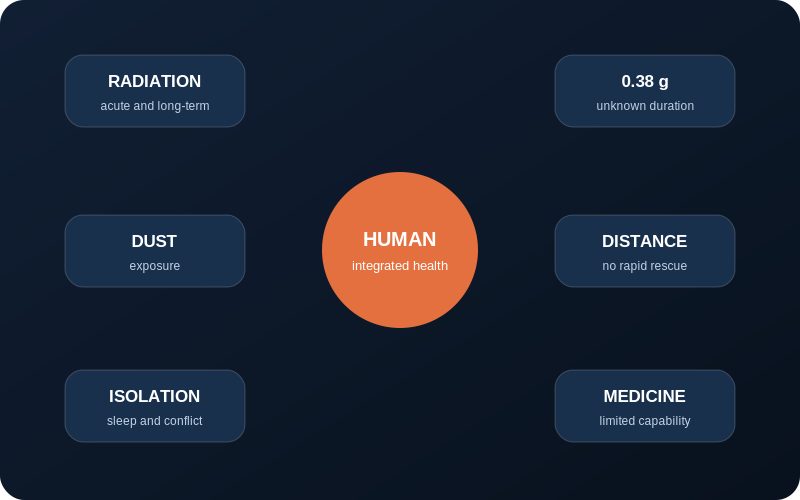
NASA’s Human Research Program describes five interacting hazards of human spaceflight: space radiation, isolation and confinement, distance from Earth, altered gravity fields, and hostile or closed environments. A Mars settlement adds vehicle loss, heavy-cargo entry/descent/landing, dust-driven power constraints, surface industry and long-term dependence on components that may be impossible to replace quickly.
A dust storm is therefore not merely “weather.” It can reduce sunlight, complicate surface operations, contaminate mechanisms, delay EVA work and consume reserves. A serious safety case asks what happens when dust, an electrical fault and a medical emergency overlap.
NASA Human Research Program — Five Hazards of Human Spaceflight.
For a settlement, risk is therefore a property of the whole system, not just of individual components. A battery can meet its specification and still fail the city if the same dust event reduces solar input, delays maintenance outside, increases heating demand and leaves no independent generation path. The safety case must trace common-cause failures and dependencies between power, air, water, thermal control, communications, mobility and medicine.
This changes the design question from “How reliable is this machine?” to “What essential services remain after this machine and one related subsystem are lost?” That distinction is crucial on Mars because rescue from Earth is not an operational option on the timescale of an emergency.
Propulsion failure, fire, structural breakup, loss of control and pad or ascent accidents. Safety requires qualification, instrumentation, abort logic and recovery planning.
Radiation, life-support degradation, fire, pressure leaks, micrometeoroids, medical emergencies, isolation and loss of propulsion or power. The spacecraft must be repairable from within.
Thermal loads, atmospheric dispersion, guidance errors, unstable deceleration and terminal propulsion. Human-class payload mass makes Mars EDL a major scaling challenge.
Depressurization, fire, dust, perchlorates, cold, radiation, power loss, airlock failures, water contamination and vehicle loss.
Unknown lifetime effects of 0.38 g, chronic disease, microbiome changes, population health, fatigue, spare-part shortages and organizational drift.
Two “redundant” machines are not truly independent if they share the same software defect, power bus, sensor, cooling line or irreplaceable component.
A launch system concentrates immense energy in a machine exposed to vibration, thermal gradients, pressure, rapidly changing aerodynamic loads and tightly sequenced software. The first line of protection is therefore disciplined engineering: qualification of components, integrated testing, failure-mode analysis, margins, instrumentation, anomaly detection and flight rules that allow a mission to be stopped when the data are no longer compatible with safety.
For a crewed vehicle, rescue must be treated as a complete function rather than as a magical “abort button.” Its effectiveness depends on altitude, velocity, trajectory, the ability of the crew vehicle to separate, recovery location, weather and the readiness of rescue teams. A human-rated architecture must therefore reason through survival windows across the whole ascent.
The cost of launch safety cannot be reduced to one universal figure. It is distributed across development, qualification vehicles, destructive and non-destructive testing, redundant equipment, abort capability, range safety and operations. Removing tests can lower visible short-term cost while increasing the probability of losing a vehicle, a crew and potentially the political continuity of the entire program.
Between planets, natural micrometeoroids must be distinguished from human-made orbital debris, which is concentrated mainly around Earth. Tiny particles can carry significant impact energy at high relative velocity. A deep-space vehicle should therefore avoid relying on one pressure shell as its only barrier: spaced shields, sacrificial layers, leak detection, isolatable volumes and repair materials all contribute to survival.
A puncture becomes dangerous through its chain of consequences: pressure loss, secondary fragments, damage to wiring or fluid loops, possible electrical fire and the time needed to locate and isolate the leak. Internal doors and pressure zones must allow the crew to abandon one volume without crossing the damaged area.
Distance from Earth changes medicine and maintenance just as radically. A serious medical event, computer fault or fire cannot be managed as if the crew were on a station a few hours from landing. Diagnostic tools, procedures, spare parts, medicines and decision authority must be available locally. Operational autonomy means that the crew and automated systems can stabilize a crisis before Earth can meaningfully advise them.
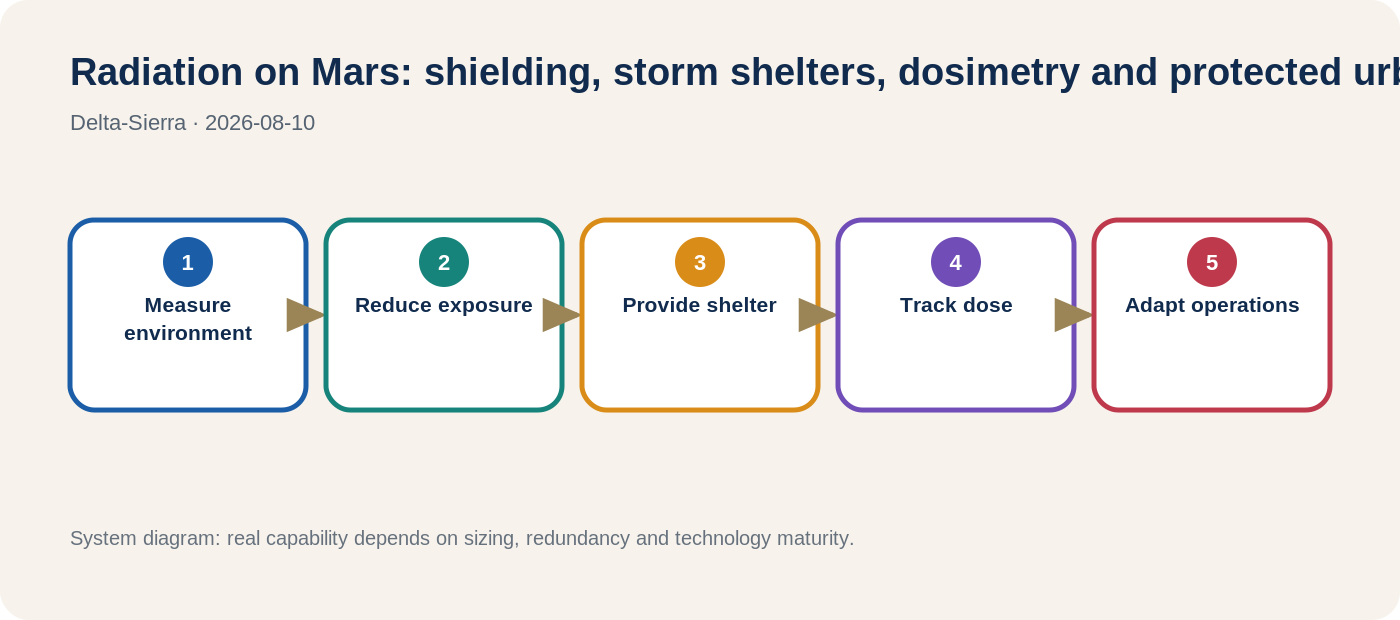
Radiation adds both a chronic and an acute threat. Galactic cosmic rays accumulate dose over long periods, while solar particle events can increase dose rates sharply. A rational architecture combines mission timing, dosimetry, exposure management and a more heavily shielded storm shelter. Water, food and other supplies can be arranged around that refuge so that mass already required for the mission also serves as shielding.
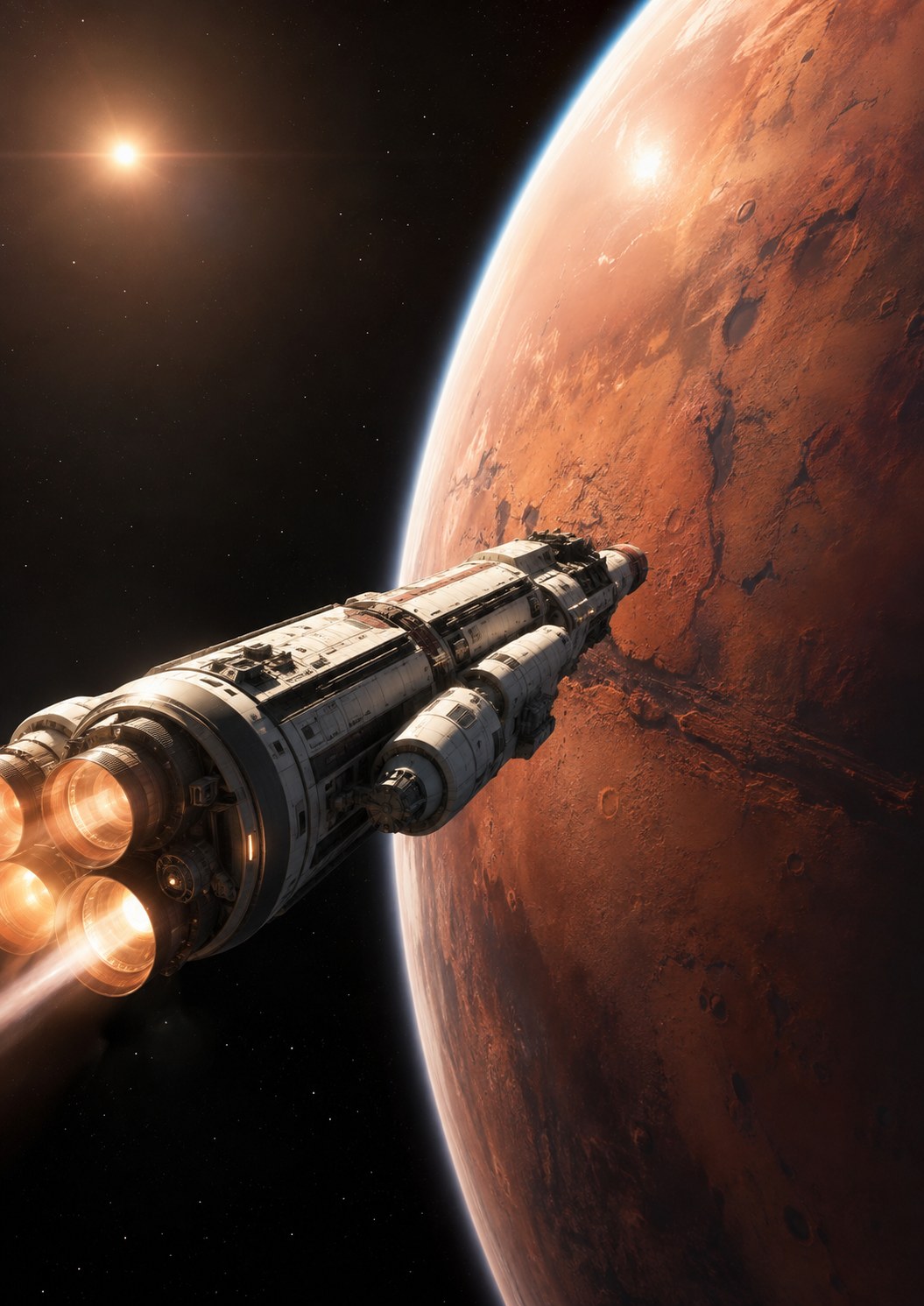
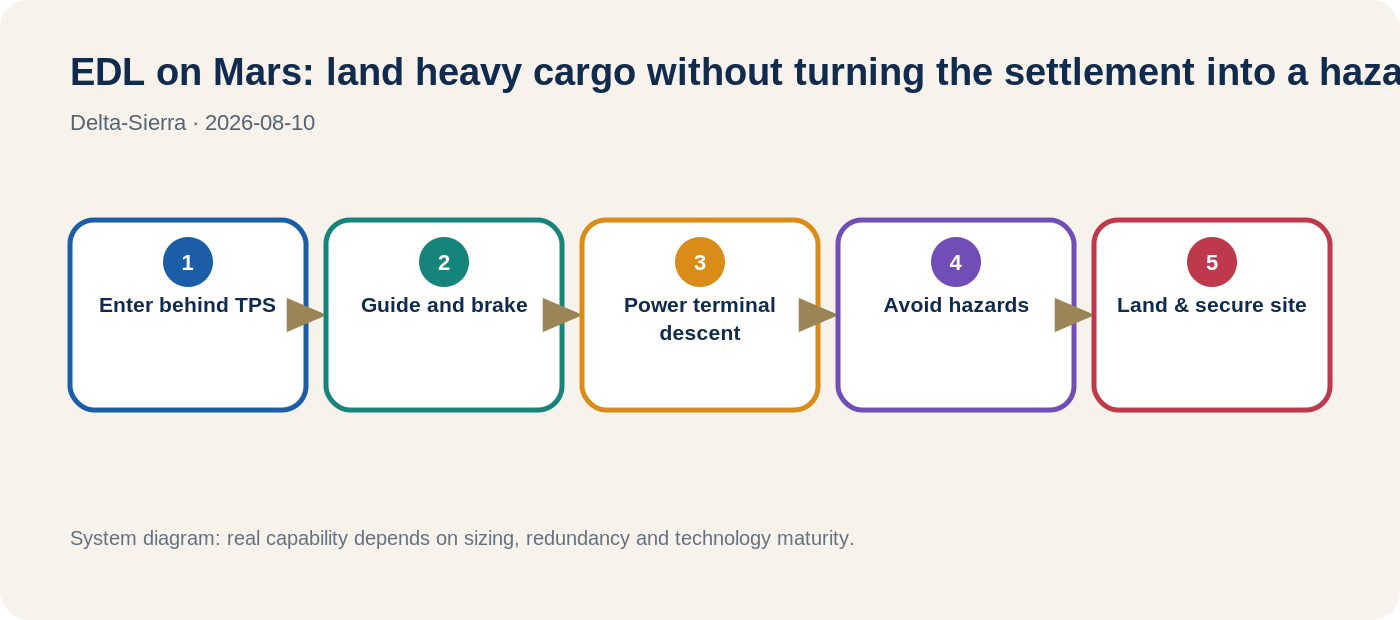
Mars has enough atmosphere to generate heating and aerodynamic drag but too little for parachutes alone to land very heavy human-class payloads gently. This “in-between” atmosphere makes EDL difficult to scale. A settlement also needs repeatability: cargo, power systems, rovers and people must land close enough for logistics but far enough away that plume effects, debris or a failed vehicle do not destroy the habitat.
That requirement changes city planning. Landing zones, navigation aids, surface routes and exclusion distances become part of settlement safety rather than mere transportation infrastructure.
NASA — Mars Entry, Descent and Landing Architecture White Paper.
A permanent settlement must repeat this operation many times. It is not enough to land one habitat: cargo vehicles, power units, rovers, industrial equipment and eventually crews must arrive near an occupied site without a failed vehicle, debris field or rocket plume destroying existing infrastructure.
Critical assets such as primary power, communications, water production and the main pressure volumes should not sit under the nominal path of incoming vehicles. A mature city therefore needs a geography of safety: distinct landing zones, diversion options, precision navigation, exclusion distances, logistics routes and quarantine areas.
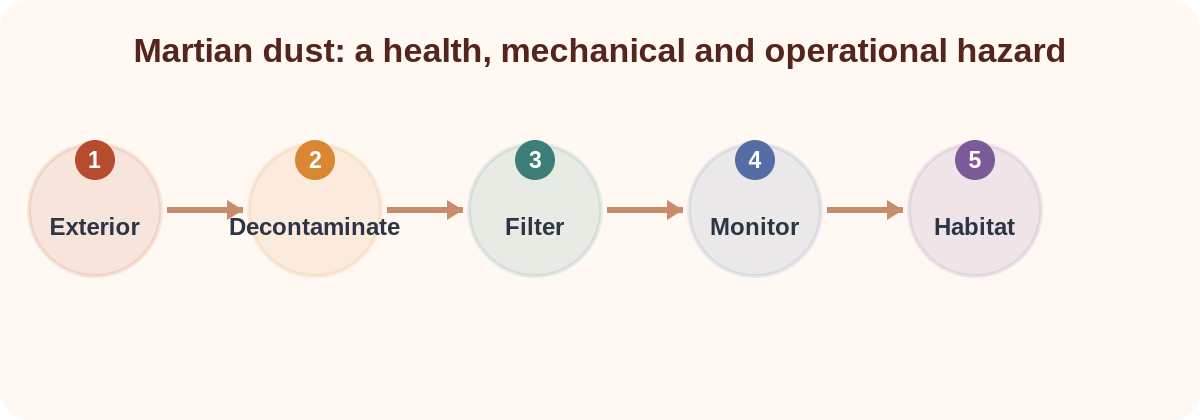
Because the Martian atmosphere is thin, wind does not push heavy structures the way a terrestrial hurricane can. Dust remains operationally important for different reasons: it can reduce solar illumination, coat surfaces, enter mechanisms, degrade visibility, contaminate airlocks and add maintenance load.
A credible solar architecture therefore needs an emergency energy budget rather than optimistic annual averages: storage, dispatchable generation, load shedding, panel cleaning or dust-tolerant geometries, weather forecasting and reserves. A mixed power architecture can reduce dependence on one environmental variable.
NASA Science — Mars Dust Storms.
A solar-only base must demonstrate that it can survive a credible worst combination of atmospheric opacity, panel degradation, low temperature and high demand. The answer is not simply “clean the panels”: it is an emergency energy budget with storage, dispatchable generation where available, load shedding, cleaning methods, forecasting and reserves. A mixed architecture can reduce dependence on one environmental variable.
Dust is also a health and contamination problem. Fine regolith should not circulate freely between the surface and living spaces. Airlocks, dirty zones, suit interfaces, filtration, cleaning procedures and material choices must form one coherent contamination-control chain.
Radiation protection must address both chronic galactic cosmic rays and episodic solar particle events. A practical strategy combines shielding, dosimetry, mission timing, limited EVA exposure and a more heavily protected storm shelter. Water and stored supplies can contribute useful shielding mass if the architecture is designed around them.
Mars surface gravity is about 38 percent of Earth’s. Humans have extensive microgravity experience, but not decades of life at 0.38 g. We therefore do not know whether Martian gravity is sufficient to preserve bone, muscle, cardiovascular function, vision, pregnancy or childhood development over a lifetime. The absence of data is itself a design uncertainty.
Partial gravity is especially uncertain because our evidence is asymmetric: we know much more about months in microgravity than about years at an intermediate gravity level. Research must therefore continue during settlement operations through bone and muscle monitoring, cardiovascular measurements, exercise protocols, nutrition studies and careful follow-up of any long-duration or multigenerational population.
Design must also account for transitions. After months in microgravity, a crew may arrive on Mars fatigued and deconditioned yet still need to respond immediately to landing anomalies, cargo handling or medical problems. The arrival architecture should not assume that every crewmember instantly performs like a healthy person on Earth.
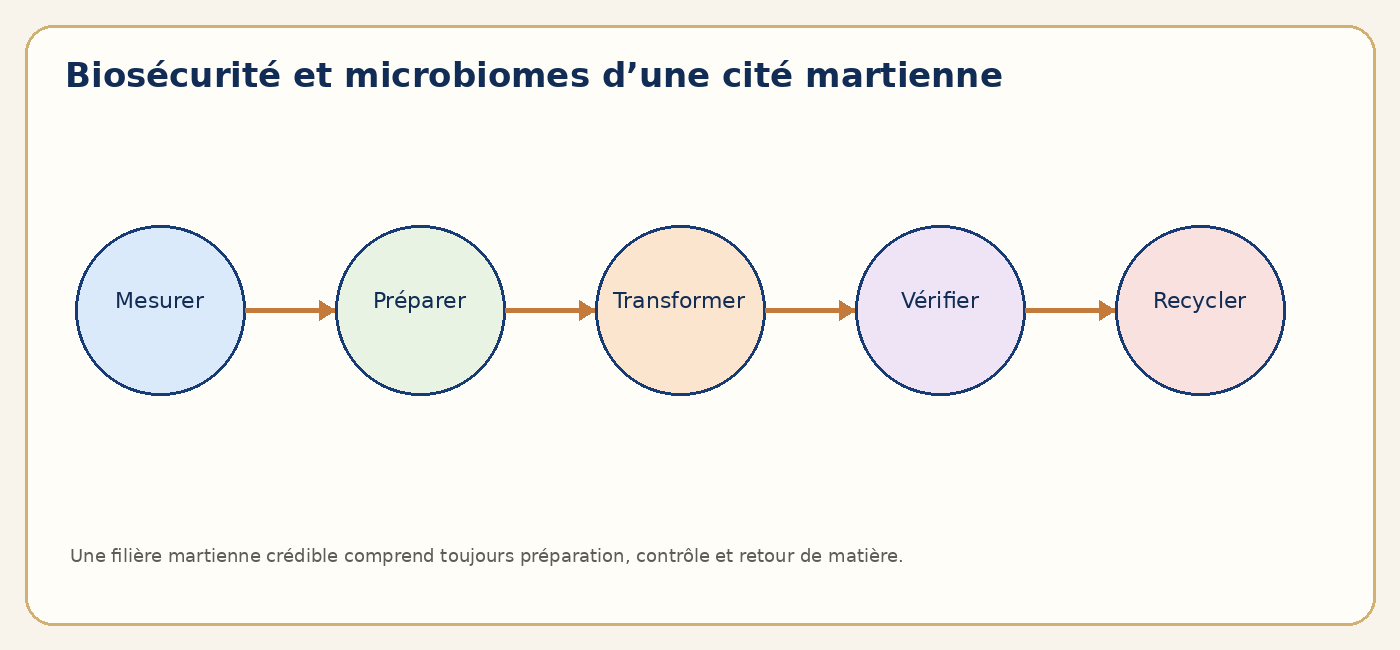
There is no evidence today that a Martian virus or bacterium capable of infecting humans exists. Treating it as an established hazard would be scientifically misleading. The immediate biological risks are terrestrial: human infection, transmission in closed volumes, antimicrobial resistance, contaminated water or food loops, changing indoor microbiomes and limited medical capacity.
Biosafety also protects science. If terrestrial microorganisms are dispersed into high-value astrobiology areas, a later biosignature may become difficult to interpret. Settlement zoning, sample chain-of-custody and planetary-protection procedures therefore have both medical and scientific value.
The practical defense is layered: vaccination where appropriate, quarantine rules, ventilation and filtration, water-quality monitoring, food safety, microbiological diagnostics, antimicrobial stewardship and the ability to isolate sick people without disabling the entire settlement. A closed habitat also needs surveillance of its own microbiome because selection pressures differ from those on Earth.
Planetary protection creates a second boundary. Samples from scientifically sensitive areas should not move casually through living quarters, and organisms from the settlement should not be allowed to erase the scientific meaning of pristine sites. Medical biosafety and astrobiology therefore meet in zoning, controlled sample flows and traceable chain-of-custody procedures.
The most dangerous event may be a combination no single component test reproduces: an electrical fire during a dust-driven power deficit while the rescue rover is unavailable, or contaminated water while a treatment unit is down. Safety engineering must ask how each failure is detected, how fast consequences develop, how the faulty branch is isolated, what degraded mode remains, and how the repaired system is verified before return to service.
That is the operational meaning of FDIR — Fault Detection, Isolation and Recovery.
Redundancy only helps when the redundant branch does not share the same hidden weakness. Two identical pumps may both fail because of the same dust ingress, software defect, manufacturing batch or contaminated lubricant. This is why common-cause failure analysis matters as much as counting backup units.
Emergency exercises should therefore combine problems deliberately: power loss plus oxygen-system degradation, fire plus depressurization, contaminated water plus treatment failure, or communications loss during a critical anomaly. The goal is to discover which procedures, sensors and reserves cease to work once assumptions about a single isolated fault are removed.
Early settlements will import many safety-critical components whose qualification is difficult: reliable electronics, sensors, membranes, pharmaceutical products, suit components, special valves and bearings. Local manufacturing should first target high-mass, inspectable items such as shielding, structural parts, supports, simple piping, road and landing-zone materials, and machined parts that can be measured reliably.
The important metric is critical dependence, not the percentage of mass produced locally. A city could make most of its annual tonnage on Mars yet remain vulnerable to one small imported catalyst, sensor or seal.
The frontier should move only when local production can be verified. Making a metal bracket is not the same as qualifying a pressure valve: material composition, heat treatment, machining, dimensional control, non-destructive inspection and traceability may all be required. Local manufacturing therefore depends on metrology and quality systems as much as on printers or machine tools.
Early inventories should prioritize items whose absence can disable several vital systems at once: seals, bearings, electronic modules, sensors, membranes, catalysts and medical supplies. The long-term objective is not to eliminate imports instantly but to identify each single-point dependency and progressively create alternatives.
There is no single “price of safety” for a Mars settlement. Safety is embedded in additional testing, reserve energy, extra pressure compartments, spare vehicles, medical capability, redundant communications, maintenance time, protective mass, inventory and the decision to keep some capacity unused during normal operations so that it is available during an emergency.
The correct economic question is therefore not how to minimize redundancy in isolation, but how much expected loss is avoided by a given layer of resilience. A backup power branch that looks expensive during normal operation may be cheap compared with the loss of a habitat, a trained crew and years of mission continuity.
Cost also changes over time. Early settlements will import expensive qualified hardware from Earth. As local industry becomes capable of producing, measuring and certifying simpler structural items, shielding, pipes, supports and replacement parts, the same level of resilience can become less dependent on launch mass. The city should track this transition explicitly rather than claiming a vague percentage of “autonomy.”
A resilient Mars city is not invulnerable. It can lose a building, power branch or industrial line without losing breathable atmosphere and water for everyone. It has separated reserves, compartmented pressure volumes, multiple distribution paths, repair workshops, medical capacity, offline procedures, cross-trained crews and refuges. It measures what it cannot yet know and updates the architecture as evidence accumulates.
Resilience also requires physical separation. Water reserves should not all sit behind one valve, oxygen production should not depend on one electrical bus, and every refuge should not rely on the same ventilation train. A settlement begins to resemble a city only when losing one district, plant or distribution corridor does not immediately threaten everyone.
Finally, resilience is a learning process. Every anomaly, near miss and maintenance intervention should update procedures, spare inventories, training and design. Mars will contain unknowns that cannot be removed on paper; the responsible response is to instrument them, measure them and build enough margin to learn without turning every surprise into a catastrophe.
These dossiers move from isolated hazards to failure chains: detection, time available, degraded mode, repair and recovery.