


MARS BIBLE — RISK & RESILIENCE DOSSIER
Major solar particle event: warning, storm shelter and radiation survival on the way to Mars
Solar particles require a time-critical defense: monitor, decide quickly and reach a better-shielded volume.
Beyond Earth’s magnetosphere, a crew is exposed to solar particle events. Protection cannot be reduced to one metal thickness: monitoring, dosimetry, a prebuilt storm shelter and emergency procedures have to work together.
Two different radiation problems
Solar particle events are acute episodes linked to solar activity. They differ from galactic cosmic rays, which are more continuous and harder to shield. A design effective against one is not automatically optimal for the other.
This distinction prevents the simplistic claim that a thicker wall solves everything. Material choice, geometry, available mass and secondary radiation matter.
The storm shelter must exist before the warning
Once an event is detected, it is too late to build a refuge. The vehicle should already include a zone surrounded by useful mass: water, food, consumables and equipment can be arranged around a compact refuge.
The volume still has to be habitable during sheltering: ventilation, carbon dioxide removal, temperature control, electrical power, communications, sleep and medication remain necessary.
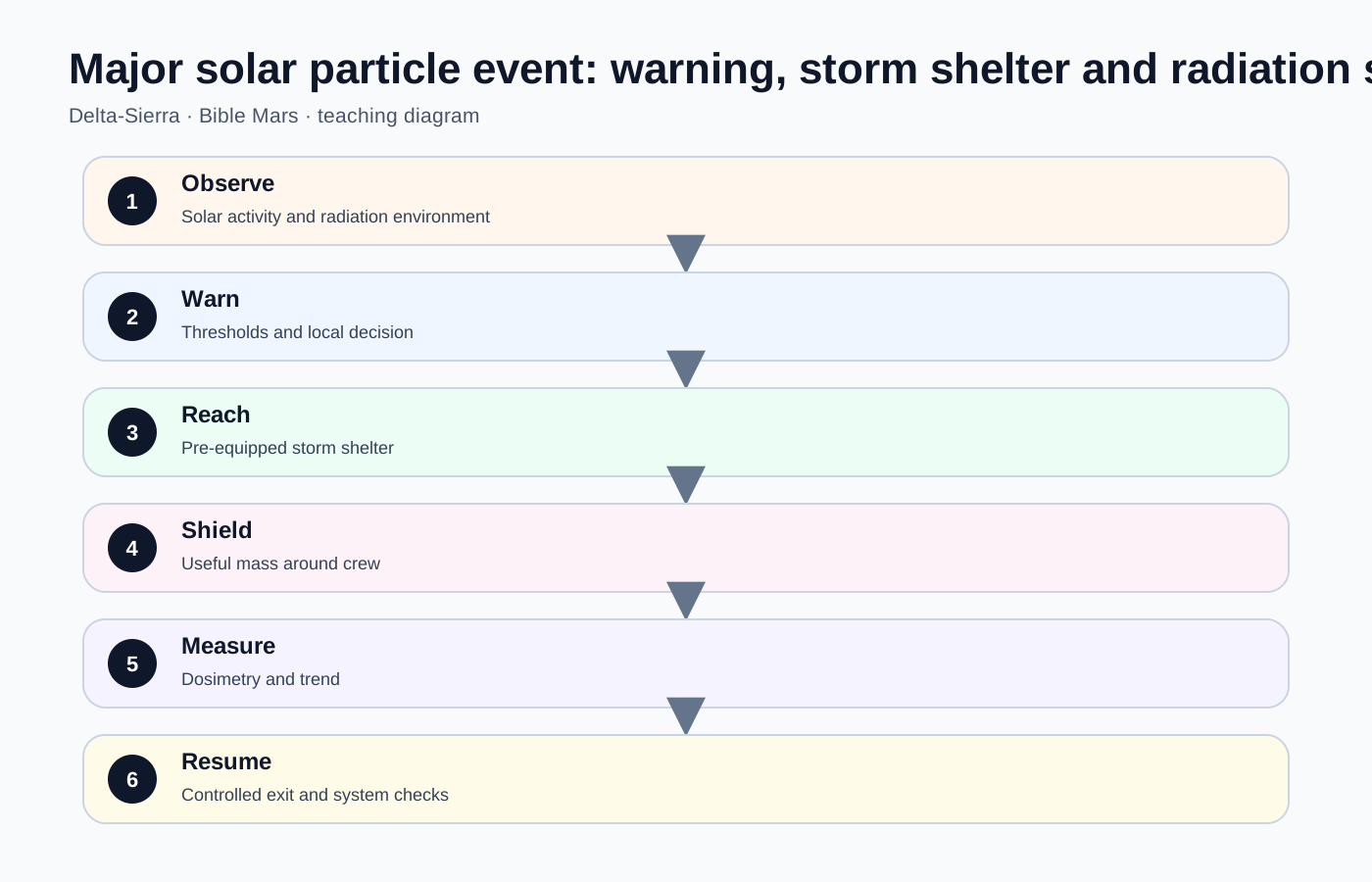
Warning becomes an operational procedure
The chain is solar observation → risk estimate → action threshold → sheltering → dosimetry → controlled exit. False positives, false negatives and delayed Earth communications must all be considered.
Mars lacks a global magnetic field and has a thin atmosphere, so surface operations must treat space weather as a real operational constraint, especially for EVA.
Do not confuse dose and dose rate
Dose rate tells how quickly exposure is accumulating; cumulative dose integrates exposure over time. A fast increase can justify sheltering before total dose becomes dangerous.
In Mars Academy this becomes a natural teaching case for units, accumulation and the difference between an instantaneous quantity and an integrated quantity.
Resilience protects people and electronics
Energetic particles can also affect electronics. Vital functions need fault detection, safe states, controlled restart and enough recorded data to understand the event afterwards.
- rapidly accessible shelter;
- personal and area dosimetry;
- EVA return procedure;
- life-support functions available in shelter;
- exit criteria and medical follow-up.
Dose = dose rate × time: learning to reason with exposure
A settlement should log warning time, shelter-entry time, measured dose rate, cumulative dose and exit criteria. These quantities make the emergency auditable rather than anecdotal.
The same calculation should always be repeated with an adverse assumption, followed by the question: what real measurement could confirm or reject that assumption? A calculation teaches as much through its limits as through its numerical result.
The dossier keeps measured data, published values, design assumptions and teaching scenarios visibly separate. Mixing those statuses would create false precision.
From calculation to action
Measurement itself needs resilience: backup sensing, independent confirmation, calibration range and a defined response when data are missing. An alarm with no strategy for sensor failure can increase risk.
What must be tested before depending on it
Run the scenario using real hardware or a representative twin, then repeat it with one additional failure. Measure diagnosis time, human errors, consumable use and ability to return to nominal conditions.
Results then update inventory, procedures and design. Safety becomes a learning loop rather than a document frozen before departure.
Questions never to skip
- What event actually starts the failure chain?
- Which functions are lost immediately, then after 10 minutes, 1 hour and 24 hours?
- Which redundant units still share power, software, location or maintenance?
- What degraded mode remains genuinely habitable?
- What must be repairable locally without waiting for Earth?
This dossier in the settlement
Scientific and technical sources
The sources below support the physical phenomena and safety building blocks; settlement architecture remains an explicitly identified prospective synthesis.
- NASA — Protect Astronauts from Space Radiation on Mars
- NASA — Scientists Gear Up for Solar Storms at Mars