


MARS BIBLE — RISK & RESILIENCE DOSSIER
Contaminated water on Mars: when a recycling loop becomes a system risk
Recovering nearly all water is remarkable; keeping it safe for years is harder.
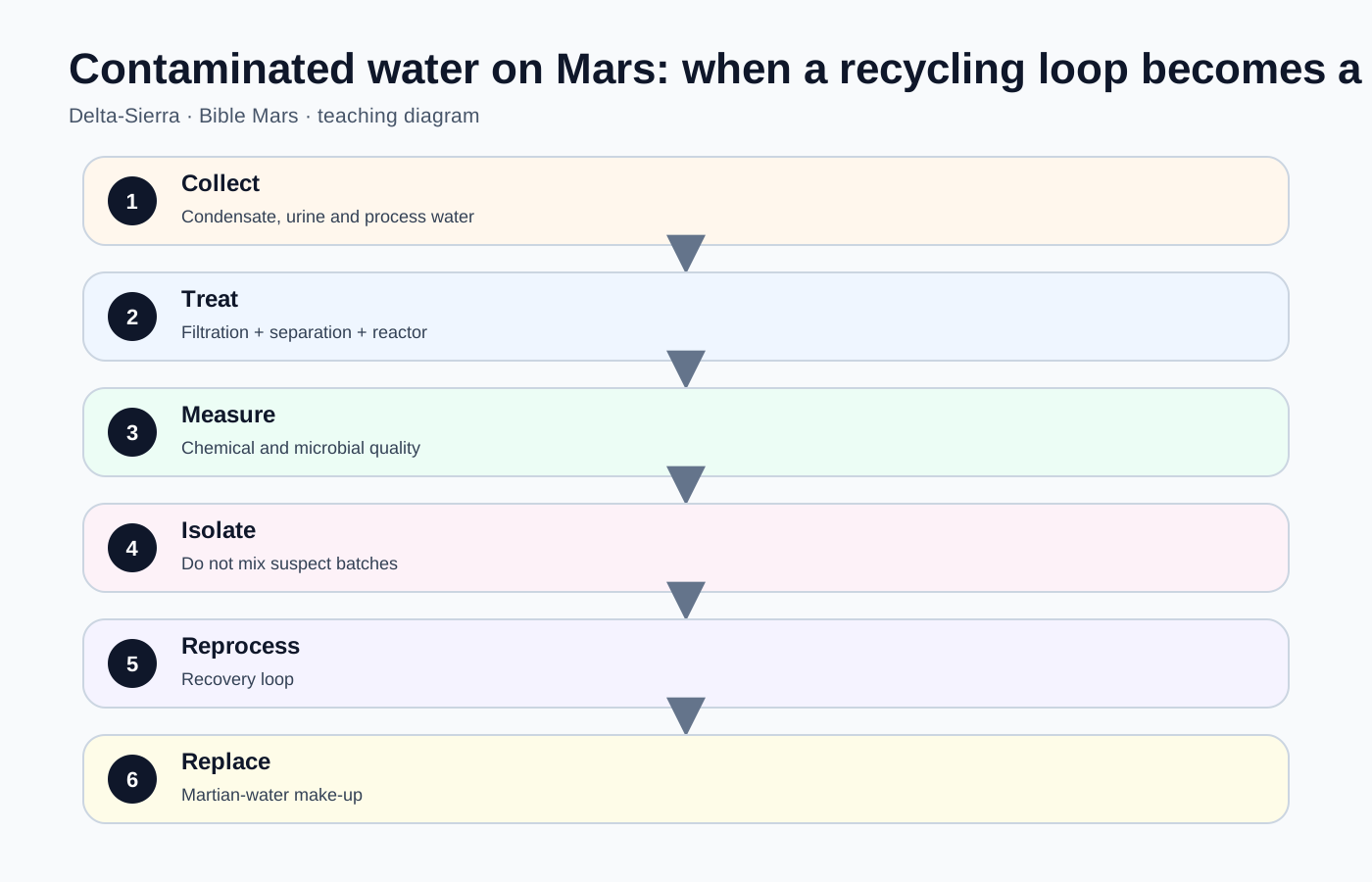
A Mars settlement cannot treat water as an ordinary consumable. Chemical or microbial contamination can affect a tank, treatment unit or closed network; the system must detect, isolate, reprocess and replenish.
98%: 98% of what exactly?
NASA demonstrated about 98% overall water recovery on the ISS, helped by the Brine Processor Assembly. This means a very large fraction of defined collected streams can be returned to usable water. It does not mean that 98% of every water flow in a Martian city remains available forever.
Scope matters: agriculture, industry, cleaning, leakage, water trapped in wastes, maintenance and purges add other flows. A settlement needs a full mass balance: inputs, reuse, identified losses and uncertainty.
Where are the 2%?
In a real loop, the final percentages can remain in concentrated residues, brines, filters or be lost during operations and maintenance. As more water is removed from residual streams, salts and contaminants become more concentrated, potentially increasing fouling, corrosion and treatment difficulty.
Therefore 100% is not automatically optimal. Compare energy, mass, consumables, maintenance and failure risk required to gain the final fraction with the alternative of replacing a small irreducible loss using Martian water.
Quality matters as much as quantity
A full tank of unsafe water is not a reserve. Potable-water treatment needs chemical and microbial monitoring and must reprocess water that fails criteria. NASA describes specialized filtration, catalytic treatment and purity sensing on ISS.
A robust Mars system should isolate a suspect batch before it contaminates all reserves. Multiple tanks and treatment paths can be safer than one highly optimized common volume.
Scenario: the sensor says good, the water is bad
The dangerous failure is not always a stopped pump. A biased sensor can pass nonconforming water. Calibration, independent measurement, reference samples and laboratory capability are therefore safety functions.
This also reveals common cause: two identical sensors calibrated with the same method or reagent may fail together. Metrological diversity becomes a barrier.
Recovery plan
After detection: stop mixing batches, define the affected boundary, secure known-good potable water, calculate minimum use, reprocess where possible and start local replenishment. Water crisis is therefore tied to energy, inventory, ISRU and health.
- compartmented tanks;
- diverse sensors and analyses;
- reprocessing capacity;
- certified buffer reserve;
- Martian extraction sized to replace real losses.
Calculate make-up water over one month
This is why the Academy doctrine asks 'where are the losses?' Every percentage must be converted back into physical inventory over a relevant time period.
The same calculation should always be repeated with an adverse assumption, followed by the question: what real measurement could confirm or reject that assumption? A calculation teaches as much through its limits as through its numerical result.
The dossier keeps measured data, published values, design assumptions and teaching scenarios visibly separate. Mixing those statuses would create false precision.
From calculation to action
Measurement itself needs resilience: backup sensing, independent confirmation, calibration range and a defined response when data are missing. An alarm with no strategy for sensor failure can increase risk.
What must be tested before depending on it
Run the scenario using real hardware or a representative twin, then repeat it with one additional failure. Measure diagnosis time, human errors, consumable use and ability to return to nominal conditions.
Results then update inventory, procedures and design. Safety becomes a learning loop rather than a document frozen before departure.
Questions never to skip
- What event actually starts the failure chain?
- Which functions are lost immediately, then after 10 minutes, 1 hour and 24 hours?
- Which redundant units still share power, software, location or maintenance?
- What degraded mode remains genuinely habitable?
- What must be repairable locally without waiting for Earth?
This dossier in the settlement
Scientific and technical sources
The sources below support the physical phenomena and safety building blocks; settlement architecture remains an explicitly identified prospective synthesis.