


MARS BIBLE — RISK & RESILIENCE DOSSIER
Critical part unavailable on Mars: surviving when repair or evacuation is impossible
Distance turns logistics into life support: a component weighing a few hundred grams can stop a machine weighing tonnes.
A Mars settlement cannot assume every failure can be repaired with one identical spare. Some failures affect design, procedures, spare parts or the tools themselves. Local diagnosis, adaptation and manufacturing become survival capabilities.
The spare-parts trap
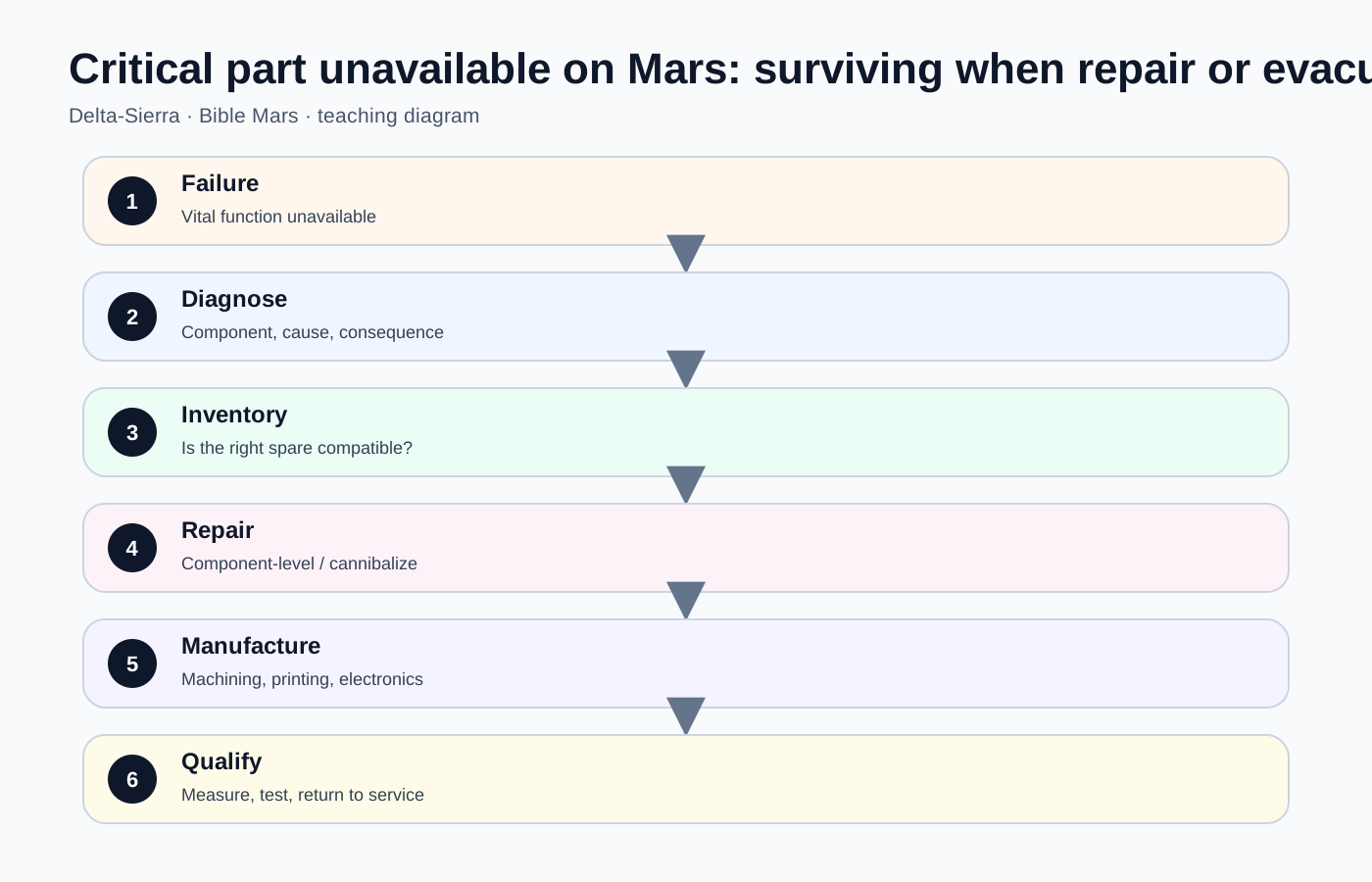
Carrying many spares reduces some risks but does not guarantee the right component is available. NASA has explicitly examined why Mars missions cannot assume every failure can be repaired using a small stock of identical spares.
A low-mass part can be critical if it is unique, difficult to fabricate, impossible to bypass or stops an entire chain. Inventory therefore has to be classified by function and consequence, not just weight or price.
Repair at a lower level
Robust repair sometimes means going below full-module replacement: seal, bearing, sensor, board, connector, winding or sealing surface. That requires documentation, measurement, tools and skills.
Other hardware is not reasonably repairable locally. The boundary must be explicit before departure: what can be diagnosed, disassembled, refurbished, printed, machined or cannibalized?
Cannibalize without destroying the future
A failed machine can become a source of parts, but cannibalization consumes future capability and shifts risk. Decisions should record which functions are lost, which parts were recovered and which scenarios are no longer possible.
A Mars city should think in terms of technical capital: machines, materials, software, documentation and expertise together create resilience.
When evacuation is not an option
Mars distance means an emergency cannot be solved by a quickly arriving medical aircraft or specialist. Even Earth communication can have a long round-trip delay. Crew therefore need local competence and authority.
Earth mission control can advise, analyze and prepare, but some critical decisions must be made locally before a response can return.
Build an economy of repairability
Over time, autonomy requires workshops, metrology, material stock, additive manufacturing, machining, electronics and test procedures. The goal is not to manufacture a complete rocket engine immediately, but to expand the fraction of failures recoverable locally.
- critical-parts list and replacement lead times;
- offline-accessible drawings and documentation;
- tools capable of repairing tools;
- standardized raw materials;
- tests that qualify locally made parts.
Part mass does not measure criticality
A repairability register should therefore include lead time, substitute options, repair level, required tools, test method and the number of other functions that depend on the same part.
The same calculation should always be repeated with an adverse assumption, followed by the question: what real measurement could confirm or reject that assumption? A calculation teaches as much through its limits as through its numerical result.
The dossier keeps measured data, published values, design assumptions and teaching scenarios visibly separate. Mixing those statuses would create false precision.
From calculation to action
Measurement itself needs resilience: backup sensing, independent confirmation, calibration range and a defined response when data are missing. An alarm with no strategy for sensor failure can increase risk.
What must be tested before depending on it
Run the scenario using real hardware or a representative twin, then repeat it with one additional failure. Measure diagnosis time, human errors, consumable use and ability to return to nominal conditions.
Results then update inventory, procedures and design. Safety becomes a learning loop rather than a document frozen before departure.
Questions never to skip
- What event actually starts the failure chain?
- Which functions are lost immediately, then after 10 minutes, 1 hour and 24 hours?
- Which redundant units still share power, software, location or maintenance?
- What degraded mode remains genuinely habitable?
- What must be repairable locally without waiting for Earth?
This dossier in the settlement
Scientific and technical sources
The sources below support the physical phenomena and safety building blocks; settlement architecture remains an explicitly identified prospective synthesis.