


MARS BIBLE — RISK & RESILIENCE DOSSIER
Launch to Mars: failures, emergency abort and survival before orbit
A Mars mission can fail before leaving Earth; abort therefore has to be designed as a chain of functions, not a magic button.
Launch compresses propulsion, structures, aerodynamics, guidance and separation into minutes. For a crew, reducing failure probability is not enough: the architecture must also define what can still be saved after a failure begins.
Why launch is a system risk
On the pad and during ascent, several subsystems operate near demanding limits. An engine anomaly can become a trajectory loss; trajectory loss can trigger abort; abort can place the crew vehicle in a difficult aerodynamic or thermal condition. The hazard is therefore a chain, not a set of independent boxes.
A Mars architecture should separate tolerable faults, failures requiring engine shutdown, loss of launch vehicle with crew recovery still possible, and catastrophic events for which no credible recovery exists. That hierarchy prevents a backup that only covers one narrow failure family from being called full redundancy.
Abort means reaching a survivable trajectory
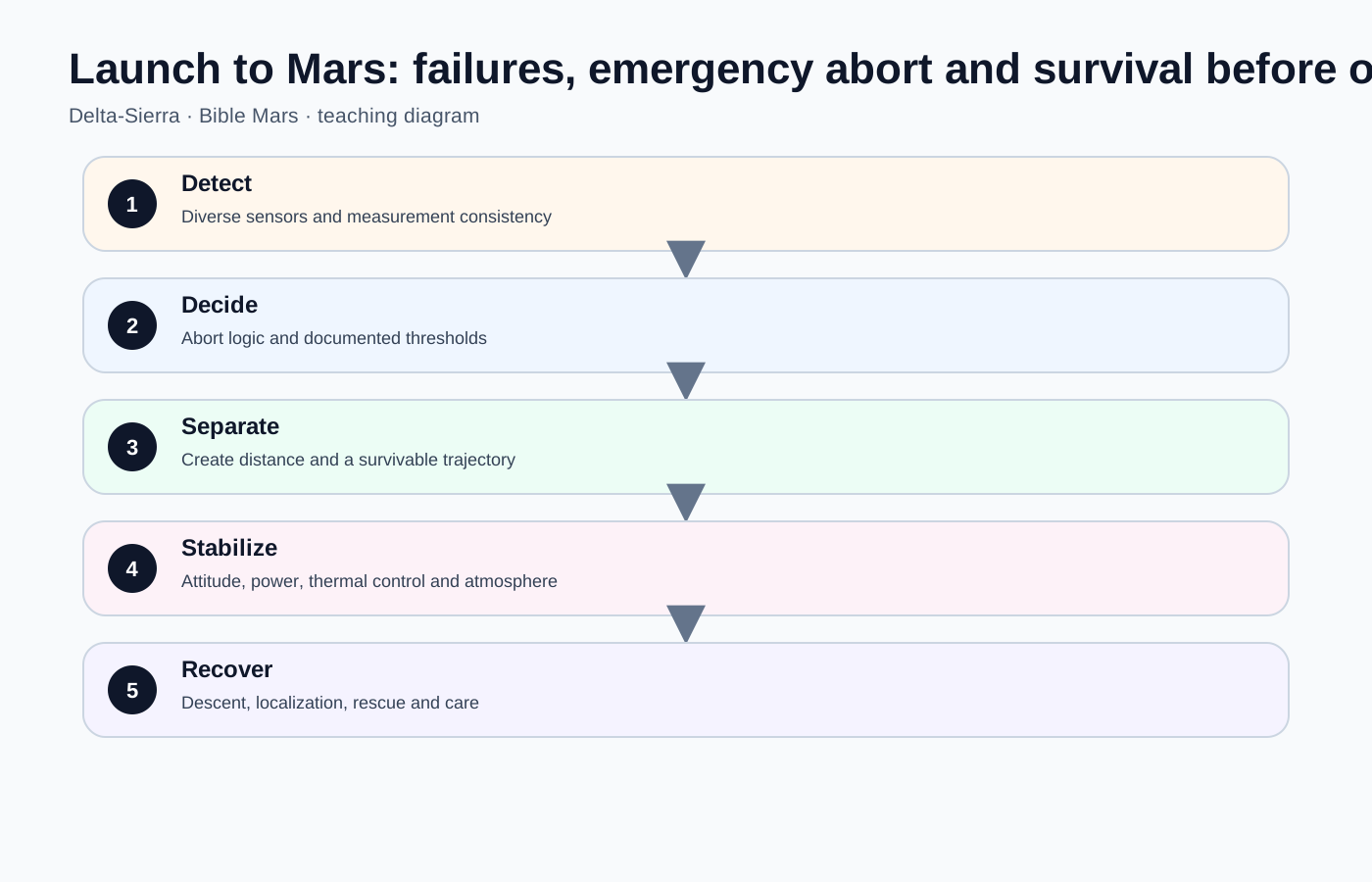
An abort system does not teleport a crew to safety. It must separate the crew vehicle, stabilize it, survive loads and then reach conditions in which parachutes, propulsion or splashdown can work. Each phase of ascent therefore has different initial conditions and limits.
The useful teaching question is: at this exact instant, what energy, altitude and velocity does the vehicle have, and where can it physically go? This connects safety directly to mission engineering and trajectory mechanics.
Time is a resource
For a slowly developing failure, seconds may allow sensor confirmation, branch isolation or throttling. During a rapid breakup, the window may be too short for human validation. Designers must therefore decide which protections are automatic, which require multiple confirmations and which can be inhibited by the crew.
Automation is not immunity. A faulty rule can trigger when it should not, or fail to trigger. Diverse sensing, documented thresholds and tests that combine sensor error with hardware failure are therefore part of the safety case.
After abort, survival continues
A crew vehicle that has escaped the booster still needs breathable atmosphere, power, communications, thermal control and localization. The terrestrial recovery network is therefore part of the launch safety architecture, not an afterthought.
Resilience is the complete chain: detection → decision → separation → control → descent → landing/splashdown → recovery and medical care. A missing link turns a theoretical capability into false reassurance.
What must be demonstrated before flight
The case cannot be reduced to saying that two systems exist. Their independence, operating envelopes, transitions, power supplies, software and failure consequences must be understood.
- map failure modes and abort windows;
- test transitions at representative conditions;
- identify common causes shared by launch vehicle and crew vehicle;
- prepare real recovery and medical response;
- retain explicit no-go criteria when margins disappear.
Read an emergency as a timeline
Abort logic becomes easier to understand when it is drawn as a timeline. At t = 0 seconds a sensor detects an anomaly. At t = 0.2 seconds a computer may have compared several measurements. At t = 1 second separation might begin. These values are illustrative, not claimed performance of any real vehicle; they show why fractions of a second may matter.
For teaching, assume a vehicle is already moving at 1,500 metres per second. If we simplify by holding speed constant for four seconds, distance is d = v × t. The letter d means distance, v speed and t time. The result is 1,500 × 4 = 6,000 metres, or six kilometres. A real launch continuously changes speed, so this is only an intuition-building calculation.
The next question is whether the vehicle remains inside a survivable abort envelope during those seconds: dynamic pressure, attitude, altitude and available recovery modes all change. Abort is therefore an envelope, not a single number.
What a test team should deliberately break
Safety is not demonstrated only by successful nominal runs. Testing should inject faults: inconsistent sensor, lost power feed, delayed command, engine response error and missing data. The purpose is to see whether the architecture turns a small anomaly into a catastrophic decision.
Tests should also target boundaries: immediately before and after mode changes, staging, guidance transitions and power-source transfers. System accidents often hide at transitions because several assumptions change together.
Tests must leave usable evidence: raw measurements, software version, hardware configuration, timeline and rationale for thresholds. Without traceability, a successful test teaches little to the next engineer.
What remains uncertain after extensive testing
No test program can reproduce every combination. Safety therefore uses layers: demonstration, analysis, margins, diversity, inspection, operating rules and fallback capability. Low probability never means impossibility.
For Mars missions this matters because successful earlier flights build confidence but do not prove that a new vehicle version, payload, software build or trajectory has exactly the same risk.
Questions never to skip
- What event actually starts the failure chain?
- Which functions are lost immediately, then after 10 minutes, 1 hour and 24 hours?
- Which redundant units still share power, software, location or maintenance?
- What degraded mode remains genuinely habitable?
- What must be repairable locally without waiting for Earth?
This dossier in the settlement
Scientific and technical sources
The sources below support the physical phenomena and safety building blocks; settlement architecture remains an explicitly identified prospective synthesis.