


MARS BIBLE — RISK & RESILIENCE DOSSIER
Micrometeoroids en route to Mars: puncture, leakage and spacecraft protection
At hypervelocity, a tiny particle can become a structural, atmospheric and survival problem.
Interplanetary transit exposes a spacecraft to natural particles that cannot be removed from the environment. A realistic strategy combines risk characterization, shielding, compartmentation, impact detection, leak localization and repair capability.
A grain can carry substantial energy
Hazard is driven not only by projectile mass but by relative velocity. Kinetic energy grows with the square of speed: at the same mass, doubling speed multiplies energy by four. A very small object can therefore perforate or spall a wall at hypervelocity.
Near Earth, NASA addresses natural micrometeoroids and orbital debris together as MMOD. Artificial debris is not the same dominant issue in interplanetary cruise, but hypervelocity impact physics and protection methods provide a valuable engineering foundation.
Shielding is not simply a thicker plate
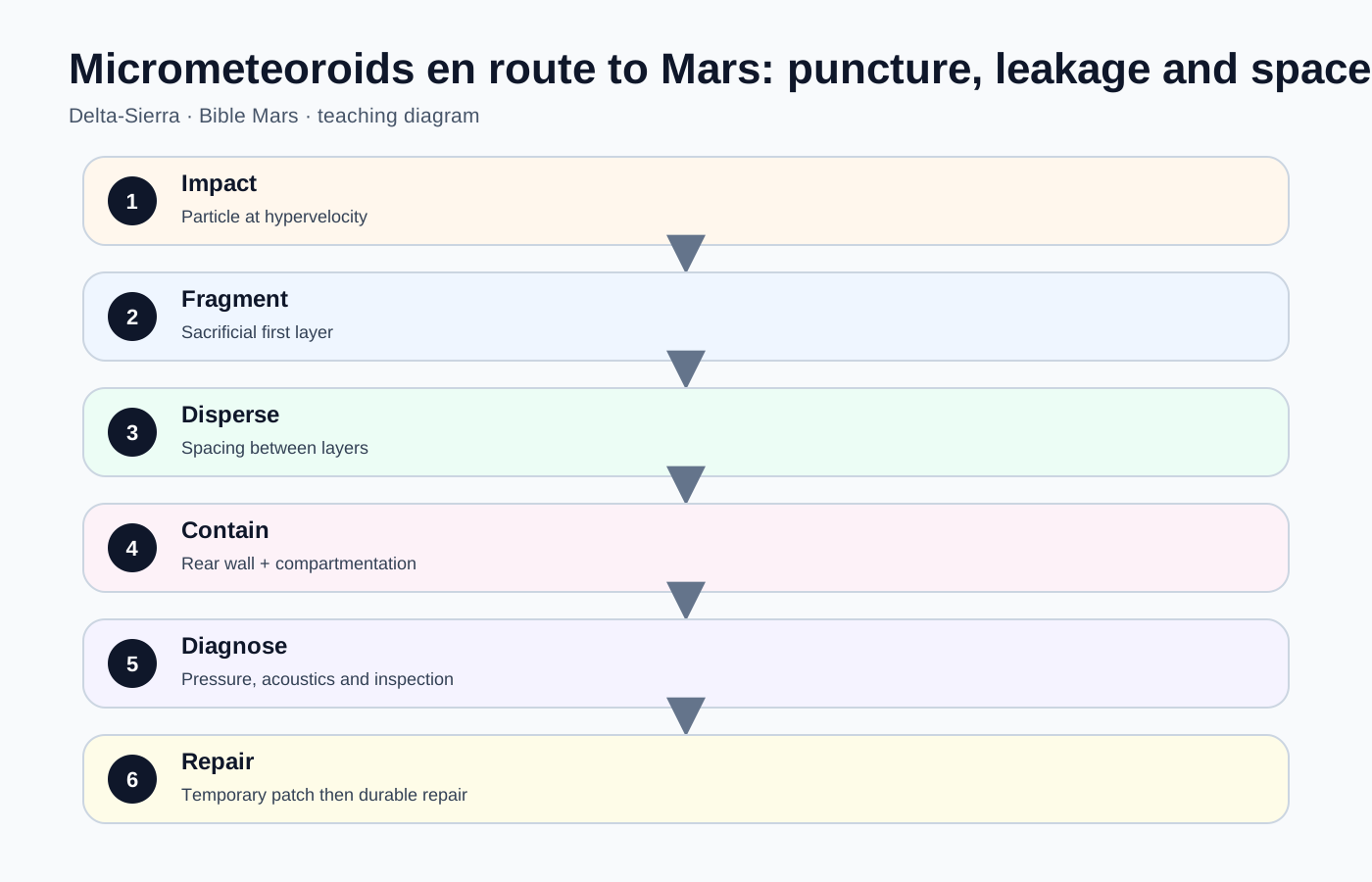
Protection can use multiple spaced layers. The first layer fragments or vaporizes part of the projectile; spacing lets the debris cloud spread; a rear wall then receives a less concentrated load. The goal is survivability without making the spacecraft prohibitively heavy.
Sizing depends on expected size and velocity distributions, vehicle orientation, mission duration and the criticality of hardware behind each wall. A tank, sleeping volume and flight computer need not accept the same residual risk.
Detect the puncture before it becomes major depressurization
An impact may be obvious or may only create a small hole. A slow leak becomes a diagnostic problem: pressure trend, flow balance, acoustic sensing, local sensors and inspection must narrow down the location.
Compartmentation matters. Without isolation, one local hole can threaten the full habitat. With pressure doors and separate volumes, the crew may turn hull loss into loss of one compartment — provided the remaining volume still has adequate oxygen, power and habitability.
Repair under constraint
Finding the hole is only half the problem. The crew may need to stabilize pressure, use breathing equipment, install a temporary plug, verify residual leakage and then make a durable repair.
Repair kits must fit multiple geometries and materials. Procedures must be tested with gloves, poor access, noise, stress and degraded lighting. A repair that is perfect on an Earth workbench may be unusable behind a cabinet in a pressurized vehicle.
Protection is a chain of barriers
Shielding, detection, isolation and repair are separate barriers. None should justify neglecting the others. The resilience question is: if the shield is penetrated, what happens next?
- add protection around vital functions;
- avoid placing all redundant units behind the same wall;
- provide localization sensors and procedures;
- isolate damaged volumes;
- carry or manufacture repair capability.
Teaching calculation: why speed changes everything
Kinetic energy is E = ½ × m × v². E is energy in joules, m mass in kilograms, v speed in metres per second, and the small ² means speed is multiplied by itself.
Take a teaching projectile of 1 gram, or 0.001 kilogram, moving at 10,000 metres per second. The calculation is ½ × 0.001 × 10,000² = 50,000 joules, or 50 kilojoules. Ten kilometres per second is the order of magnitude NASA cites for MMOD around Earth; it is not claimed here as the speed of every particle on a Mars cruise.
If speed were halved, energy would fall by a factor of four because speed is squared. That relationship explains why a tiny mass can require sophisticated protection.
From puncture to atmosphere loss: think in barriers
After penetration, the scenario depends on hole size and shape, internal pressure, compartment volume and isolation capability. A slow leak may allow minutes or hours; a large rupture changes the timescale entirely.
The settlement therefore needs a valve and pressure-door map much as a ship uses watertight compartments. Leak localization, closure order and refuge volume must be known before the accident.
Crew must also verify the repair: pressure stabilization, local leak test, hours of monitoring and structural inspection around the impact.
What shielding mass should protect first
Equal shielding everywhere is not necessarily rational. A sleeping area can be reorganized after damage; an oxygen line, tank, flight computer or unique cable may be much more critical.
MMOD mapping should therefore be crossed with a criticality map. What lies behind each wall matters as much as the wall itself — a concrete application of systems engineering to a physical hazard.
Questions never to skip
- What event actually starts the failure chain?
- Which functions are lost immediately, then after 10 minutes, 1 hour and 24 hours?
- Which redundant units still share power, software, location or maintenance?
- What degraded mode remains genuinely habitable?
- What must be repairable locally without waiting for Earth?
This dossier in the settlement
Scientific and technical sources
The sources below support the physical phenomena and safety building blocks; settlement architecture remains an explicitly identified prospective synthesis.