


MARS BIBLE — RISK & RESILIENCE
Airlock failure on Mars: doors, pressure, interlocks, and emergency access
An airlock is a machine that connects two incompatible worlds: a pressurized habitat and the near-vacuum-like Martian environment.
Airlocks support EVA, crew return, cargo transfer, and sometimes access to pressurized vehicles. A jammed door, dust-contaminated seal, stuck valve, or contradictory sensor can strand a crew outside or prevent an emergency exit.
Why an airlock concentrates risk
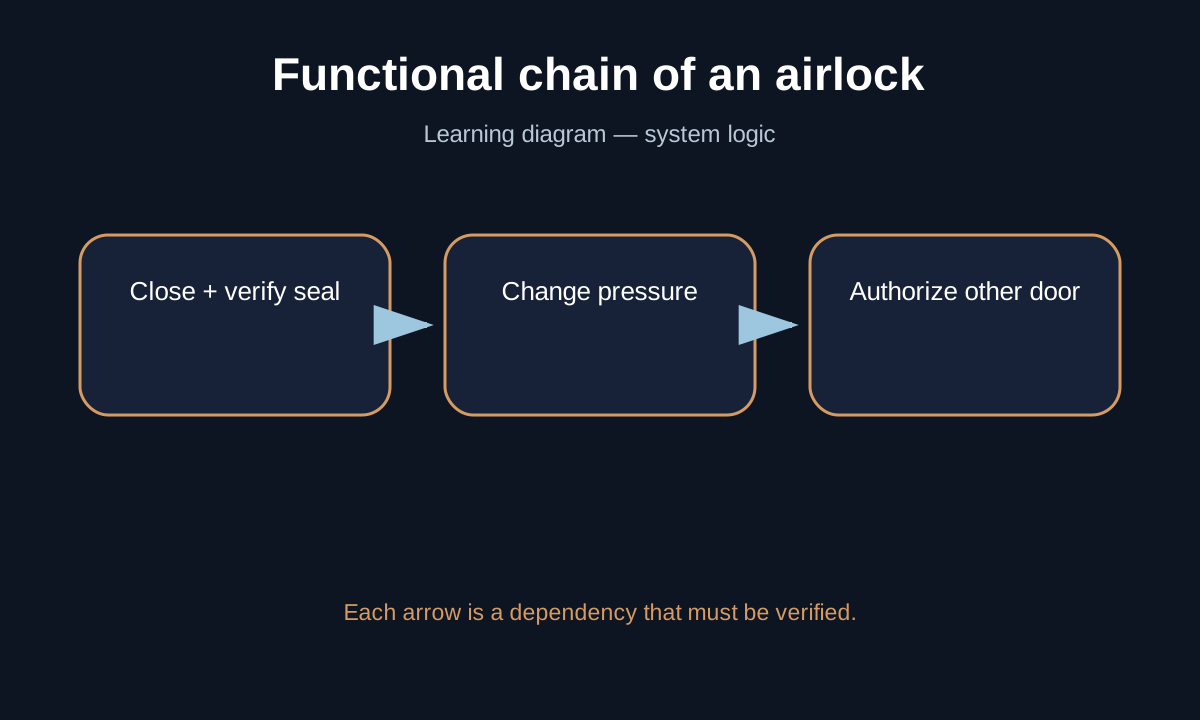
An airlock combines mechanisms, sealing, pressure control, electrical power, control logic, communications, and disciplined procedures. It must prevent incompatible doors from opening together while still allowing recovery if the automatic logic itself fails.
The most dangerous failure may be gradual rather than dramatic. A damaged seal can slow repressurization; abrasive dust can increase leakage over repeated cycles; one sensor can report safe pressure while another disagrees. Procedures need a rule for resolving that conflict with independent evidence.
Interlocks: prevent error without creating a trap
An interlock blocks a hazardous action, such as opening the outer door while the chamber remains pressurized. If the interlock relies on one computer or one sensor, however, its own failure can prevent any opening while the crew is in danger.
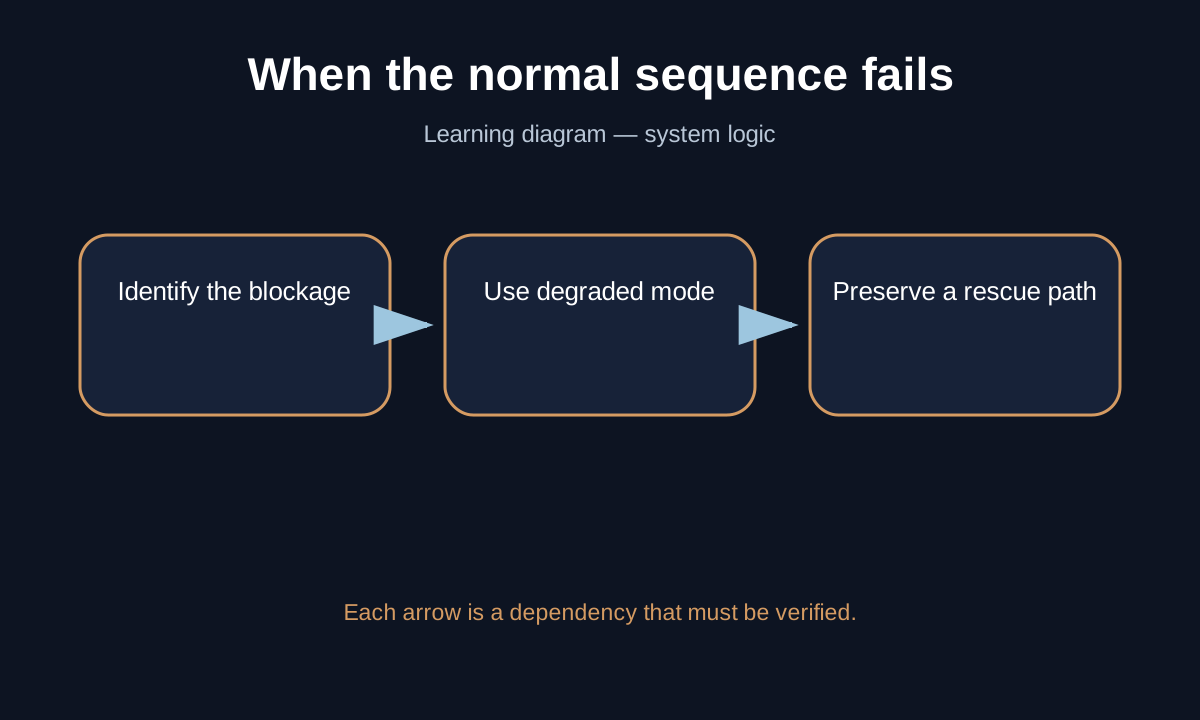
Normal safety therefore needs a separate emergency-recovery path. Degraded mode may require deliberate human confirmation, a local mechanical control, or an independent electrical path. It must be difficult to trigger accidentally yet usable with gloves, under stress, and possibly in darkness.
Dust, seals, and repeated cycling
Every EVA returns dust and adds cycles to seals, hinges, rails, and mechanisms. A system that is perfect on day one can lose margin after hundreds of operations. Inspection should track leakage trends rather than relying only on visual condition.
A settlement needs spare seals, cleaning tools, compatible lubricants, replaceable sensors, and test procedures. If the only main airlock is unavailable for fifteen days, the problem expands: can the crew still maintain solar arrays, rescue a rover, or access external infrastructure?
Physical redundancy: two airlocks help only when they are independent
Two adjacent airlocks sharing one power bus, compressor, and gas line can fail together. True redundancy begins by mapping shared resources and choosing which dependencies must be separated.
Settlement layout also matters. A backup airlock on the far side of a habitat may be unreachable after a central fire or depressurization. The base should be designed as a network of escape and access paths rather than a building with one sophisticated doorway.
How long might repressurization take?
LEARNING CALCULATION — ASSUMPTIONS ARE EXPLICIT
Simplified exercise: an 18 m³ airlock needs the pedagogical equivalent of 18 kilograms of gas to reach the selected condition, while the supply system can add 0.30 kilogram per minute.
Theoretical time: 18 kg ÷ 0.30 kg/min = 60 min. If leakage simultaneously removes 0.05 kg/min, net flow is 0.30 − 0.05 = 0.25 kg/min, so time becomes 18 ÷ 0.25 = 72 min.
The example shows how a small leak can become operationally significant. A real airlock requires proper gas-law, temperature, target-pressure, recovery, and flow-limit calculations.
Design maintenance before failure
The airlock should be testable without disabling the entire settlement. Maintenance includes leakage tests, valve checks, sensor comparison, seal inspection, manual-control verification, and cycle-time recording.
The better question is not just “does the airlock work?” but “what trend says it is degrading?” Longer repressurization, greater gas consumption, or increasing sensor disagreement can identify trouble before the emergency.
Decision questions specific to this hazard
- Can the crew enter the base if the airlock computer is completely unavailable?
- What independent sensor confirms that pressure is actually safe before door motion?
- How many full airlock cycles remain within the available gas reserve?
- Does the second airlock share a compressor, power bus, software, or gas line with the first?
- How is an outside crewmember recovered if the main airlock inner door remains jammed?