


MARS BIBLE — RISK & RESILIENCE DOSSIER
Loss of Earth–Mars communications: command, diagnosis and survival without real time
With one-way delay reaching roughly twenty-two minutes for some geometries, mission control cannot guide a Mars crew second by second.
Earth–Mars communications have unavoidable light-time delay, with additional disruptions and solar-conjunction periods possible. A settlement therefore needs autonomy by design, not merely as an emergency mode.
Delay changes mission control
A NASA analysis of crewed Mars missions reports delays up to about 22 minutes one way depending on mission geometry. An urgent question can therefore require nearly 44 minutes for a round trip before human analysis time is added.
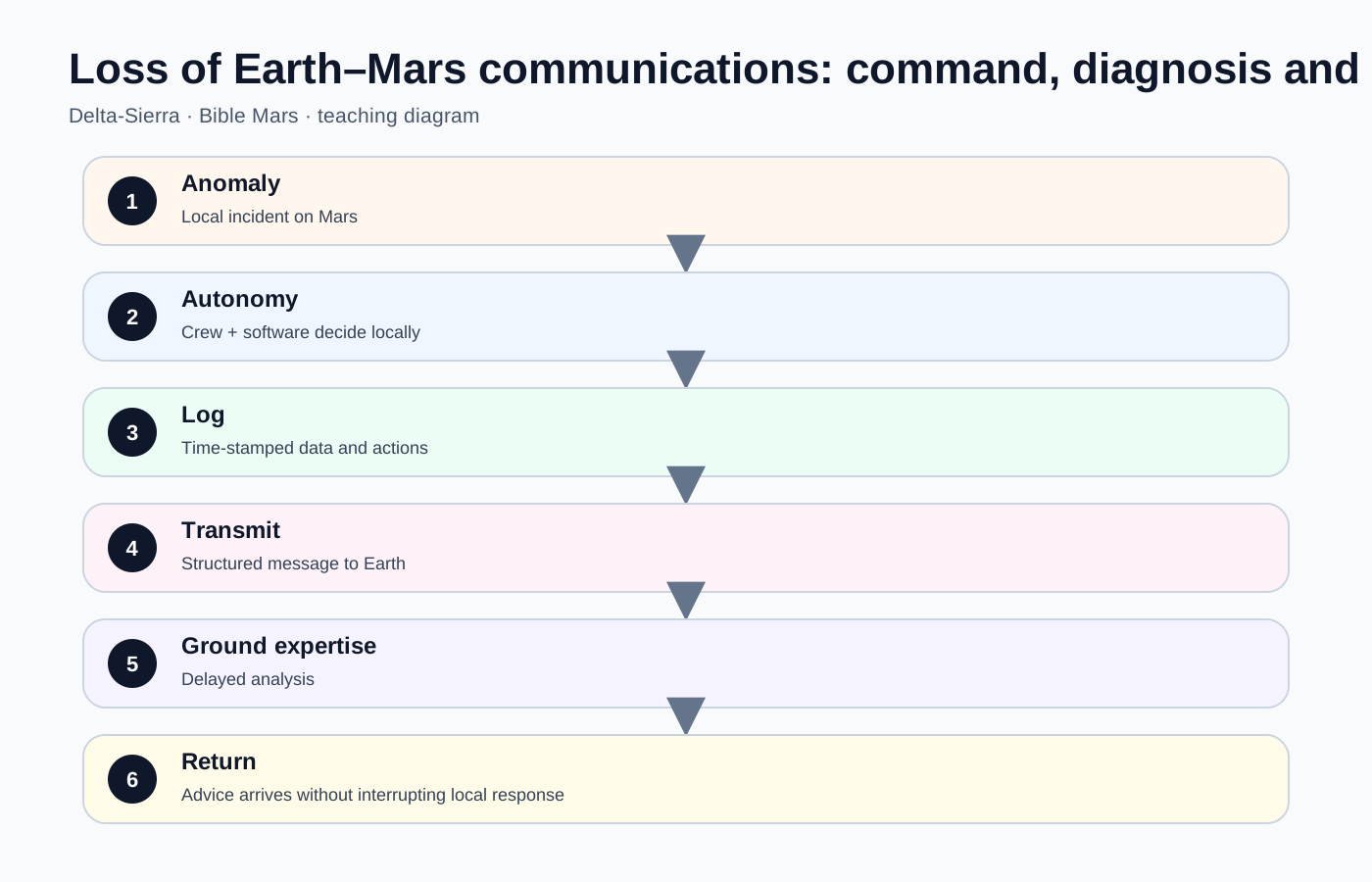
That makes second-by-second terrestrial instruction impossible. Earth shifts toward expertise, planning and delayed analysis while tactical decisions move to local crew and automation.
Solar conjunction: plan for silence
When the Sun lies near the Earth–Mars line of sight, charged particles can degrade radio links. NASA prepares robotic missions for more autonomy and restricts command transmission during conjunction periods.
A human settlement obviously cannot simply stop for two weeks. It needs a defined set of autonomous activities, local decision authorities and riskier operations that can be deferred.
The local network must survive without Earth
Local navigation, microgrid control, ECLSS, medicine, inventory, maintenance and emergency procedures must continue if the interplanetary link disappears. Local copies of documentation, software and knowledge bases are therefore safety equipment.
A settlement that needs an Earth cloud service to diagnose a pump or open a critical procedure is not truly autonomous.
Communicating with delay changes message design
Ordinary voice conversation becomes inefficient with long latency. Messages should contain context, data, assumptions, action already taken, precise question and decision deadline.
Telemetry should also allow Earth to reconstruct system state later. Time-stamped logs, synchronization and data retention become essential.
Drill without mission control
Autonomy must be practiced. Exercises can deliberately remove Earth advice for hours or days while introducing a technical anomaly. Teams then measure diagnosis time, decision quality and missing information.
- explicit local authority;
- offline documentation;
- decision procedures under uncertainty;
- store-and-forward messaging;
- ability to defer high-risk activity during degraded links.
22 minutes one way: what it does to a decision
A life-critical decision needed in five minutes therefore cannot wait for terrestrial approval. The design must pre-assign local authority, procedures and data needed for that decision.
The same calculation should always be repeated with an adverse assumption, followed by the question: what real measurement could confirm or reject that assumption? A calculation teaches as much through its limits as through its numerical result.
The dossier keeps measured data, published values, design assumptions and teaching scenarios visibly separate. Mixing those statuses would create false precision.
From calculation to action
Measurement itself needs resilience: backup sensing, independent confirmation, calibration range and a defined response when data are missing. An alarm with no strategy for sensor failure can increase risk.
What must be tested before depending on it
Run the scenario using real hardware or a representative twin, then repeat it with one additional failure. Measure diagnosis time, human errors, consumable use and ability to return to nominal conditions.
Results then update inventory, procedures and design. Safety becomes a learning loop rather than a document frozen before departure.
Questions never to skip
- What event actually starts the failure chain?
- Which functions are lost immediately, then after 10 minutes, 1 hour and 24 hours?
- Which redundant units still share power, software, location or maintenance?
- What degraded mode remains genuinely habitable?
- What must be repairable locally without waiting for Earth?
This dossier in the settlement
Scientific and technical sources
The sources below support the physical phenomena and safety building blocks; settlement architecture remains an explicitly identified prospective synthesis.
- NASA NTRS — Communication Delays, Disruptions, and Blackouts for Crewed Mars Missions
- NASA Science — Hunkering Down for Solar Conjunction