


MARS BIBLE — RISK & RESILIENCE DOSSIER
Dust storm + energy crisis: surviving when solar generation falls
The main danger is not movie-like wind; it is the combination of dust, weak generation, finite batteries and life-support loads that cannot simply stop.
Martian dust storms can reduce sunlight reaching solar arrays, while deposited dust can reduce generation for longer periods. A settlement therefore needs degraded-power budgets, load shedding, storage and genuinely independent energy sources.
Dust attacks the power budget
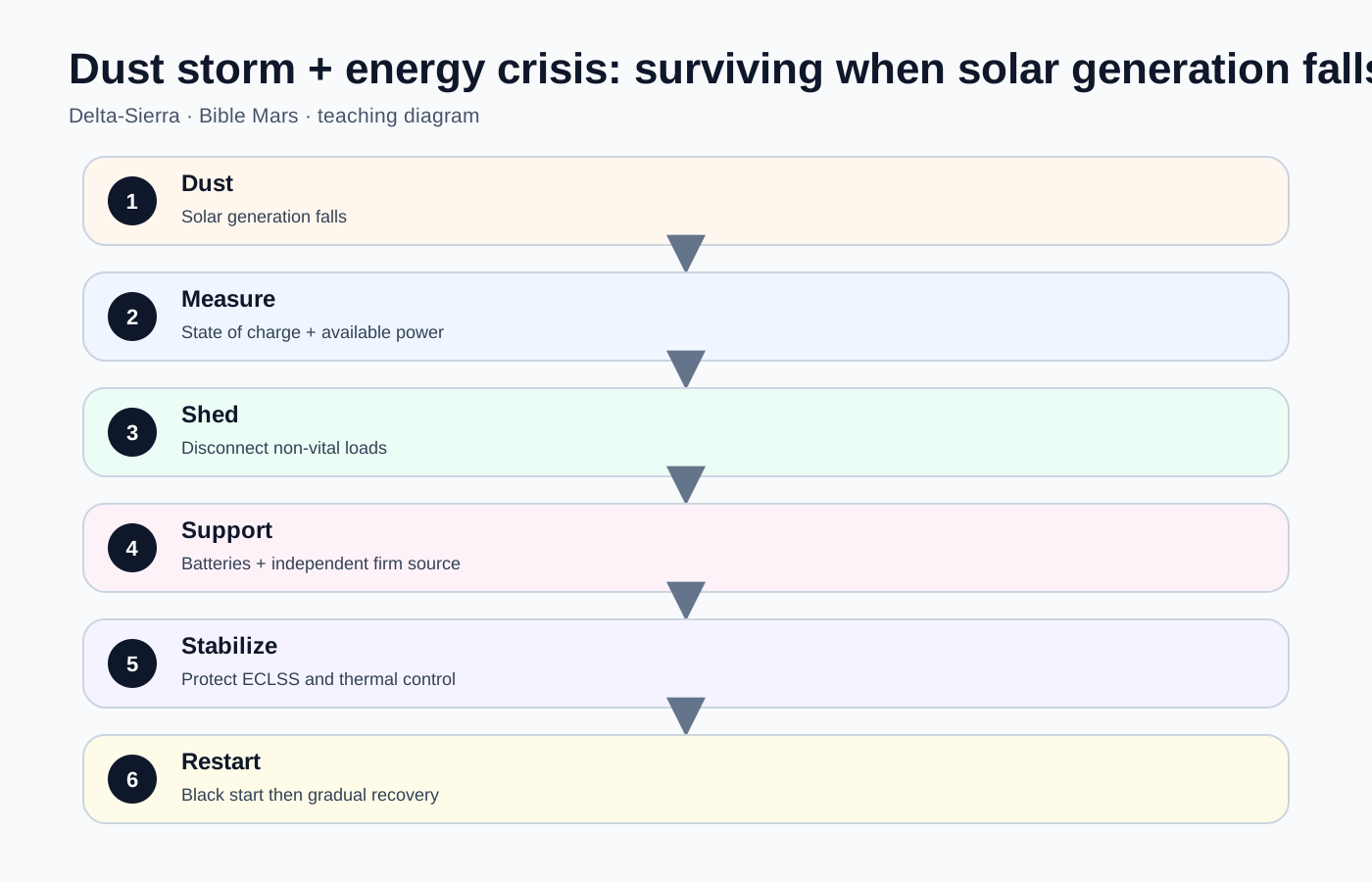
NASA has placed InSight into safe mode when dust reduced available solar power. A settlement would face a harder problem: ECLSS, heating, computing, pumps and communications cannot all be turned off.
The first defense is a clear load hierarchy: vital power, deferrable power, industrial power and comfort. Without that hierarchy, shedding becomes improvisation.
Storage buys time, not infinite energy
A battery can bridge a generation deficit, but its capacity is finite. Endurance depends on stored energy, actual load and conversion efficiency. The site should state all three instead of quoting hours of autonomy without scope.
Teaching example: 1,000 kilowatt-hours of usable storage feeding a 100-kilowatt critical load gives 10 hours in an ideal calculation, before losses, safety reserve and ageing. The method matters more than the number.
Load shedding must be decided before the crisis
The microgrid should disconnect lower-priority loads while protecting functions whose loss would endanger the crew. Each shedding level must be tested against water, oxygen, heating, pharmacy, communications and cryogenic storage.
Industrial shutdown can create delayed failures. Pumps, heaters and chemical lines may be damaged or hard to restart. Emergency planning therefore includes the condition of machinery after hours offline.
Diversify sources
A solar-only architecture concentrates weather and fouling risk. Nuclear or another independent source can provide firm power while solar supplies variable energy. Diversity matters because the second source should not fail for the same reason.
The useful metric is not merely cost per installed kilowatt but the ability of the complete system to retain vital loads through adverse scenarios.
Black start: restart a dead settlement
After grid collapse, a small independent source must energize controls, contactors, pumps and converters before large generators can return. This is black start capability.
- dedicated starting reserve;
- documented energization sequence;
- ECLSS and thermal priority;
- periodic black-start tests;
- local replacement of converters, contactors and sensors.
Calculate endurance instead of saying “we have batteries”
The same calculation should then be repeated with ageing, lower temperature, one failed converter and a larger emergency load. Resilience comes from sensitivity analysis, not from the best-case number.
The same calculation should always be repeated with an adverse assumption, followed by the question: what real measurement could confirm or reject that assumption? A calculation teaches as much through its limits as through its numerical result.
The dossier keeps measured data, published values, design assumptions and teaching scenarios visibly separate. Mixing those statuses would create false precision.
From calculation to action
Measurement itself needs resilience: backup sensing, independent confirmation, calibration range and a defined response when data are missing. An alarm with no strategy for sensor failure can increase risk.
What must be tested before depending on it
Run the scenario using real hardware or a representative twin, then repeat it with one additional failure. Measure diagnosis time, human errors, consumable use and ability to return to nominal conditions.
Results then update inventory, procedures and design. Safety becomes a learning loop rather than a document frozen before departure.
Questions never to skip
- What event actually starts the failure chain?
- Which functions are lost immediately, then after 10 minutes, 1 hour and 24 hours?
- Which redundant units still share power, software, location or maintenance?
- What degraded mode remains genuinely habitable?
- What must be repairable locally without waiting for Earth?
This dossier in the settlement
Scientific and technical sources
The sources below support the physical phenomena and safety building blocks; settlement architecture remains an explicitly identified prospective synthesis.