


MARS ARCHITECTURES — 1990s TO TODAY
Robert Zubrin and Mars Direct: breaking the mass spiral
Mars Direct changed the Mars debate by asking why Earth should launch what Mars can provide. Robert Zubrin and David Baker put in-situ resources, predeployed return capability and architectural simplification at the center of a smaller human mission concept.
The mass spiral
Late-1980s and early-1990s human Mars studies could become extremely large: orbital assembly, multiple precursor systems and huge propellant loads. Carrying return propellant increases departure mass; larger vehicles need still more propulsion. Mars Direct attacks that feedback loop by changing where a function is performed.
Predeploy the return vehicle
The return vehicle is sent before the crew and produces much of its propellant on Mars. The crew should not commit until the return system has reached an acceptable state. That makes local production a mission gate rather than a bonus experiment.
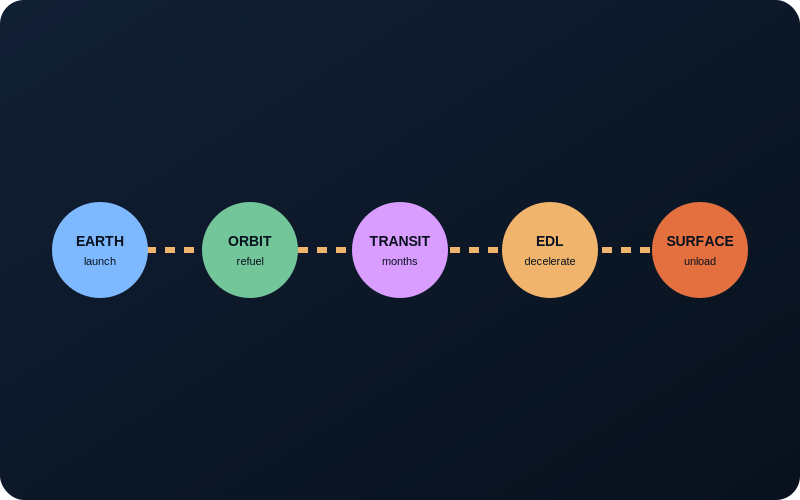
ISRU: make propellant instead of carrying all of it
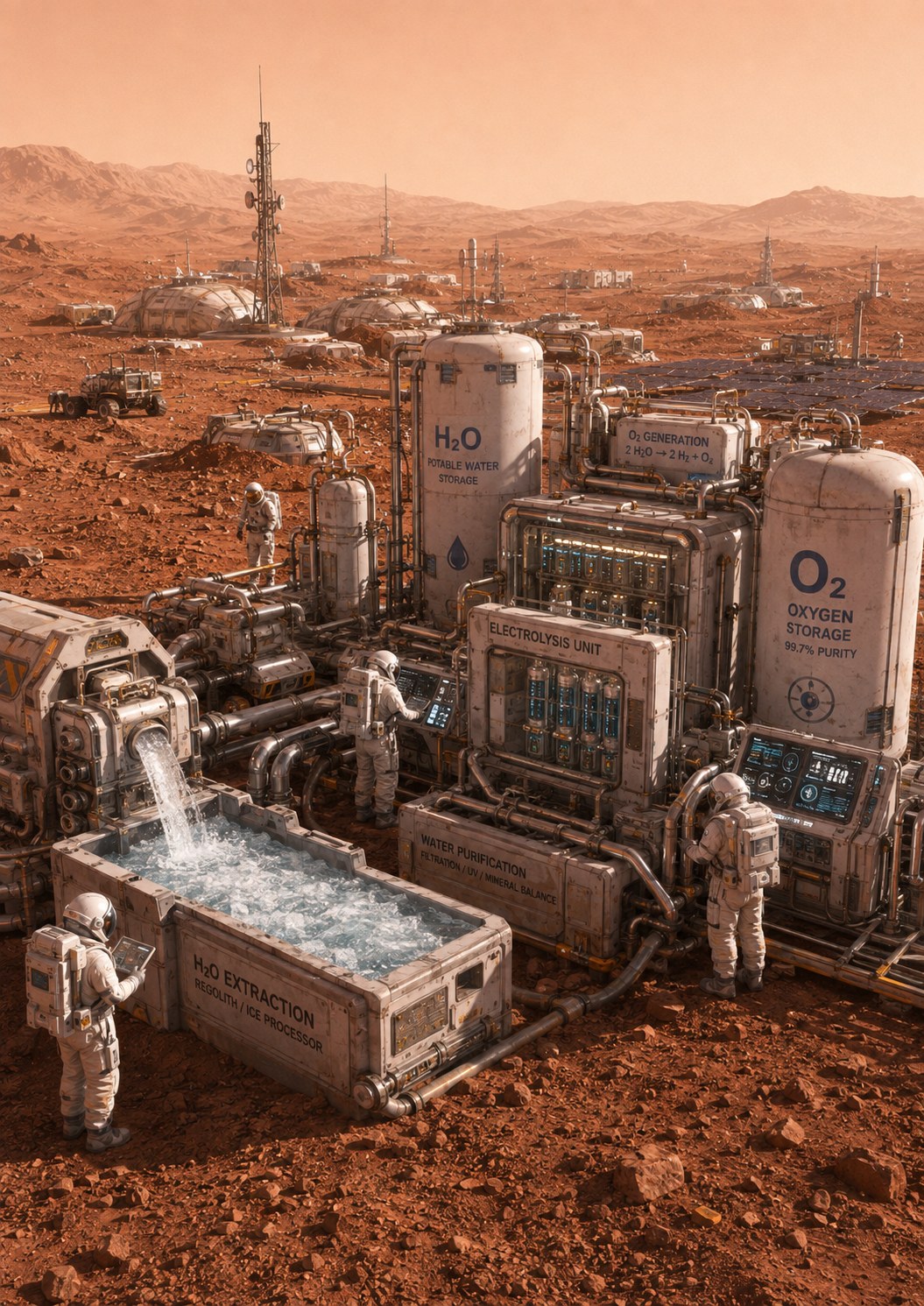
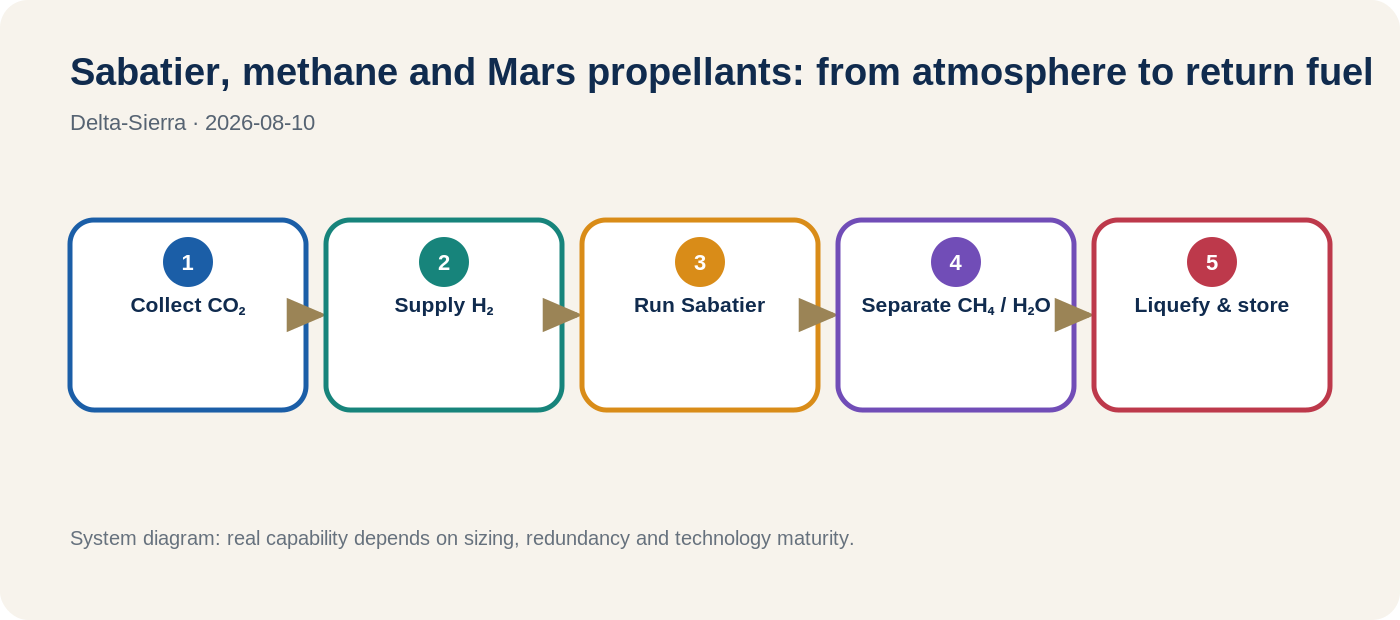
Mars Direct uses atmospheric carbon dioxide and imported hydrogen in a Sabatier-based chain to produce methane and water, with electrolysis supplying oxygen. The chemistry is known; the engineering challenge is a reliable integrated plant with compressors, reactors, power, thermal control, purification, storage, sensors and repair.
MOXIE later demonstrated oxygen production from the Martian atmosphere at small scale. It does not prove a crew-scale propellant factory, but it demonstrates an important physical step.
ISRU moves risk as well as mass
Every kilogram made on Mars can remove launch mass, but it creates dependence on the machines that make it. Local production therefore needs redundancy, metrology, stored spares and enough energy to complete production before the crew depends on it.
Direct does not mean easy
Radiation, long-duration health, EDL, dust, communication delay and surface power remain. Architectural simplification removes interfaces that can fail, but can also concentrate dependence in fewer critical systems. Simplicity and redundancy must be traded together.
Influence on NASA planning
Zubrin and Baker’s work appears in NASA technical literature and architecture comparisons. Later NASA Design Reference Missions did not simply adopt Mars Direct; they combined different vehicles, constraints and risk trades. Its lasting influence is conceptual: ISRU and predeployment can radically change mission mass.
NASA NTRS — A coherent architecture for the Space Exploration Initiative.
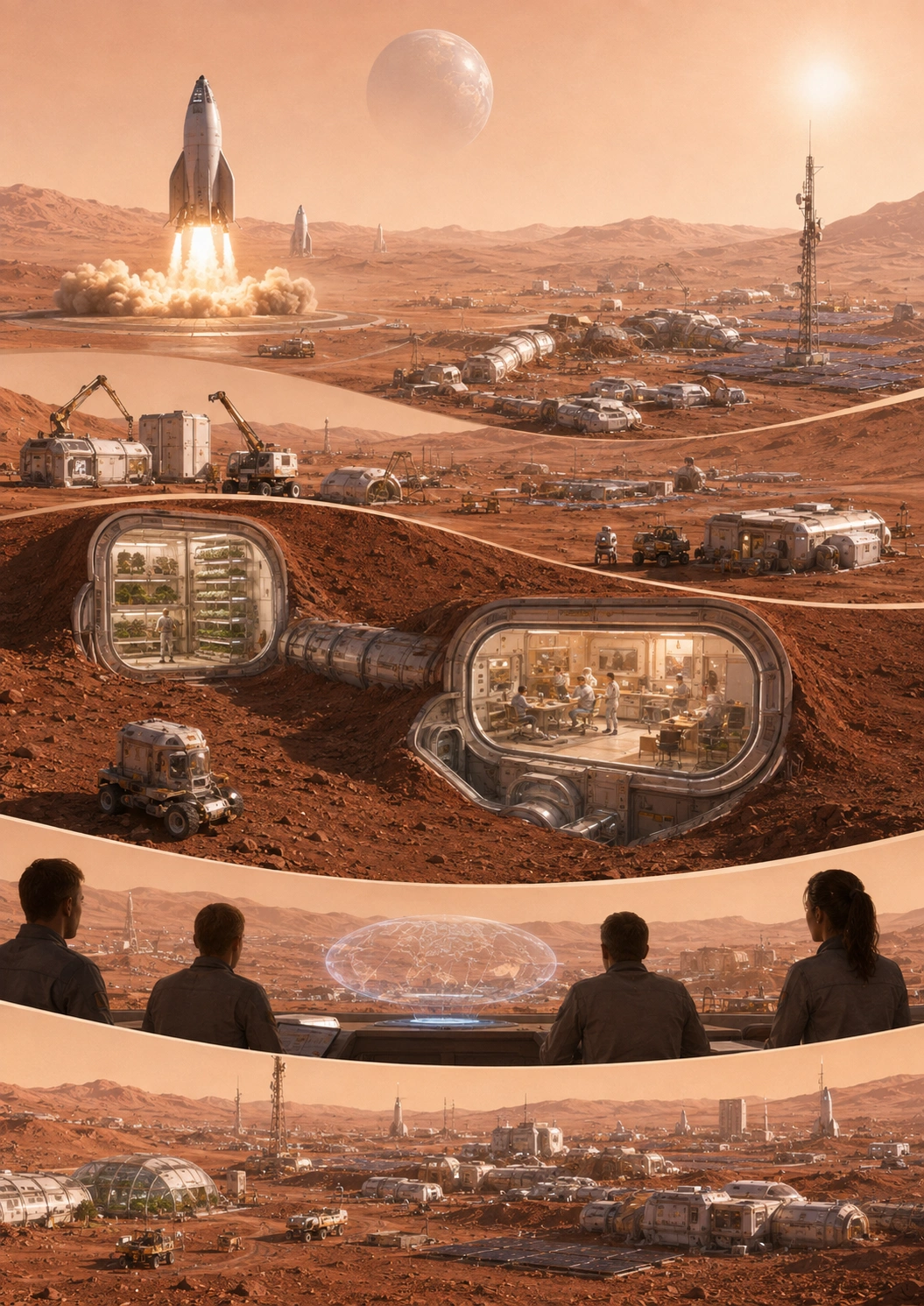
From expedition to settlement
Mars Direct is an expedition architecture, not an urban economy. A settlement must maintain machines after the first crew’s mission ends, produce food, manage medicine, replace cables and seals, calibrate instruments and transfer skills to new generations. First-generation ISRU — water, oxygen and propellant — must grow into second-generation industry: metals, glass, polymers, chemistry, electronics and machine tools.

Zubrin and Musk: two different cost attacks
Zubrin asks how much mass and infrastructure can be removed by making resources locally. SpaceX asks how transport can become reusable, high-capacity and frequent. A settlement ultimately needs both directions: cheaper transportation for what Earth must still supply, and shrinking dependence on those imports.
The critical engineering critique
An “ISRU plant” cannot remain a box in a diagram. It is intake, extraction, compression, reaction, separation, cooling, storage, instrumentation, maintenance, spares, quality assurance and power. Replacing a large propellant mass with one fragile machine would not be robust architecture.
Legacy: change the equation
Mars Direct’s deepest lesson is to ask whether a function can be moved, simplified or produced locally before adding launch mass. That applies far beyond propellant — to shielding, roads, water, oxygen, structures and eventually industrial equipment. Settlement begins when we transport not just supplies, but an industrial seed that can grow.
Why the original propellant choice matters
The logic is not simply “Mars has fuel.” Mars has carbon dioxide and evidence of water ice, but useful propellant appears only after a chain of extraction and processing. Hydrogen, methane and oxygen impose different storage temperatures, tank insulation, leak control and material requirements. The architecture is therefore a chemical plant attached to a spacecraft return strategy.
This also explains why power is a hidden propellant component. Excavation, water processing, gas compression, electrolysis, methanation, liquefaction and storage all require energy. A propellant plant that is chemically sound but underpowered can still miss the crew’s departure window.
Predeployment as a general settlement pattern
The predeployment idea scales beyond the return vehicle. A robust first settlement should land and commission power, communications, water extraction, shelter and emergency reserves before people depend on them. Cargo missions are therefore not merely deliveries; they are autonomous commissioning missions.
The same rule can be written as a safety gate: demonstrate the function before adding the human dependency. A water plant should run through faults before it becomes the sole water source. A grid should black-start before a crew needs it after an outage.
What a settlement adds to Mars Direct
A settlement needs a second layer of redundancy that a short expedition can sometimes avoid. It must withstand not only one mission cycle but equipment aging, supplier changes, institutional failure and demographic change. That means standards, interchangeable parts, calibration, training records and the ability to manufacture substitutes.
In this sense, settlement is Mars Direct repeated recursively: use local resources not only to make propellant, but to make the tools, materials and infrastructure that reduce the next layer of imports.
Cost claims need historical context
Mars Direct was also promoted as a lower-cost alternative to very large architectures. Historical cost estimates are useful for comparing concepts inside their original assumptions, but they should not be converted mechanically into a modern program price. Launch markets, safety rules, labor, acquisition models and vehicle maturity have all changed.
The durable economic point is not a specific number. It is that architecture choices can remove entire development programs and mass flows, which may matter more than optimizing a single component by a few percent.
Why Mars Direct was intellectually disruptive
Mars Direct did not introduce one magical engine. Its disruptive move was architectural: stop designing the return trip as if every kilogram of return propellant had to be launched from Earth, carried to Mars, landed, stored and then launched again. By moving propellant production to the destination, Zubrin and David Baker attacked a chain of mass multipliers rather than a single component.
This is why the proposal remains historically important even when later mission studies change vehicle sizes, trajectories or surface systems. It taught a generation of planners to ask which resources should be produced locally before asking how large the Earth-departure stack must become.
The original proposal was an expedition architecture, not a city plan
Mars Direct focused on making an early crewed expedition more achievable. A permanent settlement has additional obligations: duplicated power, water and air systems; long-term medical capability; industrial maintenance; food production; waste closure; local governance; education; housing; and the ability to survive a missed transfer opportunity. Treating Mars Direct as a complete colonization blueprint would therefore overstate what the architecture was designed to solve.
A simple mass example: why local propellant changes the equation
Consider an illustrative return stage that requires 30 metric tons of propellant on Mars. If all 30 tons must be delivered from Earth, that mass must survive Earth launch, interplanetary transport and Mars landing. If local production can provide 90% of it, the imported propellant falls to 30 × 0.10 = 3 metric tons. The × symbol means multiplication.
The apparent saving is 30 − 3 = 27 tons at the Martian surface, but the true launch-system impact can be larger because the eliminated mass no longer requires the same transport structure and landing capacity. This is an illustration, not the mass budget of the original Mars Direct vehicle. It explains the mass-spiral logic behind ISRU.
ISRU trades transport mass for machinery, power and operational risk
Local propellant is not free. It requires prospecting, feedstock collection, reactors, compressors, electrolysis, purification, cryogenic or pressure storage, instrumentation, software and enough power to run the plant. If the return vehicle depends on that plant, the plant must operate before the crew commits to the mission or be backed by another credible return strategy.
This is the deeper engineering lesson of Mars Direct: ISRU moves risk. A serious architecture must make that moved risk visible rather than describing local resources as an automatic saving.
Zubrin, Baker and the institutional context
The architecture emerged during the Space Exploration Initiative era, when NASA and the wider aerospace community were studying human exploration beyond Earth orbit. Zubrin and Baker argued that ambitious Mars missions did not have to wait for enormous orbital infrastructure if mission design exploited Martian resources and predeployed critical hardware.
NASA technical archives preserve work from this period and later studies repeatedly discuss Mars Direct as an influential alternative architecture. Influence does not mean institutional adoption of every design choice; it means that ISRU and predeployment became unavoidable elements of the Mars architecture debate.
The Mars Society extended the argument from paper to field analogs
Zubrin later founded The Mars Society, which promoted public advocacy and field analog research. Analog habitats cannot reproduce Martian gravity, radiation or distance, but they can expose operational questions: crew routines, maintenance burden, EVA procedures, communications discipline, psychology and the difference between a vehicle drawing and a place where people actually live.
Zubrin and Musk solve different layers of the cost problem
Mars Direct primarily attacks mission mass and architecture. SpaceX attacks transport cost, reusability, flight rate and vehicle scale. These approaches overlap through methane/oxygen propellants and local resource use, but they are not interchangeable. Cheap transport does not create an ISRU plant; clever ISRU does not create a reusable heavy-lift fleet.
A credible settlement would need both kinds of progress plus life support, surface power, heavy-cargo EDL, construction, medicine and industry.
What should be retained from Mars Direct in a twenty-first-century settlement architecture?
Four principles remain especially useful: predeploy critical return or survival capability; make local resources do high-leverage work; avoid transporting infrastructure whose only purpose is to support more transported infrastructure; and verify the surface production chain before human lives depend on it.
The parts that need re-engineering are scale, long-duration reliability, heavy-cargo landing, industrial closure, biosafety, planetary protection and the transition from expedition to settlement. Mars Direct is therefore best read as an architectural breakthrough and a starting point for systems reasoning, not as a frozen blueprint.
Technical sources
- NASA NTRS — Mars Direct architecture — architecture and ISRU
- NASA — MOXIE completed Mars mission — Mars oxygen demonstration
- NASA — Humans to Mars: Fifty Years — architecture history
- NASA — DRA 5.0 — human mission reference architecture
- NASA NTRS — Mars Design Reference Architecture 5.0
- NASA — Moon to Mars Architecture