


HISTORY OF MARS ARCHITECTURES
Wernher von Braun: from early rocketry to The Mars Project
Von Braun is both technically central and morally compromised in the history of spaceflight. A serious account must hold together the rocket engineer, the V-2 leader serving Nazi Germany, and the postwar U.S. program manager who became a major Saturn V leader and author of the first detailed integrated human Mars architecture.
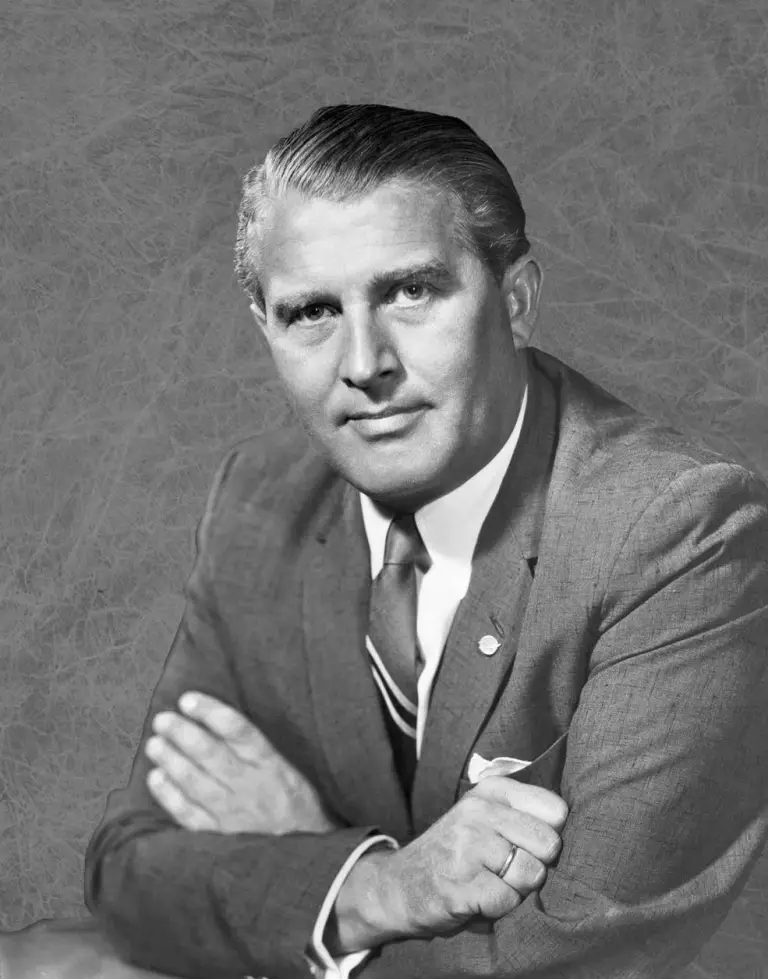
Why he matters in a Mars Bible
Von Braun did not invent the dream of Mars. Tsiolkovsky, Goddard and Oberth established essential theory and experimental foundations before him. His specific importance is architectural: he turned the idea of Mars flight into linked calculations for vehicles, mass, trajectories, crew, surface operations and return.
That systems method survived even when many environmental assumptions of the 1950s became obsolete.
His importance is not that every detail of his Mars architecture remains usable. Most do not. His importance is that he treated interplanetary travel as a connected system of mass, propulsion, assembly, crew, operations, logistics, surface activity and return. That systems habit survives even when the vehicles change completely.
1. From astronomy to rockets: the influence of Hermann Oberth
Born in 1912, Wernher von Braun became fascinated by astronomy and the possibility of spaceflight while still young. Hermann Oberth’s work on rockets and interplanetary travel strongly influenced him and a generation of German enthusiasts who believed liquid-propellant rockets could become practical machines rather than literary fantasies.
By the late 1920s von Braun had joined the Verein für Raumschiffahrt (VfR), the Society for Space Travel. Its members experimented with liquid-propellant rockets on small budgets, learning through repeated failures about combustion, feed systems, ignition, structures and control. The work was technically fragile but intellectually important: it converted abstract orbital dreams into hardware that could be measured and improved.
This early period matters because it shows the gap between an idea and an industrial program. Enthusiasts could demonstrate principles; they could not easily finance large engines, instrumented test stands, dedicated ranges or systematic production. That gap would soon be filled by military money, with profound consequences.
2. The German Army provides resources that amateurs do not have
In 1932 the German Army recruited von Braun and other rocket specialists. Military funding transformed small-scale experimentation into a major development effort with test stands, laboratories, instrumentation, manufacturing capacity and eventually the Peenemünde complex. Von Braun completed a doctorate in 1934 while working inside this military structure.
This transition should not be retold as though a neutral civilian space program were simply taken away from an innocent scientist. Von Braun chose to work within the regime’s weapons program. NASA’s current institutional biography records that he joined the Nazi Party in 1937 and became a junior SS officer in 1940.
Technically, the new resources accelerated progress in propulsion, guidance, aerodynamics and systems integration. Morally and politically, they tied that progress to a dictatorship preparing and waging aggressive war. Both facts belong in the same history.
3. V-2: technical achievement and weapon of a criminal regime
The A-4/V-2 was a remarkable technological system — powerful liquid propulsion, guidance, supersonic aerodynamics and large-scale production — and a weapon used against European cities.
After the 1943 bombing of Peenemünde, V-2 production moved underground to Mittelwerk near Nordhausen. Prisoners from Mittelbau-Dora were forced to work in brutal conditions with high mortality. NASA’s current biography states that von Braun was aware of the terrible conditions and was involved in decision-making about the use of slave labor.
That fact rules out a clean “apolitical scientist” story. It also does not erase the technical influence his team later had on U.S. rocketry. The historical responsibility and the engineering legacy must be analyzed without letting one neutralize the other.
The V-2 became the first long-range guided ballistic missile to reach operational use. Its engineering legacy includes large liquid-propellant engines, turbopumps, guidance, structural design and production methods that later influenced postwar rocketry. Its operational purpose, however, was bombardment, and its production system inflicted suffering on forced laborers on a vast scale.
4. Why the history of forced labor still matters to space engineering
It may be tempting to treat Mittelwerk and Mittelbau-Dora as a moral footnote separate from “the engineering.” That separation is misleading. Industrial engineering always includes decisions about schedules, factories, labor, safety, quality and acceptable loss. When a production system treats human beings as disposable inputs, that is not outside the system; it is part of how the system was organized.
For a future Mars settlement this lesson is unusually relevant. Whoever controls air, water, power, transport and access to Earth may possess extraordinary leverage over workers and residents. Technical scarcity can become political coercion if rights, oversight and emergency rules are weak.
Studying von Braun seriously therefore means learning two things at once: how integrated technical teams can achieve difficult goals, and why technical success can never excuse the destruction of human dignity.

5. 1945: surrender and Project Paperclip
As Germany collapsed, von Braun and members of his team surrendered to U.S. forces. Under Project Paperclip an initial group of roughly 125 specialists moved to the United States. At Fort Bliss and White Sands they worked with captured V-2 hardware and U.S. teams, using launches for technical learning and high-altitude research.
Paperclip itself raises a political and ethical issue: U.S. strategic authorities prioritized technical expertise despite the wartime backgrounds of some specialists. The Cold War space race partly grew from this transfer of people and technology.
6. From Redstone to Explorer 1
In 1950 the team moved to Redstone Arsenal in Huntsville. It developed the Redstone and Jupiter families and related launch vehicles. After Sputnik and the Vanguard failure, the Army Ballistic Missile Agency and JPL received authority to launch a U.S. satellite. Explorer 1 reached orbit on January 31, 1958, enabling the discovery of the Van Allen radiation belts.
The episode illustrates a recurring strength of von Braun’s organization: a stable team, accumulated test experience, and the ability to convert an existing propulsion system into a new mission capability.
7. An engineer who understood the power of public communication
During the 1950s von Braun wrote for Collier’s and appeared in Walt Disney television programs about spaceflight. These presentations reached a mass public with images of stations, Moon missions and Mars expeditions.
Large programs need political and budgetary legitimacy, so communication was not separate from engineering strategy. The danger, still relevant today, is that persuasive artwork can make a prospective architecture look like a demonstrated capability.
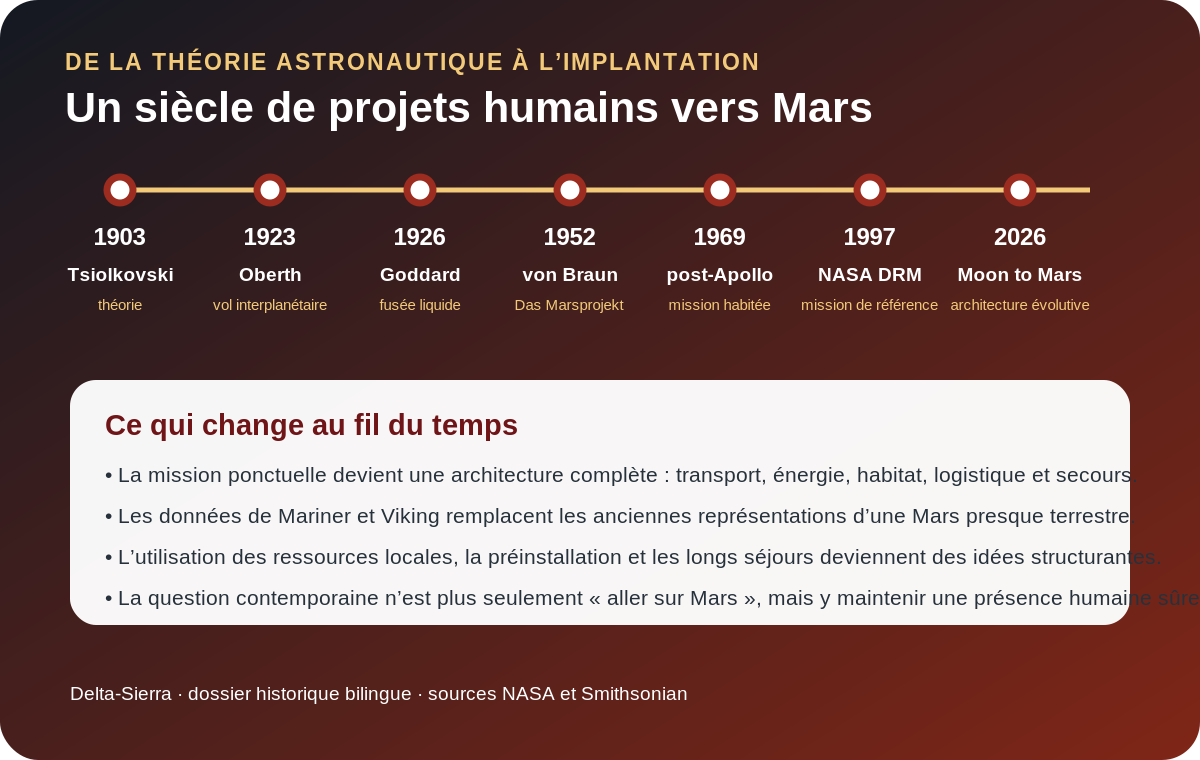
8. The Mars Project: Mars becomes an engineering calculation
Von Braun drafted the core work after World War II and published it in German in 1952; the English-language Mars Project followed. NASA historical studies describe it as the first detailed integrated human Mars mission architecture.
The scale was enormous: a fleet of roughly ten 400-ton spacecraft, about 70 crew and almost a thousand ferry launches to assemble the expedition in Earth orbit, according to NASA’s Mars Wars history. The transfer would take roughly eight months.
Some assumptions were soon overtaken by planetary science. Von Braun imagined glider landings and surface operations based on a pre-Mariner understanding of Mars. This is precisely why the plan remains educational: an architecture can be mathematically coherent and still be undermined by wrong environmental assumptions.
9. Why a fleet of ten spacecraft?
Von Braun was working with a technological horizon dominated by chemical propulsion and orbital assembly. To transport a large crew, food, surface vehicles and the propellant required for the return journey, mass grew rapidly. Without local propellant production, every kilogram delivered to Mars created additional upstream propellant, tankage and launch requirements.
The resulting “mass spiral” helps explain why The Mars Project proposed a large fleet and an extraordinary number of launches to assemble it in Earth orbit. The architecture was not large merely because von Braun liked grand projects; it was large because the chosen mission functions and assumptions forced mass to be carried through almost the entire chain.
This is precisely the pressure later attacked by Robert Zubrin and Mars Direct. Instead of accepting the whole mass burden, later architectures ask which functions can be moved: preposition cargo, produce return propellant locally, extract water, manufacture oxygen and eventually make selected replacement parts on Mars.
10. A scientific error that became an important engineering lesson
The Mars Project was based on the best planetary knowledge available before the Mariner era, but that knowledge was incomplete. Von Braun envisaged operations and landing concepts for a Mars whose atmospheric pressure, topography and surface environment were still poorly known. Some details became obsolete quickly once spacecraft observations transformed planetary science.
That does not make the work useless. It makes it a powerful lesson in prospective engineering: an architecture can be internally coherent and mathematically careful while still depending on a wrong environmental assumption. Modern Mars plans face the same responsibility with different unknowns — dust behavior, extractable resources, industrial yield, long-term health at 0.38 g and the reliability of closed-loop systems.
A serious design should therefore identify which assumptions are measured, which are modeled, which are extrapolated and what happens if an optimistic assumption fails.
11. Saturn V: from public dream to industrial program
Von Braun’s Huntsville group transferred to NASA in 1960, and he became the first director of Marshall Space Flight Center. He is commonly described as a chief architect of Saturn V, though the launcher and Apollo program were the work of enormous teams across NASA and industry.
Apollo demonstrated that an extremely ambitious architecture can become operational when politics, funding, testing and industrial capacity align. Mars, however, adds long duration and deep autonomy that make it more than another Apollo-scale destination.
Saturn V was not the creation of one man. Hundreds of companies, many NASA centers and tens of thousands of specialists contributed. Calling von Braun a leading architect of the launcher should therefore describe coordination and technical leadership, not erase the industrial system that made Apollo possible.
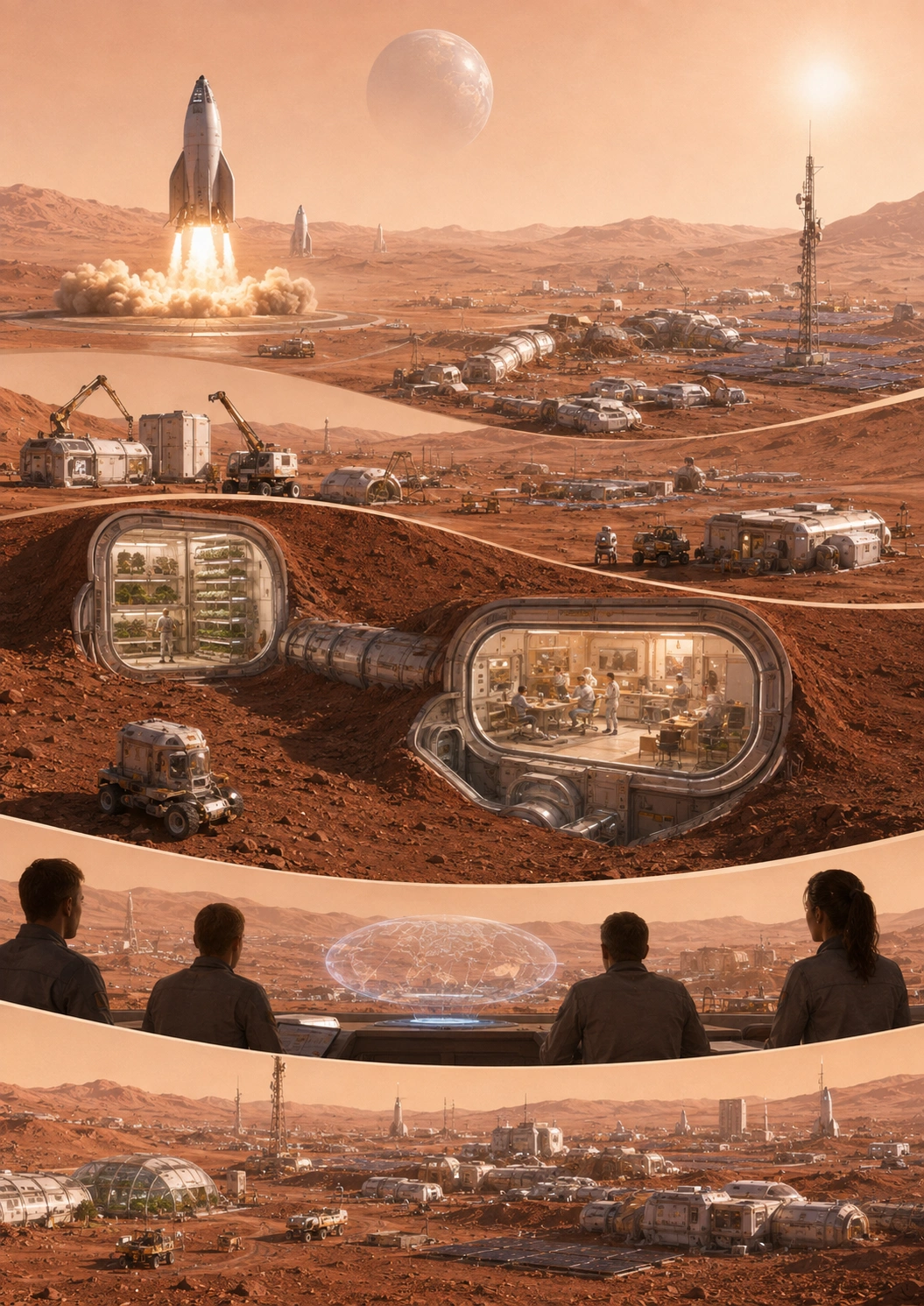
12. After the Moon, Mars returns immediately
Post-Apollo studies considered nuclear propulsion, orbital infrastructure and eventual human Mars expeditions. In 1969 Mars options appeared in Space Task Group-era planning. Yet political priorities and NASA budgets changed, and the giant post-Apollo expansion did not occur.
This is a lasting lesson: technical plausibility does not create political continuity. A multi-decade Mars program must survive elections, accidents, recessions and changing administrations.
For Mars this political discontinuity is not a side issue. Any program lasting decades must survive elections, accidents, recessions, changes of administration and shifting public priorities. Institutional resilience becomes part of mission architecture just as surely as propulsion or life support.
13. Von Braun leaves NASA
In 1970 von Braun moved from Marshall to NASA Headquarters as deputy associate administrator for planning. He left the agency in 1972 and later worked in private industry. He died in 1977, before the revival of Mars architecture studies in the 1980s and 1990s.
He therefore did not participate in Mars Direct, modern EDL studies, contemporary ISRU development or reusable heavy-lift systems. Yet many questions he had placed at the center of mission design remained familiar: orbital assembly, large transported mass, crew size, life support, surface operations, public legitimacy and the relationship between ambitious vision and available budget.

14. What Mars Direct changes compared with von Braun
Mars Direct is not simply The Mars Project with newer rockets. Zubrin and Baker change where a crucial mission function occurs. Instead of transporting all return propellant from Earth, the architecture prepositions an Earth-return vehicle and proposes producing propellant on Mars from local resources.
This relocation of function reduces transported mass and simplifies parts of the fleet. It illustrates a general design principle: an architecture can become more feasible not only because a component improves, but because the system boundary moves. “Transport from Earth” becomes “produce on Mars.”
The same reasoning now appears throughout settlement planning. Water extraction, oxygen production, construction materials and eventually selected industrial goods are valuable not because local production is ideologically attractive, but because every reliable local function can remove repeated mass from the interplanetary logistics chain.
15. What SpaceX inherits — and what it changes
SpaceX shares with von Braun a willingness to think at very large scale and to describe Mars in explicitly civilizational terms. The proposed economic mechanism, however, is radically different: full reusability, orbital refilling, large payload capacity and repeated use of the same transportation hardware rather than a vast fleet assembled from mostly expendable launch systems.
Seventy years of technological change make direct vehicle comparisons misleading. The useful historical continuity is the systems question. Reusability matters only if launch cadence, turnaround, propellant supply, orbital refilling, Mars landing, surface unloading, maintenance and return operations all work together.
SpaceX’s current Mars material should therefore be read as an industrial objective and architecture under development, not as a demonstrated settlement capability. That distinction is exactly the kind of evidence discipline a Mars reference work needs.
16. The most modern lesson: architecture before gadget
A rocket does not create a settlement. A greenhouse without energy and nutrient loops does not create food security. A 3D printer without feedstock, heat treatment, machining, metrology and electronics does not create industry. Von Braun’s systems mindset remains useful because it forces these interfaces onto the same page.
That systems view is one reason von Braun remains relevant even when his exact vehicles are obsolete. The future settlement has to close interfaces: energy for water, water for oxygen and agriculture, maintenance for energy, metrology for manufacturing, transportation for spare parts, and governance for decisions made under scarcity.
17. Can the engineer be studied without whitewashing the man?
A reference work should refuse both hagiography and erasure. Von Braun contributed to Explorer 1, Saturn V, Apollo and the development of Mars mission architecture. He also served the Nazi rocket program, belonged to the Nazi Party and SS, and was connected to a production system that used deadly forced labor. NASA’s own biography now states this explicitly.
Space history is more credible when it can carry that contradiction rather than choose a comforting half-story.
18. What a future Mars civilization should learn from this history
The technical lesson is to turn vision into verifiable architecture. The organizational lesson is that stable teams, testing and industrial capacity matter more than a lone inventor. The moral lesson is that technical success never justifies treating human beings as expendable resources.
A Mars settlement will concentrate power in whoever controls air, water, energy and transportation. That makes labor rights, emergency oversight and institutional checks engineering-adjacent requirements, not luxuries.
Historical memory therefore has an engineering function. It reminds planners that technical institutions are human institutions. A settlement that can survive a pump failure but cannot protect people from arbitrary power has solved only part of the problem of survival.
Primary historical sources
- NASA — Wernher von Braun — institutional biography including Nazi Party, SS, Mittelwerk and Paperclip
- NASA — Mars Wars — history of The Mars Project and U.S. Mars planning
- NASA — Humans to Mars: Fifty Years of Mission Planning — technical history of Mars architectures
- NASA — Story of Explorer 1 — Army/JPL satellite effort
- NASA JPL — History — JPL and von Braun team cooperation
- NASA NTRS — Mars architecture comparison — The Mars Project as an early integrated architecture