


MARS BIBLE — RISK & RESILIENCE
Agriculture + power crisis: feed the settlement when greenhouses must be load-shed
Greenhouses are both biological systems and electrical loads; shutting them down too long can turn a multi-day power crisis into a months-long food crisis.
A power crisis must therefore be managed with two clocks: minutes to technical damage and weeks or months to rebuild lost biological production.
1 — A greenhouse is not a binary load
Lighting, pumps, airflow, heating, cooling, CO₂ control, and water treatment do not share the same priority or inertia.
Load shedding should preserve minimum crop-survival functions rather than simply “turning the greenhouse off”.
2 — Plants have biological clocks
Temporary light reduction differs from pump failure or freezing. Some consequences appear after a delay and are difficult to recover.
Time to damage must be known by crop and growth phase.
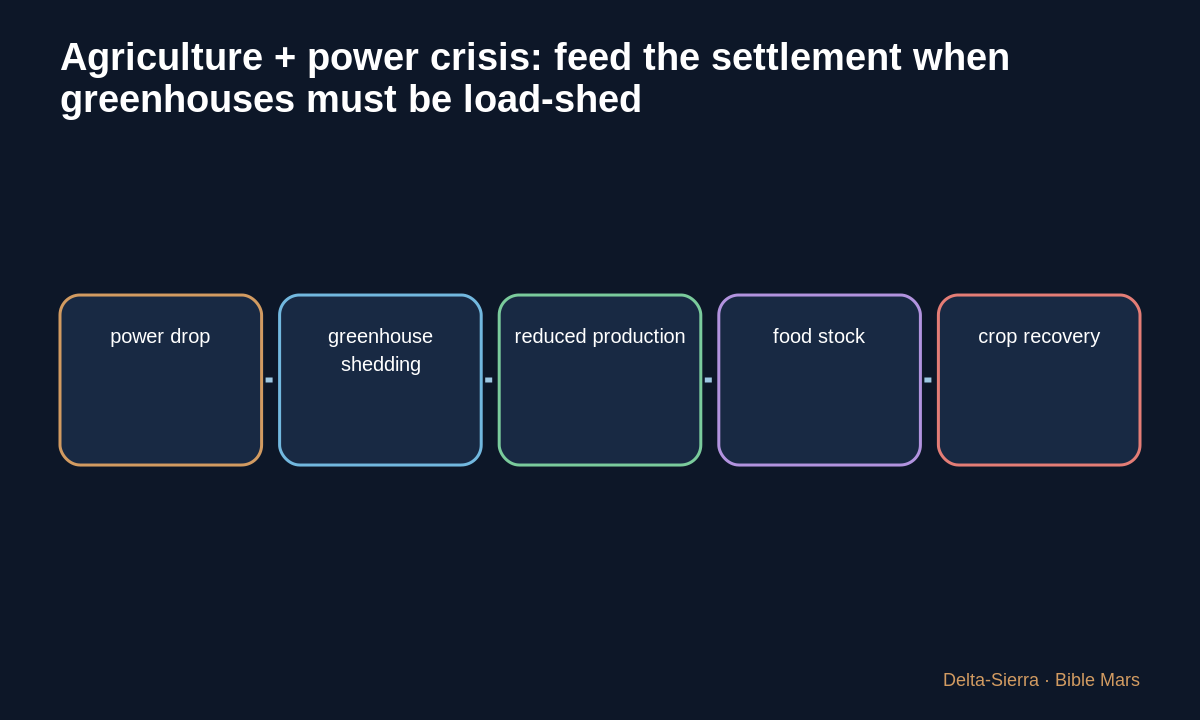
3 — Food stocks buy time
Stored food can protect vital power without immediate rationing, but it has finite duration and nutritional composition.
Count reserves as days of complete menus, not only kilograms.
4 — Early rationing can save a harvest
Reducing non-vital loads or reserve consumption early may preserve part of agricultural production.
Decisions must avoid degrading health and work capacity.
5 — Agricultural recovery is slow
Even after power returns, a lost crop does not regrow instantly. Biological recovery time belongs in the plan.
A 48-hour power crisis can create a much longer food debt.
6 — Diversity across crops and locations
Multiple greenhouses, species, and technologies distribute risk. One zone or crop failure should not remove all fresh-food production.
Biological diversity becomes a form of redundancy.
Combined scenario — power falls while crops are at a critical stage
An agricultural crisis becomes difficult when power loss does not occur at a convenient point in the crop cycle. Some plants may be young, others near harvest, while germination chambers, pumps, fans, and nutrient systems require different electrical profiles.
The first response should not be to reduce every greenhouse in the same way. Each electrical load must be translated into a biological consequence: what is lost if lighting is reduced for six hours, if a pump stops for thirty minutes, or if temperature drifts by a few degrees? Without that translation, load shedding can destroy food production that another priority scheme could have preserved.
The second calculation concerns food energy already stored. A greenhouse produces in the future; reserves feed the crew today. Decisions must connect days of stored food, time to the next harvest, power required to protect that harvest, and uncertainty in outage duration.
The third level is recovery. Restoring power does not instantly restore production: a lost crop must regrow, nutrient solution may need reconditioning, and equipment may require inspection. The cost of an outage can therefore be measured in weeks rather than kilowatt-hours.
Finally, power rationing without a human plan can move the problem into crew performance: more manual work, reduced thermal comfort, or a less varied diet can increase fatigue and error. The scenario must consider food, power, and work capacity together.
What the agriculture-power plan must make measurable
Each greenhouse should have a load inventory classified not only by watts but by the consequence of stopping. A pump that becomes critical in ten minutes is not equivalent to lighting that can be reduced temporarily. This hierarchy becomes the agricultural load-shedding table.
The plan should define several modes: normal, economy, crop-survival, and controlled abandonment of a zone. Transitions should depend on measured thresholds — available generation, battery state, expected duration, and food reserves — rather than a vague sense of shortage.
Diversity must also be protected. If all crops depend on the same climate chamber or controller, one failure can erase the benefit of multiple greenhouses. Separating some functions and keeping independent seed reserves reduces that common cause.
Drills should verify the time required to reconfigure circuits, restart pumps, check water quality, and confirm that crops have not suffered irreversible damage. A written plan alone does not prove that operations can actually change mode.
The useful metric is therefore not simply “how many kilowatt-hours remain?” but “how many days of safe nutrition can we guarantee with this power, these crops, these stocks, and this crew?”
Teaching calculation — make margin visible
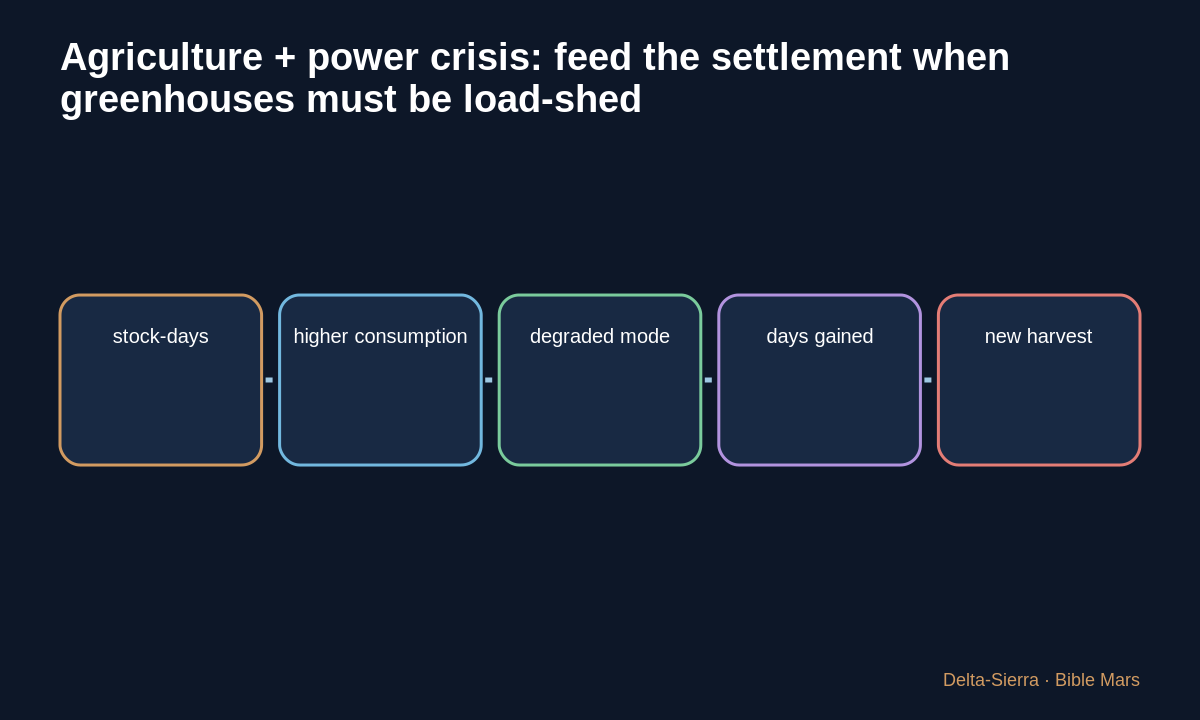
TEACHING ASSUMPTION: complete food reserve=90 days for 100 people. A crisis consumes 1.2 “stock-days” per calendar day because fresh production falls.
Theoretical endurance=90/1.2=75 days. Why divide? Each real day consumes 1.2 reserve units.
If degraded agriculture reduces use to 1.05 stock-days/day, endurance≈85.7 days: preserving a small production fraction gains more than ten days.
Questions never to forget
- Which greenhouse functions fail first when power is cut?
- Which foods cover protein, micronutrients, and energy for the full duration?
- Which crop has the longest recovery time?
- Which non-agricultural loads can be shed before sacrificing a crop?
- Which indicator triggers rationing before emergency conditions?