


MARS BIBLE — RISK & RESILIENCE
Latent manufacturing quality defect: when a batch of “good” parts shares one weakness
A part can pass inspection, operate for months, and still contain a series-wide weakness that appears only under a particular combination of load, temperature, or aging.
This chapter explains why lot traceability, sampling, accelerated testing, and supply diversity become survival functions on Mars. Once a latent defect is discovered, the urgent question is how many installed parts share the same manufacturing history.
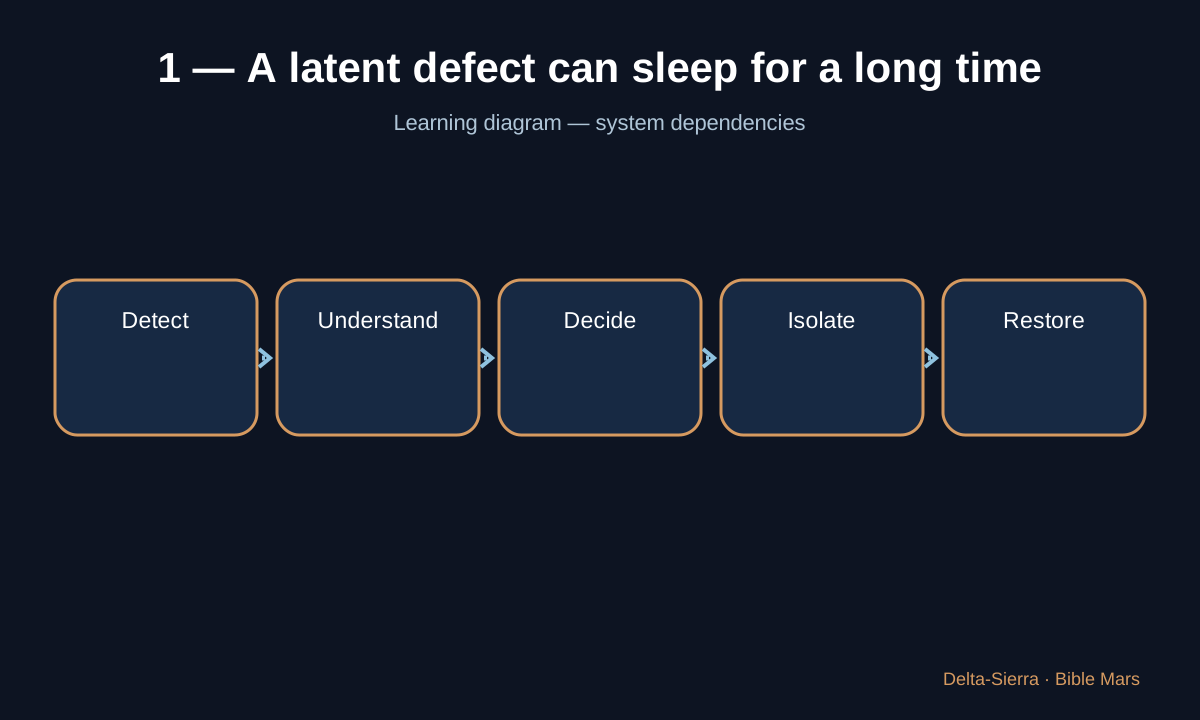
1 — A latent defect can sleep for a long time
A microscopic crack, wrong heat treatment, or material contamination may pass initial inspection and appear only after cycles.
Risk grows when the same production lot feeds multiple redundant units.
2 — Identical redundancy can share the same defect
Two new pumps from the same batch can fail the same way.
Lot and serial traceability quickly identifies which other parts may be exposed.
3 — Control the process, not only the finished part
Weld or additive-manufacturing quality depends on process parameters. A finished surface can look acceptable while internal conditions differ.
Recording parameters, operator, feedstock, and machine supports correlation after an incident.
4 — Sampling and nondestructive inspection
Every part cannot be destroyed for internal inspection. Nondestructive methods — ultrasound, radiography, penetrant testing where applicable — reduce uncertainty.
Inspection plans should target defects plausible for the actual process.
5 — Batch quarantine
When one part reveals a defect, sister parts need identification and possibly quarantine.
Immediately replacing it with another part from the same lot can reproduce the failure.
6 — Mars-Earth quality loop
A settlement manufacturing locally needs metrology and quality assurance appropriate to system criticality.
Industrial autonomy without quality control can increase rather than reduce risk.
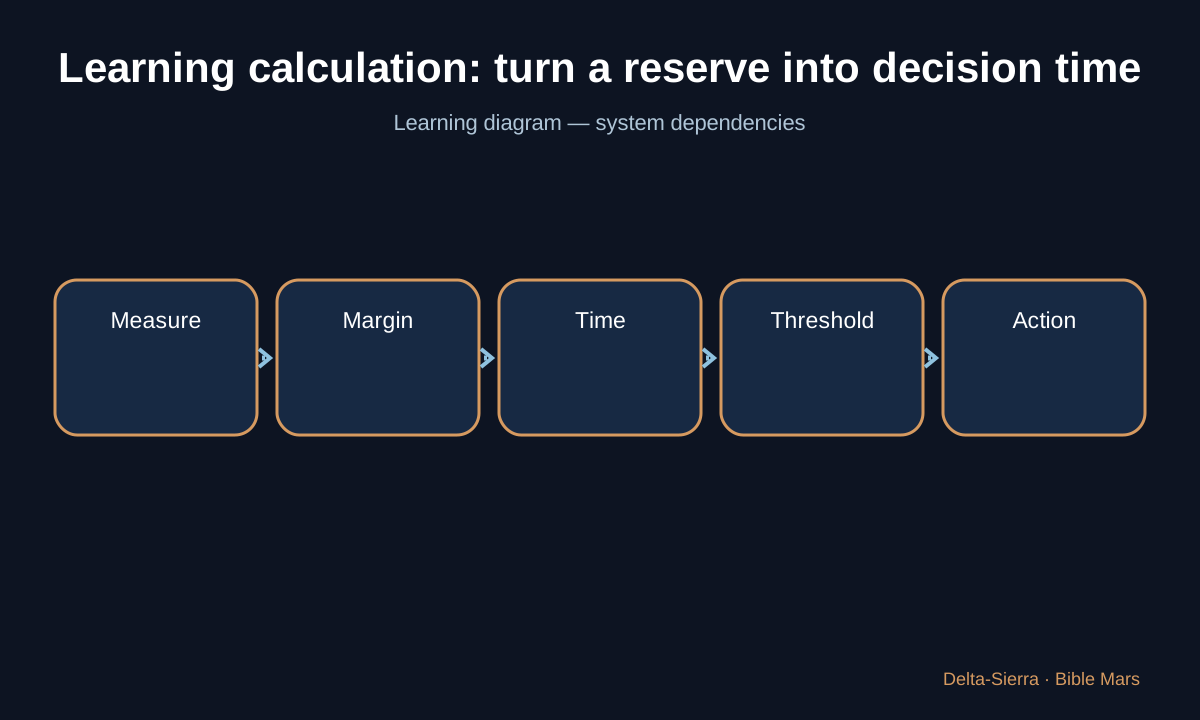
Learning calculation: turn a reserve into decision time
LEARNING CALCULATION — ASSUMPTIONS ARE EXPLICIT
LEARNING ASSUMPTION: 24 parts from one batch equip 12 redundant machines; a common defect is found.
If two parts equip each machine, the batch potentially touches 24 ÷ 2 = 12 machines.
This traceability calculation is not a failure probability; it shows the possible inspection scope.
Decision questions specific to this risk
- Which other parts came from the same batch?
- Which process parameter could explain the defect?
- Which nondestructive inspection can detect this failure mode?
- Do backups use the same supplier and batch?
- What evidence is required before releasing quarantined parts?
A latent defect can sleep for months
Some anomalies cause nothing on first use. A small crack, inclusion, heat-treatment error or contamination may merely reduce fatigue margin. The part appears normal until accumulated cycles expose the weakness. Receiving inspection alone therefore cannot guarantee service life.
A settlement must connect manufacturing records with usage data. If several parts from the same batch begin to drift after comparable cycles, that pattern matters more than each failure in isolation. Maintenance can then become predictive by inspecting sister parts before they repeat the event.
Restore confidence in a local production line
When a Mars-made part shows a serious defect, two extreme responses are both harmful: continuing as if nothing happened, or abandoning local production entirely. The investigation should isolate the responsible variable—material, machine, process setting, operator or inspection—then demonstrate that the correction works on representative specimens or components.
This is central to autonomy. Martian industry will be credible only if it can demonstrate the quality of what it makes. Metrology, manufacturing witnesses and process records therefore become infrastructure as important as the machine tools themselves.
Main primary sources
Connect to other dossiers
The defect that waits for enough cycles
A component can pass early tests yet contain a weakness that becomes critical only after many thermal, vibration or pressure cycles. That is a latent defect: it exists before failure, while consequences remain hidden until time and loading reveal it.
The risk is amplified on Mars when multiple spares come from one production lot. Replacing a failed part with its twin may not remove the cause. Lot, process and inspection traceability therefore become safety information as important as spare count.
Quality must produce data, not only a “passed” label
Useful quality records show how a component was made, what tests it saw, which deviations were accepted and under what criteria. In an isolated settlement, that memory helps determine whether two spares are truly independent or share one vulnerability.
This supports robust local archives. Certificates and histories should not depend on an Earth server that may be unavailable. Maintenance teams need local access to component genealogy before installing a part on a life-critical function.
When should an entire family of parts be grounded?
One discovered defect may force an expensive decision: keep using other parts because no alternative exists, or declare them suspect and suddenly lose redundancy. This decision should be prepared with consequence classification and independent inspection methods.
Martian industry will eventually need qualified substitutions, not only copies. Changing supplier, material or manufacturing process can become a form of diversity against common manufacturing defects.