


MARS BIBLE — RISK & RESILIENCE
Industrial spare-parts chain collapse: when the settlement can repair but can no longer manufacture
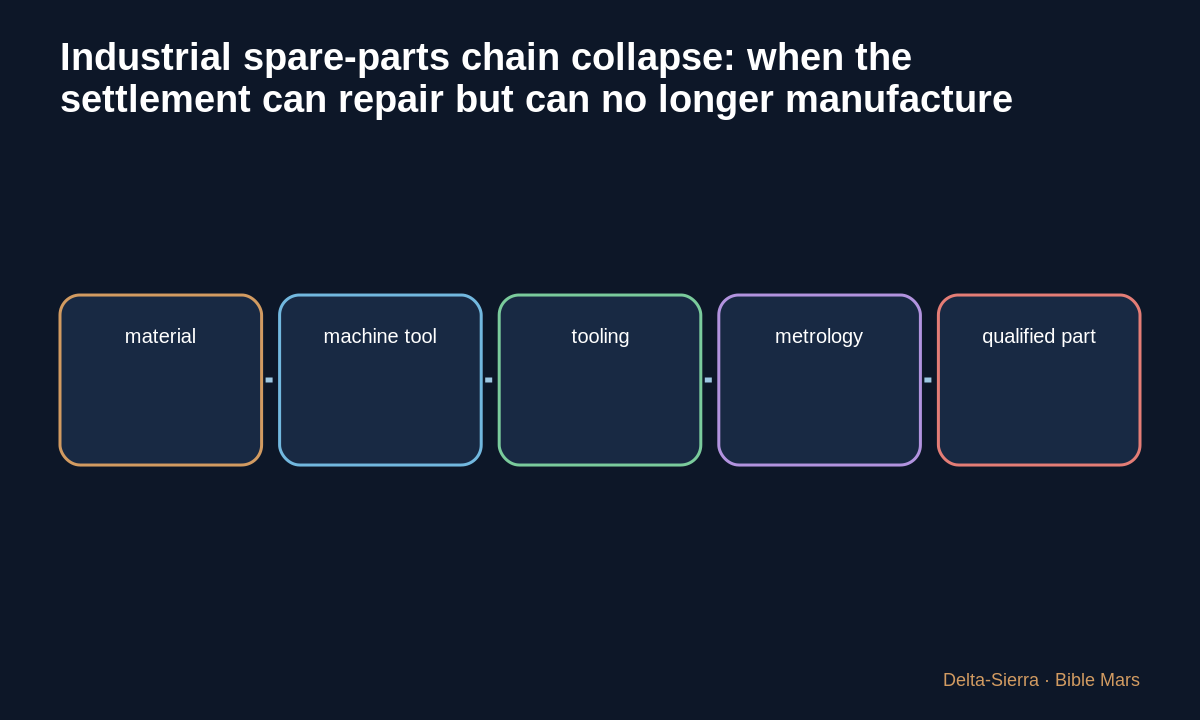
A spare part does not exist alone: material, machine tool, sensor, software, metrology, operator, and power form a production chain that can break at several points.
A settlement can possess the raw material yet still be unable to make a part if one metrology, tooling, software, or qualification link is missing.
1 — A parts list hides a dependency tree
“Make part X” may require an alloy, treatment, machine, cutting tool, program, metrology, and test bench.
Industrial capability is measured in complete chains, not printer count.
2 — The machine that makes parts also needs parts
Bearings, motors, spindles, electronics, and sensors inside machine tools become higher-level spares.
A settlement must identify equipment that “repairs the repairers”.
3 — Metrology: making is not proving
A shape that looks correct can be out of tolerance. Dimensions, surface condition, properties, or leak tightness may require verification before service.
Without reliable standards and measurement tools, local manufacturing can create invisible defects.
4 — Substitution and redesign
When the original process is impossible, a component may sometimes be redesigned for an available material or architecture.
That freedom still requires validation, testing, and interface analysis.
5 — Cannibalization buys time but shrinks the fleet
Taking a part from a secondary system can restore the priority system while removing another capability or backup.
Record the decision as resilience debt.
6 — Real autonomy grows in layers
Initial stocks, repair, simple remanufacture, local materials, advanced processing, and qualification capability form a progression.
A settlement is not “self-sufficient” the day it prints its first part.
Combined scenario — the settlement can repair, but three manufacturing links disappear
A settlement can have excellent technicians and still be unable to restore a system if one family of parts depends on a machine, material, or inspection capability that is unavailable. Human skill does not automatically replace an industrial chain.
Imagine a workshop that can machine a mechanical part, while the heat-treatment machine is down, required bearings are out of stock, and the metrology instrument needed for acceptance is unavailable. Each problem alone appears manageable; together they make the part impossible to qualify.
The first step is therefore to map the functional bill of materials: which parts can actually stop a pump, airlock, rover, or plant? For each one, which materials, machines, tools, software, measurement standards, and skills are required? This map reveals dependencies that a simple spare-parts inventory hides.
The second step is to distinguish manufacturing from qualification. Printing or machining a shape is not enough if dimension, surface condition, strength, leak-tightness, or compatibility cannot be verified. Metrology is part of manufacturing capability.
The third step is time. Some parts can be cannibalized from secondary equipment, some can receive temporary repairs, and others require rebuilding a production chain over weeks. Planning must connect repair time, remaining stock, and expected consumption.
Build industrial autonomy in layers instead of promising “make everything on Mars”
An early settlement will not reproduce all terrestrial industry immediately. A realistic goal is layered autonomy: diagnosis and repair first, then simple parts, then selected materials and treatments, and progressively more complex components as volume, energy, and skills grow.
This progression needs a list of dominant parts: items whose failure disables a critical system and whose replacement from Earth is slow or uncertain. Stocks, standardization, repair plans, and local production capability should focus on those items first.
Standardization can reduce the number of references, but it also creates common-cause risk. Using one bearing everywhere simplifies inventory; discovering a batch defect later can disable many systems. The trade between commonality and diversity must be explicit.
Industrial documentation is itself a resource: drawings, tolerances, materials, inspection procedures, software versions, tooling, and modification history. A part whose function or qualification can no longer be explained becomes practically unreproducible.
Finally, autonomy should be tested through supply-interruption exercises: “this cargo does not arrive; this machine is unavailable; this material is missing.” The goal is not to claim autarky but to measure how long, and with what degradation, essential functions can be maintained.
Teaching calculation — make margin visible
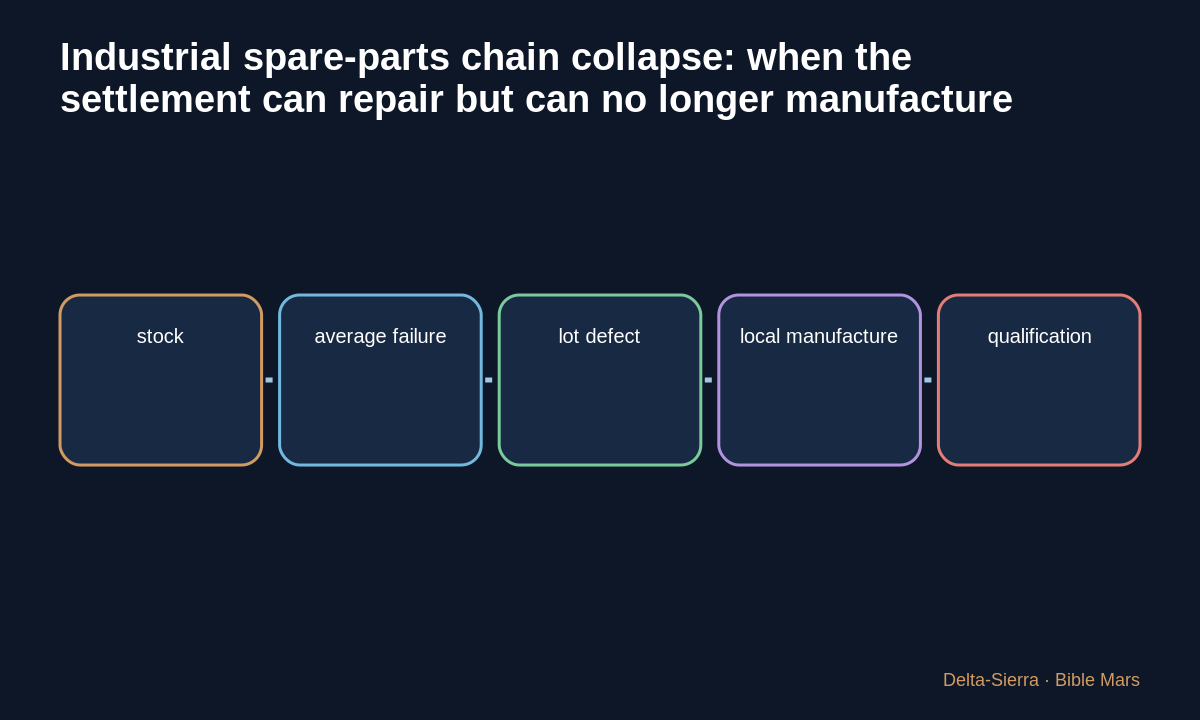
TEACHING ASSUMPTION: 12 identical systems each use 2 critical sensors, so 24 are installed. Spare stock=6. At 2 failures/year, theoretical stock endurance=6/2=3 years.
But if a lot defect requires simultaneous replacement of 8 sensors, stock is immediately insufficient: 6 available for 8 needs, shortfall=2.
This shows why average failure rate and common-cause events must be studied together.
Questions never to forget
- Which unique machine or standard blocks several part families?
- Can the tools needed by the machine tool itself be produced?
- Which substitute changes interfaces or qualification?
- Which stock protects against average failure and which against a series-wide event?
- Which cannibalization removes redundancy elsewhere?