


MARS BIBLE — RISK & RESILIENCE
Missed resupply window: surviving extra months without Earth support
A missed delivery does not merely delay arrival by a few days: Earth–Mars geometry can force a settlement to wait many months for another suitable transfer opportunity.
A settlement must therefore survive beyond its nominal logistics calendar. This chapter examines food, medicines, spares, propellants, industrial capacity, and growth margins when the next cargo does not arrive, turning a logistics delay into measurable decisions rather than improvisation.
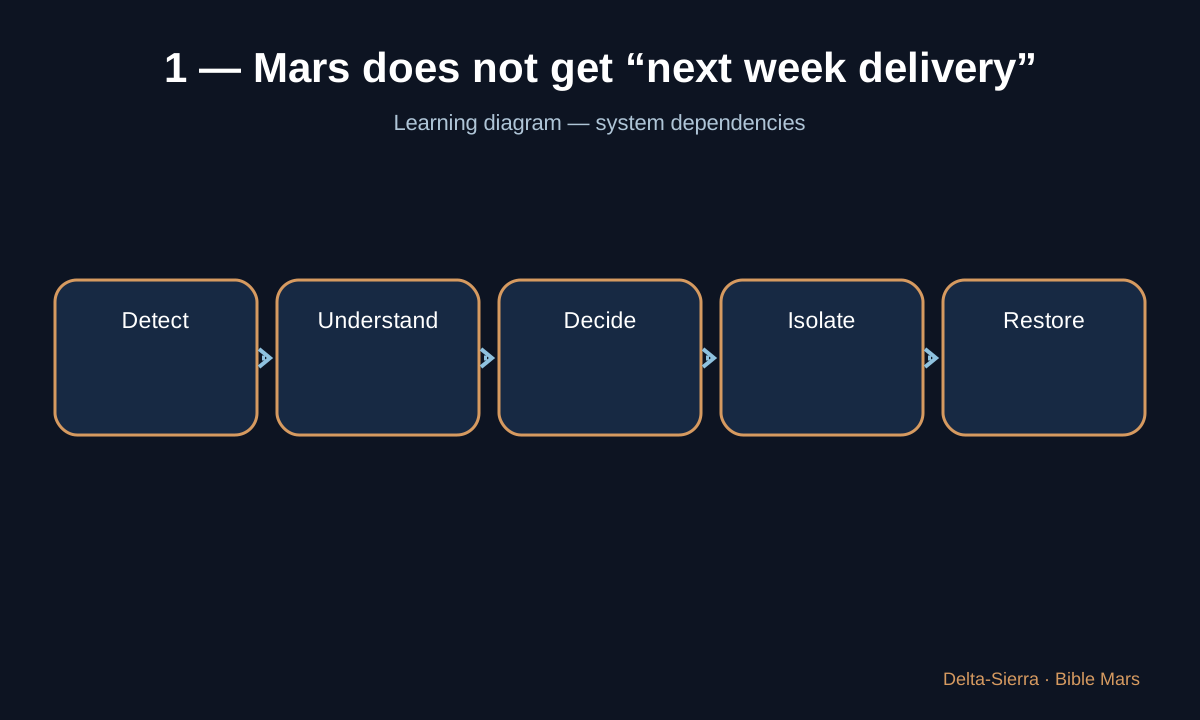
1 — Mars does not get “next week delivery”
Earth-Mars opportunities are constrained by orbital geometry. Missing a resupply campaign can extend required autonomy by many months.
Strategic reserve must therefore be sized against spaceflight calendars, not terrestrial logistics.
2 — Minimum stock depends on the next credible rescue
For every Earth-dependent resource, calculate consumption, reserve, plausible loss, and earliest replacement date.
A part with a 26-month rescue interval needs a different safety stock than a consumable made locally.
3 — Reduce consumption before shortage
Early rationing can prevent brutal rationing later.
Non-vital science or industry can be suspended to preserve filters, gases, lubricants, or spares.
4 — Repair for endurance, not merely restart
A temporary fix consuming the last spare can be dangerous if the system fails again before the next cargo.
Strategy trades cannibalization, local manufacturing, and reduced load.
5 — Morale becomes a resilience variable
Announcing many extra months without resupply changes fatigue, conflict, and risk perception.
Internal communication should explain resources, decisions, and return-to-normal criteria.
6 — Turn the crisis into autonomy
A missed window exposes the most dangerous Earth dependencies.
Every shortage should feed the ISRU, maintenance, and local-industry roadmap.
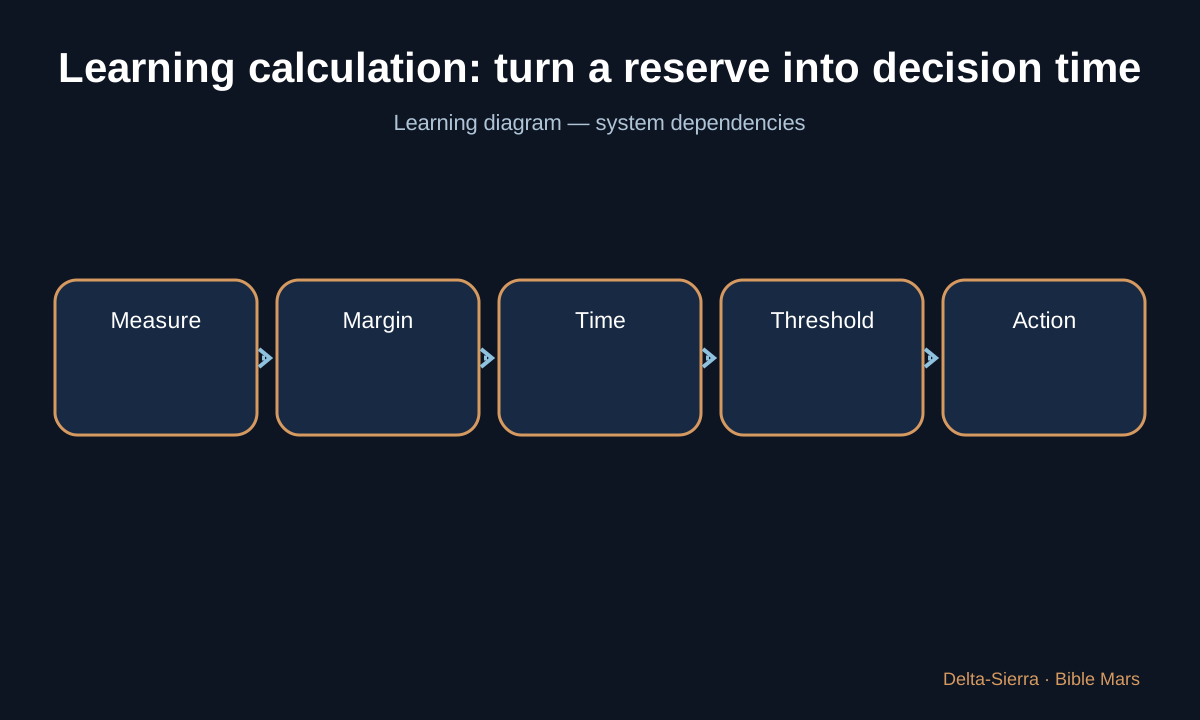
Learning calculation: turn a reserve into decision time
LEARNING CALCULATION — ASSUMPTIONS ARE EXPLICIT
LEARNING ASSUMPTION: consumable reserve = 1,200 units; nominal use = 5 units/day.
Nominal endurance = 1,200 ÷ 5 = 240 days. Reducing to 4 units/day gives 300 days, gaining 60 days.
Rationing is valid only if 4 units/day remains compatible with function and health.
Decision questions specific to this risk
- Which resource runs out before the next credible cargo?
- Which consumption can be reduced without moving risk elsewhere?
- Which part has no local substitute?
- Which stock level must remain untouched for emergencies?
- Which Earth dependency becomes the next industrial priority?
A decision made today may have to last until the next credible window
When a resupply mission is lost, the key variable is not only what remains but how long the settlement must survive before a credible replacement. If Earth–Mars geometry prevents a quick substitute, a consumption rate tolerable for two months may become unsustainable over a much longer interval. Reduction must begin early, before stocks are already low.
This favors progressive thresholds: enhanced monitoring, reduced nonessential use, planned cannibalization, local substitution and, if necessary, suspension of whole activities. Each threshold should be defined in advance so the community does not wait too long before preserving reserves.
Rescue can arrive as information rather than cargo
Even when no hardware can arrive quickly, Earth can still provide expertise, drawings, diagnostics and revised procedures. But such help matters only if the settlement owns the tools, materials and skills to execute it. Resilience therefore depends on the ability to turn received knowledge into local action.
Over time, a crucial metric may become the number of critical functions repairable without a unique Earth-supplied part. Every logistics crisis then becomes a full-scale test of progress toward industrial autonomy.
Main primary sources
Connect to other dossiers
A missed window turns the calendar into a survival resource
Efficient Earth–Mars transfer opportunities are governed by orbital geometry on a scale of many months. A delayed mission may not simply move by a few weeks. A settlement therefore has to consider critical cargo arriving much later than the nominal plan.
Stocks must be sized against disruption duration as well as nominal schedule. Consumables, wear parts and medicines should be classified by days or months to depletion.
Reduce consumption before shortage
Effective rationing starts before a hard threshold. A settlement can delay noncritical maintenance, reduce nonessential production, reassign components or limit resource-heavy activities. Earlier decisions usually create more margin.
Every saving has a delayed cost. Deferred maintenance can increase failure risk; reducing greenhouse output can reduce future food reserves. Strategy must be simulated as a portfolio of consequences rather than uniform cuts.
A rescue cargo should not contain one frozen solution
When the next launch opportunity arrives, the settlement state will have changed. Some originally planned parts may no longer be needed while other systems have accumulated unexpected wear.
Logistics should preserve late re-planning within vehicle and integration limits. Resilience is not only more stock; it is the ability to change supply priorities as conditions evolve.