


MARS BIBLE — RISK & RESILIENCE
Chemical contamination in a Mars habitat: detect the invisible before poisoning
Breathable air can become hazardous without visible smoke or an early warning smell: solvents, combustion products, and industrial leaks require continuous chemical awareness.
The problem is both detection and source identification. This chapter follows sampling, cross-check sensors, ventilation, zone isolation, filtration, decontamination, and re-entry criteria, including false negatives and contaminants that settle onto surfaces.
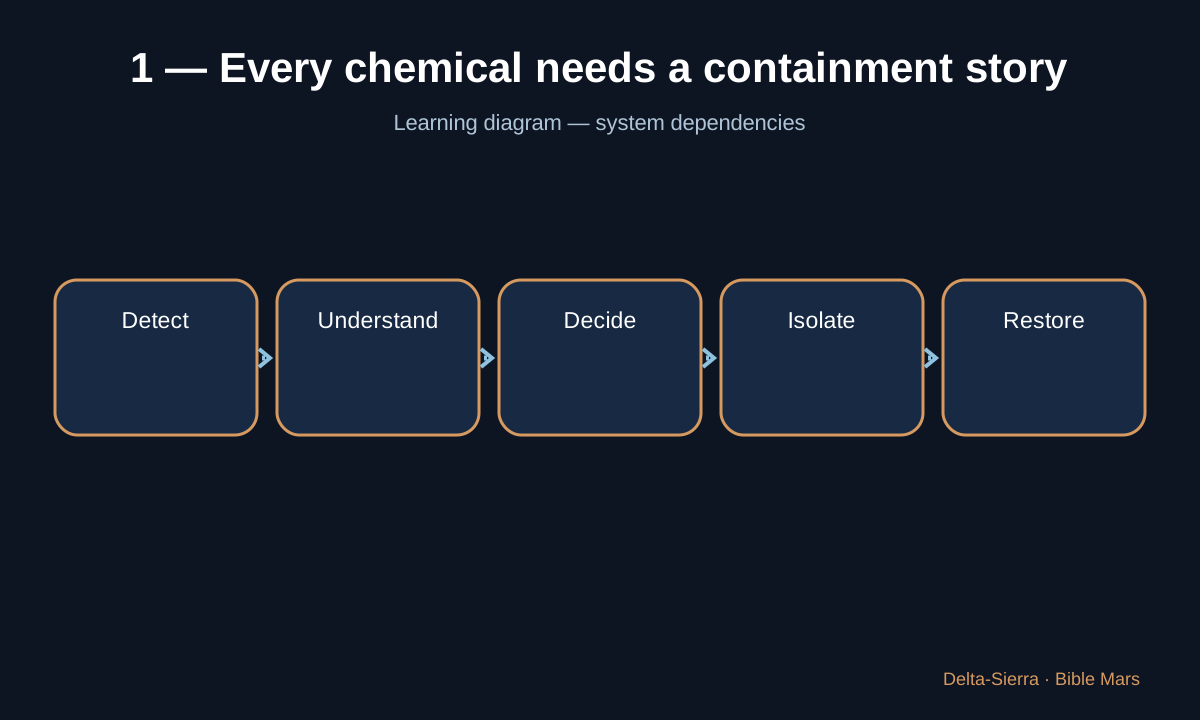
1 — Every chemical needs a containment story
Cleaners, polymers, batteries, thermal fluids, and industrial processes can emit vapors or particles. Safety begins with inventory, compatibility, and maximum accessible quantity.
A product acceptable in a highly ventilated terrestrial workshop may be unsuitable in a closed air-recycling habitat.
2 — Detection: specific or general?
A dedicated sensor may detect one compound at very low concentration; a general air-quality sensor may detect drift without identifying the molecule.
A robust strategy combines instruments, sample collection, and laboratory analysis capability.
3 — Isolate without spreading
The first response is not always “ventilate everywhere”. General ventilation may transport contamination toward clean quarters.
Plans need local containment, flow reversal or isolation, controlled extraction, and refuge for displaced residents.
4 — Protect ECLSS
Filters and sorbents can saturate or become contaminated. Treatment media that captures the chemical becomes hazardous waste requiring isolation.
After the event, residual purification capability must be demonstrated before normal operation returns.
5 — Measure before reopening
No odor is not a criterion. Reoccupation thresholds must use measurements, exposure duration, and chemical-specific toxicology limits.
Continued monitoring after reopening checks for secondary off-gassing from porous materials.
6 — Find the cause
A leaking fitting, material incompatibility, transfer procedure, or heater-control problem can be the origin. Cleaning alone does not remove the cause.
Inventory, procedure, sensing, and design should be updated after the event.
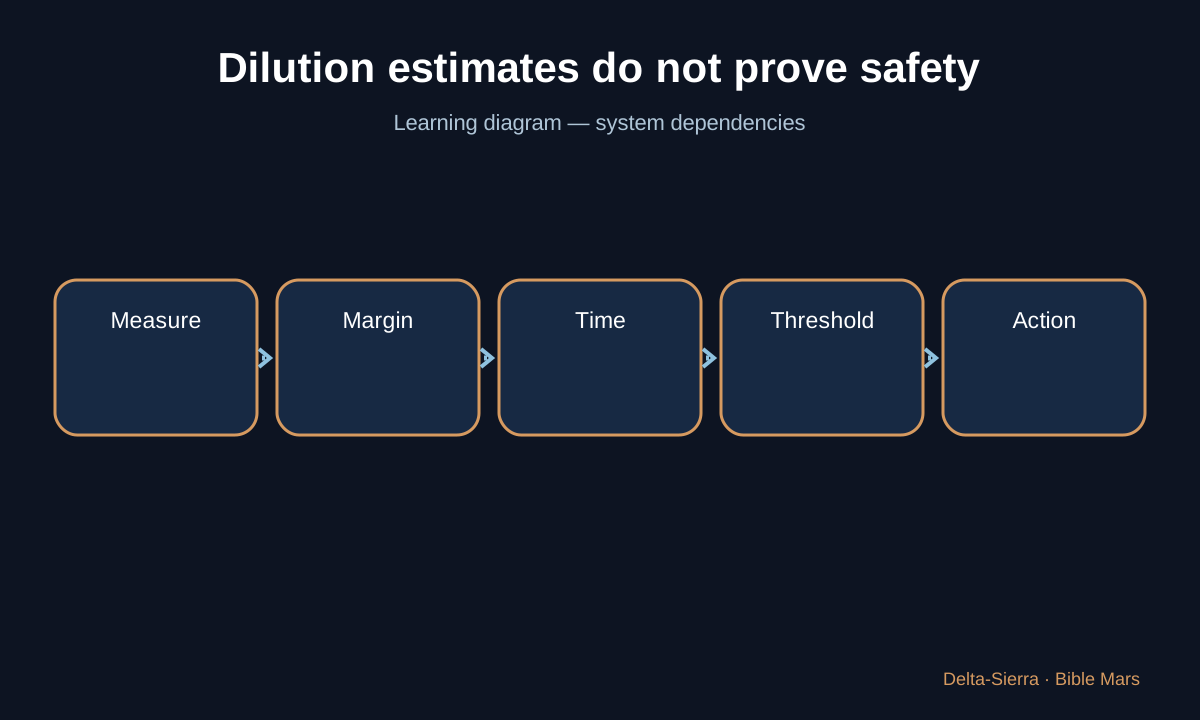
Dilution estimates do not prove safety
LEARNING CALCULATION — ASSUMPTIONS ARE EXPLICIT
LEARNING ASSUMPTION: 2 g of contaminant becomes uniformly distributed in 200 m³ of air. Average mass concentration = 2,000 mg ÷ 200 m³ = 10 mg/m³.
This calculation gives no toxicological verdict. Hazard, adsorption, chemistry, actual distribution, and exposure limits depend on the substance. It only teaches mass-to-volume concentration.
Decision questions specific to this risk
- Which exact chemical can leak, and what maximum amount is accessible?
- Does airflow carry contamination toward clean zones?
- Which independent instrument confirms return below threshold?
- Must exposed filters be replaced or can they be requalified?
- Which measured criterion authorizes reoccupation?
Detecting a contaminant is not the same as finding its source
A chemical alarm may show that a limit has been crossed without revealing whether the substance comes from a material, industrial process, cleaning operation, leak or Martian sample. Operations therefore need traceability and the ability to isolate air or water volumes so that signatures can be compared. Otherwise the symptom may be treated while the source continues to emit.
The strategy should separate rapid screening from confirmation analysis. A fast sensor protects people; a more precise laboratory identifies the substance and concentration. This avoids demanding that one instrument be instant, universal and extremely precise at the same time.
Decontaminate without creating a second contamination problem
A cleanup operation can itself generate solvents, concentrated waste or saturated filters that must then be contained. Engineering must follow the material: what is removed from water or air does not disappear; it moves into another medium. Storage, treatment and evidence of safe recovery belong to the same operation.
Restart should not depend on one reassuring reading. Teams look for a stable trend, multiple sampling points and, for important hazards, independent confirmation. Analytical chemistry then becomes a decision tool rather than a collection of numbers.
Main primary sources
Connect to other dossiers
Contamination can be invisible before it becomes medical
Smell is not a detection system. Many compounds can reach problematic concentration before producing an obvious immediate sign. A habitat therefore needs chemical monitoring of air and water, alarm thresholds and sampling capability to confirm a first alert.
Diagnosis must also trace the source: material off-gassing, maintenance fluids, industrial leakage, cleaning products, incomplete combustion or contamination carried through an airlock. Without source control, purification may only hide the problem temporarily.
Isolate before contaminating the entire loop
In a highly interconnected settlement, ventilation, water recycling and transfer networks can spread contamination. Compartment isolation and bypass capability therefore matter as much as filters. Operators must be able to isolate a volume, switch to a clean reserve and keep local treatment from returning contamination to another loop.
That resilience costs mass and maintenance, but lack of separation can turn a local release into a settlement-wide problem. Design should therefore be driven by propagation pathways, not only event probability.
When can the crew safely re-enter?
An alarm clearing is not proof that conditions are safe again. Re-entry criteria should include concentration below limits, stable trends, source control, functioning purification and independent confirmation. Some contaminants may also remain on surfaces, fabrics or condensate.
Procedures must distinguish detection, confinement, cleanup and certification of return. The final step matters on Mars because reopening too early can recreate exposure or contaminate a volume that remained clean.