


MARS BIBLE — RISK & RESILIENCE
Reusable rockets: how a first stage returns and lands autonomously
Returning a first stage is not simply “restarting the engines”: energy, attitude, aerodynamics, navigation, relights, and ground contact must be controlled in a tightly constrained autonomous sequence.
This chapter decomposes the logic of first-stage recovery without providing an operational flight procedure: state estimation, guidance, thrust-vector control, aerodynamic surfaces, propellant margins, and closed-loop control. It also explains why modern sensors, computing, and algorithms enable precision unavailable to early pioneers.
1 — Une fusée réutilisable est conçue pour revenir dès le départ
Falcon 9 is designed for return from the start: propellant margin, entry, relights, aerodynamic control, and landing are part of the mission architecture.
SpaceX publishes sequences including stage flip, boostback, entry burn, and landing burn.
2 — Les ailettes de grille travaillent avec l’atmosphère
SpaceX states that four hypersonic grid fins orient Falcon 9 during reentry by moving the center of pressure.
They become effective when atmosphere provides aerodynamic force and complement other control methods.
3 — Le moteur devient aussi un organe de guidage
A gimbaled engine tilts the thrust vector; the lateral component creates torque for attitude correction.
Flight computers command actuators from estimated vehicle state in a fast automatic loop.
4 — Pourquoi ce n’était pas réaliste avec une V-2
Mechanics was known, but V-2 lacked the integrated propellant margin, relight, navigation, actuators, digital computing, entry protection, and landing systems of modern recovery.
The difference is system and industrial integration, not a newly discovered physical law.
5 — Europe : TVC maîtrisé, architecture de récupération différente
Ariane has long used gimbaled engines and guidance avionics; ESA documents Vulcain gimbal actuation.
A reusable booster additionally requires a complete return architecture; Ariane not landing vertically does not mean Europe lacks TVC knowledge.
6 — Pont vers Space Academy
Courses AM-04.26 to AM-04.30 cover TVC, feedback control, actuators, Falcon 9, and historical comparison.
Numerical examples are explicitly educational and never presented as proprietary SpaceX laws.
Order-of-magnitude calculation
LEARNING ASSUMPTION: a stage reserves 25,000 kg of propellant from a fictional initial 400,000 kg propellant load.
Reserved fraction = 25,000 ÷ 400,000 = 0.0625 = 6.25%.
This fictional percentage teaches the tradeoff and is not a real Falcon 9 reserve figure.
The vehicle must continuously estimate its own state
A returning stage does not merely ‘know where the landing zone is’. It estimates position, velocity, attitude and measurement quality, then compares that state with a reference trajectory. The estimate combines multiple sensors and models; no single measurement completely describes the motion.
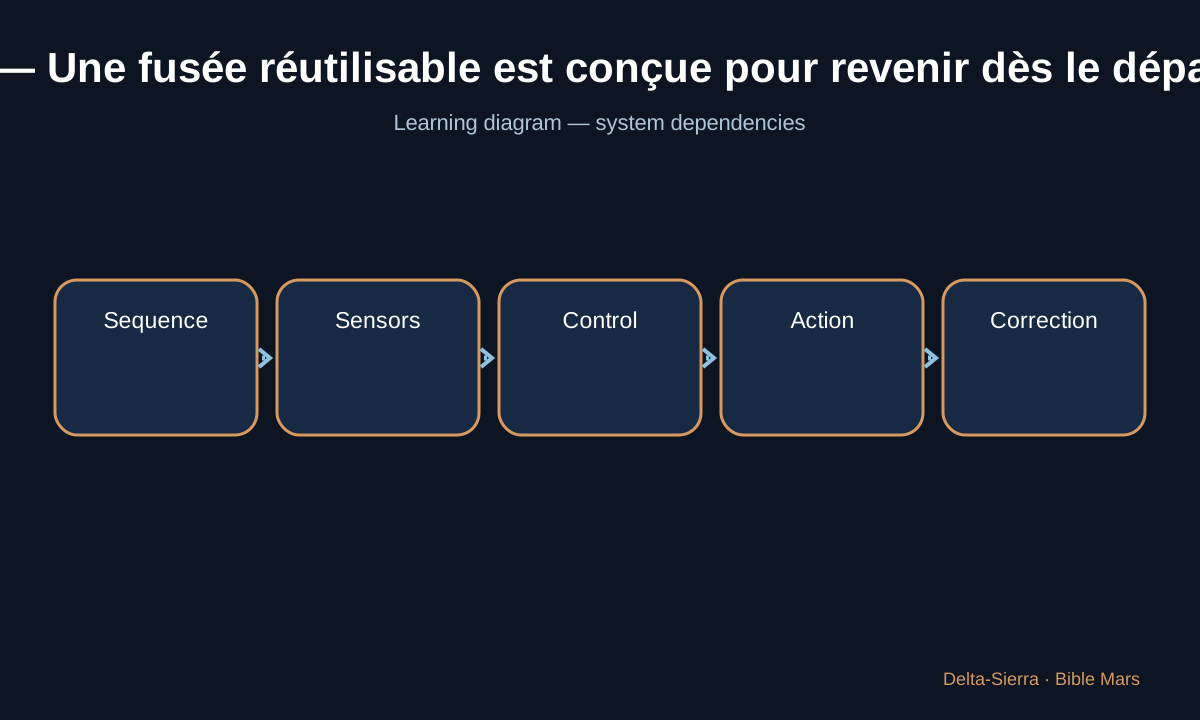
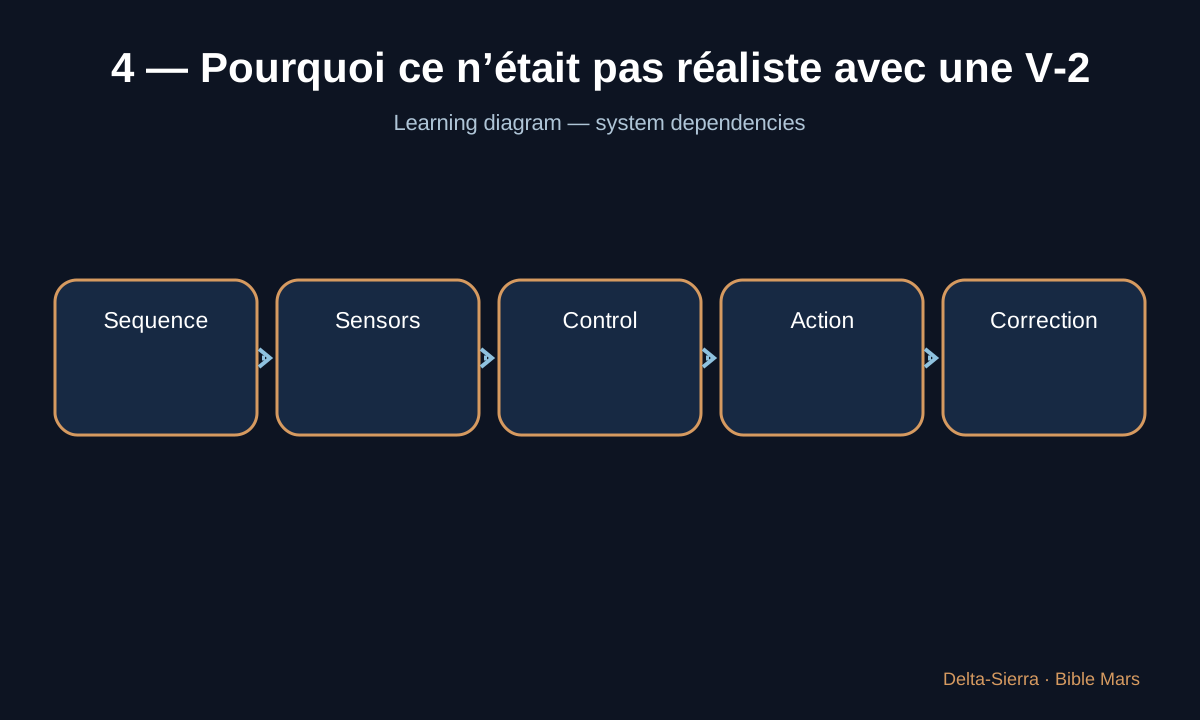
Control then applies successive corrections. The key educational idea is not a proprietary algorithm but the universal loop: measure → estimate → compare → command → measure again. The vehicle performs that loop quickly and locally because a human on the ground cannot observe and correct every deviation in real time.
Why a small engine rotation can rotate the vehicle
When thrust no longer passes exactly through the center of mass, it creates a moment that tends to rotate the vehicle. The effect depends on force, direction and the offset between the thrust line and the center of mass. This is the principle of thrust vector control, or TVC.
Space Academy will explain this with vectors and diagrams, then show why a real system must also consider vehicle inertia, remaining propellant, actuator limits and measurement delays. This encyclopedia page stays deliberately conceptual: actual launch-vehicle control laws are complex systems validated through simulation and testing.
Main primary sources
Return is a second mission in its own right
After stage separation, the first stage still has velocity, altitude, attitude and limited propellant. It must manage orientation, energy, atmospheric flight, engine availability and navigation accuracy. Recovery is therefore a self-contained mission inside the launch mission.
SpaceX publishes sequences separating entry burn, landing burn and touchdown. Grid fins provide aerodynamic control during reentry, while thrust vectoring provides control when engines operate. Different control authorities dominate in different phases.
The onboard computer closes the loop
Instantaneous landing control is not performed manually from the ground. Event speed and correction frequency require onboard autonomy. Sensors estimate position, velocity and attitude; guidance selects a path; control turns error into actuator and engine commands.
The proprietary flight laws are not public and are not necessary to understand the principle. The core loop is measure → estimate → compare → command → measure again, repeated rapidly through descent.
Why this changes launcher economics
Recovery is useful only if preserving the stage creates more value than the return process consumes. Designers trade propellant reserved for return, extra equipment, recovery operations, inspection and turnaround time.
Technical landing success is one condition; economic success depends on cadence and refurbishment effort. Reuse is therefore a systems and operations architecture, not only a guidance achievement.