Course compass
Guiding question: How can a complete beginner learn space science without completing years of abstract prerequisites before understanding a rocket?
Markers: 📏 MEASURED · 📐 CONVENTION · 🧮 CALCULATED · 🎓 TEACHING ASSUMPTION · ⚠️ APPROXIMATION
- understand the concept
- do a simple calculation
- explain every symbol
- check a result
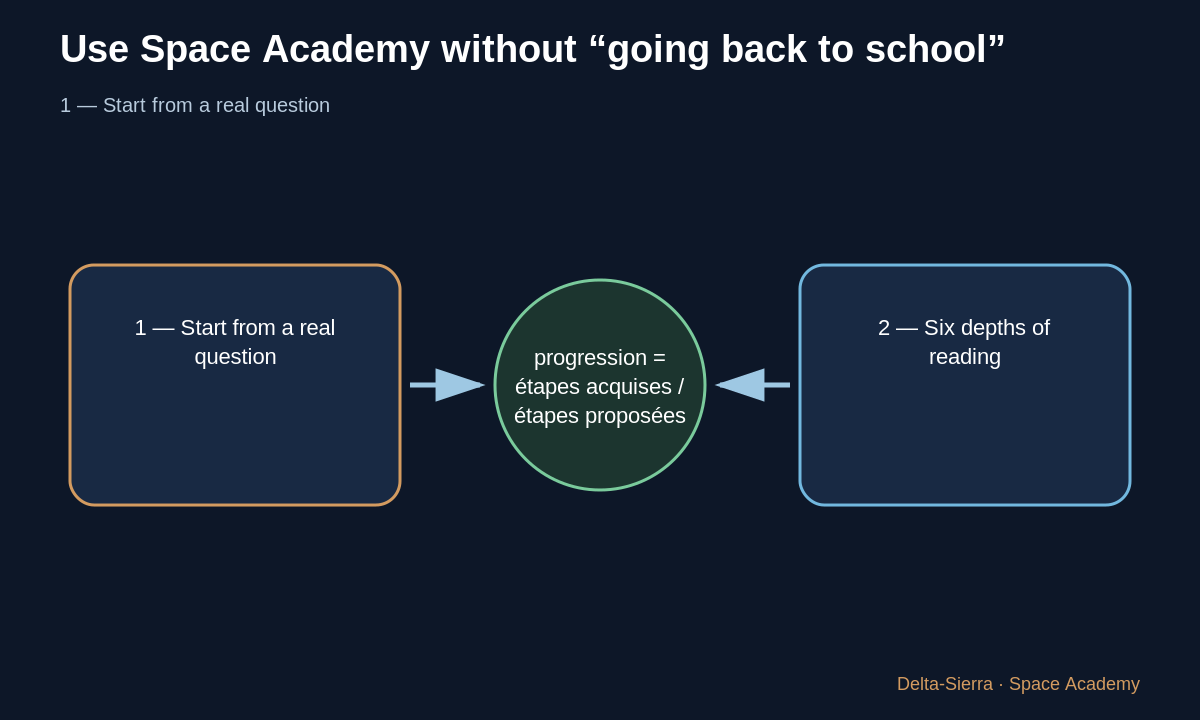
1 — Start from a real question
The path begins with a concrete problem: why a rocket produces thrust, why a satellite keeps falling around Earth, or how to aim at a moving target. Mathematics appears when it becomes useful.
You do not need to memorize an entire syllabus before continuing; prerequisites are introduced just in time.
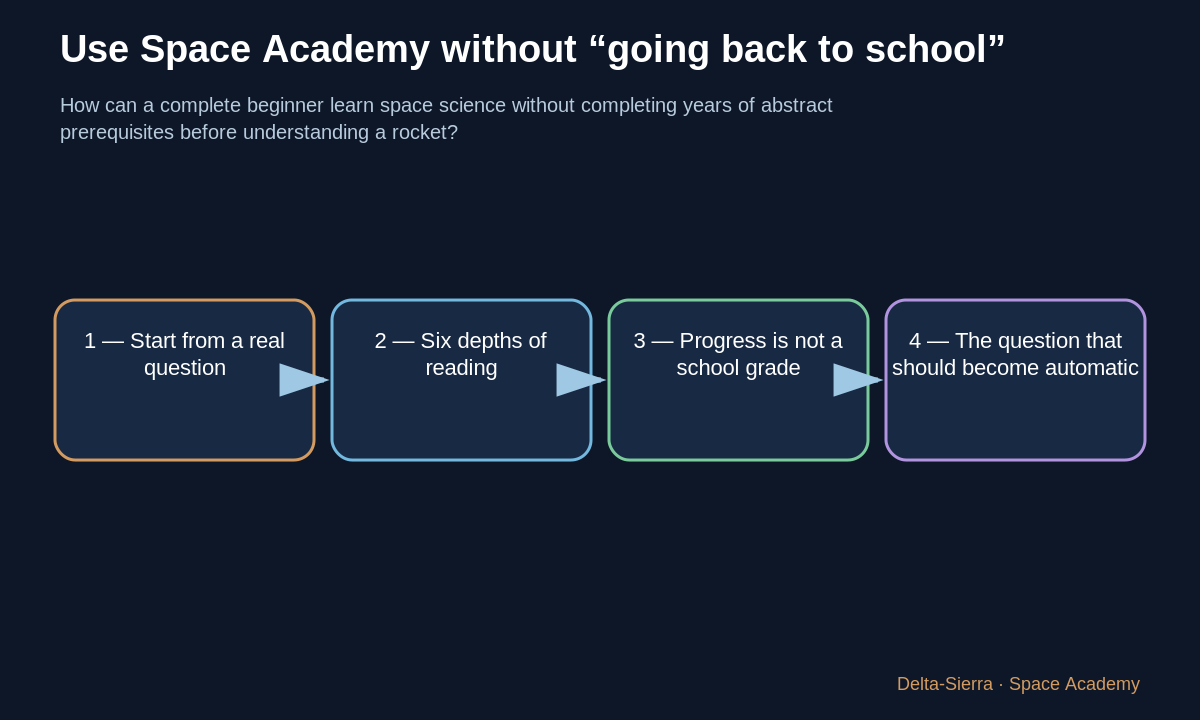
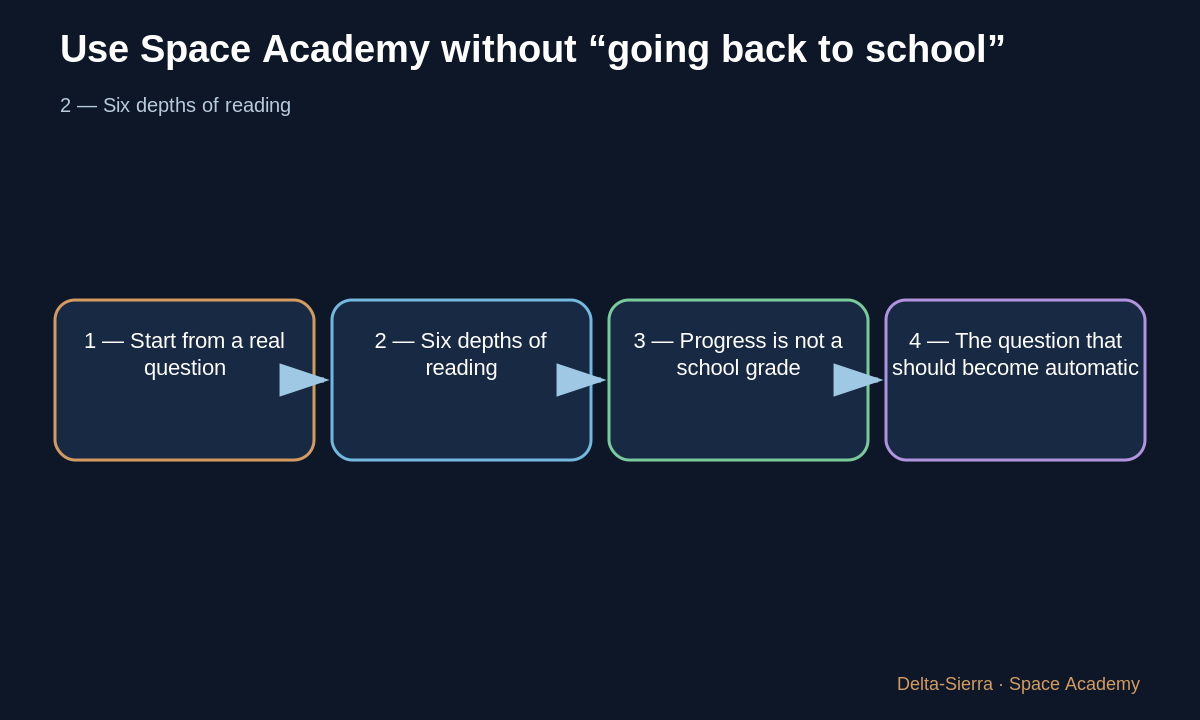
2 — Six depths of reading
Each concept moves from intuition to words and units, first calculation, mission case, and engineering-level limitations. A beginner can stop early; an advanced reader can continue.
This prevents metaphors from replacing science: analogy opens the door and the real model follows.
3 — Progress is not a school grade
A lesson can be not started, in progress, or acquired. “Acquired” is a learning marker, not a professional qualification.
Progress can be exported to a small backup file in addition to browser storage.
4 — The question that should become automatic
For every number: where did it come from? For every symbol: how is it read? For every operation: why add, multiply, or divide? For every model: when does it stop being good enough?
The goal is to reconstruct reasoning rather than recite formulas.
Three complete examples: change one assumption to understand
Before each calculation, identify where every number comes from and whether it is measured, conventional, assumed, or calculated.
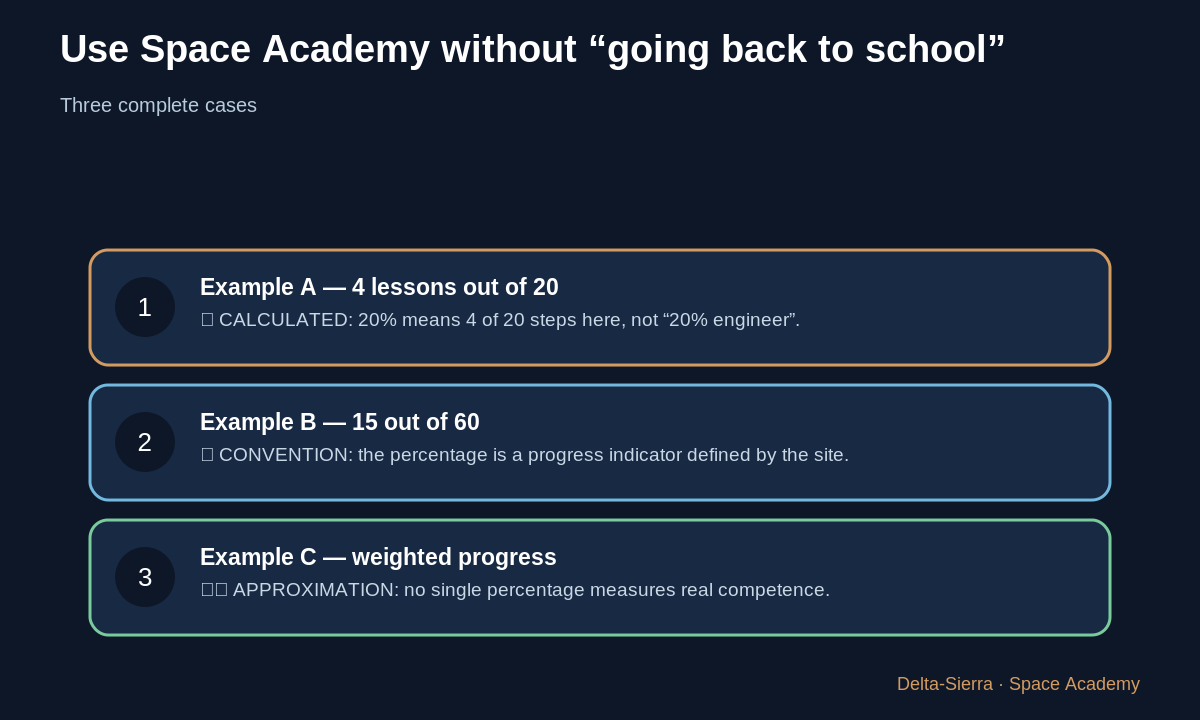
Example A — 4 lessons out of 20
If a small path contains 20 steps and 4 are acquired, 4 ÷ 20 = 0.20. Multiply by 100 to get 20%.
🧮 CALCULATED: 20% means 4 of 20 steps here, not “20% engineer”.
Example B — 15 out of 60
15 ÷ 60 = 0.25, then ×100 = 25%. The same percentage can represent more lessons in a longer path.
📐 CONVENTION: the percentage is a progress indicator defined by the site.
Example C — weighted progress
A future module may distinguish opened lessons from acquired concepts or heavier projects. Those indicators answer different questions.
⚠️ APPROXIMATION: no single percentage measures real competence.
Inverse calculation
To recover acquired steps from a percentage, multiply the total by the corresponding fraction: 20% of 35 = 0.20 × 35 = 7.
Common trap and result check
Trap: confusing “I opened the page” with “I understood it.” Progress is a navigation aid, not an automatic medal.
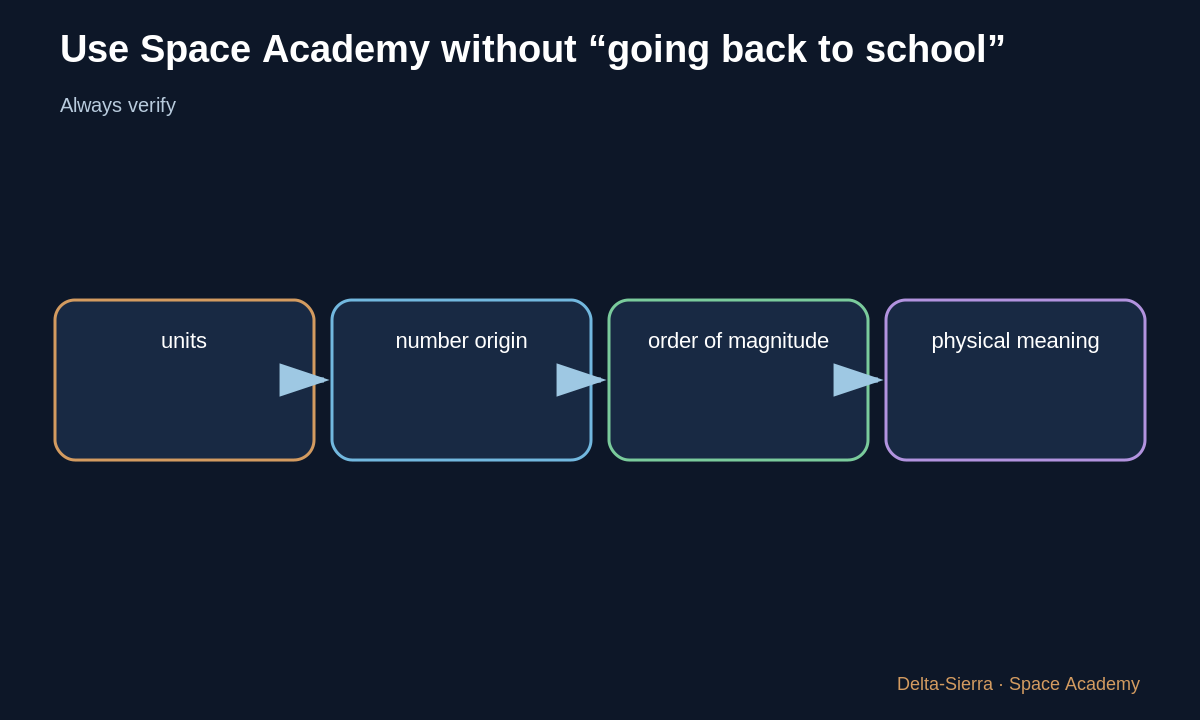
Always check units, order of magnitude, and physical meaning before accepting a result.
Exercises and answers
Understand
Explain the relationship in your own words.
Change an assumption
Modify one input and predict the direction of change before calculating.
Verify
Name two checks after a calculation.