Course compass
Guiding question : How do we connect what a source “pushes”, what flows and what actually heats or powers a load?
1 — The physical question
How do we connect what a source “pushes”, what flows and what actually heats or powers a load?
2 — Symbols, reading and units
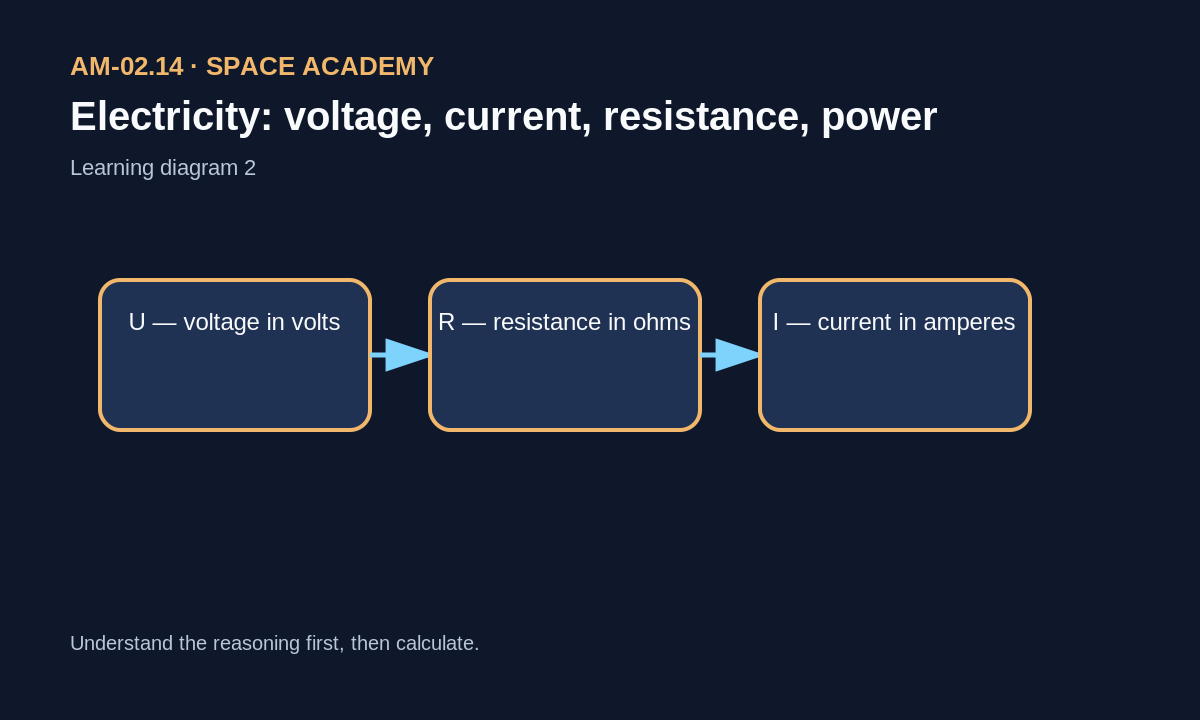
U — voltage in volts; R — resistance in ohms; I — current in amperes; P — power in watts.
3 — Where does the relation come from?
Ohm’s law connects voltage, current and resistance for an ohmic component. Electrical power connects voltage and current to energy transferred per unit time. Together they let us reason about a simple electrical line without mixing volts, amps and watts.
4 — A — 10 Ω resistor at 20 V
I=U/R=20/10=2 A. Power is P=UI=20×2=40 W.
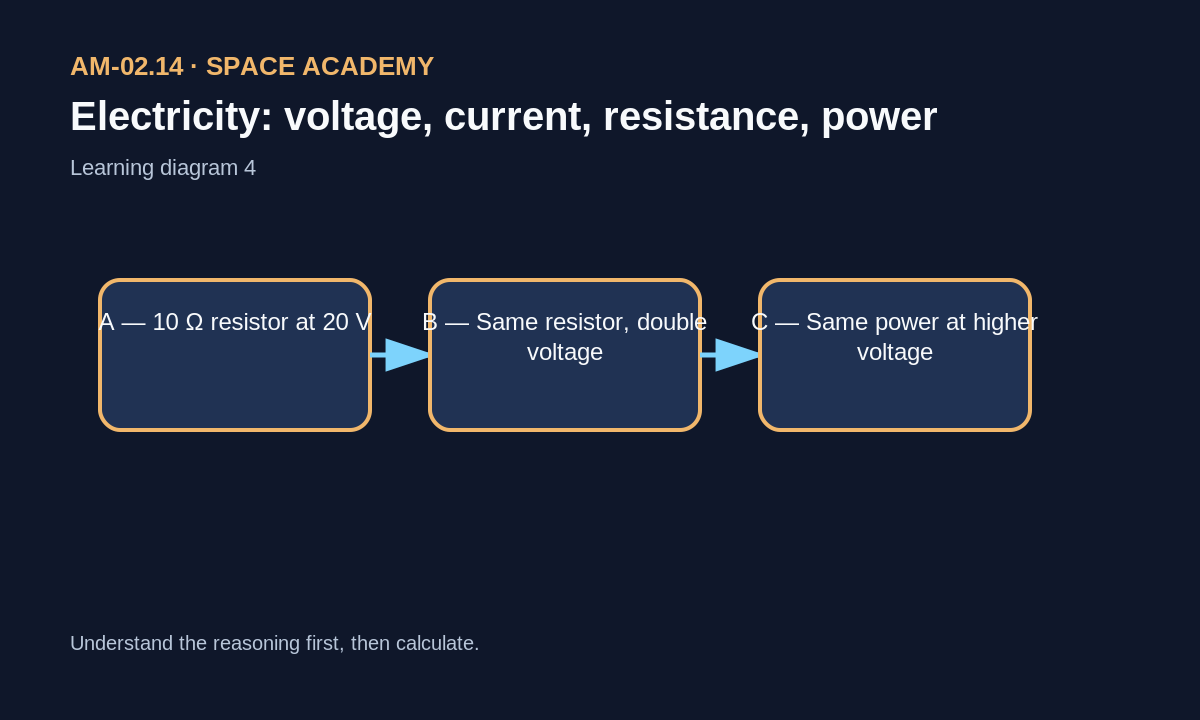
5 — B — Same resistor, double voltage
At 40 V, I=4 A and P=160 W. Doubling voltage quadrupled power dissipated in this resistor.
6 — C — Same power at higher voltage
To transmit 1,000 W at 100 V, I=10 A; at 500 V, I=2 A. Lower current can reduce resistive cable losses.
7 — Go deeper
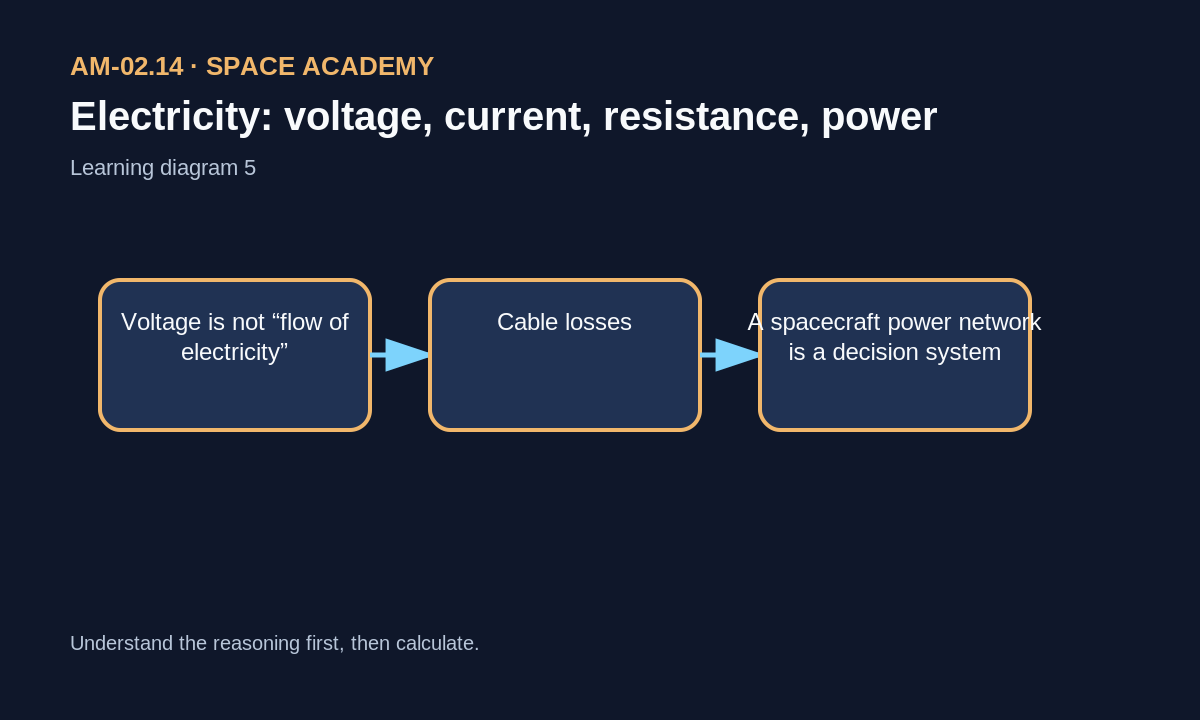
Voltage is not “flow of electricity”
Voltage is electrical potential difference. Current is a flow rate of charge. Confusing them hides why high-voltage transmission can carry large power with relatively modest current.
Cable losses
A cable resistance dissipates P_loss=I²R. Because current is squared, reducing I can greatly reduce heating for the same line resistance.
A spacecraft power network is a decision system
Solar array, battery, converter, bus, protection device and load each have voltage, current, thermal and power limits. A reliable network must monitor margins, isolate faults and shed loads before collapse.
Voltage and current are not the same thing
Voltage describes an electric potential difference; current describes a flow of electric charge. High voltage therefore does not automatically imply high current: the connected load and its resistance matter. A hydraulic analogy can help initially, but becomes misleading if we forget that electrons and electric fields are not literally water in pipes.
Power and energy must be separated
Power P is a rate of energy conversion, measured in watts. Energy used over time is the integral of power; for constant power, E=P×t. A 10 kW system does not “contain” 10 kWh: kW measures power while kWh measures energy. This distinction is fundamental for battery endurance.
Why higher voltage can reduce cable losses
For a given transmitted power, P=UI. Higher voltage therefore allows lower current. Resistive conductor losses follow Ploss=I²R, so reducing current can strongly reduce losses, while creating different insulation, conversion and safety requirements. Selecting a bus voltage is therefore a system trade rather than a single optimum number.
Series, parallel and continuity of service
Connecting components in series or parallel changes voltage, current and failure behavior. Redundancy is not simply “two batteries”: engineers must examine shared buses, converters, contactors, protection and the ability to isolate a fault. Electrical design therefore connects directly to resilience engineering.
Measuring electricity without trusting one number blindly
Voltage, current, insulation resistance and power quality are monitored by sensors. A measurement can still be biased, saturated or lose its reference. Critical systems therefore connect electrical values to thresholds, independent comparisons and hardware protection rather than trusting one displayed number.
8 — Exercises and answers
Challenge 1
A — 10 Ω resistor at 20 V: repeat the reasoning with the stated values, then explain the physical meaning of the result.
Challenge 2
B — Same resistor, double voltage: repeat the reasoning with the stated values, then explain the physical meaning of the result.
Challenge 3
C — Same power at higher voltage: repeat the reasoning with the stated values, then explain the physical meaning of the result.