Course compass
Guiding question : How do we move from an enormous number of molecules to a mass that can be measured on a scale?
1 — The physical question
How do we move from an enormous number of molecules to a mass that can be measured on a scale?
2 — Symbols, reading and units
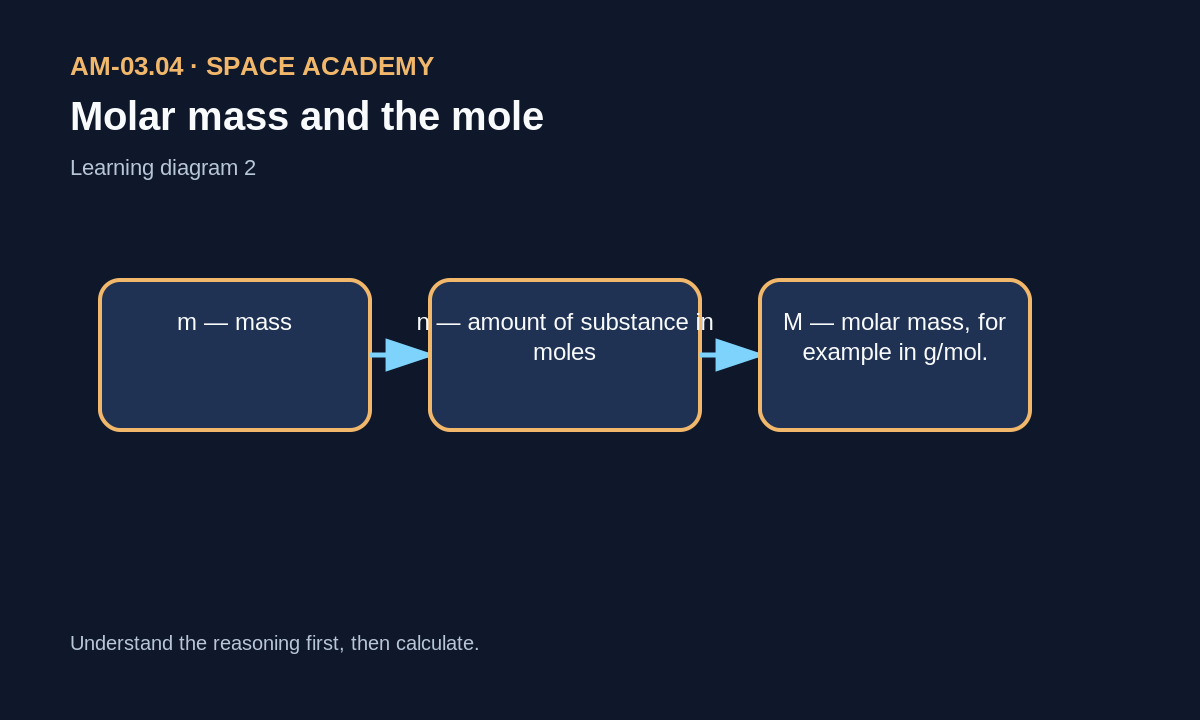
m — mass; n — amount of substance in moles; M — molar mass, for example in g/mol.
3 — Where does the relation come from?
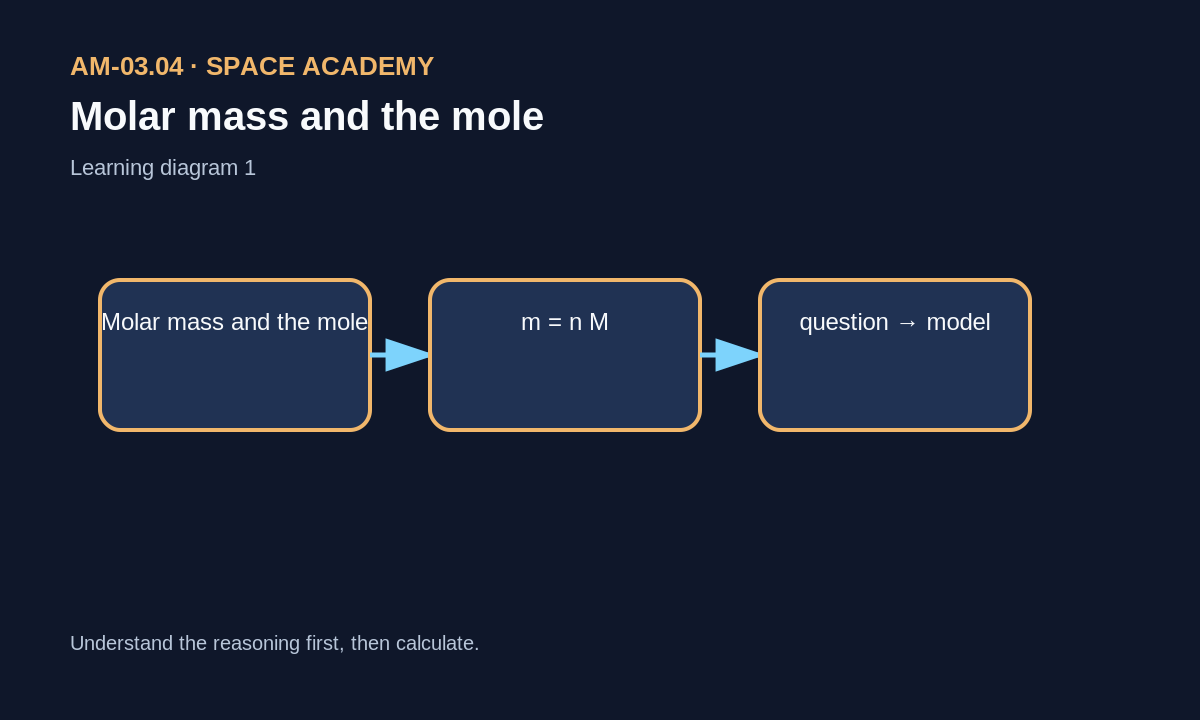
Chemists group particles into moles, rather like grouping objects by dozens but with an enormously larger count. Molar mass tells the mass of one mole of a substance. The relation m=nM converts amount of substance into measurable mass.
4 — A — One mole of water
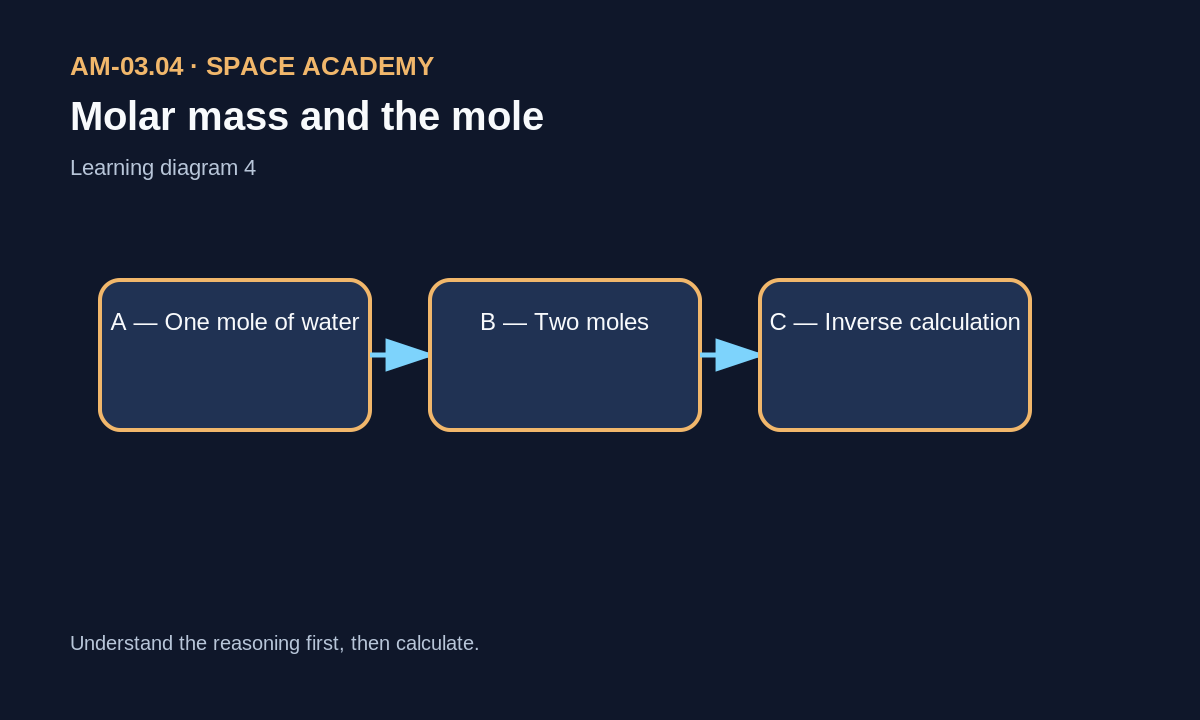
M(H₂O)≈18 g/mol. For n=1 mol, m=1×18=18 g.
5 — B — Two moles
n=2 mol of water gives m=2×18=36 g.
6 — C — Inverse calculation
With 90 g of water, n=m/M=90/18≈5 mol.
7 — Go deeper
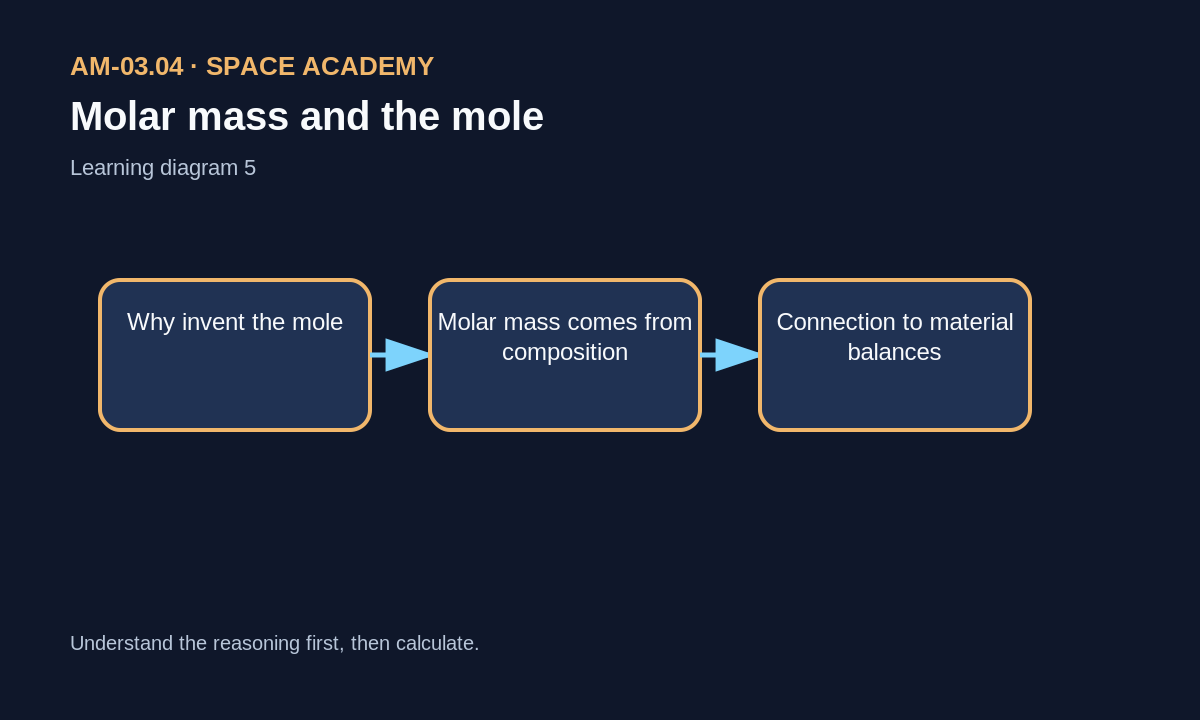
Why invent the mole
A drop of water contains an enormous number of molecules. Counting them individually is impossible. The mole connects the microscopic world of particles to the macroscopic world of measurable mass.
Molar mass comes from composition
For a first calculation, H is about 1 g/mol and O about 16 g/mol; H₂O is therefore 2×1+16≈18 g/mol. Precise values come from measured atomic masses.
Connection to material balances
A chemical reaction conserves atoms. Working in moles converts that conservation into masses of propellant, oxygen or water required by a real process.
Avogadro’s constant tells us the size of the package
One mole contains exactly 6.02214076×10²³ elementary entities. This value, the Avogadro constant, defines the mole in the modern SI. It is enormous because atoms and molecules are extremely small. The mole therefore lets us count particles indirectly by measuring macroscopic amounts of matter.
Always state what is being counted
Saying “one mole” is incomplete when the entity is ambiguous. One mole of H₂O molecules, one mole of H atoms and one mole of electrons count different things. Amount of substance replaces microscopic counting, but the counted entity still has to be named.
Units cancel in m=nM
If n is in mol and M is in g/mol, then mol×g/mol gives grams. The mol unit cancels algebraically. This explains why the operation is multiplication rather than division. In the inverse calculation n=m/M, grams cancel and moles remain.
Molar mass comes from the atoms in the molecule
For H₂O using rounded classroom values, M≈2×1+16=18 g/mol. For CO₂, M≈12+2×16=44 g/mol. The addition reflects molecular composition. Precise work uses standardized atomic masses with a precision appropriate to the problem.
Why the mole becomes essential in a chemical plant
Chemical equations use ratios of particles, while tanks and scales deal with kilograms. The mole is the bridge. It converts a balanced reaction into mass requirements for water, oxygen, hydrogen or methane and then connects chemistry to flow rates and storage capacity.
8 — Exercises and answers
Challenge 1
A — One mole of water: repeat the reasoning with the stated values, then explain the physical meaning of the result.
Challenge 2
B — Two moles: repeat the reasoning with the stated values, then explain the physical meaning of the result.
Challenge 3
C — Inverse calculation: repeat the reasoning with the stated values, then explain the physical meaning of the result.