Course compass
Guiding question : How did the simple idea of burning propellants and accelerating a jet become a guided high-altitude vehicle?
Evidence tags : 📏 MEASURED · 📐 CONVENTION · 🧮 CALCULATED · 🎓 LEARNING ASSUMPTION · 🚀 MISSION DATA · 🏭 MANUFACTURER DATA · ⚠️ APPROXIMATION
Objectives :
- identify liquid-engine building blocks
- understand the jump from demonstrator to complete system
- follow the evolution of flight control
- separate technical heritage from historical context
- see what remains unchanged in modern engines
1 — Before the V-2: thrust was only one problem
Early twentieth-century pioneers already had Newtonian mechanics, thermodynamics, and chemistry. The difficult step was turning those laws into pumps, tanks, injectors, chambers, and guidance hardware that could survive real operation.
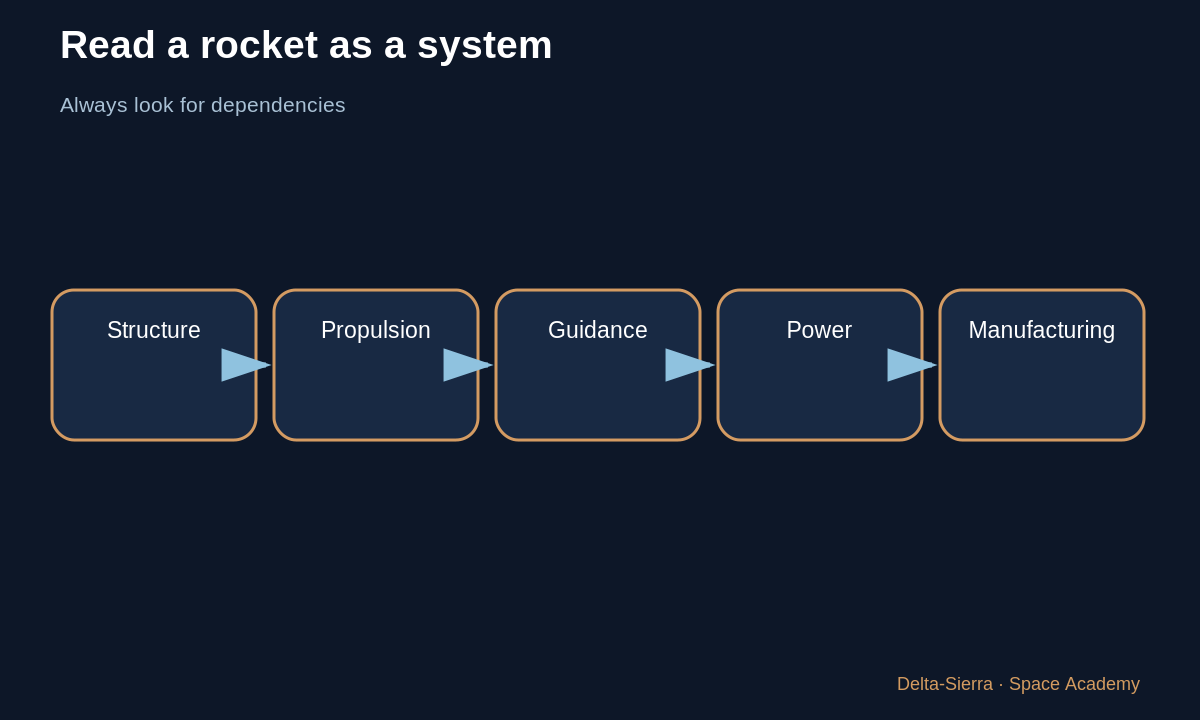
A laboratory engine can fire for seconds without proving a launch vehicle. A complete rocket also needs light structure, propellant feed, stability, thrust steering, instrumentation, sequences, and repeatable manufacturing.
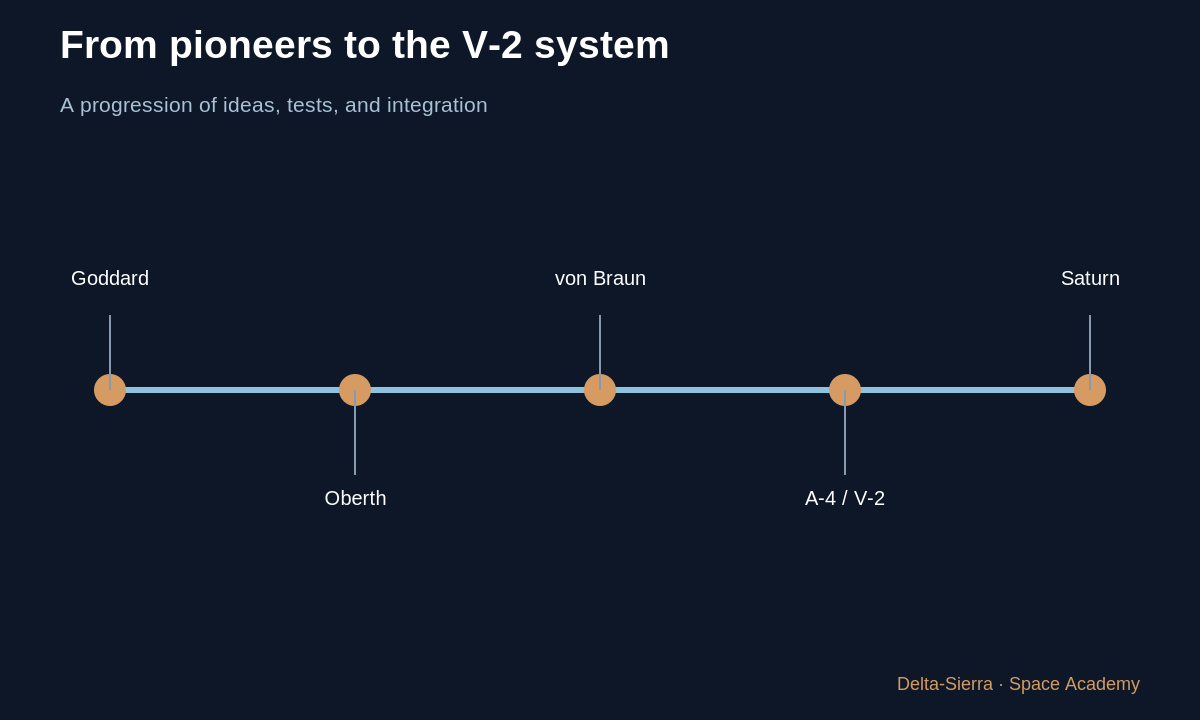
2 — Goddard, Oberth, von Braun: do not merge their roles
Robert Goddard demonstrated early liquid-propellant rocket flight. Hermann Oberth formalized and popularized spaceflight concepts in Europe. Wernher von Braun belonged to that intellectual lineage and later worked on military and space systems.
The Academy separates technical contribution from moral and historical judgment. The V-2 was a Nazi weapon and its production relied on murderous forced labor. Studying its engineering never means minimizing that context.
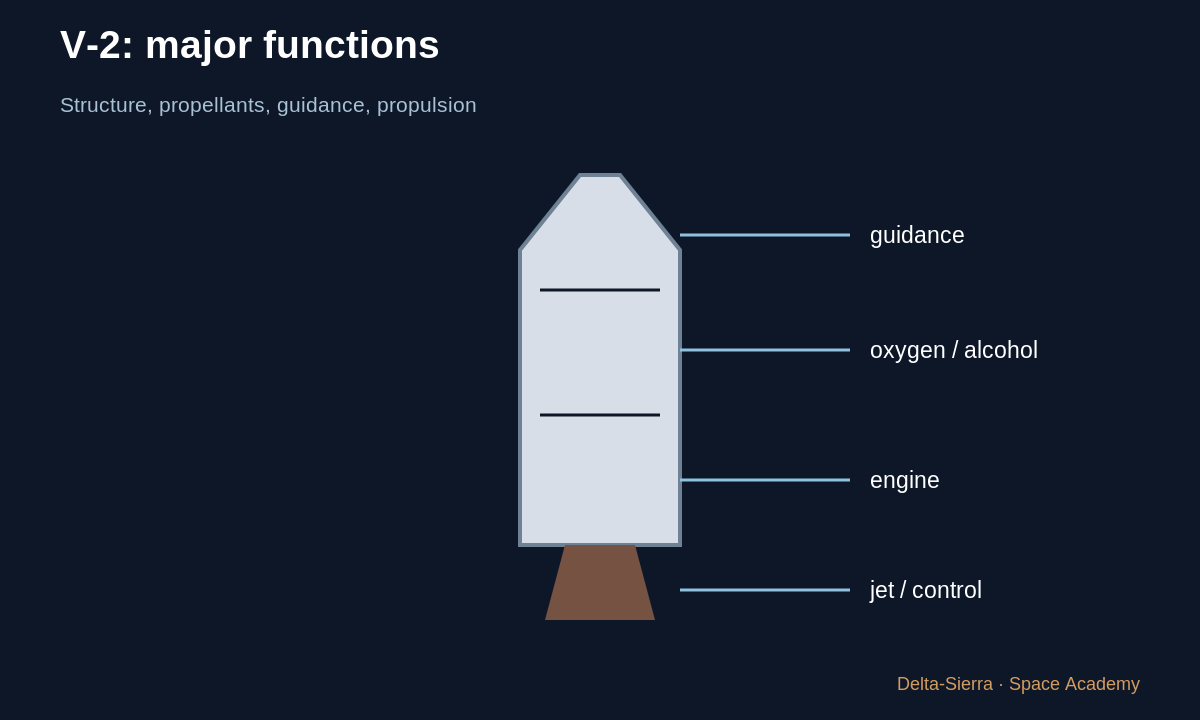
3 — V-2 propulsion: fuel, oxidizer, chamber, nozzle
NASA describes the V-2 as a liquid rocket burning liquid oxygen and alcohol. The fundamental chain is already visible: two tanks, feed system, injection, combustion, then nozzle.
That continuity is useful. Raptor or Vulcain are vastly more sophisticated, but they still rely on the same core logic while improving pressures, cycles, materials, cooling, control, and reuse.
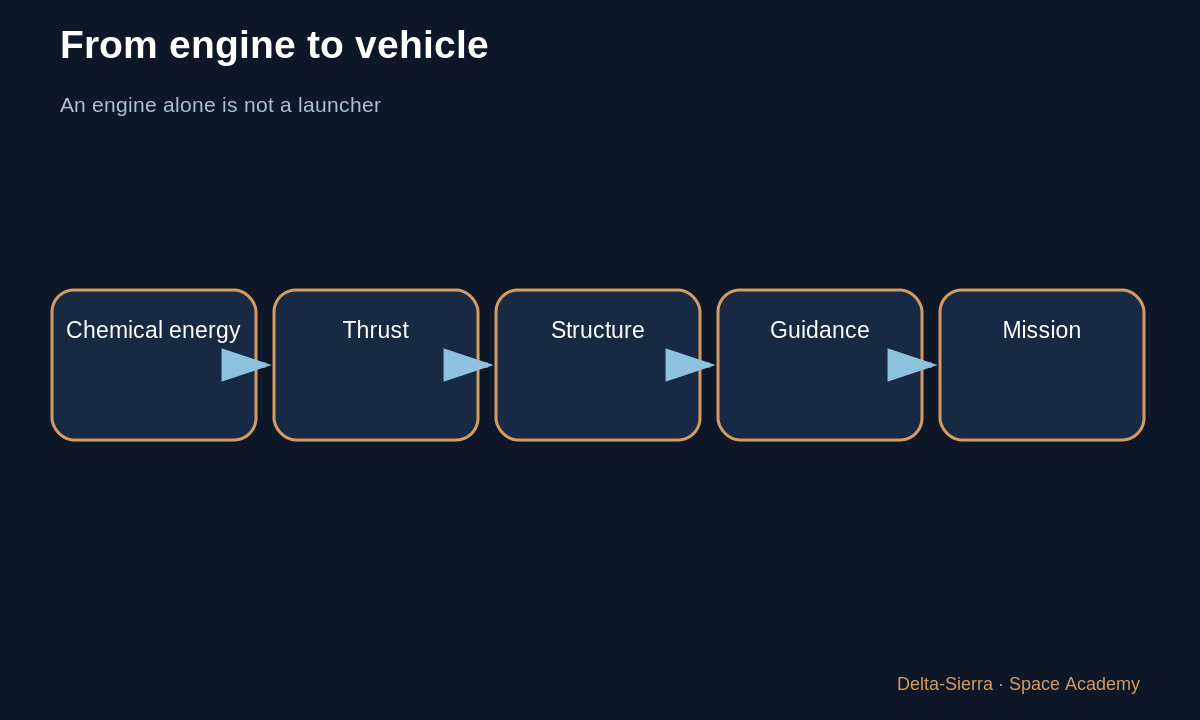
4 — Why a complete rocket needs a brain
Generating thrust does not guarantee that the vehicle keeps the desired attitude. The rocket must sense orientation and create correcting torque. The V-2 used thrust vanes in the exhaust to deflect the jet.
Modern launchers commonly gimbal an engine or nozzle. The thrust axis rotates slightly. The torque physics remains recognizable; sensor precision, actuators, and control algorithms have changed.
5 — What the V-2 could not do like a modern launcher
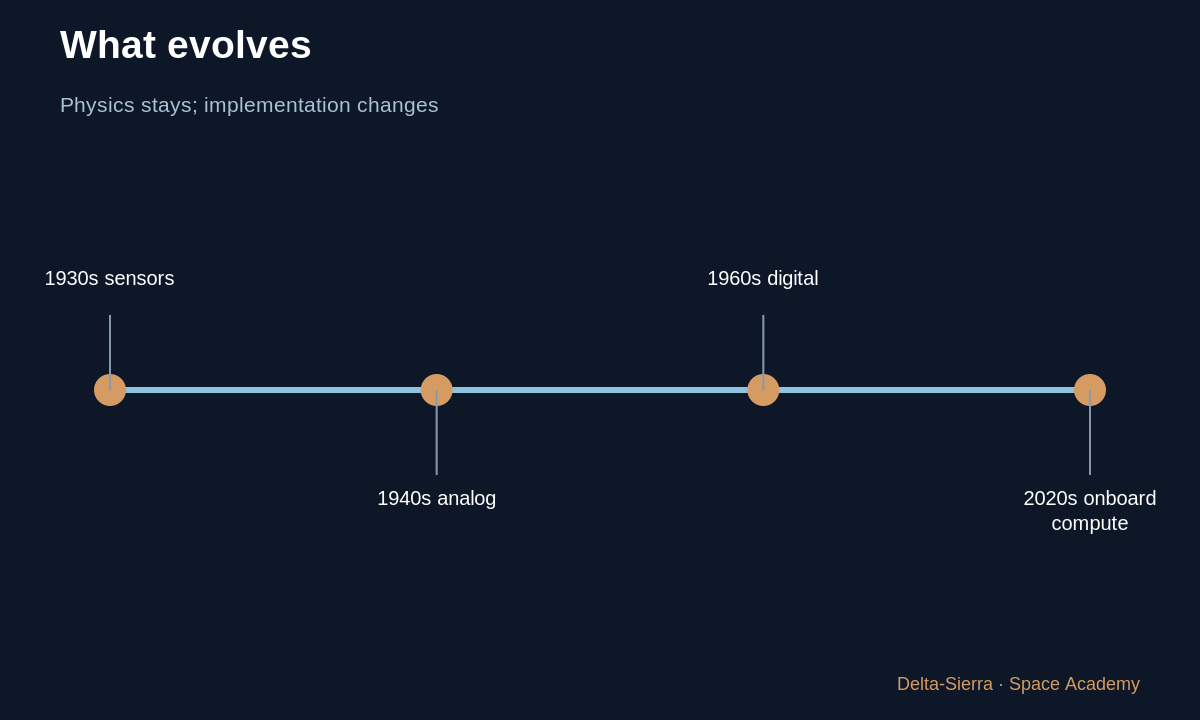
The V-2 had no modern microprocessors, satellite navigation, high-performance digital actuators, or software capable of real-time reusable-landing optimization.
This does not mean 1940s engineers lacked feedback ideas. Gyros, analog computing, and servomechanisms existed. Their precision, computing power, mass, and integrated reliability limited what was practical.
6 — What changes and what never changes
What changes: materials, pressure, allowable temperature, structural mass fraction, manufacturing, sensor accuracy, numerical computing, and reuse capability.
What does not change: momentum conservation, pressure loads, heat transfer, strength of materials, and dynamic stability.
7 — Progress comes from measurement as much as from thrust
Early pioneers did not merely have lower-performance engines; they also had far fewer ways to understand what happened during a test. Poorly measured pressure, temperature or vibration turns a failure into a mystery. The history of propulsion is therefore also the history of sensors, recorders, test stands and the ability to compare a prediction with an actual measurement.
This separates a spectacular experiment from repeatable technology. A space vehicle is not considered dependable because it worked once. Engineers need to explain why it worked, reproduce conditions, measure deviations, change hardware or procedure, and test again. The loop test → measure → analyze → correct became as important as thrust itself.
8 — Read history without creating a technical legend
Two opposite simplifications must be avoided. One is to present the V-2 as the origin of all modern astronautics; the other is to erase its technical importance because the program was a Nazi weapon program that used forced labor. Serious history must hold both realities together: real technical advances and a real criminal context.
Engineering history must also distinguish a new idea from an idea that became industrially usable. Many principles existed before they could be built at scale. The useful story follows the transition from theory to prototype, complete system, production, testing and operations.
Exercises and answers
Find the building blocks
Name five systems needed in addition to the combustion chamber.
Understand steering
Why does deflecting the jet rotate the rocket?
Historical trap
Why separate technical analysis from historical judgment?