Course compass
Question directrice : How can a slanted direction be split into horizontal and vertical parts, and why do sine and cosine do that?
Markers: 📏 MEASURED · 📐 CONVENTION · 🧮 CALCULATED · 🎓 TEACHING ASSUMPTION · ⚠️ APPROXIMATION
- understand the concept
- do a simple calculation
- explain every symbol
- check a result
1 — Before sine and cosine: the essential words
Start with one simple idea: one slanted arrow can be understood as two actions happening at the same time. One part goes left to right; the other goes bottom to top. Mathematics then lets us calculate the size of each part.
What is an angle?
An angle measures the opening between two directions. Two lines shaped like the corner of a sheet of paper form a right angle of 90 degrees, written 90°.
Horizontal, vertical, perpendicular
Horizontal means left to right in our chosen diagram. Vertical means bottom to top. Two directions are perpendicular when they form a 90° right angle.
What is a right triangle?
It is a triangle containing one right angle. Its longest side, opposite the right angle, is the hypotenuse. In this lesson that side will often represent the total slanted arrow.
2 — What do “horizontal part” and “vertical part” mean?
Imagine a rover climbing a slope. Between its start and end points it has done two things at once: it has moved forward and moved upward.
The horizontal part is the amount corresponding only to left-right motion. The vertical part is the amount corresponding only to climbing or descending.
These are not two unrelated actions invented afterwards. They are two simple descriptions of the same slanted action.
Mental picture
Draw a slanted arrow from start to finish. Now draw an L-shaped route: first horizontally until you are directly below the endpoint, then vertically to the endpoint. Those two legs reconstruct the slanted arrow.
3 — What do F, Fx, Fy, cos and sin mean?
In a force example, F means the total force: the full slanted arrow.
Fx is read “F x”. It means the horizontal part of the force along the x-axis. Fy is read “F y”. It means the vertical part along the y-axis.
cos(angle) is read “cosine of the angle”. sin(angle) is read “sine of the angle”.
The two formulas
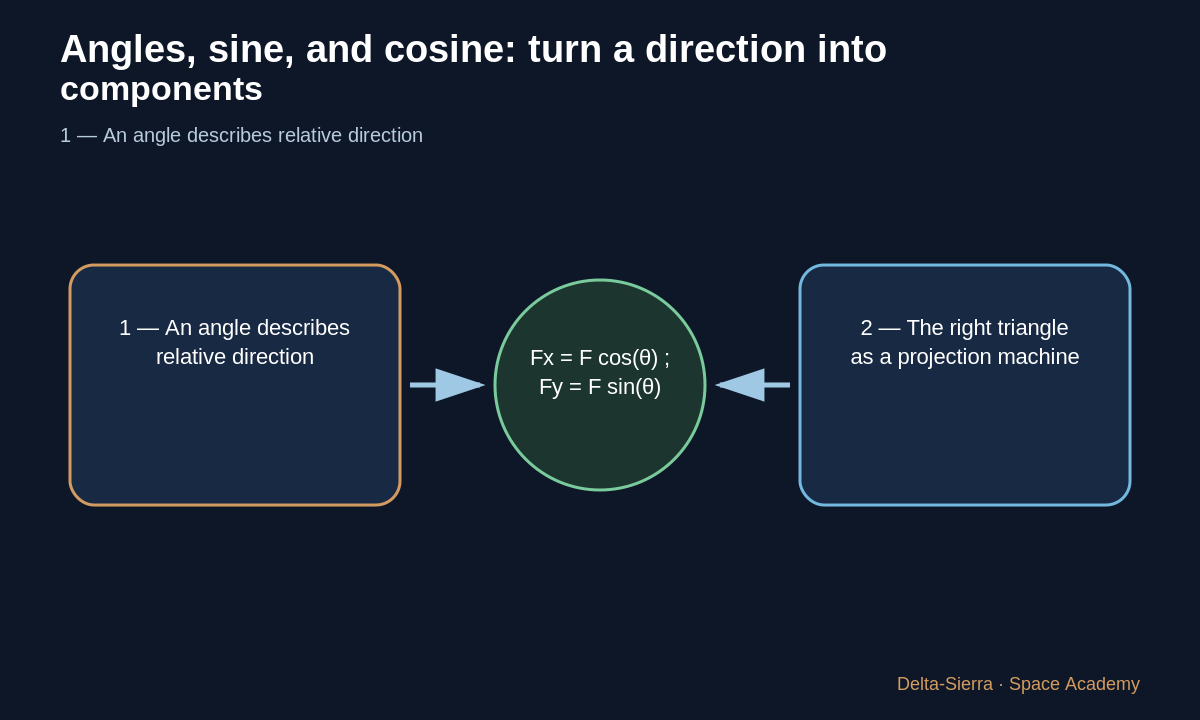
Fx = F × cos(angle) is read: “F x equals F multiplied by the cosine of the angle.”
Fy = F × sin(angle) is read: “F y equals F multiplied by the sine of the angle.”
They turn one slanted force into two easier quantities: how much acts horizontally and how much acts vertically.
What is a newton?
The newton, symbol N, is the SI unit of force. At beginner level, think of a force as a push or pull.
4 — Why does cosine give the horizontal part and sine the vertical part?
Here the angle is measured from the horizontal. The horizontal side touches that angle and is called the adjacent side. The vertical side lies across from the angle and is called the opposite side.
Cosine compares adjacent side with hypotenuse. Sine compares opposite side with hypotenuse. That is why, with an angle measured from the horizontal, cosine gives the horizontal part and sine gives the vertical part.
If the angle were measured from the vertical, the roles relative to the axes would swap. Always ask: from which direction is the angle measured?
5 — Three concrete examples, line by line
Example A — A rover travels 10 m up a 30° slope
Total displacement: 10 m. Angle: 30° above horizontal.
cos(30°) ≈ 0.866; sin(30°)=0.5.
Horizontal part: 10 × 0.866 ≈ 8.66 m.
Vertical part: 10 × 0.5 = 5 m.
In plain language: the rover moves about 8.66 m horizontally and gains 5 m of height.
Example B — A lander descends at 20 m/s along a 60° path
The angle is measured from horizontal. Horizontal speed: 20 × cos(60°)=10 m/s. Vertical speed magnitude: 20 × sin(60°)≈17.32 m/s. Because the lander is descending, that vertical component points downward.
Example C — A cable pulls with 100 N at 30°
Fx = 100 × cos(30°) ≈ 86.6 N.
Fy = 100 × sin(30°) = 50 N.
The cable pulls forward with about 86.6 N and upward with 50 N.
6 — Calculator: check degree mode
For these examples, the calculator must be in DEG mode. If it is in RAD mode, entering 30 will mean something different.
Horizontal part
Check DEG. Enter 30, press cos, read about 0.8660254, multiply by 10, obtain about 8.660254, and round sensibly to 8.66 m.
Vertical part
Enter 30, press sin, read 0.5, multiply by 10, obtain 5 m.
7 — Three angles for sanity checks
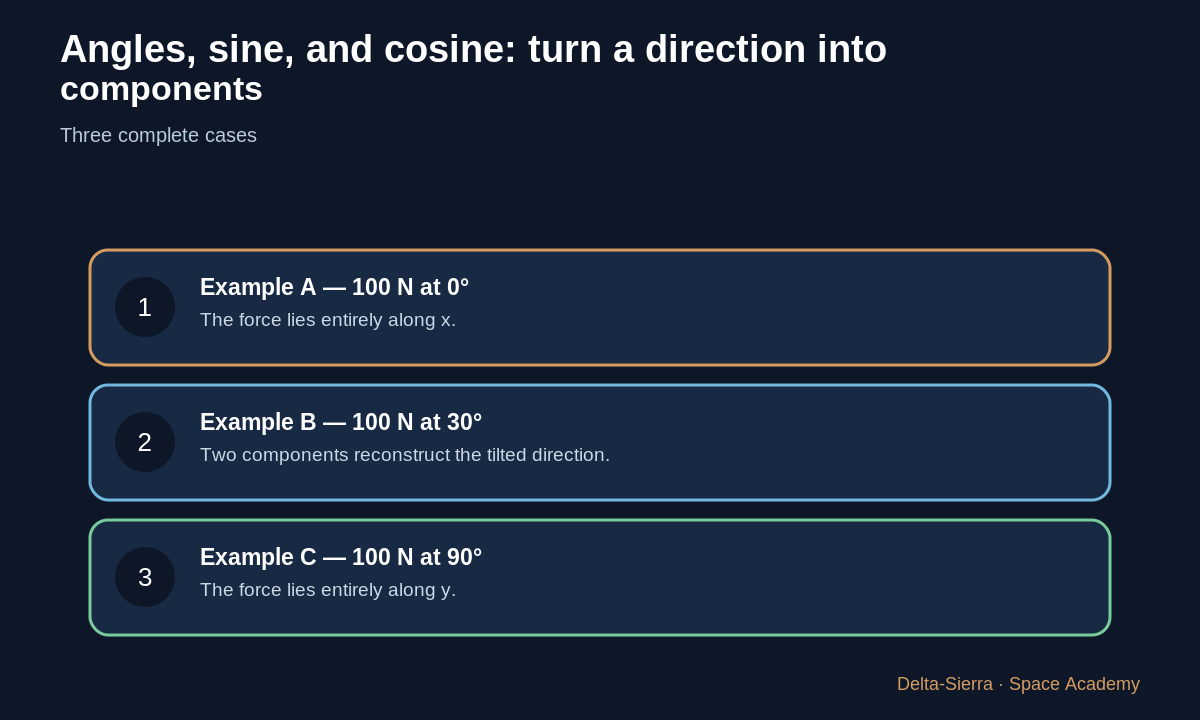
- 0°: fully horizontal. cos(0°)=1, sin(0°)=0.
- 45°: horizontal and vertical components have equal magnitude, about 70.7% of the total.
- 90°: fully vertical. cos(90°)=0, sin(90°)=1.
If a calculation gives a large horizontal component for a perfectly vertical arrow, something is wrong.
8 — Common traps
- Using a formula without knowing where the angle is measured from.
- Confusing the total arrow with one component.
- Forgetting that horizontal and vertical depend on the chosen reference frame.
- Using radians when the exercise gives degrees.
- Giving a number without its unit.
Exercises and answers
Exercise 1
A 20 m displacement is 30° above horizontal. Find its horizontal and vertical parts.
Exercise 2
A 50 N force is perfectly vertical. What are its components?
Exercise 3
Why must you know where the angle is measured from?