Course compass
Guiding question : Why can a chamber that burns well “on average” enter a destructive oscillation?
Evidence tags : 📏 MEASURED · 📐 CONVENTION · 🧮 CALCULATED · 🎓 LEARNING ASSUMPTION · 🚀 MISSION DATA · 🏭 MANUFACTURER DATA · ⚠️ APPROXIMATION
Objectives :
- define combustion instability
- connect acoustics and injection
- understand disturbance testing
- see the injector as a dynamic component
- understand why testing complements models
1 — The average-value trap
Two engines can show the same average thrust while one is stable and the other experiences fast pressure spikes. The average then hides the dangerous event.
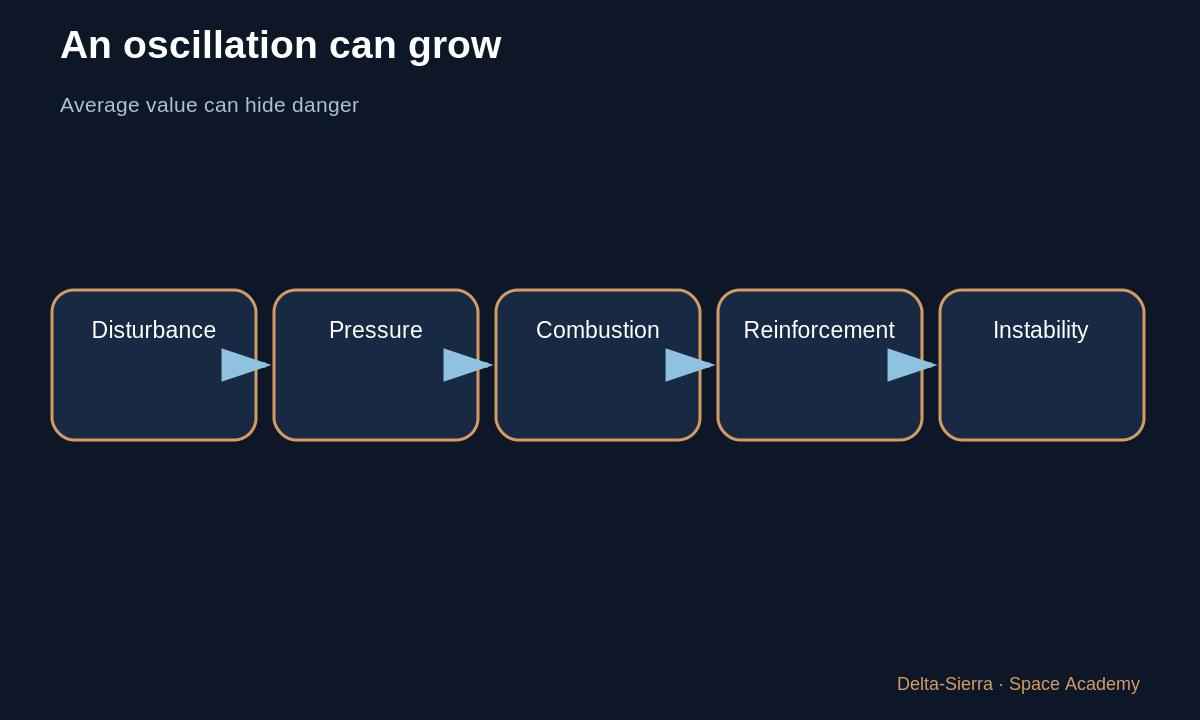
A chamber is an acoustic volume. Pressure fluctuations can interact with combustion rate and injection. If energy release reinforces the oscillation at the right phase, the oscillation grows.
2 — The injector is not only a distributor
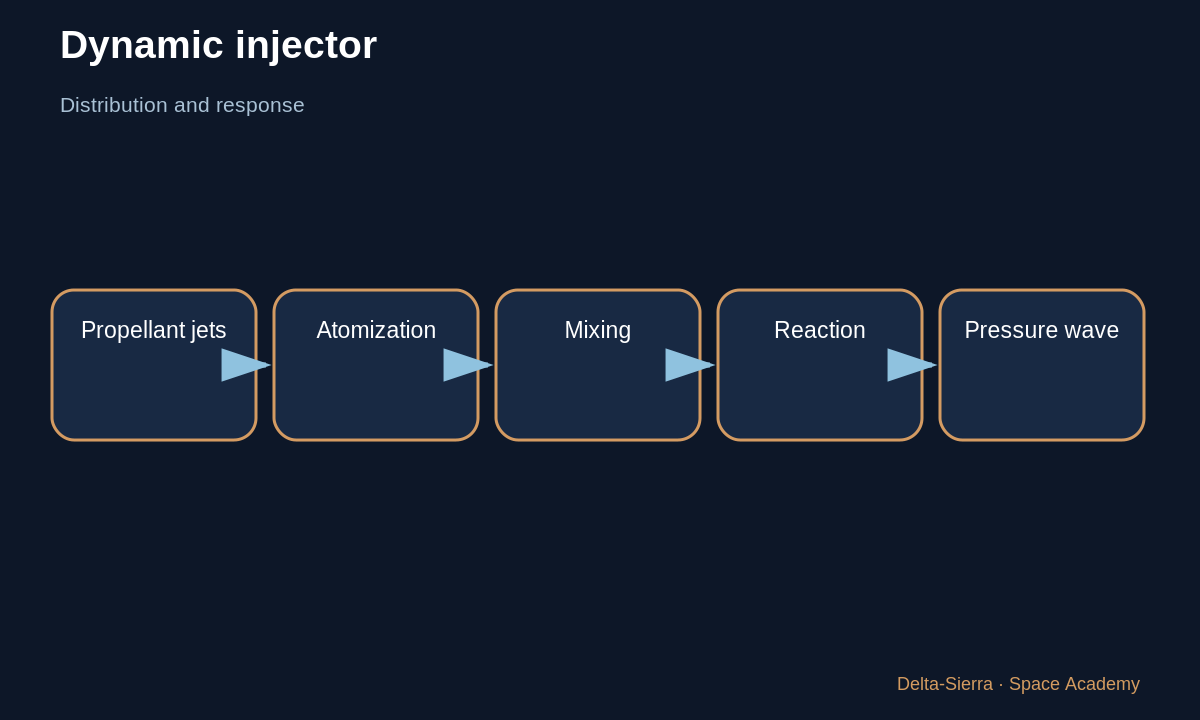
It controls how fuel and oxidizer meet, atomize, and react in space and time. A layout that looks uniform statically can respond differently to pressure oscillation.
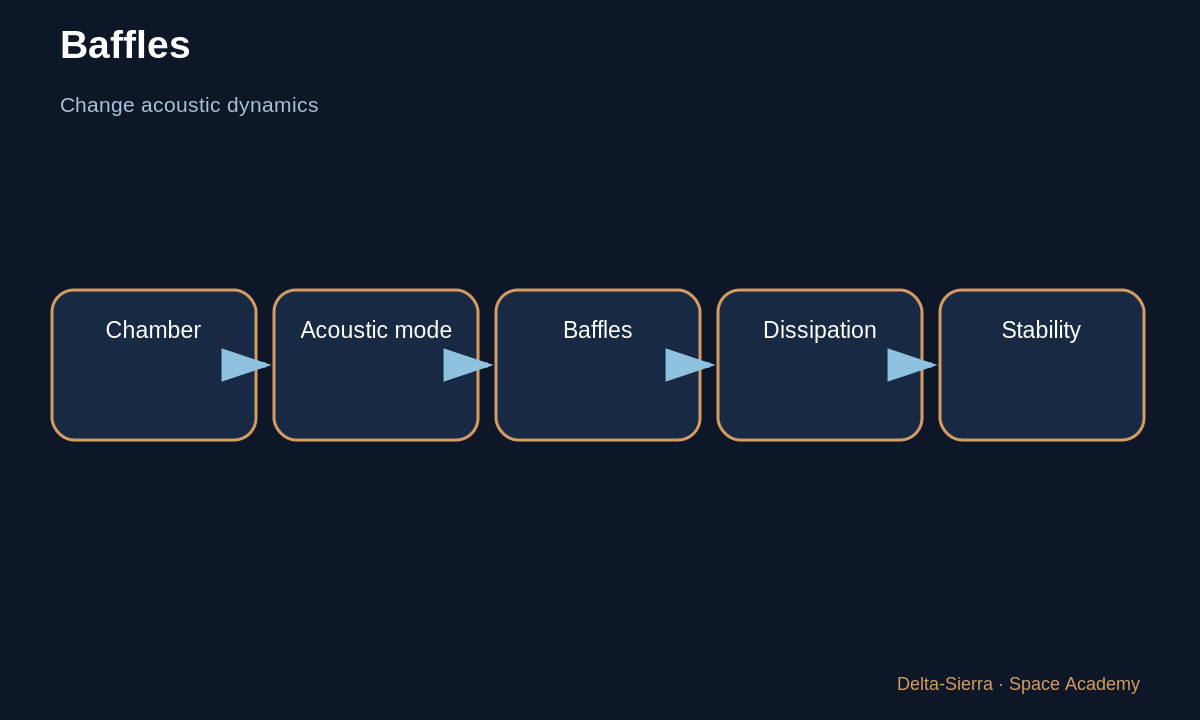
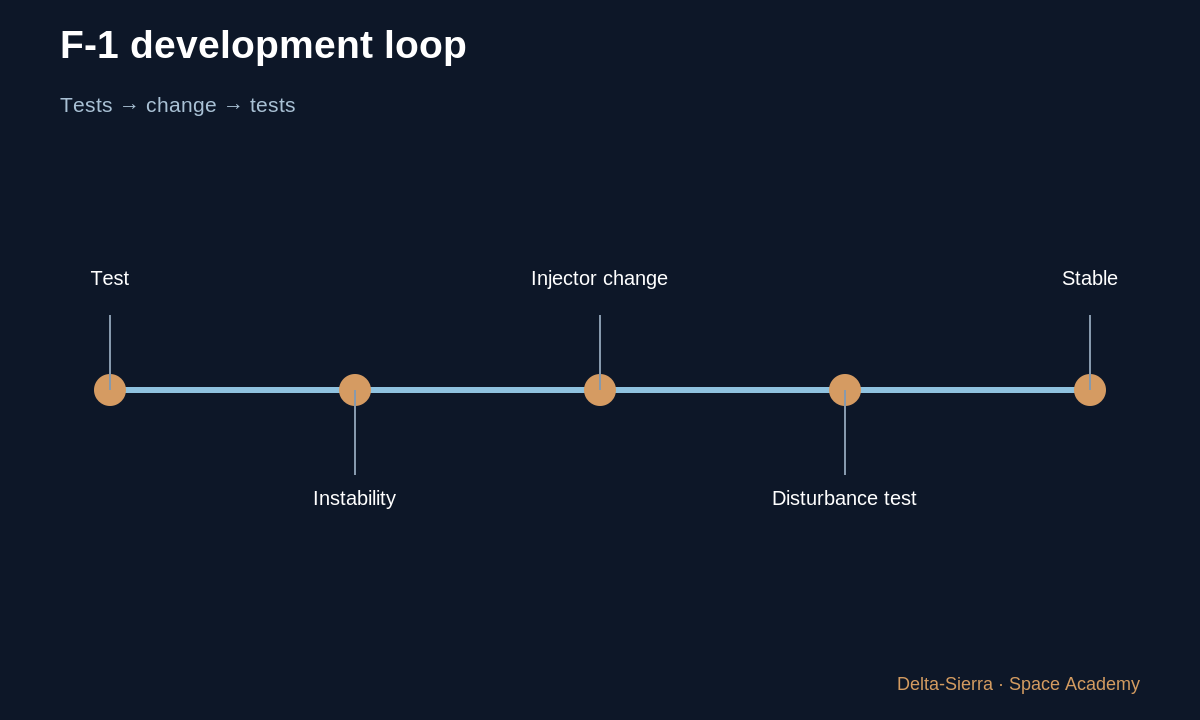
F-1 development forced engineers to treat the injector as a dynamic stability component. NASA describes how baffles and injector changes helped solve the problem.
3 — Why deliberately disturb an engine during a test?
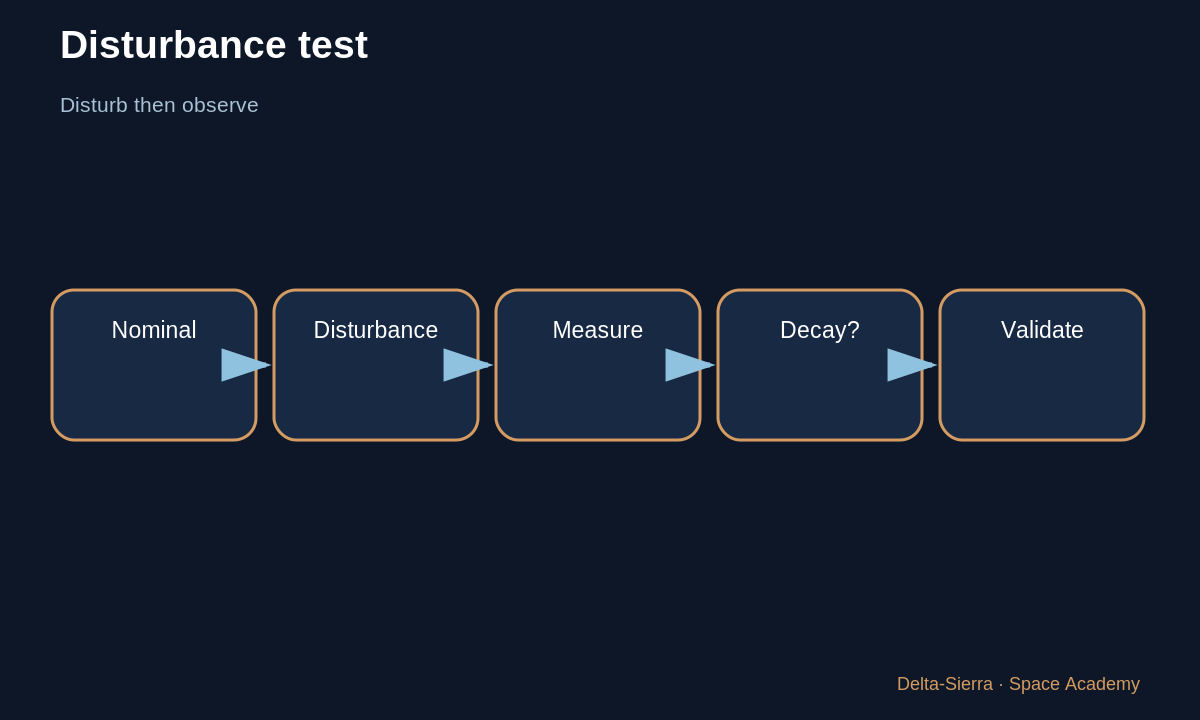
To check whether a stable system returns toward nominal conditions after a disturbance. Historical F-1 testing deliberately introduced disturbances and observed whether oscillation decayed or grew.
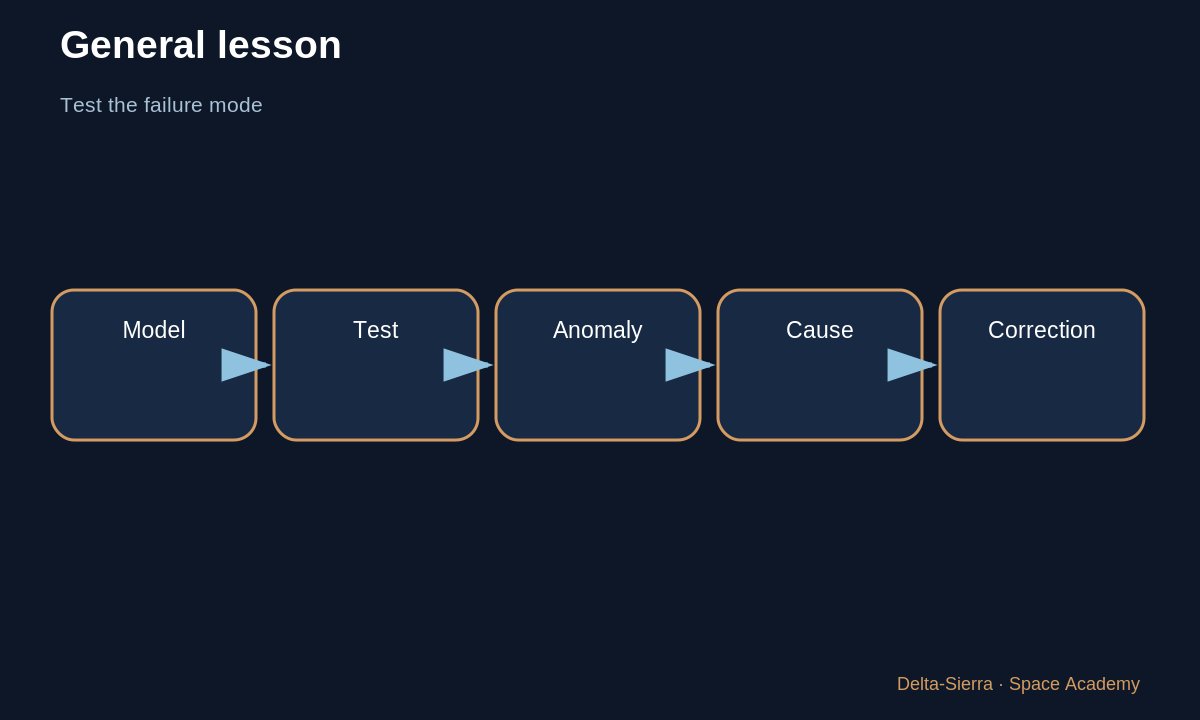
The general validation lesson is powerful: do not only test calm operation; test recovery toward equilibrium.
4 — Read a pressure signal
Pressure versus time can reveal normal noise, damped oscillation, sustained oscillation, or divergence. The key is not only initial amplitude but how it changes.
If every cycle grows, dangerous positive feedback exists. If each cycle shrinks, the mode is damped.
5 — Why calculation alone cannot close the problem
Combustion couples turbulence, chemistry, droplets, acoustics, heat transfer, and geometry. Models are essential, but their assumptions must be checked against instrumented testing.
NASA still combines advanced analysis, manufacturing, and hot-fire tests for modern chambers. “Calculate then test” is an iterative learning loop.
6 — F-1 as a general engineering lesson
F-1 teaches more than Saturn history: complex systems must be tested against failure modes, not only nominal performance.
The same logic applies to modern engines, life support, power grids, and critical software.
7 — An oscillation can become a self-sustaining loop
Danger appears when a small combustion disturbance changes pressure, that pressure changes injection or heat release, and the resulting response reinforces the original disturbance. The result is positive feedback: instead of dying away, the oscillation grows. “Instability” describes that loss of a natural tendency to return toward equilibrium.
The idea extends far beyond the F-1. Structures can resonate, control loops can oscillate and electrical supplies can become unstable. Engineers therefore search for feedback mechanisms and frequencies where several phenomena may reinforce one another.
8 — A deliberately disturbed test can be more reassuring than a perfect one
A nominally successful test does not always prove that a system can reject disturbances. Some campaigns deliberately introduce a controlled perturbation and observe whether the system returns to stable behavior. This seems paradoxical to beginners: engineers create a problem in order to prove that the design can survive the problem.
The lesson applies across Space Academy. Validation is not only about showing the nominal scenario. It explores boundaries, dispersion, disturbances and plausible failures. Confidence comes from understanding behavior, not from one spectacular demonstration.
Exercises and answers
Signal
An oscillation goes 2 → 3 → 4.5 → 6.8 units. Stable or unstable?
Test
Why introduce a deliberate disturbance?
Injector
Why is hole count insufficient to describe an injector?