Course compass
Guiding question: How can an object accelerate if its speed stays constant?
1 — The physical question
How can an object accelerate if its speed stays constant?
We start from the concrete problem before notation. The goal is to understand what we seek, then why mathematics becomes useful.
2 — How to read the symbols and units
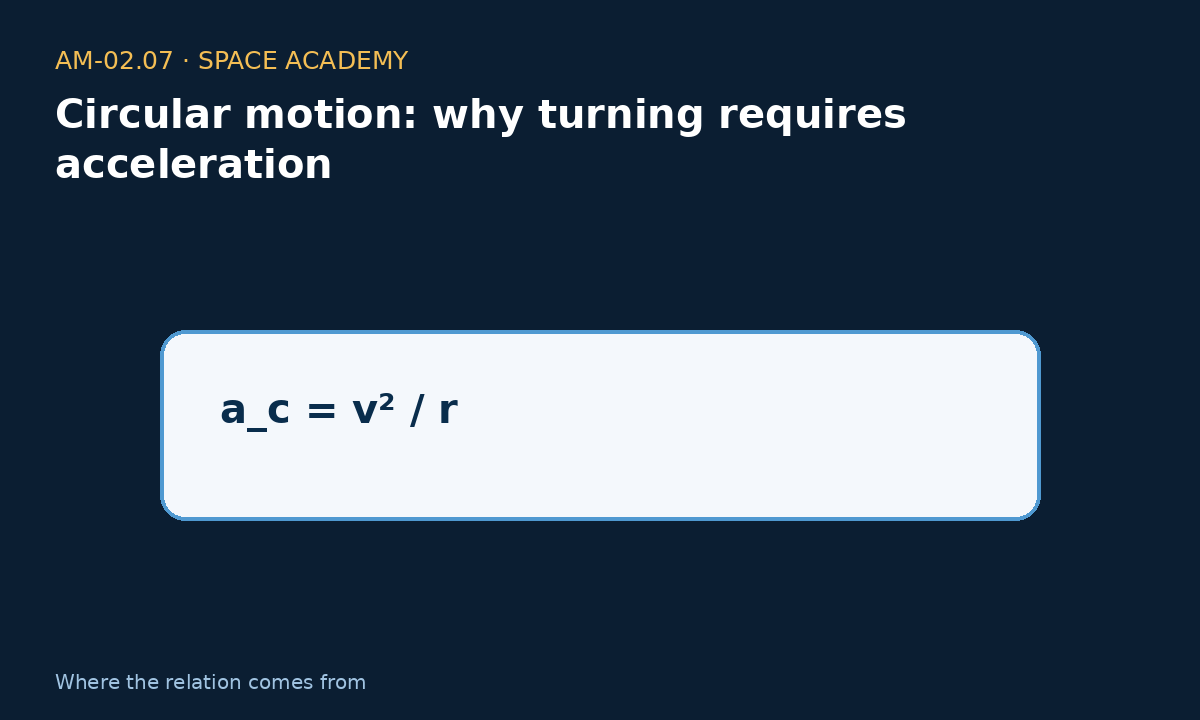
a_c = v² / r. Read: “a c equals v squared divided by r”.
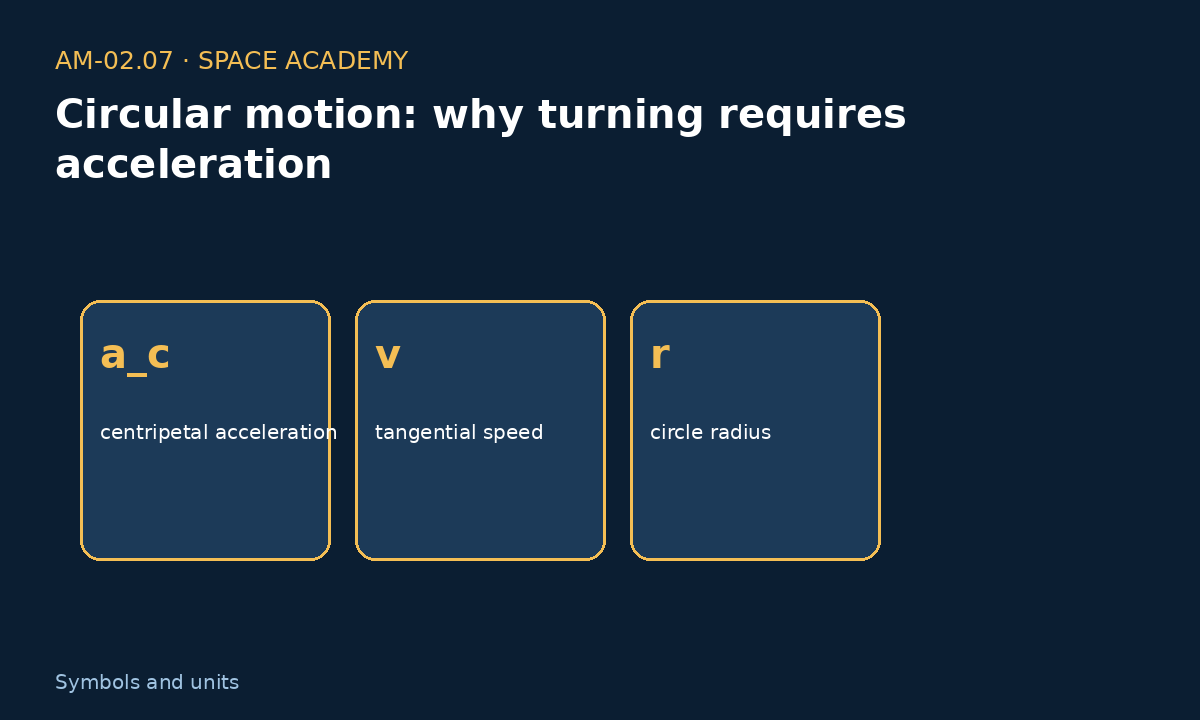
a_c — centripetal acceleration ; v — tangential speed ; r — circle radius
3 — Where does the relation come from?
Velocity is a vector: direction matters. On a circle, direction changes continuously, so there is an acceleration toward the centre even when speed magnitude is constant.
Every number used below is explicitly treated as data, convention, learning assumption, or calculated result.
4 — A — Simple
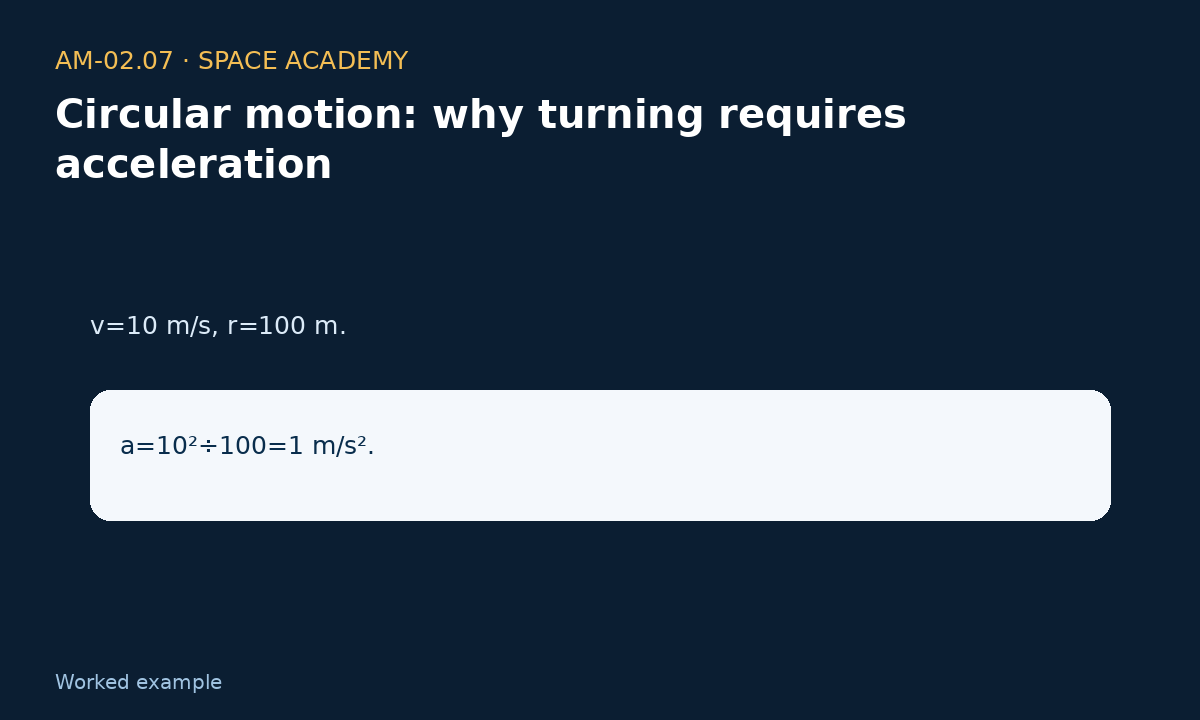
Where do the numbers come from? v=10 m/s, r=100 m.
Step-by-step calculation: a=10²÷100=1 m/s².
Speed is squared, so it strongly affects acceleration.
5 — B — Double speed
Where do the numbers come from? v=20 m/s, same r=100 m.
Step-by-step calculation: a=20²÷100=4 m/s².
Doubling v multiplies a by four.
6 — C — Double radius
Where do the numbers come from? v=20 m/s, r=200 m.
Step-by-step calculation: a=400÷200=2 m/s².
At the same speed, a wider turn requires less acceleration.
7 — Sensitivity, inverse calculation, and sanity check
Change one input, predict the direction of the result, calculate, then check units, sign, order of magnitude, and limits.
Essential limit for Circular motion: why turning requires acceleration: the displayed relation is a learning model. A real system adds detailed geometry, variable properties, sensors, uncertainty, transients, and testing.
8 — Why this matters in a mission
In a space mission, how can an object accelerate if its speed stays constant? The useful skill is not reciting the formula but knowing which data are needed, which are measured, and when the model becomes insufficient.
10 — Go deeper: from calculation to physical understanding
Why turning requires acceleration even at constant speed
A car taking a bend at constant speed is still changing velocity in the physical sense because velocity is a vector: its direction changes. Any change in the velocity vector is acceleration. In uniform circular motion this acceleration points toward the centre of the circle and is called centripetal acceleration.
Why velocity is squared
The relation a_c=v²/r shows that increasing speed is expensive in acceleration. Doubling v does not double acceleration; it multiplies it by four because (2v)²=4v². This sensitivity explains why a modest increase in speed can require a much larger force to maintain the same curved path.
Why a larger radius reduces acceleration
At the same speed, a broad curve requires less directional change per second than a tight turn. Radius is in the denominator: if r doubles, a_c is halved. This qualitative reading should happen before numerical calculation because it immediately reveals a result that changes in the wrong direction.
The bridge to orbit
A circular orbit can be understood as continuous falling: gravity supplies the acceleration that keeps curving the path. The vehicle moves tangentially while its velocity vector keeps turning. The orbit lessons will therefore connect centripetal acceleration to gravitational acceleration rather than introducing unrelated new physics.
9 — Exercises and answers
Challenge 1
v=10 m/s, r=100 m.
Challenge 2
v=20 m/s, same r=100 m.
Challenge 3
v=20 m/s, r=200 m.