Course compass
Guiding question: How does pressure, temperature or rotational speed become a number the controller can use?
1 — The physical question
How does pressure, temperature or rotational speed become a number the controller can use?
We start from the concrete problem before notation. The goal is to understand what we seek, then why mathematics becomes useful.
2 — How to read the symbols and units
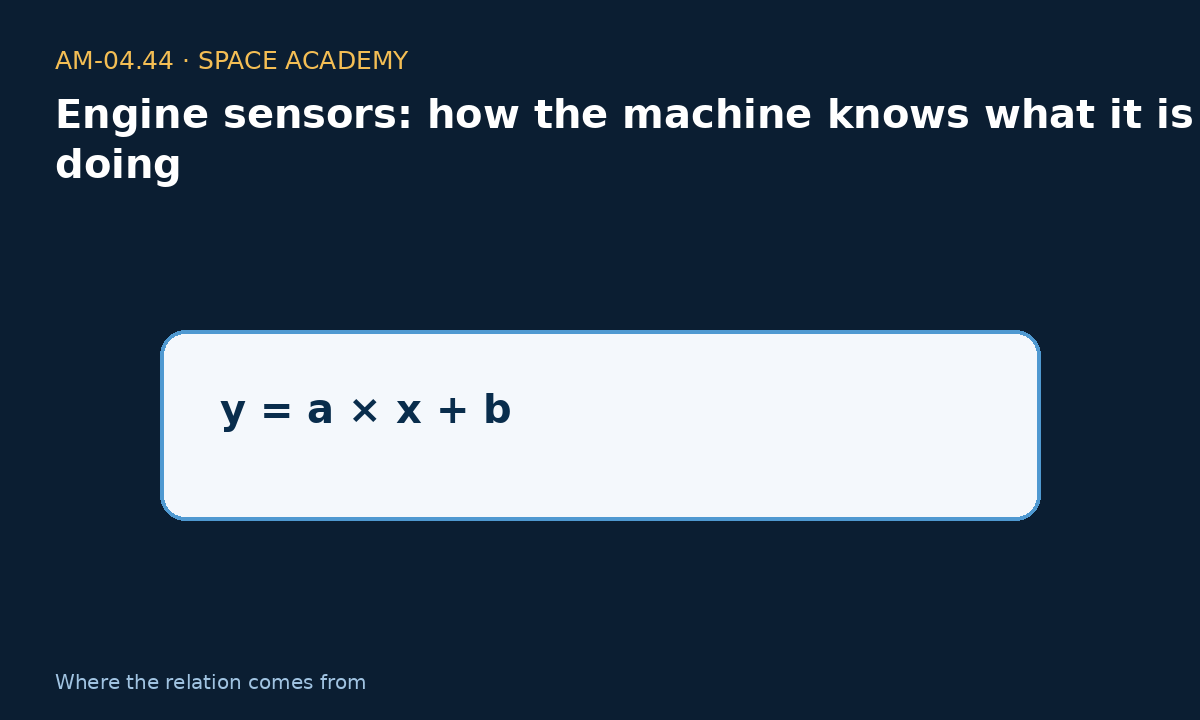
y = a × x + b. Read: “y equals a times x plus b”.
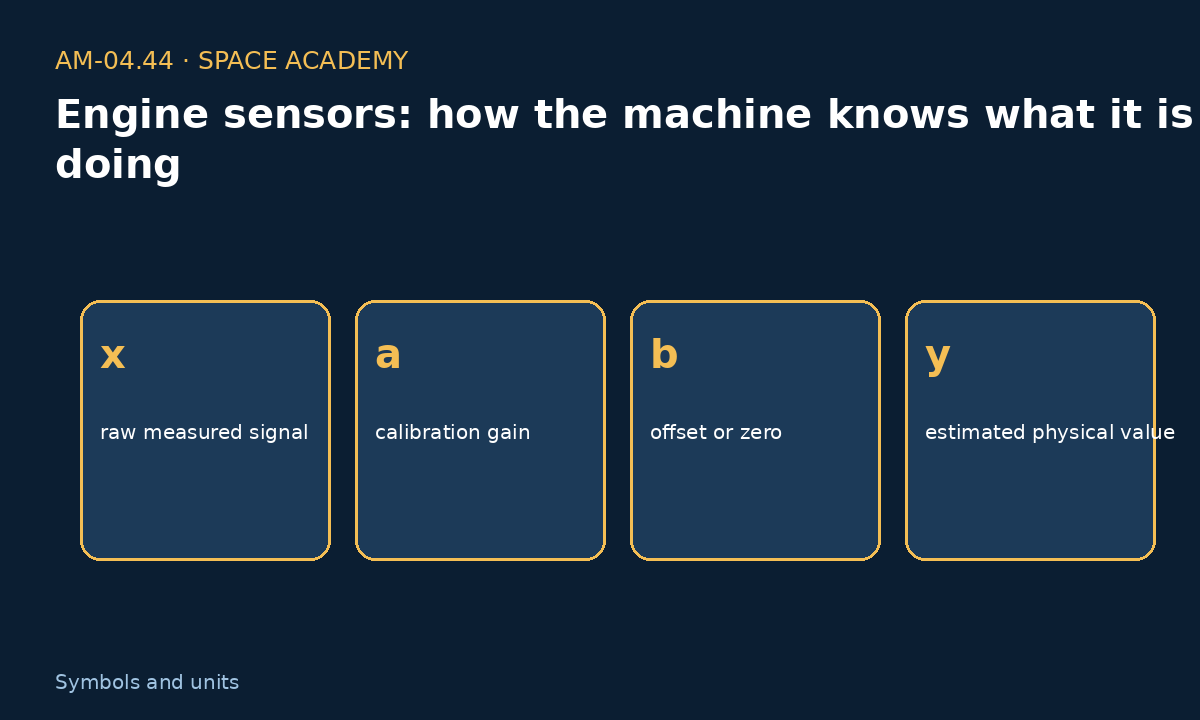
x — raw measured signal ; a — calibration gain ; b — offset or zero ; y — estimated physical value
3 — Where does the relation come from?
A sensor converts a physical quantity into a signal. In a simple linear calibration, x is raw signal, a is gain, b is offset and y is reconstructed quantity. Real sensors add noise, drift, saturation and uncertainty.
Every number used below is explicitly treated as data, convention, learning assumption, or calculated result.
4 — A — Pressure
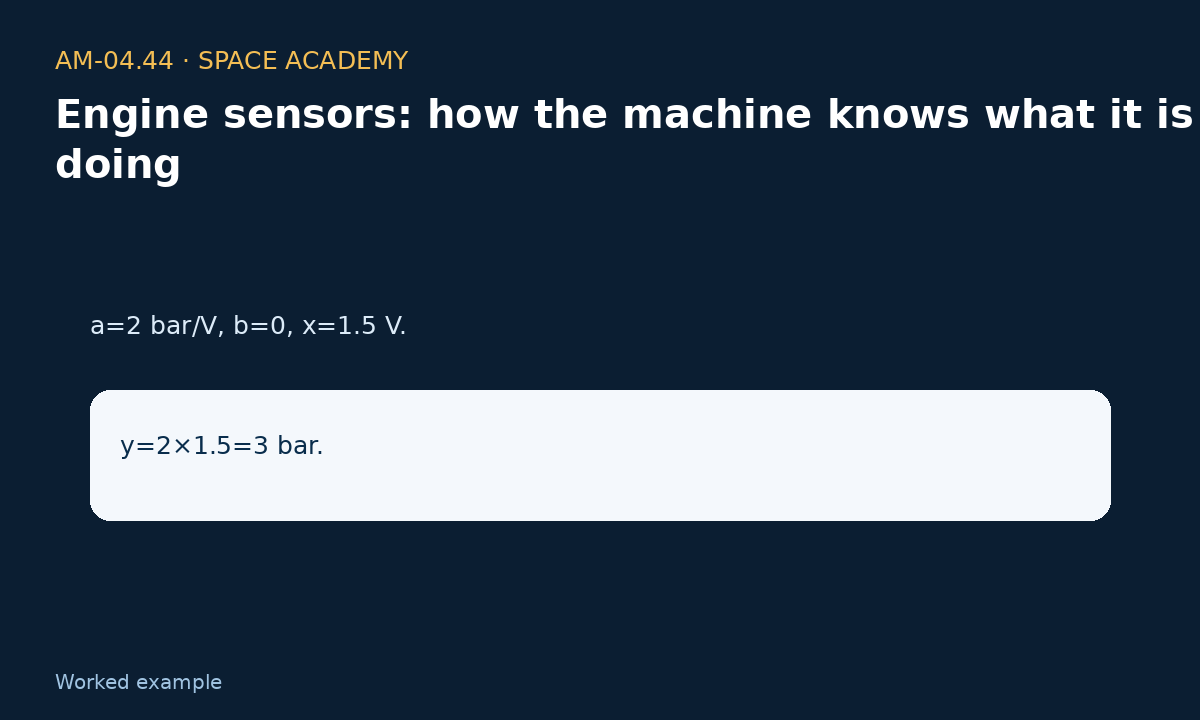
Where do the numbers come from? a=2 bar/V, b=0, x=1.5 V.
Step-by-step calculation: y=2×1.5=3 bar.
The electrical signal becomes pressure through calibration.
5 — B — Offset
Where do the numbers come from? a=100 °C/V, b=−50 °C, x=1.2 V.
Step-by-step calculation: y=100×1.2−50=70 °C.
Offset explains why zero volts does not always mean zero physical units.
6 — C — Drift
Where do the numbers come from? Same x=1.5 V, but b drifts from 0 to +0.2 bar.
Step-by-step calculation: Reading changes from 3.0 to 3.2 bar with no real x change.
Hence the need for redundancy, calibration and plausibility checks.
7 — Sensitivity, inverse calculation, and sanity check
Change one input, predict the direction of the result, calculate, then check units, sign, order of magnitude, and limits.
Essential limit for Engine sensors: how the machine knows what it is doing: the displayed relation is a learning model. A real system adds detailed geometry, variable properties, sensors, uncertainty, transients, and testing.
8 — Why this matters in a mission
In a space mission, how does pressure, temperature or rotational speed become a number the controller can use? The useful skill is not reciting the formula but knowing which data are needed, which are measured, and when the model becomes insufficient.
10 — Go deeper: from calculation to physical understanding
A sensor turns a physical quantity into usable information
Pressure, temperature, or vibration are not directly digital numbers. A sensor produces an electrical or digital signal related to the quantity. Calibration establishes the relation between signal and physical value. In the linear model y=ax+b, a is sensitivity and b is offset; a real sensor may require a more complex relation.
Why two sensors can agree and both be wrong
Two identical sensors sharing the same manufacturing defect, power supply, thermal environment, or calibration error can produce similar values and still be wrong. Redundancy must therefore not be confused with independence. This connects the sensor lesson with common-cause failure in the Mars Bible.
Measurement, accuracy, precision, and resolution are different
Resolution describes the smallest change detectable by the measurement chain. Accuracy describes closeness to the true value. Precision can describe the spread of repeated measurements. A display showing six decimal places therefore does not prove that the physical quantity is known to six reliable digits.
The sensor must survive the system it monitors
A useful measurement must remain available through expected vibration, temperature, radiation, acceleration, and transient conditions. The system must also have ways to detect sensor failure. An engine sensor is therefore both a metrology instrument and a safety element whose limits must be characterised.
9 — Exercises and answers
Challenge 1
a=2 bar/V, b=0, x=1.5 V.
Challenge 2
a=100 °C/V, b=−50 °C, x=1.2 V.
Challenge 3
Same x=1.5 V, but b drifts from 0 to +0.2 bar.