Course compass
Guiding question: How can you suspect a result is wrong even when the calculator reports no error?
Markers: 📏 MEASURED · 📐 CONVENTION · 🧮 CALCULATED · 🎓 TEACHING ASSUMPTION · ⚠️ APPROXIMATION
- understand the concept
- do a simple calculation
- explain every symbol
- check a result
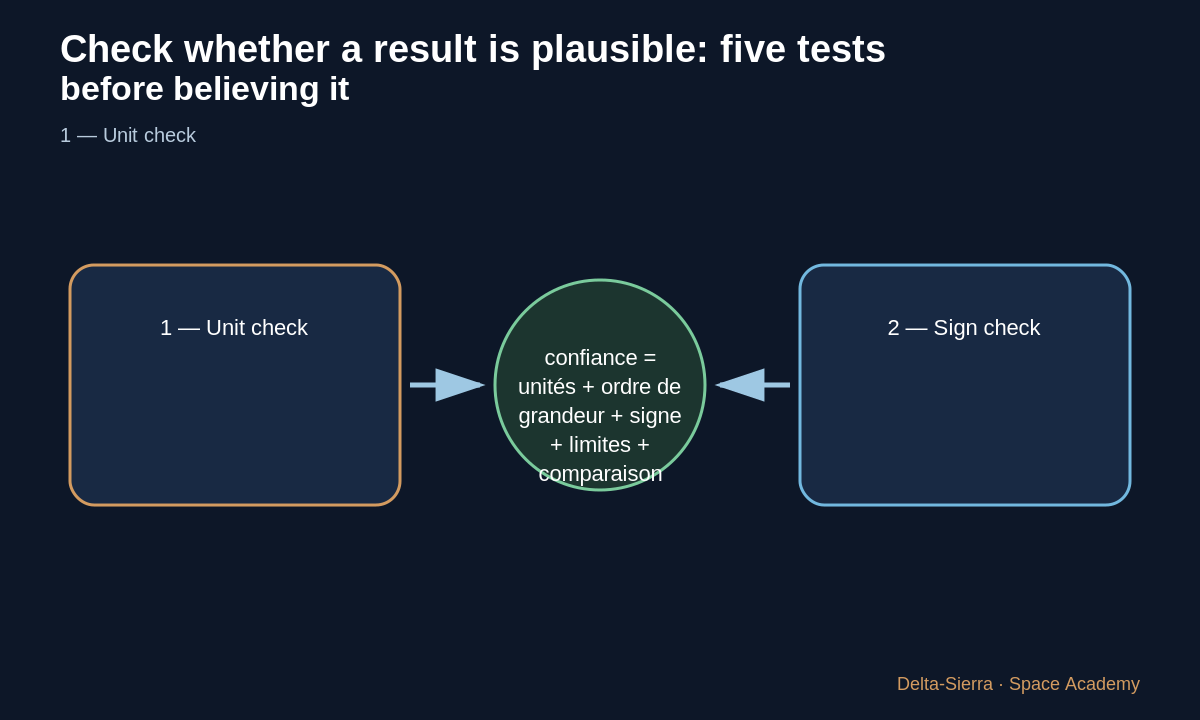
1 — Unit check
A speed result should end with speed units. If it ends in joules or kilograms, the chain of operations probably does not answer the question.
This check is independent of the numerical value.
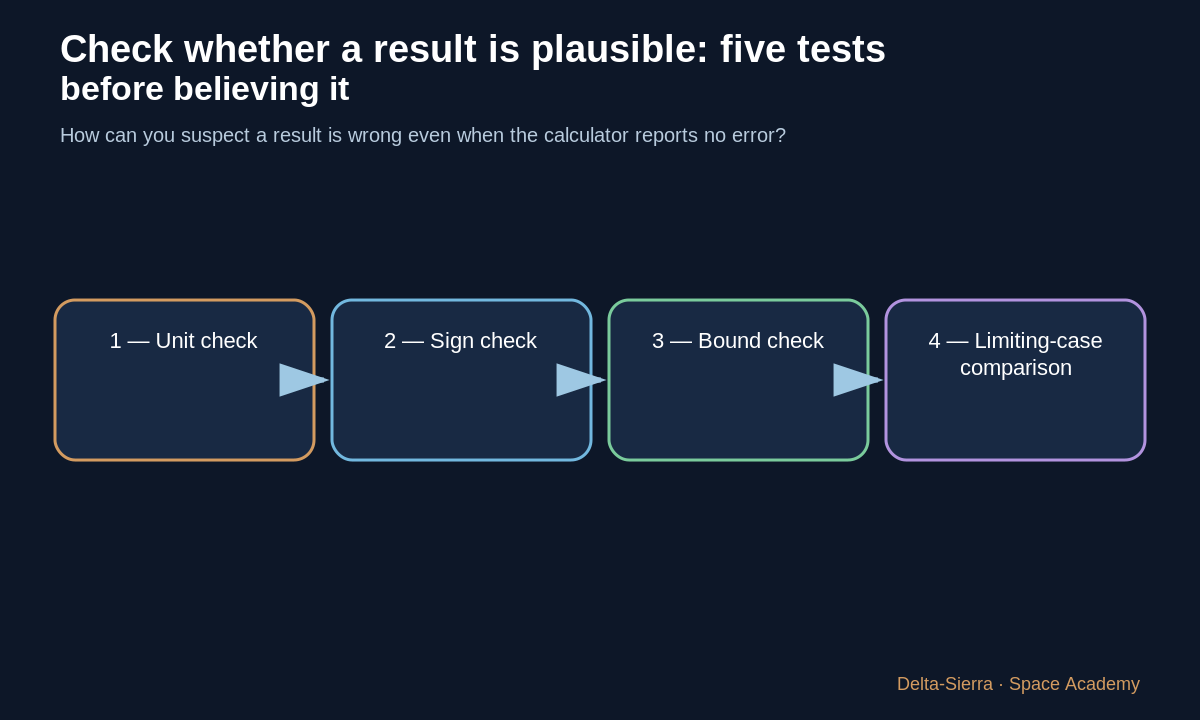
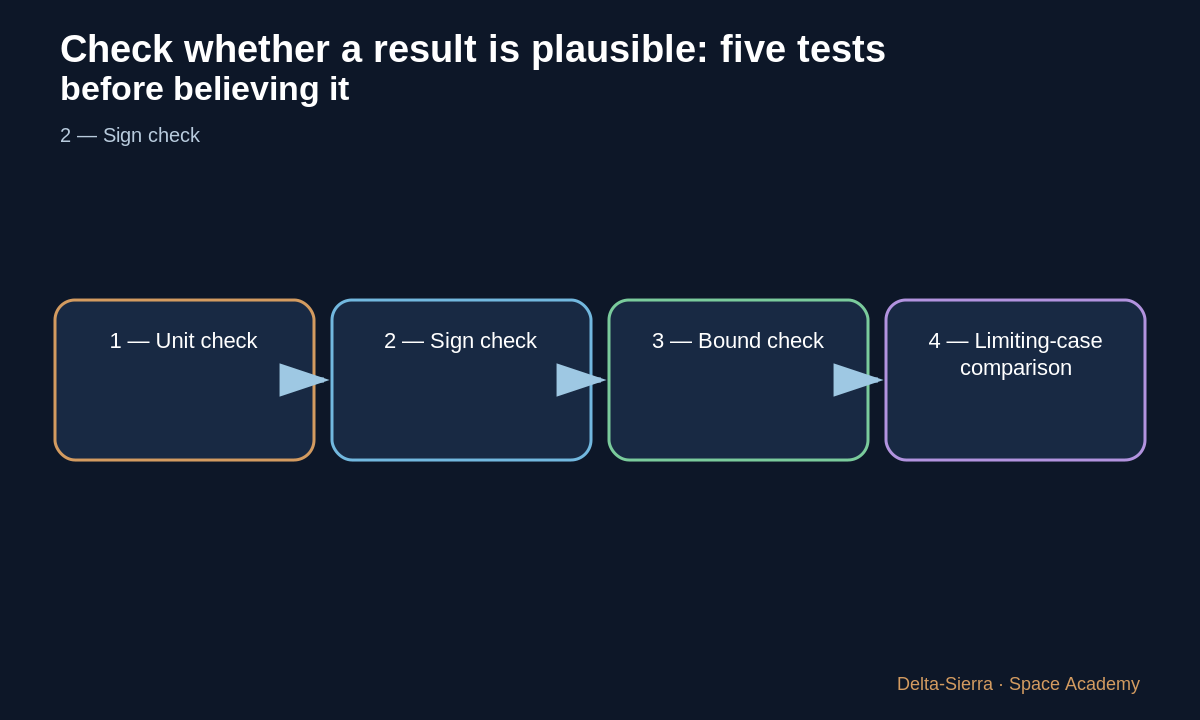
2 — Sign check
Distance travelled in a simple example should not become negative, but a velocity component can be negative if the direction convention allows it.
A sign is not good or bad without a defined reference frame.
3 — Bound check
An efficiency defined as a simple fraction between 0 and 1 cannot become 1.4 unless the definition changes. A simple probability cannot be 230%.
Known bounds are powerful error detectors.
4 — Limiting-case comparison
If a force goes to zero, should the predicted effect vanish? If distance doubles, should the quantity rise or fall?
Mentally testing extreme cases can reveal a transcribed equation error.
Three complete examples: change one assumption to understand
Before each calculation, identify where every number comes from and whether it is measured, conventional, assumed, or calculated.
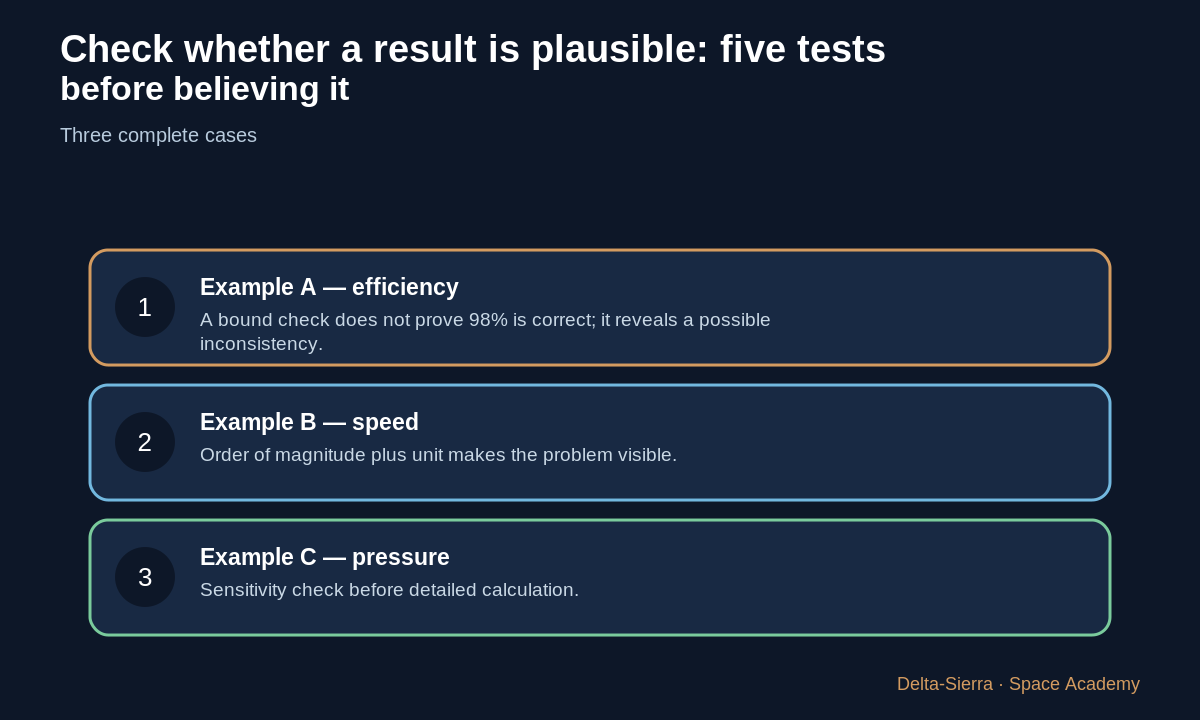
Example A — efficiency
98% = 0.98. A calculated 1.08 = 108% should trigger a question: are we still using the same efficiency definition?
A bound check does not prove 98% is correct; it reveals a possible inconsistency.
Example B — speed
120 km in 2 h gives 60 km/h. A result of 0.06 km/h would be three orders of magnitude too small.
Order of magnitude plus unit makes the problem visible.
Example C — pressure
If p = F/A, doubling F at constant area should double p. If your calculation predicts the opposite, check the relationship.
Sensitivity check before detailed calculation.
Inverse calculation
If p and A are known, recover F = p×A and substitute it back into p=F/A. Returning to p is a simple algebraic check.
Common trap and result check
Trap: “the result looks precise” is not a check. A number with six decimals can be precisely wrong.
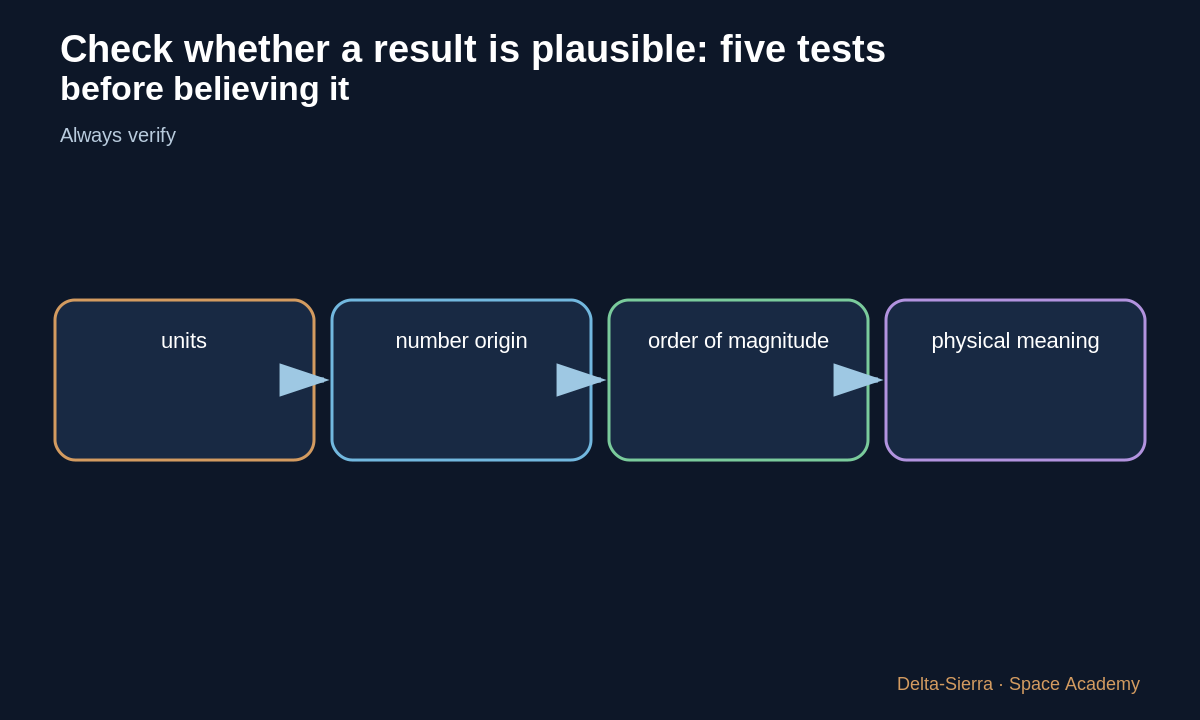
Always check units, order of magnitude, and physical meaning before accepting a result.
Exercises and answers
Understand
Explain the relationship in your own words.
Change an assumption
Modify one input and predict the direction of change before calculating.
Verify
Name two checks after a calculation.