Course compass
Guiding question: What does oxidizer-to-fuel ratio mean, and why is the chemically ideal value not automatically the best engine setting?
Markers: 📏 MEASURED · 📐 CONVENTION · 🧮 CALCULATED · 🎓 TEACHING ASSUMPTION · ⚠️ APPROXIMATION
- define combustion
- read O/F
- calculate flow allocation
- distinguish stoichiometry from engine setting
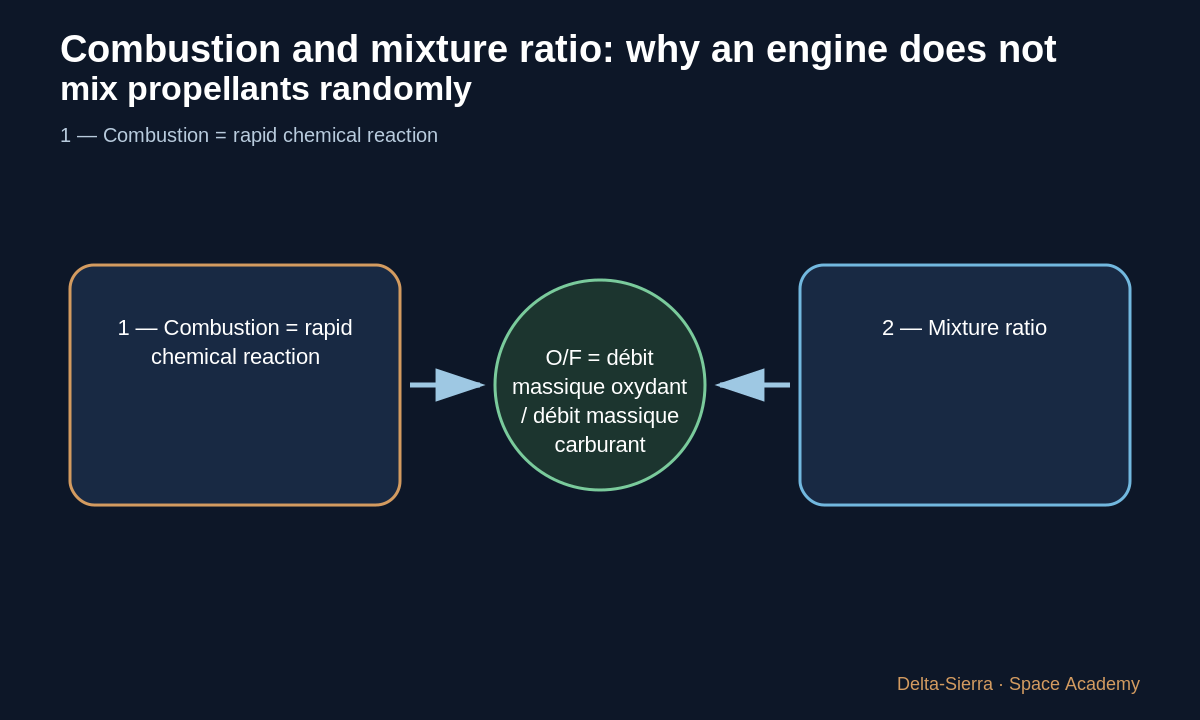
1 — Combustion = rapid chemical reaction
In a chemical rocket engine, fuel and oxidizer react and release energy, creating hot products that can be accelerated through a nozzle.
The rocket carries oxidizer, so the engine does not need atmospheric oxygen.
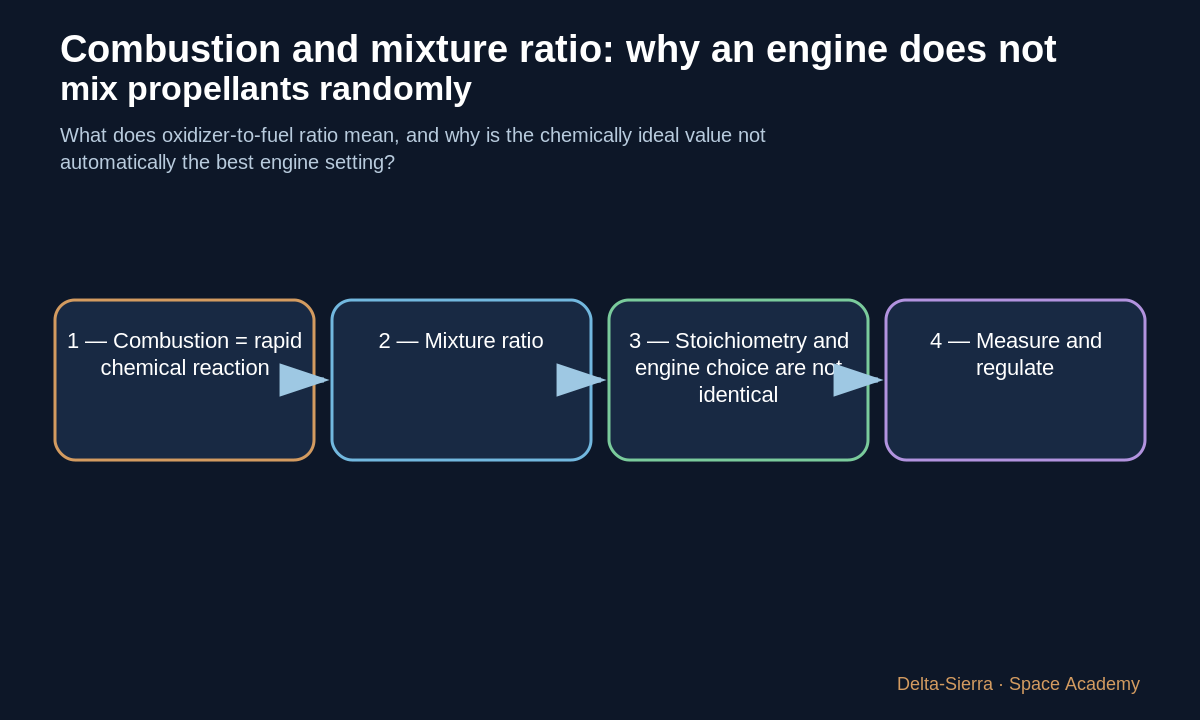
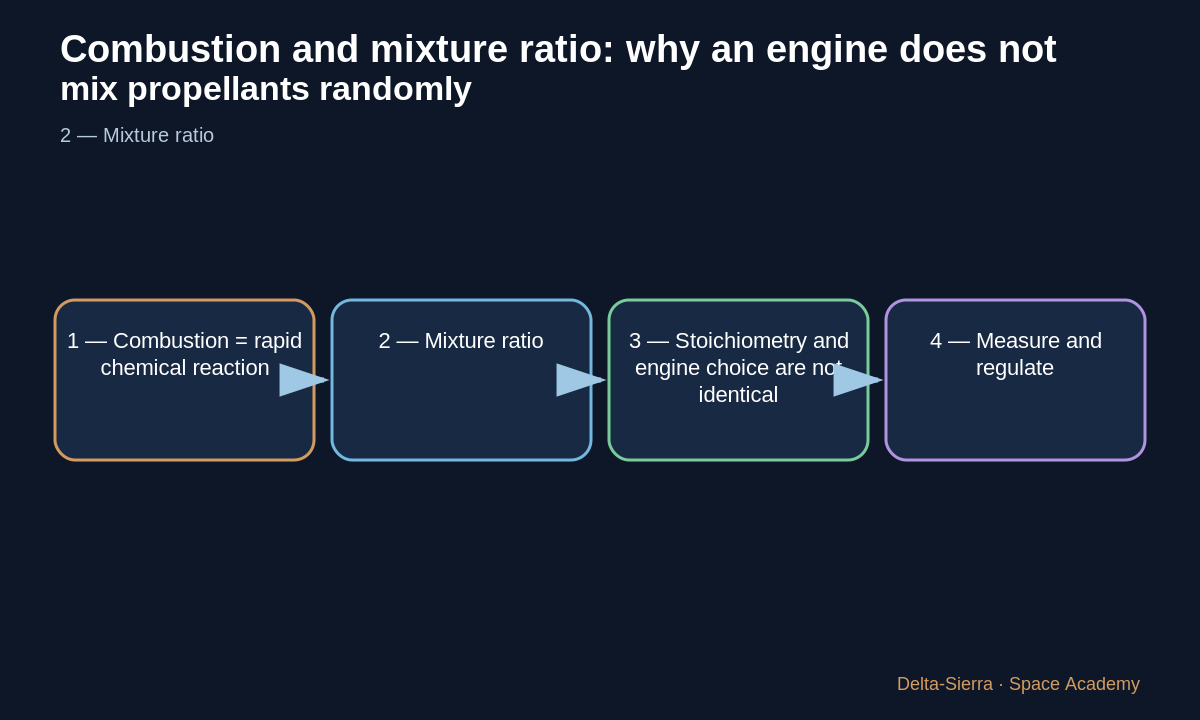
2 — Mixture ratio
O/F compares oxidizer and fuel mass flow. O/F=3 means three kilograms of oxidizer per kilogram of fuel in the same interval.
The ratio is dimensionless when both flows use the same unit.
3 — Stoichiometry and engine choice are not identical
Stoichiometry describes a chemical complete-reaction ratio under a chosen model. A real engine may operate at another ratio for temperature, performance, cooling, stability, or materials.
Distinguish ideal chemistry from engineering trade-offs.
4 — Measure and regulate
Actual ratio depends on flow rates. Sensors, valves, and turbomachinery participate in maintaining commanded conditions.
Advanced engine lessons explain functional loops without becoming an operational construction manual.
Three complete examples: change one assumption to understand
Before each calculation, identify where every number comes from and whether it is measured, conventional, assumed, or calculated.
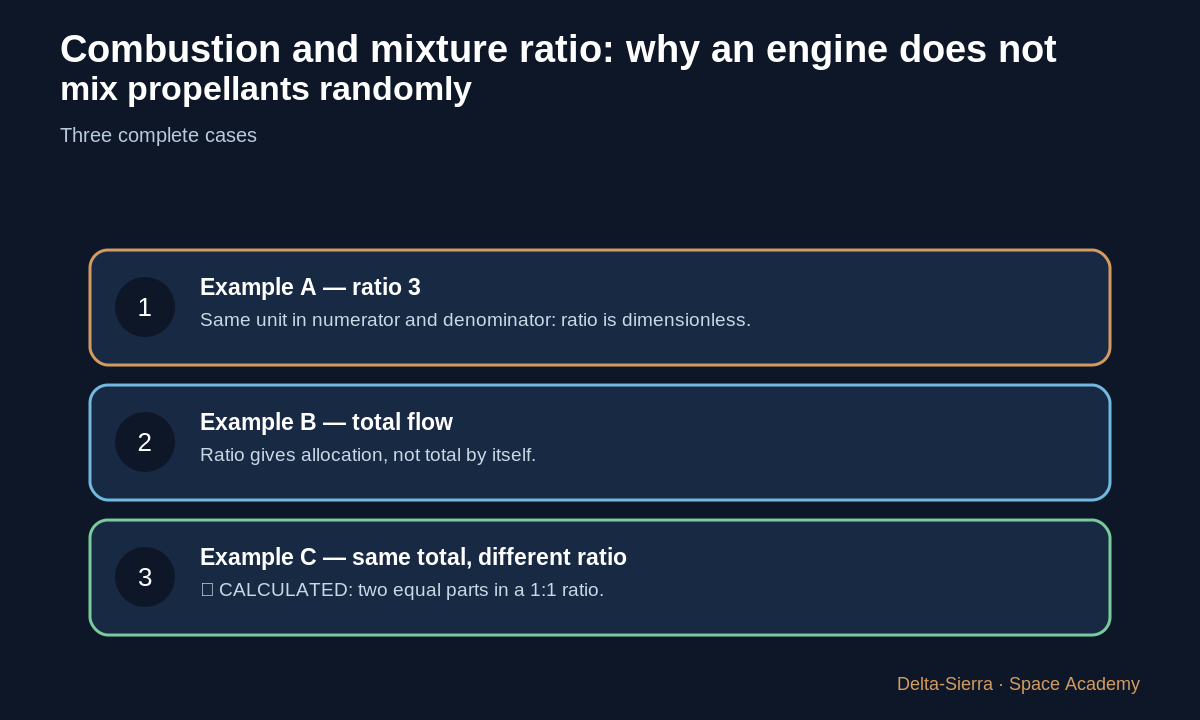
Example A — ratio 3
Oxidizer=30 kg/s, fuel=10 kg/s: O/F=30/10=3.
Same unit in numerator and denominator: ratio is dimensionless.
Example B — total flow
With O/F=3 and fuel 10 kg/s, total=30+10=40 kg/s.
Ratio gives allocation, not total by itself.
Example C — same total, different ratio
Total 40 kg/s and O/F=1 gives 20 kg/s + 20 kg/s. Changing ratio changes allocation even if total flow stays the same.
🧮 CALCULATED: two equal parts in a 1:1 ratio.
Inverse calculation
If total=40 kg/s and O/F=3, there are four parts: fuel=40/4=10 kg/s; oxidizer=30 kg/s.
Common trap and result check
Trap: presenting a generic mixture ratio as a real engine value without source, conditions, or definition.
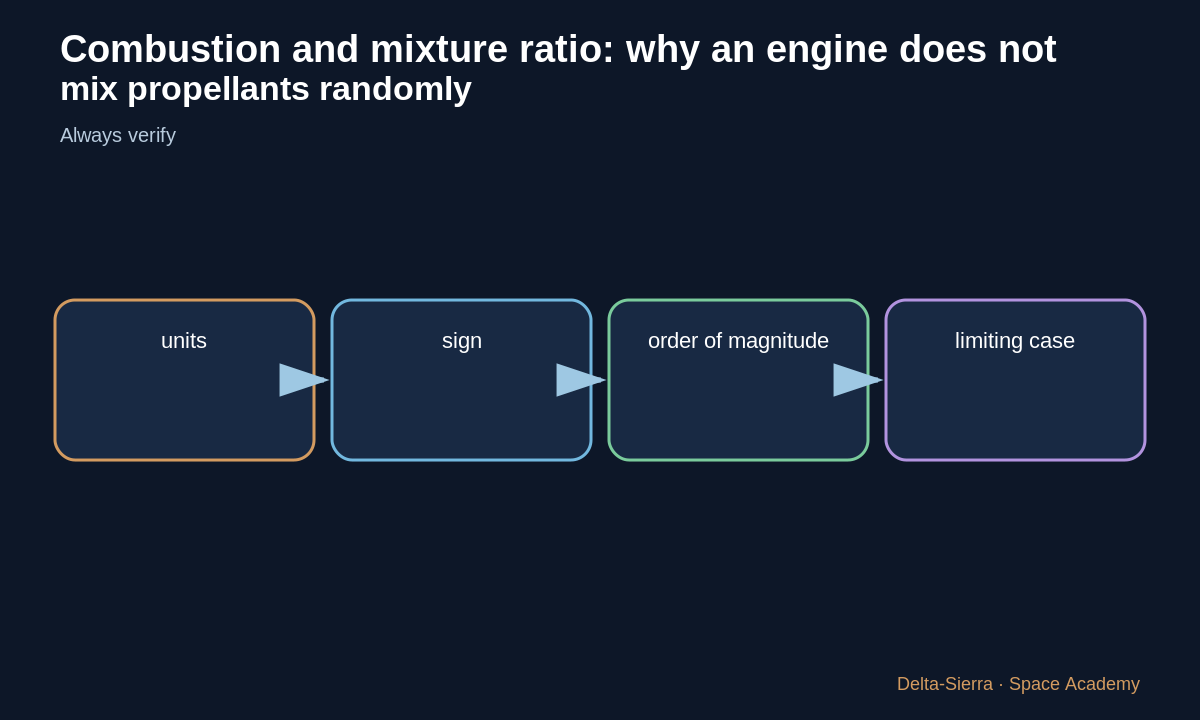
Check units, sign, order of magnitude, and consistency with a limiting case.
Exercises and answers
Restate
Explain in your own words what the equation connects.
Vary
Halve one input and predict the result before calculating.
Check
What independent check can you perform?