Course compass
Guiding question: How can extremely hot gas flow past a metal wall without destroying it?
1 — The physical question
How can extremely hot gas flow past a metal wall without destroying it?
We start from the concrete problem before notation. The goal is to understand what we seek, then why mathematics becomes useful.
2 — How to read the symbols and units
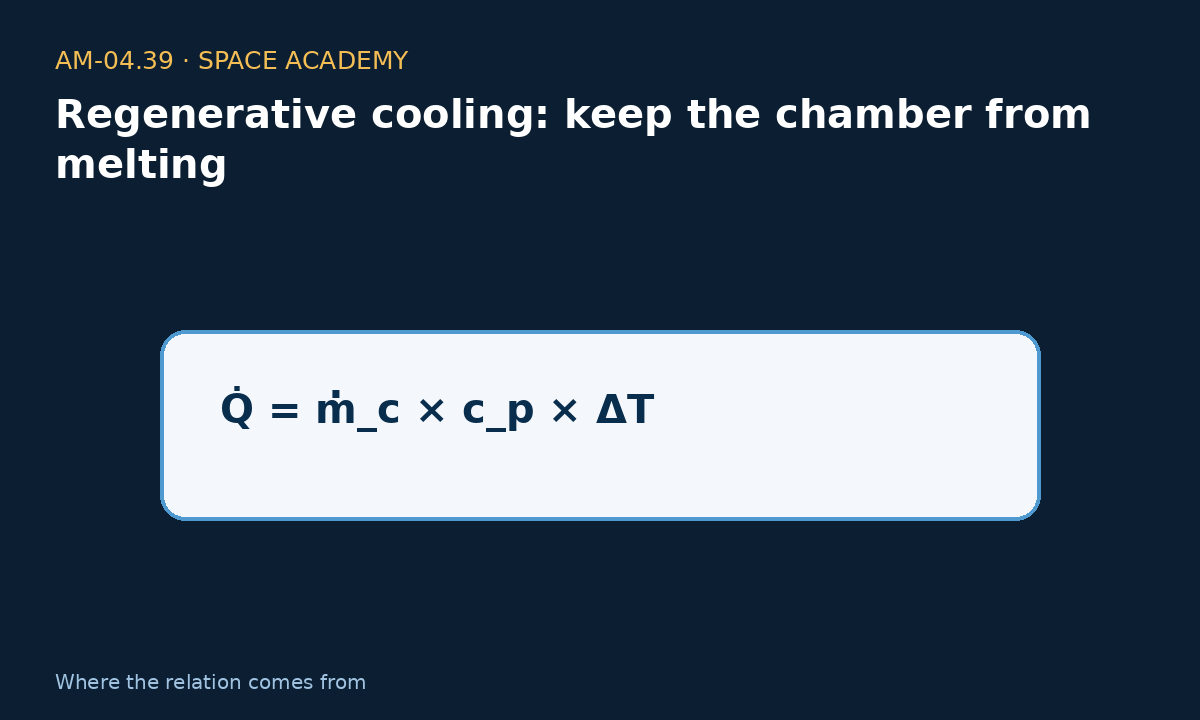
Q̇ = ṁ_c × c_p × ΔT. Read: “Q dot equals m dot c times c p times delta T”.
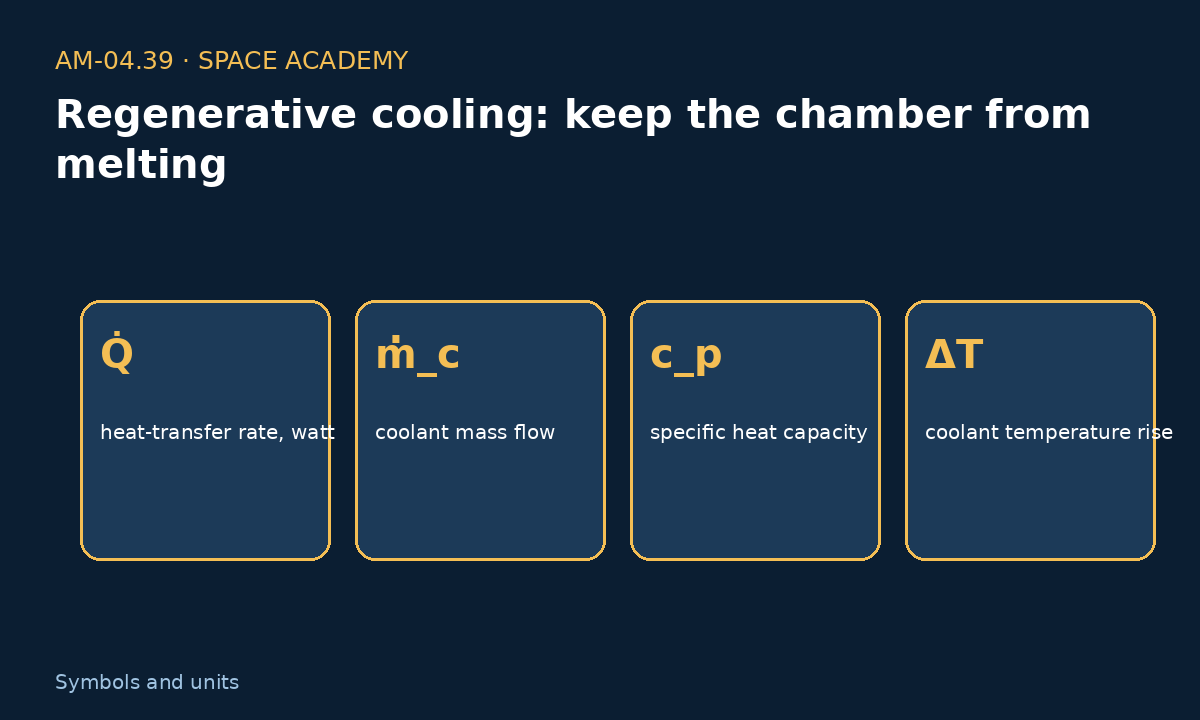
Q̇ — heat-transfer rate, watts ; ṁ_c — coolant mass flow ; c_p — specific heat capacity ; ΔT — coolant temperature rise
3 — Where does the relation come from?
Coolant flowing through wall channels carries energy away. In a simple calorimetric model, absorbed thermal power equals coolant mass flow × specific heat capacity × temperature rise.
Every number used below is explicitly treated as data, convention, learning assumption, or calculated result.
4 — A — Imaginary water
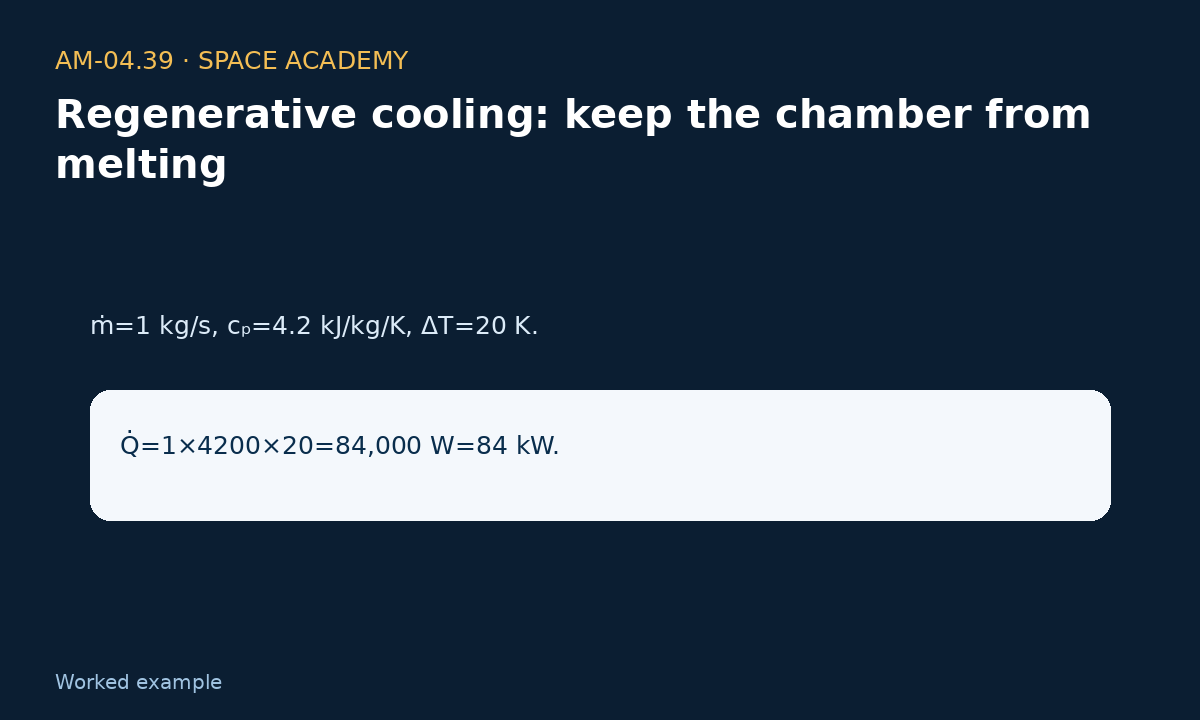
Where do the numbers come from? ṁ=1 kg/s, cₚ=4.2 kJ/kg/K, ΔT=20 K.
Step-by-step calculation: Q̇=1×4200×20=84,000 W=84 kW.
Learning example only: a real engine uses its actual propellant properties.
5 — B — Double flow
Where do the numbers come from? Same cₚ and ΔT, ṁ=2 kg/s.
Step-by-step calculation: Q̇=168 kW.
In this model, doubling flow doubles removed heat.
6 — C — Lower permitted temperature rise
Where do the numbers come from? ṁ=2 kg/s, but ΔT=10 K.
Step-by-step calculation: Q̇=84 kW.
Limiting temperature rise requires more flow for the same heat load.
7 — Sensitivity, inverse calculation, and sanity check
Change one input, predict the direction of the result, calculate, then check units, sign, order of magnitude, and limits.
Essential limit for Regenerative cooling: keep the chamber from melting: the displayed relation is a learning model. A real system adds detailed geometry, variable properties, sensors, uncertainty, transients, and testing.

8 — Why this matters in a mission
In a space mission, how can extremely hot gas flow past a metal wall without destroying it? The useful skill is not reciting the formula but knowing which data are needed, which are measured, and when the model becomes insufficient.
10 — Go deeper: from calculation to physical understanding
Why cool with the propellant itself?
A combustion chamber can receive an intense heat flux. In regenerative cooling, a cold propellant flows through passages near the wall before entering the engine cycle. It carries away heat that would otherwise raise metal temperature. “Regenerative” refers to making useful use of that heat transfer with a fluid already required by the engine.
Q̇=ṁc_pΔT is an energy balance
Mass flow × heat capacity × temperature rise estimates the thermal power absorbed by a fluid when the assumptions remain reasonable. If flow doubles, the same temperature rise can carry roughly twice the power. If the same thermal power must be removed with lower flow, the required temperature rise increases.
Fluid temperature is not wall temperature
The learning calculation for Q̇ does not directly give maximum metal temperature. Between hot gas and cold fluid lie convection, conduction, wall gradients, channel geometry, and properties that vary with temperature. This distinction prevents a simple energy balance from being mistaken for chamber dimensioning.
Cooling becomes a critical dependency itself
If coolant flow falls, thermal margin may disappear quickly. But increasing flow is not free: it interacts with pumps, pressures, mixture, and engine cycle. Safety analysis therefore treats cooling as a monitored function with sensors and shutdown criteria, not as a passive property of the metal.
9 — Exercises and answers
Challenge 1
ṁ=1 kg/s, cₚ=4.2 kJ/kg/K, ΔT=20 K.
Challenge 2
Same cₚ and ΔT, ṁ=2 kg/s.
Challenge 3
ṁ=2 kg/s, but ΔT=10 K.