Course compass
Question directrice : How do we calculate change per unit, read delta, interpret signs and distinguish average from local slope?
1 — Slope before mathematics: “how much does it rise while I move forward?”
Imagine a Mars rover at the foot of a ramp. It moves 10 metres horizontally and gains 2 metres of height. Before any formula, the question is simply: for each metre forward, how many metres does the rover rise?
A rate of change asks how much one quantity changes when another quantity changes by one unit. The same idea can describe water production per hour or temperature change per minute.
2 — Symbols: Δ, x, y and the slope formula
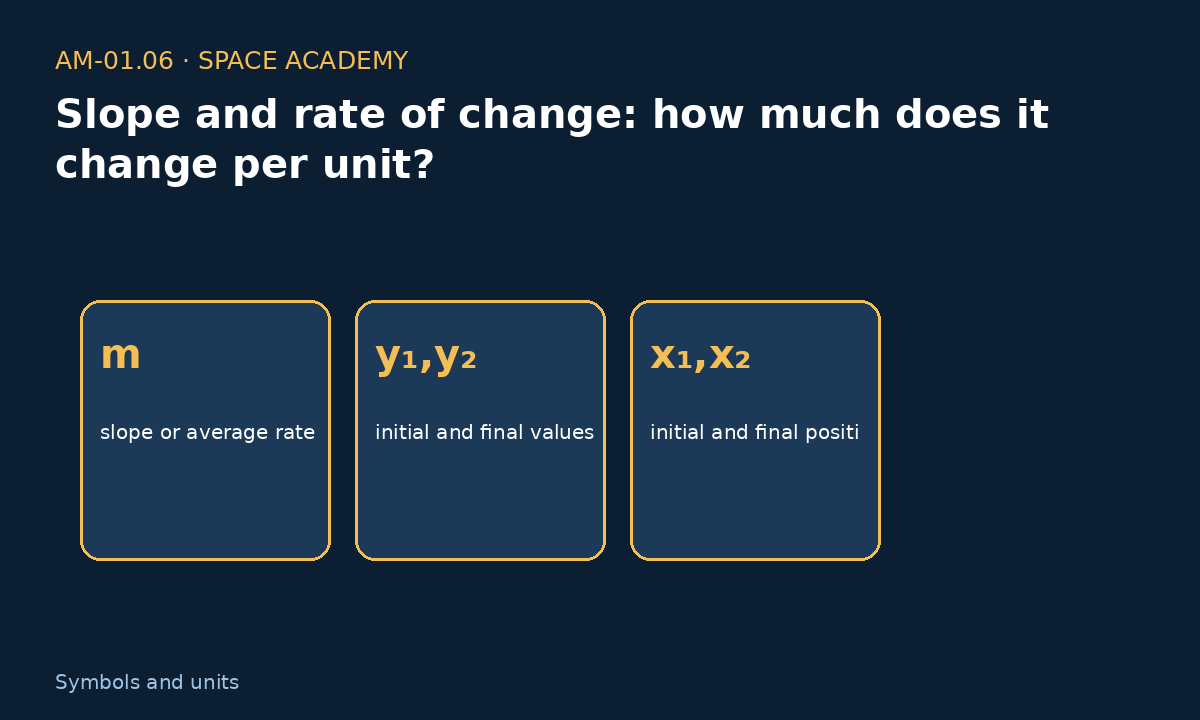
Δ is the Greek letter delta. It is pronounced “delta” and here means “change in”. Thus Δx is “delta x” and Δy is “delta y”.
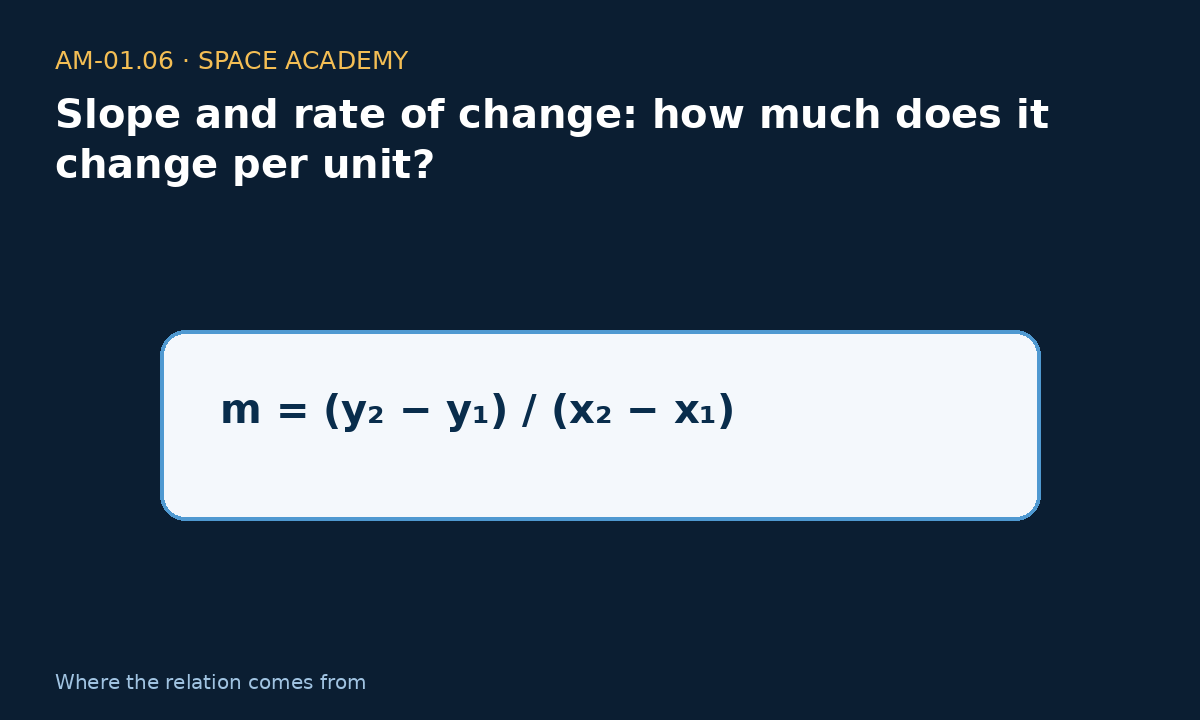
Read it as: “slope equals change in y divided by change in x.”
Because we want the change in y for one unit of change in x. Division spreads the total change across the x-units.
3 — Complete example 1: rover climbing a slope
The rover advances 40 m horizontally and gains 12 m of height.
Δx = 40 m
Δy = 12 m
slope = 12 ÷ 40 = 0.30
0.30 means 0.30 m of height for every 1 m of horizontal advance. Because both quantities are in metres, the units cancel.
As a percentage: 0.30 × 100 = 30%.
4 — Two more examples: water production and cooling
Example 2 — Water production
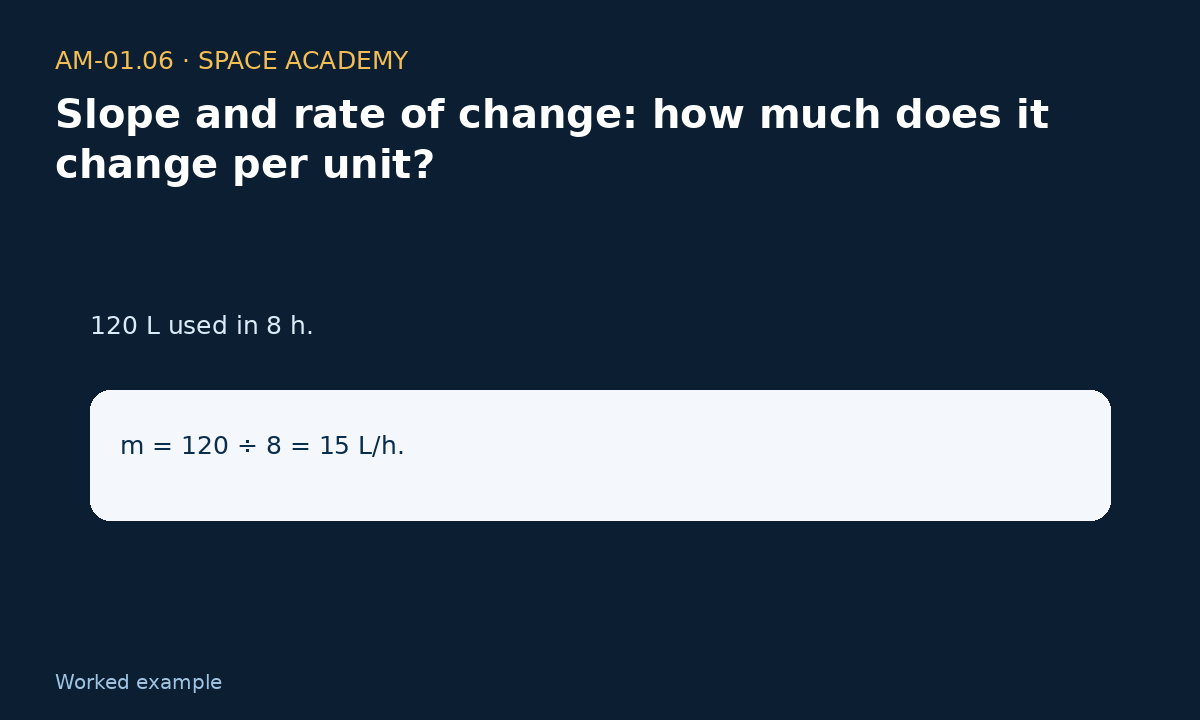
A processing unit produces 18 kg of water in 6 h.
mass change = 18 kg
time change = 6 h
average rate = 18 ÷ 6 = 3 kg/h
kg/h is read “kilograms per hour”.
Example 3 — Cooling
A box cools from 50 °C to 38 °C in 4 min.
ΔT = 38 − 50 = −12 °C
Δt = 4 min
average rate = −12 ÷ 4 = −3 °C/min
The negative sign means the temperature is decreasing.
5 — Sign and starting point tell the story
Positive slope means y increases as x increases; negative slope means y decreases; zero slope means no change over the interval.
Always compute a change as final value − initial value. If a rover goes from x=15 m to x=55 m, Δx=55−15=40 m, not 55 m.
6 — Average and local slope
Δy/Δx gives an average slope between two points. A real ramp can be gentle first and steeper later. The average does not describe every location.
Move the two measurement points closer together and you approach the local slope. That idea leads to the derivative in AM-01.11.
7 — What to type on a calculator
For the rover: 12 ÷ 40 = gives 0.3. Then × 100 = gives 30%.
For cooling: 38 − 50 = gives −12, then ÷ 4 = gives −3.
The calculator cannot tell whether you chose the correct quantities or units.
8 — What to remember
- A slope or rate compares two changes.
- Δ is read “delta” and means “change in”.
- Change = final − initial.
- We divide to find change “per unit”.
- Units explain what the rate measures.
- An average slope can hide local changes.
Exercises and answers
Exercise 1
A rover advances 25 m and rises 5 m. Average slope?
Exercise 2
A tank gains 48 kg of water in 8 h. Average rate?
Exercise 3
Temperature rises from 20 °C to 32 °C in 6 min. Average rate?