Course compass
Guiding question: How do you read a percentage without losing the reference quantity and associated losses?
Markers: 📏 MEASURED · 📐 CONVENTION · 🧮 CALCULATED · 🎓 TEACHING ASSUMPTION · ⚠️ APPROXIMATION
- understand the concept
- do a simple calculation
- explain every symbol
- check a result
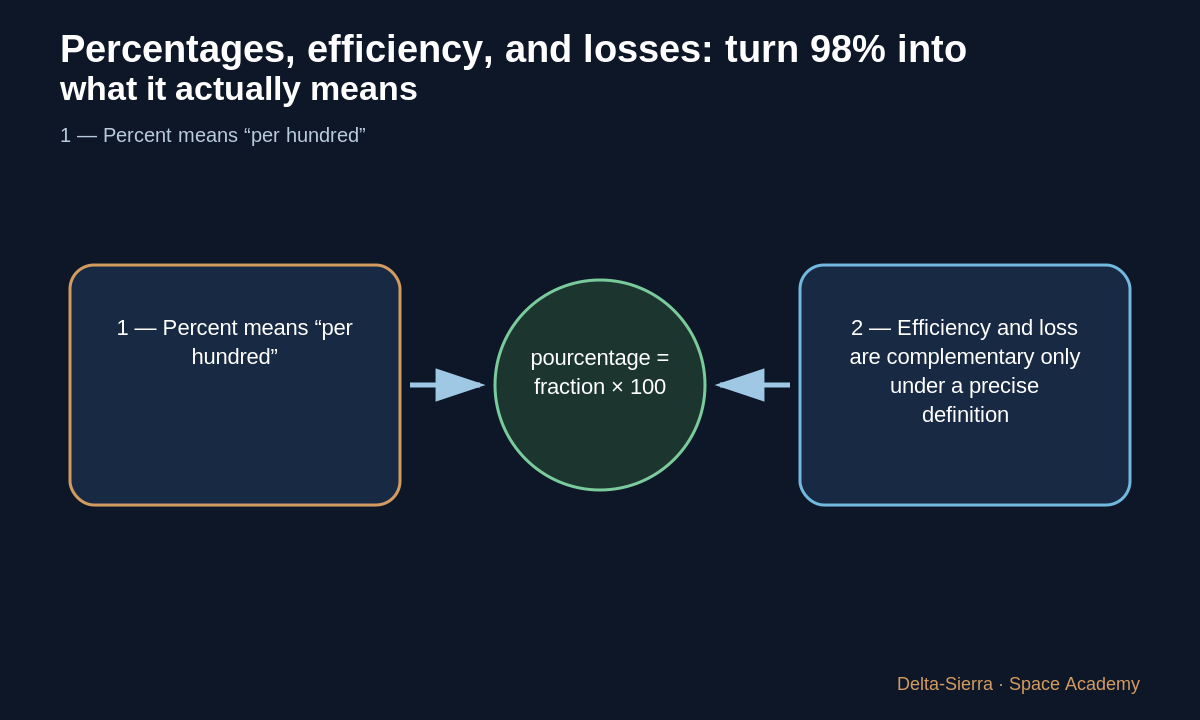
1 — Percent means “per hundred”
25% means 25/100 = 0.25. To apply 25% to a quantity, multiply by 0.25.
Always name the reference quantity.
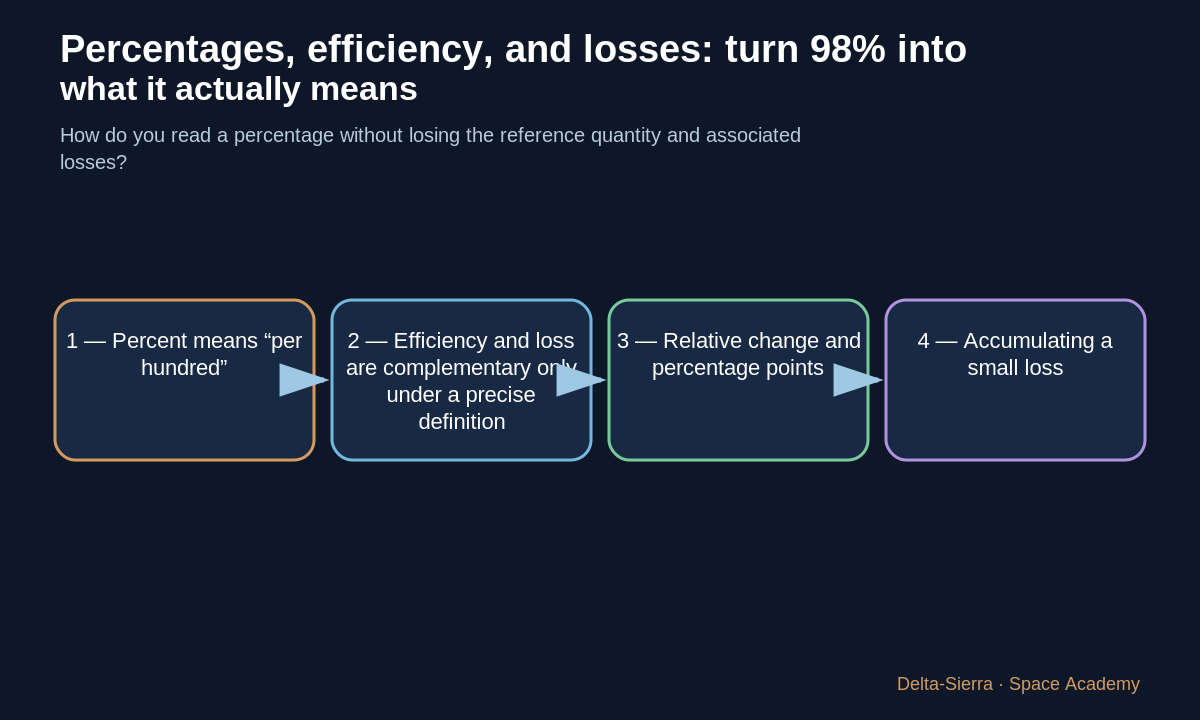
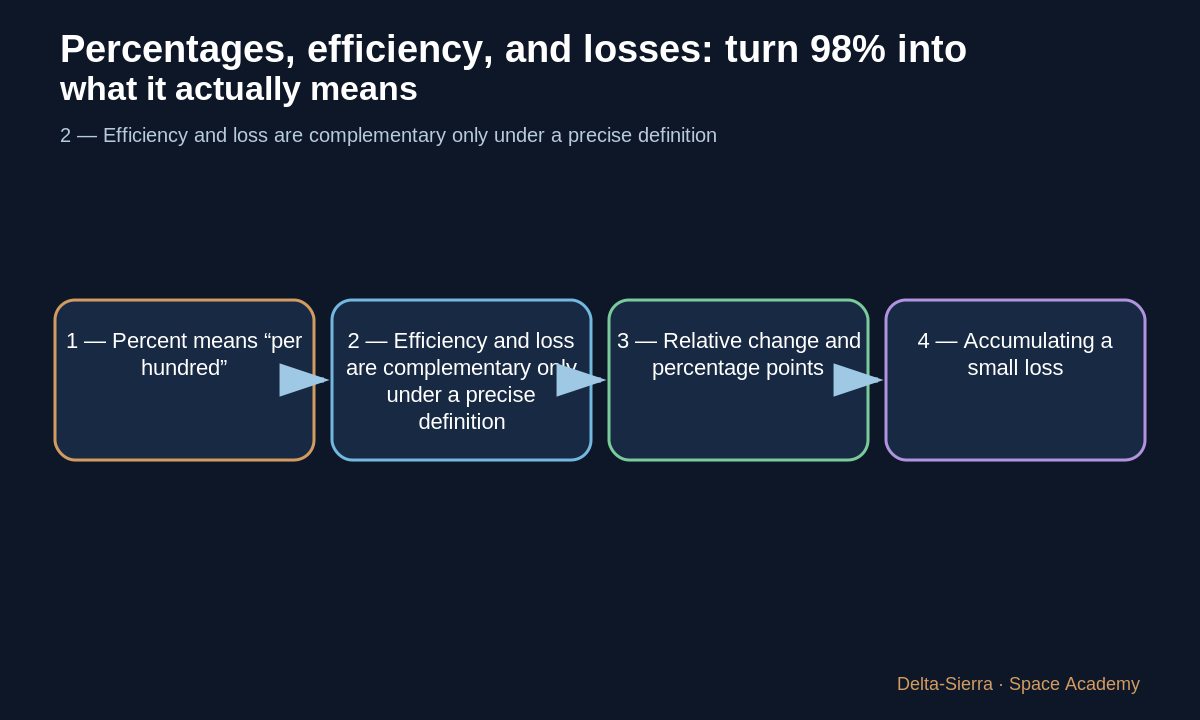
2 — Efficiency and loss are complementary only under a precise definition
If every non-useful output is classified as loss, 98% useful leaves 2%. But real systems can have several outputs, recycles, or intermediate storage.
Define the boundary before writing 100−98.
3 — Relative change and percentage points
Moving from 90% to 95% is +5 percentage points, but a relative increase of 5/90 ≈ 5.56%.
Those statements are not equivalent.
4 — Accumulating a small loss
A 2% daily loss on a renewed flow does not automatically mean “2% after one year.” Replacement, recycling, and accumulation matter.
Percentages always need a system model.
Three complete examples: change one assumption to understand
Before each calculation, identify where every number comes from and whether it is measured, conventional, assumed, or calculated.
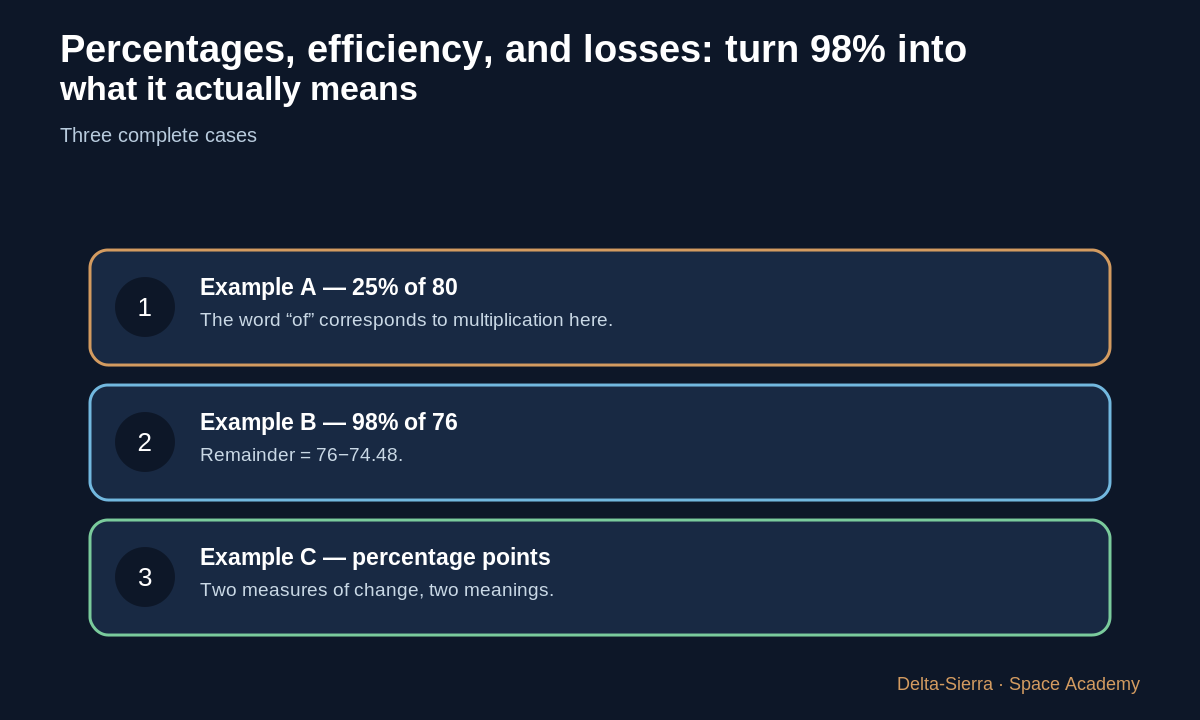
Example A — 25% of 80
0.25 × 80 = 20.
The word “of” corresponds to multiplication here.
Example B — 98% of 76
0.98 × 76 = 74.48. Remainder 1.52.
Remainder = 76−74.48.
Example C — percentage points
90% → 95% = +5 points. Relative change = (95−90)/90 ≈ 0.0556 = 5.56%.
Two measures of change, two meanings.
Inverse calculation
If 74.48 represents 98% of the original flow, original = 74.48/0.98 = 76.
Common trap and result check
Trap: saying “+5%” when you mean “+5 percentage points.”
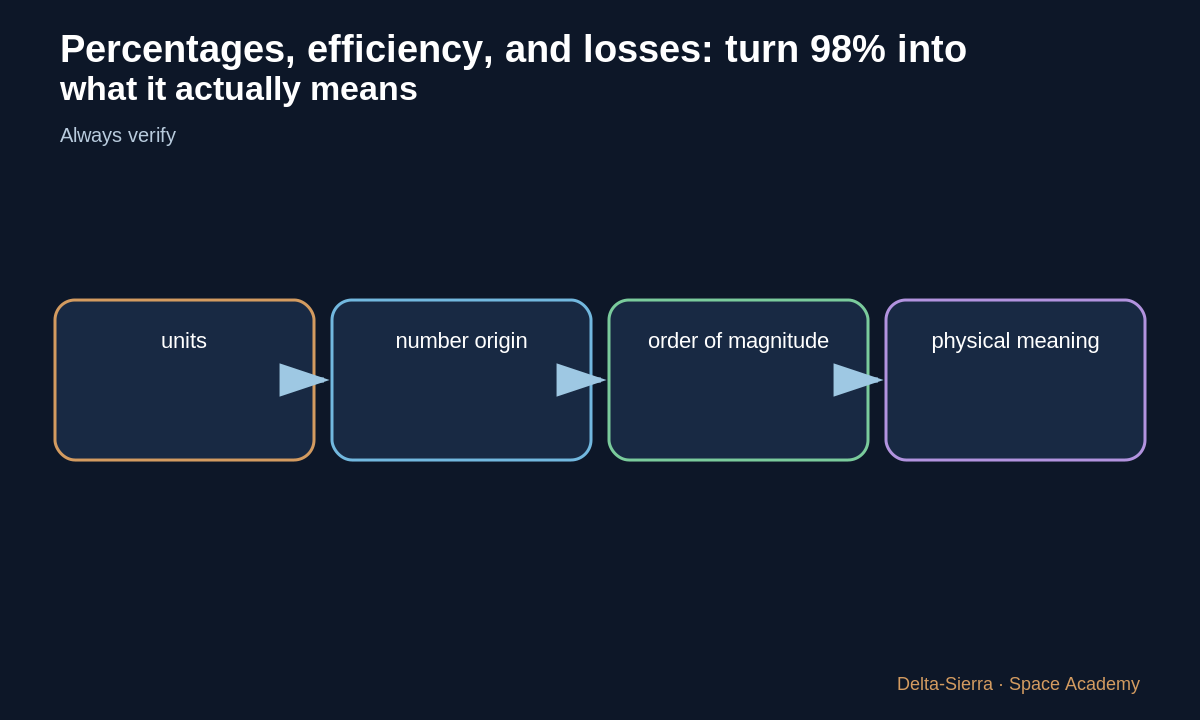
Always check units, order of magnitude, and physical meaning before accepting a result.
Exercises and answers
Understand
Explain the relationship in your own words.
Change an assumption
Modify one input and predict the direction of change before calculating.
Verify
Name two checks after a calculation.