Course compass
Goal: understand every word, symbol, unit and operation before using the formula.
Method: concrete situation → vocabulary → step-by-step calculation → three examples → check.
1 — A force is a push or a pull
Rover wheels push, a cable pulls, the ground resists and gravity pulls downward. Each interaction can be represented by a force arrow with magnitude and direction.
2 — Newton: the unit of force
N is read “newton”. One newton is the net force that gives 1 kg an acceleration of 1 m/s².
3 — Several forces combine into a net force
Engine force: +500 N east. Resistance: −200 N west.
F net = 500 − 200 = +300 N
4 — Newton’s first law: zero net force means no change in velocity
In the ideal model, an object at rest stays at rest and an object in uniform straight-line motion keeps that motion when net force is zero.
This is inertia.
5 — Newton’s second law: F = m × a
Read: “F equals m times a”.
A 150 kg rover has a net force of 300 N east.
a = F ÷ m = 300 ÷ 150 = 2 m/s²
6 — Newton’s third law: action and reaction
If A exerts a force on B, B exerts an equal-magnitude opposite force on A. Rocket exhaust pushed backward pushes the engine forward.
7 — Three guided examples
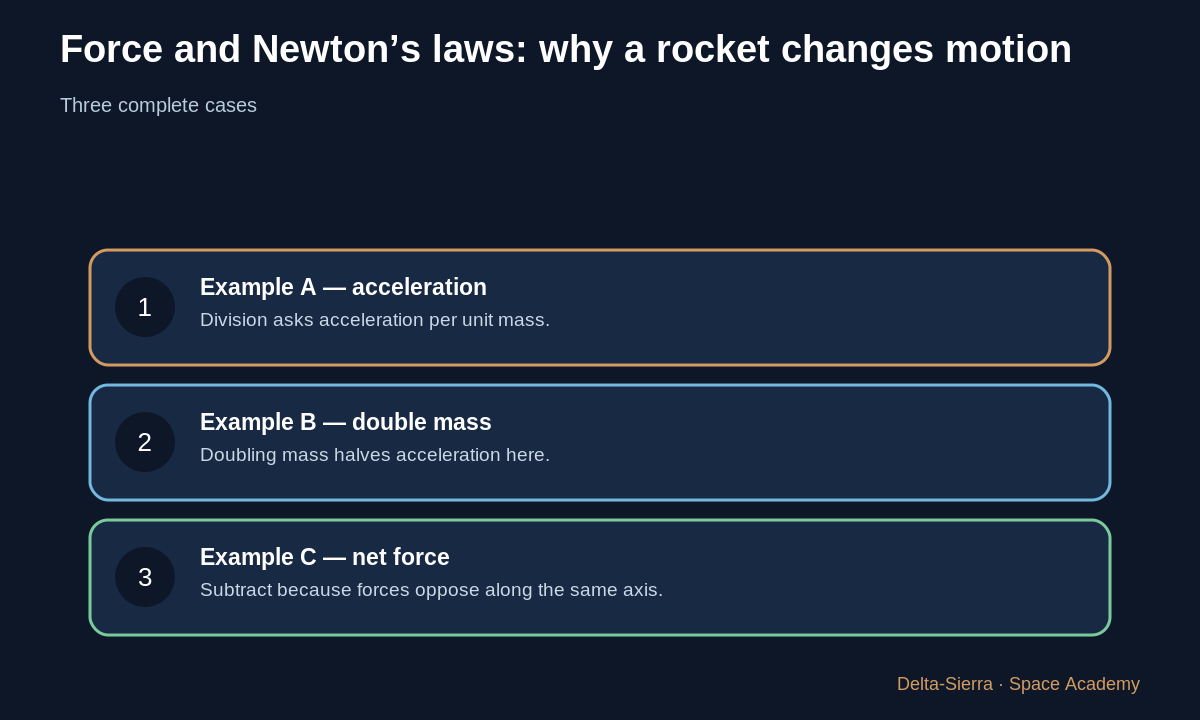
Example A — Accelerate a rover
400 N ÷ 200 kg = 2 m/s²Example B — Balanced forces
+600 N − 600 N = 0 NExample C — Required force
1,000 kg at 0.5 m/s².
F = 1,000 × 0.5 = 500 N8 — Practical method: draw forces before writing equations
- choose the object;
- draw all forces acting on it;
- choose positive direction;
- sum components;
- apply F = m × a.
Beginner checkpoint — choose one object before adding forces
A force diagram becomes much easier when you first decide which single object is being studied. For a rover, include only forces acting on the rover: wheel-ground interaction, resistance, gravity, ground reaction and any cable force. Do not mix in the force that the rover exerts on the ground as though it also acted on the rover; that belongs to the action-reaction partner.
After choosing the object, select a positive direction and give each force a sign. Add the signed forces to obtain the net force. Only then use F = m × a. This order matters because Newton’s second law uses the net force, not one convenient force selected from the diagram.
9 — Corrected exercises
Exercise 1
800 N east and 300 N west?
Exercise 2
250 kg accelerating at 1.2 m/s²?