Course compass
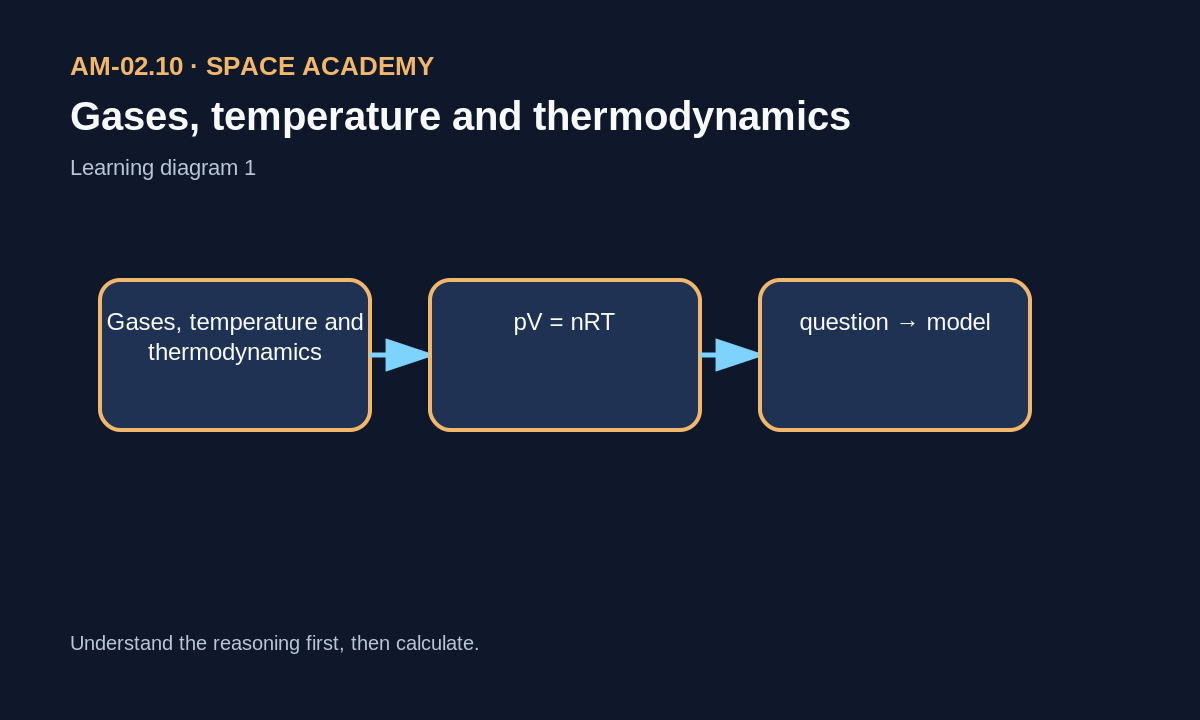
Guiding question : Why does heating, compressing or expanding a gas change pressure, temperature and available energy together?
1 — The physical question
Why does heating, compressing or expanding a gas change pressure, temperature and available energy together?
2 — Symbols, reading and units
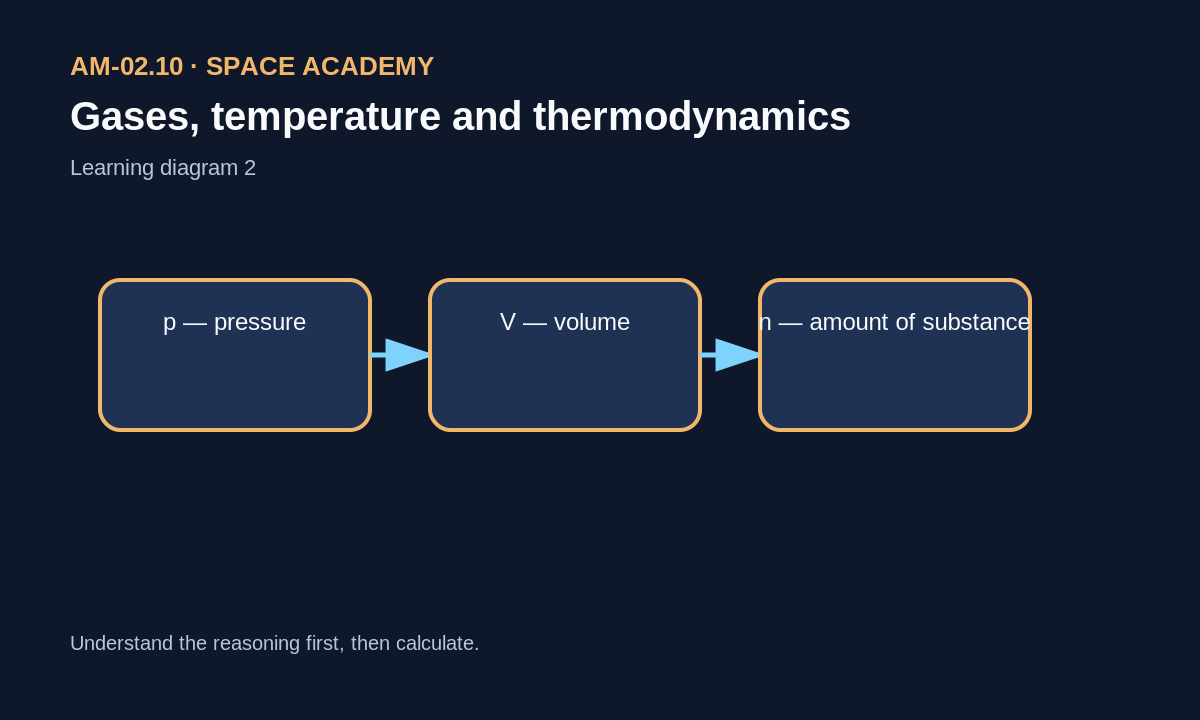
p — pressure; V — volume; n — amount of substance; R — ideal-gas constant; T — absolute temperature in kelvins.
3 — Where does the relation come from?
The ideal-gas equation links four macroscopic quantities. It does not describe every real gas in every condition, but it is an excellent first model for understanding why pressure, volume, amount of substance and temperature cannot be varied independently.
4 — A — Double temperature at fixed volume
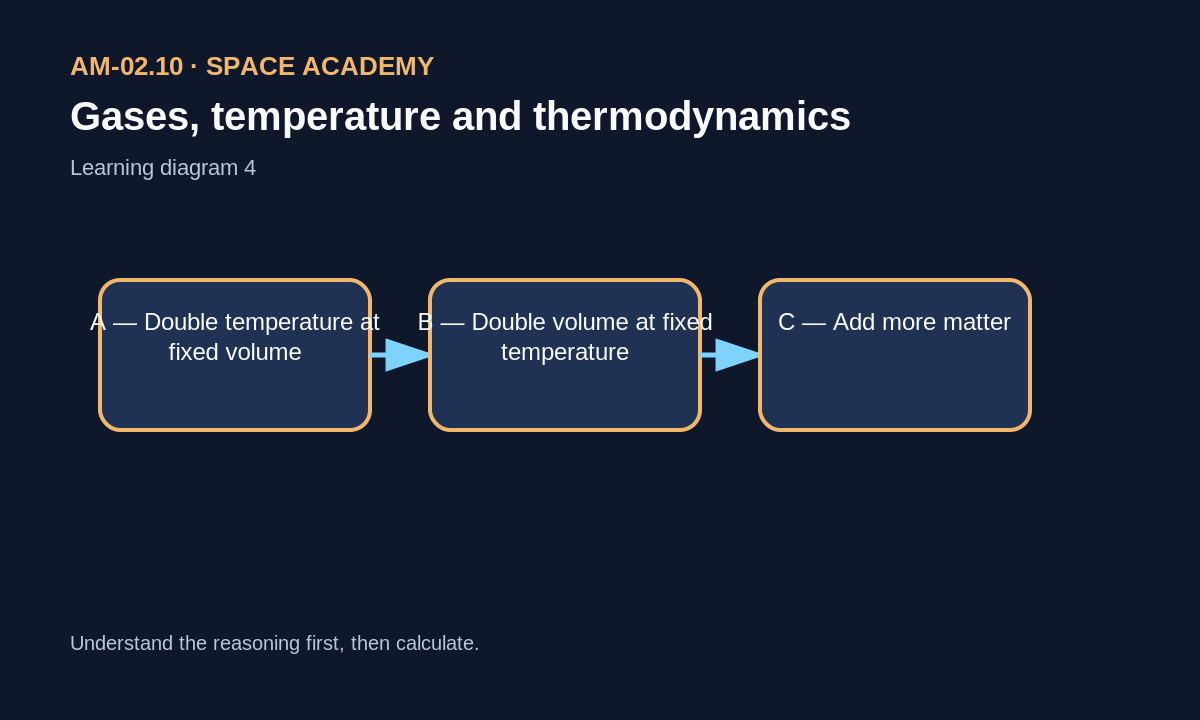
If n and V stay constant, p is proportional to T. Raising 300 K to 600 K doubles pressure in the ideal model.
5 — B — Double volume at fixed temperature
With n and T fixed, doubling V halves p. The same molecules occupy more space.
6 — C — Add more matter
At fixed V and T, doubling n doubles p. Adding gas to a closed volume therefore raises ideal pressure proportionally.
7 — Go deeper
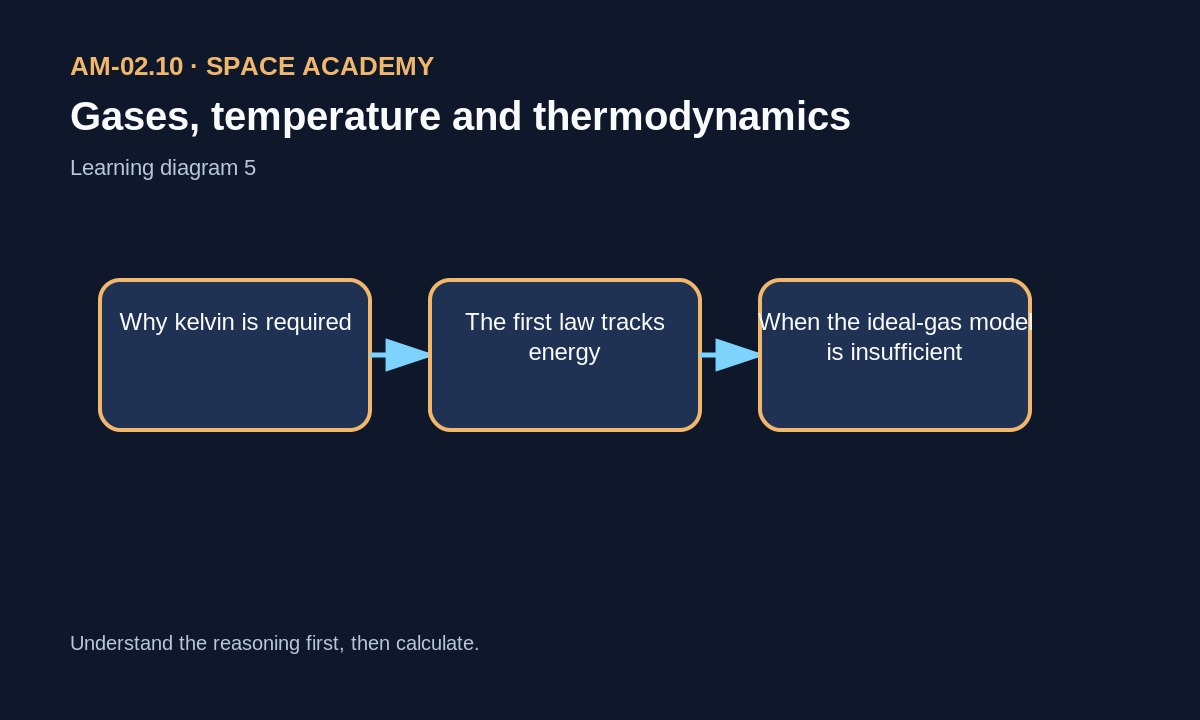
Why kelvin is required
Thermodynamic ratios need a scale whose zero corresponds to the absolute thermal limit. “Doubling” 20 °C to 40 °C is not a physical doubling of temperature; 300 K to 600 K is.
The first law tracks energy
Thermodynamics is not only pV=nRT. The first law relates change in internal energy, heat received and work exchanged. Heating, compression, expansion and flow in an engine are therefore different parts of one energy accounting problem.
When the ideal-gas model is insufficient
At high pressure, very low temperature or near phase changes, molecular interactions matter. Real cryogenic systems then use fluid property data far more accurate than the ideal model.
State variables and process history
Pressure, volume and temperature describe the macroscopic state of a gas, but the path between two states matters for energy exchange. Two processes can reach the same final state while transferring different amounts of heat and work. Thermodynamics therefore separates the state of the system from the process used to change it.
Why absolute temperature is required
In pV=nRT, T is measured in kelvins. The Kelvin zero corresponds to the thermodynamic zero, making temperature ratios physically meaningful. Using degrees Celsius directly in a proportional calculation can be absurd because 0 °C does not mean zero molecular thermal motion.
Compression and expansion change energy
Compressing a gas requires work and tends to raise temperature if heat cannot escape quickly. Expansion can convert internal energy into work or flow velocity. This is central to turbomachinery and nozzles: pressure, temperature and velocity are different parts of the same energy accounting.
The first law requires an energy balance
Energy does not vanish. In a simplified closed system, internal-energy change is related to heat received and work exchanged. Sign conventions differ between textbooks, so a course should state the chosen convention before manipulating an equation rather than asking learners to memorize a sign without context.
Why real fluids depart from the ideal-gas model
pV=nRT is an excellent first mental model, but at high pressure, near liquefaction or at very low temperature, molecular interactions matter. Cryogenic rocket systems therefore rely on real-fluid property data and more detailed models when accurate design calculations are required.
8 — Exercises and answers
Challenge 1
A — Double temperature at fixed volume: repeat the reasoning with the stated values, then explain the physical meaning of the result.
Challenge 2
B — Double volume at fixed temperature: repeat the reasoning with the stated values, then explain the physical meaning of the result.
Challenge 3
C — Add more matter: repeat the reasoning with the stated values, then explain the physical meaning of the result.