Course compass
Question directrice : How do you read a unit, understand what it measures and decide whether a result makes sense?
Markers: 📏 MEASURED · 📐 CONVENTION · 🧮 CALCULATED · 🎓 TEACHING ASSUMPTION · ⚠️ APPROXIMATION
- understand the concept
- do a simple calculation
- explain every symbol
- check a result
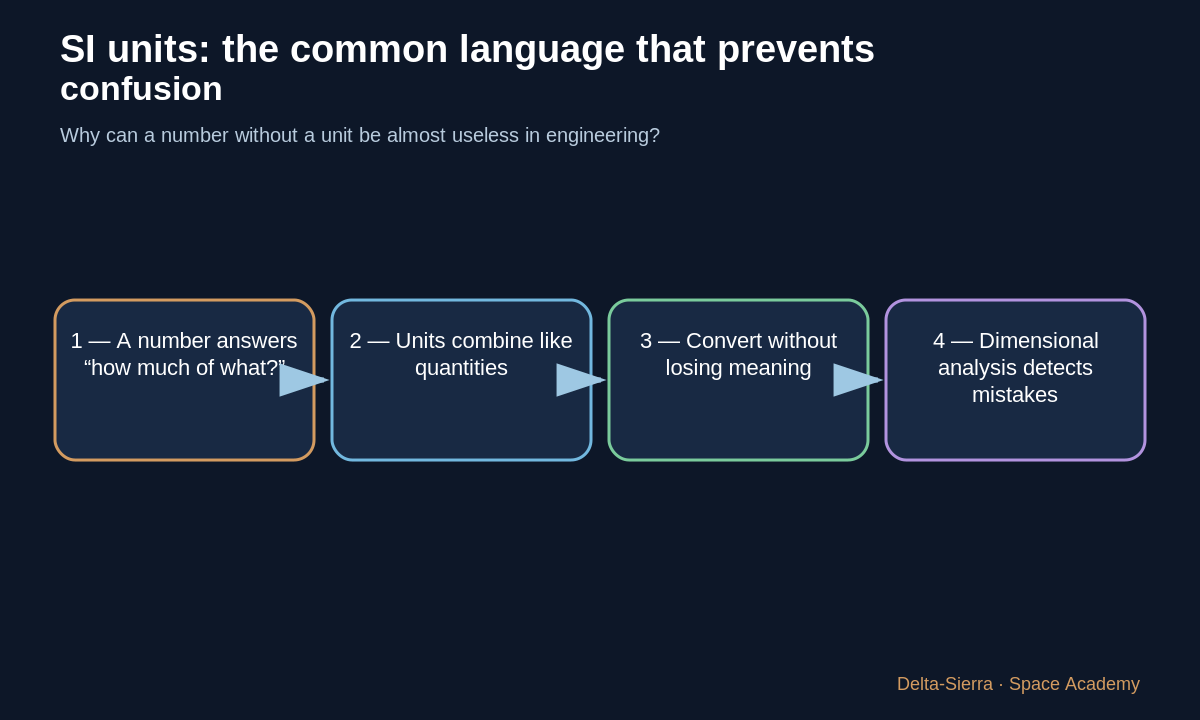
1 — A number always answers “how much of what?”
A number by itself can be almost useless in engineering. “500” does not tell us whether it means 500 grams, kilograms, seconds, watts or square metres.
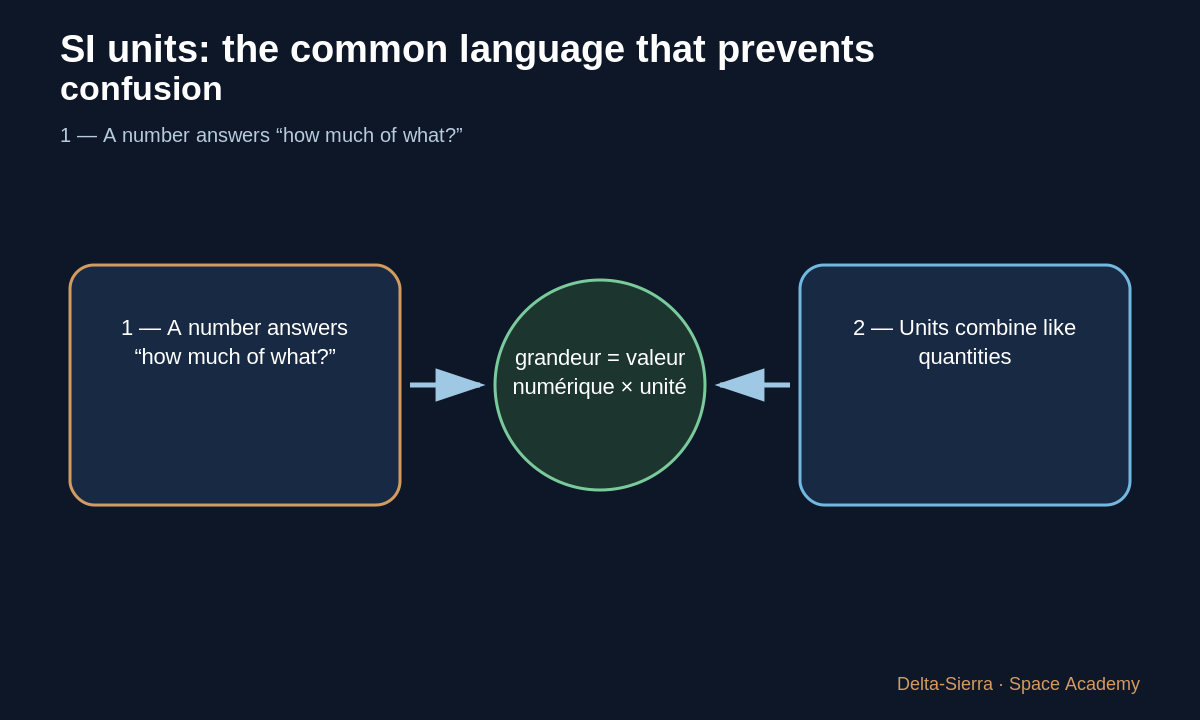
A quantity combines a value with what is being measured. A unit provides the common reference used to express that quantity.
Simple example
“The tank contains 120” is incomplete. “The tank contains 120 kg of propellant” already tells us what the number means.
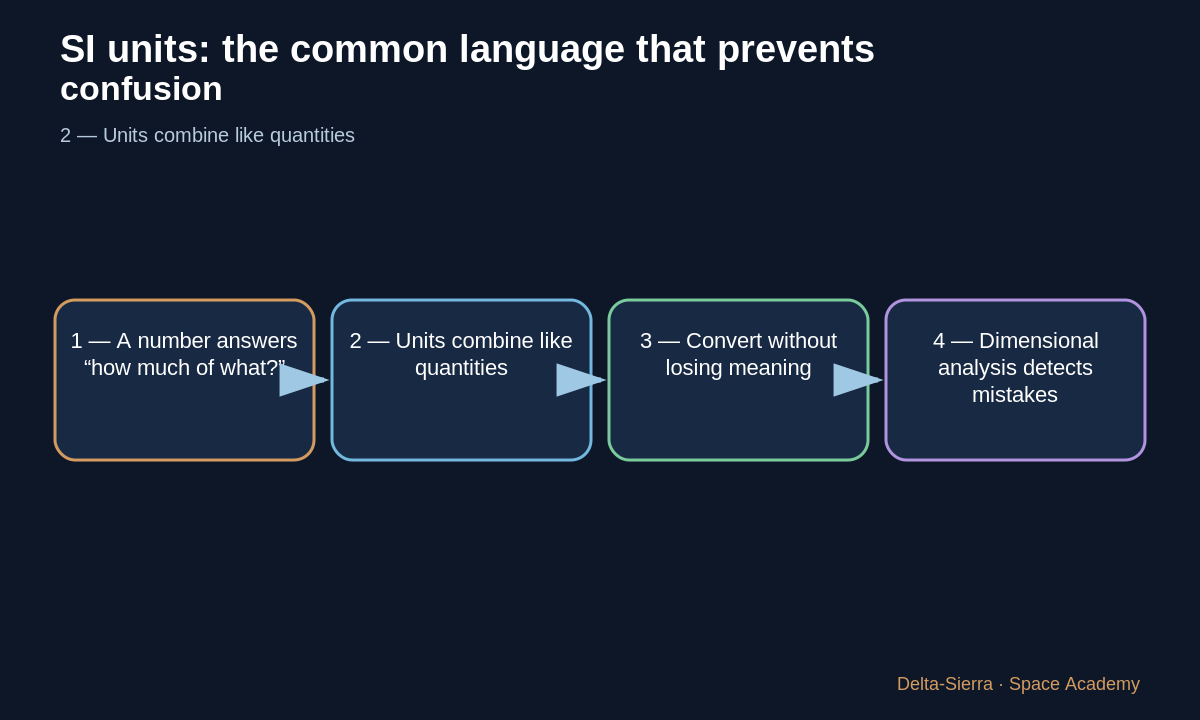
2 — Read symbols aloud
- kg: kilogram, unit of mass;
- s: second, unit of time;
- m: metre, unit of length;
- m²: square metre, unit of area;
- m/s: metres per second;
- m/s²: metres per second squared, unit of acceleration;
- N: newton, unit of force;
- W: watt, unit of power.
The International System of Units, or SI, organizes base and derived units. NIST notes, for example, that area is expressed in m², speed in m/s and acceleration in m/s².
3 — kg/s: how much propellant per second?
kg/s is read “kilograms per second”. It answers: how many kilograms pass or are consumed during one second?
Space example — 120 kg of propellant in 4 seconds
Imagine a rocket engine consuming 120 kg of propellant over 4 seconds.
Propellant is the material consumed by the engine to produce thrust; depending on the engine, it may include a fuel and an oxidizer.
To find the average for one second, divide the total mass by the total time: 120 ÷ 4 = 30.
Result: 30 kg/s.
After 1 s: about 30 kg; after 2 s: 60 kg; after 3 s: 90 kg; after 4 s: 120 kg.
The technical term is mass flow rate: mass passing per unit time.
Calculator
Type 120 ÷ 4 =. The result 30 carries the unit kg/s because a mass in kilograms was divided by a time in seconds.
4 — N/kg: force per kilogram
N/kg is read “newtons per kilogram”.
A newton, symbol N, is the SI unit of force. At beginner level, a force is a push or pull that can change an object’s motion.
Mars surface gravity is about 3.71 m/s². The same gravitational field strength may also be expressed numerically as about 3.71 N/kg: each kilogram experiences about 3.71 newtons of weight near the surface.
Example — A 10 kg tool on Mars
Tool mass: 10 kg. Teaching value for gravitational field: 3.71 N/kg.
10 × 3.71 = 37.1.
Result: about 37.1 N of weight.
Mass versus weight: the tool remains 10 kg; its weight is a force that depends on gravity and is measured in newtons.
5 — W/m²: power per area
W/m² is read “watts per square metre”.
The watt, W, is the SI unit of power. A square metre, m², is the area of a square one metre on each side.
Example — A 2 m² solar panel
Suppose, in a deliberately simplified teaching model, that a 2 m² panel receives a uniform 500 W/m².
Each square metre receives 500 W. Two square metres receive 500 × 2 = 1,000.
Result: 1,000 W incident on the 2 m² panel in this simplified model.
This is not automatically the electrical output. Efficiency, angle, temperature and other losses would still matter.
6 — Convert without losing meaning
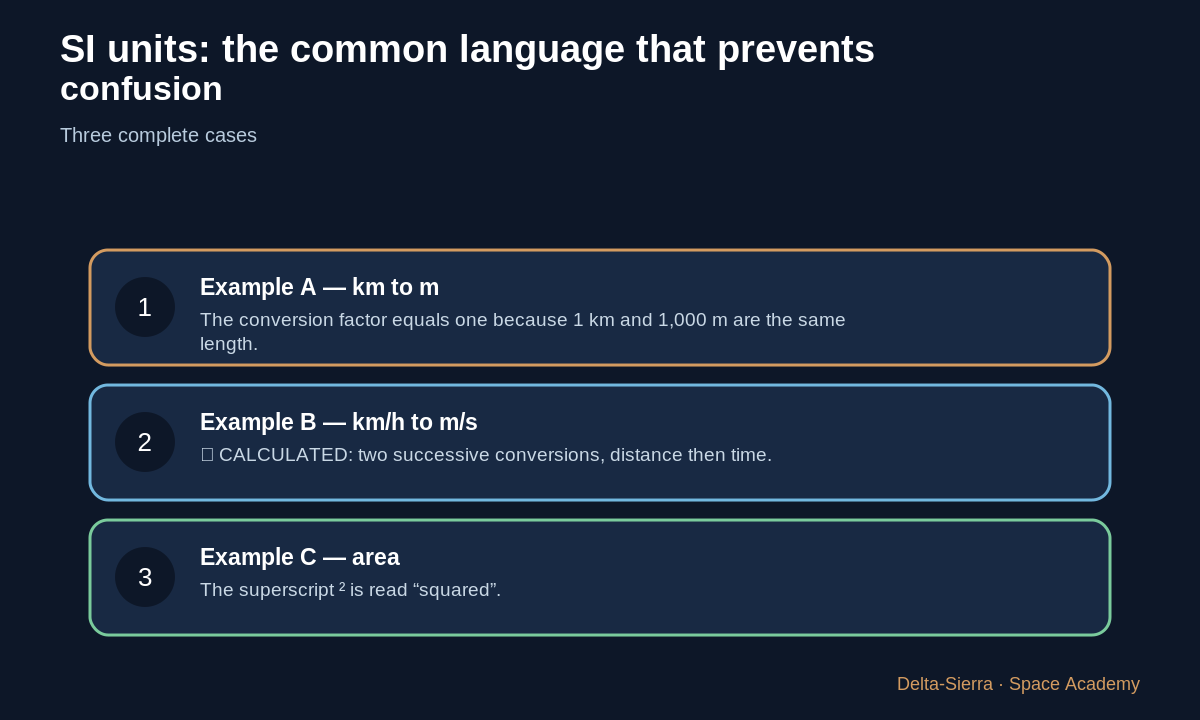
2.5 km to metres
1 km = 1,000 m, so 2.5 km = 2,500 m.
72 km/h to m/s
72 km = 72,000 m and 1 h = 3,600 s. Therefore 72,000 ÷ 3,600 = 20 m/s.
Area
0.50 m × 0.40 m = 0.20 m². Units multiply too: m × m = m².
7 — Dimensional analysis detects errors
Units act like a second calculation line. If a formula claims to produce a speed but ends in kilograms, something is wrong.
Mass divided by time produces kg/s. Power divided by area produces W/m². Force divided by mass produces N/kg.
Three complete examples: one unit, one question, one result
Example A — Mass flow
90 kg in 3 s: 90 ÷ 3 = 30 kg/s.
Example B — Weight on Mars
5 kg × 3.71 N/kg = about 18.55 N.
Example C — Power per area
3 m² receiving 400 W/m² gives 1,200 W incident in a uniform simplified model.
Common traps and checks
- Writing a number without its unit.
- Confusing mass in kg with force in N.
- Reading m² without understanding that it means square metres.
- Confusing 120 kg over four seconds with 120 kg/s.
- Multiplying quantities without checking what happens to their units.
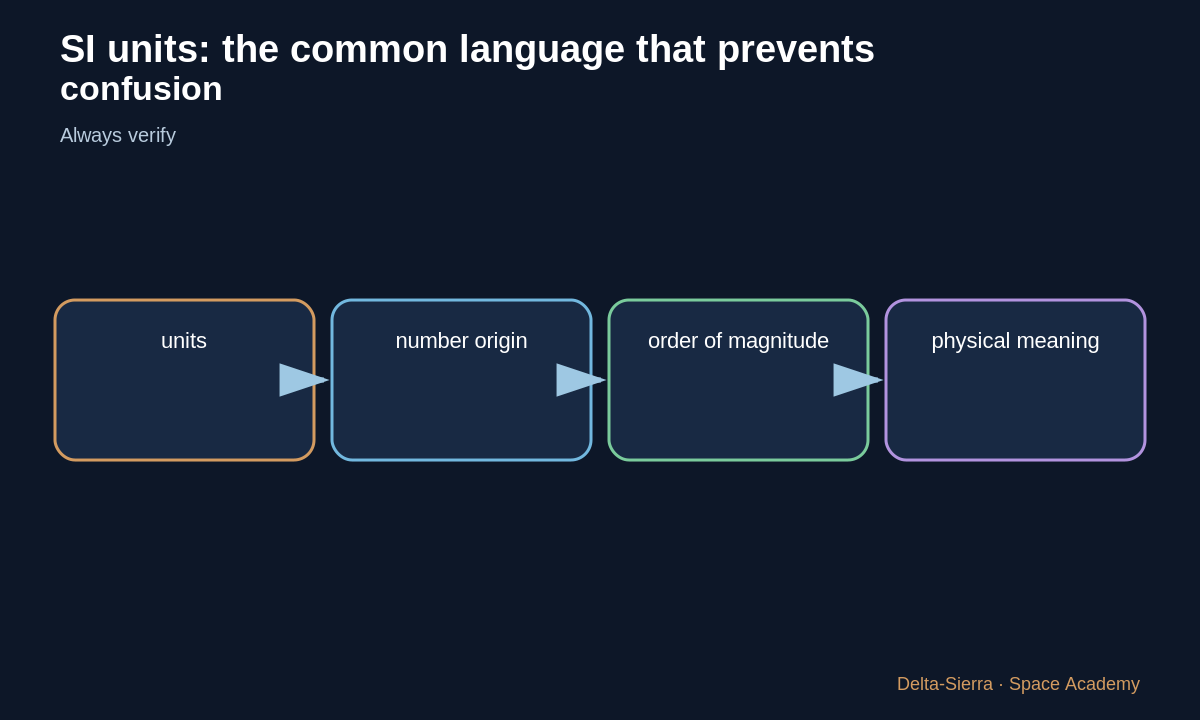
Control question: does the result answer the original question with the correct unit?
Exercises and solutions
Exercise 1 — Read the unit
How do you read kg/s, N/kg and W/m²?
Exercise 2 — Flow rate
An engine consumes 200 kg in 5 s. What is the average mass flow rate?
Exercise 3 — Solar panel
A 1.5 m² panel receives a uniform 600 W/m². What incident power does it receive in this model?